×
Request Free Sample ×

Kindly complete the form below to receive a free sample of this Report

* Please use a valid business email

Leading companies partner with us for data-driven Insights

clients tt-cursor
Hero Background

UK Percutaneous Coronary Intervention Market

ID: MRFR/HC/43692-HCR
200 Pages
Rahul Gotadki
February 2026

UK Percutaneous Coronary Intervention Market Research Report By Product Type (Coronary Stents, Ballon Catheters, Coronary Guidewires, Guiding Catheters, Guiding Sheaths, Diagnostic Catheters, Crossing Catheters, Inflation Device, Guidance System, Peripheral Thrombectomy System, Embolic Protection System, Accessories), By Vascular Access (Radial, Femoral) and By End User (Hospitals Clinics, Ambulatory Surgical Centers, Others) -Forecast to 2035

Share:
Download PDF ×

We do not share your information with anyone. However, we may send you emails based on your report interest from time to time. You may contact us at any time to opt-out.

UK Percutaneous Coronary Intervention Market Infographic
Purchase Options

UK Percutaneous Coronary Intervention Market Summary

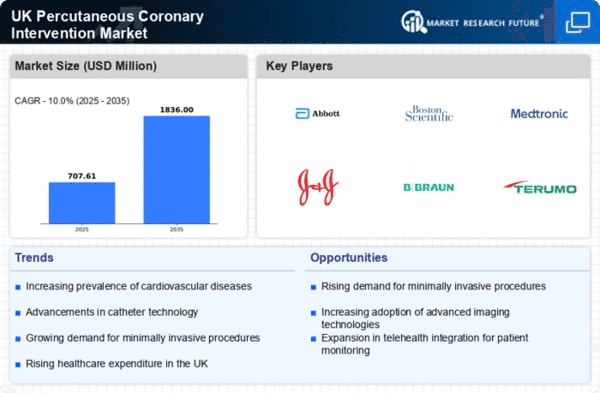
As per Market Research Future analysis, the UK percutaneous coronary-intervention market Size was estimated at 643.28 USD Million in 2024. The UK percutaneous coronary-intervention market is projected to grow from 707.61 USD Million in 2025 to 1836.0 USD Million by 2035, exhibiting a compound annual growth rate (CAGR) of 10% during the forecast period 2025 - 2035

Key Market Trends & Highlights

The UK percutaneous coronary-intervention market is poised for growth driven by technological advancements and increasing healthcare demands.

  • Technological advancements are enhancing the efficacy and safety of percutaneous coronary interventions.
  • The rising incidence of cardiovascular diseases is propelling the demand for interventional procedures across the UK.
  • The largest segment in this market is the coronary stenting segment, while the fastest-growing segment is the balloon angioplasty segment.
  • Key market drivers include the increasing demand for minimally invasive procedures and the aging population, which heightens health risks.

Market Size & Forecast

2024 Market Size 643.28 (USD Million)
2035 Market Size 1836.0 (USD Million)
CAGR (2025 - 2035) 10.0%

Major Players

Abbott Laboratories (US), Boston Scientific Corporation (US), Medtronic plc (IE), Johnson & Johnson (US), B. Braun Melsungen AG (DE), Terumo Corporation (JP), Cardinal Health, Inc. (US), Siemens Healthineers AG (DE)

Our Impact
Enabled $4.3B Revenue Impact for Fortune 500 and Leading Multinationals
Partnering with 2000+ Global Organizations Each Year
30K+ Citations by Top-Tier Firms in the Industry

UK Percutaneous Coronary Intervention Market Trends

The percutaneous coronary-intervention market is currently experiencing notable developments, driven by advancements in technology and an increasing prevalence of cardiovascular diseases. The integration of innovative devices and techniques is enhancing procedural outcomes, thereby improving patient safety and recovery times. Furthermore, the growing awareness of heart health among the population is prompting more individuals to seek preventive measures and treatments, which in turn fuels demand for these interventions. As healthcare systems evolve, the focus on minimally invasive procedures is becoming more pronounced, leading to a shift in clinical practices and patient preferences. In addition, regulatory bodies in the UK are actively promoting the adoption of new technologies within the percutaneous coronary-intervention market. This regulatory support is likely to facilitate faster approvals for novel devices, encouraging manufacturers to invest in research and development. The collaboration between healthcare providers and technology firms is also fostering innovation, which may lead to the introduction of more effective solutions for coronary artery disease. Overall, the landscape appears to be shifting towards a more patient-centric approach, with an emphasis on improving outcomes and enhancing the quality of care.

Technological Advancements

The percutaneous coronary-intervention market is witnessing rapid technological advancements that enhance procedural efficiency and patient outcomes. Innovations such as drug-eluting stents and bioresorbable scaffolds are becoming increasingly prevalent, offering improved performance and reduced complications. These developments are likely to attract more healthcare providers to adopt these advanced solutions, thereby expanding the market.

Rising Incidence of Cardiovascular Diseases

The increasing incidence of cardiovascular diseases in the UK is significantly impacting the percutaneous coronary-intervention market. As more individuals are diagnosed with conditions requiring intervention, the demand for these procedures is expected to rise. This trend underscores the necessity for healthcare systems to adapt and provide adequate resources to meet the growing needs of patients.

Regulatory Support for Innovation

Regulatory bodies in the UK are actively supporting innovation within the percutaneous coronary-intervention market. By streamlining approval processes for new devices and techniques, these organizations are encouraging manufacturers to develop cutting-edge solutions. This regulatory environment is likely to foster a culture of innovation, ultimately benefiting patients through improved treatment options.

UK Percutaneous Coronary Intervention Market Drivers

Rising Healthcare Expenditure

The increase in healthcare expenditure in the UK is a significant driver for the percutaneous coronary-intervention market. With the government and private sectors investing more in healthcare infrastructure and technology, there is a greater availability of resources for advanced cardiac care. Recent reports indicate that healthcare spending in the UK has risen by approximately 5% annually, with a substantial portion allocated to cardiovascular treatments. This financial commitment is likely to enhance the accessibility and quality of percutaneous interventions, thereby stimulating market growth. As funding continues to improve, the percutaneous coronary-intervention market is expected to benefit from enhanced service delivery and patient outcomes.

Growing Focus on Preventive Healthcare

The increasing emphasis on preventive healthcare measures in the UK is influencing the percutaneous coronary-intervention market. As healthcare policies shift towards prevention and early intervention, there is a heightened awareness of cardiovascular health among the population. Initiatives aimed at educating the public about heart health and the importance of regular screenings are likely to lead to earlier diagnoses and timely interventions. This proactive approach may result in a higher demand for percutaneous procedures as patients seek to manage their cardiovascular risks effectively. Consequently, the percutaneous coronary-intervention market is poised for growth as preventive strategies become more ingrained in healthcare practices.

Advancements in Medical Imaging Technologies

Innovations in medical imaging technologies are playing a pivotal role in enhancing the precision and outcomes of percutaneous coronary interventions. Techniques such as intravascular ultrasound (IVUS) and optical coherence tomography (OCT) are becoming increasingly integrated into clinical practice in the UK. These advancements allow for better visualization of coronary anatomy, leading to improved decision-making during procedures. The integration of these technologies is expected to drive growth in the percutaneous coronary-intervention market, as they contribute to higher success rates and reduced complications. As healthcare providers continue to invest in advanced imaging solutions, the market is likely to witness a significant uptick in procedural volumes.

Aging Population and Associated Health Risks

The demographic shift towards an aging population in the UK is a critical driver for the percutaneous coronary-intervention market. As individuals age, the prevalence of cardiovascular diseases tends to increase, necessitating more frequent interventions. Current statistics indicate that approximately 40% of individuals over 65 years old experience some form of cardiovascular condition. This demographic trend suggests a sustained demand for percutaneous interventions, as healthcare systems adapt to the needs of older patients. Consequently, the percutaneous coronary-intervention market is likely to expand in response to the growing number of elderly patients requiring treatment, thereby shaping the future landscape of cardiovascular care.

Increasing Demand for Minimally Invasive Procedures

The percutaneous coronary-intervention market is experiencing a notable shift towards minimally invasive procedures, driven by patient preference for reduced recovery times and lower complication rates. As healthcare providers in the UK increasingly adopt these techniques, the market is projected to grow significantly. According to recent data, minimally invasive cardiac procedures have shown a 30% increase in adoption over the past five years. This trend is likely to continue as advancements in technology enhance the safety and efficacy of these interventions. Furthermore, the growing awareness among patients regarding the benefits of such procedures is expected to further fuel demand, thereby positively impacting the percutaneous coronary-intervention market.


Market Segment Insights

By Product Type: Coronary Stents (Largest) vs. Balloon Catheters (Fastest-Growing)

In the UK percutaneous coronary-intervention market, the product type segment is primarily dominated by Coronary Stents, which holds the largest market share among the different devices used for cardiac interventions. Following closely are Balloon Catheters, regarded for their significant contributions to the segment. Other critical players include Coronary Guidewires and Guiding Catheters, which also maintain a notable presence in the market landscape. The growth trends for this segment are primarily driven by advancements in technology and the increasing prevalence of cardiovascular diseases. Balloon Catheters have emerged as the fastest-growing product type, attributed to innovations enhancing their efficiency and performance. Moreover, the rising adoption of minimally invasive procedures is bolstering the demand for various devices within this segment, including Accessories and Diagnostic Catheters, further indicating positive market dynamics leading toward sustained growth.

Coronary Stents (Dominant) vs. Balloon Catheters (Emerging)

Coronary Stents maintain their status as the dominant product in the UK percutaneous coronary-intervention market due to their proven efficacy in treating coronary artery diseases and their high rate of utilization in interventional procedures. These devices are critical in providing structural support within coronary arteries post-angioplasty. In contrast, Balloon Catheters, as an emerging segment, are rapidly gaining traction due to their innovative designs and capabilities in achieving effective vessel dilation. Their growing prevalence in minimally invasive surgeries highlights their importance, as they are often used in tandem with stent placement procedures. The ongoing advancements in both product types continue to shape the competitive landscape, catering to various patient needs and enhancing procedural outcomes.

By Vascular Access: Radial (Largest) vs. Femoral (Fastest-Growing)

In the UK percutaneous coronary-intervention market, the radial access approach holds the largest market share, widely preferred by cardiologists for its benefits including reduced complications and faster recovery. In contrast, femoral access, historically the primary approach, is witnessing a significant increase in adoption, particularly among specific patient demographics that require more complex interventions. The growth of the femoral segment can be attributed to advancements in medical technology and increasing awareness of its efficacy in challenging cases. Furthermore, robust clinical outcomes coupled with favorable patient experiences are driving its rise. As procedural innovations continue to emerge, both segments are expected to see sustained engagement, but the femoral approach may accelerate as practitioners adapt to evolving best practices.

Radial (Dominant) vs. Femoral (Emerging)

The radial access method is established as the dominant choice in the UK percutaneous coronary-intervention market. Its advantages include lower rates of bleeding and major vascular complications, leading to quicker patient recovery and discharge times. Clinically backed studies highlight its safety and efficacy, solidifying its role in routine interventions. On the other hand, femoral access, once the standard, is evolving into an emerging option, particularly in complex cases. Despite some residual bias towards radial access, innovations and enhanced training for femoral procedures are catalyzing its resurgence. Overall, while radial access maintains a stronghold, femoral access is carving a niche that could expand significantly in the future.
By End User: Hospitals & Clinics (Largest) vs. Ambulatory Surgical Centers (Fastest-Growing)

In the UK percutaneous coronary-intervention market, Hospitals & Clinics dominate the end-user segment, accounting for a significant share of the market. This segment benefits from the high volume of cardiovascular procedures performed in these facilities, reflecting their established infrastructure and advanced technologies. Ambulatory Surgical Centers, although smaller in share, are rapidly gaining traction due to their efficiency and lower costs for patients, thereby increasing their appeal. Growth trends in this market segment are driven by various factors, including the rising prevalence of cardiovascular diseases and the growing preference for minimally invasive procedures. Innovations in medical technologies and an increasing number of healthcare policies promoting outpatient services are further propelling the expansion of Ambulatory Surgical Centers. This shift is indicative of a broader trend toward value-based care, which emphasizes patient outcomes and cost efficiency in the delivery of healthcare services.

Hospitals & Clinics (Dominant) vs. Ambulatory Surgical Centers (Emerging)

Hospitals & Clinics in the UK percutaneous coronary-intervention market represent the dominant end-user segment due to their comprehensive facilities and expertise in managing complex cardiovascular conditions. These institutions are equipped with state-of-the-art technologies and multidisciplinary teams, ensuring high-quality patient care. Ambulatory Surgical Centers, on the other hand, are emerging as a viable alternative, particularly for less complicated procedures, offering patients convenience and reduced wait times. As the healthcare landscape evolves, these centers are becoming increasingly important, catering to a growing consumer base that seeks effective treatment options without the need for overnight stays.

Get more detailed insights about UK Percutaneous Coronary Intervention Market

Key Players and Competitive Insights

The percutaneous coronary-intervention market is characterized by a dynamic competitive landscape, driven by technological advancements, increasing prevalence of cardiovascular diseases, and a growing aging population. Key players such as Abbott Laboratories (US), Boston Scientific Corporation (US), and Medtronic plc (IE) are at the forefront, each adopting distinct strategies to enhance their market presence. Abbott Laboratories (US) focuses on innovation, particularly in drug-eluting stents, while Boston Scientific Corporation (US) emphasizes strategic partnerships to expand its product portfolio. Medtronic plc (IE) is actively pursuing regional expansion, particularly in emerging markets, which collectively shapes a competitive environment that is both collaborative and competitive.In terms of business tactics, companies are increasingly localizing manufacturing to reduce costs and enhance supply chain efficiency. The market structure appears moderately fragmented, with several key players exerting influence over various segments. This fragmentation allows for niche players to thrive, while larger corporations leverage their resources to optimize operations and capture market share.

In October Boston Scientific Corporation (US) announced a strategic partnership with a leading UK-based healthcare provider to enhance access to its innovative coronary intervention technologies. This collaboration is expected to facilitate the integration of advanced medical devices into routine clinical practice, thereby improving patient outcomes and solidifying Boston Scientific's position in the UK market. The strategic importance of this partnership lies in its potential to streamline distribution channels and enhance brand visibility.

In September Medtronic plc (IE) launched a new generation of bioresorbable stents, which are designed to improve patient recovery times and reduce long-term complications. This product introduction not only reflects Medtronic's commitment to innovation but also positions the company to capture a growing segment of the market that prioritizes minimally invasive solutions. The launch is likely to enhance Medtronic's competitive edge by addressing evolving patient needs and preferences.

In August Abbott Laboratories (US) expanded its manufacturing capabilities in the UK, investing approximately £50 million to enhance production efficiency for its coronary intervention devices. This investment underscores Abbott's commitment to meeting increasing demand while ensuring high-quality standards. The strategic importance of this expansion is multifaceted, as it not only boosts local employment but also strengthens Abbott's supply chain resilience in a competitive market.

As of November current trends in the percutaneous coronary-intervention market include a pronounced shift towards digitalization, sustainability, and the integration of artificial intelligence (AI) in clinical practices. Strategic alliances are increasingly shaping the landscape, enabling companies to pool resources and expertise. Looking ahead, competitive differentiation is likely to evolve from traditional price-based competition to a focus on innovation, technological advancements, and supply chain reliability, as companies strive to meet the complex demands of healthcare providers and patients alike.

Key Companies in the UK Percutaneous Coronary Intervention Market include

Industry Developments

Recent developments in the UK Percutaneous Coronary Intervention Market have highlighted significant advancements and trends among leading players, particularly B. Braun Melsungen AG, Terumo Corporation, Abbott Laboratories, and Medtronic.

With an ongoing emphasis on enhancing patient outcomes, there is a notable uptick in the adoption of innovative PCI technologies, influenced by the increasing prevalence of coronary artery diseases in the UK. In terms of market valuation, growth has been propelled by rising investments in research and development, with major companies actively seeking to expand their product portfolios.

Notable mergers and acquisitions in the sector include Abbott Laboratories acquiring a strategic interest in a cardiac device startup in September 2021, enhancing their capabilities in catheter technologies. Similarly, Boston Scientific's acquisition of a smaller tech firm specializing in advanced imaging for PCI in May 2022 has strengthened their competitive positioning.

In the last couple of years, initiatives from the UK’s National Health Service to improve the efficiency of PCI procedures are shaping the landscape by promoting best practices and technology integration. These developments signify a dynamic market climate responding to both technological advances and healthcare demands within the UK.

Future Outlook

UK Percutaneous Coronary Intervention Market Future Outlook

The Percutaneous Coronary Intervention Market is projected to grow at a 10.0% CAGR from 2025 to 2035, driven by technological advancements, increasing prevalence of cardiovascular diseases, and rising healthcare expenditure.

New opportunities lie in:

  • Development of advanced catheter technologies for improved patient outcomes.
  • Expansion of telehealth services for remote monitoring and follow-up care.
  • Partnerships with insurance providers to enhance reimbursement models for procedures.

By 2035, the market is expected to achieve substantial growth, reflecting evolving healthcare dynamics.

Market Segmentation

UK Percutaneous Coronary Intervention Market End User Outlook

  • Hospitals & Clinics
  • Ambulatory Surgical Centers
  • Others

UK Percutaneous Coronary Intervention Market Product Type Outlook

  • Coronary Stents
  • Balloon Catheters
  • Coronary Guidewires
  • Guiding Catheters
  • Guiding Sheaths
  • Diagnostic Catheters
  • Crossing Catheters
  • Inflation Device
  • Guidance System
  • Peripheral Thrombectomy System
  • Embolic Protection System
  • Accessories

UK Percutaneous Coronary Intervention Market Vascular Access Outlook

  • Radial
  • Femoral

Report Scope

MARKET SIZE 2024 643.28(USD Million)
MARKET SIZE 2025 707.61(USD Million)
MARKET SIZE 2035 1836.0(USD Million)
COMPOUND ANNUAL GROWTH RATE (CAGR) 10.0% (2025 - 2035)
REPORT COVERAGE Revenue Forecast, Competitive Landscape, Growth Factors, and Trends
BASE YEAR 2024
Market Forecast Period 2025 - 2035
Historical Data 2019 - 2024
Market Forecast Units USD Million
Key Companies Profiled Abbott Laboratories (US), Boston Scientific Corporation (US), Medtronic plc (IE), Johnson & Johnson (US), B. Braun Melsungen AG (DE), Terumo Corporation (JP), Cardinal Health, Inc. (US), Siemens Healthineers AG (DE)
Segments Covered Product Type, Vascular Access, End User
Key Market Opportunities Integration of advanced imaging technologies enhances procedural accuracy in the percutaneous coronary-intervention market.

Key Market Dynamics Technological advancements and regulatory changes drive growth in the percutaneous coronary-intervention market in the UK.
Countries Covered UK
Leave a Comment

FAQs

What is the projected market size of the UK Percutaneous Coronary Intervention Market in 2024?

The UK Percutaneous Coronary Intervention Market is expected to be valued at 438.75 USD Million in 2024.

What will be the market size of the UK Percutaneous Coronary Intervention Market by 2035?

By 2035, the market is projected to reach approximately 1096.88 USD Million.

What is the expected compound annual growth rate (CAGR) for the UK Percutaneous Coronary Intervention Market from 2025 to 2035?

The market is expected to grow at a CAGR of 8.687% from 2025 to 2035.

Which product type in the UK Percutaneous Coronary Intervention Market has the highest projected value in 2035?

Coronary Stents are projected to have the highest value at 434.91 USD Million in 2035.

What are the anticipated market values for Balloon Catheters in 2024 and 2035?

Balloon Catheters are expected to be valued at 122.25 USD Million in 2024, increasing to 302.17 USD Million by 2035.

What is the projected market size for Coronary Guidewires in 2024?

The market size for Coronary Guidewires is expected to be 69.0 USD Million in 2024.

Who are the major players in the UK Percutaneous Coronary Intervention Market?

Key players include B. Braun Melsungen AG, Terumo Corporation, Johnson and Johnson, and Abbott Laboratories among others.

What will be the market value of Guiding Catheters in 2035?

The market value for Guiding Catheters is expected to reach 105.53 USD Million in 2035.

What challenges are likely to affect the UK Percutaneous Coronary Intervention Market in the coming years?

Challenges may include regulatory hurdles, increasing competition, and technological advancements impacting market dynamics.

How does the market for Guiding Sheaths compare between 2024 and 2035?

Guiding Sheaths are forecasted to grow from 28.75 USD Million in 2024 to 85.09 USD Million in 2035.

Download Free Sample

Kindly complete the form below to receive a free sample of this Report

Compare Licence

×
Features License Type
Single User Multiuser License Enterprise User
Price $4,950 $5,950 $7,250
Maximum User Access Limit 1 User Upto 10 Users Unrestricted Access Throughout the Organization
Free Customization
Direct Access to Analyst
Deliverable Format
Platform Access
Discount on Next Purchase 10% 15% 15%
Printable Versions