×
Request Free Sample ×

Kindly complete the form below to receive a free sample of this Report

* Please use a valid business email

Leading companies partner with us for data-driven Insights

clients tt-cursor
Hero Background

India Palm Recognition Market

ID: MRFR/ICT/59658-HCR
200 Pages
Aarti Dhapte
February 2026

India Palm Recognition Market Size, Share and Trends Analysis Report By Offering (Hardware, Software & Services), By Product (Finger Vein Biometrics, Palm Vein Biometrics), By Authentication (Unimodal Biometric System, Multimodal Biometric System), By Functionality (Physical Access Control & Biometric Identification, Logical Access Control & Biometric Identification, Embedded System), By Vertical (BFSI, Commercial, Industrial, Others) and By Application (Access Control & Biometric Identification, OEM Terminal Devices, User Authentication, Others)-Forecast to 2035

Share:
Download PDF ×

We do not share your information with anyone. However, we may send you emails based on your report interest from time to time. You may contact us at any time to opt-out.

India Palm Recognition Market Infographic
Purchase Options

India Palm Recognition Market Summary

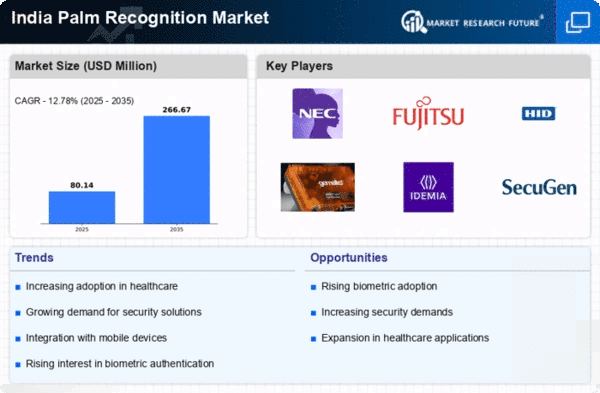
As per Market Research Future analysis, the India Palm Recognition Market size was estimated at 71.06 USD Million in 2024. The Palm Recognition market is projected to grow from 80.14 USD Million in 2025 to 266.67 USD Million by 2035. This growth exhibits a compound annual growth rate (CAGR) of 12.7% during the forecast period 2025 - 2035

Key Market Trends & Highlights

The India palm recognition market is poised for substantial growth driven by technological advancements and increasing consumer awareness.

  • Technological advancements are enhancing the accuracy and efficiency of palm recognition systems.
  • The healthcare sector emerges as the largest segment, while the integration with smart devices is the fastest-growing segment.
  • Regulatory support is fostering a conducive environment for the adoption of biometric solutions.
  • The growing demand for biometric security solutions and government initiatives for digital identity are key market drivers.

Market Size & Forecast

2024 Market Size 71.06 (USD Million)
2035 Market Size 266.67 (USD Million)
CAGR (2025 - 2035) 12.78%

Major Players

NEC Corporation (JP), Fujitsu Limited (JP), HID Global Corporation (US), Gemalto NV (NL), IDEMIA (FR), SecuGen Corporation (US), Crossmatch Technologies (US), Innovatrics (SK)

Our Impact
Enabled $4.3B Revenue Impact for Fortune 500 and Leading Multinationals
Partnering with 2000+ Global Organizations Each Year
30K+ Citations by Top-Tier Firms in the Industry

India Palm Recognition Market Trends

The India Palm Recognition Market is experiencing notable growth, driven by advancements in biometric technology and increasing demand for secure authentication methods. In India, the integration of palm recognition systems in various sectors, including banking, healthcare, and security, appears to be gaining traction. This trend is likely influenced by the rising concerns over data privacy and the need for efficient identity verification solutions. As organizations seek to enhance their security protocols, the adoption of palm recognition technology may become more prevalent, potentially reshaping the landscape of biometric authentication in the country. Moreover, the regulatory environment in India seems to be evolving, with government initiatives promoting digital identity solutions. This regulatory support could further stimulate the palm recognition market, encouraging investments and innovations in this field. The increasing penetration of smartphones and smart devices equipped with biometric capabilities may also contribute to the market's expansion. As consumers become more accustomed to using biometric features for convenience and security, the palm recognition market is poised for significant developments in the coming years.

Technological Advancements

Recent innovations in sensor technology and image processing are enhancing the accuracy and efficiency of palm recognition systems. These advancements may lead to broader applications across various industries, including finance and healthcare.

Regulatory Support

Government initiatives aimed at promoting digital identity solutions are likely to bolster the palm recognition market. This support may encourage businesses to adopt biometric technologies for secure authentication.

Consumer Awareness

As awareness of biometric security solutions increases, consumers may show a growing preference for palm recognition technology. This shift could drive demand in sectors such as retail and personal devices.

India Palm Recognition Market Drivers

Integration with Smart Devices

The proliferation of smart devices in India is significantly influencing the palm recognition market. As smartphones, tablets, and wearables increasingly incorporate biometric authentication features, the demand for palm recognition technology is expected to rise. The market is anticipated to reach a valuation of $500 million by 2027, driven by consumer preference for seamless and secure access to their devices. This integration not only enhances user experience but also promotes the adoption of palm recognition in various applications, including mobile payments and personal identification, thereby expanding the market's reach.

Rising Adoption in Healthcare Sector

The healthcare sector in India is increasingly adopting palm recognition technology to streamline patient identification and enhance security. Hospitals and clinics are implementing biometric systems to reduce fraud and improve patient data management. The palm recognition market is projected to capture a significant share of the healthcare technology market, which is expected to grow to $370 billion by 2030. This trend indicates a growing recognition of the benefits of biometric solutions in improving operational efficiency and patient safety, thereby driving the palm recognition market forward.

Increased Focus on Contactless Solutions

The shift towards contactless solutions in various industries is propelling the palm recognition market in India. As businesses seek to minimize physical contact due to hygiene concerns, palm recognition technology offers a non-invasive and efficient alternative for authentication. This trend is particularly relevant in sectors such as retail and banking, where customer experience and safety are paramount. The palm recognition market is likely to see a surge in demand as organizations prioritize contactless interactions, potentially leading to a market growth rate aligned with the projected CAGR of 12.78%.

Government Initiatives for Digital Identity

The Indian government's push for digital identity solutions is a crucial driver for the palm recognition market. Initiatives such as the Digital India program aim to provide citizens with secure and efficient access to services. These initiatives are likely to benefit the palm recognition market, as biometric systems are integral to the government's vision of a digitally empowered society. With an estimated investment of $1 billion in biometric technologies, the government is fostering an environment conducive to the growth of the palm recognition market, enhancing its adoption across public services and private sectors.

Growing Demand for Biometric Security Solutions

The increasing need for enhanced security measures across various sectors is driving the growth of the palm recognition market in India. With rising concerns over data breaches and identity theft, organizations are seeking reliable biometric solutions. The palm recognition market is projected to grow at a CAGR of approximately 12.78% from 2025 to 2035. This growth is fueled by the adoption of palm recognition technology in banking, healthcare, and government sectors, where secure access to sensitive information is paramount. As businesses and institutions prioritize security, the demand for advanced biometric systems, including palm recognition, is likely to escalate, indicating a robust market trajectory.


Market Segment Insights

By Offering: Hardware (Largest) vs. Software & Services (Fastest-Growing)

In the India palm recognition market, the distribution of market share reveals that hardware constitutes the largest segment, driven by demand for efficient and effective recognition systems. Software and services, while smaller in share, are gaining traction as organizations seek integrated solutions that enhance the functionality of hardware components. The push towards automation and smart technologies has led to a significant interest in software and services, allowing businesses to leverage data analytics and real-time insights. The growth trends in this sector indicate a robust expansion for software and services, which are now recognized as vital for optimizing hardware capabilities. With advancements in artificial intelligence and machine learning, software solutions are tailoring their offerings to meet the evolving needs of users. The increasing demand for security and operational efficiency applications in various industries is contributing to this rapid growth, making software & services not only an emerging segment but potentially the future heart of palm recognition technology.

Hardware (Dominant) vs. Software & Services (Emerging)

Hardware plays a dominant role in the India palm recognition market, owing to its critical importance in the deployment of recognition systems. This segment includes scanners, recognition devices, and supporting infrastructure, which are crucial for operational efficiency in various applications, including security and access control. On the other hand, software and services are emerging as vital components of this ecosystem, enhancing the user experience and functionality of hardware technologies. These solutions provide the necessary analytics and data management features that allow organizations to fully harness the capabilities of their hardware investments. As industries become more reliant on data-driven decision-making, the demand for robust software applications that support hardware becomes increasingly evident, marking a significant shift in market dynamics.

By Product: Finger Vein Biometrics (Largest) vs. Palm Vein Biometrics (Fastest-Growing)

In the India palm recognition market, Finger Vein Biometrics holds the largest share due to its robust adoption across various sectors, including finance and healthcare. Its reliability and security features have made it a preferred choice for numerous enterprises looking to enhance user authentication processes. Meanwhile, Palm Vein Biometrics is gaining traction, representing a significant opportunity for growth as organizations increasingly seek innovative, contactless methods of biometric identification. The growth trends in these segments are driven by advancements in technology and rising demand for secure access solutions. Finger Vein Biometrics continues to dominate due to its established presence and effectiveness, while Palm Vein Biometrics is recognized as the fastest-growing segment, fueled by its user-friendly interface and ability to integrate seamlessly with existing systems. This evolving landscape is indicative of a broader shift towards more sophisticated biometric solutions in the region.

Finger Vein Biometrics (Dominant) vs. Palm Vein Biometrics (Emerging)

Finger Vein Biometrics, as the dominant player, is characterized by its high accuracy and low false acceptance rates, making it highly reliable for critical applications. Its integration into security systems is further enhanced by its speed and ease of use. Conversely, Palm Vein Biometrics is emerging as a strong alternative due to its non-intrusive nature and increasing recognition for its efficiency in high-traffic environments. The scalability of Palm Vein solutions makes them appealing for various sectors, including transportation and public services, where quick identification is essential. Both segments are witnessing innovations aimed at improving user experience and operational efficiency in an increasingly security-conscious market.

By Authentication: Unimodal Biometric System (Largest) vs. Multimodal Biometric System (Fastest-Growing)

In the India palm recognition market, the Unimodal Biometric System captures the largest share, dominating the segment with its simplicity and established technology. This system primarily utilizes a single biometric trait, allowing for a compact and efficient solution. On the other hand, the Multimodal Biometric System, while currently smaller, is gaining traction due to its ability to integrate multiple biometric traits, enhancing accuracy and security in recognition processes. Growth trends indicate a significant shift towards Multimodal Biometric Systems, driven by increasing concerns over security and the need for more reliable authentication methods. Advances in technology are facilitating this transition, as innovations continue to improve the functionality and user experience of palm recognition systems. Moreover, rising adoption across various sectors, including finance and healthcare, is propelling the demand for more sophisticated authentication solutions.

Authentication: Unimodal Biometric System (Dominant) vs. Multimodal Biometric System (Emerging)

The Unimodal Biometric System remains the dominant force in the India palm recognition market, characterized by its reliance on a single biometric feature. Its widespread usage is attributed to its cost-effectiveness and ease of implementation, making it a preferred choice for many organizations. Conversely, the Multimodal Biometric System is emerging as a significant player, combining multiple biometric traits to provide enhanced accuracy and security. This system caters to organizations seeking higher security measures, particularly in sensitive environments. As users prioritize safety and reliability, the transition from unimodal to multimodal systems is expected to accelerate, redefining market dynamics in the years to come.

By Functionality: Physical Access Control & Biometric Identification (Largest) vs. Logical Access Control & Biometric Identification (Fastest-Growing)

In the India palm recognition market, Physical Access Control & Biometric Identification occupies the largest share, driven by increasing security concerns and the rising need for authentication in various sectors. This segment's robust market presence is attributed to its widespread application in commercial and governmental facilities, which prioritize enhanced safety measures. On the other hand, Logical Access Control & Biometric Identification is emerging as the fastest-growing segment, fueled by the digital transformation across industries. Organizations are increasingly adopting digital identity verification methods to secure sensitive information, thus promoting the demand for these advanced technologies. The surge in cloud-based solutions and remote work further propels this segment's growth trajectory.

Physical Access Control & Biometric Identification (Dominant) vs. Logical Access Control & Biometric Identification (Emerging)

Physical Access Control & Biometric Identification stands out as the dominant segment, characterized by its proven reliability and established usage in various sectors, including government, finance, and healthcare. This segment focuses on securing physical access points through biometric verification, ensuring only authorized individuals can enter sensitive areas. In contrast, Logical Access Control & Biometric Identification is emerging rapidly, representing a shift towards securing information technology resources. This segment encompasses digital systems that utilize biometric data to permit access to software and data, reflecting a growing inclination towards integrated security solutions in an increasingly digital landscape.

By Vertical: BFSI (Largest) vs. Commercial (Fastest-Growing)

Among the vertical segments in the India palm recognition market, the BFSI sector holds the largest market share with its established infrastructure and high adoption rates of biometric technologies. Driven by the need for enhanced security and customer authentication, BFSI leads the way, significantly influencing the overall market landscape. Meanwhile, the Commercial sector is rapidly gaining traction due to increasing demand for secure access control systems in businesses, contributing to its status as the fastest-growing segment. Growth trends in the India palm recognition market showcase an increasing reliance on biometric solutions across various sectors. Factors such as heightened security concerns, regulatory compliance, and the push for contactless technology propel both BFSI and Commercial sectors. The ongoing digital transformation and the integration of advanced technologies such as AI and machine learning are further expected to enhance the capabilities and applications of palm recognition systems within these segments.

BFSI: Dominant vs. Commercial: Emerging

The BFSI sector is characterized by its extensive implementation of biometric authentication, providing robust security solutions to banks and financial institutions. As the dominant player in the India palm recognition market, BFSI continues to innovate and invest in technology to enhance user experience and trust. In contrast, the Commercial sector is emerging with a focus on integrating palm recognition systems for secure access control. This growing interest is fueled by businesses' need to safeguard assets and streamline operations. The Commercial sector, while currently smaller than BFSI, is positioned for significant growth, driven by advancements in technology and increasing awareness of the benefits of biometric systems.

By Application: User Authentication (Largest) vs. Access Control & Biometric Identification (Fastest-Growing)

The market share distribution within the various application segments indicates that user authentication holds the largest share, reflecting its critical importance in securing user identity and access across digital platforms. Access control and biometric identification, while not the largest in share, are gaining traction and are expected to grow significantly due to the increasing emphasis on security in corporate and public spaces. Growth trends in the India palm recognition market are largely driven by technological advancements and the rising demand for secure user interactions in various sectors. The proliferation of smart devices and a shift towards biometric solutions for user authentication are pushing the market forward. Additionally, the increasing investments in security infrastructure support the rapid growth of access control and biometric identification solutions, marking their significance in the overall market landscape.

User Authentication (Dominant) vs. Access Control & Biometric Identification (Emerging)

User authentication remains a dominant application in the India palm recognition market, primarily due to its critical role in enhancing cybersecurity through biometric solutions. As organizations increasingly prioritize data protection, the demand for reliable authentication methods solidifies user authentication's market leadership. Conversely, access control and biometric identification are emerging rapidly by addressing security needs across varied environments, including government agencies, corporations, and educational institutions. The integration of advanced biometric technologies is facilitating smoother user experiences while bolstering security. As public awareness of biometric solutions grows, these segments are expected to experience significant growth, adapting to emerging challenges and technological improvements within the industry.

Get more detailed insights about India Palm Recognition Market

Key Players and Competitive Insights

The palm recognition market in India is currently characterized by a dynamic competitive landscape, driven by technological advancements and increasing demand for secure biometric solutions. Key players such as NEC Corporation (Japan), Fujitsu Limited (Japan), and IDEMIA (France) are actively shaping the market through strategic initiatives focused on innovation and regional expansion. These companies are leveraging their technological expertise to enhance product offerings, thereby fostering a competitive environment that emphasizes not only security but also user convenience and efficiency.In terms of business tactics, companies are increasingly localizing manufacturing and optimizing supply chains to better serve the Indian market. The competitive structure appears moderately fragmented, with several players vying for market share. However, the influence of major companies is significant, as they set benchmarks for quality and innovation that smaller firms often strive to meet. This collective presence of key players contributes to a robust ecosystem that encourages continuous improvement and adaptation to market needs.

In October NEC Corporation (Japan) announced a partnership with a leading Indian technology firm to develop advanced palm recognition systems tailored for the local market. This strategic move is likely to enhance NEC's footprint in India, allowing it to leverage local expertise while addressing specific consumer needs. Such collaborations may facilitate faster deployment of solutions and improve customer engagement, thereby solidifying NEC's competitive position.Similarly, in September 2025, Fujitsu Limited (Japan) launched a new palm recognition device designed for high-security environments, targeting government and financial sectors in India. This product introduction not only showcases Fujitsu's commitment to innovation but also reflects a strategic focus on sectors that demand stringent security measures. The device's advanced features may provide Fujitsu with a competitive edge, appealing to organizations seeking reliable biometric solutions.Moreover, in August 2025, IDEMIA (France) expanded its operations in India by establishing a research and development center dedicated to biometric technologies, including palm recognition. This initiative underscores IDEMIA's long-term commitment to the Indian market and its intention to drive innovation from within. By investing in local talent and resources, IDEMIA is likely to enhance its product development capabilities, positioning itself as a leader in the biometric space.

As of November current trends in the palm recognition market indicate a strong emphasis on digitalization, AI integration, and sustainability. Strategic alliances among key players are increasingly shaping the competitive landscape, fostering innovation and collaboration. Looking ahead, it appears that competitive differentiation will evolve, with a shift from price-based competition to a focus on technological advancements and supply chain reliability. Companies that prioritize innovation and adaptability are likely to thrive in this rapidly changing environment.

Key Companies in the India Palm Recognition Market include

Industry Developments

The India Palm Recognition Market has experienced significant growth in recent months,which has been fueled by the growing demand for secure, contactless biometric solutions in both the public and private sectors. Mantra Softech introduced its PV2000 contactless palm vein scanner in March 2023, which is designed to be used in industrial attendance and access control systems. This product is a prime example of domestic innovation in biometric technology.

Furthermore, in November 2023, Amazon launched Amazon One Enterprise in India, which provides palm-based biometric authentication for enterprise-level access control. This move underscores the entrance of global players into the Indian biometric landscape.In June 2024, the Karnataka Examinations Authority issued a tender for the implementation of palm and fingerprint biometric systems for candidate authentication in public examinations, further emphasizing the government's interest.

This action suggests a more extensive institutional adoption of palm recognition technologies for the purposes of identity verification and security.While there have been no significant mergers or acquisitions reported in recent months, companies such as MorphoTrust, Innovatrics, and ZKTeco are continuing to expand their presence and offerings in India. The sector's momentum is being further bolstered by government initiatives that are promoting digital transformation and secure authentication systems. These developments indicate that palm recognition technologies in India are on a robust growth trajectory, with applications expanding across education, enterprise, and public administration.

Future Outlook

India Palm Recognition Market Future Outlook

The Palm Recognition Market in India is projected to grow at a 12.78% CAGR from 2025 to 2035, driven by technological advancements and increasing security demands.

New opportunities lie in:

  • Integration of palm recognition in mobile payment systems
  • Development of palm-based access control solutions for enterprises
  • Partnerships with healthcare providers for patient identification systems

By 2035, the palm recognition market is expected to achieve substantial growth and innovation.

Market Segmentation

India Palm Recognition Market Product Outlook

  • Finger Vein Biometrics
  • Palm Vein Biometrics

India Palm Recognition Market Offering Outlook

  • Hardware
  • Software & Services

India Palm Recognition Market Vertical Outlook

  • BFSI
  • Commercial
  • Industrial
  • Others

India Palm Recognition Market Application Outlook

  • Access Control & Biometric Identification
  • OEM Terminal Devices
  • User Authentication
  • Others

India Palm Recognition Market Functionality Outlook

  • Physical Access Control & Biometric Identification
  • Logical Access Control & Biometric Identification
  • Embedded System

India Palm Recognition Market Authentication Outlook

  • Unimodal Biometric System
  • Multimodal Biometric System

Report Scope

MARKET SIZE 2024 71.06(USD Million)
MARKET SIZE 2025 80.14(USD Million)
MARKET SIZE 2035 266.67(USD Million)
COMPOUND ANNUAL GROWTH RATE (CAGR) 12.78% (2025 - 2035)
REPORT COVERAGE Revenue Forecast, Competitive Landscape, Growth Factors, and Trends
BASE YEAR 2024
Market Forecast Period 2025 - 2035
Historical Data 2019 - 2024
Market Forecast Units USD Million
Key Companies Profiled NEC Corporation (JP), Fujitsu Limited (JP), HID Global Corporation (US), Gemalto NV (NL), IDEMIA (FR), SecuGen Corporation (US), Crossmatch Technologies (US), Innovatrics (SK)
Segments Covered Offering, Product, Authentication, Functionality, Vertical, Application
Key Market Opportunities Integration of palm recognition technology in secure payment systems enhances user convenience and security.
Key Market Dynamics Rising demand for secure authentication drives innovation in palm recognition technology across various sectors.
Countries Covered India
Leave a Comment

FAQs

What is the expected market size of the India Palm Recognition Market in 2024?

The India Palm Recognition Market is expected to be valued at 65.26 USD Million in 2024.

What is the projected market size of the India Palm Recognition Market by 2035?

By 2035, the India Palm Recognition Market is projected to reach a valuation of 271.0 USD Million.

What is the expected Compound Annual Growth Rate (CAGR) for the India Palm Recognition Market from 2025 to 2035?

The India Palm Recognition Market is expected to grow at a CAGR of 13.819% during the forecast period from 2025 to 2035.

What is the market value of hardware in the India Palm Recognition Market for the year 2024?

The market value of hardware in the India Palm Recognition Market is valued at 25.0 USD Million in 2024.

What is the expected market value of software and services in the India Palm Recognition Market in 2024?

The expected market value for software and services in the India Palm Recognition Market is 40.26 USD Million in 2024.

Which key players are dominating the India Palm Recognition Market?

Key players in the India Palm Recognition Market include MorphoTrust, Fingerprint Cards, Safran, and SecuGen among others.

What market value is anticipated for hardware in the India Palm Recognition Market by the year 2035?

The hardware segment of the India Palm Recognition Market is anticipated to reach a valuation of 107.0 USD Million by 2035.

What is the projected value of software and services in the India Palm Recognition Market by 2035?

By 2035, the market value of software and services in the India Palm Recognition Market is projected to be 164.0 USD Million.

What are the growth drivers for the India Palm Recognition Market?

Growth drivers for the India Palm Recognition Market include increasing demand for biometric authentication solutions and advancements in technology.

How might the current global scenario impact the India Palm Recognition Market?

The current global scenario may influence the India Palm Recognition Market by affecting supply chains and altering consumer demand patterns.

Download Free Sample

Kindly complete the form below to receive a free sample of this Report

Compare Licence

×
Features License Type
Single User Multiuser License Enterprise User
Price $4,950 $5,950 $7,250
Maximum User Access Limit 1 User Upto 10 Users Unrestricted Access Throughout the Organization
Free Customization
Direct Access to Analyst
Deliverable Format
Platform Access
Discount on Next Purchase 10% 15% 15%
Printable Versions