×
Request Free Sample ×

Kindly complete the form below to receive a free sample of this Report

* Please use a valid business email

Leading companies partner with us for data-driven Insights

clients tt-cursor
Hero Background

India Mobile Payments Market

ID: MRFR/BS/59474-HCR
200 Pages
Aarti Dhapte
February 2026

India Mobile Payments Market Size, Share and Research Report By Transaction Type (Remote Payments, Proximity Payments, In-App Payments, Person-to-Person Payments), By Payment Method (Credit Cards, Debit Cards, Mobile Wallets, Bank Transfers), By End User (Retail Consumers, Businesses, Government) and By Platform (Android, iOS, Web-Based)- Industry Forecast Till 2035

Share:
Download PDF ×

We do not share your information with anyone. However, we may send you emails based on your report interest from time to time. You may contact us at any time to opt-out.

India Mobile Payments Market Infographic
Purchase Options

India Mobile Payments Market Summary

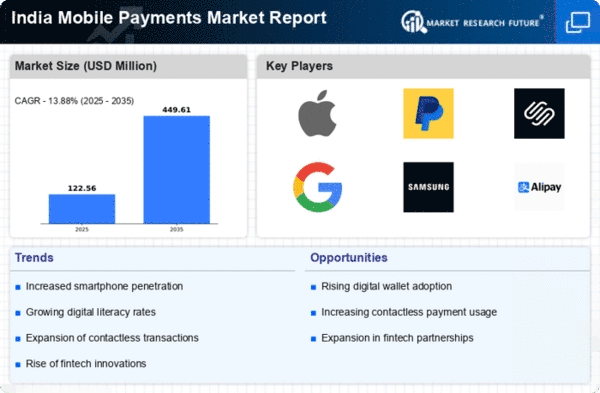
As per Market Research Future analysis, the India Mobile Payments Market size was estimated at 107.62 USD Million in 2024. The Mobile Payments market is projected to grow from 122.56 USD Million in 2025 to 449.61 USD Million by 2035, exhibiting a compound annual growth rate (CAGR) of 13.8% during the forecast period 2025 - 2035

Key Market Trends & Highlights

The India mobile payments market is experiencing robust growth driven by technological advancements and consumer preferences.

  • The largest segment in the India mobile payments market is digital wallets, which are witnessing increased adoption among consumers.
  • Contactless payments are rapidly gaining traction, reflecting a shift towards convenience and speed in transactions.
  • The fastest-growing segment is the integration of advanced security features, as consumers prioritize safety in their payment methods.
  • Rising smartphone penetration and government initiatives are key drivers propelling the growth of mobile payments in India.

Market Size & Forecast

2024 Market Size 107.62 (USD Million)
2035 Market Size 449.61 (USD Million)
CAGR (2025 - 2035) 13.88%

Major Players

Apple (US), PayPal (US), Square (US), Google (US), Samsung (KR), Alipay (CN), WeChat Pay (CN), Visa (US), Mastercard (US)

Our Impact
Enabled $4.3B Revenue Impact for Fortune 500 and Leading Multinationals
Partnering with 2000+ Global Organizations Each Year
30K+ Citations by Top-Tier Firms in the Industry

India Mobile Payments Market Trends

The India Mobile Payments Market is rapidly evolving, driven by technological advancements and changing consumer behaviors. With the increasing penetration of smartphones and internet connectivity, a growing number of individuals are adopting digital payment solutions. This shift is further supported by government initiatives aimed at promoting cashless transactions, which appear to be reshaping the financial landscape. As a result, various stakeholders, including banks, fintech companies, and merchants, are investing in innovative solutions to enhance user experience and security. Moreover, the rise of e-commerce and the demand for seamless payment experiences are propelling the mobile payments market forward. Consumers are increasingly seeking convenience and speed in their transactions, leading to the development of diverse payment platforms. This trend suggests a potential for further growth, as more users become accustomed to using mobile wallets and contactless payment methods. The competitive environment is likely to intensify, with new entrants and established players striving to capture market share through unique offerings and enhanced functionalities.

Increased Adoption of Digital Wallets

The mobile payments market is witnessing a surge in the use of digital wallets. Consumers are increasingly favoring these platforms for their convenience and ease of use. Digital wallets allow users to store multiple payment methods securely, facilitating quick transactions. This trend indicates a shift towards a more digital-centric approach to financial management.

Integration of Advanced Security Features

Security remains a paramount concern in the mobile payments market. As cyber threats evolve, companies are prioritizing the integration of advanced security measures. Biometric authentication, encryption, and tokenization are becoming standard practices to protect user data. This focus on security is likely to enhance consumer trust and encourage wider adoption.

Growth of Contactless Payments

Contactless payment methods are gaining traction within the mobile payments market. The convenience of tapping a device to complete a transaction appeals to consumers seeking efficiency. This trend suggests a potential shift in consumer preferences, as more individuals opt for contactless solutions over traditional payment methods.

India Mobile Payments Market Drivers

E-commerce Expansion

The rapid expansion of the e-commerce sector in India is a crucial driver for the mobile payments market. With online retail sales projected to reach $200 billion by 2026, the demand for efficient payment solutions is escalating. Consumers increasingly prefer mobile payments for their convenience and speed, particularly in the context of online shopping. This trend is further supported by the proliferation of mobile applications that facilitate seamless transactions. As e-commerce continues to grow, the mobile payments market is expected to benefit significantly, as more consumers opt for digital payment methods to complete their purchases.

Increased Consumer Awareness

Consumer awareness regarding the benefits of mobile payments is on the rise in India, contributing positively to the mobile payments market. Educational campaigns and marketing efforts by financial institutions and payment service providers have played a pivotal role in informing consumers about the advantages of using mobile payment solutions. As of 2025, surveys indicate that approximately 70% of consumers are aware of mobile payment options, leading to increased adoption. This heightened awareness not only encourages usage but also fosters trust in digital transactions, which is essential for the sustained growth of the mobile payments market.

Rising Smartphone Penetration

The mobile payments market in India is experiencing significant growth due to the increasing penetration of smartphones. As of 2025, smartphone users in India are projected to reach approximately 1 billion, which represents a significant portion of the population. This widespread adoption facilitates access to mobile payment applications, enabling users to conduct transactions seamlessly. The convenience offered by smartphones, combined with the availability of affordable data plans, encourages consumers to engage in digital transactions. Consequently, this trend is likely to drive the growth of the mobile payments market, as more individuals embrace technology for everyday financial activities.

Emergence of Fintech Innovations

The mobile payments market in India is experiencing a wave of fintech innovations that are reshaping the landscape of digital transactions. Startups and established companies are introducing advanced payment solutions, such as peer-to-peer lending and blockchain-based transactions. These innovations enhance the user experience by providing faster, more secure, and cost-effective payment options. As of 2025, the fintech sector is expected to attract substantial investments, further driving the growth of the mobile payments market. The integration of cutting-edge technology not only meets consumer demands but also positions India as a leader in the mobile payments ecosystem.

Government Initiatives and Support

The Indian government has been actively promoting digital payments through various initiatives aimed at enhancing financial inclusion. Programs such as Digital India and the introduction of the Unified Payments Interface (UPI) have significantly contributed to the mobile payments market. As of 2025, UPI transactions have surged, with over 45 billion transactions recorded in the previous year alone. These initiatives not only provide a robust infrastructure for mobile payments but also instill consumer confidence in digital transactions. The government's commitment to fostering a cashless economy is likely to further propel the mobile payments market in India.


Market Segment Insights

By Transaction Type: Remote Payments (Largest) vs. Proximity Payments (Fastest-Growing)

In the India mobile payments market, remote payments dominate the transaction type landscape, significantly influencing overall market dynamics. They capture the largest share due to the convenience and flexibility they offer users, enabling seamless online transactions across various platforms. In contrast, proximity payments, while currently smaller in market share, are rapidly gaining traction as contactless technologies become more widespread and consumer preferences shift towards convenience and speed. The growth of the proximity payments segment is largely driven by increasing acceptance of digital wallets and NFC technology, leading to enhanced user experiences. Additionally, the push from financial institutions and service providers to promote cashless transactions plays a significant role in boosting proximity payments. As mobile payment adoption continues to rise, these segments are set to evolve, with consumers increasingly leaning towards mobile solutions for both remote and proximity transactions.

Remote Payments (Dominant) vs. In-App Payments (Emerging)

Remote payments stand as the dominant force in the India mobile payments market, characterized by their ease of use and broad applicability across e-commerce and online transactions. These payments leverage technology, allowing users to conduct transactions from their devices without needing to be physically present, thereby aligning with the increasing trend of remote commerce. Meanwhile, in-app payments are emerging rapidly, driven by the growth of mobile applications across various sectors, including gaming and retail. In-app payments provide a seamless checkout experience within applications, thus catering to consumer demand for convenience. As both segments continue to grow, the dynamic between remote and in-app payments will define the future of mobile transactions in the market.

By Payment Method: Mobile Wallets (Largest) vs. Debit Cards (Fastest-Growing)

In the India mobile payments market, Mobile Wallets hold the largest share, dominating the payment method landscape. Their widespread adoption can be attributed to the convenience and speed they offer to users, leading to increased transaction volumes over traditional methods. Meanwhile, Debit Cards also hold a significant position; they are frequently utilized for online purchases, particularly in the growing eCommerce sector, showcasing a healthy share in the market. Growth trends indicate that Mobile Wallets will continue to enhance their dominance, fueled by rising smartphone penetration and digital literacy among the population. Moreover, Debit Cards are emerging as the fastest-growing segment, supported by banks and financial institutions promoting their use and the increasing preference of consumers for secure and swift payments. The pandemic has accelerated the shift towards digital transactions, further enhancing the appeal of these payment methods.

Mobile Wallets: Dominant vs. Debit Cards: Emerging

Mobile Wallets have established themselves as the dominant payment method in the India mobile payments market due to their user-friendly interfaces and robust security features, appealing to a tech-savvy population. They enable seamless transactions, often with loyalty rewards that encourage consumer usage. In contrast, Debit Cards, while currently the fastest-growing segment, are increasingly being adopted for both online and offline transactions. Debit Cards offer users the comfort of direct bank access while ensuring budget control. As financial institutions innovate to integrate debit card usage with emerging technologies, their growth trajectory promises to capture a significant market share, presenting viable competition to Mobile Wallets.

By End User: Retail Consumers (Largest) vs. Businesses (Fastest-Growing)

In the India mobile payments market, the distribution of market share among the end user segments reveals that retail consumers constitute the largest segment, driven by the increasing adoption of mobile wallets and contactless payment methods. Businesses, while smaller in market share compared to retail consumers, are witnessing extraordinary growth as digital payment solutions become more integrated into everyday operations, enhancing consumer transactions and operational efficiencies. The growth trends show a significant uptick in mobile payment usage across various demographics, with retail consumers pushing for seamless shopping experiences and businesses accelerating their digital transformation. The government's initiatives to promote digital payments and ensure a robust infrastructure cater to this burgeoning demand. Moreover, businesses are increasingly recognizing the potential of mobile payments to facilitate transactions, leading to a rise in partnerships with payment service providers.

Retail Consumers: Dominant vs. Businesses: Emerging

Retail consumers represent the dominant segment in the India mobile payments market, characterized by their preference for convenience and speed in transactions. The shift towards digital wallets and contactless payments has resulted in a substantial customer base that expects seamless experiences. On the other hand, businesses, as an emerging segment, are rapidly adopting mobile payments to enhance operational efficiency and meet customer expectations. This segment is driven by the demand for integrated payment solutions and increasing digital literacy among entrepreneurs. As businesses recognize the benefits of mobile payments for transaction speed and security, they are likely to play a critical role in driving market innovation and customer engagement.

By Platform: Android (Largest) vs. iOS (Fastest-Growing)

In the India mobile payments market, Android dominates the platform segment, holding a significant share due to its widespread adoption across various demographics. With diverse device offerings and affordability, Android platforms cater to a broad audience, enhancing their market leadership. Conversely, iOS, while smaller in market share compared to Android, is experiencing rapid growth, particularly among affluent users who favor its secure payment functionalities and integrated ecosystem. The growth trends in this segment reflect a shift toward digital transactions, driven by increasing smartphone penetration and user-friendly payment solutions across both platforms. Innovative features, enhanced security, and the push towards contactless payments are key drivers for the burgeoning iOS segment, while Android's expansive reach continues to reinforce its dominant status in the competitive landscape.

Android (Dominant) vs. iOS (Emerging)

Android's dominance in the mobile payments market is attributed to its vast user base and the availability of a wider range of devices that cater to various price points. This accessibility allows Android to reach a more extensive audience, which in turn drives higher transaction volumes. The platform's support for numerous payment apps and integration with banking services promotes its utility in everyday transactions. In contrast, iOS, though emerging, is gaining traction due to its emphasis on security, privacy, and user experience. Users prefer iOS for its seamless integration of payment solutions within its ecosystem, making it a favored choice for tech-savvy consumers. As both platforms evolve, the competition is set to heighten, with each targeting distinct consumer segments.

Get more detailed insights about India Mobile Payments Market

Key Players and Competitive Insights

The mobile payments market in India is characterized by a rapidly evolving competitive landscape, driven by technological advancements and increasing consumer adoption. Major players such as Google (US), PayPal (US), and Alipay (CN) are strategically positioning themselves to capture market share through innovation and partnerships. Google (US) focuses on enhancing its Google Pay platform, integrating advanced features like AI-driven financial insights, which appears to resonate well with tech-savvy consumers. Meanwhile, PayPal (US) emphasizes expanding its services to small and medium-sized enterprises (SMEs), indicating a shift towards supporting local businesses in their digital transformation journeys. Alipay (CN), leveraging its extensive user base, is likely to enhance its offerings through collaborations with local merchants, thereby shaping a competitive environment that prioritizes user experience and accessibility.
The business tactics employed by these companies reflect a nuanced understanding of the Indian market. Localizing services and optimizing supply chains are critical strategies that enhance operational efficiency. The market structure appears moderately fragmented, with numerous players vying for dominance. However, the collective influence of key players like Visa (US) and Mastercard (US) cannot be overlooked, as they provide essential infrastructure that supports the growth of mobile payments.
In October 2025, Google (US) announced a partnership with a leading Indian bank to offer instant credit facilities through its Google Pay platform. This strategic move is significant as it not only enhances the platform's value proposition but also addresses the growing demand for accessible credit solutions among consumers. By integrating financial services directly into its payment platform, Google (US) is likely to strengthen its competitive edge in the market.
In September 2025, PayPal (US) launched a new feature aimed at facilitating cross-border transactions for Indian merchants. This initiative is crucial as it opens up new revenue streams for local businesses, allowing them to tap into international markets. The strategic importance of this move lies in its potential to position PayPal (US) as a preferred partner for SMEs looking to expand their reach, thereby enhancing customer loyalty and market penetration.
In August 2025, Alipay (CN) expanded its services to include QR code payments for local street vendors in major Indian cities. This initiative appears to be a strategic response to the growing trend of digital payments among small businesses. By enabling street vendors to accept mobile payments, Alipay (CN) is likely to increase its user base while fostering financial inclusion, which is a critical aspect of the Indian market.
As of November 2025, the competitive trends in the mobile payments market are increasingly defined by digitalization, sustainability, and the integration of AI technologies. Strategic alliances among key players are shaping the landscape, fostering innovation and enhancing service delivery. The shift from price-based competition to a focus on technological advancement and supply chain reliability is evident. Companies that prioritize innovation and customer-centric solutions are likely to differentiate themselves in this dynamic market.

Key Companies in the India Mobile Payments Market include

Industry Developments

The India Mobile Payments Market continues to witness significant growth and developments as of late 2023. Companies like Tech Mahindra and ICICI Bank are focusing on enhancing their digital payment capabilities in response to increasing consumer demand. MobiKwik announced a strategic collaboration with Visa to increase its payment offerings, while Google Pay and Paytm are investing in advanced security measures amidst rising cybersecurity concerns. 

Recently, Bharti Airtel made headlines with its partnership with PhonePe to allow users seamless transactions through their platform. In terms of market valuation, the overall mobile payments market in India was projected to grow exponentially, driven by high smartphone penetration and favorable regulatory measures. In September 2023, HDFC Bank revealed plans to expand its payment gateway services to small and medium enterprises, further boosting the sector's growth. 

Notably, in October 2022, Amazon Pay and Axis Bank merged their digital wallet services to streamline payment experiences for users, marking a significant shift in competitive dynamics within the sector. The continuous evolution and the sturdy demand for mobile payment solutions are reshaping the landscape of financial transactions across India.

Future Outlook

India Mobile Payments Market Future Outlook

The mobile payments market in India is projected to grow at a 13.88% CAGR from 2025 to 2035, driven by technological advancements, increased smartphone penetration, and evolving consumer preferences.

New opportunities lie in:

  • Integration of AI-driven fraud detection systems
  • Expansion of mobile wallets into rural markets
  • Partnerships with e-commerce platforms for seamless transactions

By 2035, the mobile payments market is expected to be robust, reflecting substantial growth and innovation.

Market Segmentation

India Mobile Payments Market End User Outlook

  • Retail Consumers
  • Businesses
  • Government

India Mobile Payments Market Platform Outlook

  • Android
  • iOS
  • Web-Based

India Mobile Payments Market Payment Method Outlook

  • Credit Cards
  • Debit Cards
  • Mobile Wallets
  • Bank Transfers

India Mobile Payments Market Transaction Type Outlook

  • Remote Payments
  • Proximity Payments
  • In-App Payments
  • Person-to-Person Payments

Report Scope

MARKET SIZE 2024 107.62(USD Million)
MARKET SIZE 2025 122.56(USD Million)
MARKET SIZE 2035 449.61(USD Million)
COMPOUND ANNUAL GROWTH RATE (CAGR) 13.88% (2025 - 2035)
REPORT COVERAGE Revenue Forecast, Competitive Landscape, Growth Factors, and Trends
BASE YEAR 2024
Market Forecast Period 2025 - 2035
Historical Data 2019 - 2024
Market Forecast Units USD Million
Key Companies Profiled Apple (US), PayPal (US), Square (US), Google (US), Samsung (KR), Alipay (CN), WeChat Pay (CN), Visa (US), Mastercard (US)
Segments Covered Transaction Type, Payment Method, End User, Platform
Key Market Opportunities Integration of advanced security features enhances consumer trust in the mobile payments market.
Key Market Dynamics Rapid technological advancements and evolving consumer preferences drive growth in the mobile payments market.
Countries Covered India
Leave a Comment

FAQs

What is the expected market size of the India Mobile Payments Market in 2024?

The India Mobile Payments Market is expected to be valued at 172.2 million USD in 2024.

How much is the India Mobile Payments Market projected to be valued at by 2035?

By 2035, the India Mobile Payments Market is projected to reach a value of 1,035.0 million USD.

What is the expected CAGR for the India Mobile Payments Market from 2025 to 2035?

The expected CAGR for the India Mobile Payments Market from 2025 to 2035 is 17.709%.

Which segment of the market is expected to be the largest by value in 2035?

The Remote Payments segment is expected to hold the largest market share in 2035 with a value of 306.0 million USD.

Who are the key players in the India Mobile Payments Market?

Key players include Tech Mahindra, ICICI Bank, MobiKwik, Google Pay, and Paytm among others.

What is the projected value of In-App Payments in 2035?

In-App Payments are projected to reach a value of 270.0 million USD by 2035.

What market value do Person-to-Person Payments hold in 2024?

Person-to-Person Payments are valued at 45.7 million USD in 2024.

What is the expected market size for Proximity Payments in 2035?

Proximity Payments are expected to achieve a market size of 180.0 million USD by 2035.

What challenges does the India Mobile Payments Market currently face?

The market faces challenges such as regulatory hurdles and increasing competition from emerging players.

How much is the market for Remote Payments in 2024?

The Remote Payments segment is valued at 51.5 million USD in 2024.

Download Free Sample

Kindly complete the form below to receive a free sample of this Report

Compare Licence

×
Features License Type
Single User Multiuser License Enterprise User
Price $4,950 $5,950 $7,250
Maximum User Access Limit 1 User Upto 10 Users Unrestricted Access Throughout the Organization
Free Customization
Direct Access to Analyst
Deliverable Format
Platform Access
Discount on Next Purchase 10% 15% 15%
Printable Versions