×
Request Free Sample ×

Kindly complete the form below to receive a free sample of this Report

* Please use a valid business email

Leading companies partner with us for data-driven Insights

clients tt-cursor
Hero Background

Germany Mobile Payments Market

ID: MRFR/BS/59471-HCR
200 Pages
Aarti Dhapte
February 2026

Germany Mobile Payments Market Size, Share and Research Report By Transaction Type (Remote Payments, Proximity Payments, In-App Payments, Person-to-Person Payments), By Payment Method (Credit Cards, Debit Cards, Mobile Wallets, Bank Transfers), By End User (Retail Consumers, Businesses, Government) and By Platform (Android, iOS, Web-Based)- Industry Forecast Till 2035

Share:
Download PDF ×

We do not share your information with anyone. However, we may send you emails based on your report interest from time to time. You may contact us at any time to opt-out.

Germany Mobile Payments Market Infographic
Purchase Options

Germany Mobile Payments Market Summary

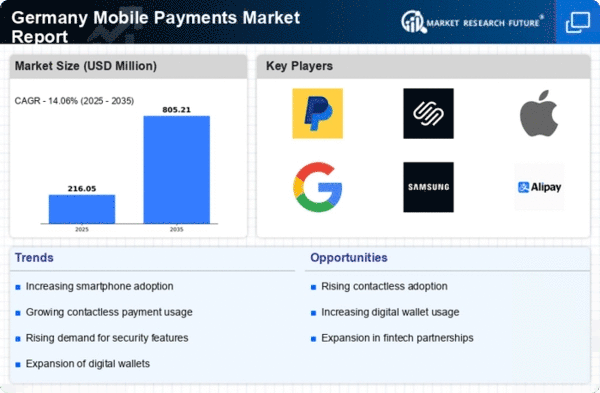
As per Market Research Future analysis, the Germany Mobile Payments Market size was estimated at 189.42 USD Million in 2024. The Mobile Payments market is projected to grow from 216.05 USD Million in 2025 to 805.21 USD Million by 2035, exhibiting a compound annual growth rate (CAGR) of 14.0% during the forecast period 2025 - 2035

Key Market Trends & Highlights

The Germany mobile payments market is experiencing robust growth driven by technological advancements and consumer preferences.

  • The largest segment in the Germany mobile payments market is the contactless payments segment, which continues to gain traction among consumers.
  • The fastest-growing segment is mobile wallets, reflecting a shift towards digital payment solutions.
  • The market is characterized by a heightened focus on security and fraud prevention measures to protect consumer transactions.
  • Key drivers of this market include technological advancements in payment systems and increasing consumer demand for convenience.

Market Size & Forecast

2024 Market Size 189.42 (USD Million)
2035 Market Size 805.21 (USD Million)
CAGR (2025 - 2035) 14.06%

Major Players

PayPal (US), Square (US), Apple (US), Google (US), Samsung (KR), Alipay (CN), WeChat Pay (CN), Adyen (NL), Stripe (US)

Our Impact
Enabled $4.3B Revenue Impact for Fortune 500 and Leading Multinationals
Partnering with 2000+ Global Organizations Each Year
30K+ Citations by Top-Tier Firms in the Industry

Germany Mobile Payments Market Trends

Germany's mobile payments market is experiencing notable growth., driven by increasing consumer adoption and advancements in technology. The rise of smartphones and contactless payment options has transformed the way individuals conduct transactions. As digital wallets gain traction, consumers are increasingly opting for convenient and secure payment methods. This shift is further supported by a robust infrastructure that facilitates seamless transactions across various platforms. Additionally, the regulatory environment is evolving to accommodate the growing demand for mobile payment solutions, ensuring consumer protection and fostering innovation. Moreover, the competitive landscape is intensifying, with numerous players entering the Germany Mobile Payments Market. Traditional banks are collaborating with fintech companies to enhance their offerings, while new entrants are introducing innovative solutions that cater to diverse consumer needs. This dynamic environment suggests that the mobile payments market will continue to evolve, with a focus on enhancing user experience and security. As more consumers embrace digital payment methods, the market is poised for sustained growth, reflecting broader trends in consumer behavior and technological advancements.

Increased Adoption of Contactless Payments

The trend towards contactless payments is gaining momentum, as consumers seek faster and more convenient transaction methods. This shift is evident in various retail environments, where contactless terminals are becoming standard. The ease of tapping a card or smartphone to complete a purchase appeals to a growing demographic that values efficiency.

Integration of Mobile Wallets

Mobile wallets are increasingly being integrated into everyday transactions, allowing users to store multiple payment options in one place. This trend simplifies the payment process and enhances user convenience. As more retailers accept mobile wallet payments, the adoption rate is likely to rise, further embedding these solutions into consumer habits.

Focus on Security and Fraud Prevention

As the mobile payments market expands, there is a heightened emphasis on security measures to protect consumer data. Innovations such as biometric authentication and encryption technologies are being implemented to enhance trust in mobile payment solutions. This focus on security is crucial for encouraging wider adoption among consumers who may have concerns about the safety of digital transactions.

Germany Mobile Payments Market Drivers

Consumer Demand for Convenience

Consumer demand for convenience is a pivotal driver in Germany's mobile payments market is driven by consumer demand for convenience.. As lifestyles become increasingly fast-paced, individuals seek efficient payment solutions that save time and effort. Surveys indicate that over 70% of German consumers prefer mobile payments for their ease of use and quick transaction capabilities. This trend is particularly evident in urban areas, where busy professionals and tech-savvy millennials are leading the charge. The mobile payments market is adapting to this demand by offering user-friendly interfaces and seamless integration with e-commerce platforms. Additionally, the rise of on-demand services and digital marketplaces further fuels this demand, as consumers expect instant payment options. Consequently, businesses are compelled to adopt mobile payment solutions to meet customer expectations, thereby driving growth in the mobile payments market.

Regulatory Support and Frameworks

Regulatory support plays a crucial role in shaping Germany's mobile payments market is shaped by regulatory support.. The government has implemented various frameworks aimed at promoting digital payment solutions while ensuring consumer protection. Initiatives such as the Payment Services Directive 2 (PSD2) encourage competition and innovation within the market. As of 2025, regulatory bodies are actively working to enhance the security of mobile transactions, which is vital for consumer confidence. This supportive regulatory environment is likely to attract new entrants and stimulate investment in the mobile payments market. Furthermore, the alignment of regulations with technological advancements ensures that the market remains agile and responsive to emerging trends. As a result, the mobile payments market is poised for sustained growth, driven by a robust regulatory landscape that fosters innovation and consumer trust.

Increased Focus on Security Features

An increased focus on security features is a critical driver for Germany's mobile payments market is driven by an increased focus on security features.. As digital transactions become more commonplace, concerns regarding data breaches and fraud are rising. In response, mobile payment providers are investing heavily in advanced security measures, such as biometric authentication and end-to-end encryption. As of 2025, approximately 80% of consumers express a preference for payment solutions that prioritize security, indicating a strong demand for trustworthy services. This emphasis on security not only protects consumers but also enhances the credibility of the mobile payments market. Furthermore, regulatory requirements are pushing companies to adopt stringent security protocols, thereby fostering a safer transaction environment. As a result, the mobile payments market is likely to benefit from heightened consumer confidence, which is essential for its continued growth.

Rise of E-commerce and Digital Services

The rise of e-commerce and digital services is significantly impacting Germany's mobile payments market is significantly impacted by the rise of e-commerce.. With online shopping becoming increasingly prevalent, consumers are seeking convenient payment methods that facilitate seamless transactions. As of 2025, e-commerce sales in Germany are projected to reach €100 billion, with a substantial portion of these transactions being conducted via mobile payment solutions. This trend is further amplified by the growing popularity of subscription services and digital content platforms, which require efficient payment processing. The mobile payments market is adapting to this shift by offering tailored solutions that cater to the needs of e-commerce businesses. Additionally, partnerships between mobile payment providers and online retailers are becoming more common, enhancing the overall consumer experience. Consequently, the mobile payments market is likely to thrive as it aligns with the evolving landscape of digital commerce.

Technological Advancements in Payment Systems

The mobile payments market in Germany is experiencing a surge due to rapid technological advancements in payment systems. Innovations such as Near Field Communication (NFC) and QR code scanning are enhancing transaction efficiency and user experience. As of 2025, approximately 60% of consumers in Germany utilize mobile payment solutions, reflecting a growing acceptance of these technologies. The integration of Artificial Intelligence (AI) in fraud detection is also contributing to the market's expansion, as it provides enhanced security measures. This technological evolution not only streamlines payment processes but also fosters consumer trust, which is crucial for the mobile payments market. Furthermore, the increasing penetration of smartphones and high-speed internet access supports the proliferation of mobile payment applications, indicating a robust growth trajectory for Germany's mobile payments market is experiencing a surge due to rapid technological advancements..

Market Segment Insights

By Transaction Type: Remote Payments (Largest) vs. Proximity Payments (Fastest-Growing)

In the Germany mobile payments market, Remote Payments capture the largest share, reflecting the increasing preference for online transactions among consumers. Proximity Payments, while smaller in comparison, showcase incredible growth due to the rising adoption of contactless technology and mobile wallets, illustrating a shift in consumer behavior towards convenient and immediate payment options. The growth trends in this segment are driven by evolving consumer preferences and advancements in technology. The surge in online shopping and digital services propels Remote Payments, while Proximity Payments gain traction from the proliferation of NFC-enabled devices and a push for seamless checkout experiences. This dynamic environment indicates that both categories are instrumental in shaping the future of mobile payments in Germany.

Remote Payments (Dominant) vs. Proximity Payments (Emerging)

Remote Payments dominate the Germany mobile payments market, offering consumers a seamless way to transact online. This method is characterized by its user-friendly interface and the convenience of making payments from anywhere, which has been fueled by the growth of e-commerce. On the other hand, Proximity Payments are emerging rapidly, driven by the increasing use of smartphones equipped with NFC technology. These payments allow users to make instant transactions in physical locations, making them ideal for everyday purchases. As consumer demand for quick and easy payment solutions continues to grow, Proximity Payments are expected to capture a larger share of the market, highlighting a significant shift towards in-person mobile transactions.

By Payment Method: Credit Cards (Largest) vs. Mobile Wallets (Fastest-Growing)

In the Germany mobile payments market, Credit Cards hold the largest share among payment methods, greatly preferred for their ease of use and widespread acceptance. Debit Cards follow closely, appealing to consumers looking for immediate, risk-averse payment options. Mobile Wallets are gaining traction, particularly among younger consumers, as they offer convenient transaction experiences. Bank Transfers, while traditional, lag behind in preference due to slightly slower processing times and perceived complexity. Growth trends in this segment showcase a significant shift towards digital payment solutions, emphasizing the adoption of Mobile Wallets as a fast-growing alternative. Factors such as increased smartphone penetration, advancements in security technology, and enhanced user experiences are driving widespread acceptance of Mobile Wallets. Meanwhile, Credit Cards continue to dominate due to their established reliability and bonus rewards, catering to consumer loyalty in the mobile payments landscape.

Credit Cards (Dominant) vs. Mobile Wallets (Emerging)

Credit Cards remain the dominant choice in the Germany mobile payments market, characterized by robust infrastructure and a strong consumer trust base. They are recognized for their convenience, offering benefits such as fraud protection and rewards programs, making them appealing for frequent users. In contrast, Mobile Wallets are emerging rapidly, driven by the shift in consumer preferences towards digital solutions. They offer seamless contactless payments and easy transaction processes, particularly for the tech-savvy population. This segment's growth is further fueled by collaborations between tech firms and banks, enhancing usability and encouraging broader adoption in everyday transactions.

By End User: Retail Consumers (Largest) vs. Businesses (Fastest-Growing)

In the Germany mobile payments market, retail consumers dominate the end user segment with a significant share, reflecting the shift towards digital payment solutions among everyday users. This segment's strong adoption rates can be attributed to the increased penetration of smartphones and user-friendly payment applications that encourage spontaneous purchases. Conversely, businesses, particularly small and medium enterprises (SMEs), are rapidly embracing mobile payment solutions, driven by the need for efficiency and improved customer experiences. The growth trends in this segment indicate a growing preference for mobile transactions over traditional payment methods. Retail consumers are increasingly opting for contactless payments, which have surged in popularity due to convenience and safety, especially post-pandemic. Meanwhile, businesses are investing in mobile payment technologies to streamline operations and meet consumer demand for flexible payment options, making this segment an exciting frontier within the Germany mobile payments landscape.

Retail Consumers (Dominant) vs. Businesses (Emerging)

Retail consumers represent the dominant segment within the Germany mobile payments market, characterized by their high adoption rates due to convenience, accessibility, and the growing preference for digital transactions. This group consists of a diverse demographic, including tech-savvy Millennials and Gen Z, who favor mobile wallets and apps for everyday purchases. In contrast, businesses are emerging as a pivotal segment, particularly with SMEs leveraging mobile payments to adapt to changing consumer behaviors. They are increasingly recognizing the value of providing multiple payment options to enhance customer satisfaction and capture a larger market share. As this segment evolves, businesses are expected to significantly contribute to the overall growth of mobile payment adoption.

By Platform: Android (Largest) vs. iOS (Fastest-Growing)

In the Germany mobile payments market, the distribution of market share among the platform segment values illustrates a clear leader and an emerging contender. Android commands a significant portion of the market, making it the most widely adopted platform for mobile payments due to its wide accessibility and variety of device compatibility. Conversely, iOS, while having a smaller market share, is rapidly increasing its presence among users, driven by the growing adoption of Apple Pay and the premium user experience it offers. This dynamic establishes a competitive landscape between the two platforms. The growth trends in this segment reveal that while Android remains dominant, iOS is becoming the fastest-growing platform, fueled by factors such as increasing smartphone penetration and consumer preference for secure, user-friendly payment solutions. The trend towards digital wallets and contactless payments enhances the appeal of both platforms, but particularly boosts the growth of iOS as more users shift towards its superior features and security. This competitive environment signifies an important evolution in mobile payment preferences.

Android (Dominant) vs. iOS (Emerging)

Android, as the dominant platform in the Germany mobile payments market, benefits from a diverse range of devices and a large user base, making it a practical choice for many consumers. Its functionality is widely recognized, allowing various payment applications that cater to user preferences. In contrast, iOS emerges as an attractive choice for users looking for seamless integration with Apple products and services. With the increasing emphasis on security and user experience, iOS is successfully cultivating a loyal customer base that appreciates its robust payment ecosystem. As these two platforms continue to evolve, they will shape the future of mobile payments, influencing both consumer behavior and vendor strategies.

Get more detailed insights about Germany Mobile Payments Market

Key Players and Competitive Insights

The mobile payments market in Germany is characterized by a dynamic competitive landscape, driven by rapid technological advancements and evolving consumer preferences. Key players such as PayPal (US), Apple (US), and Adyen (NL) are strategically positioned to leverage innovation and partnerships to enhance their service offerings. PayPal (US) has focused on expanding its ecosystem through strategic acquisitions and partnerships, aiming to integrate more financial services into its platform. Meanwhile, Apple (US) continues to innovate with its Apple Pay service, emphasizing security and user experience, which appears to resonate well with consumers. Adyen (NL) has adopted a global approach, facilitating seamless cross-border transactions, which is increasingly vital in a globalized economy. Collectively, these strategies contribute to a competitive environment that is both collaborative and competitive, as companies seek to differentiate themselves through unique value propositions.
In terms of business tactics, companies are increasingly localizing their operations to better serve the German market. This includes optimizing supply chains and enhancing customer service capabilities. The market structure is moderately fragmented, with several players vying for market share, yet dominated by a few key players who exert considerable influence. This competitive structure allows for innovation and differentiation, as companies strive to capture the attention of tech-savvy consumers who demand convenience and security in their payment solutions.
In October 2025, PayPal (US) announced a partnership with a leading German bank to enhance its payment processing capabilities, allowing for faster transactions and improved security features. This strategic move is likely to bolster PayPal's presence in the German market, as it aligns with the growing consumer demand for secure and efficient payment solutions. The collaboration may also facilitate the integration of additional financial services, further solidifying PayPal's competitive edge.
In September 2025, Apple (US) launched a new feature within Apple Pay that allows users to make payments using biometric authentication, such as facial recognition. This innovation not only enhances security but also streamlines the payment process, catering to the preferences of consumers who prioritize convenience. The introduction of this feature may position Apple Pay as a leader in the mobile payments sector, as it addresses key consumer concerns regarding security and ease of use.
In November 2025, Adyen (NL) expanded its services to include cryptocurrency payment options, responding to the increasing interest in digital currencies among consumers. This strategic decision could attract a new segment of tech-savvy users who prefer to transact using cryptocurrencies, thereby enhancing Adyen's market appeal. The move reflects a broader trend towards digitalization and innovation within the mobile payments landscape, as companies adapt to changing consumer behaviors.
As of November 2025, the competitive trends in the mobile payments market are increasingly defined by digitalization, sustainability, and the integration of artificial intelligence. Strategic alliances are becoming more prevalent, as companies recognize the value of collaboration in enhancing their service offerings. Looking ahead, competitive differentiation is likely to evolve, shifting from price-based competition to a focus on innovation, technology, and supply chain reliability. This transition suggests that companies that prioritize technological advancements and customer-centric solutions will be better positioned to thrive in the evolving landscape.

Key Companies in the Germany Mobile Payments Market include

Industry Developments

The Germany Mobile Payments Market has been witnessing significant developments in recent months. Companies like N26 and Klarna have intensified their efforts to enhance consumer digital payment experiences, tapping into the growing trend of mobile commerce among German consumers. In August 2023, N26 announced a partnership with Visa to facilitate seamless payments, further solidifying its position in the market. 

Regarding mergers and acquisitions, in September 2023, Adyen acquired a minority stake in Heidelpay, aiming to strengthen its foothold in the German market and enhance payment technology offerings. The market valuation for mobile payment companies like PayPal and Square has seen notable growth due to increased consumer preference for contactless payments, spurred by the COVID-19 pandemic. 

In the last two years, the growth of mobile payment platforms has accelerated, with a reported increase in transactions, highlighting the shifting behavior of consumers towards digital solutions. Moreover, companies such as SumUp and Giropay have been focusing on expanding their services to meet the rising demand for online shopping and mobile payment solutions, contributing to a competitive landscape in Germany's payment industry.

Future Outlook

Germany Mobile Payments Market Future Outlook

The mobile payments market in Germany is projected to grow at a 14.06% CAGR from 2025 to 2035, driven by technological advancements, increased smartphone penetration, and evolving consumer preferences.

New opportunities lie in:

  • Integration of AI-driven fraud detection systems
  • Expansion of mobile wallet partnerships with retailers
  • Development of contactless payment solutions for public transport

By 2035, the mobile payments market is expected to be robust, reflecting substantial growth and innovation.

Market Segmentation

Germany Mobile Payments Market End User Outlook

  • Retail Consumers
  • Businesses
  • Government

Germany Mobile Payments Market Platform Outlook

  • Android
  • iOS
  • Web-Based

Germany Mobile Payments Market Payment Method Outlook

  • Credit Cards
  • Debit Cards
  • Mobile Wallets
  • Bank Transfers

Germany Mobile Payments Market Transaction Type Outlook

  • Remote Payments
  • Proximity Payments
  • In-App Payments
  • Person-to-Person Payments

Report Scope

MARKET SIZE 2024 189.42(USD Million)
MARKET SIZE 2025 216.05(USD Million)
MARKET SIZE 2035 805.21(USD Million)
COMPOUND ANNUAL GROWTH RATE (CAGR) 14.06% (2025 - 2035)
REPORT COVERAGE Revenue Forecast, Competitive Landscape, Growth Factors, and Trends
BASE YEAR 2024
Market Forecast Period 2025 - 2035
Historical Data 2019 - 2024
Market Forecast Units USD Million
Key Companies Profiled PayPal (US), Square (US), Apple (US), Google (US), Samsung (KR), Alipay (CN), WeChat Pay (CN), Adyen (NL), Stripe (US)
Segments Covered Transaction Type, Payment Method, End User, Platform
Key Market Opportunities Integration of advanced security features enhances consumer trust in the mobile payments market.
Key Market Dynamics Rising consumer preference for contactless transactions drives innovation in mobile payments technology and regulatory frameworks.
Countries Covered Germany
Leave a Comment

FAQs

What is the expected market size of the Germany Mobile Payments Market in 2024?

The Germany Mobile Payments Market is expected to be valued at 107.62 million USD in 2024.

How much is the Germany Mobile Payments Market projected to grow by 2035?

By 2035, the market is projected to reach 900.0 million USD, indicating significant growth.

What is the expected CAGR for the Germany Mobile Payments Market from 2025 to 2035?

The expected compound annual growth rate (CAGR) for the market is 21.296% from 2025 to 2035.

What are the key players dominating the Germany Mobile Payments Market?

Some major players include Giropay, N26, Adyen, Heidelpay, Klarna, PPRO, Apple, PayPal, Square, Revolut, Google, Wirecard, Zalando, SumUp, and Verifone.

What is the projected market value for Remote Payments in 2035?

Remote Payments are projected to reach 285.0 million USD by 2035.

How much will the Proximity Payments segment be worth in 2024?

The Proximity Payments segment is valued at 27.0 million USD in 2024.

What is the expected market size for In-App Payments in 2035?

The In-App Payments segment is expected to grow to 260.0 million USD by 2035.

What will be the market value of Person-to-Person Payments in 2024?

Person-to-Person Payments are valued at 15.62 million USD in 2024.

What growth opportunities exist within the Germany Mobile Payments Market?

With increased smartphone use and digital transactions, the market presents significant growth opportunities.

Which segment shows the highest growth potential in the Germany Mobile Payments Market?

The Remote Payments segment is anticipated to exhibit the highest growth potential leading up to 2035.

Download Free Sample

Kindly complete the form below to receive a free sample of this Report

Compare Licence

×
Features License Type
Single User Multiuser License Enterprise User
Price $4,950 $5,950 $7,250
Maximum User Access Limit 1 User Upto 10 Users Unrestricted Access Throughout the Organization
Free Customization
Direct Access to Analyst
Deliverable Format
Platform Access
Discount on Next Purchase 10% 15% 15%
Printable Versions