×
Request Free Sample ×

Kindly complete the form below to receive a free sample of this Report

* Please use a valid business email

Leading companies partner with us for data-driven Insights

clients tt-cursor
Hero Background

India Lymphedema Treatment Market

ID: MRFR/HC/49238-HCR
200 Pages
Garvit Vyas
February 2026

India Lymphedema Treatment Market Research Report: Size, Share, Trend Analysis By Types (Primary Lymphedema, Secondary Lymphedema), By Affected Area (Lower Extremity, Upper Extremity, Genitalia), By Treatment (Compression Devices & Bandaging, Laser Therapy, Drug Therapy & Surgery), andBy End-User (Hospitals and Clinics, Clinical Research Organizations, Research & Academic Institutes) - Growth Outlook & Industry Forecast 2025 To 2035

Share:
Download PDF ×

We do not share your information with anyone. However, we may send you emails based on your report interest from time to time. You may contact us at any time to opt-out.

India Lymphedema Treatment Market Infographic
Purchase Options

India Lymphedema Treatment Market Summary

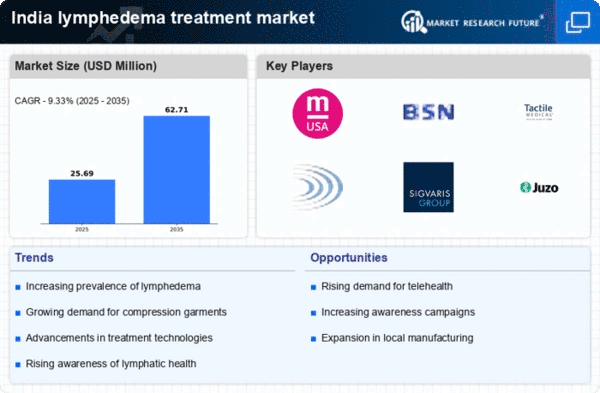
As per Market Research Future analysis, the India Lymphedema Treatment Market size was estimated at 23.5 USD million in 2024. The Lymphedema Treatment market is projected to grow from 25.69 USD Million in 2025 to 62.71 USD Million by 2035, exhibiting a compound annual growth rate (CAGR) of 9.3% during the forecast period 2025 - 2035

Key Market Trends & Highlights

The India lymphedema treatment market is experiencing notable growth driven by technological advancements and increased awareness.

  • Technological advancements in treatment modalities are enhancing patient outcomes and expanding treatment options.
  • Increased awareness and education about lymphedema are driving demand for effective management solutions.
  • The focus on holistic management approaches is gaining traction among healthcare providers and patients alike.
  • Rising incidence of lymphedema and government initiatives are key drivers propelling market growth.

Market Size & Forecast

2024 Market Size 23.5 (USD Million)
2035 Market Size 62.71 (USD Million)
CAGR (2025 - 2035) 9.33%

Major Players

Medi USA (US), BSN Medical (DE), Tactile Medical (US), Lympha Press (US), Sigvaris (CH), Juzo (DE), Essity (SE), 3M (US)

Our Impact
Enabled $4.3B Revenue Impact for Fortune 500 and Leading Multinationals
Partnering with 2000+ Global Organizations Each Year
30K+ Citations by Top-Tier Firms in the Industry

India Lymphedema Treatment Market Trends

This market is experiencing notable developments, driven by a combination of increasing awareness and advancements in treatment modalities. The rising incidence of lymphedema, particularly among cancer survivors and individuals with chronic conditions, has led to a growing demand for effective management solutions. Healthcare providers are increasingly recognizing the importance of early diagnosis and intervention, which is fostering a more proactive approach to treatment. Furthermore, the integration of technology in treatment options, such as the use of compression garments and pneumatic devices, is enhancing patient outcomes and satisfaction. In addition, the India Lymphedema Treatment Market is witnessing a shift towards personalized care, with tailored treatment plans becoming more prevalent. This trend is supported by ongoing research and clinical trials aimed at understanding the unique needs of patients. The collaboration between healthcare professionals and patients is crucial in developing effective management strategies. As the healthcare landscape evolves, the focus on holistic approaches, including lifestyle modifications and patient education, is likely to shape the future of lymphedema treatment. Overall, the market appears poised for growth, with innovations and patient-centric strategies driving its evolution.

Technological Advancements in Treatment

The lymphedema treatment market is seeing a surge in technological innovations, particularly in the development of advanced compression devices and wearable technology. These innovations aim to improve patient compliance and enhance treatment efficacy. The integration of smart technology in compression garments allows for real-time monitoring of limb volume and pressure, providing valuable data for healthcare providers. This trend suggests a shift towards more personalized and effective treatment options.

Increased Awareness and Education

There is a growing emphasis on awareness and education regarding lymphedema, which is crucial for early detection and management. Healthcare organizations and patient advocacy groups are actively promoting information campaigns to educate both patients and healthcare professionals. This trend indicates a collective effort to reduce stigma and improve understanding of the condition, ultimately leading to better patient outcomes.

Focus on Holistic Management Approaches

The lymphedema treatment market is increasingly adopting holistic management strategies that encompass not only medical interventions but also lifestyle modifications. This trend highlights the importance of integrating physical therapy, nutrition, and psychological support into treatment plans. Such comprehensive approaches are believed to enhance the overall quality of life for patients, suggesting a more patient-centered focus in the management of lymphedema.

India Lymphedema Treatment Market Drivers

Growing Geriatric Population

The increasing geriatric population in India is a significant driver of the lymphedema treatment market. As individuals age, the risk of developing lymphedema rises due to factors such as decreased mobility and the prevalence of chronic diseases. By 2030, it is projected that the elderly population in India will reach approximately 300 million, creating a substantial demand for healthcare services, including lymphedema treatment. This demographic shift necessitates a focus on specialized care and tailored treatment options for older adults. Consequently, healthcare providers are likely to expand their services to accommodate this growing population, thereby enhancing the lymphedema treatment market's scope and reach.

Rising Incidence of Lymphedema

The lymphedema treatment market is experiencing growth due to the increasing incidence of lymphedema in India. Factors such as cancer treatments, obesity, and genetic predispositions contribute to this rise. According to recent estimates, approximately 1 in 1,000 individuals may develop lymphedema, particularly post-surgery or radiation therapy for cancer. This growing patient population necessitates effective treatment options, thereby driving demand within the lymphedema treatment market. Furthermore, as awareness of the condition increases, more individuals seek medical intervention, further propelling market growth. The healthcare system's response to this rising incidence is crucial, as it influences the availability and accessibility of treatment options, including compression garments and physiotherapy.

Government Initiatives and Support

Government initiatives aimed at improving healthcare access and quality are significantly impacting the lymphedema treatment market. In India, various health programs focus on cancer care and chronic disease management, which indirectly address lymphedema. For instance, the National Health Mission has been instrumental in promoting awareness and providing resources for chronic conditions. Such initiatives may lead to increased funding for lymphedema treatment facilities and training for healthcare professionals. As a result, the market could see enhanced service delivery and patient outcomes. The government's commitment to improving healthcare infrastructure is likely to foster a more supportive environment for lymphedema treatment, ultimately benefiting patients and healthcare providers alike.

Advancements in Treatment Modalities

Innovations in treatment modalities are reshaping the lymphedema treatment market. The introduction of advanced compression therapies, such as pneumatic compression devices, has shown promising results in managing lymphedema symptoms. Additionally, the development of new surgical techniques, including lymphaticovenous anastomosis, offers potential solutions for patients with severe lymphedema. These advancements not only improve patient outcomes but also enhance the overall efficacy of treatment options available in the market. As healthcare providers adopt these innovative approaches, the lymphedema treatment market is likely to expand, catering to a broader range of patient needs. The integration of technology in treatment protocols may also lead to better monitoring and management of the condition.

Increased Focus on Patient-Centric Care

The lymphedema treatment market is witnessing a shift towards patient-centric care, emphasizing individualized treatment plans and holistic approaches. Healthcare providers are increasingly recognizing the importance of addressing not only the physical aspects of lymphedema but also the psychological and emotional well-being of patients. This trend is likely to lead to the development of comprehensive care models that integrate various treatment modalities, including physical therapy, counseling, and lifestyle modifications. As patients become more involved in their treatment decisions, the demand for personalized care solutions is expected to rise. This focus on patient-centricity may drive innovation within the lymphedema treatment market, ultimately improving patient satisfaction and outcomes.


Market Segment Insights

By Type: Primary Lymphedema (Largest) vs. Secondary Lymphedema (Fastest-Growing)

In the India lymphedema treatment market, Primary Lymphedema currently holds a significant market share due to its established presence and the availability of tailored treatment options. The awareness and diagnosis of this condition have improved, leading to a steady demand for targeted therapies. On the other hand, Secondary Lymphedema is experiencing rapid growth as it stems from various underlying conditions such as cancer and obesity, which are increasingly prevalent, thus widening the patient base needing treatment. The growth trends in this segment are primarily driven by the rising incidence of chronic diseases and lifestyle changes that contribute to Secondary Lymphedema. Additionally, advancements in treatment methods and increasing awareness among healthcare professionals and patients are propelling the demand. As healthcare systems evolve, the focus on early intervention and holistic care is also fostering an environment conducive to growth across both segments.

Lymphedema: Primary (Dominant) vs. Secondary (Emerging)

Primary Lymphedema is characterized by a genetic predisposition that often presents at birth or during puberty. This segment holds a dominant position in the market due to established treatment protocols and patient familiarity. Conversely, Secondary Lymphedema, arising from various medical conditions or treatments, is emerging rapidly. Factors such as rising cancer survival rates and an increase in obesity are contributing to its growth. The therapies for Secondary Lymphedema are diversifying, with new innovations and interventions being introduced. Both segments require specialized management approaches, but the urgent need to address Secondary Lymphedema is shaping future market dynamics significantly.

By Affected Area: Lower Extremity (Largest) vs. Genitalia (Fastest-Growing)

In the India lymphedema treatment market, the distribution among the affected areas is defined by notable differences in demand. The Lower Extremity segment holds the largest share, primarily due to the higher incidence of lymphedema in the legs and feet among patients. Comparatively, the Upper Extremity segment follows, while Genitalia represents a smaller, yet increasingly significant portion of the market, indicating a shift in patient awareness and treatment needs. Growth trends in this segment reveal a promising trajectory for the Genitalia area, which is emerging as the fastest-growing segment. This growth is driven by increasing clinical awareness, patient advocacy, and tailored treatment options that address specific needs of genital lymphedema. Healthcare providers are adapting to these demands, enhancing the market landscape for innovative therapies and improved patient outcomes.

Lower Extremity (Dominant) vs. Genitalia (Emerging)

The Lower Extremity segment is dominant in the India lymphedema treatment market, characterized by a higher volume of cases and an established network of treatment options. This segment benefits from a robust infrastructure, enabling better access to therapies like compression garments and physiotherapy. On the other hand, the Genitalia segment is emerging as a focus area, reflecting a growing recognition of lymphedema's impact on quality of life. Innovations and specialized treatments catering to this area are on the rise, as healthcare providers and patients alike seek comprehensive solutions. The evolving landscape is crucial, as awareness and treatment options continue to expand, serving both dominant and emerging segments.

By Treatment: Compression Devices (Largest) vs. Surgery (Fastest-Growing)

The India lymphedema treatment market showcases a diverse range of treatment options with varying market shares. Compression devices and bandaging segments currently represent the largest proportion of the market, driven by their widespread application and effectiveness in managing lymphedema symptoms. Laser therapy and drug therapy also contribute significantly, yet remain slightly behind in terms of overall market share, while surgical interventions are emerging as a crucial alternative for advanced cases. Examining the growth trends, the surgery segment is noted for its rapid expansion, attributed to advancements in surgical techniques and increased awareness about lymphedema treatment options. Furthermore, rising healthcare accessibility and government initiatives for better disease management are also propelling the growth of drug therapy and laser therapy segments, hence fostering a dynamic and competitive treatment landscape in the market.

Compression Devices (Dominant) vs. Laser Therapy (Emerging)

Compression devices hold a dominant position in the India lymphedema treatment market, being a foundational approach for managing symptoms in patients. These devices, including bandages and garments, aid in reducing swelling and promoting lymphatic drainage, making them essential for patients. In contrast, laser therapy emerges as a novel and innovative treatment option, targeting lymphatic tissue with precision. Although gaining traction, laser therapy is still in the early adoption phase but shows promise for enhanced patient outcomes and fewer side effects, positioning it as an attractive alternative or complement to traditional methods.

By End-User: Hospitals and Clinics (Largest) vs. Clinical Research Organizations (Fastest-Growing)

The India lymphedema treatment market shows a diverse distribution in its end-user segments, with hospitals and clinics holding the largest share. This segment benefits from a rising number of facilities offering specialized services for lymphedema treatment. Clinical research organizations, while smaller, represent a fast-growing segment as more trials and studies are dedicated to understanding and improving treatment methods, highlighting a shift towards research-intensive approaches in healthcare. Growth trends in this segment are driven by increased awareness of lymphedema conditions and advancements in treatment technologies. Hospitals and clinics are expanding their capacities to accommodate more patients, while clinical research organizations are gaining traction through partnerships with healthcare providers to facilitate innovative therapies. This dynamic creates opportunities for both segments, shaping the overall landscape of the market.

Hospitals and Clinics (Dominant) vs. Clinical Research Organizations (Emerging)

Hospitals and clinics dominate the India lymphedema treatment market due to their established infrastructure and comprehensive service offerings. They provide a wide range of treatments and have direct access to patients, ensuring a steady demand for lymphedema therapies. Their dominance is complemented by the increasing number of patients seeking treatment, which is further propelled by greater awareness and advocacy efforts. On the other hand, clinical research organizations are emerging as significant players, focusing on innovative treatment solutions and facilitating clinical trials. They play a crucial role in advancing therapeutic options, collaborating with academia and industry to deliver novel therapies. The synergy between these segments indicates strong potential for growth and enhanced patient outcomes.

Get more detailed insights about India Lymphedema Treatment Market

Key Players and Competitive Insights

The lymphedema treatment market in India is characterized by a competitive landscape that is increasingly shaped by innovation, strategic partnerships, and regional expansion. Key players such as Medi USA (US), BSN Medical (DE), and Tactile Medical (US) are actively pursuing strategies that enhance their market presence. Medi USA (US) focuses on developing advanced compression therapy solutions, while BSN Medical (DE) emphasizes a broad portfolio of wound care and compression products. Tactile Medical (US) is leveraging its expertise in pneumatic compression devices to cater to the growing demand for effective lymphedema management. Collectively, these strategies indicate a trend towards comprehensive treatment solutions that address patient needs holistically.In terms of business tactics, companies are increasingly localizing manufacturing to reduce costs and improve supply chain efficiency. This approach not only enhances responsiveness to market demands but also aligns with the broader trend of sustainability. The competitive structure of the market appears moderately fragmented, with several players vying for market share. However, the influence of major companies is significant, as they set benchmarks for quality and innovation that smaller firms often strive to meet.

In October BSN Medical (DE) announced a strategic partnership with a leading Indian healthcare provider to enhance distribution channels for its compression therapy products. This move is likely to bolster BSN's market penetration and improve accessibility for patients in need of lymphedema treatment. The partnership underscores the importance of local collaborations in navigating the complexities of the Indian healthcare landscape.

In September Tactile Medical (US) launched a new line of wearable pneumatic compression devices specifically designed for the Indian market. This product introduction is significant as it reflects Tactile's commitment to innovation and its responsiveness to local patient needs. By tailoring its offerings, Tactile Medical (US) positions itself as a leader in providing effective solutions for lymphedema management in India.

In August Medi USA (US) expanded its manufacturing capabilities in India, aiming to increase production efficiency and reduce lead times for its compression garments. This strategic move not only enhances Medi's operational capabilities but also aligns with the growing demand for locally produced medical devices, which can lead to improved patient outcomes and satisfaction.

As of November the competitive trends in the lymphedema treatment market are increasingly defined by digitalization, sustainability, and the integration of advanced technologies such as AI. Strategic alliances are becoming pivotal in shaping the landscape, as companies seek to leverage each other's strengths to enhance their offerings. Looking ahead, it appears that competitive differentiation will evolve from traditional price-based competition to a focus on innovation, technological advancements, and reliable supply chains. This shift may ultimately lead to improved patient care and outcomes in the lymphedema treatment market.

Key Companies in the India Lymphedema Treatment Market include

Industry Developments

The India Lymphedema Treatment Market has recently seen various news developments and current affairs enhancing its landscape. With the increasing prevalence of lymphedema, major companies such as Pfizer and Merck are ramping up their Research and Development efforts to introduce innovative treatment options. In April 2023, Tata Medical expanded its portfolio to include advanced compression therapies, demonstrating a notable shift towards improved management solutions. 

Additionally, Boehringer Ingelheim has collaborated with Indian healthcare providers to enhance patient education and awareness about lymphedema, reflecting a growing focus on holistic patient care.In terms of mergers and acquisitions, in November 2022, Cook Medical announced its acquisition of a leading Indian lymphedema technology company, strengthening its foothold in the Indian market. This strategic move is expected to enhance its market valuation significantly. 

Since 2021, partnerships between organizations such as Johnson and Johnson and local hospitals have increased the accessibility of treatment options, further propelling market growth. Reports indicate a promising trajectory for the India Lymphedema Treatment Market, predicted to witness substantial growth due to rising demand for effective therapies and awareness initiatives by industry leaders.

Future Outlook

India Lymphedema Treatment Market Future Outlook

The Lymphedema Treatment Market in India is projected to grow at a 9.33% CAGR from 2025 to 2035, driven by increasing awareness and advancements in treatment technologies.

New opportunities lie in:

  • Development of telehealth platforms for remote patient monitoring
  • Investment in biodegradable compression garments for sustainability
  • Expansion of specialized lymphedema clinics in urban areas

By 2035, the market is expected to achieve substantial growth, reflecting enhanced treatment accessibility and innovation.

Market Segmentation

India Lymphedema Treatment Market Type Outlook

  • Primary Lymphedema
  • Secondary Lymphedema

India Lymphedema Treatment Market End-User Outlook

  • Hospitals and Clinics
  • Clinical Research Organizations
  • Research & Academic Institutes

India Lymphedema Treatment Market Treatment Outlook

  • Compression Devices & Bandaging
  • Laser Therapy
  • Drug Therapy
  • Surgery

India Lymphedema Treatment Market Affected Area Outlook

  • Lower Extremity
  • Upper Extremity
  • Genitalia

Report Scope

MARKET SIZE 2024 23.5(USD Million)
MARKET SIZE 2025 25.69(USD Million)
MARKET SIZE 2035 62.71(USD Million)
COMPOUND ANNUAL GROWTH RATE (CAGR) 9.33% (2025 - 2035)
REPORT COVERAGE Revenue Forecast, Competitive Landscape, Growth Factors, and Trends
BASE YEAR 2024
Market Forecast Period 2025 - 2035
Historical Data 2019 - 2024
Market Forecast Units USD Million
Key Companies Profiled Medi USA (US), BSN Medical (DE), Tactile Medical (US), Lympha Press (US), Sigvaris (CH), Juzo (DE), Essity (SE), 3M (US)
Segments Covered Type, Affected Area, Treatment, End-User
Key Market Opportunities Emerging technologies in lymphedema treatment enhance patient outcomes and drive market growth opportunities.
Key Market Dynamics Rising demand for innovative lymphedema therapies drives competition and regulatory adaptations in the treatment market.
Countries Covered India
Leave a Comment

FAQs

What is the expected market size of the India Lymphedema Treatment Market in 2024?

The India Lymphedema Treatment Market is expected to be valued at 23.5 USD Million in 2024.

What is the projected market size for the India Lymphedema Treatment Market by 2035?

By 2035, the market is projected to reach a value of 71.84 USD Million.

What is the expected CAGR for the India Lymphedema Treatment Market from 2025 to 2035?

The expected CAGR for the market during the forecast period is 10.692%.

Which type of lymphedema treatment has a higher market value in 2024?

In 2024, Secondary Lymphedema is valued at 14.1 USD Million, which is higher than Primary Lymphedema's value of 9.4 USD Million.

What will be the market value for Primary Lymphedema treatment by 2035?

The market value for Primary Lymphedema treatment is expected to be 28.2 USD Million by 2035.

What is the expected market value for Secondary Lymphedema treatment by 2035?

By 2035, the market value for Secondary Lymphedema treatment is projected to be 43.64 USD Million.

Who are some key players in the India Lymphedema Treatment Market?

Major players in the market include Pfizer, Boehringer Ingelheim, and Tata Medical among others.

What opportunities exist in the India Lymphedema Treatment Market?

Emerging trends, advancements in treatment methods and increasing healthcare awareness provide substantial opportunities for market growth.

What challenges does the India Lymphedema Treatment Market face?

The market faces challenges such as lack of awareness and limited accessibility to treatment options in certain regions.

How is the current global scenario affecting the India Lymphedema Treatment Market?

Current global issues may influence supply chains and healthcare accessibility, impacting market stability.

Download Free Sample

Kindly complete the form below to receive a free sample of this Report

Compare Licence

×
Features License Type
Single User Multiuser License Enterprise User
Price $4,950 $5,950 $7,250
Maximum User Access Limit 1 User Upto 10 Users Unrestricted Access Throughout the Organization
Free Customization
Direct Access to Analyst
Deliverable Format
Platform Access
Discount on Next Purchase 10% 15% 15%
Printable Versions