×
Request Free Sample ×

Kindly complete the form below to receive a free sample of this Report

* Please use a valid business email

Leading companies partner with us for data-driven Insights

clients tt-cursor
Hero Background

Japan Lymphedema Treatment Market

ID: MRFR/MED/49234-HCR
200 Pages
Garvit Vyas
February 2026

Japan Lymphedema Treatment Market Research Report: Size, Share, Trend Analysis By Types (Primary Lymphedema, Secondary Lymphedema), By Affected Area (Lower Extremity, Upper Extremity, Genitalia), By Treatment (Compression Devices & Bandaging, Laser Therapy, Drug Therapy & Surgery), and By End-User (Hospitals and Clinics, Clinical Research Organizations, Research & Academic Institutes) - Growth Outlook & Industry Forecast 2025 To 2035

Share:
Download PDF ×

We do not share your information with anyone. However, we may send you emails based on your report interest from time to time. You may contact us at any time to opt-out.

Japan Lymphedema Treatment Market Infographic
Purchase Options

Japan Lymphedema Treatment Market Summary

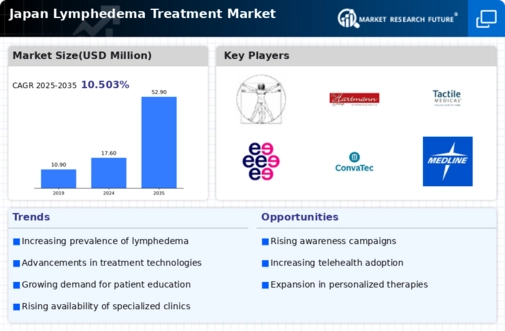
As per Market Research Future analysis, the Japan lymphedema treatment market size was estimated at 17.63 USD Million in 2024. The Japan lymphedema treatment market is projected to grow from 19.37 USD Million in 2025 to 49.87 USD Million by 2035, exhibiting a compound annual growth rate (CAGR) of 9.9% during the forecast period 2025 - 2035

Key Market Trends & Highlights

The Japan lymphedema treatment market is experiencing notable growth driven by increased awareness and technological advancements.

  • Rising awareness and education about lymphedema treatment options are fostering market growth.
  • Technological advancements in treatment modalities are enhancing patient outcomes and driving demand.
  • The largest segment in the market is home-based care, while the fastest-growing segment is advanced therapeutic devices.
  • Key market drivers include the increasing incidence of lymphedema and growing healthcare expenditure, which are likely to propel market expansion.

Market Size & Forecast

2024 Market Size 17.63 (USD Million)
2035 Market Size 49.87 (USD Million)
CAGR (2025 - 2035) 9.92%

Major Players

Medi USA (US), BSN Medical (DE), Tactile Medical (US), Lympha Press (US), Sigvaris (CH), Juzo (DE), Essity (SE), MediCom (US)

Our Impact
Enabled $4.3B Revenue Impact for Fortune 500 and Leading Multinationals
Partnering with 2000+ Global Organizations Each Year
30K+ Citations by Top-Tier Firms in the Industry

Japan Lymphedema Treatment Market Trends

The lymphedema treatment market in Japan is currently experiencing significant growth, driven by an increasing awareness of the condition and its management. Lymphedema, characterized by localized fluid retention and tissue swelling, often results from surgical procedures or radiation therapy, particularly in cancer patients. As the population ages, the prevalence of lymphedema is likely to rise, prompting healthcare providers to seek effective treatment options. This growing demand is reflected in the expansion of specialized clinics and the introduction of advanced therapeutic devices. Furthermore, the integration of multidisciplinary approaches in treatment plans appears to enhance patient outcomes, fostering a more comprehensive understanding of lymphedema management. In addition, the Japanese government has been proactive in promoting healthcare initiatives aimed at improving the quality of life for individuals affected by lymphedema. This includes funding for research and development of innovative therapies, as well as educational programs for healthcare professionals. The collaboration between public health entities and private sector stakeholders seems to be strengthening the overall framework for lymphedema treatment. As awareness continues to grow, the market is poised for further advancements, potentially leading to improved therapeutic options and increased accessibility for patients in need.

Rising Awareness and Education

There is a noticeable increase in awareness regarding lymphedema among both healthcare professionals and the general public in Japan. Educational campaigns and workshops are being organized to inform individuals about the condition, its causes, and available treatment options. This heightened awareness is likely to lead to earlier diagnosis and intervention, which may improve patient outcomes.

Technological Advancements in Treatment

The lymphedema treatment market is witnessing significant technological innovations, particularly in the development of advanced compression garments and devices. These innovations aim to enhance the effectiveness of treatment while ensuring patient comfort. As technology continues to evolve, it is expected that new solutions will emerge, potentially transforming the management of lymphedema.

Government Support and Funding

The Japanese government is actively supporting initiatives aimed at improving lymphedema treatment. This includes funding for research projects and the establishment of specialized treatment centers. Such support is likely to facilitate the development of new therapies and improve access to care for patients, thereby enhancing the overall treatment landscape.

Japan Lymphedema Treatment Market Drivers

Growing Healthcare Expenditure

Japan's increasing healthcare expenditure is a significant driver for the lymphedema treatment market. The government has been investing heavily in healthcare infrastructure, which includes funding for specialized treatments. In 2025, healthcare spending is projected to reach approximately ¥50 trillion, reflecting a commitment to improving patient care. This financial support is likely to enhance access to lymphedema treatments, including surgical options and rehabilitation services. As healthcare budgets expand, the lymphedema treatment market may experience growth in both public and private sectors, facilitating the development of new treatment facilities and training programs for healthcare providers.

Rising Demand for Home-Based Care

The trend towards home-based care is reshaping the lymphedema treatment market. Patients increasingly prefer receiving treatment in the comfort of their homes, which has led to a surge in demand for home care services and products. This shift is partly driven by the desire for convenience and the need for continuous management of lymphedema. The lymphedema treatment market is responding by offering a range of home-based solutions, including portable compression devices and telehealth consultations. This evolution in care delivery may improve patient outcomes and satisfaction, as it allows for more personalized and flexible treatment options.

Increasing Incidence of Lymphedema

The rising incidence of lymphedema in Japan is a crucial driver for the lymphedema treatment market. Factors such as an aging population and the prevalence of chronic diseases contribute to this increase. According to recent health statistics, approximately 1.5 million individuals in Japan are affected by lymphedema, which underscores the need for effective treatment options. This growing patient population is likely to drive demand for various therapeutic modalities, including compression garments and manual lymphatic drainage. As awareness of lymphedema expands, healthcare providers are more inclined to offer specialized treatment, further propelling market growth. The lymphedema treatment market must adapt to these demographic changes by enhancing service delivery and expanding access to care.

Advancements in Treatment Modalities

Innovations in treatment modalities are significantly influencing the lymphedema treatment market. The introduction of advanced compression technologies, such as pneumatic compression devices, has improved patient outcomes and comfort. Additionally, the development of new pharmacological agents aimed at managing lymphedema symptoms is emerging. The market is witnessing a shift towards more personalized treatment plans, which may enhance patient adherence and satisfaction. In Japan, the lymphedema treatment market is expected to benefit from these advancements, as they provide healthcare professionals with more effective tools to manage the condition. The integration of these technologies into clinical practice could potentially lead to a more streamlined approach to lymphedema care.

Enhanced Training and Education for Healthcare Providers

The emphasis on enhanced training and education for healthcare providers is a pivotal driver for the lymphedema treatment market. As awareness of lymphedema grows, there is a corresponding need for healthcare professionals to be well-versed in the latest treatment protocols. Educational initiatives and certification programs are being developed to equip providers with the necessary skills to manage lymphedema effectively. This focus on professional development is likely to improve the quality of care delivered to patients, thereby fostering trust and encouraging more individuals to seek treatment. The lymphedema treatment market stands to benefit from a more knowledgeable workforce, which may lead to better patient outcomes and increased market demand.


Market Segment Insights

By Type: Primary Lymphedema (Largest) vs. Secondary Lymphedema (Fastest-Growing)

The Japan lymphedema treatment market is primarily driven by two distinct segment values: Primary Lymphedema and Secondary Lymphedema. Primary Lymphedema has established itself as the largest segment, reflecting a significant market share due to the prevalence of genetic conditions affecting lymphatic development. On the other hand, Secondary Lymphedema is witnessing rapid growth, primarily driven by the rising incidence of chronic illnesses such as cancer and obesity that lead to lymphedema as a complication. Growth trends in the Japan lymphedema treatment market are influenced by advancements in treatment modalities and increasing awareness about lymphedema management. As healthcare providers become more informed about effective treatment options, particularly for Secondary Lymphedema, the demand is expected to surge. Innovative therapies and improved access to treatment facilities are contributing factors, positioning Secondary Lymphedema as a dynamic and evolving segment.

Primary Lymphedema (Dominant) vs. Secondary Lymphedema (Emerging)

Primary Lymphedema is characterized by its genetic origins, typically manifesting in individuals with hereditary conditions that disrupt lymphatic development. This segment remains dominant due to its established presence within healthcare frameworks and the availability of specialized treatments. In contrast, Secondary Lymphedema is emerging as a significant player in the market, driven by the increasing prevalence of lifestyle-related diseases and post-surgical complications. It often requires a complex management approach, including drainage therapies and compression garments. Secondary Lymphedema’s rapid growth is also supported by a heightened focus on patient education and rehabilitation efforts tailored to improve patient outcomes and enhance quality of life.

By Affected Area: Lower Extremity (Largest) vs. Upper Extremity (Fastest-Growing)

In the Japan lymphedema treatment market, the lower extremity segment dominates the market share, reflecting the higher prevalence of lymphedema in the legs due to various medical conditions and surgeries. This segment's substantial share is driven by the critical need for effective management strategies and products to address the unique challenges faced by patients with lower extremity lymphedema. Conversely, the upper extremity segment is experiencing rapid growth, attributed to rising awareness about lymphedema management and increased diagnosis rates. Factors such as advancements in treatment technologies and greater availability of specialized products are contributing to its status as the fastest-growing segment. This trend showcases a shift in focus towards comprehensive care across different affected areas, enhancing patient quality of life.

Lower Extremity (Dominant) vs. Upper Extremity (Emerging)

The lower extremity segment holds a dominant position in the Japan lymphedema treatment market due to its significant patient base and established treatment protocols. This segment involves various therapeutic options, including compression therapy, manual lymphatic drainage, and surgical interventions, tailored to effectively manage lymphedema symptoms. On the other hand, the upper extremity segment is emerging with increasing market presence, as healthcare professionals advocate for early intervention strategies and personalized care. Innovations in product development, including advanced compression garments and therapy devices, are gaining traction among patients. The collaboration between healthcare providers and manufacturers is further enhancing treatment accessibility and effectiveness, paving the way for the upper extremity segment to grow.

By Treatment: Compression Devices & Bandaging (Largest) vs. Laser Therapy (Fastest-Growing)

In the Japan lymphedema treatment market, the largest share is held by Compression Devices & Bandaging, which is crucial for managing symptoms and improving patient quality of life. This segment benefits from a solid customer base and a high rate of adoption among healthcare providers. While Compression Devices & Bandaging leads, Laser Therapy is quickly gaining traction, capturing increasing attention for its non-invasive approach and effective outcomes. Growth in this segment is driven by technological advancements and a rising prevalence of lymphedema. As awareness increases, patients seek effective treatment options, leading to heightened demand for innovative therapies. Particularly, the emergence of advanced laser technologies illustrates a shift towards less invasive treatments, enhancing patient comfort and ultimately driving market growth. Overall, the segment is expected to expand, with Compression Devices maintaining dominance while Laser Therapy emerges as a significant player.

Compression Devices & Bandaging (Dominant) vs. Laser Therapy (Emerging)

Compression Devices & Bandaging represents the dominant treatment option within the segment, characterized by various products designed to alleviate lymphedema symptoms effectively. These devices are an integral part of patient management plans, helping to reduce swelling and improve mobility. Conversely, Laser Therapy is an emerging option that utilizes targeted light beams to treat tissue damage and promote healing. As this therapy becomes more widely recognized, its adoption is fueled by ongoing clinical studies indicating its effectiveness, positioning it as a promising alternative for patients seeking innovative treatment solutions.

By End-User: Hospitals and Clinics (Largest) vs. Clinical Research Organizations (Fastest-Growing)

In the Japan lymphedema treatment market, the distribution of market share among end-users reflects a significant emphasis on Hospitals and Clinics, which hold the majority share due to their essential role in patient treatment and management. Clinical Research Organizations follow closely, driven by their increasing engagement in clinical trials and the development of innovative treatment solutions, contributing to a dynamic landscape within the sector. Growth in the end-user segment is fueled by various factors including an increasing prevalence of lymphedema, enhanced awareness of effective treatment options, and advancements in surgical techniques and compression therapies. Hospitals and Clinics continue to be the primary facilitators of treatments, while Clinical Research Organizations are rapidly evolving, showing robust growth as they focus on research and development of new therapies tailored to patient needs. Their strategic collaborations with healthcare providers are propelling this growth further, reflecting a combination of market demand and the need for innovative treatment methodologies.

Hospitals and Clinics (Dominant) vs. Clinical Research Organizations (Emerging)

Hospitals and Clinics represent the dominant force in the Japan lymphedema treatment market, providing essential patient care through a range of treatment options including manual lymphatic drainage, compression therapy, and surgical interventions. Their established infrastructure and patient trust contribute to their leading position. Conversely, Clinical Research Organizations are emerging players, focusing on clinical trials and research initiatives that drive innovation in lymphedema treatments. These organizations play a critical role in bridging the gap between research and practical application, often collaborating with hospitals to introduce novel therapies. Their agility in adapting to new research findings positions them effectively for growth, making them an integral part of the evolving treatment landscape.

Get more detailed insights about Japan Lymphedema Treatment Market

Key Players and Competitive Insights

The lymphedema treatment market in Japan is characterized by a competitive landscape that is increasingly shaped by innovation, strategic partnerships, and a focus on patient-centric solutions. Key players such as Medi USA (US), BSN Medical (DE), and Sigvaris (CH) are actively engaged in enhancing their product offerings and expanding their market presence. Medi USA (US) has positioned itself as a leader in compression therapy, emphasizing the development of advanced materials that improve patient comfort and compliance. Meanwhile, BSN Medical (DE) has focused on integrating digital health solutions into its product lines, which appears to resonate well with the growing demand for telehealth services. Sigvaris (CH) is also notable for its commitment to sustainability, which is becoming a crucial factor in consumer decision-making, thereby influencing the competitive dynamics of the market.The business tactics employed by these companies reflect a nuanced understanding of local market needs. For instance, localizing manufacturing processes has allowed these firms to reduce lead times and enhance supply chain efficiency. The market structure is moderately fragmented, with several players vying for market share, yet the collective influence of major companies is significant. This fragmentation fosters innovation, as companies strive to differentiate their offerings in a crowded marketplace.

In October Tactile Medical (US) announced a strategic partnership with a leading Japanese healthcare provider to enhance access to its lymphedema management solutions. This collaboration is expected to facilitate the integration of Tactile Medical's advanced technologies into local healthcare systems, thereby improving patient outcomes. Such partnerships are indicative of a broader trend where companies seek to leverage local expertise to navigate regulatory landscapes and enhance service delivery.

In September Juzo (DE) launched a new line of compression garments specifically designed for the Japanese market, incorporating feedback from local healthcare professionals. This move not only demonstrates Juzo's commitment to meeting regional needs but also highlights the importance of customization in product development. By aligning its offerings with local preferences, Juzo is likely to strengthen its competitive position in the market.

In August Essity (SE) unveiled a digital platform aimed at educating patients about lymphedema management and treatment options. This initiative reflects a growing trend towards digitalization in healthcare, where companies are increasingly investing in educational resources to empower patients. By enhancing patient knowledge and engagement, Essity is positioning itself as a thought leader in the lymphedema treatment space.

As of November the competitive landscape is being defined by trends such as digitalization, sustainability, and the integration of artificial intelligence in treatment protocols. Strategic alliances are becoming more prevalent, as companies recognize the value of collaboration in enhancing their service offerings. Looking ahead, it appears that competitive differentiation will increasingly hinge on innovation and technological advancements rather than solely on price. The emphasis on supply chain reliability and patient-centric solutions is likely to shape the future of the lymphedema treatment market.

Key Companies in the Japan Lymphedema Treatment Market include

Industry Developments

In Japan, the Lymphedema Treatment Market is experiencing significant growth and advancements. Notable companies, including Surgical Innovations, HARTMANN GROUP, Tactile Medical, and Smith & Nephew, are actively engaged in introducing innovative treatment options.

A noteworthy development occurred in January 2023, when HARTMANN GROUP unveiled a new product line aimed specifically at improving lymphatic health among patients. The increasing prevalence of lymphedema due to an aging population is driving demand for effective treatment solutions, with market valuations of key players like Medi and Nipro Corporation rising steadily.

In recent times, Tactile Medical has reported substantial growth in sales within Japan, attributed to increased awareness and early diagnosis of lymphedema. Furthermore, in March 2022, KCI Medical acquired a local company to enhance its distribution networks, enabling easier access to advanced lymphedema therapies across Japan’s healthcare facilities.

The ongoing collaboration among international and local firms is expected to lead to a surge in Research and Development activities, ultimately benefiting patients who require comprehensive lymphedema management solutions. The concerted efforts of companies such as 3M and Cardinal Health continue to add value and drive progress within this specialized market segment.

Future Outlook

Japan Lymphedema Treatment Market Future Outlook

The Lymphedema Treatment Market is projected to grow at a 9.92% CAGR from 2025 to 2035, driven by increasing awareness, technological advancements, and rising patient populations.

New opportunities lie in:

  • Development of telehealth platforms for remote patient monitoring
  • Investment in biodegradable compression garments
  • Expansion of specialized lymphedema clinics in urban areas

By 2035, the market is expected to achieve substantial growth, enhancing treatment accessibility and innovation.

Market Segmentation

Japan Lymphedema Treatment Market Type Outlook

  • Primary Lymphedema
  • Secondary Lymphedema

Japan Lymphedema Treatment Market End-User Outlook

  • Hospitals and Clinics
  • Clinical Research Organizations
  • Research & Academic Institutes

Japan Lymphedema Treatment Market Treatment Outlook

  • Compression Devices & Bandaging
  • Laser Therapy
  • Drug Therapy
  • Surgery

Japan Lymphedema Treatment Market Affected Area Outlook

  • Lower Extremity
  • Upper Extremity
  • Genitalia

Report Scope

MARKET SIZE 2024 17.63(USD Million)
MARKET SIZE 2025 19.37(USD Million)
MARKET SIZE 2035 49.87(USD Million)
COMPOUND ANNUAL GROWTH RATE (CAGR) 9.92% (2025 - 2035)
REPORT COVERAGE Revenue Forecast, Competitive Landscape, Growth Factors, and Trends
BASE YEAR 2024
Market Forecast Period 2025 - 2035
Historical Data 2019 - 2024
Market Forecast Units USD Million
Key Companies Profiled Medi USA (US), BSN Medical (DE), Tactile Medical (US), Lympha Press (US), Sigvaris (CH), Juzo (DE), Essity (SE), MediCom (US)
Segments Covered Type, Affected Area, Treatment, End-User
Key Market Opportunities Emerging technologies in lymphedema treatment enhance patient outcomes and drive market growth opportunities.
Key Market Dynamics Rising demand for innovative therapies drives competition and regulatory adaptations in the lymphedema treatment market.
Countries Covered Japan
Leave a Comment

FAQs

What is the projected market size of the Japan Lymphedema Treatment Market in 2024?

The Japan Lymphedema Treatment Market is expected to be valued at 17.63 USD million in 2024.

What will the value of the Japan Lymphedema Treatment Market reach by 2035?

By 2035, the market is anticipated to grow to 52.88 USD million.

What is the expected CAGR for the Japan Lymphedema Treatment Market from 2025 to 2035?

The market is expected to grow at a CAGR of 10.503 percent during the period from 2025 to 2035.

Which segment dominates the Japan Lymphedema Treatment Market?

The segment for Secondary Lymphedema is valued at 10.58 USD million in 2024 and is a significant part of the market.

What will be the market value for Primary Lymphedema by 2035?

The market value for Primary Lymphedema is projected to reach 21.2 USD million by 2035.

Who are the major players in the Japan Lymphedema Treatment Market?

Key players include Surgical Innovations, HARTMANN GROUP, Tactile Medical, and Smith & Nephew, among others.

What is the 2025 market growth rate for Secondary Lymphedema?

The Secondary Lymphedema segment is expected to contribute significantly to market growth during 2025 to 2035.

How does the market size for Lymphedema treatment compare between Primary and Secondary Lymphedema?

In 2024, Primary Lymphedema is valued at 7.05 USD million while Secondary Lymphedema stands at 10.58 USD million.

What are the emerging trends in the Japan Lymphedema Treatment Market?

The market is witnessing trends such as increased awareness and advancements in treatment technologies.

What challenges are currently facing the Japan Lymphedema Treatment Market?

Challenges include the increasing cost of treatments and ensuring accessibility for patients.

Download Free Sample

Kindly complete the form below to receive a free sample of this Report

Compare Licence

×
Features License Type
Single User Multiuser License Enterprise User
Price $4,950 $5,950 $7,250
Maximum User Access Limit 1 User Upto 10 Users Unrestricted Access Throughout the Organization
Free Customization
Direct Access to Analyst
Deliverable Format
Platform Access
Discount on Next Purchase 10% 15% 15%
Printable Versions