×
Request Free Sample ×

Kindly complete the form below to receive a free sample of this Report

* Please use a valid business email

Leading companies partner with us for data-driven Insights

clients tt-cursor
Hero Background

India Intrusion Detection System Market

ID: MRFR/ICT/59046-HCR
200 Pages
Aarti Dhapte
February 2026

India Intrusion Detection System Market Size, Share and Research Report: By Component (Solution, Services), By Deployment (Cloud Based, Infrastructure Based) and By End User (BFSI, IT & Communication, Aerospace & Defense, Software Industry, Manufacturing)- Industry Forecast to 2035

Share:
Download PDF ×

We do not share your information with anyone. However, we may send you emails based on your report interest from time to time. You may contact us at any time to opt-out.

India Intrusion Detection System Market Infographic
Purchase Options

India Intrusion Detection System Market Summary

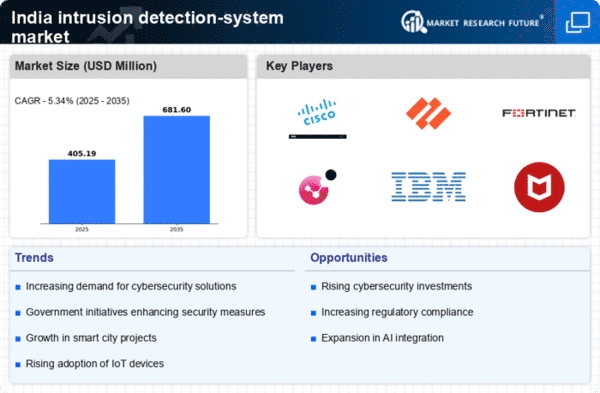
As per Market Research Future analysis, the India intrusion detection-system market Size was estimated at 384.65 USD Million in 2024. The India intrusion detection-system market industry is projected to grow from 405.19 USD Million in 2025 to 681.6 USD Million by 2035, exhibiting a compound annual growth rate (CAGR) of 5.3% during the forecast period 2025 - 2035

Key Market Trends & Highlights

The India intrusion detection-system market is experiencing robust growth driven by increasing cybersecurity awareness and technological advancements.

  • Rising cybersecurity awareness is prompting organizations to invest more in intrusion detection systems.
  • Regulatory compliance requirements are driving the adoption of advanced security solutions across various sectors.
  • Technological advancements in AI and machine learning are enhancing the effectiveness of intrusion detection systems.
  • Increasing cyber threats and government initiatives for cybersecurity are major drivers propelling market growth.

Market Size & Forecast

2024 Market Size 384.65 (USD Million)
2035 Market Size 681.6 (USD Million)
CAGR (2025 - 2035) 5.34%

Major Players

Cisco Systems (US), Palo Alto Networks (US), Fortinet (US), Check Point Software Technologies (IL), IBM (US), McAfee (US), Trend Micro (JP), FireEye (US), Splunk (US)

Our Impact
Enabled $4.3B Revenue Impact for Fortune 500 and Leading Multinationals
Partnering with 2000+ Global Organizations Each Year
30K+ Citations by Top-Tier Firms in the Industry

India Intrusion Detection System Market Trends

The intrusion detection-system market is currently experiencing notable growth, driven by increasing security concerns and the rising frequency of cyber threats. Organizations across various sectors are prioritizing the implementation of advanced security measures to protect sensitive data and infrastructure. This heightened awareness has led to a surge in demand for sophisticated intrusion detection systems that can effectively monitor and respond to potential threats in real-time. As technology evolves, the market is witnessing innovations that enhance the capabilities of these systems, making them more efficient and user-friendly. Moreover, the regulatory landscape is also influencing the intrusion detection-system market. Government initiatives aimed at strengthening cybersecurity frameworks are prompting businesses to invest in robust security solutions. Compliance with these regulations not only safeguards organizations from potential breaches but also fosters trust among clients and stakeholders. As a result, the market is likely to see a continuous influx of investments, further propelling its expansion in the coming years. The integration of artificial intelligence and machine learning into these systems is expected to enhance their effectiveness, providing organizations with a proactive approach to threat detection and response.

Rising Cybersecurity Awareness

There is an increasing recognition of the importance of cybersecurity among organizations. This trend is leading to greater investments in intrusion detection systems as businesses seek to protect their assets from potential threats.

Regulatory Compliance

Government regulations are becoming more stringent, compelling organizations to adopt advanced security measures. Compliance with these regulations is driving the demand for intrusion detection systems, as businesses aim to meet legal requirements.

Technological Advancements

The intrusion detection-system market is witnessing rapid technological innovations. The integration of artificial intelligence and machine learning is enhancing the capabilities of these systems, allowing for more effective threat detection and response.

India Intrusion Detection System Market Drivers

Emergence of IoT Devices

The proliferation of Internet of Things (IoT) devices in India is significantly impacting the intrusion detection-system market. With the increasing connectivity of devices, the potential for cyber threats escalates, necessitating advanced security solutions. The number of IoT devices in India is projected to reach 1.5 billion by 2025, creating a vast network that requires robust intrusion detection systems to monitor and protect against unauthorized access. Organizations are recognizing the importance of securing their IoT ecosystems, leading to a surge in demand for specialized intrusion detection solutions. This trend suggests that the intrusion detection-system market will continue to grow as businesses adapt to the challenges posed by the expanding IoT landscape.

Increasing Cyber Threats

The intrusion detection-system market is experiencing growth due to the rising frequency and sophistication of cyber threats in India. Organizations are increasingly targeted by cybercriminals, leading to a heightened demand for robust security solutions. Reports indicate that cybercrime costs in India could reach $1 trillion by 2025, prompting businesses to invest in advanced intrusion detection systems. This trend is particularly evident in sectors such as finance and healthcare, where sensitive data is at risk. As a result, companies are prioritizing the implementation of intrusion detection systems to safeguard their assets and maintain customer trust. The urgency to protect against these threats is likely to drive market expansion in the coming years.

Growth of Digital Transformation

The ongoing digital transformation across various industries in India is a significant driver for the intrusion detection-system market. As businesses increasingly adopt digital technologies, the attack surface for cyber threats expands, necessitating enhanced security measures. The market for digital transformation in India is projected to reach $500 billion by 2025, with a substantial portion allocated to cybersecurity solutions. Organizations are recognizing the importance of integrating intrusion detection systems into their digital strategies to mitigate risks associated with cyber threats. This trend indicates a growing awareness of the need for comprehensive security solutions, which is likely to propel the intrusion detection-system market forward.

Rising Adoption of Cloud Services

The intrusion detection-system market is benefiting from the rising adoption of cloud services in India. As more organizations migrate their operations to the cloud, the need for effective security measures becomes paramount. Cloud environments present unique challenges, making traditional security measures insufficient. Consequently, businesses are increasingly investing in intrusion detection systems tailored for cloud infrastructure. The cloud services market in India is expected to grow at a CAGR of 25% over the next five years, indicating a strong demand for integrated security solutions. This shift towards cloud computing is likely to drive the intrusion detection-system market as organizations seek to protect their data and applications in the cloud.

Government Initiatives for Cybersecurity

The intrusion detection-system market is positively influenced by various government initiatives aimed at enhancing cybersecurity in India. The government has launched programs to promote digital security, including the National Cyber Security Policy, which emphasizes the need for advanced security measures. These initiatives encourage organizations to adopt intrusion detection systems as part of their cybersecurity framework. Furthermore, the allocation of funds for cybersecurity infrastructure is expected to increase, with estimates suggesting a growth of 20% in government spending on cybersecurity by 2026. This proactive approach by the government is likely to stimulate demand for intrusion detection systems, thereby contributing to market growth.


Market Segment Insights

By Type: Network Intrusion Detection System (Largest) vs. Host-based Intrusion Detection System (Fastest-Growing)

In the India intrusion detection-system market, the Network Intrusion Detection System holds the largest share, indicating its strong adoption among organizations focused on safeguarding their network infrastructure. Conversely, the Host-based Intrusion Detection System is emerging rapidly, catering to specific device-level threats, and is gaining traction among enterprises seeking targeted security solutions. The growth trends illustrate a significant shift towards more sophisticated security measures. The increasing frequency of cyber threats is propelling demand for Host-based Intrusion Detection Systems, while organizations are also investing heavily in Network Intrusion Detection Systems for comprehensive protection. Factors such as regulatory compliance and the rising need for real-time threat detection are driving this evolution in the India intrusion detection-system market.

Network Intrusion Detection System (Dominant) vs. Host-based Intrusion Detection System (Emerging)

The Network Intrusion Detection System represents a dominant segment in the India intrusion detection-system market, recognized for its capability to monitor network traffic and detect potential security breaches. It is favored for its broad visibility and ability to analyze traffic from various sources, making it essential for organizations aiming for a robust security posture. In contrast, the Host-based Intrusion Detection System is emerging as a key player, designed to monitor individual devices for suspicious activities, thus providing a granular level of security. As businesses increasingly adopt remote work policies, the relevance of Host-based systems is augmenting, particularly in endpoint security, which is becoming vital for protecting sensitive data.

By Deployment Mode: On-premise (Largest) vs. Cloud-based (Fastest-Growing)

In the India intrusion detection-system market, the on-premise deployment mode holds the largest market share, favored for its control and security features. Conversely, the cloud-based segment, although smaller in share, is witnessing rapid adoption due to the increased demand for scalable, cost-effective solutions. Hybrid solutions combine the best aspects of both and are also gaining traction among enterprises seeking flexibility. The growth trends in deployment modes are driven by organizations' evolving security needs and technological advancements. The hybrid model is emerging as a preferred choice for many as it offers a balanced approach, integrating cloud benefits with on-premise security. As cyber threats become more sophisticated, the need for versatile deployment options continues to rise, further fueled by remote work trends and digital transformation initiatives.

On-premise (Dominant) vs. Cloud-based (Emerging)

The on-premise deployment mode is characterized by its robust security measures and centralized control, making it particularly appealing for enterprises with strict compliance requirements. This model allows organizations to manage sensitive data internally, which is crucial for sectors like finance and healthcare. In contrast, the cloud-based deployment offers flexibility and scalability, enabling businesses to rapidly adapt to changing security landscapes without heavy upfront investments. Organizations leveraging cloud solutions benefit from continuous updates and reduced maintenance overhead. As businesses increasingly prioritize agility and cost efficiency, the cloud-based segment is expected to grow, challenging the dominance of on-premise systems.

By End-use: BFSI (Largest) vs. Retail (Fastest-Growing)

The market share distribution among the end-use segments in the India intrusion detection-system market reveals that BFSI holds the largest share due to the critical need for security in financial institutions. This sector prioritizes advanced surveillance and monitoring systems to mitigate risks associated with theft and fraud. Retail, while smaller in comparison, shows a significant demand for security solutions to protect against shoplifting and enhance customer safety, indicating a growing trend in this sector. Growth trends indicate that the BFSI sector continues to expand its investments in advanced intrusion detection systems to comply with regulations and protect sensitive information. Conversely, the retail segment is experiencing a surge as businesses increasingly recognize the need for robust security solutions amidst rising theft incidents and heightened consumer expectations for safety, leading to innovations and greater market penetration.

BFSI: Dominant vs. Retail: Emerging

BFSI stands as the dominant force in the India intrusion detection-system market, characterized by its robust infrastructure investments in security technologies aimed at safeguarding financial assets. This segment leverages advanced analytics, real-time monitoring, and automated threat detection to enhance security measures. In contrast, the retail sector is categorized as emerging, driven by a growing awareness of security risks alongside the proliferation of smart surveillance technologies. Retailers are increasingly adopting integrated security systems that combine intrusion detection with video surveillance to provide comprehensive protection, responding to both theft and customer safety demands.

By Service Type: Managed Services (Largest) vs. Professional Services (Fastest-Growing)

The distribution of market share within the service type segment reveals that Managed Services accounts for the largest portion of the India intrusion detection-system market. Its comprehensive support and ongoing maintenance make it attractive for businesses looking for robust security solutions. In contrast, Professional Services, although smaller in share, showcases an impressive growth trajectory, driven by increasing demand for specialized installations and consulting services that enhance security effectiveness. Growth trends indicate that Managed Services are increasingly being favored by organizations for their convenience and the ability to provide ongoing security management. However, Professional Services are experiencing rapid expansion, fueled by organizations seeking tailored solutions and expert guidance to navigate the complexities of cybersecurity. This dual trend highlights a market that is evolving and diversifying according to unique business needs.

Managed Services (Dominant) vs. Professional Services (Emerging)

Managed Services occupy a dominant position in the service type segment, offering long-term security solutions that include constant monitoring and management of intrusion detection systems. Their attractiveness lies in providing businesses with the peace of mind that their security systems are always operational and up-to-date. On the other hand, Professional Services represent an emerging trend in the market, characterized by increasing needs for consultancy and bespoke security solutions. As organizations face unique security challenges, they are gravitating towards Professional Services for expert advice, specialized system installations, and strategic security assessments, thus driving this segment's impressive growth.

Get more detailed insights about India Intrusion Detection System Market

Key Players and Competitive Insights

The intrusion detection-system market in India is characterized by a dynamic competitive landscape, driven by increasing cybersecurity threats and the growing need for robust security solutions across various sectors. Major players such as Cisco Systems (US), Palo Alto Networks (US), and Fortinet (US) are strategically positioned to leverage their technological advancements and extensive product portfolios. Cisco Systems (US) focuses on integrating AI and machine learning into its security solutions, enhancing threat detection capabilities. Meanwhile, Palo Alto Networks (US) emphasizes cloud security and has been expanding its offerings to include advanced threat intelligence services. Fortinet (US) is known for its high-performance security appliances and has been actively pursuing partnerships to enhance its market reach, particularly in the enterprise segment. Collectively, these strategies contribute to a competitive environment that is increasingly centered around innovation and technological integration.In terms of business tactics, companies are localizing manufacturing and optimizing supply chains to better serve the Indian market. The competitive structure appears moderately fragmented, with several key players vying for market share. This fragmentation allows for a diverse range of solutions, catering to various customer needs, while the influence of major players ensures a level of standardization in quality and service delivery.

In October Cisco Systems (US) announced a strategic partnership with a leading Indian telecommunications provider to enhance its intrusion detection capabilities through integrated network security solutions. This collaboration is expected to bolster Cisco's presence in the region, allowing it to tap into the growing demand for comprehensive cybersecurity solutions among enterprises. The partnership signifies a shift towards more localized approaches in addressing specific market needs, thereby enhancing Cisco's competitive edge.

In September Palo Alto Networks (US) launched a new suite of cloud-based security services tailored for the Indian market, focusing on small and medium-sized enterprises (SMEs). This initiative reflects the company's commitment to addressing the unique challenges faced by SMEs in cybersecurity. By providing scalable and cost-effective solutions, Palo Alto Networks aims to capture a larger share of the burgeoning SME sector, which is increasingly recognizing the importance of cybersecurity.

In August Fortinet (US) expanded its operations in India by establishing a new research and development center in Bengaluru. This move is indicative of Fortinet's long-term strategy to innovate and develop localized solutions that cater to the specific security needs of Indian businesses. The establishment of the R&D center not only enhances Fortinet's operational capabilities but also positions the company as a key player in the region's cybersecurity landscape.

As of November current trends in the intrusion detection-system market are heavily influenced by digitalization, AI integration, and a growing emphasis on sustainability. Strategic alliances among key players are shaping the competitive landscape, fostering innovation and collaboration. The shift from price-based competition to a focus on technological advancement and supply chain reliability is becoming increasingly evident. Companies that prioritize innovation and adaptability are likely to emerge as leaders in this evolving market.

Key Companies in the India Intrusion Detection System Market include

Industry Developments

The India Intrusion Detection System Market has seen significant developments recently, with major players like Cisco, Fortinet, and Palo Alto Networks expanding their footprints in the region. In August 2023, Cisco unveiled enhanced threat detection features tailored for the Indian market, focusing on addressing local cybersecurity needs. In September 2022, Fortinet reported a substantial increase in market demand driven by the rise in cyber threats faced by Indian enterprises, emphasizing the importance of robust security measures.

Additionally, SonicWall announced new partnerships with local firms to enhance its service offerings in India in October 2023, adapting their solutions to cater to sector-specific requirements. 

The market has also observed mergers and acquisitions such as Rapid7 acquiring a smaller entity to strengthen its technological capabilities in August 2022. Growth in the sector is evidenced by the increased investment in Research and Development by companies like IBM and Check Point, which have been focusing on advancing their intrusion detection technologies. Over the last two years, the Indian government has actively encouraged initiatives to bolster cybersecurity frameworks, reflecting the critical need for advanced Intrusion Detection Systems among various sectors including banking, finance, and critical infrastructure.

Future Outlook

India Intrusion Detection System Market Future Outlook

The intrusion detection-system market in India is projected to grow at a 5.34% CAGR from 2025 to 2035, driven by increasing cybersecurity threats and regulatory compliance demands.

New opportunities lie in:

  • Integration of AI-driven analytics for real-time threat detection
  • Development of cloud-based intrusion detection solutions
  • Expansion into IoT security systems for smart infrastructure

By 2035, the market is expected to achieve robust growth, reflecting evolving security needs.

Market Segmentation

India Intrusion Detection System Market Type Outlook

  • Network Intrusion Detection System
  • Host-based Intrusion Detection System
  • Hybrid Intrusion Detection System

India Intrusion Detection System Market End-use Outlook

  • BFSI
  • Retail
  • Healthcare
  • IT and Telecommunications
  • Government

India Intrusion Detection System Market Service Type Outlook

  • Managed Services
  • Professional Services

India Intrusion Detection System Market Deployment Mode Outlook

  • On-premise
  • Cloud-based
  • Hybrid

Report Scope

MARKET SIZE 2024 384.65(USD Million)
MARKET SIZE 2025 405.19(USD Million)
MARKET SIZE 2035 681.6(USD Million)
COMPOUND ANNUAL GROWTH RATE (CAGR) 5.34% (2025 - 2035)
REPORT COVERAGE Revenue Forecast, Competitive Landscape, Growth Factors, and Trends
BASE YEAR 2024
Market Forecast Period 2025 - 2035
Historical Data 2019 - 2024
Market Forecast Units USD Million
Key Companies Profiled Cisco Systems (US), Palo Alto Networks (US), Fortinet (US), Check Point Software Technologies (IL), IBM (US), McAfee (US), Trend Micro (JP), FireEye (US), Splunk (US)
Segments Covered Type, Deployment Mode, End-use, Service Type
Key Market Opportunities Integration of artificial intelligence enhances threat detection in the intrusion detection-system market.
Key Market Dynamics Rising cybersecurity threats drive demand for advanced intrusion detection systems in India's evolving digital landscape.
Countries Covered India
Leave a Comment

FAQs

What is the expected market size of the India Intrusion Detection System Market in 2024?

The India Intrusion Detection System Market is expected to be valued at 380.0 USD Million in 2024.

What is the anticipated market size for the India Intrusion Detection System Market by 2035?

By 2035, the India Intrusion Detection System Market is projected to reach 640.0 USD Million.

What is the forecasted compound annual growth rate (CAGR) for the India Intrusion Detection System Market from 2025 to 2035?

The expected CAGR for the India Intrusion Detection System Market from 2025 to 2035 is 4.853%.

Which segment of the India Intrusion Detection System Market is expected to be valued at 230.0 USD Million in 2024?

The Solution segment of the India Intrusion Detection System Market is anticipated to be valued at 230.0 USD Million in 2024.

What is the projected market value for the Services segment of the India Intrusion Detection System Market in 2035?

The Services segment of the India Intrusion Detection System Market is projected to be valued at 250.0 USD Million in 2035.

Who are the key players in the Indian Intrusion Detection System Market?

Major players in the India Intrusion Detection System Market include Cisco, IBM, Palo Alto Networks, and Fortinet.

What are the emerging trends expected to impact the India Intrusion Detection System Market?

Emerging trends include increased adoption of AI-driven security solutions and a growing focus on cloud-based services.

How does the India Intrusion Detection System Market growth compare regionally?

The market is experiencing growth driven by rising demand for cybersecurity solutions across diverse sectors in India.

What are the key applications driving the growth of the India Intrusion Detection System Market?

Key applications include network security, data integrity, and threat detection and response across various industries.

What are the growth drivers for the India Intrusion Detection System Market?

The growth drivers include increasing cyber threats and the rising need for advanced security frameworks among organizations.

Download Free Sample

Kindly complete the form below to receive a free sample of this Report

Compare Licence

×
Features License Type
Single User Multiuser License Enterprise User
Price $4,950 $5,950 $7,250
Maximum User Access Limit 1 User Upto 10 Users Unrestricted Access Throughout the Organization
Free Customization
Direct Access to Analyst
Deliverable Format
Platform Access
Discount on Next Purchase 10% 15% 15%
Printable Versions