×
Request Free Sample ×

Kindly complete the form below to receive a free sample of this Report

* Please use a valid business email

Leading companies partner with us for data-driven Insights

clients tt-cursor
Hero Background

India Fiber Optic Components Market

ID: MRFR/ICT/58773-HCR
200 Pages
Aarti Dhapte
February 2026

India Fiber Optic Components Market Size, Share and Research Report: By Data Rate (10 G, 40 G, 100 G, Above 100 G), By Application (Communications, Distributed Sensing, Analytical and Medical Equipment, Lighting) and By Type (Cables, Amplifiers, Active Optical Cables, Splitters, Connectors, Transceivers, Others)-Forecast to 2035

Share:
Download PDF ×

We do not share your information with anyone. However, we may send you emails based on your report interest from time to time. You may contact us at any time to opt-out.

India Fiber Optic Components Market Infographic
Purchase Options

India Fiber Optic Components Market Summary

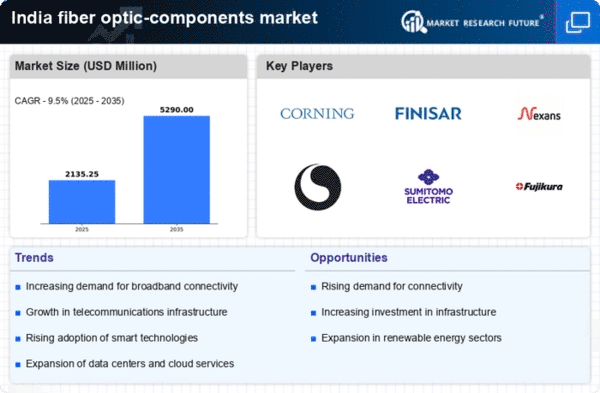
As per Market Research Future analysis, the India Fiber Optic Components Market size was estimated at 1950.0 $ Million in 2024. The Fiber Optic-components market is projected to grow from 2135.25 $ Million in 2025 to 5290.0 $ Million by 2035, exhibiting a compound annual growth rate (CAGR) of 9% during the forecast period 2025 - 2035

Key Market Trends & Highlights

The India The India fiber optic-components market is poised for substantial growth. This growth is driven by technological advancements and an increasing demand for connectivity.

  • The market is witnessing a rising demand for high-speed connectivity, particularly in urban areas.
  • Government initiatives aimed at enhancing digital infrastructure are significantly influencing market dynamics.
  • Technological advancements in fiber optics are fostering innovation and efficiency in the sector.
  • Key market drivers include increasing internet penetration and the growth of smart cities, which are propelling the demand for fiber optic components.

Market Size & Forecast

2024 Market Size 1950.0 (USD Million)
2035 Market Size 5290.0 (USD Million)
CAGR (2025 - 2035) 9.5%

Major Players

Corning (US), Finisar (US), Nexans (FR), CommScope (US), Sumitomo Electric (JP), Fujikura (JP), Prysmian Group (IT), Optical Cable Corporation (US), TE Connectivity (CH)

Our Impact
Enabled $4.3B Revenue Impact for Fortune 500 and Leading Multinationals
Partnering with 2000+ Global Organizations Each Year
30K+ Citations by Top-Tier Firms in the Industry

India Fiber Optic Components Market Trends

The India Fiber Optic Components Market is currently experiencing notable growth. This growth is driven by the increasing demand for high-speed internet and advanced communication technologies. As urbanization accelerates and digital transformation initiatives gain momentum, the need for reliable and efficient data transmission solutions becomes paramount. This market is characterized by a diverse range of products, including fiber optic cables, connectors, and transceivers, which are essential for supporting the infrastructure of telecommunications and data centers. Furthermore, the government's push towards enhancing digital connectivity in rural and urban areas is likely to bolster the market's expansion. In addition, the fiber optic-components market is witnessing innovations in technology, with manufacturers focusing on developing more efficient and cost-effective solutions. The integration of smart technologies and the Internet of Things (IoT) into various sectors is expected to further drive the demand for fiber optic components. As industries increasingly rely on data-driven decision-making, the importance of high-performance fiber optic solutions cannot be overstated. Overall, the market appears poised for sustained growth, reflecting the broader trends in digital communication and infrastructure development.

Rising Demand for High-Speed Connectivity

The fiber optic-components market is experiencing a surge in demand for high-speed connectivity solutions. This trend is largely attributed to the increasing reliance on digital services and the need for faster data transmission. As businesses and consumers seek improved internet speeds, the market is likely to see a corresponding rise in the adoption of fiber optic technologies.

Government Initiatives for Digital Infrastructure

Government initiatives aimed at enhancing digital infrastructure are playing a crucial role in shaping the fiber optic-components market. Policies promoting broadband access and investment in telecommunications infrastructure are expected to drive growth. These initiatives may lead to increased deployment of fiber optic networks, particularly in underserved regions.

Technological Advancements in Fiber Optics

Technological advancements are significantly influencing the fiber optic-components market. Innovations in manufacturing processes and materials are leading to the development of more efficient and durable fiber optic products. This trend suggests that the market will continue to evolve, with new solutions emerging to meet the demands of modern communication systems.

India Fiber Optic Components Market Drivers

Growth of Smart Cities

The development of smart cities in India is significantly influencing the fiber optic-components market. With the government's initiative to create 100 smart cities, there is a heightened need for advanced communication networks. Fiber optic technology is crucial for enabling smart city applications such as traffic management, smart lighting, and public safety systems. The estimated investment in smart city projects is around $30 billion, which is likely to create substantial demand for fiber optic components. As these cities evolve, the integration of fiber optics will be essential for ensuring efficient data transmission and connectivity, thereby propelling the growth of the fiber optic-components market in India.

Telecom Sector Expansion

The expansion of the telecom sector in India is a significant driver for the fiber optic-components market. With the increasing number of mobile subscribers, which is projected to exceed 1.2 billion by 2025, telecom operators are investing heavily in fiber optic networks to enhance service quality and coverage. The shift towards 5G technology is also a critical factor, as it requires extensive fiber optic infrastructure to support high-speed data transmission. The telecom industry's growth is likely to create a robust demand for fiber optic components, as operators seek to upgrade their networks to meet the evolving needs of consumers and businesses.

Emergence of IoT Applications

The emergence of Internet of Things (IoT) applications in India is poised to impact the fiber optic-components market significantly. As industries adopt IoT solutions for automation and data collection, the demand for reliable and high-speed connectivity becomes paramount. The IoT market in India is projected to grow at a CAGR of 30% over the next few years, driving the need for fiber optic networks that can handle the increased data traffic. Fiber optics provide the necessary bandwidth and speed to support a multitude of connected devices, making them essential for the successful implementation of IoT applications. This trend is likely to bolster the fiber optic-components market as businesses invest in the required infrastructure.

Rising Demand for Data Centers

The rising demand for data centers in India is also driving the fiber optic-components market. With the increasing reliance on cloud computing and big data analytics, the need for robust data storage and processing facilities is growing. As of 2025, the data center market in India is expected to reach $4.5 billion, necessitating the deployment of high-capacity fiber optic networks to support data transfer and connectivity. Fiber optic technology offers superior bandwidth and lower latency, making it the preferred choice for data centers. This trend is likely to enhance the fiber optic-components market as companies invest in infrastructure to meet the demands of digital transformation.

Increasing Internet Penetration

The fiber optic-components market in India is experiencing growth due to the increasing internet penetration across urban and rural areas. As of 2025, internet users in India are projected to reach approximately 900 million, indicating a surge in demand for high-speed connectivity. This trend necessitates the deployment of fiber optic networks, which are essential for supporting the bandwidth requirements of modern applications. The expansion of internet services, particularly in remote regions, is likely to drive investments in fiber optic infrastructure, thereby enhancing the fiber optic-components market. Furthermore, the government's focus on bridging the digital divide is expected to further stimulate demand for fiber optic solutions, as they provide the backbone for reliable and fast internet access.


Market Segment Insights

By Data Rate: 100 G (Largest) vs. 40 G (Fastest-Growing)

The India fiber optic-components market showcases distinct segment values in data rate, with 100 G holding the largest share among its counterparts. This segment significantly outpaces the others, primarily driven by the increasing demand for high-speed internet and data transmission capabilities across various sectors. On the other hand, the 40 G segment, while smaller than 100 G, is rapidly gaining traction due to the expansion of cloud services and data centers, leading to a shift in focus towards more versatile and faster alternatives. Growth in the data rate segment is largely fueled by technological advancements and rising bandwidth demands. The rapid digitalization across industries is pushing operators to upgrade their infrastructure to support higher data rates. Emerging applications like IoT and big data analytics are further accelerating this movement as companies seek reliable solutions that can cater to their expansive data handling needs. The demand for high-performance fiber optic components is expected to continue its upward trend as businesses invest in enhancing their network capabilities.

100 G (Dominant) vs. 40 G (Emerging)

The 100 G segment dominates the India fiber optic-components market, being recognized for its capacity to deliver ultra-high-speed data transmission essential for modern telecommunications. It is favored by large enterprises and service providers who are building next-generation networks to meet escalating data requirements. In contrast, the 40 G segment is emerging as a cost-effective solution for mid-tier data centers and enterprises aiming for reliable performance at competitive pricing. Its versatility and capability support various applications, making it an attractive choice for organizations looking to enhance their infrastructure without substantial investments. Both segments contribute to shaping the future of connectivity, signifying a shift in industry expectations towards higher data rates.

By Application: Communications (Largest) vs. Distributed Sensing (Fastest-Growing)

The India fiber optic-components market showcases robust participation across various application segments, predominantly led by communications, which holds the largest share. This segment benefits from increasing telecommunications demand, urbanization, and the ongoing digital transformation initiatives. Meanwhile, distributed sensing emerges as a fast-growing segment, driven by the need for continuous monitoring in various industries, including oil and gas, and environmental monitoring. Growth trends in the market are influenced significantly by technological advancements and the integration of fiber optics in diverse applications. As industries evolve, the demand for high-speed internet and advanced sensing solutions accelerates, fostering innovation and expanding the market landscape. The emphasis on smart infrastructure further propels the deployment of fiber optic components, enhancing the overall market potential.

Communications (Dominant) vs. Distributed Sensing (Emerging)

In the India fiber optic-components market, communications remains the dominant segment, characterized by extensive applications in telecommunication networks and internet service providers. This segment leverages high-performance optical fibers that support data transmission, vital for the nation's expanding digital economy. On the other hand, distributed sensing is recognized as an emerging segment, driven by its versatility and technological evolution in sectors like environmental monitoring and structural health. It features advanced fiber optic sensors capable of real-time data collection over extensive distances, making it integral to smart city projects. Both segments reflect the growing reliance on fiber optics, with communications leading in volume while distributed sensing captures attention due to its innovative potential and increasing adoption.

By Type: Cables (Largest) vs. Active Optical Cables (Fastest-Growing)

In the India fiber optic-components market, Cables represent the largest segment, driven by increasing demand for high-speed internet and robust telecommunication infrastructure. Other segments such as Amplifiers and Transceivers also hold significant market shares but are closely followed by emerging technologies like Active Optical Cables, which are gaining momentum due to their advanced capabilities and efficiency. Growth trends in this market are primarily influenced by rising data consumption, the proliferation of smart devices, and government initiatives to improve digital connectivity. As the push for 5G technology advances, Active Optical Cables are anticipated to grow the fastest, attracting investments aimed at enhancing network quality and user experience. The accelerated deployment of fiber optics in various sectors underscores a promising outlook for the entire segment.

Cables (Dominant) vs. Active Optical Cables (Emerging)

Cables, as the dominant segment in the India fiber optic-components market, are essential for establishing reliable communication networks. Their robustness and capacity to transmit data over long distances without significant loss make them the preferred choice for telecom operators. In contrast, Active Optical Cables are emerging as a revolutionary option, particularly in data centers and high-performance computing applications. They combine the benefits of optical fiber with built-in transceivers, which facilitate high-speed data transfer and significantly reduce latency. While Cables maintain widespread usage due to their established role, Active Optical Cables offer innovative solutions that cater to the evolving demands of modern connectivity.

Get more detailed insights about India Fiber Optic Components Market

Key Players and Competitive Insights

The fiber optic-components market in India is currently characterized by a dynamic competitive landscape, driven by increasing demand for high-speed internet and data transmission. Key players are actively engaging in strategies that emphasize innovation, regional expansion, and partnerships to enhance their market positioning. For instance, Corning (US) has focused on developing advanced optical fiber technologies, which positions it as a leader in high-performance solutions. Similarly, Prysmian Group (IT) has been expanding its manufacturing capabilities in India, aiming to cater to the growing local demand while optimizing its supply chain. These strategies collectively contribute to a competitive environment that is increasingly focused on technological advancement and customer-centric solutions.In terms of business tactics, companies are localizing manufacturing to reduce costs and improve supply chain efficiency. The market appears moderately fragmented, with several players vying for market share. This fragmentation allows for a diverse range of products and services, but also intensifies competition among key players. The collective influence of these companies shapes the market structure, as they strive to differentiate themselves through innovation and operational excellence.

In October Finisar (US) announced a strategic partnership with a leading telecommunications provider in India to enhance its fiber optic network solutions. This collaboration is expected to leverage Finisar's cutting-edge technology to improve network performance and reliability, thereby addressing the increasing demand for high-speed connectivity. The strategic importance of this partnership lies in its potential to solidify Finisar's presence in the Indian market, while also contributing to the overall growth of the fiber optic infrastructure in the region.

In September Sumitomo Electric (JP) launched a new range of environmentally friendly fiber optic cables designed to reduce carbon emissions during production. This initiative aligns with the growing emphasis on sustainability within the industry and positions Sumitomo Electric as a forward-thinking player committed to environmental responsibility. The strategic importance of this launch is underscored by the increasing regulatory pressures and consumer preferences for sustainable products, which could enhance the company's competitive edge.

In August CommScope (US) expanded its operations in India by establishing a new manufacturing facility aimed at increasing production capacity for fiber optic components. This move is likely to enhance CommScope's ability to meet local demand while reducing lead times and transportation costs. The strategic significance of this expansion is evident as it not only strengthens CommScope's market position but also reflects a broader trend of companies investing in local manufacturing to enhance supply chain resilience.

As of November the competitive trends in the fiber optic-components market are increasingly defined by digitalization, sustainability, and the integration of AI technologies. Strategic alliances are becoming more prevalent, as companies recognize the need to collaborate to innovate and meet evolving customer demands. Looking ahead, competitive differentiation is expected to shift from price-based strategies to a focus on technological innovation, reliability, and sustainable practices. This evolution suggests that companies that prioritize these aspects will likely emerge as leaders in the market.

Key Companies in the India Fiber Optic Components Market include

Industry Developments

The India Fiber Optic Components Market has seen significant developments in recent months. Notably, in September 2023, Tata Communications and Hughes Communications announced a collaboration aimed at enhancing connectivity solutions across rural areas, thereby expanding their market reach and offerings.

In August 2023, Sterlite Technologies secured a substantial contract to supply fiber optic cables to a leading telecom company, reinforcing its position in the market. In terms of mergers and acquisitions, in June 2023, CommScope and Tejas Networks entered a strategic partnership to jointly develop next-generation optical networks, leveraging both companies' technological expertise.

Additionally, L&T Technology Services has announced plans to increase its investment in fiber optic R&D, reflecting a trend towards innovation in the sector. The market is also witnessing growth due to rising demand for high-speed internet services, evidenced by Airtel Xstream Fiber's expansion into new regions. Over the past few years, from 2021 to 2023, the Indian government has been actively promoting fiber optics as a key component of the Digital India initiative, further driving growth in the sector. This surge in demand is expected to propel various companies, including Vodafone Idea and Corning, to improve their product offerings.

Future Outlook

India Fiber Optic Components Market Future Outlook

The fiber optic-components market is projected to grow at a 9.5% CAGR from 2025 to 2035, driven by increasing demand for high-speed data transmission and expanding telecommunications infrastructure.

New opportunities lie in:

  • Development of advanced fiber optic sensors for industrial applications.
  • Expansion into rural broadband connectivity solutions.
  • Investment in R&D for next-generation optical components.

By 2035, the market is expected to achieve substantial growth, driven by technological advancements and increased adoption.

Market Segmentation

India Fiber Optic Components Market Type Outlook

  • Cables
  • Amplifiers
  • Active Optical Cables
  • Splitters
  • Connectors
  • Transceivers
  • Others

India Fiber Optic Components Market Data Rate Outlook

  • 10 G
  • 40 G
  • 100 G
  • Above 100 G

India Fiber Optic Components Market Application Outlook

  • Communications
  • Distributed Sensing
  • Analytical and Medical Equipment
  • Lighting

Report Scope

MARKET SIZE 2024 1950.0(USD Million)
MARKET SIZE 2025 2135.25(USD Million)
MARKET SIZE 2035 5290.0(USD Million)
COMPOUND ANNUAL GROWTH RATE (CAGR) 9.5% (2025 - 2035)
REPORT COVERAGE Revenue Forecast, Competitive Landscape, Growth Factors, and Trends
BASE YEAR 2024
Market Forecast Period 2025 - 2035
Historical Data 2019 - 2024
Market Forecast Units USD Million
Key Companies Profiled Corning (US), Finisar (US), Nexans (FR), CommScope (US), Sumitomo Electric (JP), Fujikura (JP), Prysmian Group (IT), Optical Cable Corporation (US), TE Connectivity (CH)
Segments Covered Data Rate, Application, Type
Key Market Opportunities Growing demand for high-speed internet drives innovation in the fiber optic-components market.
Key Market Dynamics Rising demand for high-speed internet drives innovation and competition in the fiber optic-components market.
Countries Covered India
Leave a Comment

FAQs

What is the expected market size of the India Fiber Optic Components Market in 2024?

The India Fiber Optic Components Market is expected to be valued at 1.5 USD Billion in 2024.

What is the projected market value for the India Fiber Optic Components Market in 2035?

By 2035, the India Fiber Optic Components Market is projected to reach a value of 4.5 USD Billion.

What is the expected CAGR for the India Fiber Optic Components Market from 2025 to 2035?

The market is expected to grow at a CAGR of 10.503% from 2025 to 2035.

Which data rate segment is expected to have the largest market size in 2035?

The 10 G data rate segment is expected to have the largest market value, reaching 1.8 USD Billion in 2035.

Who are the key players in the India Fiber Optic Components Market?

Some major players include L&T Technology Services, Sterlite Technologies, Corning, and Bharti Airtel.

What will the market size for the 40 G data rate segment be in 2035?

The market size for the 40 G data rate segment is expected to reach 1.2 USD Billion in 2035.

How is the Above 100 G data rate segment projected to perform by 2035?

The Above 100 G segment is projected to grow to 0.6 USD Billion by 2035.

What are the emerging trends in the India Fiber Optic Components Market?

Emerging trends include increasing demand for high-speed data transmission and expanding telecommunications infrastructure.

How does regional competition affect the India Fiber Optic Components Market?

Intense regional competition is driving innovation and improving service delivery within the market.

What challenges does the India Fiber Optic Components Market face?

Challenges include rapid technological changes and the need for continuous infrastructure investment to meet demand.

Download Free Sample

Kindly complete the form below to receive a free sample of this Report

Compare Licence

×
Features License Type
Single User Multiuser License Enterprise User
Price $4,950 $5,950 $7,250
Maximum User Access Limit 1 User Upto 10 Users Unrestricted Access Throughout the Organization
Free Customization
Direct Access to Analyst
Deliverable Format
Platform Access
Discount on Next Purchase 10% 15% 15%
Printable Versions