×
Request Free Sample ×

Kindly complete the form below to receive a free sample of this Report

* Please use a valid business email

Leading companies partner with us for data-driven Insights

clients tt-cursor
Hero Background

Argentina Fiber Optic Components Market

ID: MRFR/ICT/58617-HCR
200 Pages
Garvit Vyas
February 2026

Argentina Fiber Optic Components Market Size, Share and Research Report: By Data Rate (10 G, 40 G, 100 G, Above 100 G), By Application (Communications, Distributed Sensing, Analytical and Medical Equipment, Lighting) and By Type (Cables, Amplifiers, Active Optical Cables, Splitters, Connectors, Transceivers, Others) - Industry Forecast to 2035

Share:
Download PDF ×

We do not share your information with anyone. However, we may send you emails based on your report interest from time to time. You may contact us at any time to opt-out.

Argentina Fiber Optic Components Market Infographic
Purchase Options

Argentina Fiber Optic Components Market Summary

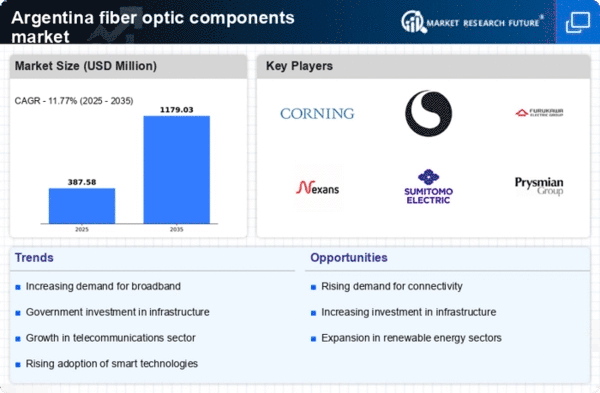
As per Market Research Future analysis, the Argentina fiber optic-components market Size was estimated at 346.76 USD Million in 2024. The Argentina fiber optic-components market is projected to grow from 387.58 USD Million in 2025 to 1179.03 USD Million by 2035, exhibiting a compound annual growth rate (CAGR) of 11.7% during the forecast period 2025 - 2035

Key Market Trends & Highlights

The Argentina fiber optic-components market is poised for growth driven by increasing demand for connectivity and technological advancements.

  • The market experiences rising demand for high-speed connectivity, particularly in urban areas.
  • Government initiatives and investments are fostering infrastructure development across the country.
  • The telecommunications sector emerges as the largest segment, while the data center segment is the fastest-growing.
  • Key market drivers include increasing internet penetration and the expansion of smart technologies.

Market Size & Forecast

2024 Market Size 346.76 (USD Million)
2035 Market Size 1179.03 (USD Million)
CAGR (2025 - 2035) 11.77%

Major Players

Corning (US), CommScope (US), Furukawa Electric (JP), Nexans (FR), Sumitomo Electric (JP), Prysmian Group (IT), TE Connectivity (CH), 3M (US)

Our Impact
Enabled $4.3B Revenue Impact for Fortune 500 and Leading Multinationals
Partnering with 2000+ Global Organizations Each Year
30K+ Citations by Top-Tier Firms in the Industry

Argentina Fiber Optic Components Market Trends

The fiber optic-components market in Argentina is currently experiencing a notable transformation, driven by the increasing demand for high-speed internet and advanced telecommunications infrastructure. This shift is largely attributed to the growing reliance on digital services across various sectors, including education, healthcare, and business. As a result, investments in fiber optic technology are becoming more prevalent, with both public and private entities recognizing the need for robust connectivity solutions. The government has initiated several projects aimed at expanding fiber optic networks, which is expected to enhance overall communication capabilities within the country. Moreover, the competitive landscape of the fiber optic-components market is evolving, with local manufacturers and international players vying for market share. This competition is fostering innovation and driving down costs, making fiber optic solutions more accessible to a broader range of consumers. The emphasis on sustainability and energy efficiency is also influencing product development, as companies seek to align with environmental standards and consumer preferences. Overall, the fiber optic-components market appears poised for growth, with a strong focus on technological advancements and infrastructure improvements that could reshape the communication landscape in Argentina.

Rising Demand for High-Speed Connectivity

The increasing need for high-speed internet access is a primary driver in the fiber optic-components market. As more individuals and businesses rely on digital platforms, the demand for reliable and fast connectivity solutions continues to grow. This trend is likely to encourage further investments in fiber optic infrastructure, enhancing overall communication capabilities.

Government Initiatives and Investments

Government initiatives aimed at expanding fiber optic networks are playing a crucial role in shaping the market. These projects are designed to improve connectivity in underserved areas, thereby promoting digital inclusion. Such efforts may lead to increased collaboration between public and private sectors, fostering a more robust fiber optic ecosystem.

Focus on Sustainability and Innovation

There is a noticeable shift towards sustainability within the fiber optic-components market. Companies are increasingly prioritizing energy-efficient solutions and environmentally friendly practices. This focus on sustainability, coupled with ongoing innovation, is expected to drive the development of advanced fiber optic technologies that meet both consumer needs and regulatory standards.

Argentina Fiber Optic Components Market Drivers

Growing Demand for Data Centers

The growing demand for data centers in Argentina is significantly impacting the fiber optic-components market. As businesses increasingly rely on cloud computing and data storage solutions, the need for efficient data centers has surged. This trend is expected to continue, with projections indicating a growth rate of around 12% in the data center sector over the next few years. The fiber optic-components market is poised to benefit from this expansion, as data centers require high-capacity fiber optic solutions to handle large volumes of data traffic. This demand for advanced connectivity solutions is likely to drive innovation and investment in the fiber optic sector.

Increasing Internet Penetration

The fiber optic-components market in Argentina is experiencing growth due to the increasing penetration of internet services across urban and rural areas. As of November 2025, approximately 75% of households have access to the internet, a notable rise from previous years. This surge in connectivity demands robust infrastructure, leading to a heightened need for fiber optic components. The government has initiated various programs aimed at expanding broadband access, which further stimulates market growth. The fiber optic-components market is poised to benefit from this trend, as service providers invest in upgrading their networks to meet consumer expectations for faster and more reliable internet services.

Telecommunications Sector Expansion

The expansion of the telecommunications sector in Argentina significantly influences the fiber optic-components market. With major telecommunications companies investing heavily in infrastructure, the demand for fiber optic components is expected to rise. Recent data indicates that the telecommunications sector has grown by approximately 10% annually, driven by the need for enhanced data transmission capabilities. This growth is likely to continue as companies seek to improve service quality and expand their customer base. The fiber optic-components market stands to gain from these investments, as they are essential for supporting the increasing data traffic and connectivity requirements.

Rising Adoption of Smart Technologies

The adoption of smart technologies in Argentina is creating new opportunities for the fiber optic-components market. As businesses and consumers increasingly embrace IoT devices, smart homes, and automation, the demand for high-speed data transmission becomes critical. The fiber optic-components market is likely to see a surge in demand as these technologies require reliable and fast connectivity. Estimates suggest that the smart technology sector could grow by over 15% in the coming years, further driving the need for advanced fiber optic solutions. This trend indicates a shift towards more integrated and efficient systems, which rely heavily on fiber optic infrastructure.

Investment in Renewable Energy Projects

Investment in renewable energy projects in Argentina is emerging as a key driver for the fiber optic-components market. As the country aims to increase its renewable energy capacity, the integration of advanced communication systems becomes essential for monitoring and managing these projects. The fiber optic-components market is likely to benefit from this trend, as fiber optics provide the necessary bandwidth and reliability for data transmission in energy management systems. Recent reports indicate that renewable energy investments could reach $5 billion by 2027, highlighting the potential for growth in related sectors, including fiber optics.


Market Segment Insights

By Data Rate: 100 G (Largest) vs. 40 G (Fastest-Growing)

In the Argentina fiber optic-components market, the distribution of market share among the data rate segments reveals a clear hierarchy. The 100 G segment stands out as the largest, commanding a significant share due to its widespread adoption in enterprise networking and data centers. Following closely, the 40 G segment is gaining traction, particularly in medium-sized enterprises that demand robust data transfer capabilities, further shaping the competitive landscape. Growth trends indicate that the demand for higher bandwidth solutions is propelling the overall data rate segment forward. The rapid expansion of cloud computing and increased internet traffic are key drivers behind the rising popularity of 100 G components. Meanwhile, the 40 G segment is emerging as a popular option for organizations looking to upgrade their existing infrastructures without a complete overhaul, thus contributing to its status as the fastest-growing segment.

100 G (Dominant) vs. 40 G (Emerging)

The 100 G segment is characterized by its capacity to handle vast data streams, making it the dominant player in the Argentina fiber optic-components market. This segment benefits from advancements in technology, allowing for improved efficiency and lower latency. It caters primarily to large data centers and enterprises that require robust and reliable bandwidth solutions. On the other hand, the 40 G segment is emerging as an attractive alternative for businesses seeking cost-effectiveness with adequate performance. Its ability to bridge existing infrastructure with newer technologies positions it well for growth, particularly as more companies look to optimize their operational efficiencies without significant capital investments.

By Application: Communications (Largest) vs. Distributed Sensing (Fastest-Growing)

In the Argentina fiber optic-components market, the communications segment holds the largest share owing to the increasing demand for high-speed internet and enhanced connectivity solutions. This segment's dominance is driven by the rise in telecommunications infrastructure and expansion of broadband services, which are critical for supporting data-intensive applications and smart technologies. On the other hand, the distributed sensing segment is recognized as the fastest-growing due to its applications in various industries like oil and gas, environmental monitoring, and civil engineering. The growing need for real-time data and monitoring capabilities is fueling investments and technological advancements in this sector, positioning it for significant growth over the coming years.

Communications (Dominant) vs. Distributed Sensing (Emerging)

The communications segment, being the dominant force, leverages advancements in fiber optic technology to deliver high-speed data transmission and reliable communication systems. This segment caters predominantly to telecommunications providers and enterprises seeking robust infrastructure solutions. In contrast, the distributed sensing segment represents an emerging market with significant potential, driven by the integration of fiber optic sensors in various applications. Its versatility enables monitoring of temperature, strain, and pressure in real-time, making it increasingly vital in industries such as healthcare, construction, and environmental management. Both segments play crucial roles, but their market dynamics differ, with communications focusing on connectivity and distributed sensing prioritizing monitoring and data collection.

By Type: Cables (Largest) vs. Amplifiers (Fastest-Growing)

In the Argentina fiber optic-components market, Cables dominate the segment with a significant market share, making them the largest component in the product landscape. Amplifiers, on the other hand, have emerged as a key player due to their growing adoption in telecommunications, contributing to a dynamic market share distribution among various types. Other components such as Active Optical Cables, Splitters, Connectors, and Transceivers also play vital roles but lag behind these two in overall contribution and growth. The growth trends for the segment are driven by the increasing demand for high-speed data transmission and the expansion of telecommunication networks across the country. The shift towards Fiber To The Home (FTTH) deployments and advancements in amplifier technologies are propelling amplifiers to become the fastest-growing segment. Meanwhile, the stable demand for cables, influenced by infrastructure projects, ensures their continued dominance in the market.

Cables (Dominant) vs. Amplifiers (Emerging)

Cables are the cornerstone of the Argentina fiber optic-components market, characterized by their reliability and essential role in data transmission. They account for the majority market share, supported by continuous infrastructure development and the demand for enhanced connectivity. In contrast, Amplifiers represent an emerging segment that is rapidly gaining traction, attributed to advancements in boosting signals for long-distance transmission. While Cables provide stability to the market, Amplifiers are evolving with innovations aimed at improving efficiency and performance, signaling a shift in consumer preferences towards integrated solutions that incorporate both segments effectively.

Get more detailed insights about Argentina Fiber Optic Components Market

Key Players and Competitive Insights

The fiber optic-components market in Argentina is characterized by a dynamic competitive landscape, driven by increasing demand for high-speed internet and advanced telecommunications infrastructure. Key players such as Corning (US), Prysmian Group (IT), and Sumitomo Electric (JP) are strategically positioned to leverage innovation and regional expansion. Corning (US) focuses on developing cutting-edge optical fiber technologies, while Prysmian Group (IT) emphasizes its extensive product portfolio and global reach. Sumitomo Electric (JP) is enhancing its operational capabilities through strategic partnerships, collectively shaping a competitive environment that prioritizes technological advancement and customer-centric solutions.In terms of business tactics, companies are increasingly localizing manufacturing to reduce costs and enhance supply chain efficiency. The market appears moderately fragmented, with several key players exerting influence over various segments. This structure allows for competitive differentiation, as companies adopt unique strategies to capture market share and respond to local demands.

In October Corning (US) announced the launch of a new line of environmentally friendly optical fibers designed to reduce energy consumption during data transmission. This initiative not only aligns with global sustainability trends but also positions Corning as a leader in eco-friendly technology, potentially attracting environmentally conscious customers and enhancing its market share.

In September Prysmian Group (IT) expanded its manufacturing facility in Buenos Aires, aiming to increase production capacity by 30%. This strategic move is likely to enhance the company's ability to meet the growing demand for fiber optic components in the region, thereby solidifying its competitive position and improving supply chain responsiveness.

In August Sumitomo Electric (JP) entered into a strategic partnership with a local telecommunications provider to develop advanced fiber optic networks across Argentina. This collaboration is expected to facilitate the deployment of next-generation broadband services, thereby enhancing connectivity and positioning Sumitomo as a key player in the local market.

As of November the competitive trends in the fiber optic-components market are increasingly defined by digitalization, sustainability, and the integration of artificial intelligence. Strategic alliances are becoming more prevalent, enabling companies to pool resources and expertise to drive innovation. The competitive landscape is shifting from traditional price-based competition to a focus on technological differentiation and supply chain reliability, suggesting that future success will hinge on the ability to innovate and adapt to evolving market demands.

Key Companies in the Argentina Fiber Optic Components Market include

Industry Developments

In recent developments within the Argentina Fiber Optic Components Market, companies like Fibras de Argentina and Corning are experiencing growth driven by increased demand for high-speed internet and improved telecommunications infrastructure. In June 2023, Telecom Argentina announced partnerships to enhance its fiber optic network, which is pivotal in meeting the rising connectivity demands across urban and rural areas. Furthermore, in July 2023, a significant merger was announced between Prysmian Group and a regional player to expand their operational footprint and product offerings in Argentina, with emphasis on enhancing fiber optic production capabilities.

In the last few years, there have been notable investments in fiber optic technology, with CommScope and AFL launching new products aimed at reducing installation times and costs in August 2022. The Argentine government, recognizing the importance of digital connectivity, has initiated several projects to expand fiber optic networks nationwide, incentivizing investments from major companies like Nexans and Sterlite Technologies. As the market continues to evolve, these developments are likely to further bolster technological advancements and market expansion, catering to a growing consumer base seeking reliable fiber optic solutions.

Future Outlook

Argentina Fiber Optic Components Market Future Outlook

The fiber optic-components market is projected to grow at 11.77% CAGR from 2025 to 2035, driven by increasing demand for high-speed data transmission and technological advancements.

New opportunities lie in:

  • Expansion of fiber optic networks in rural areas
  • Development of cost-effective, high-performance optical transceivers
  • Integration of fiber optics in smart city infrastructure projects

By 2035, the market is expected to achieve substantial growth, driven by innovation and increased adoption.

Market Segmentation

Argentina Fiber Optic Components Market Type Outlook

  • Cables
  • Amplifiers
  • Active Optical Cables
  • Splitters
  • Connectors
  • Transceivers
  • Others

Argentina Fiber Optic Components Market Data Rate Outlook

  • 10 G
  • 40 G
  • 100 G
  • Above 100 G

Argentina Fiber Optic Components Market Application Outlook

  • Communications
  • Distributed Sensing
  • Analytical and Medical Equipment
  • Lighting

Report Scope

MARKET SIZE 2024 346.76(USD Million)
MARKET SIZE 2025 387.58(USD Million)
MARKET SIZE 2035 1179.03(USD Million)
COMPOUND ANNUAL GROWTH RATE (CAGR) 11.77% (2025 - 2035)
REPORT COVERAGE Revenue Forecast, Competitive Landscape, Growth Factors, and Trends
BASE YEAR 2024
Market Forecast Period 2025 - 2035
Historical Data 2019 - 2024
Market Forecast Units USD Million
Key Companies Profiled Corning (US), CommScope (US), Furukawa Electric (JP), Nexans (FR), Sumitomo Electric (JP), Prysmian Group (IT), TE Connectivity (CH), 3M (US)
Segments Covered Data Rate, Application, Type
Key Market Opportunities Growing demand for high-speed internet drives innovation in the fiber optic-components market.
Key Market Dynamics Rising demand for high-speed internet drives innovation and competition in the fiber optic-components market.
Countries Covered Argentina
Leave a Comment

FAQs

What is the expected market size of the Argentina Fiber Optic Components Market in 2024?

The Argentina Fiber Optic Components Market is expected to be valued at 346.08 million USD in 2024.

How much is the Argentina Fiber Optic Components Market projected to grow by 2035?

By 2035, the Argentina Fiber Optic Components Market is projected to reach a value of 1018.0 million USD.

What is the expected compound annual growth rate (CAGR) for the Argentina Fiber Optic Components Market from 2025 to 2035?

The anticipated CAGR for the Argentina Fiber Optic Components Market from 2025 to 2035 is 10.306%.

What are the major data rate segments within the Argentina Fiber Optic Components Market?

The major data rate segments include 10 G, 40 G, 100 G, and Above 100 G.

What was the market value for the 10 G segment in the Argentina Fiber Optic Components Market in 2024?

The 10 G segment is valued at 90.0 million USD in the year 2024.

Which companies are considered key players in the Argentina Fiber Optic Components Market?

Key players include Fibras de Argentina, Corning, Prysmian Group, and CommScope among others.

How much is the 100 G segment expected to generate in market value in 2035?

The 100 G segment is expected to generate 360.0 million USD in market value by 2035.

What opportunities exist within the Argentina Fiber Optic Components Market?

The market presents growth opportunities driven by increasing demand for high-speed data transmission.

What challenges might the Argentina Fiber Optic Components Market face over the forecast period?

Challenges may include competition from alternative technologies and supply chain disruptions.

What is the market size for the Above 100 G segment in 2024?

The Above 100 G segment is valued at 66.08 million USD in the year 2024.

Download Free Sample

Kindly complete the form below to receive a free sample of this Report

Compare Licence

×
Features License Type
Single User Multiuser License Enterprise User
Price $4,950 $5,950 $7,250
Maximum User Access Limit 1 User Upto 10 Users Unrestricted Access Throughout the Organization
Free Customization
Direct Access to Analyst
Deliverable Format
Platform Access
Discount on Next Purchase 10% 15% 15%
Printable Versions