×
Request Free Sample ×

Kindly complete the form below to receive a free sample of this Report

* Please use a valid business email

Leading companies partner with us for data-driven Insights

clients tt-cursor
Hero Background

India Civil Engineering Market

ID: MRFR/PCM/54145-HCR
111 Pages
Garvit Vyas
February 2026

India Civil Engineering Market Research Report: By Service (Planning & Design, Construction, Maintenance), By Application (Industrial, Real Estate, Infrastructure) andBy Customer Group (Government, Private)- Forecast to 2035

Share:
Download PDF ×

We do not share your information with anyone. However, we may send you emails based on your report interest from time to time. You may contact us at any time to opt-out.

India Civil Engineering Market Infographic
Purchase Options

India Civil Engineering Market Summary

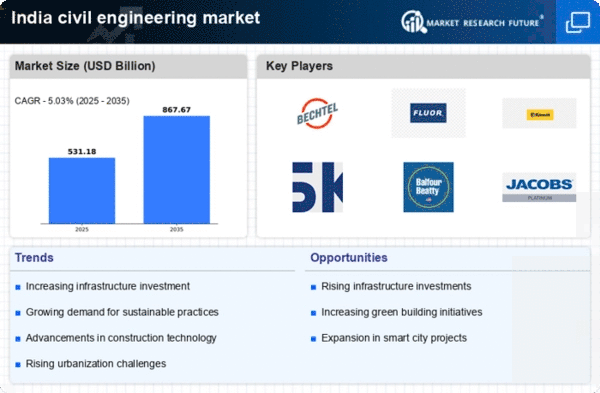
As per Market Research Future analysis, the India Civil Engineering Market size was estimated at 505.74 USD Billion in 2024. The Civil Engineering market is projected to grow from 531.18 USD Billion in 2025 to 867.67 USD Billion by 2035, exhibiting a compound annual growth rate (CAGR) of 5.0% during the forecast period 2025 - 2035

Key Market Trends & Highlights

The India civil engineering market is experiencing robust growth driven by sustainability and technological advancements.

  • Sustainable construction practices are increasingly being adopted across the sector, reflecting a shift towards eco-friendly methodologies.
  • Technological integration, particularly in project management and construction processes, is enhancing efficiency and reducing costs.
  • Government infrastructure initiatives are propelling investments, particularly in urban areas, which are the largest market segments.
  • Urbanization and population growth, along with government investment in infrastructure, are key drivers fueling market expansion.

Market Size & Forecast

2024 Market Size 505.74 (USD Billion)
2035 Market Size 867.67 (USD Billion)
CAGR (2025 - 2035) 5.03%

Major Players

Bechtel (US), Fluor Corporation (US), Kiewit Corporation (US), Skanska (SE), Balfour Beatty (GB), Jacobs Engineering Group (US), Tetra Tech (US), AECOM (US), China Communications Construction Company (CN)

Our Impact
Enabled $4.3B Revenue Impact for Fortune 500 and Leading Multinationals
Partnering with 2000+ Global Organizations Each Year
30K+ Citations by Top-Tier Firms in the Industry

India Civil Engineering Market Trends

The India Civil Engineering Market in India is currently experiencing a transformative phase, driven by rapid urbanization and infrastructural development. The government's emphasis on enhancing infrastructure through initiatives such as the National Infrastructure Pipeline is indicative of a strategic focus on improving connectivity and public services. This initiative aims to attract investments and facilitate the construction of roads, bridges, and urban transit systems, thereby fostering economic growth. Furthermore, the increasing demand for sustainable construction practices is reshaping project methodologies, as stakeholders seek to minimize environmental impacts while maximizing efficiency. In addition, advancements in technology are playing a pivotal role in the evolution of the civil engineering market. The integration of Building Information Modeling (BIM) and smart construction techniques is enhancing project management and execution. These innovations not only streamline processes but also improve collaboration among various stakeholders. As the market continues to evolve, the emphasis on skilled labor and training programs is becoming more pronounced, ensuring that the workforce is equipped to meet the demands of modern construction projects. Overall, the civil engineering market is poised for substantial growth, driven by a combination of government initiatives, technological advancements, and a commitment to sustainable practices.

Sustainable Construction Practices

There is a growing trend towards sustainable construction within the civil engineering market. Stakeholders are increasingly prioritizing eco-friendly materials and energy-efficient designs. This shift is largely influenced by regulatory frameworks and public awareness regarding environmental issues. As a result, projects are being designed with a focus on reducing carbon footprints and enhancing resource efficiency.

Technological Integration

The adoption of advanced technologies is reshaping the civil engineering market. Tools such as Building Information Modeling (BIM) and automation are streamlining project workflows. These technologies facilitate better planning, reduce errors, and enhance collaboration among teams. Consequently, the efficiency of project delivery is significantly improved.

Government Infrastructure Initiatives

Government initiatives aimed at infrastructure development are driving growth in the civil engineering market. Programs focused on enhancing transportation networks and urban infrastructure are attracting investments. This strategic focus not only aims to improve public services but also stimulates economic activity across various sectors.

India Civil Engineering Market Drivers

Urbanization and Population Growth

The rapid urbanization in India is a primary driver of the civil engineering market. With an estimated urban population growth rate of around 2.3% annually, cities are expanding, necessitating extensive infrastructure development. This includes residential, commercial, and transportation projects. The demand for housing alone is projected to require approximately 10 million new units by 2030. Additionally, the increasing population density in urban areas leads to a greater need for public utilities and services, such as water supply, sewage systems, and road networks. Consequently, civil engineering firms are likely to experience heightened demand for innovative solutions to address these challenges, thereby propelling the civil engineering market forward.

Rising Demand for Smart Infrastructure

The demand for smart infrastructure is emerging as a significant driver in the civil engineering market. With the advent of smart city initiatives, there is a growing need for integrated systems that enhance urban living. This includes smart transportation systems, energy-efficient buildings, and advanced waste management solutions. The Indian government has allocated substantial funds for the development of 100 smart cities, which could lead to an estimated investment of $30 billion. As these projects progress, civil engineering firms will need to adapt to new technologies and methodologies, positioning themselves to capitalize on the opportunities presented by this shift towards smarter urban environments.

Government Investment in Infrastructure

Government initiatives play a crucial role in shaping the civil engineering market in India. The government has committed to investing over $1 trillion in infrastructure development over the next five years, focusing on transportation, energy, and urban development. This investment is expected to create numerous opportunities for civil engineering firms, as projects such as highways, railways, and smart cities are prioritized. Furthermore, the National Infrastructure Pipeline aims to facilitate the development of 7,000 projects, which could significantly boost the civil engineering market. As these projects unfold, the demand for skilled labor and advanced materials will likely increase, further stimulating market growth.

Technological Advancements in Construction

Technological advancements are transforming the civil engineering market in India. The integration of Building Information Modeling (BIM), drones, and 3D printing is enhancing project efficiency and accuracy. For instance, BIM allows for better planning and management of construction projects, reducing costs by up to 20%. Additionally, the use of drones for site surveys and inspections is becoming increasingly common, providing real-time data and improving safety. These innovations not only streamline processes but also contribute to sustainable practices by minimizing waste. As technology continues to evolve, civil engineering firms that adopt these advancements are likely to gain a competitive edge in the market.

Sustainability and Green Building Practices

Sustainability is becoming a pivotal focus within the civil engineering market in India. The growing awareness of environmental issues has led to an increased demand for green building practices. The Indian Green Building Council reports that the green building footprint is expected to reach 10 billion sq ft by 2022, indicating a substantial shift towards eco-friendly construction. This trend is driven by both regulatory requirements and consumer preferences for sustainable living spaces. Civil engineering firms that prioritize sustainable materials and energy-efficient designs are likely to find new opportunities in this evolving market landscape, as clients increasingly seek to reduce their carbon footprint.


Market Segment Insights

By Service Type: Construction (Largest) vs. Maintenance (Fastest-Growing)

The India civil engineering market demonstrates a diverse distribution across service types, with construction holding the largest share. This segment benefits from rapid urbanization and infrastructural development, reflecting the growing demand for residential and commercial projects. Meanwhile, the planning & design phase remains crucial for ensuring project feasibility and alignment with regulations, while maintenance services are gaining momentum due to the increasing focus on sustainability and asset longevity. Growth trends in the service type segment are driven by several factors, including government initiatives to enhance infrastructure spending, advancements in construction technologies, and a rising need for specialized construction services. Maintenance, recognized as the fastest-growing segment, is propelled by the necessity for regular upkeep and modernization of aging infrastructure. The growing emphasis on lifecycle management further shapes the service landscape, promoting efficiency and reducing long-term operational costs.

Construction: Planning & Design (Dominant) vs. Maintenance (Emerging)

The planning & design phase is a dominant force in the India civil engineering market, setting the groundwork for successful project execution. It involves critical activities such as feasibility studies, design optimization, and compliance with regulatory frameworks, which not only enhance project viability but also mitigate risks associated with construction. On the other hand, maintenance services are emerging as a vital segment, driven by the push for sustainable practices. These services focus on extending the lifespan of infrastructure and ensuring it meets modern standards. The rise of smart technologies and maintenance management systems is facilitating this transition, making maintenance an integral part of the civil engineering landscape.

By Application: Real Estate (Largest) vs. Infrastructure (Fastest-Growing)

In the India civil engineering market, the application segment is primarily dominated by the Real Estate sector, which captures the largest market share. This segment benefits from urbanization and rising disposable incomes, propelling demand for residential and commercial construction projects. Following closely, the Infrastructure segment shows promising growth driven by government initiatives and increased investments in transportation and utilities, showcasing the shift towards enhancing connectivity and urban infrastructure. The growth trends in the application segment reveal a robust trajectory for both Real Estate and Infrastructure. Real Estate continues to thrive due to a surge in housing demand and commercial projects, while Infrastructure is gaining momentum as the government prioritizes infrastructure development. These trends are influenced by a combination of economic policies, population growth, and increasing public-private partnerships that are driving significant capital inflows into the sector.

Real Estate (Dominant) vs. Infrastructure (Emerging)

Real Estate stands out as the dominant application in the India civil engineering market, characterized by a diverse range of residential, commercial, and mixed-use developments. Factors such as urban migration, lifestyle changes, and favorable policies are fueling this segment's growth. On the other hand, the Infrastructure segment is emerging rapidly, with significant infrastructure projects underway aimed at enhancing connectivity and service delivery. This includes investments in roads, bridges, and public transport systems, driven by the recognition of infrastructure as a critical component for economic development. Both segments contribute to the overall growth dynamics and showcase the diversified opportunities within the India civil engineering market.

By Consumer Group: Government (Largest) vs. Private (Fastest-Growing)

In the consumer group segment of the India civil engineering market, the government sector holds the largest share, driven by substantial investments in infrastructure projects and public works. The government's commitment to improving urban and rural infrastructure has established it as a dominant player in this segment, capturing a significant portion of the overall market. In contrast, the private sector is emerging rapidly, characterized by increasing participation in construction and engineering projects. The shift toward privatization and deregulation has led to a notable rise in private investments, enhancing its overall market presence. Growth trends indicate that the government sector is likely to experience steady investment levels, while the private sector is set for accelerated growth driven by innovation and efficiency. The private sector benefits from technological advancements and a surge in demand for modern infrastructure solutions. Factors such as urbanization and a growing middle class are propelling this segment forward, positioning it as a key player for future development in the India civil engineering market.

Government (Dominant) vs. Private (Emerging)

The government segment in the India civil engineering market represents a cornerstone of infrastructure development, with policies that favor long-term projects and stable funding. It is characterized by large-scale initiatives that contribute significantly to societal needs, including transportation, housing, and public amenities. On the other hand, the private sector is gaining momentum as an emerging force with a focus on efficiency and innovation in construction methodologies. Private enterprises are increasingly involved in public-private partnerships, driving competitive pricing and technological integration. This duality in the consumer group showcases a balanced approach towards infrastructure development, where both segments play crucial roles in meeting the growing demands of the population.

Get more detailed insights about India Civil Engineering Market

Key Players and Competitive Insights

The civil engineering market in India is characterized by a dynamic competitive landscape, driven by rapid urbanization, infrastructure development, and government initiatives aimed at enhancing connectivity. Major players such as Bechtel (US), Jacobs Engineering Group (US), and China Communications Construction Company (CN) are actively shaping the market through strategic positioning focused on innovation and regional expansion. Bechtel (US) emphasizes sustainable construction practices, while Jacobs Engineering Group (US) leverages digital transformation to enhance project efficiency. Meanwhile, China Communications Construction Company (CN) is expanding its footprint through partnerships with local firms, indicating a trend towards collaborative approaches in project execution.Key business tactics within this market include localizing manufacturing and optimizing supply chains to reduce costs and improve service delivery. The competitive structure appears moderately fragmented, with numerous players vying for market share. However, the influence of key players is substantial, as they set benchmarks for quality and innovation, thereby shaping the overall market dynamics.

In September Bechtel (US) announced a partnership with a leading Indian construction firm to develop a state-of-the-art transportation hub in Mumbai. This strategic move is significant as it not only enhances Bechtel's local presence but also aligns with India's push for improved urban infrastructure. The collaboration is expected to leverage advanced construction technologies, thereby setting a new standard for efficiency in large-scale projects.

In October Jacobs Engineering Group (US) unveiled a new digital platform aimed at streamlining project management processes across its operations in India. This initiative is crucial as it reflects the growing trend of digitalization within the civil engineering sector, potentially leading to enhanced project delivery timelines and cost savings. By integrating AI and data analytics, Jacobs is positioning itself as a leader in innovative project solutions.

In August China Communications Construction Company (CN) secured a major contract for the construction of a highway in southern India, marking a significant expansion of its operations in the region. This contract not only underscores the company's commitment to infrastructure development but also highlights the increasing reliance on foreign expertise to meet local demands. The project is anticipated to improve regional connectivity and stimulate economic growth.

As of November current competitive trends in the civil engineering market are heavily influenced by digitalization, sustainability, and the integration of AI technologies. Strategic alliances are becoming increasingly important, as companies seek to combine resources and expertise to tackle complex projects. The competitive differentiation is likely to evolve from traditional price-based competition towards a focus on innovation, technological advancement, and supply chain reliability, indicating a shift in how companies will compete in the future.

Key Companies in the India Civil Engineering Market include

Industry Developments

Recent developments in the Indian civil engineering market show a robust growth trajectory, driven by government initiatives and infrastructure spends. The Union Budget 2023 emphasized substantial investment in infrastructure, aiming to enhance the nation's Gati Shakti initiative. IRB Infrastructure Developers reported increased contracts for road projects in April 2023, while Ashoka Buildcon secured a significant state highway project in May 2023. September 2023 saw GMR Group expand its portfolio with a new airport project in the southern region.

In terms of market consolidation, GR Infra Projects announced an acquisition of a minor competitor in August 2023, further strengthening its market position. The share valuation of major firms like Larsen and Toubro and Hindustan Construction Company has shown resilience, reflecting the booming demand for civil engineering services. Additionally, the National Infrastructure Pipeline is set to boost investments significantly, promoting growth opportunities for all listed companies, including Simplex Infrastructures and Tata Projects. Major achievements over the past few years, such as the completion of the Mumbai-Expressway project in March 2022, highlight the sector's dynamic evolution amidst favorable policy frameworks.

Future Outlook

India Civil Engineering Market Future Outlook

The civil engineering market in India is projected to grow at a 5.03% CAGR from 2025 to 2035, driven by urbanization, infrastructure investments, and technological advancements.

New opportunities lie in:

  • Development of smart infrastructure solutions integrating IoT technologies.
  • Expansion of sustainable construction materials and practices.
  • Investment in advanced project management software for efficiency.

By 2035, the civil engineering market is expected to be robust, driven by innovation and strategic investments.

Market Segmentation

India Civil Engineering Market Application Outlook

  • Industrial
  • Real Estate
  • Infrastructure

India Civil Engineering Market Service Type Outlook

  • Planning & Design
  • Construction
  • Maintenance

India Civil Engineering Market Consumer Group Outlook

  • Government
  • Private

Report Scope

MARKET SIZE 2024 505.74(USD Billion)
MARKET SIZE 2025 531.18(USD Billion)
MARKET SIZE 2035 867.67(USD Billion)
COMPOUND ANNUAL GROWTH RATE (CAGR) 5.03% (2025 - 2035)
REPORT COVERAGE Revenue Forecast, Competitive Landscape, Growth Factors, and Trends
BASE YEAR 2024
Market Forecast Period 2025 - 2035
Historical Data 2019 - 2024
Market Forecast Units USD Billion
Key Companies Profiled Bechtel (US), Fluor Corporation (US), Kiewit Corporation (US), Skanska (SE), Balfour Beatty (GB), Jacobs Engineering Group (US), Tetra Tech (US), AECOM (US), China Communications Construction Company (CN)
Segments Covered Service Type, Application, Consumer Group
Key Market Opportunities Integration of sustainable materials and smart technologies in infrastructure projects presents a key opportunity.
Key Market Dynamics Rising demand for sustainable infrastructure drives innovation and competition in the civil engineering market.
Countries Covered India
Leave a Comment

FAQs

What is the projected market size of the India Civil Engineering Market by 2035?

The India Civil Engineering Market is expected to reach a value of 931.67 USD Billion by the year 2035.

What is the expected Compound Annual Growth Rate (CAGR) for the India Civil Engineering Market from 2025 to 2035?

The expected CAGR for the India Civil Engineering Market from 2025 to 2035 is 5.645 percent.

How large is the India Civil Engineering Market in 2024?

The India Civil Engineering Market is projected to be valued at 509.22 USD Billion in the year 2024.

Which segment of the India Civil Engineering Market holds the largest market share?

The Construction segment holds the largest market share, valued at 300.0 USD Billion in 2024.

Who are the key players in the India Civil Engineering Market?

Key players in the India Civil Engineering Market include IRB Infrastructure Developers, Ashoka Buildcon, and Larsen and Toubro among others.

What is the projected market size for the Maintenance segment in 2035?

The Maintenance segment of the India Civil Engineering Market is expected to be valued at 91.67 USD Billion by 2035.

What are the main applications driving growth in the India Civil Engineering Market?

The main applications driving growth in the India Civil Engineering Market include infrastructure development, planning and design, and construction management.

What are the growth drivers for the India Civil Engineering Market?

Growth drivers for the India Civil Engineering Market include increased urbanization, government investment in infrastructure projects, and economic development.

What challenges does the India Civil Engineering Market currently face?

The India Civil Engineering Market faces challenges such as regulatory hurdles, project delays, and rising material costs.

How is the regional growth for the civil engineering market expected to develop?

Regional growth in the India Civil Engineering Market is expected to be robust, particularly in urban and rural development projects across various states.

Download Free Sample

Kindly complete the form below to receive a free sample of this Report

Compare Licence

×
Features License Type
Single User Multiuser License Enterprise User
Price $4,950 $5,950 $7,250
Maximum User Access Limit 1 User Upto 10 Users Unrestricted Access Throughout the Organization
Free Customization
Direct Access to Analyst
Deliverable Format
Platform Access
Discount on Next Purchase 10% 15% 15%
Printable Versions