×
Request Free Sample ×

Kindly complete the form below to receive a free sample of this Report

* Please use a valid business email

Leading companies partner with us for data-driven Insights

clients tt-cursor
Hero Background

India Biomass Market

ID: MRFR/CnM/46760-HCR
111 Pages
Chitranshi Jaiswal
February 2026

India Biomass Market Research Report By Feedstock (Food Crop, Non-Food Crop, Wood, Agricultural Residue, Municipal Solid Waste (MSW), Microalgae, Others), By Technology (Combined Heat and Power (CHP), Anaerobic Digestion and Feedstockification, Co-Firing, Landfill Feedstock), By Product (Biodiesel, Bio-methanol, Bio-Feedstock, Others) and By End Use (Industrial, Commercial, Residential) - Forecast to 2035.

Share:
Download PDF ×

We do not share your information with anyone. However, we may send you emails based on your report interest from time to time. You may contact us at any time to opt-out.

India Biomass Market Infographic
Purchase Options

India Biomass Market Summary

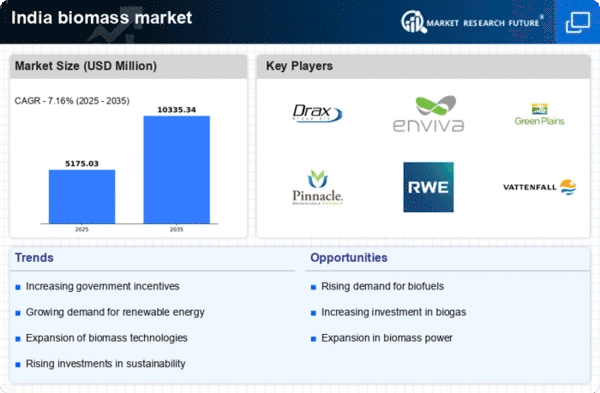
As per Market Research Future analysis, the Biomass market Size was estimated at 4829.26 USD Million in 2024. The biomass market is projected to grow from 5175.03 USD Million in 2025 to 10335.34 USD Million by 2035, exhibiting a compound annual growth rate (CAGR) of 7.1% during the forecast period 2025 - 2035

Key Market Trends & Highlights

The India biomass market is poised for substantial growth driven by government initiatives and rising environmental concerns.

  • Government initiatives are increasingly promoting the adoption of biomass energy solutions across various sectors.
  • Technological advancements in biomass conversion processes are enhancing efficiency and reducing costs.
  • Consumer awareness regarding sustainable energy sources is driving demand for biomass products, particularly in urban areas.
  • Rising energy demand and government policy support are key drivers propelling the growth of the biomass market in India.

Market Size & Forecast

2024 Market Size 4829.26 (USD Million)
2035 Market Size 10335.34 (USD Million)
CAGR (2025 - 2035) 7.16%

Major Players

Drax Group (GB), Enviva (US), Green Plains (US), Pinnacle Renewable Energy (CA), RWE (DE), Vattenfall (SE), Fortum (FI), Bioenergy Infrastructure Group (GB), A2A (IT)

Our Impact
Enabled $4.3B Revenue Impact for Fortune 500 and Leading Multinationals
Partnering with 2000+ Global Organizations Each Year
30K+ Citations by Top-Tier Firms in the Industry

India Biomass Market Trends

The biomass market in India is experiencing notable growth, driven by a combination of government initiatives and increasing demand for renewable energy sources. The Indian government has implemented various policies aimed at promoting biomass utilization, which is seen as a viable alternative to fossil fuels. This shift is largely influenced by the need to reduce greenhouse gas emissions and enhance energy security. Furthermore, the agricultural sector plays a crucial role in this market, as agricultural residues are a primary source of biomass feedstock. The integration of biomass into the energy mix is expected to contribute significantly to India's energy transition, aligning with its commitments to sustainable development and climate change mitigation. In addition to policy support, technological advancements are enhancing the efficiency of biomass conversion processes. Innovations in gasification and anaerobic digestion are making it easier to convert biomass into usable energy forms. The growing awareness of environmental issues among consumers is also fostering a shift towards cleaner energy solutions. As the biomass market continues to evolve, it appears poised to attract investments and foster collaborations across various sectors, including agriculture, energy, and waste management. This multifaceted approach may lead to a more sustainable energy landscape in India, with biomass playing a pivotal role in achieving energy independence and environmental sustainability.

Government Initiatives

The Indian government is actively promoting the biomass market through various policies and incentives. These initiatives aim to encourage the use of biomass as a renewable energy source, thereby reducing reliance on fossil fuels. Programs focused on financial support and subsidies for biomass projects are being implemented to stimulate growth in this sector.

Technological Advancements

Recent technological innovations are enhancing the efficiency of biomass conversion processes. Techniques such as gasification and anaerobic digestion are becoming more prevalent, allowing for improved energy extraction from biomass. These advancements are likely to make biomass a more attractive option for energy production.

Consumer Awareness

There is a growing awareness among consumers regarding the environmental benefits of biomass energy. This shift in perception is driving demand for cleaner energy solutions. As more individuals and businesses seek sustainable alternatives, the biomass market is expected to expand, reflecting a broader trend towards renewable energy adoption.

Market Segment Insights

By Feedstock: Agricultural Residue (Largest) vs. Microalgae (Fastest-Growing)

The India biomass market's feedstock segment is characterized by a diverse array of inputs, with agricultural residue holding the largest share due to the abundant availability of crop waste in the region. This is followed by food crops and wood, which also contribute significantly to biomass production. Other sources like municipal solid waste (MSW) and microalgae, while smaller in share, are increasingly being recognized for their potential as valuable biomass feedstocks. Growth trends in this segment are driven by increasing energy demands and government policies promoting renewable energy sources. Microalgae is emerging as the fastest-growing feedstock, fueled by advancements in cultivation technologies and its high yield potential. Agricultural residues continue to benefit from various sustainability initiatives aimed at reducing waste and enhancing energy efficiency, contributing to the growth of the biomass market.

Agricultural Residue (Dominant) vs. Microalgae (Emerging)

Agricultural residue is the dominant feedstock in the India biomass market, primarily because it is readily available and inexpensive, deriving from extensive agricultural activities. Farmers are increasingly utilizing crop residues for biomass energy, aligning with sustainable practices. Conversely, microalgae presents an emerging opportunity with high growth potential. It is rich in lipids and carbohydrates, making it ideal for biofuels. As technology evolves and the understanding of its cultivation improves, microalgae could revolutionize the biomass sector, offering a sustainable alternative while also contributing to carbon capture initiatives.

By Technology: Combined Heat and Power (Largest) vs. Anaerobic Digestion (Fastest-Growing)

The India biomass market features a diverse range of technologies, with Combined Heat and Power (CHP) systems leading in market share, harnessing heat and power generation efficiencies. Anaerobic Digestion is rapidly gaining traction, appealing to the need for sustainable waste management solutions, and currently represents a significant share of the market. Growth trends are notable, as an increasing number of industries are recognizing the environmental and economic benefits of biomass technologies. The push for renewable energy, governmental support through incentives, and the rising cost of fossil fuels are key drivers propelling growth in anaerobic digestion and other biomass technologies, ensuring a robust competitive landscape in the India biomass market.

Technology: Combined Heat and Power (Dominant) vs. Anaerobic Digestion (Emerging)

Combined Heat and Power (CHP) technology stands out as the dominant force in the India biomass market, delivering dual benefits by generating electricity and usable heat from biomass sources, thus maximizing efficiency and minimizing waste. In contrast, Anaerobic Digestion represents an emerging technology focusing primarily on waste treatment and renewable energy production. Utilizing organic waste materials, this process reduces landfill usage while producing biogas as a renewable energy source. The complementarity of these technologies suggests a synergistic potential in addressing energy needs while promoting environmental sustainability across the market.

By Product: Biodiesel (Largest) vs. Biogas (Fastest-Growing)

In the India biomass market, the product segment displays a diverse distribution of market share among biodiesel, biomethanol, biogas, and others. Biodiesel holds the largest share, driven by its established presence and usage in various sectors, particularly transportation. Biogas, as an emerging segment, is growing rapidly due to increased awareness of renewable energy solutions, receiving substantial backing from both government initiatives and private investments. The growth trends in the product segment are significantly influenced by governmental policies aimed at enhancing renewable energy adoption. Technological advancements in biomass conversion processes have also propelled the development of biogas solutions. On the other hand, biodiesel continues to thrive, supported by the automotive industry's shift towards greener fuels. Moreover, increasing consumer demand for sustainable energy sources fosters innovation and expansion across all product categories in the India biomass market.

Biodiesel (Dominant) vs. Biogas (Emerging)

Biodiesel remains the dominant product in the India biomass market, characterized by its extensive use in transportation and energy applications. It benefits from a well-structured supply chain and established production technologies. The segment is poised for stable growth, bolstered by supportive government policies and growing environmental concerns. In contrast, biogas represents an emerging segment, gaining traction for its renewable energy potential. Supported by advancements in digestion technologies and increasing local production, biogas is attracting considerable interest from both the agricultural sector and households. Thus, the contrast between biodiesel's established market position and biogas's growth potential creates a dynamic landscape in the renewable energy sector.

By End Use: Industrial (Largest) vs. Residential (Fastest-Growing)

The India biomass market is characterized by varying contributions across different end use segments. The industrial segment holds the largest market share due to extensive adoption in manufacturing processes and energy generation. Industries are increasingly relying on biomass as a sustainable energy source, which has resulted in a significant share compared to other segments. In contrast, the residential sector is emerging rapidly, fueled by growing awareness of renewable energy sources and government incentives to utilize biomass for heating and cooking. Growth trends in the end use segment highlight a shift towards cleaner energy solutions. The industrial segment continues to thrive as industries pivot towards sustainability, while the residential segment is propelled by rising energy costs and environmental concerns. With innovative biomass solutions and favorable policies, both segments are expected to witness robust growth, yet the residential market is predicted to outpace others as more households adopt biomass solutions for daily energy needs.

Commercial (Dominant) vs. Residential (Emerging)

In the context of the India biomass market, the commercial segment has established itself as a dominant player due to the integration of biomass systems in various commercial applications, including hotels, restaurants, and small-scale industries. The commercial sector prioritizes cost-effective and environmentally friendly energy solutions, making biomass a strategic choice. Meanwhile, the residential segment is viewed as an emerging market, as more households are beginning to recognize the benefits of biomass for heating and cooking. This transition is largely influenced by changing consumer attitudes towards sustainability and government support programs. As both segments evolve, the commercial sector remains significant in terms of energy consumption, while the residential sector is rapidly catching up, indicating a promising shift towards biomass utilization in everyday life.

Get more detailed insights about India Biomass Market

Key Players and Competitive Insights

The biomass market in India is currently characterized by a dynamic competitive landscape, driven by increasing energy demands and a growing emphasis on renewable energy sources. Key players such as Drax Group (GB), Enviva (US), and RWE (DE) are actively shaping the market through strategic initiatives aimed at enhancing their operational capabilities and market reach. Drax Group (GB) has positioned itself as a leader in biomass energy production, focusing on innovation in sustainable practices and technology integration. Meanwhile, Enviva (US) emphasizes its commitment to sustainability, leveraging partnerships to expand its supply chain and enhance its biomass sourcing capabilities. RWE (DE) is also making strides in the market, concentrating on regional expansion and the development of new biomass facilities to meet the rising demand for renewable energy in India.The business tactics employed by these companies reflect a concerted effort to optimize supply chains and localize manufacturing processes. The market structure appears moderately fragmented, with several players vying for market share while also collaborating on sustainability initiatives. This collective influence of key players fosters a competitive environment that encourages innovation and efficiency, ultimately benefiting the biomass market as a whole.

In October Drax Group (GB) announced a significant investment in a new biomass facility in India, aimed at increasing its production capacity by 30%. This strategic move is expected to enhance Drax's ability to meet the growing energy demands in the region while reinforcing its commitment to sustainable energy solutions. The investment not only signifies Drax's confidence in the Indian market but also highlights the potential for biomass to play a crucial role in the country's energy transition.

In September Enviva (US) entered into a partnership with a local Indian firm to enhance its biomass sourcing capabilities. This collaboration is likely to streamline supply chain operations and improve the sustainability of biomass production in the region. By leveraging local expertise, Enviva aims to strengthen its market position and ensure a reliable supply of biomass feedstock, which is essential for its growth strategy in India.

In August RWE (DE) launched a new digital platform designed to optimize biomass logistics and supply chain management. This initiative reflects RWE's commitment to integrating advanced technologies into its operations, potentially leading to increased efficiency and reduced operational costs. The platform is expected to facilitate better coordination among suppliers and enhance the overall reliability of biomass supply in the Indian market.

As of November the competitive trends in the biomass market are increasingly defined by digitalization, sustainability, and the integration of advanced technologies. Strategic alliances among key players are shaping the landscape, fostering innovation and collaboration. The shift from price-based competition to a focus on technological advancement and supply chain reliability is becoming evident. Companies that prioritize innovation and sustainable practices are likely to differentiate themselves in this evolving market, positioning themselves for long-term success.


Key Companies in the India Biomass Market include

Industry Developments

The India Biomass Market has seen significant developments recently, with various companies making strides in sustainable energy initiatives. In October 2023, Indian Oil Corporation announced plans to increase its biomass utilization in response to the government's push for cleaner energy sources. Bharat Heavy Electricals Limited has also been focusing on biomass-based power generation technologies to enhance efficiency. Notable activities include Renew Power collaborating with Adani Green Energy to develop biomass power plants expanding their renewable energy portfolio.

In terms of mergers and acquisitions, KPI Global Infrastructure and Orient Green Power Company announced a strategic partnership in September 2023 to enhance their biomass production capabilities, which has been well received within the market. The growth in revenue and market valuation for companies like Tata Power and Biomass Power Association reflects an increasing demand for biomass energy, aided by government incentives and policies supporting renewable energy adoption.

In the past few years, particularly in May 2022, Sugenja Biomass Energy launched new projects aimed at leveraging agricultural waste for electricity production, indicating the ongoing evolution and potential of the biomass sector in India.

Future Outlook

India Biomass Market Future Outlook

The biomass market in India is projected to grow at a 7.16% CAGR from 2025 to 2035, driven by increasing energy demands and government initiatives.

New opportunities lie in:

  • Development of advanced biomass gasification technologies
  • Expansion of biomass supply chains for rural energy access
  • Investment in biomass waste-to-energy conversion facilities

By 2035, the biomass market is expected to achieve substantial growth and innovation.

Market Segmentation

India Biomass Market End Use Outlook

  • Industrial
  • Commercial
  • Residential

India Biomass Market Product Outlook

  • Biodiesel
  • Biomethanol
  • Biogas
  • Others

India Biomass Market Feedstock Outlook

  • Food Crop
  • Non-Food Crop
  • Wood
  • Agricultural Residue
  • Municipal Solid Waste (MSW)
  • Microalgae
  • Others

India Biomass Market Technology Outlook

  • Combined Heat and Power (CHP)
  • Anaerobic Digestion
  • Gasification
  • Co-Firing
  • Landfill Gas

Report Scope

MARKET SIZE 2024 4829.26(USD Million)
MARKET SIZE 2025 5175.03(USD Million)
MARKET SIZE 2035 10335.34(USD Million)
COMPOUND ANNUAL GROWTH RATE (CAGR) 7.16% (2025 - 2035)
REPORT COVERAGE Revenue Forecast, Competitive Landscape, Growth Factors, and Trends
BASE YEAR 2024
Market Forecast Period 2025 - 2035
Historical Data 2019 - 2024
Market Forecast Units USD Million
Key Companies Profiled Drax Group (GB), Enviva (US), Green Plains (US), Pinnacle Renewable Energy (CA), RWE (DE), Vattenfall (SE), Fortum (FI), Bioenergy Infrastructure Group (GB), A2A (IT)
Segments Covered Feedstock, Technology, Product, End Use
Key Market Opportunities Growing demand for sustainable energy solutions drives innovation in biomass market technologies.
Key Market Dynamics Rising demand for renewable energy drives innovation and investment in biomass technologies across India.
Countries Covered India
Leave a Comment

FAQs

What is the expected market size of the India Biomass Market in 2024?

The India Biomass Market is expected to be valued at 4.83 billion USD in 2024.

What will be the market size of the India Biomass Market by 2035?

By 2035, the India Biomass Market is projected to reach a valuation of 10.97 billion USD.

What is the expected CAGR for the India Biomass Market from 2025 to 2035?

The expected CAGR for the India Biomass Market during the period from 2025 to 2035 is 7.743%.

Who are the key players in the India Biomass Market?

Major players in the India Biomass Market include companies like Bestec, Indian Oil Corporation, and Adani Green Energy.

What is the projected market size for Food Crop feedstock in 2035?

The market size for Food Crop feedstock is projected to be 2.69 billion USD by 2035.

What is the expected market value of Agricultural Residue feedstock in 2024?

The expected market value for Agricultural Residue feedstock in 2024 is 0.95 billion USD.

How much is the Municipal Solid Waste (MSW) segment expected to grow by 2035?

The Municipal Solid Waste (MSW) segment is projected to grow to 1.07 billion USD by 2035.

What are the growth drivers for the India Biomass Market?

Key growth drivers for the India Biomass Market include increasing demand for renewable energy and government policies supporting sustainable practices.

What challenges does the India Biomass Market face?

Challenges for the India Biomass Market include technological limitations and competition from other energy sources.

What is the projected market value for Wood feedstock in 2035?

The projected market value for Wood feedstock is estimated to be 2.92 billion USD in 2035.

Download Free Sample

Kindly complete the form below to receive a free sample of this Report

Compare Licence

×
Features License Type
Single User Multiuser License Enterprise User
Price $4,950 $7,250 $
Maximum User Access Limit 1 User Upto 10 Users Unrestricted Access Throughout the Organization
Free Customization
Direct Access to Analyst
Deliverable Format
Platform Access
Discount on Next Purchase 10% 15% 15%
Printable Versions