×
Hero Background
English
Chinese
French
Japanese
Korean
German
Spanish

In-wheel Motors Market Analysis

ID: MRFR/AT/5824-CR
110 Pages
Sejal Akre
October 2022

In-wheel motor Market Research Report Information By Propulsion Type (BEV, PHEV, FCEV, Cooling Type, Air Cooling, Liquid Cooling) Power Output (Up to 60 kW, 60–90 kW, Above 90 kW) Vehicle Type (Passenger Cars, Commercial Vehicles) Forecast 2030

Share:
Download PDF ×

We do not share your information with anyone. However, we may send you emails based on your report interest from time to time. You may contact us at any time to opt-out.

In-wheel Motors Market Infographic
Purchase Options

Market Analysis

In-depth Analysis of In-wheel Motors Market Industry Landscape

Governments around the world are doing things to make people more aware of using electric commercial vehicles. They want to do this to help the environment and save money on foreign exchange. For example, the International Council on Clean Transportation is working on rules about zero-emission vehicles, better policies for electric utilities, more types of electric vehicles available, promoting them to customers, giving discounts to buyers, allowing them to use special lanes on busy roads, building more places to charge electric vehicles, letting them use special lanes with fewer cars, and supporting local promotions for electric vehicles. This is happening because the prices of crude oil, which is used to make regular vehicle fuel, keep going up. Electric vehicles are better for the environment because they make less noise and pollution compared to regular vehicles. Commercial vehicles, which are used for things like deliveries, can also do more work at night, which helps ease traffic during the day. Because of these benefits, many companies that make electric vehicles are working on new products to meet the growing demand from customers. For example, in 2021, Renault Trucks made the first electric truck called D Wide ZE, which has a tipper and a crane for the Noblet Group, especially for construction work. Another company called Protean changed the Ford F-150 EV by taking out the regular engine and putting four electric motors directly into the wheels. This is important for vehicles that need power in all four wheels, like off-road trucks or high-performance cars. So, the efforts by governments to get more people to use electric commercial vehicles are expected to make the global in-wheel motor market grow in the future. Right now, the efforts by governments are just starting, and different countries are planning to make more rules and do more things to get people to use electric vehicles in the next few years. Because of this, the impact of government efforts on the global in-wheel motor market is expected to go from low to high in the coming years.

Author
Sejal Akre
Senior Research Analyst

She has over 5 years of rich experience, in market research and consulting providing valuable market insights to client. Hands on expertise in management consulting, and extensive knowledge in domain including ICT, Automotive & Transportation and Aerospace & Defense. She is skilled in Go-to market strategy, industry analysis, market sizing, in depth company profiling, competitive intelligence & benchmarking and value chain amongst others.

Leave a Comment

FAQs

What growth rate would the Global In-wheel motor Market register in the future?

The Global In-wheel motor Market would register a growth of ~32.31% during the forecast period.

What is the key restraining factor for the Global In-wheel motor Market?

High prices of electric vehicles is a key restraining factor for the Global In-wheel motor Market

Which region would enjoy the upper hand in the Global In-wheel motor Market?

Asia-pacific would enjoy the upper hand in the Global In-wheel motor Market

Which Asia-pacific country would set the trend in the Global In-wheel motor Market?

China.

Who are the key players operative in the global inwheel motors market?

A few major market players operating in the global inwheel motors market are ECOmove GmbH (Germany), NTN Corporation (Japan), Protean Electric (US), among others.

Market Summary

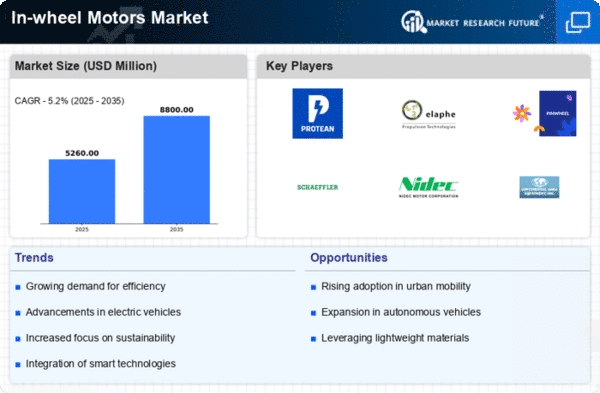
As per MRFR analysis, the in-wheel motor market size was estimated at 5000.0 USD Million in 2024. The in-wheel motor industry is projected to grow from 5300.0 USD Million in 2025 to 8800.0 USD Million by 2035, exhibiting a compound annual growth rate (CAGR) of 5.2% during the forecast period 2025 - 2035.

Key Market Trends & Highlights

The In-wheel Motors Market is poised for substantial growth driven by technological advancements and sustainability initiatives.

  • North America remains the largest market for in-wheel motors, reflecting a strong demand for innovative automotive solutions. Asia-Pacific is emerging as the fastest-growing region, propelled by increasing investments in electric vehicle technology. The passenger vehicle segment dominates the market, while the electric vehicle segment is rapidly gaining traction due to changing consumer preferences. Technological advancements and sustainability concerns are key drivers, as they enhance performance and align with environmental goals.

Market Size & Forecast

2024 Market Size 5000.0 (USD Million)
2035 Market Size 8800.0 (USD Million)
CAGR (2025 - 2035) 5.2%
Largest Regional Market Share in 2024 Asia-Pacific

Major Players

<p>Protean Electric (GB), Elaphe Propulsion Technologies (SI), Inwheel (DE), Schaeffler (DE), Nidec Corporation (JP), Continental AG (DE), Zhejiang VIE Science &amp; Technology Co., Ltd. (CN), Yamaha Motor Co., Ltd. (JP), BorgWarner Inc. (US)</p>

Market Trends

The in-wheel motor market is currently experiencing a transformative phase, driven by advancements in electric vehicle technology and a growing emphasis on energy efficiency. This market segment appears to be gaining traction as manufacturers increasingly recognize the benefits of integrating motors directly into the wheel assembly. Such integration not only optimizes space but also enhances vehicle performance by reducing weight and improving handling.

Furthermore, the rising demand for sustainable transportation solutions seems to be propelling innovations in this field, as stakeholders seek to develop more efficient and environmentally friendly alternatives to traditional propulsion systems. In addition, the In-wheel Motor Market is likely to witness a surge in applications beyond passenger vehicles, potentially extending into commercial and industrial sectors.

This diversification may open new avenues for growth, as various industries explore the advantages of in-wheel motor technology. The ongoing research and development efforts indicate a commitment to overcoming existing challenges, such as heat management and cost-effectiveness. As the market evolves, it may become increasingly competitive, with numerous players vying for a share of this promising segment, suggesting a dynamic landscape ahead for in-wheel motor solutions.

Technological Advancements

Recent innovations in materials and design are enhancing the efficiency and performance of in-wheel motors. These advancements may lead to lighter, more compact solutions that improve vehicle dynamics and energy consumption.

Sustainability Focus

The growing emphasis on reducing carbon footprints is driving interest in electric vehicles equipped with in-wheel motors. This trend suggests a shift towards greener technologies, aligning with global sustainability goals.

Diverse Applications

In-wheel motors are finding applications beyond passenger vehicles, potentially expanding into commercial and industrial sectors. This diversification indicates a broader acceptance and integration of this technology across various transportation modes.

In-wheel Motors Market Market Drivers

Market Growth Projections

The Global In-wheel motor market is poised for remarkable growth, with projections indicating a market size of 7.63 USD Billion in 2024 and an impressive escalation to 113.8 USD Billion by 2035. This growth trajectory suggests a compound annual growth rate (CAGR) of 27.85% from 2025 to 2035. Such figures reflect the increasing adoption of electric vehicles and the integration of advanced technologies in automotive design. The market's expansion is likely to be driven by various factors, including technological advancements, government policies, and changing consumer preferences. As the industry evolves, stakeholders are expected to capitalize on emerging opportunities, further propelling the market forward.

Rising Focus on Vehicle Efficiency

The rising focus on vehicle efficiency is a significant driver for the In-wheel motor sector. As automotive manufacturers strive to enhance fuel economy and reduce emissions, in-wheel motors present a viable solution. By integrating motors directly into the wheel hub, manufacturers can achieve better weight distribution and lower energy losses. This efficiency is particularly appealing in the context of electric vehicles, where maximizing range is critical. The market's growth trajectory, with an expected valuation of 7.63 USD Billion in 2024, underscores the importance of efficiency in automotive design. As consumer preferences shift towards more efficient vehicles, the demand for in-wheel motors is likely to increase.

Growing Demand for Electric Vehicles

The increasing global demand for electric vehicles (EVs) is a primary driver for the In-wheel motor sector. As consumers become more environmentally conscious, the shift towards sustainable transportation solutions accelerates. In 2024, the market is projected to reach 7.63 USD Billion, reflecting a robust interest in innovative technologies like in-wheel motors. These motors enhance vehicle efficiency by reducing weight and improving space utilization, which is crucial for EV manufacturers. The anticipated growth in EV sales is expected to further bolster the adoption of in-wheel motors, aligning with the industry's trajectory towards cleaner mobility solutions.

Government Initiatives and Incentives

Government initiatives and incentives aimed at promoting electric mobility play a crucial role in driving the In-wheel motor industry. Various countries are implementing policies that encourage the adoption of electric vehicles, including tax rebates, subsidies, and infrastructure development for charging stations. These measures are likely to stimulate demand for in-wheel motors, as they are integral to the design of electric vehicles. With the market expected to grow at a CAGR of 27.85% from 2025 to 2035, supportive government policies are anticipated to create a favorable environment for manufacturers and consumers alike, fostering innovation and investment in this sector.

Emerging Markets and Urbanization Trends

Emerging markets and urbanization trends are reshaping the Global In-wheel motor Industry. As urban populations grow, the demand for efficient and compact transportation solutions rises. In-wheel motors offer a unique advantage in urban settings, allowing for smaller vehicle designs that can navigate congested areas more effectively. This trend is particularly evident in regions experiencing rapid urbanization, where traditional vehicle designs may not suffice. The anticipated growth in these markets is expected to contribute to the overall expansion of the in-wheel motor sector, with projections indicating a market size of 113.8 USD Billion by 2035. Manufacturers are likely to adapt their strategies to cater to these evolving urban mobility needs.

Technological Advancements in Motor Design

Technological advancements in motor design significantly influence the In-wheel motors industry. Innovations such as improved power density, thermal management, and integration of smart technologies enhance the performance and reliability of in-wheel motors. These developments enable manufacturers to produce lighter and more efficient motors, which are essential for modern electric and hybrid vehicles. As a result, the market is likely to experience substantial growth, with projections indicating a rise to 113.8 USD Billion by 2035. The continuous evolution of motor technology not only meets consumer expectations but also aligns with regulatory standards for emissions and energy efficiency.


Market Segment Insights

By Application: Passenger Vehicle (Largest) vs. Electric Vehicle (Fastest-Growing)

<p>In the in-wheel motor market, the application segment is primarily divided into Passenger Vehicles, Commercial Vehicles,&nbsp;<a href="https://www.marketresearchfuture.com/reports/two-wheeler-aftermarket-industry-39176">Two-Wheelers</a>, Electric Vehicles, and Autonomous Vehicles. Among these, Passenger Vehicles account for the largest market share, driven by high consumer demand for personal transportation solutions. This segment benefits from advancements in electric vehicle technologies and a shift towards more efficient drive systems, contributing to a significant portion of total sales. Meanwhile, Electric Vehicles are emerging as the fastest-growing segment, fueled by increasing environmental concerns and government support for electric mobility solutions.</p>

<p>Passenger Vehicle (Dominant) vs. Electric Vehicle (Emerging)</p>

<p>The <a href="https://www.marketresearchfuture.com/reports/automotive-passenger-vehicle-sensor-market-23738">Passenger Vehicle</a> segment is characterized by its large production volumes and strong consumer demand, positioning it as the dominant force in the in-wheel motor market. This segment not only caters to traditional gasoline vehicles but is rapidly adapting to electric models, integrating in-wheel motors for enhanced performance and efficiency. On the other hand, the Electric Vehicle segment is recognized as an emerging powerhouse, increasingly gaining traction due to advancements in battery technologies and supportive regulations. These vehicles are particularly appealing to eco-conscious consumers looking for sustainable options. The integration of in-wheel motors in this segment enhances vehicle agility and structure, promoting further growth as manufacturers strive to meet the evolving automotive landscape.</p>

By Type: Permanent Magnet Synchronous Motor (Largest) vs. Switched Reluctance Motor (Fastest-Growing)

<p>The in-wheel motor market is characterized by a diverse range of technologies, notably including Permanent Magnet Synchronous Motors (PMSM) and Switched Reluctance Motors (SRM). Currently, PMSM holds the largest market share due to its superior efficiency and performance in electric vehicle applications. On the other hand, SRM is gaining traction, especially in urban mobility solutions, owing to its simplicity and cost-effectiveness, making it a prominent player in the evolving landscape of in-wheel motor technologies.</p>

<p>Motor Types: PMSM (Dominant) vs. SRM (Emerging)</p>

<p>Permanent Magnet Synchronous Motors (PMSM) have established themselves as the dominant choice in the In-wheel Motors Market due to their high efficiency, compact size, and favorable power-to-weight ratio. These motors effectively harness the benefits of permanent magnets to deliver robust performance in varying conditions. Conversely, Switched Reluctance Motors (SRM) are emerging due to their ability to operate efficiently without permanent magnets, leading to reduced production costs and enhanced durability. As manufacturers seek more cost-effective and reliable solutions, SRMs are expected to become increasingly favored, particularly in regions prioritizing affordable electric mobility.</p>

By Power Rating: High Power (Largest) vs. Medium Power (Fastest-Growing)

<p>The in-wheel motor market demonstrates distinct market share distribution across different power rating segments. High Power In-wheel Motors dominate this market, largely due to their suitability for performance-oriented electric vehicles that require significant torque and power delivery. Medium Power motors, while smaller in share, are rapidly gaining traction as they cater to a growing demand for balance between efficiency and performance in urban applications. In contrast, Low Power options hold a smaller share, primarily appealing to low-speed applications in smaller electric vehicles.</p>

<p>Power Rating: High Power (Dominant) vs. Medium Power (Emerging)</p>

<p>High Power In-wheel Motors are designed for high-performance electric vehicles, providing enhanced torque and acceleration capabilities, which makes them the preferred choice for manufacturers aiming to compete in the premium segment of the market. Their robustness and ability to handle substantial power demands position them as the dominant force. Medium Power In-wheel Motors, on the other hand, represent an emerging trend, responding to the shift towards urban mobility solutions. They offer a balanced performance for light electric vehicles and are particularly appealing for their energy efficiency, promising a blend of affordability and effective power management. This segment is expected to see innovative advancements, making them attractive to manufacturers and consumers alike.</p>

By Vehicle Type: Electric Cars (Largest) vs. Electric Buses (Fastest-Growing)

<p>The in-wheel motor market is characterized by a diverse distribution among various vehicle types, with electric cars holding the largest market share. They have gained significant popularity due to advancements in battery technology and eco-friendly initiatives. Following closely are electric buses, which are increasingly being adopted for public transportation efforts aimed at reducing emissions and enhancing energy efficiency. Other segments like electric trucks and motorcycles also contribute to the market but remain smaller in comparison. Growth trends indicate a promising future for all segments, particularly for electric buses, which are projected as the fastest-growing category. Factors driving this growth include government incentives, technological advancements, and expanding <a href="https://www.marketresearchfuture.com/reports/us-electric-vehicle-ev-charging-infrastructure-market-17222">charging infrastructure</a>. Furthermore, consumer demand for sustainable transportation solutions continues to rise, further solidifying the position of electric vehicles in the market.</p>

<p>Electric Cars (Dominant) vs. Electric Trucks (Emerging)</p>

<p>Electric cars continue to dominate the in-wheel motor market due to their widespread adoption, driven by consumer preferences for eco-friendly alternatives. They benefit from established infrastructure and continuous improvements in technology, enabling longer ranges and faster charging times. On the other hand, electric trucks, while currently categorized as an emerging segment, are poised to capture a larger share of the market as <a href="https://www.marketresearchfuture.com/reports/blockchain-in-logistics-market-32069">logistics </a>companies seek out sustainable solutions for freight transport. The growing emphasis on reducing carbon footprints and enhancing distribution efficiency contributes to this trend. As battery technologies improve and costs decrease, electric trucks are expected to become a more plausible option for commercial applications, bridging the gap between traditional diesel vehicles and electric alternatives.</p>

By Technology: Direct Drive (Largest) vs. Regenerative Braking (Fastest-Growing)

<p>In the in-wheel motor market, the segment is characterized by three primary technologies: Direct Drive, Regenerative Braking, and Wireless Charging. Among these, Direct Drive technology holds the largest market share due to its simplicity and efficiency in converting electrical energy into mechanical motion without intermediate steps.&nbsp;<a href="https://www.marketresearchfuture.com/reports/automotive-regenerative-braking-system-market-6919">Regenerative Braking</a> follows, recognized for its ability to recapture energy during braking, thereby enhancing overall vehicle efficiency and extending battery life. Meanwhile, Wireless Charging technology is still emerging but gaining traction as a convenient solution for electric vehicles.</p>

<p>Technology: Direct Drive (Dominant) vs. Regenerative Braking (Emerging)</p>

<p>Direct Drive technology in the in-wheel motor market is recognized for its straightforward execution, enabling direct transmission of power to the wheels. This approach reduces mechanical complexity, leading to improved reliability and maintenance ease. On the other hand, Regenerative Braking is an emerging component that allows vehicles to recover energy during braking, thus contributing to higher energy efficiency. While Direct Drive remains dominant, Regenerative Braking is rapidly gaining attention due to growing environmental consciousness and advancements in electric vehicle technology, highlighting a shift towards more sustainable driving solutions.</p>

Get more detailed insights about In-wheel motors Market Research Report—Global Forecast till 2035

Regional Insights

North America : Technological Innovation Leader

North America is witnessing significant growth in the In-wheel Motors market, driven by advancements in electric vehicle (EV) technology and increasing consumer demand for efficient transportation solutions. The market size is projected to reach $1,200.0 million by 2025, reflecting a robust growth trajectory. Regulatory support for EV adoption and sustainability initiatives further catalyze this growth, positioning the region as a key player in the global market. The competitive landscape in North America is characterized by the presence of major players such as BorgWarner Inc. and Continental AG, who are investing heavily in R&D to enhance product offerings. The U.S. leads the market, supported by a strong automotive industry and favorable government policies promoting electric mobility. This competitive environment fosters innovation, ensuring that North America remains at the forefront of the In-wheel Motors market.

Europe : Sustainable Mobility Hub

Europe is emerging as a pivotal market for In-wheel Motors, with a projected market size of $1,500.0 million by 2025. The region's commitment to sustainability and stringent emissions regulations are driving the demand for electric vehicles, thereby boosting the In-wheel Motors market. European countries are increasingly investing in infrastructure to support EV adoption, which is expected to further enhance market growth in the coming years. Leading countries such as Germany, France, and the UK are at the forefront of this market, with key players like Schaeffler and Nidec Corporation actively participating in the development of innovative solutions. The competitive landscape is marked by collaborations and partnerships aimed at advancing technology and expanding market reach. This dynamic environment positions Europe as a leader in the In-wheel Motors sector, fostering a culture of innovation and sustainability.

Asia-Pacific : Global Market Leader

Asia-Pacific is the largest market for In-wheel Motors, with a market size of $2,500.0 million projected by 2025. The region's rapid urbanization, increasing disposable incomes, and growing environmental awareness are driving the demand for electric vehicles. Government initiatives promoting EV adoption and investments in charging infrastructure are further catalyzing market growth, making Asia-Pacific a key player in the global landscape. Countries like China, Japan, and South Korea are leading the charge, with significant contributions from companies such as Zhejiang VIE Science & Technology and Yamaha Motor Co., Ltd. The competitive landscape is characterized by a mix of established players and emerging startups, fostering innovation and technological advancements. This dynamic environment ensures that Asia-Pacific remains at the forefront of the In-wheel Motors market, catering to the growing demand for sustainable transportation solutions.

Middle East and Africa : Emerging Market Potential

The Middle East and Africa region is witnessing emerging opportunities in the In-wheel Motors market, with a projected size of $800.0 million by 2025. The increasing focus on sustainable transportation and the rise of electric vehicles are key drivers of market growth. Governments in the region are beginning to implement policies aimed at promoting EV adoption, which is expected to further stimulate demand for In-wheel Motors in the coming years. Countries such as South Africa and the UAE are leading the way in adopting electric mobility solutions. The competitive landscape is still developing, with both local and international players exploring opportunities in this market. As infrastructure improves and consumer awareness grows, the Middle East and Africa are poised to become significant contributors to the global In-wheel Motors market.

Key Players and Competitive Insights

The In-wheel Motors Market is currently characterized by a dynamic competitive landscape, driven by technological advancements and increasing demand for electric vehicles (EVs). Key players are actively pursuing strategies that emphasize innovation, regional expansion, and strategic partnerships to enhance their market positioning. For instance, Protean Electric (GB) has focused on developing high-performance in-wheel motors that cater to the growing EV segment, while Schaeffler (DE) has been investing in R&D to improve the efficiency and integration of their in-wheel motor systems. These strategies collectively contribute to a competitive environment that is increasingly centered around technological differentiation and sustainability.

In terms of business tactics, companies are localizing manufacturing to reduce costs and enhance supply chain efficiency. The market structure appears moderately fragmented, with several players vying for market share. This fragmentation allows for a diverse range of products and innovations, although it also intensifies competition among key players. The collective influence of these companies shapes market dynamics, as they strive to meet the evolving demands of consumers and regulatory standards.

In November 2025, Elaphe Propulsion Technologies (SI) announced a partnership with a leading automotive manufacturer to integrate their in-wheel motor technology into a new line of electric vehicles. This collaboration is strategically significant as it not only enhances Elaphe's market visibility but also positions them as a key player in the EV supply chain, potentially leading to increased sales and market penetration.

In October 2025, Nidec Corporation (JP) unveiled a new generation of in-wheel motors designed to improve energy efficiency by 15%. This innovation is crucial as it aligns with the industry's shift towards more sustainable and efficient technologies, thereby enhancing Nidec's competitive edge in the market. The introduction of this product is likely to attract interest from various automotive manufacturers looking to enhance their EV offerings.

In September 2025, Continental AG (DE) expanded its production capabilities by opening a new facility dedicated to the manufacturing of in-wheel motors in Europe. This strategic move is indicative of Continental's commitment to meeting the rising demand for EV components and signifies a proactive approach to securing a larger market share in the European region. The facility is expected to streamline operations and reduce lead times, thereby enhancing Continental's competitive positioning.

As of December 2025, current trends in the In-wheel Motors sector are heavily influenced by digitalization, sustainability, and the integration of artificial intelligence (AI) in manufacturing processes. Strategic alliances are becoming increasingly important, as companies recognize the value of collaboration in driving innovation and enhancing product offerings. Looking ahead, competitive differentiation is likely to evolve from traditional price-based competition to a focus on technological innovation, reliability in supply chains, and sustainable practices. This shift underscores the necessity for companies to adapt and innovate continuously to maintain their competitive edge in a rapidly changing market.

In October 2025, China approved Dongfeng’s E-007 as the first mass-produced EV with four in-wheel motors, setting a new benchmark in electric drivetrain technology. The system enhances torque distribution, handling, and performance. This approval reinforces China’s leadership in next-generation EV engineering.

In August 2025, Protean Electric announced the first mainstream OEM application of its in-wheel motors, marking a milestone in electric drivetrain technology. The integration improves efficiency, handling, and design flexibility for EV manufacturers. This adoption validates in-wheel motors as a production-ready innovation.

Key Companies in the In-wheel Motors Market market include

Industry Developments

Elaphe Ltd. (Slovenia)

January, 2025: Elaphe unveiled the Sonic.1, a high-performance front in-wheel motor, at CES 2025. This motor integrates a 400 mm brake disc within a 21-inch rim, delivering a continuous output of 272 horsepower per wheel and a peak power of 347 horsepower.

The design allows for potential configurations achieving up to one megawatt of power in rear-wheel-drive setups. The Sonic.1 enhances vehicle control with response times twenty times faster than traditional electric axle systems.

January, 2025: In collaboration with Italdesign, Elaphe's Sonic.1 motors were showcased in the Quintessenza concept car at CES 2025. This partnership demonstrates the integration of advanced in-wheel motor technology with innovative vehicle design, highlighting the potential for future electric vehicle architectures.

In June 2021, e-Traction partnered with ViriCti, to help accelerate the adoption of electric buses by using the state-of-art The Motion 2.0 drivetrain.

In February 2021, Tajima Motor Corporation Idemitsu Kosan partnered with Corporation to build and market mini electric vehicles that can travel as fast as 60 kilometers per hour.

In January 2021, National Electric Vehicle Sweden (NEVS), a subsidiary of Evergrande Health, has acquired Protean Electric, a leading developer of in-wheel motor technology. The acquisition is part of Evergrande’s strategy to become a major player-in the global electric vehicle (EV) industry.

In May 2019, Elaphe Ltd. Has announced they have begun low-volume series manufacturing of the world’s highest performance direct drive, gearless in-wheel powertrain system, called the L1500.

In September 2018, Printed Motor Works, resigned and enhanced the specification of its compact XR15 series in-wheel motor range. The upgraded models have greater radial and axial load bearing capacity.

Future Outlook

In-wheel Motors Market Future Outlook

<p>The global in-wheel motor market is projected to grow at a 5.2% CAGR from 2024 to 2035, driven by advancements in electric vehicle technology, increasing demand for energy efficiency, and urbanization.</p>

New opportunities lie in:

  • <p>Development of modular in-wheel motor systems for diverse vehicle types.</p>
  • <p>Partnerships with electric vehicle manufacturers for integrated solutions.</p>
  • <p>Expansion into emerging markets with tailored in-wheel motor designs.</p>

<p>By 2035, the In-wheel Motors Market is expected to achieve substantial growth and innovation.</p>

Market Segmentation

In-wheel Motors Market Type Outlook

  • Permanent Magnet Synchronous Motor
  • Switched Reluctance Motor
  • Induction Motor
  • Brushless DC Motor

In-wheel Motors Market Technology Outlook

  • Direct Drive
  • Regenerative Braking
  • Wireless Charging

In-wheel Motors Market Application Outlook

  • Passenger Vehicle
  • Commercial Vehicle
  • Two-Wheeler
  • Electric Vehicle
  • Autonomous Vehicle

In-wheel Motors Market Power Rating Outlook

  • Low Power
  • Medium Power
  • High Power

In-wheel Motors Market Vehicle Type Outlook

  • Electric Cars
  • Electric Buses
  • Electric Trucks
  • Motorcycles

Report Scope

MARKET SIZE 2024 5000.0(USD Million)
MARKET SIZE 2025 5300.0(USD Million)
MARKET SIZE 2035 8800.0(USD Million)
COMPOUND ANNUAL GROWTH RATE (CAGR) 5.2% (2024 - 2035)
REPORT COVERAGE Revenue Forecast, Competitive Landscape, Growth Factors, and Trends
BASE YEAR 2024
Market Forecast Period 2025 - 2035
Historical Data 2019 - 2024
Market Forecast Units USD Million
Key Companies Profiled Protean Electric (GB), Elaphe Propulsion Technologies (SI), Inwheel (DE), Schaeffler (DE), Nidec Corporation (JP), Continental AG (DE), Zhejiang VIE Science & Technology Co., Ltd. (CN), Yamaha Motor Co., Ltd. (JP), BorgWarner Inc. (US)
Segments Covered Application, Type, Power Rating, Vehicle Type, Technology
Key Market Opportunities Growing demand for electric vehicles drives innovation in the In-wheel Motors Market.
Key Market Dynamics Rising demand for electric vehicles drives innovation and competition in the in-wheel motors market.
Countries Covered North America, Europe, APAC, South America, MEA

FAQs

What growth rate would the Global In-wheel motor Market register in the future?

The Global In-wheel motor Market would register a growth of ~32.31% during the forecast period.

What is the key restraining factor for the Global In-wheel motor Market?

High prices of electric vehicles is a key restraining factor for the Global In-wheel motor Market

Which region would enjoy the upper hand in the Global In-wheel motor Market?

Asia-pacific would enjoy the upper hand in the Global In-wheel motor Market

Which Asia-pacific country would set the trend in the Global In-wheel motor Market?

China.

Who are the key players operative in the global inwheel motors market?

A few major market players operating in the global inwheel motors market are ECOmove GmbH (Germany), NTN Corporation (Japan), Protean Electric (US), among others.

  1. EXECUTIVE SUMMARY
    1. MARKET ATTRACTIVENESS ANALYSIS
      1. GLOBAL IN-WHEEL MOTOR MARKET, BY PROPULSION TYPE
      2. GLOBAL IN-WHEEL MOTOR MARKET, BY COOLING TYPE
      3. GLOBAL IN-WHEEL MOTOR MARKET, BY MOTOR TYPE
      4. GLOBAL IN-WHEEL MOTOR MARKET, BY VEHICLE TYPE
      5. GLOBAL IN-WHEEL MOTOR MARKET, BY POWER OUTPUT
      6. GLOBAL IN-WHEEL MOTOR MARKET, BY REGION
    2. 2: MARKET INTRODUCTION
    3. DEFINITION
    4. SCOPE OF THE STUDY
    5. MARKET STRUCTURE
  2. RESEARCH METHODOLOGY
    1. RESEARCH PROCESS
    2. PRIMARY RESEARCH
    3. SECONDARY RESEARCH
    4. MARKET SIZE ESTIMATION
    5. TOP-DOWN AND BOTTOM-UP APPROACH
    6. FORECAST MODEL
    7. LIST OF ASSUMPTIONS
  3. MARKET DYNAMICS
    1. INTRODUCTION
    2. DRIVERS
      1. GOVERNMENT INITIATIVES TO ENCOURAGE ADOPTION OF ELECTRIC COMMERCIAL VEHICLES
      2. EXPANSION OF GLOBAL ELECTRIC VEHICLE MANUFACTURERS INTO EMERGING MARKETS
      3. DRIVER IMPACT ANALYSIS
    3. RESTRAINTS
      1. HIGH PRICES OF ELECTRIC VEHICLES
      2. LIMITED CAPACITY OF BATTERIES
      3. RESTRAINT IMPACT ANALYSIS
    4. OPPORTUNITY
      1. INCREASING LOGISTIC ACTIVITIES
    5. COVID-19 IMPACT ANALYSIS
      1. ECONOMIC IMPACT ON THE AUTOMOTIVE INDUSTRY
      2. IMPACT ON PRODUCTION AND SALES
      3. IMPACT ON THE IN-WHEEL MOTOR MARKET
      4. IMPACT ON WORLD TRADE
  4. MARKET FACTOR ANALYSIS
    1. PORTER’S FIVE FORCES MODEL
      1. THREAT OF NEW ENTRANTS
      2. BARGAINING POWER OF SUPPLIERS
      3. THREAT OF SUBSTITUTES
      4. BARGAINING POWER OF BUYERS
      5. INTENSITY OF RIVALRY
    2. SUPPLY CHAIN ANALYSIS
      1. DESIGN & DEVELOPMENT
      2. RAW MATERIAL/COMPONENT SUPPLY
      3. ASSEMBLY
      4. DISTRIBUTION/SUPPLY
      5. END USE
  5. GLOBAL IN-WHEEL MOTOR MARKET, BY PROPULSION TYPE
    1. OVERVIEW
    2. BEV
    3. PHEV
    4. FCEV
  6. GLOBAL IN-WHEEL MOTOR MARKET, BY COOLING TYPE
    1. OVERVIEW
    2. AIR COOLING
    3. LIQUID COOLING
  7. GLOBAL IN-WHEEL MOTOR MARKET, BY MOTOR TYPE
    1. OVERVIEW
    2. AXIAL FLUX MOTOR
    3. RADIAL FLUX MOTOR
  8. GLOBAL IN-WHEEL MOTOR MARKET, BY POWER OUTPUT
    1. OVERVIEW
    2. UP TO 60 KW
    3. 60–90 KW
    4. ABOVE 90 KW
  9. GLOBAL IN-WHEEL MOTOR MARKET, BY VEHICLE TYPE
    1. OVERVIEW
    2. PASSENGER CARS
    3. COMMERCIAL VEHICLES
  10. GLOBAL IN-WHEEL MOTOR MARKET, BY REGION
    1. OVERVIEW
    2. NORTH AMERICA
      1. US
      2. CANADA
      3. MEXICO
    3. EUROPE
      1. GERMANY
      2. UK
      3. FRANCE
      4. ITALY
      5. REST OF EUROPE
    4. ASIA-PACIFIC
      1. CHINA
      2. JAPAN
      3. INDIA
      4. REST OF ASIA-PACIFIC
    5. REST OF THE WORLD
      1. MIDDLE EAST & AFRICA
      2. SOUTH AMERICA
  11. COMPETITIVE LANDSCAPES
    1. COMPETITIVE OVERVIEW
    2. COMPETITIVE BENCHMARKING
    3. MARKET SHARE ANALYSIS
    4. KEY DEVELOPMENTS IN THE GLOBAL IN-WHEEL MOTOR MARKET
      1. PRODUCT DEVELOPMENT
      2. PARTNERSHIP
      3. MERGERS AND ACQUISITIONS
      4. EXPANSION
  12. COMPANY PROFILES
    1. PROTEAN
      1. COMPANY OVERVIEW
      2. FINANCIAL OVERVIEW
      3. PRODUCTS OFFERED
      4. KEY DEVELOPMENTS
      5. SWOT ANALYSIS
      6. KEY STRATEGIES
    2. NTN CORPORATION
      1. COMPANY OVERVIEW
      2. FINANCIAL OVERVIEW
      3. PRODUCTS OFFERED
      4. KEY DEVELOPMENTS
      5. SWOT ANALYSIS
      6. KEY STRATEGIES
    3. NSK LTD.
      1. COMPANY OVERVIEW
      2. FINANCIAL OVERVIEW
      3. PRODUCTS OFFERED
      4. KEY DEVELOPMENTS
      5. SWOT ANALYSIS
      6. KEY STRATEGIES
    4. TAJIMA MOTOR CORPORATION
      1. COMPANY OVERVIEW
      2. FINANCIAL OVERVIEW
      3. PRODUCTS OFFERED
      4. KEY DEVELOPMENTS
    5. YASA LIMITED
      1. COMPANY OVERVIEW
      2. FINANCIAL OVERVIEW
      3. PRODUCTS OFFERED
      4. KEY DEVELOPMENTS
    6. ECOMOVE
      1. COMPANY OVERVIEW
      2. FINANCIAL OVERVIEW
      3. PRODUCTS OFFERED
      4. KEY DEVELOPMENTS
    7. ELAPHE LTD.
      1. COMPANY OVERVIEW
      2. FINANCIAL OVERVIEW
      3. PRODUCTS OFFERED
      4. KEY DEVELOPMENTS
    8. SCHAEFFLER AG
      1. COMPANY OVERVIEW
      2. FINANCIAL OVERVIEW
      3. PRODUCTS, SOLUTIONS, AND SERVICES OFFERED
      4. KEY DEVELOPMENTS
    9. ZIEHL-ABEGG SE
      1. COMPANY OVERVIEW
      2. FINANCIAL OVERVIEW
      3. PRODUCTS OFFERED
      4. KEY DEVELOPMENTS
    10. PRINTED MOTOR WORKS
      1. COMPANY OVERVIEW
      2. FINANCIAL OVERVIEW
      3. PRODUCTS OFFERED
      4. KEY DEVELOPMENTS
    11. E-TRACTION B.V.
      1. COMPANY OVERVIEW
      2. FINANCIAL OVERVIEW
      3. PRODUCTS OFFERED
      4. KEY DEVELOPMENTS
    12. DANA TM4 INC.
      1. COMPANY OVERVIEW
      2. FINANCIAL OVERVIEW
      3. PRODUCTS OFFERED
      4. KEY DEVELOPMENTS
  13. APPENDIX
    1. DATA SOURCES
  14. LIST OF TABLES
    1. TABLE 1: LIST OF ASSUMPTIONS 28
  15. GLOBAL IN-WHEEL MOTOR MARKET ESTIMATES & FORECAST, BY PROPULSION TYPE, 2024–2030 (USD MILLION) 41
  16. GLOBAL IN-WHEEL MOTOR MARKET ESTIMATES & FORECAST, BY COOLING TYPE, 2024–2030 (USD MILLION) 43
  17. GLOBAL IN-WHEEL MOTOR MARKET ESTIMATES & FORECAST, BY MOTOR TYPE, 2024–2030 (USD MILLION) 45
  18. GLOBAL IN-WHEEL MOTOR MARKET ESTIMATES & FORECAST, BY POWER OUTPUT, 2024–2030 (USD MILLION) 47
  19. GLOBAL IN-WHEEL MOTOR MARKET ESTIMATES & FORECAST, BY VEHICLE TYPE, 2024–2030 (USD MILLION) 49
  20. GLOBAL IN-WHEEL MOTOR MARKET, BY REGION, 2024–2030 (USD MILLION) 51
  21. TABLE 8: North America: In-WHEEL MOTOR MARKET, BY COUNTRY, 2024–2030 (USD MILLION) 52
  22. NORTH AMERICA: IN-WHEEL MOTOR MARKET ESTIMATES & FORECAST, BY PROPULSION TYPE, 2024–2030 (USD MILLION) 52
  23. NORTH AMERICA: IN-WHEEL MOTOR MARKET ESTIMATES & FORECAST, BY COOLING TYPE, 2024–2030 (USD MILLION) 53
  24. NORTH AMERICA: IN-WHEEL MOTOR MARKET ESTIMATES & FORECAST, BY MOTOR TYPE, 2024–2030 (USD MILLION) 53
  25. NORTH AMERICA: IN-WHEEL MOTOR MARKET ESTIMATES & FORECAST, BY POWER OUTPUT, 2024–2030 (USD MILLION) 53
  26. NORTH AMERICA: IN-WHEEL MOTOR MARKET ESTIMATES & FORECAST, BY VEHICLE TYPE, 2024–2030 (USD MILLION) 54
  27. US: IN-WHEEL MOTOR MARKET ESTIMATES & FORECAST, BY PROPULSION TYPE, 2024–2030 (USD MILLION) 54
  28. US: IN-WHEEL MOTOR MARKET ESTIMATES & FORECAST, BY COOLING TYPE, 2024–2030 (USD MILLION) 54
  29. US: IN-WHEEL MOTOR MARKET ESTIMATES & FORECAST, BY MOTOR TYPE, 2024–2030 (USD MILLION) 55
  30. TABLE 17: IN-WHEEL MOTOR MARKET ESTIMATES & FORECAST, BY POWER OUTPUT, 2024–2030 (USD MILLION)
  31. US: IN-WHEEL MOTOR MARKET ESTIMATES & FORECAST, BY VEHICLE TYPE, 2024–2030 (USD MILLION) 55
  32. CANADA: IN-WHEEL MOTOR MARKET ESTIMATES & FORECAST, BY PROPULSION TYPE, 2024–2030 (USD MILLION) 56
  33. CANADA: IN-WHEEL MOTOR MARKET ESTIMATES & FORECAST, BY COOLING TYPE, 2024–2030 (USD MILLION) 56
  34. CANADA: IN-WHEEL MOTOR MARKET ESTIMATES & FORECAST, BY MOTOR TYPE, 2024–2030 (USD MILLION) 56
  35. CANADA: IN-WHEEL MOTOR MARKET ESTIMATES & FORECAST, BY POWER OUTPUT, 2024–2030 (USD MILLION) 57
  36. CANADA: IN-WHEEL MOTOR MARKET ESTIMATES & FORECAST, BY VEHICLE TYPE, 2024–2030 (USD MILLION) 57
  37. MEXICO: IN-WHEEL MOTOR MARKET ESTIMATES & FORECAST, BY PROPULSION TYPE, 2024–2030 (USD MILLION) 58
  38. MEXICO: IN-WHEEL MOTOR MARKET ESTIMATES & FORECAST, BY COOLING TYPE, 2024–2030 (USD MILLION) 58
  39. MEXICO: IN-WHEEL MOTOR MARKET ESTIMATES & FORECAST, BY MOTOR TYPE, 2024–2030 (USD MILLION) 58
  40. MEXICO: IN-WHEEL MOTOR MARKET ESTIMATES & FORECAST, BY POWER OUTPUT, 2024–2030 (USD MILLION)
  41. MEXICO: IN-WHEEL MOTOR MARKET ESTIMATES & FORECAST, BY VEHICLE TYPE, 2024–2030 (USD MILLION) 59
  42. TABLE 29: EUROPE: IN-WHEEL MOTOR MARKET, BY COUNTRY, 2024–2030 (USD MILLION)
  43. TABLE 30: IN-WHEEL MOTOR MARKET ESTIMATES & FORECAST, BY PROPULSION TYPE, 2024–2030 (USD MILLION)
  44. TABLE 31: EUROPE: IN-WHEEL MOTOR MARKET ESTIMATES & FORECAST, BY COOLING TYPE, 2024–2030 (USD MILLION)
  45. TABLE 32: EUROPE: IN-WHEEL MOTOR MARKET ESTIMATES & FORECAST, BY MOTOR TYPE, 2024–2030 (USD MILLION)
  46. EUROPE: IN-WHEEL MOTOR MARKET ESTIMATES & FORECAST, BY POWER OUTPUT, 2024–2030 (USD MILLION) 62
  47. EUROPE: IN-WHEEL MOTOR MARKET ESTIMATES & FORECAST, BY VEHICLE TYPE, 2024–2030 (USD MILLION) 62
  48. GERMANY: IN-WHEEL MOTOR MARKET ESTIMATES & FORECAST, BY PROPULSION TYPE, 2024–2030 (USD MILLION) 62
  49. GERMANY: IN-WHEEL MOTOR MARKET ESTIMATES & FORECAST, BY COOLING TYPE, 2024–2030 (USD MILLION) 63
  50. GERMANY: IN-WHEEL MOTOR MARKET ESTIMATES & FORECAST, BY MOTOR TYPE, 2024–2030 (USD MILLION) 63
  51. GERMANY: IN-WHEEL MOTOR MARKET ESTIMATES & FORECAST, BY POWER OUTPUT, 2024–2030 (USD MILLION) 63
  52. GERMANY: IN-WHEEL MOTOR MARKET ESTIMATES & FORECAST, BY VEHICLE TYPE, 2024–2030 (USD MILLION) 64
  53. UK: IN-WHEEL MOTOR MARKET ESTIMATES & FORECAST, BY PROPULSION TYPE, 2024–2030 (USD MILLION) 64
  54. UK: IN-WHEEL MOTOR MARKET ESTIMATES & FORECAST, BY COOLING TYPE, 2024–2030 (USD MILLION) 64
  55. UK: IN-WHEEL MOTOR MARKET ESTIMATES & FORECAST, BY MOTOR TYPE, 2024–2030 (USD MILLION) 65
  56. UK: IN-WHEEL MOTOR MARKET ESTIMATES & FORECAST, BY POWER OUTPUT, 2024–2030 (USD MILLION) 65
  57. UK: IN-WHEEL MOTOR MARKET ESTIMATES & FORECAST, BY VEHICLE TYPE, 2024–2030 (USD MILLION) 65
  58. FRANCE: IN-WHEEL MOTOR MARKET ESTIMATES & FORECAST, BY PROPULSION TYPE, 2024–2030 (USD MILLION) 66
  59. FRANCE: IN-WHEEL MOTOR MARKET ESTIMATES & FORECAST, BY COOLING TYPE, 2024–2030 (USD MILLION) 66
  60. FRANCE: IN-WHEEL MOTOR MARKET ESTIMATES & FORECAST, BY MOTOR TYPE, 2024–2030 (USD MILLION) 66
  61. FRANCE: IN-WHEEL MOTOR MARKET ESTIMATES & FORECAST, BY POWER OUTPUT, 2024–2030 (USD MILLION) 67
  62. FRANCE: IN-WHEEL MOTOR MARKET ESTIMATES & FORECAST, BY VEHICLE TYPE, 2024–2030 (USD MILLION) 67
  63. ITALY: IN-WHEEL MOTOR MARKET ESTIMATES & FORECAST, BY PROPULSION TYPE, 2024–2030 (USD MILLION) 67
  64. ITALY: IN-WHEEL MOTOR MARKET ESTIMATES & FORECAST, BY COOLING TYPE, 2024–2030 (USD MILLION) 68
  65. ITALY: IN-WHEEL MOTOR MARKET ESTIMATES & FORECAST, BY MOTOR TYPE, 2024–2030 (USD MILLION) 68
  66. ITALY: IN-WHEEL MOTOR MARKET ESTIMATES & FORECAST, BY POWER OUTPUT, 2024–2030 (USD MILLION) 68
  67. ITALY: IN-WHEEL MOTOR MARKET ESTIMATES & FORECAST, BY VEHICLE TYPE, 2024–2030 (USD MILLION) 69
  68. REST OF EUROPE: IN-WHEEL MOTOR MARKET ESTIMATES & FORECAST, BY PROPULSION TYPE, 2024–2030 (USD MILLION) 69
  69. REST OF EUROPE: IN-WHEEL MOTOR MARKET ESTIMATES & FORECAST, BY COOLING TYPE, 2024–2030 (USD MILLION) 69
  70. REST OF EUROPE: IN-WHEEL MOTOR MARKET ESTIMATES & FORECAST, BY MOTOR TYPE, 2024–2030 (USD MILLION) 70
  71. REST OF EUROPE: IN-WHEEL MOTOR MARKET ESTIMATES & FORECAST, BY POWER OUTPUT, 2024–2030 (USD MILLION) 70
  72. REST OF EUROPE: IN-WHEEL MOTOR MARKET ESTIMATES & FORECAST, BY VEHICLE TYPE, 2024–2030 (USD MILLION) 70
  73. ASIA-PACIFIC: IN-WHEEL MOTOR MARKET, BY COUNTRY, 2024–2030 (USD MILLION) 71
  74. ASIA-PACIFIC: IN-WHEEL MOTOR MARKET ESTIMATES & FORECAST, BY PROPULSION TYPE, 2024–2030 (USD MILLION) 71
  75. ASIA-PACIFIC: IN-WHEEL MOTOR MARKET ESTIMATES & FORECAST, BY COOLING TYPE, 2024–2030 (USD MILLION) 72
  76. ASIA-PACIFIC: IN-WHEEL MOTOR MARKET ESTIMATES & FORECAST, BY MOTOR TYPE, 2024–2030 (USD MILLION) 72
  77. ASIA-PACIFIC: IN-WHEEL MOTOR MARKET ESTIMATES & FORECAST, BY POWER OUTPUT, 2024–2030 (USD MILLION) 72
  78. ASIA-PACIFIC: IN-WHEEL MOTOR MARKET ESTIMATES & FORECAST, BY VEHICLE TYPE, 2024–2030 (USD MILLION) 73
  79. CHINA: IN-WHEEL MOTOR MARKET ESTIMATES & FORECAST, BY PROPULSION TYPE, 2024–2030 (USD MILLION) 73
  80. CHINA: IN-WHEEL MOTOR MARKET ESTIMATES & FORECAST, BY COOLING TYPE, 2024–2030 (USD MILLION) 73
  81. CHINA: IN-WHEEL MOTOR MARKET ESTIMATES & FORECAST, BY MOTOR TYPE, 2024–2030 (USD MILLION) 74
  82. CHINA: IN-WHEEL MOTOR MARKET ESTIMATES & FORECAST, BY POWER OUTPUT, 2024–2030 (USD MILLION) 74
  83. CHINA: IN-WHEEL MOTOR MARKET ESTIMATES & FORECAST, BY VEHICLE TYPE, 2024–2030 (USD MILLION) 74
  84. JAPAN: IN-WHEEL MOTOR MARKET ESTIMATES & FORECAST, BY PROPULSION TYPE, 2024–2030 (USD MILLION) 75
  85. JAPAN: IN-WHEEL MOTOR MARKET ESTIMATES & FORECAST, BY COOLING TYPE, 2024–2030 (USD MILLION) 75
  86. JAPAN: IN-WHEEL MOTOR MARKET ESTIMATES & FORECAST, BY MOTOR TYPE, 2024–2030 (USD MILLION) 75
  87. JAPAN: IN-WHEEL MOTOR MARKET ESTIMATES & FORECAST, BY POWER OUTPUT, 2024–2030 (USD MILLION) 76
  88. JAPAN: IN-WHEEL MOTOR MARKET ESTIMATES & FORECAST, BY VEHICLE TYPE, 2024–2030 (USD MILLION) 76
  89. INDIA: IN-WHEEL MOTOR MARKET ESTIMATES & FORECAST, BY PROPULSION TYPE, 2024–2030 (USD MILLION) 76
  90. INDIA: IN-WHEEL MOTOR MARKET ESTIMATES & FORECAST, BY COOLING TYPE, 2024–2030 (USD MILLION) 77
  91. INDIA: IN-WHEEL MOTOR MARKET ESTIMATES & FORECAST, BY MOTOR TYPE, 2024–2030 (USD MILLION) 77
  92. INDIA: IN-WHEEL MOTOR MARKET ESTIMATES & FORECAST, BY POWER OUTPUT, 2024–2030 (USD MILLION) 77
  93. INDIA: IN-WHEEL MOTOR MARKET ESTIMATES & FORECAST, BY VEHICLE TYPE, 2024–2030 (USD MILLION) 78
  94. REST OF ASIA-PACIFC: IN-WHEEL MOTOR MARKET ESTIMATES & FORECAST, BY PROPULSION TYPE, 2024–2030 (USD MILLION) 78
  95. REST OF ASIA-PACIFC: IN-WHEEL MOTOR MARKET ESTIMATES & FORECAST, BY COOLING TYPE, 2024–2030 (USD MILLION) 78
  96. REST OF ASIA-PACIFC: IN-WHEEL MOTOR MARKET ESTIMATES & FORECAST, BY MOTOR TYPE, 2024–2030 (USD MILLION) 79
  97. REST OF ASIA-PACIFC: IN-WHEEL MOTOR MARKET ESTIMATES & FORECAST, BY POWER OUTPUT, 2024–2030 (USD MILLION) 79
  98. REST OF ASIA-PACIFC: IN-WHEEL MOTOR MARKET ESTIMATES & FORECAST, BY VEHICLE TYPE, 2024–2030 (USD MILLION) 79
  99. REST OF THE WORLD: IN-WHEEL MOTOR MARKET, BY REGION, 2024–2030 (USD MILLION) 80
  100. REST OF THE WORLD: IN-WHEEL MOTOR MARKET ESTIMATES & FORECAST, BY PROPULSION TYPE, 2024–2030 (USD MILLION) 80
  101. REST OF THE WORLD: IN-WHEEL MOTOR MARKET ESTIMATES & FORECAST, BY COOLING TYPE, 2024–2030 (USD MILLION) 80
  102. REST OF THE WORLD: IN-WHEEL MOTOR MARKET ESTIMATES & FORECAST, BY MOTOR TYPE, 2024–2030 (USD MILLION) 81
  103. REST OF THE WORLD: IN-WHEEL MOTOR MARKET ESTIMATES & FORECAST, BY POWER OUTPUT, 2024–2030 (USD MILLION) 81
  104. REST OF THE WORLD: IN-WHEEL MOTOR MARKET ESTIMATES & FORECAST, BY VEHICLE TYPE, 2024–2030 (USD MILLION) 81
  105. MIDDLE EAST & AFRICA: IN-WHEEL MOTOR MARKET ESTIMATES & FORECAST, BY PROPULSION TYPE, 2024–2030 (USD MILLION) 82
  106. MIDDLE EAST & AFRICA: IN-WHEEL MOTOR MARKET ESTIMATES & FORECAST, BY COOLING TYPE, 2024–2030 (USD MILLION) 82
  107. MIDDLE EAST & AFRICA: IN-WHEEL MOTOR MARKET ESTIMATES & FORECAST, BY MOTOR TYPE, 2024–2030 (USD MILLION) 83
  108. MIDDLE EAST & AFRICA: IN-WHEEL MOTOR MARKET ESTIMATES & FORECAST, BY POWER OUTPUT, 2024–2030 (USD MILLION) 83
  109. MIDDLE EAST & AFRICA: IN-WHEEL MOTOR MARKET ESTIMATES & FORECAST, BY VEHICLE TYPE, 2024–2030 (USD MILLION) 83
  110. SOUTH AMERICA: IN-WHEEL MOTOR MARKET ESTIMATES & FORECAST, BY PROPULSION TYPE, 2024–2030 (USD MILLION) 84
  111. SOUTH AMERICA: IN-WHEEL MOTOR MARKET ESTIMATES & FORECAST, BY COOLING TYPE, 2024–2030 (USD MILLION) 84
  112. SOUTH AMERICA: IN-WHEEL MOTOR MARKET ESTIMATES & FORECAST, BY MOTOR TYPE, 2024–2030 (USD MILLION) 85
  113. SOUTH AMERICA: IN-WHEEL MOTOR MARKET ESTIMATES & FORECAST, BY POWER OUTPUT, 2024–2030 (USD MILLION) 85
  114. SOUTH AMERICA: IN-WHEEL MOTOR MARKET ESTIMATES & FORECAST, BY VEHICLE TYPE, 2024–2030 (USD MILLION) 85
  115. PRODUCT DEVELOPMENT 88
  116. PARTNERSHIP 89
  117. MERGERS & ACQUISITIONS 89
  118. EXPANSION 89
  119. PROTEAN: PRODUCTS OFFERED 90
  120. PROTEAN: KEY DEVELOPMENTS 90
  121. NTN CORPORATION PRODUCTS OFFERED 93
  122. NTN CORPORATION KEY DEVELOPMENTS 94
  123. NSK LTD. PRODUCTS OFFERED 97
  124. NSK LTD. KEY DEVELOPMENTS 98
  125. TAJIMA MOTOR CORPORATION PRODUCTS OFFERED 99
  126. TAJIMA MOTOR CORPORATION KEY DEVELOPMENTS 99
  127. YASA LIMITED PRODUCTS OFFERED 100
  128. ECOMOVE PRODUCTS OFFERED 101
  129. ECOMOVE KEY DEVELOPMENTS 101
  130. ELAPHE LTD.: PRODUCTS OFFERED 102
  131. ELAPHE LTD.: KEY DEVELOPMENTS 102
  132. SCHAEFFLER AG: PRODUCTS/SOLUTIONS/SERVICES OFFERED 104
  133. ZIEHL-ABEGG SE.: PRODUCTS OFFERED 105
  134. PRINTED MOTOR WORKS: PRODUCTS OFFERED 106
  135. PRINTED MOTOR WORKS: KEY DEVELOPMENTS 106
  136. E-TRACTION B.V.: PRODUCTS OFFERED 107
  137. E-TRACTION B.V.: KEY DEVELOPMENTS 107
  138. DANA TM4 INC.: PRODUCTS OFFERED 108
  139. LIST OF FIGURES
  140. MARKET SYNOPSIS 15
  141. GLOBAL IN-WHEEL MOTOR MARKET ANALYSIS, BY PROPULSION TYPE 16
  142. GLOBAL IN-WHEEL MOTOR MARKET ANALYSIS, BY COOLING TYPE 17
  143. GLOBAL IN-WHEEL MOTOR MARKET ANALYSIS, BY MOTOR TYPE 18
  144. GLOBAL IN-WHEEL MOTOR MARKET ANALYSIS, BY VEHICLE TYPE 19
  145. GLOBAL IN-WHEEL MOTOR MARKET ANALYSIS, BY POWER OUTPUT 20
  146. GLOBAL IN-WHEEL MOTOR MARKET ANALYSIS, BY REGION 21
  147. GLOBAL IN-WHEEL MOTOR MARKET: MARKET STRUCTURE 22
  148. RESEARCH PROCESS OF MRFR 23
  149. MARKET DYNAMICS: GLOBAL IN-WHEEL MOTOR MARKET 29
  150. DRIVER IMPACT ANALYSIS: GLOBAL IN-WHEEL MOTOR MARKET 31
  151. RESTRAINT IMPACT ANALYSIS: GLOBAL IN-WHEEL MOTOR MARKET 32
  152. PORTER’S FIVE FORCES ANALYSIS: GLOBAL IN-WHEEL MOTOR MARKET 37
  153. SUPPLY CHAIN ANALYSIS: GLOBAL IN-WHEEL MOTOR MARKET 39
  154. GLOBAL IN-WHEEL MOTOR MARKET, BY PROPULSION TYPE, 2020 (% SHARE) 41
  155. GLOBAL IN-WHEEL MOTOR MARKET, BY COOLING TYPE, 2020 (% SHARE) 43
  156. GLOBAL IN-WHEEL MOTOR MARKET, BY MOTOR TYPE, 2020 (% SHARE) 45
  157. GLOBAL IN-WHEEL MOTOR MARKET, BY POWER OUTPUT, 2020 (% SHARE) 47
  158. GLOBAL IN-WHEEL MOTOR MARKET, BY VEHICLE TYPE, 2020 (% SHARE) 49
  159. GLOBAL IN-WHEEL MOTOR MARKET, BY REGION, 2020 (% SHARE) 51
  160. BENCHMARKING OF MAJOR COMPETITORS 87
  161. GLOBAL IN-WHEEL MOTOR MARKET SHARE ANALYSIS, 2020 88
  162. PROTEAN: SWOT ANALYSIS 91
  163. NTN CORPORATION FINANCIAL OVERVIEW SNAPSHOT 93
  164. NTN CORPORATION: SWOT ANALYSIS 94
  165. NSK LTD. FINANCIAL OVERVIEW SNAPSHOT 97
  166. NSK LTD.: SWOT ANALYSIS 98
  167. SCHAEFFLER AG: FINANCIAL OVERVIEW SNAPSHOT 104

In-wheel motors Market Segmentation

Market Segmentation Overview

  • Detailed segmentation data will be available in the full report
  • Comprehensive analysis by multiple parameters
  • Regional and country-level breakdowns
  • Market size forecasts by segment
Infographic

Free Sample Request

Kindly complete the form below to receive a free sample of this Report

Get Free Sample

Customer Strories

Compare Licence

×
Features License Type
Single User Multiuser License Enterprise User
Price $4,950 $5,950 $7,250
Maximum User Access Limit 1 User Upto 10 Users Unrestricted Access Throughout the Organization
Free Customization
Direct Access to Analyst
Deliverable Format
Platform Access
Discount on Next Purchase 10% 15% 15%
Printable Versions