×
Request Free Sample ×

Kindly complete the form below to receive a free sample of this Report

* Please use a valid business email

Leading companies partner with us for data-driven Insights

clients tt-cursor
Hero Background
English
Chinese
French
Japanese
Korean
German
Spanish

High Barrier Packaging Films Market Share

ID: MRFR/PCM/3593-HCR
100 Pages
Pradeep Nandi
October 2025

High Barrier Packaging Films Market Research Report Information by Material (Plastic, Metal, and Oxides), By Product (Bags & Pouches, Trays Lidding Films, Wrapping Films, Blister Packs, and others ), By Technology (Multi-Layer Films, Sustainable Barrier Coating Films, Besela Barrier Films, and Others ), By Application (Food & Beverages, Pharmaceuticals, Personal Care & Cosmetics, and Others) And By Region (North America, Europe, Asia-Pacific, And Rest Of The World) - Forecast Till 2035

Share:
Download PDF ×

We do not share your information with anyone. However, we may send you emails based on your report interest from time to time. You may contact us at any time to opt-out.

High Barrier Packaging Films Market Infographic
Purchase Options

Market Share

High Barrier Packaging Films Market Share Analysis

The High Barrier Packaging Films Market space has a fast-paced and competitive nature, in which companies try different tactics in order to conquer the market. One of the common ways stimulates this is through selling a product that has a never before been seen innovation. Companies continue use challenging packaging films to ensure that no gas, liquid, or light is penetrating the package and it is being adapted for industries industries i.e. food and pharmaceutical. Through funds invested on research and development, companies may end up with a new technology and materials that differentiate them from the competitors with a good market share and a niche.

In short, a significant marketing strategy is to win the cost leadership game. Others players in key areas of the packaging film market such as economies of scale, optimized processes, and reduced costs, to gain competitiveness, and offer top quality packaging films at affordable cost. This approach enables companies to appeal to a bigger potential customer group, especially the poor consumers in price-sensitive markets. Cost leadership is a sustainable strategy that can be achieved through putting into place operational efficiency; adherence to consumer's demand preference and building viable business model to ensure profitability while at the same time, offering the much-needed cost effective solutions.

Both collaboration and partnerships bag even the strategic way in the release of a strengthened market position within the High Barrier Packaging Films Market. The companies might be teaming up with the suppliers, the distributors, or the competitors to explore the strategies of leverage and grabbing bigger markets. Strategic alliances are very effective in terms of discovering new opportunities and markets, introducing new distribution networks and competent side products to the market, and as a result increasing the overall competitiveness of the market contenders.

Market segmentation is also useful, as it lets enterprises to personalize their businesses for th edifferent industry necessities. Through understanding specific needs of different areas such as food and beverage, health care and electronics companies may develop individualized packaging solutions and invent new eco-friendly methods to use less resources available. This pinpoint technique enables business to deal with the particular difficulties of different beat, grow specific skills domain, enlarge expertise acumen and compete in particular segments. Successful market segmentation leads to the realization of what customers actually need as well as the capability of coping up through the changing market dynamics.

Brand building which means the brand identity constitutes a key component of your market share positioning because your target market trust and is loyal to the brand. Good brand popularity creation include having the same communication, good quality shipped product, and high-quality marketing strategies. Firms resort to brand equity creation to differentiate themselves from the rivals, which gives them a competence their counterparts lack and comes in addition to the functional features their packaging films bring along. There you have it! A brand name that is nicely built can sell products on premium prices and triggers higher profit margins by leading to huge market share.

Author
Pradeep Nandi
Senior Research Analyst

I have a bachelor's degree in mechanical engineering and an MBA. I have more than two years of expertise in the retail, food, and beverage, chemical, and material industries, and hence have developed a sound cross-domain expertise. A firm believer in lifelong learning and sharing of knowledge. Having a proclivity for hatching ideas and trying to absorb as much information as possible in a short amount of time. Introducing corporates to the data and insight, which enables them to move from probability to possibility, has been my key areas of interest. 

Leave a Comment

FAQs

How much is the High Barrier Packaging Films Market?

High Barrier Packaging Films Market was valued at USD 25963.89 Billion in 2024

How Big is the U.S High Barrier Packaging Films Market?

High Barrier Packaging Films Market size was valued at USD 25963.89 Billion in 2024

What is the growth rate of the High Barrier Packaging Films Market?

High Barrier Packaging Films Market is expected to grow with a CAGR of 5.42% in the period 2025-2035

Which region held the largest market share in the High Barrier Packaging Films Market?

Asia Pacific region held the largest market share in the High Barrier Packaging Films Market.

Who are the key players in the High Barrier Packaging Films Market?

The companies such as Amcor plc, Sealed air, Huhtamaki, Klockner pentaplast, Mondi, Constantia flexibles, and Berry global inc are the key players in the High Barrier Packaging Films Market.

Which type led the High Barrier Packaging Films Market?

Plastic is the major type that led the High Barrier Packaging Films Market.

Which type had the largest market share in the High Barrier Packaging Films Market?

Bags & Pouches had the largest market share in the High Barrier Packaging Films Market.

Market Summary

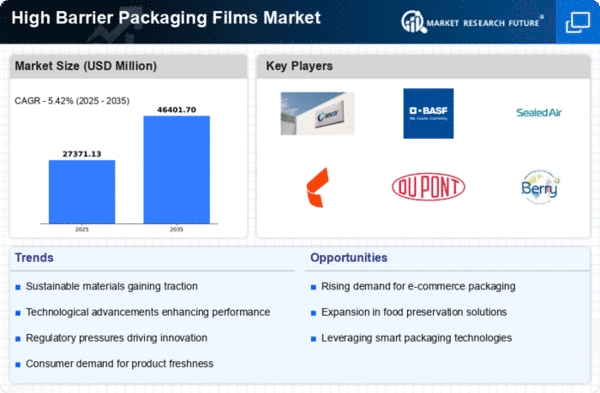
As per MRFR analysis, the High Barrier Packaging Films Market was estimated at 25963.89 USD Million in 2024. The High Barrier Packaging Films industry is projected to grow from 27371.2 USD Million in 2025 to 46401.7 USD Million by 2035, exhibiting a compound annual growth rate (CAGR) of 5.42 during the forecast period 2025 - 2035.

Key Market Trends & Highlights

The High Barrier Packaging Films Market is experiencing robust growth driven by sustainability and technological advancements.

  • North America remains the largest market for high barrier packaging films, driven by increasing demand for food preservation.
  • Asia-Pacific is the fastest-growing region, reflecting a surge in e-commerce and online retail activities.
  • Food packaging continues to dominate the market, while pharmaceutical packaging is emerging as the fastest-growing segment.
  • Key market drivers include rising consumer awareness of sustainability and the expansion of the pharmaceutical sector.

Market Size & Forecast

2024 Market Size 25963.89 (USD Million)
2035 Market Size 46401.7 (USD Million)
CAGR (2025 - 2035) 5.42%
Largest Regional Market Share in 2024 Asia-Pacific

Major Players

Amcor (AU), BASF (DE), Sealed Air (US), Mondi Group (GB), DuPont (US), Berry Global (US), Kraton Corporation (US), Toppan Printing (JP), Clondalkin Group (IE)

Market Trends

The High Barrier Packaging Films Market is currently experiencing a notable transformation driven by various factors. The increasing demand for food safety and extended shelf life is propelling the adoption of high barrier films across multiple sectors, particularly in food and beverage packaging. These films are designed to provide superior protection against moisture, oxygen, and light, which are critical in preserving product integrity. As consumers become more health-conscious, the need for packaging that maintains freshness and quality is paramount. Furthermore, the rise in e-commerce and online grocery shopping is influencing packaging requirements, as products need to withstand longer transit times while ensuring safety and quality upon delivery. In addition to food applications, the High Barrier Packaging Films Market is witnessing growth in pharmaceuticals and electronics. The need for secure and reliable packaging solutions in these industries is becoming increasingly important, as they require protection from environmental factors that could compromise product efficacy. Innovations in materials and technology are also contributing to the market's evolution, with manufacturers exploring sustainable options that align with environmental regulations and consumer preferences. Overall, the High Barrier Packaging Films Market appears poised for continued expansion, driven by evolving consumer demands and technological advancements.

Sustainability Initiatives

The High Barrier Packaging Films Market is increasingly focusing on sustainability. Manufacturers are exploring biodegradable and recyclable materials to meet consumer demand for eco-friendly packaging solutions. This trend reflects a broader shift towards environmental responsibility, as companies aim to reduce their carbon footprint and comply with stringent regulations.

Technological Advancements

Innovations in film technology are shaping the High Barrier Packaging Films Market. Enhanced barrier properties and improved manufacturing processes are enabling the production of thinner, lighter films without compromising performance. These advancements not only reduce material usage but also lower shipping costs, appealing to both manufacturers and consumers.

E-commerce Growth

The rise of e-commerce is significantly impacting the High Barrier Packaging Films Market. As online shopping becomes more prevalent, the need for durable and protective packaging solutions is increasing. High barrier films are essential for ensuring that products remain intact and fresh during transit, thus meeting the expectations of consumers who prioritize quality.

High Barrier Packaging Films Market Market Drivers

Growing Demand for Food Preservation

The Global High Barrier Packaging Films Market Industry is witnessing a surge in demand for food preservation solutions. High barrier films effectively extend the shelf life of perishable goods by preventing moisture, oxygen, and light from degrading the product. This is particularly relevant in regions with varying climate conditions, where food spoilage is a significant concern. As consumers increasingly seek convenience and longer-lasting products, the market is projected to reach 26.0 USD Billion in 2024. This trend indicates a robust growth trajectory, as manufacturers invest in advanced packaging technologies to meet consumer expectations.

Market Segment Insights

By Application: Food Packaging (Largest) vs. Pharmaceutical Packaging (Fastest-Growing)

The high barrier packaging films market shows a significant distribution of market share across various applications. Food packaging currently dominates the market due to its extensive need for prolonged shelf life and protection against environmental factors. In contrast, pharmaceuticals, while holding a smaller share, are emerging rapidly as stricter regulations and rising healthcare awareness drive demand for high-quality packaging solutions that ensure product integrity and safety. As consumers become increasingly concerned about food safety, the food packaging segment remains robust while pharmaceuticals are catching up swiftly. Growth trends in the high barrier packaging films market are heavily influenced by increasing demands for sustainable and innovative packaging solutions across sectors. The food packaging segment continues to thrive with innovations aimed at enhancing barrier properties to preserve product freshness, while the pharmaceutical packaging segment benefits from advancements in materials that enhance protective qualities and comply with regulatory standards. Cosmetic and industrial packaging also exhibit steady growth, driven by more applications and rising consumer expectations for quality packaging in various products. Overall, the market is poised for further expansion, driven by evolving consumer preferences and technological advancements.

Food Packaging (Dominant) vs. Cosmetic Packaging (Emerging)

Food packaging remains the dominant force in the high barrier packaging films market, characterized by its critical role in preserving food quality and safety. This segment utilizes advanced barrier materials to enhance shelf life while addressing environmental concerns. Leading food manufacturers are increasingly adopting high barrier films for their effective moisture, oxygen, and light protection properties. Meanwhile, the cosmetic packaging segment, although emerging, is gaining traction due to the growing beauty and personal care industry. This segment demands aesthetically appealing and protective packaging that retains the efficacy of formulations. Both segments are witnessing innovations aimed at integrating sustainability into packaging solutions, reflecting a shift towards eco-friendly materials that cater to consumer preferences.

By Material Type: Polyethylene (Largest) vs. Polyamide (Fastest-Growing)

In the High Barrier Packaging Films Market, Material Types play a crucial role in determining product efficiency and applications. Among the various materials, Polyethylene holds the largest market share due to its excellent barrier properties and versatility, making it a preferred choice for food and beverage packaging. Polypropylene follows closely, valued for its rigidity and high melting point, apt for applications requiring strength. Polyvinyl Chloride and Ethylene Vinyl Alcohol are also significant, catering to specific segments thanks to their unique characteristics.

Polyethylene (Dominant) vs. Polyamide (Emerging)

Polyethylene is the dominant segment in the High Barrier Packaging Films Market, recognized for its superior moisture barrier, lightweight nature, and cost-effectiveness, making it ideal for various consumer packaging solutions. In contrast, Polyamide is emerging rapidly due to its exceptional gas barrier properties and mechanical strength, which are increasingly demanded in high-performance applications, including pharmaceuticals and delicate food items. This shift reflects a growing trend towards sustainability and enhanced product protection, propelling Polyamide's adoption, especially in environments where shelf-life extension is critical.

By End Use Industry: Food and Beverage (Largest) vs. Healthcare (Fastest-Growing)

The High Barrier Packaging Films Market demonstrates a significant distribution among various end-use industries, with the Food and Beverage sector holding the largest share. This sector remains essential due to an increased emphasis on food safety, shelf life extension, and convenient packaging solutions. Following closely is the Healthcare industry, which, while smaller in comparison, exhibits rapid growth thanks to the rising demand for pharmaceutical packaging that requires high barrier protection against moisture and gases.

Food and Beverage (Dominant) vs. Healthcare (Emerging)

In the High Barrier Packaging Films Market, the Food and Beverage industry emerges as the dominant segment owing to its crucial role in ensuring product longevity and quality. This sector relies heavily on high barrier films for packaging perishable goods, thus protecting them from environmental factors. Conversely, the Healthcare segment is rapidly emerging, driven by innovations in medical packaging that demand superior barrier properties for medications and biological products. This segment is poised for growth due to increased consumer health awareness and the rising trend of online pharmaceutical sales, leading to a surge in demand for packaging that offers durability and safety.

By Thickness: 50 to 100 Microns (Largest) vs. Below 50 Microns (Fastest-Growing)

In the High Barrier Packaging Films Market, the '50 to 100 Microns' thickness segment holds the largest market share. This range caters to a wide array of industries, effectively balancing flexibility and performance, thus meeting diverse packaging requirements. In contrast, the 'Below 50 Microns' segment, although currently smaller in market size, is rapidly gaining traction due to innovative manufacturing techniques that reduce thickness while optimizing barrier properties, making it an appealing choice for environmentally-conscious consumers and brands. Growth trends in the thickness segment are primarily driven by the increasing demand for lightweight and sustainable packaging solutions. The 'Below 50 Microns' category is poised for significant expansion as companies prioritize eco-friendly materials and production processes. Moreover, advancements in polymer technologies are enabling thinner films to deliver superior protective qualities, contributing to their rapid adoption in food and beverage packaging applications.

50 to 100 Microns (Dominant) vs. Below 50 Microns (Emerging)

The '50 to 100 Microns' thickness range is the dominant segment in high barrier packaging films, offering a robust combination of durability and cost-effectiveness. These films are widely utilized in the food and consumer goods sectors, providing excellent moisture and gas barrier properties essential for product preservation. Meanwhile, the 'Below 50 Microns' segment is emerging as a popular choice for brands looking to adopt lighter and more sustainable packaging options. The advancements in film technology have allowed manufacturers to create thinner films with effective barrier characteristics, positioning this segment as a key player in the ongoing sustainability initiatives across various industries.

By Barrier Properties: Oxygen Barrier (Largest) vs. Moisture Barrier (Fastest-Growing)

In the High Barrier Packaging Films Market, the segment values exhibit a dynamic distribution, with Oxygen Barrier leading as the paramount segment. This prominence is attributed to its extensive applications in food and pharmaceutical industries, ensuring product freshness and prolonging shelf life. Moisture Barrier, while not commanding the largest share, is rapidly catching up, showcasing significant growth opportunities driven by increased demand in sectors such as cosmetics and electronics, where preserving product integrity is essential.

Oxygen Barrier (Dominant) vs. Moisture Barrier (Emerging)

Oxygen Barrier films are critical in maintaining product quality by preventing oxidation, making them the dominant choice in packaging solutions. They are widely used in various sectors, especially the food industry, where shelf life is paramount. Conversely, Moisture Barrier films are emerging quickly due to rising consumer awareness of product preservation. These films are particularly vital in packaging for cosmetics and electronic products, where moisture can dramatically affect performance and usability. As sustainability becomes more critical, both segments are innovating with new materials and technologies to enhance their functionalities.

Get more detailed insights about High Barrier Packaging Films Market Research Report - Global Forecast to 2035

Regional Insights

North America : Market Leader in Innovation

North America is witnessing robust growth in the High Barrier Packaging Films Market, driven by increasing demand for sustainable packaging solutions and stringent regulations on food safety. The market size reached $10,385.56 million in 2025, reflecting a significant share in the global landscape. Regulatory catalysts, such as the FDA's focus on food safety, are propelling innovations in packaging technologies, enhancing product shelf life and safety. The competitive landscape is dominated by key players like Amcor, Sealed Air, and DuPont, who are investing heavily in R&D to develop advanced materials. The U.S. leads the market, supported by a strong manufacturing base and a growing trend towards eco-friendly packaging. This region's focus on innovation and sustainability positions it as a leader in the high barrier packaging sector.

Europe : Sustainable Packaging Initiatives

Europe is emerging as a significant player in the High Barrier Packaging Films Market, with a market size of €7,785 million in 2025. The region is characterized by a strong emphasis on sustainability and regulatory frameworks aimed at reducing plastic waste. Initiatives like the European Green Deal are driving demand for eco-friendly packaging solutions, which are expected to dominate the market in the coming years. Leading countries such as Germany, France, and the UK are at the forefront of this transition, with companies like BASF and Mondi Group leading the charge in developing innovative materials. The competitive landscape is marked by collaborations between manufacturers and regulatory bodies to enhance product standards and sustainability practices, ensuring a robust market presence in Europe.

Asia-Pacific : Emerging Market Powerhouse

Asia-Pacific is the largest market for High Barrier Packaging Films, with a market size of $10,385.56 million in 2025. The region's growth is fueled by rapid industrialization, increasing consumer demand for packaged goods, and a shift towards high-quality packaging solutions. Countries like China and India are leading this growth, supported by favorable government policies and investments in manufacturing capabilities. The competitive landscape is vibrant, with key players such as Toppan Printing and Clondalkin Group expanding their operations in the region. The presence of a large consumer base and rising disposable incomes are driving demand for innovative packaging solutions, making Asia-Pacific a focal point for market expansion and investment in high barrier films.

Middle East and Africa : Niche Market Development

The Middle East and Africa (MEA) region is witnessing gradual growth in the High Barrier Packaging Films Market, with a market size of $407.77 million in 2025. The region's growth is primarily driven by increasing urbanization and a rising demand for packaged food products. Regulatory frameworks are evolving to support food safety and quality, which is expected to enhance market dynamics in the coming years. Countries like South Africa and the UAE are emerging as key players in this market, with local manufacturers focusing on developing high-quality packaging solutions. The competitive landscape is characterized by a mix of local and international players, creating opportunities for innovation and market penetration in this niche segment.

Key Players and Competitive Insights

The High Barrier Packaging Films Market is currently characterized by a dynamic competitive landscape, driven by increasing demand for sustainable packaging solutions and advancements in material technology. Key players such as Amcor (AU), BASF (DE), and Sealed Air (US) are strategically positioned to leverage innovation and sustainability as core components of their operational focus. Amcor (AU) emphasizes its commitment to sustainability through the development of recyclable packaging solutions, while BASF (DE) invests heavily in research and development to enhance the barrier properties of its films. Sealed Air (US) adopts a customer-centric approach, tailoring its offerings to meet specific market needs, thereby shaping a competitive environment that prioritizes innovation and responsiveness.The market structure appears moderately fragmented, with several players vying for market share through localized manufacturing and optimized supply chains. This fragmentation allows for a diverse range of products and solutions, catering to various end-user industries. The collective influence of these key players fosters a competitive atmosphere where agility and adaptability are paramount, as companies strive to meet evolving consumer preferences and regulatory requirements.

In November Amcor (AU) announced a partnership with a leading food manufacturer to develop a new line of high-barrier packaging that utilizes bio-based materials. This strategic move not only enhances Amcor's sustainability credentials but also positions the company to capture a growing segment of environmentally conscious consumers. The collaboration is expected to yield significant market advantages, as it aligns with the increasing demand for sustainable packaging solutions across the food industry.

In October BASF (DE) unveiled a new product line featuring advanced barrier films designed for the pharmaceutical sector. This launch reflects BASF's commitment to innovation and its strategic focus on high-growth industries. By enhancing the barrier properties of its films, BASF aims to address the stringent requirements of pharmaceutical packaging, thereby solidifying its position as a leader in high-performance materials.

In September Sealed Air (US) expanded its manufacturing capabilities in Europe, investing €20 million in a new facility dedicated to producing high barrier films. This expansion is indicative of Sealed Air's strategy to enhance its operational footprint and meet the increasing demand for high-quality packaging solutions in the region. The investment is expected to improve supply chain efficiency and reduce lead times, further strengthening Sealed Air's competitive position.

As of December the competitive trends within the High Barrier Packaging Films Market are increasingly defined by digitalization, sustainability, and the integration of artificial intelligence (AI) in production processes. Strategic alliances among key players are shaping the landscape, fostering innovation and enhancing supply chain reliability. The shift from price-based competition to a focus on technological advancement and sustainable practices is evident, suggesting that future competitive differentiation will hinge on the ability to innovate and adapt to changing market dynamics.

Key Companies in the High Barrier Packaging Films Market include

Industry Developments

In June 2022 Winpack Ltd., a maker and supplier of premium quality packaging materials won an International Sustainability and Carbon Certification (ISCC) award because their products use recycled content.In March 2022, Cosmo Films Limited increased its production line at Aurangabad, India, to an annual rated capacity of 25,000 MT.In November 2020, A new high-barrier PE film was developed by RKW Group together with SAES Coated Films that targets both performance and recyclability.

RKW blends this MDO-PE base film with excellent processability with heat resistance as well as top-quality recycled ingredients, thus enabling mono-material PE packaging while replacing stiff films such as polyester or nylon that are commonly laminated with PE in multi-material packaging designs.Toppan in October 2022 expanded GL Barrier’s barrier range with a mono-material PE barrier to package liquid in a robust, sterile and easily recyclable material (Toppan Packaging Solutions).

According to the company, there has been an existing challenge using PE packaging due to vapor deposition, which it claims its new barrier resolves better than alternative designs.In September 2022, Jindal introduced new high-barrier Ethyl-Lyte films. They can be used as PE printing films for recyclable mono-PE structures in the flexible packaging market.


Future Outlook

High Barrier Packaging Films Market Future Outlook

The High Barrier Packaging Films Market is projected to grow at a 5.42% CAGR from 2025 to 2035, driven by increasing demand for food safety, sustainability, and technological advancements.

New opportunities lie in:

  • Development of biodegradable high barrier films for eco-conscious consumers.
  • Integration of smart packaging technologies to enhance product tracking.
  • Expansion into emerging markets with tailored packaging solutions.

By 2035, the market is expected to solidify its position as a leader in packaging innovation.

Market Segmentation

High Barrier Packaging Films Market Thickness Outlook

  • Below 50 Microns
  • 50 to 100 Microns
  • 100 to 200 Microns
  • Above 200 Microns

High Barrier Packaging Films Market Application Outlook

  • Food Packaging
  • Pharmaceutical Packaging
  • Cosmetic Packaging
  • Industrial Packaging
  • Electronics Packaging

High Barrier Packaging Films Market Material Type Outlook

  • Polyethylene
  • Polypropylene
  • Polyvinyl Chloride
  • Polyamide
  • Ethylene Vinyl Alcohol

High Barrier Packaging Films Market End Use Industry Outlook

  • Food and Beverage
  • Healthcare
  • Personal Care
  • Electronics
  • Automotive

High Barrier Packaging Films Market Barrier Properties Outlook

  • Oxygen Barrier
  • Moisture Barrier
  • Light Barrier
  • Chemical Barrier

Report Scope

MARKET SIZE 202425963.89(USD Million)
MARKET SIZE 202527371.2(USD Million)
MARKET SIZE 203546401.7(USD Million)
COMPOUND ANNUAL GROWTH RATE (CAGR)5.42% (2025 - 2035)
REPORT COVERAGERevenue Forecast, Competitive Landscape, Growth Factors, and Trends
BASE YEAR2024
Market Forecast Period2025 - 2035
Historical Data2019 - 2024
Market Forecast UnitsUSD Million
Key Companies ProfiledAmcor (AU), BASF (DE), Sealed Air (US), Mondi Group (GB), DuPont (US), Berry Global (US), Kraton Corporation (US), Toppan Printing (JP), Clondalkin Group (IE)
Segments CoveredApplication, Material Type, End Use Industry, Thickness, Barrier Properties
Key Market OpportunitiesGrowing demand for sustainable packaging solutions drives innovation in the High Barrier Packaging Films Market.
Key Market DynamicsRising demand for sustainable packaging solutions drives innovation in high barrier packaging films technology and materials.
Countries CoveredNorth America, Europe, APAC, South America, MEA

FAQs

How much is the High Barrier Packaging Films Market?

High Barrier Packaging Films Market was valued at USD 25963.89 Billion in 2024

How Big is the U.S High Barrier Packaging Films Market?

High Barrier Packaging Films Market size was valued at USD 25963.89 Billion in 2024

What is the growth rate of the High Barrier Packaging Films Market?

High Barrier Packaging Films Market is expected to grow with a CAGR of 5.42% in the period 2025-2035

Which region held the largest market share in the High Barrier Packaging Films Market?

Asia Pacific region held the largest market share in the High Barrier Packaging Films Market.

Who are the key players in the High Barrier Packaging Films Market?

The companies such as Amcor plc, Sealed air, Huhtamaki, Klockner pentaplast, Mondi, Constantia flexibles, and Berry global inc are the key players in the High Barrier Packaging Films Market.

Which type led the High Barrier Packaging Films Market?

Plastic is the major type that led the High Barrier Packaging Films Market.

Which type had the largest market share in the High Barrier Packaging Films Market?

Bags & Pouches had the largest market share in the High Barrier Packaging Films Market.

  1. SECTION I: EXECUTIVE SUMMARY AND KEY HIGHLIGHTS
    1. | 1.1 EXECUTIVE SUMMARY
    2. | 1.1.1 Market Overview
    3. | 1.1.2 Key Findings
    4. | 1.1.3 Market Segmentation
    5. | 1.1.4 Competitive Landscape
    6. | 1.1.5 Challenges and Opportunities
    7. | 1.1.6 Future Outlook
  2. SECTION II: SCOPING, METHODOLOGY AND MARKET STRUCTURE
    1. | 2.1 MARKET INTRODUCTION
    2. | 2.1.1 Definition
    3. | 2.1.2 Scope of the study
    4. |-- 2.1.2.1 Research Objective
    5. |-- 2.1.2.2 Assumption
    6. |-- 2.1.2.3 Limitations
    7. | 2.2 RESEARCH METHODOLOGY
    8. | 2.2.1 Overview
    9. | 2.2.2 Data Mining
    10. | 2.2.3 Secondary Research
    11. | 2.2.4 Primary Research
    12. |-- 2.2.4.1 Primary Interviews and Information Gathering Process
    13. |-- 2.2.4.2 Breakdown of Primary Respondents
    14. | 2.2.5 Forecasting Model
    15. | 2.2.6 Market Size Estimation
    16. |-- 2.2.6.1 Bottom-Up Approach
    17. |-- 2.2.6.2 Top-Down Approach
    18. | 2.2.7 Data Triangulation
    19. | 2.2.8 Validation
  3. SECTION III: QUALITATIVE ANALYSIS
    1. | 3.1 MARKET DYNAMICS
    2. | 3.1.1 Overview
    3. | 3.1.2 Drivers
    4. | 3.1.3 Restraints
    5. | 3.1.4 Opportunities
    6. | 3.2 MARKET FACTOR ANALYSIS
    7. | 3.2.1 Value chain Analysis
    8. | 3.2.2 Porter's Five Forces Analysis
    9. |-- 3.2.2.1 Bargaining Power of Suppliers
    10. |-- 3.2.2.2 Bargaining Power of Buyers
    11. |-- 3.2.2.3 Threat of New Entrants
    12. |-- 3.2.2.4 Threat of Substitutes
    13. |-- 3.2.2.5 Intensity of Rivalry
    14. | 3.2.3 COVID-19 Impact Analysis
    15. |-- 3.2.3.1 Market Impact Analysis
    16. |-- 3.2.3.2 Regional Impact
    17. |-- 3.2.3.3 Opportunity and Threat Analysis
  4. SECTION IV: QUANTITATIVE ANALYSIS
    1. | 4.1 Packaging & Transport, BY Application (USD Million)
    2. | 4.1.1 Food Packaging
    3. | 4.1.2 Pharmaceutical Packaging
    4. | 4.1.3 Cosmetic Packaging
    5. | 4.1.4 Industrial Packaging
    6. | 4.1.5 Electronics Packaging
    7. | 4.2 Packaging & Transport, BY Material Type (USD Million)
    8. | 4.2.1 Polyethylene
    9. | 4.2.2 Polypropylene
    10. | 4.2.3 Polyvinyl Chloride
    11. | 4.2.4 Polyamide
    12. | 4.2.5 Ethylene Vinyl Alcohol
    13. | 4.3 Packaging & Transport, BY End Use Industry (USD Million)
    14. | 4.3.1 Food and Beverage
    15. | 4.3.2 Healthcare
    16. | 4.3.3 Personal Care
    17. | 4.3.4 Electronics
    18. | 4.3.5 Automotive
    19. | 4.4 Packaging & Transport, BY Thickness (USD Million)
    20. | 4.4.1 Below 50 Microns
    21. | 4.4.2 50 to 100 Microns
    22. | 4.4.3 100 to 200 Microns
    23. | 4.4.4 Above 200 Microns
    24. | 4.5 Packaging & Transport, BY Barrier Properties (USD Million)
    25. | 4.5.1 Oxygen Barrier
    26. | 4.5.2 Moisture Barrier
    27. | 4.5.3 Light Barrier
    28. | 4.5.4 Chemical Barrier
    29. | 4.6 Packaging & Transport, BY Region (USD Million)
    30. | 4.6.1 North America
    31. |-- 4.6.1.1 US
    32. |-- 4.6.1.2 Canada
    33. | 4.6.2 Europe
    34. |-- 4.6.2.1 Germany
    35. |-- 4.6.2.2 UK
    36. |-- 4.6.2.3 France
    37. |-- 4.6.2.4 Russia
    38. |-- 4.6.2.5 Italy
    39. |-- 4.6.2.6 Spain
    40. |-- 4.6.2.7 Rest of Europe
    41. | 4.6.3 APAC
    42. |-- 4.6.3.1 China
    43. |-- 4.6.3.2 India
    44. |-- 4.6.3.3 Japan
    45. |-- 4.6.3.4 South Korea
    46. |-- 4.6.3.5 Malaysia
    47. |-- 4.6.3.6 Thailand
    48. |-- 4.6.3.7 Indonesia
    49. |-- 4.6.3.8 Rest of APAC
    50. | 4.6.4 South America
    51. |-- 4.6.4.1 Brazil
    52. |-- 4.6.4.2 Mexico
    53. |-- 4.6.4.3 Argentina
    54. |-- 4.6.4.4 Rest of South America
    55. | 4.6.5 MEA
    56. |-- 4.6.5.1 GCC Countries
    57. |-- 4.6.5.2 South Africa
    58. |-- 4.6.5.3 Rest of MEA
  5. SECTION V: COMPETITIVE ANALYSIS
    1. | 5.1 Competitive Landscape
    2. | 5.1.1 Overview
    3. | 5.1.2 Competitive Analysis
    4. | 5.1.3 Market share Analysis
    5. | 5.1.4 Major Growth Strategy in the Packaging & Transport
    6. | 5.1.5 Competitive Benchmarking
    7. | 5.1.6 Leading Players in Terms of Number of Developments in the Packaging & Transport
    8. | 5.1.7 Key developments and growth strategies
    9. |-- 5.1.7.1 New Product Launch/Service Deployment
    10. |-- 5.1.7.2 Merger & Acquisitions
    11. |-- 5.1.7.3 Joint Ventures
    12. | 5.1.8 Major Players Financial Matrix
    13. |-- 5.1.8.1 Sales and Operating Income
    14. |-- 5.1.8.2 Major Players R&D Expenditure. 2023
    15. | 5.2 Company Profiles
    16. | 5.2.1 Amcor (AU)
    17. |-- 5.2.1.1 Financial Overview
    18. |-- 5.2.1.2 Products Offered
    19. |-- 5.2.1.3 Key Developments
    20. |-- 5.2.1.4 SWOT Analysis
    21. |-- 5.2.1.5 Key Strategies
    22. | 5.2.2 BASF (DE)
    23. |-- 5.2.2.1 Financial Overview
    24. |-- 5.2.2.2 Products Offered
    25. |-- 5.2.2.3 Key Developments
    26. |-- 5.2.2.4 SWOT Analysis
    27. |-- 5.2.2.5 Key Strategies
    28. | 5.2.3 Sealed Air (US)
    29. |-- 5.2.3.1 Financial Overview
    30. |-- 5.2.3.2 Products Offered
    31. |-- 5.2.3.3 Key Developments
    32. |-- 5.2.3.4 SWOT Analysis
    33. |-- 5.2.3.5 Key Strategies
    34. | 5.2.4 Mondi Group (GB)
    35. |-- 5.2.4.1 Financial Overview
    36. |-- 5.2.4.2 Products Offered
    37. |-- 5.2.4.3 Key Developments
    38. |-- 5.2.4.4 SWOT Analysis
    39. |-- 5.2.4.5 Key Strategies
    40. | 5.2.5 DuPont (US)
    41. |-- 5.2.5.1 Financial Overview
    42. |-- 5.2.5.2 Products Offered
    43. |-- 5.2.5.3 Key Developments
    44. |-- 5.2.5.4 SWOT Analysis
    45. |-- 5.2.5.5 Key Strategies
    46. | 5.2.6 Berry Global (US)
    47. |-- 5.2.6.1 Financial Overview
    48. |-- 5.2.6.2 Products Offered
    49. |-- 5.2.6.3 Key Developments
    50. |-- 5.2.6.4 SWOT Analysis
    51. |-- 5.2.6.5 Key Strategies
    52. | 5.2.7 Kraton Corporation (US)
    53. |-- 5.2.7.1 Financial Overview
    54. |-- 5.2.7.2 Products Offered
    55. |-- 5.2.7.3 Key Developments
    56. |-- 5.2.7.4 SWOT Analysis
    57. |-- 5.2.7.5 Key Strategies
    58. | 5.2.8 Toppan Printing (JP)
    59. |-- 5.2.8.1 Financial Overview
    60. |-- 5.2.8.2 Products Offered
    61. |-- 5.2.8.3 Key Developments
    62. |-- 5.2.8.4 SWOT Analysis
    63. |-- 5.2.8.5 Key Strategies
    64. | 5.2.9 Clondalkin Group (IE)
    65. |-- 5.2.9.1 Financial Overview
    66. |-- 5.2.9.2 Products Offered
    67. |-- 5.2.9.3 Key Developments
    68. |-- 5.2.9.4 SWOT Analysis
    69. |-- 5.2.9.5 Key Strategies
    70. | 5.3 Appendix
    71. | 5.3.1 References
    72. | 5.3.2 Related Reports

Packaging & Transport Market Segmentation

Packaging & Transport By Application (USD Million, 2025-2035)

  • Food Packaging
  • Pharmaceutical Packaging
  • Cosmetic Packaging
  • Industrial Packaging
  • Electronics Packaging

Packaging & Transport By Material Type (USD Million, 2025-2035)

  • Polyethylene
  • Polypropylene
  • Polyvinyl Chloride
  • Polyamide
  • Ethylene Vinyl Alcohol

Packaging & Transport By End Use Industry (USD Million, 2025-2035)

  • Food and Beverage
  • Healthcare
  • Personal Care
  • Electronics
  • Automotive

Packaging & Transport By Thickness (USD Million, 2025-2035)

  • Below 50 Microns
  • 50 to 100 Microns
  • 100 to 200 Microns
  • Above 200 Microns

Packaging & Transport By Barrier Properties (USD Million, 2025-2035)

  • Oxygen Barrier
  • Moisture Barrier
  • Light Barrier
  • Chemical Barrier
Infographic

Free Sample Request

Kindly complete the form below to receive a free sample of this Report

Get Free Sample

Customer Strories

Compare Licence

×
Features License Type
Single User Multiuser License Enterprise User
Price $4,950 $5,950 $7,250
Maximum User Access Limit 1 User Upto 10 Users Unrestricted Access Throughout the Organization
Free Customization
Direct Access to Analyst
Deliverable Format
Platform Access
Discount on Next Purchase 10% 15% 15%
Printable Versions