×
Request Free Sample ×

Kindly complete the form below to receive a free sample of this Report

* Please use a valid business email

Leading companies partner with us for data-driven Insights

clients tt-cursor
Hero Background

Germany Virtual Private Cloud Market

ID: MRFR/ICT/62594-HCR
200 Pages
Aarti Dhapte
February 2026

Germany Virtual Private Cloud Market Size, Share and Trends Analysis Report By Service Model (Infrastructure as a Service, Platform as a Service, Software as a Service), By Deployment Type (Public Virtual Private Cloud, Private Virtual Private Cloud, Hybrid Virtual Private Cloud), By End User (BFSI, Healthcare, Government, IT and Telecom, Retail) and By Cloud Management (Automated, Manual)- Forecast to 2035

Share:
Download PDF ×

We do not share your information with anyone. However, we may send you emails based on your report interest from time to time. You may contact us at any time to opt-out.

Germany Virtual Private Cloud Market Infographic
Purchase Options

Germany Virtual Private Cloud Market Summary

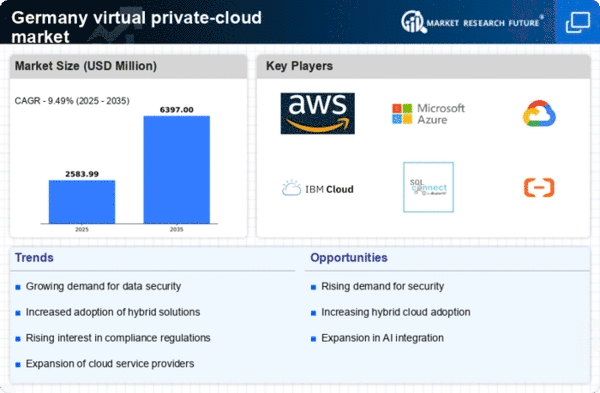
As per Market Research Future analysis, the Germany Virtual Private Cloud Market size was estimated at 2360.02 USD Million in 2024. The Virtual Private-cloud market is projected to grow from 2583.99 USD Million in 2025 to 6397.0 USD Million by 2035, exhibiting a compound annual growth rate (CAGR) of 9.4% during the forecast period 2025 - 2035

Key Market Trends & Highlights

The Germany virtual private-cloud market is experiencing robust growth driven by evolving security needs and technological advancements.

  • The market is witnessing an increased focus on data security as organizations prioritize safeguarding sensitive information.
  • Customization and flexibility are becoming essential as businesses seek tailored solutions to meet specific operational requirements.
  • Integration with emerging technologies is gaining traction, enhancing the capabilities of virtual private-cloud offerings.
  • Key market drivers include rising demand for scalable solutions and regulatory compliance, which are shaping the landscape of the virtual private-cloud market.

Market Size & Forecast

2024 Market Size 2360.02 (USD Million)
2035 Market Size 6397.0 (USD Million)
CAGR (2025 - 2035) 9.49%

Major Players

Amazon Web Services (US), Microsoft Azure (US), Google Cloud (US), IBM Cloud (US), Oracle Cloud (US), Alibaba Cloud (CN), DigitalOcean (US), Linode (US), Vultr (US)

Our Impact
Enabled $4.3B Revenue Impact for Fortune 500 and Leading Multinationals
Partnering with 2000+ Global Organizations Each Year
30K+ Citations by Top-Tier Firms in the Industry

Germany Virtual Private Cloud Market Trends

The Germany Virtual Private Cloud Market in Germany is currently experiencing a notable transformation, driven by the increasing demand for secure and scalable cloud solutions. Organizations are increasingly recognizing the advantages of private-cloud environments, which offer enhanced control over data and applications. This shift is largely influenced by the growing emphasis on data privacy regulations and compliance requirements, compelling businesses to adopt solutions that align with stringent legal frameworks. Furthermore, the rise of remote work and digital transformation initiatives has accelerated the need for flexible and reliable cloud infrastructures, prompting many enterprises to invest in virtual private-cloud services. In addition, the competitive landscape is evolving, with numerous providers entering the market to offer tailored solutions that cater to specific industry needs. This diversification is likely to foster innovation and drive down costs, making virtual private-cloud options more accessible to a wider range of organizations. As companies continue to prioritize operational efficiency and data security, the virtual private-cloud market is poised for sustained growth in the coming years, reflecting a broader trend towards cloud adoption across various sectors in Germany.

Increased Focus on Data Security

Organizations are prioritizing data security in their cloud strategies, leading to a surge in demand for virtual private-cloud solutions. This trend is driven by stringent data protection regulations in Germany, compelling businesses to seek environments that ensure compliance and safeguard sensitive information.

Customization and Flexibility

The need for tailored cloud solutions is becoming more pronounced, as businesses seek virtual private-cloud offerings that can be customized to meet specific operational requirements. This trend reflects a broader shift towards flexibility, allowing organizations to adapt their cloud environments to changing business needs.

Integration with Emerging Technologies

There is a growing trend towards integrating virtual private-cloud services with emerging technologies such as artificial intelligence and machine learning. This integration is expected to enhance operational capabilities, enabling organizations to leverage advanced analytics and automation within their cloud environments.

Germany Virtual Private Cloud Market Drivers

Rising Demand for Scalable Solutions

The virtual private-cloud market in Germany experiences a notable surge in demand for scalable solutions. As businesses increasingly seek to adapt to fluctuating workloads, the ability to scale resources up or down becomes essential. This trend is particularly pronounced among small to medium-sized enterprises (SMEs) that require flexibility without incurring excessive costs. According to recent data, the market is projected to grow at a CAGR of approximately 15% over the next five years, driven by the need for efficient resource management. The virtual private-cloud market is thus positioned to cater to this demand, offering tailored solutions that align with the dynamic needs of businesses.

Cost Efficiency and Operational Savings

Cost efficiency remains a pivotal driver in the virtual private-cloud market in Germany. Organizations are continually seeking ways to reduce operational expenses while maintaining high performance. The shift from traditional on-premises infrastructure to virtual private-cloud solutions offers substantial savings, as businesses can avoid hefty capital expenditures associated with hardware. Reports indicate that companies can save up to 30% on IT costs by transitioning to virtual private-cloud services. This financial incentive is compelling for many organizations, leading to increased adoption of virtual private-cloud solutions within the market.

Technological Advancements and Innovation

Technological advancements play a crucial role in shaping the virtual private-cloud market in Germany. Innovations in cloud computing technologies, such as artificial intelligence and machine learning, are driving the development of more sophisticated virtual private-cloud solutions. These advancements enable organizations to leverage data analytics for improved decision-making and operational efficiency. The virtual private-cloud market is witnessing a wave of innovation, with companies investing in cutting-edge technologies to enhance their service offerings. This focus on innovation is expected to attract more businesses to adopt virtual private-cloud solutions, further stimulating market growth.

Regulatory Compliance and Data Sovereignty

In Germany, stringent data protection regulations, such as the General Data Protection Regulation (GDPR), significantly influence the virtual private-cloud market. Companies are increasingly prioritizing compliance with these regulations, which necessitates the use of cloud solutions that ensure data sovereignty. The virtual private-cloud market is adapting to these requirements by providing services that guarantee data remains within national borders. This focus on compliance not only mitigates legal risks but also enhances customer trust. As a result, organizations are more inclined to invest in virtual private-cloud solutions that align with regulatory frameworks, further propelling market growth.

Enhanced Collaboration and Remote Work Capabilities

The virtual private-cloud market in Germany is significantly influenced by the growing emphasis on collaboration and remote work capabilities. As organizations embrace flexible work arrangements, the demand for cloud solutions that facilitate seamless collaboration has intensified. Virtual private-cloud services provide the necessary infrastructure to support remote teams, enabling real-time access to data and applications. This trend is likely to continue, with a projected increase in remote work adoption by 25% over the next few years. Consequently, the virtual private-cloud market is poised to benefit from this shift, offering solutions that enhance productivity and connectivity.


Market Segment Insights

By Service Model: Software as a Service (Largest) vs. Infrastructure as a Service (Fastest-Growing)

In the Germany virtual private-cloud market, the distribution of market share among the service model segment values reveals Software as a Service (SaaS) as the dominant player, capturing a significant portion of the overall market. SaaS's appeal stems from its ease of use, flexibility, and increasingly essential role in operations across various sectors. Meanwhile, Infrastructure as a Service (IaaS) follows closely as the fastest-growing segment, attracting businesses looking to enhance their computational resources without the need for hefty investments in physical infrastructure. The growth trends in this segment are driven by several factors, including the rising demand for remote work solutions and the increasing need for scalable infrastructure solutions. IaaS is rapidly gaining traction as organizations seek to leverage cloud resources to optimize their operations. The ongoing digital transformation across industries further accelerates this trend, leading to a more agile and cost-effective IT environment. Additionally, strong investments in cloud-native technologies are propelling SaaS growth, making it a critical component for modern enterprises.

Software as a Service: SaaS (Dominant) vs. Infrastructure as a Service: IaaS (Emerging)

Software as a Service (SaaS) is the dominant service model in the Germany virtual private-cloud market, characterized by its subscription-based model that offers users seamless access to applications over the internet. This service model empowers businesses with the flexibility to scale their operations and enhances user collaboration through easy accessibility. On the other hand, Infrastructure as a Service (IaaS) is emerging rapidly, providing essential computational resources and storage without the complexities of traditional IT setups. Businesses are increasingly drawn to IaaS due to its cost-effectiveness and the ability to dynamically adjust resources based on current demands, making it an attractive alternative for enterprises looking to modernize their infrastructure.

By Deployment Type: Private Virtual Private Cloud (Largest) vs. Hybrid Virtual Private Cloud (Fastest-Growing)

In the Germany virtual private-cloud market, the segmentation reveals that the Private Virtual Private Cloud holds the largest market share among the deployment types, driven by increasing demand for data security and compliance from enterprises. Conversely, the Hybrid Virtual Private Cloud segment is gaining traction, appealing to organizations seeking flexibility and scalability in their cloud solutions. The growth in the Hybrid Virtual Private Cloud segment is fueled by businesses looking to optimize workloads and leverage both private and public infrastructures. This flexibility allows enterprises to adapt to changing demands and integrate on-premise resources with cloud capabilities. Investments in this area are expected to rise, as companies increasingly prioritize hybrid solutions to enhance IT performance and reduce operational costs.

Private Virtual Private Cloud (Dominant) vs. Hybrid Virtual Private Cloud (Emerging)

The Private Virtual Private Cloud segment represents the dominant choice for enterprises prioritizing security, privacy, and regulatory compliance. Companies leveraging this solution benefit from dedicated resources and tailored environments, which are essential for industries with stringent data protection laws. On the other hand, the Hybrid Virtual Private Cloud segment is emerging as a preferred choice for organizations seeking dynamic resource allocation and the ability to manage both private and public cloud environments seamlessly. This hybrid approach not only fosters innovation but also enhances operational efficiency by allowing organizations to scale resources as needed while maintaining critical data within secure private environments.

By End User: BFSI (Largest) vs. Healthcare (Fastest-Growing)

The market share distribution among the end-user segments in the Germany virtual private-cloud market reveals that the BFSI sector holds the largest share, driven by increasing demand for secure and scalable cloud solutions. Healthcare follows closely, leveraging virtual private clouds to enhance patient data management and cloud computing capabilities. Government, IT and Telecom, and Retail sectors also contribute significantly, yet remain more niche compared to BFSI and Healthcare. Growth trends in these segments indicate a robust shift towards cloud adoption, particularly among Healthcare and Government sectors. The accelerating digital transformation, regulatory compliance demands, and the pursuit of operational efficiency are propelling the virtual private-cloud uptake. Healthcare, in particular, is experiencing the fastest growth, fueled by the need for secure patient information handling and telemedicine solutions, leading to higher investments in cloud technologies.

BFSI (Dominant) vs. Healthcare (Emerging)

The BFSI sector serves as the dominant force in the end-user landscape of the Germany virtual private-cloud market due to its critical need for data security, compliance with financial regulations, and the demand for scalable infrastructure. This segment heavily invests in advanced cloud solutions to enhance operational efficiencies and customer experiences. Conversely, the Healthcare sector is emerging rapidly, characterized by its focus on secure patient data management, telehealth services, and the integration of AI technologies. As healthcare providers seek to modernize their IT environments, the adoption of virtual private clouds is becoming increasingly strategic, supporting improved patient outcomes and streamlined operations.

By Cloud Management: Automated (Largest) vs. Manual (Fastest-Growing)

In the Germany virtual private-cloud market, the distribution of market share between automated and manual cloud management solutions is quite pronounced. Automated solutions dominate this segment, attracting a significant portion of users due to their efficiency and reduced operational costs. Meanwhile, manual solutions, although smaller in overall market share, are rapidly gaining traction among niche users seeking more hands-on control and tailored services. This indicates an evolving landscape where both solutions can coexist, fulfilling different needs of the market. Growth trends in the Germany virtual private-cloud market are being propelled by the increasing demand for automated services that enhance operational efficiency and resource management. As organizations continue to embrace digital transformation, the need for agile and scalable solutions becomes imperative. Automated systems offer significant advantages in performance, while manual systems are favored by those prioritizing customization and control. This duality creates a dynamic environment as users weigh the benefits between streamlined efficiency and personalized management.

Cloud Management: Automated (Dominant) vs. Manual (Emerging)

Automated cloud management solutions are currently the dominant force in the Germany virtual private-cloud market, appealing to enterprises looking for seamless integration and operational efficiency. These solutions offer automatic scaling, real-time monitoring, and reduced management overhead, making them attractive for businesses aiming to optimize their IT resources. On the other hand, manual cloud management is emerging as a tailored alternative, predominantly appealing to organizations that require customized configurations and deeper technical involvement. This growing trend is driven by businesses seeking flexibility and specific features that automated solutions might not provide. As companies navigate their cloud strategies, both segments present unique advantages that cater to varying business preferences.

Get more detailed insights about Germany Virtual Private Cloud Market

Key Players and Competitive Insights

The virtual private-cloud market in Germany is characterized by a dynamic competitive landscape, driven by rapid technological advancements and increasing demand for scalable, secure cloud solutions. Major players such as Amazon Web Services (US), Microsoft Azure (US), and Google Cloud (US) are at the forefront, leveraging their extensive resources to innovate and expand their service offerings. These companies focus on enhancing their infrastructure capabilities, integrating advanced AI technologies, and forming strategic partnerships to bolster their market presence. Their collective strategies not only intensify competition but also foster a climate of continuous improvement and customer-centric solutions.In terms of business tactics, these companies are increasingly localizing their operations to better serve the German market, optimizing supply chains to enhance efficiency and responsiveness. The competitive structure of the market appears moderately fragmented, with a mix of established giants and emerging players. This fragmentation allows for diverse offerings and competitive pricing, although the influence of key players remains substantial, shaping market trends and customer expectations.

In October Amazon Web Services (US) announced the launch of a new data center in Frankfurt, aimed at enhancing its service delivery and compliance with local data protection regulations. This strategic move underscores AWS's commitment to expanding its footprint in Germany, catering to the growing demand for localized cloud services. The establishment of this data center is likely to strengthen AWS's competitive edge by providing faster access and improved service reliability to its German clientele.Similarly, in September 2025, Microsoft Azure (US) unveiled a partnership with a leading German telecommunications provider to enhance its cloud connectivity solutions. This collaboration is expected to facilitate better integration of Azure's services with local networks, thereby improving performance and security for businesses operating in Germany. Such partnerships are indicative of a broader trend where cloud providers seek to align more closely with local infrastructure to meet specific market needs.

In August Google Cloud (US) expanded its AI capabilities by acquiring a German AI startup specializing in machine learning solutions. This acquisition not only enhances Google Cloud's technological prowess but also signals a strategic focus on integrating AI into its cloud offerings. The move is likely to attract businesses looking for advanced analytics and automation capabilities, further solidifying Google Cloud's position in the competitive landscape.

As of November the competitive trends in the virtual private-cloud market are increasingly defined by digitalization, sustainability initiatives, and the integration of AI technologies. Strategic alliances are becoming more prevalent, as companies recognize the value of collaboration in enhancing service offerings and market reach. Looking ahead, competitive differentiation is expected to evolve, shifting from traditional price-based competition to a focus on innovation, technological advancements, and supply chain reliability. This transition may redefine how companies position themselves in the market, emphasizing the importance of delivering unique value propositions to customers.

Key Companies in the Germany Virtual Private Cloud Market include

Industry Developments

The Germany Virtual Private Cloud Market has witnessed significant developments in recent months. As of September 2023, Oracle announced enhancements to its cloud infrastructure to cater specifically to German enterprises, focusing on data sovereignty and compliance with local regulations.

In August 2023, Google Cloud expanded its partnerships with local data centers in Germany, bolstering its offerings to meet growing enterprise demand. Meanwhile, Rackspace reported growth in its customer base, emphasizing tailored solutions for German clients, highlighting a trend towards customized cloud solutions.In terms of mergers and acquisitions, Deutsche Telekom has been active, officially acquiring a local cloud services provider in July 2023, which aims to strengthen its position in the market. IBM also announced its intent to collaborate with T-Systems for shared cloud projects in Germany, intensifying competition with AWS and Microsoft.

The German market is experiencing increased investments, with significant funding directed towards improving cloud security and compliance measures. Over the last two years, companies like 1&1 Ionos and OVHcloud have ramped up efforts to establish robust virtual private cloud offerings, reflecting the rising demand among SMEs for secure and scalable cloud solutions. The market is poised for further disruption as these companies innovate and adapt to evolving customer needs.

Future Outlook

Germany Virtual Private Cloud Market Future Outlook

The Virtual Private Cloud Market in Germany is projected to grow at a 9.49% CAGR from 2025 to 2035, driven by increasing demand for data security and scalability.

New opportunities lie in:

  • Development of hybrid cloud solutions for enhanced flexibility.
  • Expansion of managed services to optimize cloud resource utilization.
  • Investment in AI-driven analytics for improved operational efficiency.

By 2035, the market is expected to achieve substantial growth and innovation.

Market Segmentation

Germany Virtual Private Cloud Market End User Outlook

  • BFSI
  • Healthcare
  • Government
  • IT and Telecom
  • Retail

Germany Virtual Private Cloud Market Service Model Outlook

  • Infrastructure as a Service
  • Platform as a Service
  • Software as a Service

Germany Virtual Private Cloud Market Deployment Type Outlook

  • Public Virtual Private Cloud
  • Private Virtual Private Cloud
  • Hybrid Virtual Private Cloud

Germany Virtual Private Cloud Market Cloud Management Outlook

  • Automated
  • Manual

Report Scope

MARKET SIZE 2024 2360.02(USD Million)
MARKET SIZE 2025 2583.99(USD Million)
MARKET SIZE 2035 6397.0(USD Million)
COMPOUND ANNUAL GROWTH RATE (CAGR) 9.49% (2025 - 2035)
REPORT COVERAGE Revenue Forecast, Competitive Landscape, Growth Factors, and Trends
BASE YEAR 2024
Market Forecast Period 2025 - 2035
Historical Data 2019 - 2024
Market Forecast Units USD Million
Key Companies Profiled Amazon Web Services (US), Microsoft Azure (US), Google Cloud (US), IBM Cloud (US), Oracle Cloud (US), Alibaba Cloud (CN), DigitalOcean (US), Linode (US), Vultr (US)
Segments Covered Service Model, Deployment Type, End User, Cloud Management
Key Market Opportunities Growing demand for secure data management solutions drives innovation in the virtual private-cloud market.
Key Market Dynamics Rising demand for data sovereignty drives growth in the virtual private-cloud market amid evolving regulatory frameworks.
Countries Covered Germany
Leave a Comment

FAQs

What is the projected market size of the Germany Virtual Private Cloud Market in 2024?

The projected market size of the Germany Virtual Private Cloud Market in 2024 is valued at 2.5 USD Billion.

What will the expected market size be in 2035?

The expected market size of the Germany Virtual Private Cloud Market in 2035 is anticipated to reach 6.5 USD Billion.

What is the expected CAGR for the Germany Virtual Private Cloud Market from 2025 to 2035?

The expected CAGR for the Germany Virtual Private Cloud Market from 2025 to 2035 is 9.075%.

Which service model holds the largest market share in the Germany Virtual Private Cloud Market?

The Infrastructure as a Service model holds the largest market share in the Germany Virtual Private Cloud Market.

What is the valuation of the Infrastructure as a Service segment in 2024?

The Infrastructure as a Service segment is valued at 1.0 USD Billion in 2024.

What is the projected market size for Platform as a Service in 2035?

The projected market size for Platform as a Service in 2035 is expected to be 2.0 USD Billion.

What are the major key players in the Germany Virtual Private Cloud Market?

Major key players in the Germany Virtual Private Cloud Market include Oracle, Google, Amazon Web Services, and Microsoft.

What is the expected market size for Software as a Service in 2024?

The expected market size for Software as a Service in 2024 is valued at 0.7 USD Billion.

What challenges does the Germany Virtual Private Cloud Market currently face?

The Germany Virtual Private Cloud Market currently faces challenges related to security and compliance regulations.

How is the competitive landscape evolving in the Germany Virtual Private Cloud Market?

The competitive landscape in the Germany Virtual Private Cloud Market is evolving with technological advancements and increased offerings from leading players.

Download Free Sample

Kindly complete the form below to receive a free sample of this Report

Compare Licence

×
Features License Type
Single User Multiuser License Enterprise User
Price $4,950 $5,950 $7,250
Maximum User Access Limit 1 User Upto 10 Users Unrestricted Access Throughout the Organization
Free Customization
Direct Access to Analyst
Deliverable Format
Platform Access
Discount on Next Purchase 10% 15% 15%
Printable Versions