×
Request Free Sample ×

Kindly complete the form below to receive a free sample of this Report

* Please use a valid business email

Leading companies partner with us for data-driven Insights

clients tt-cursor
Hero Background

Germany Total Hip Knee Replacements Market

ID: MRFR/HC/50397-HCR
200 Pages
Rahul Gotadki
February 2026

Germany Total Hip and Knee Replacements Market Research Report By Procedure Type (Total Hip Replacement, Partial Hip Replacement, Revision Hip Replacement, Total Knee Replacement, Partial Knee Replacement, Revision Knee Replacement), By Implant Type (Mobile Bearing, Fixed Bearing, Others) and By End User (Hospitals, Ambulatory Surgical Centers, Orthopedic Clinics, Others) - Growth & Industry Forecast 2025 To 2035

Share:
Download PDF ×

We do not share your information with anyone. However, we may send you emails based on your report interest from time to time. You may contact us at any time to opt-out.

Germany Total Hip Knee Replacements Market Infographic
Purchase Options

Germany Total Hip Knee Replacements Market Summary

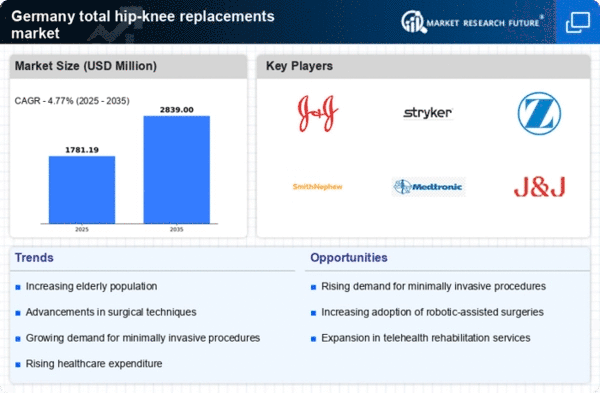
As per Market Research Future analysis, the Germany Total Hip Knee Replacements Market size was estimated at 1700.1 USD Million in 2024. The Total Hip-knee-replacements market is projected to grow from 1781.19 USD Million in 2025 to 2839.0 USD Million by 2035, exhibiting a compound annual growth rate (CAGR) of 4.7% during the forecast period 2025 - 2035

Key Market Trends & Highlights

The Germany total hip-knee-replacements market is experiencing robust growth driven by demographic shifts and technological innovations.

  • The aging population in Germany is significantly driving demand for total hip and knee replacements.
  • Technological advancements are enhancing surgical outcomes and patient recovery times in the market.
  • The shift towards minimally invasive techniques is becoming increasingly prevalent among healthcare providers.
  • Rising prevalence of osteoarthritis and increased healthcare expenditure are major drivers of market growth.

Market Size & Forecast

2024 Market Size 1700.1 (USD Million)
2035 Market Size 2839.0 (USD Million)
CAGR (2025 - 2035) 4.77%

Major Players

Johnson & Johnson (US), Stryker Corporation (US), Zimmer Biomet (US), Smith & Nephew (GB), Medtronic (US), DePuy Synthes (US), B. Braun Melsungen AG (DE), Ottobock (DE), Exactech (US)

Our Impact
Enabled $4.3B Revenue Impact for Fortune 500 and Leading Multinationals
Partnering with 2000+ Global Organizations Each Year
30K+ Citations by Top-Tier Firms in the Industry

Germany Total Hip Knee Replacements Market Trends

The Germany Total Hip Knee Replacements Market is currently experiencing notable growth, driven by an aging population and increasing prevalence of orthopedic conditions. In Germany, the demand for these procedures is influenced by advancements in surgical techniques and implant technologies, which enhance patient outcomes and recovery times. Furthermore, the healthcare system's focus on improving quality of life for individuals suffering from joint pain contributes to the rising number of surgeries performed. As a result, hospitals and clinics are investing in state-of-the-art equipment and training for medical professionals to meet this growing demand. In addition, the total hip-knee-replacements market is witnessing a shift towards minimally invasive procedures. These techniques not only reduce recovery time but also minimize complications, making them more appealing to both patients and healthcare providers. The integration of digital technologies, such as robotic-assisted surgeries, is also becoming more prevalent, indicating a trend towards precision and efficiency in surgical practices. Overall, the landscape of the total hip-knee-replacements market in Germany appears to be evolving rapidly, with a strong emphasis on innovation and patient-centered care.

Aging Population Driving Demand

The increasing number of elderly individuals in Germany is a primary factor propelling the total hip-knee-replacements market. As age-related joint issues become more common, the need for surgical interventions rises, leading to higher surgery rates.

Technological Advancements

Innovations in surgical techniques and implant materials are transforming the total hip-knee-replacements market. Enhanced precision and improved recovery outcomes are encouraging more patients to opt for these procedures.

Shift Towards Minimally Invasive Techniques

There is a growing preference for minimally invasive surgeries within the total hip-knee-replacements market. These approaches offer reduced recovery times and lower complication rates, appealing to both patients and healthcare providers.

Germany Total Hip Knee Replacements Market Drivers

Increased Healthcare Expenditure

Germany's healthcare expenditure has been on an upward trajectory, which positively influences the total hip-knee-replacements market. The government allocates a significant portion of its budget to healthcare, with spending reaching approximately €400 billion in recent years. This financial commitment facilitates access to advanced medical technologies and surgical procedures, including hip and knee replacements. As healthcare budgets expand, hospitals and clinics are more likely to invest in state-of-the-art equipment and training for medical professionals. Consequently, this trend may lead to improved patient outcomes and increased surgical volumes, further propelling the total hip-knee-replacements market. Additionally, the emphasis on quality healthcare services aligns with the growing demand for effective treatments, thereby enhancing market prospects.

Rising Awareness of Joint Health

There is a growing awareness of joint health among the German population, which serves as a significant driver for the total hip-knee-replacements market. Educational campaigns and health initiatives have increased public knowledge regarding the importance of maintaining joint function and the available treatment options for joint-related ailments. This heightened awareness encourages individuals to seek medical advice sooner, leading to earlier diagnoses and timely interventions. As a result, the demand for total hip and knee replacements is likely to rise, as patients become more proactive in managing their joint health. Furthermore, the integration of joint health education into primary care practices may facilitate referrals for surgical options, thereby positively impacting the total hip-knee-replacements market.

Advancements in Surgical Techniques

Advancements in surgical techniques are transforming the landscape of the total hip-knee-replacements market. Innovations such as robotic-assisted surgeries and computer navigation systems enhance precision and reduce recovery times for patients. These technological improvements not only improve surgical outcomes but also increase patient satisfaction, which is crucial in a competitive healthcare environment. In Germany, hospitals are increasingly adopting these advanced techniques, leading to a rise in the number of procedures performed. The total hip-knee-replacements market is likely to benefit from this trend, as patients are more inclined to opt for surgeries that promise better results and quicker rehabilitation. Moreover, the continuous evolution of surgical methods may attract more healthcare professionals to specialize in joint replacement, further driving market growth.

Government Initiatives and Policies

Government initiatives and policies aimed at improving healthcare access and quality are pivotal in shaping the total hip-knee-replacements market. In Germany, the government has implemented various programs to enhance the efficiency of healthcare delivery, including initiatives that promote early intervention and preventive care. These policies are designed to reduce waiting times for surgeries and improve patient outcomes, thereby increasing the overall demand for joint replacement procedures. Additionally, reimbursement policies that favor surgical interventions over conservative treatments may further stimulate the total hip-knee-replacements market. As the government continues to prioritize healthcare improvements, the market is expected to expand, driven by increased patient access to necessary surgical procedures.

Rising Prevalence of Osteoarthritis

The increasing prevalence of osteoarthritis in Germany is a critical driver for the total hip-knee-replacements market. As the population ages, the incidence of osteoarthritis, a degenerative joint disease, rises significantly. Reports indicate that approximately 10-15% of adults over 60 years are affected by this condition, leading to a higher demand for joint replacement surgeries. The total hip-knee-replacements market is likely to experience growth as healthcare providers seek to address the needs of this demographic. Furthermore, the economic burden associated with osteoarthritis treatment is substantial, with costs reaching up to €30 billion annually in Germany. This financial impact may prompt healthcare systems to invest more in surgical interventions, thereby boosting the total hip-knee-replacements market.


Market Segment Insights

By Procedure Type: Total Knee Replacement (Largest) vs. Total Hip Replacement (Fastest-Growing)

In the Germany total hip-knee-replacements market, the distribution among procedure types is characterized by a significant dominance of Total Knee Replacement, which captures the largest share due to the rising prevalence of knee-related ailments and increased surgical adoption. On the other hand, Total Hip Replacement follows closely, reflecting strong traction as a critical intervention for hip-related conditions, driven by an aging population and a wider acceptance of surgical procedures in clinical practice. Examining growth trends, Total Hip Replacement has emerged as the fastest-growing segment as advancements in surgical techniques and implant technologies enhance outcomes and shorten recovery times. The increasing awareness and acceptance of such procedures among patients contribute to this growth, alongside healthcare initiatives that encourage early intervention. Revision procedures for both hips and knees also indicate a steady rise, underscoring ongoing demand for corrective operations in this market.

Total Knee Replacement (Dominant) vs. Total Hip Replacement (Emerging)

Total Knee Replacement stands out as the dominant procedure in the Germany total hip-knee-replacements market due to its extensive use among patients suffering from severe knee degenerative disorders. Its position is fortified by improved surgical methodologies and a patient-centric focus as healthcare professionals emphasize quicker recovery times and enhanced quality of life. Conversely, Total Hip Replacement is gaining ground as an emerging choice amid rising cases of hip osteoarthritis, bolstered by innovations in prosthesis designs and minimized surgical invasiveness. Both procedure types are essential in the clinical setting, reflecting the evolving landscape of orthopedic interventions and the growing demand for effective surgical solutions.

By Implant Type: Mobile Bearing (Largest) vs. Fixed Bearing (Fastest-Growing)

In the Germany total hip-knee-replacements market, Mobile Bearing implants hold the largest share, reflecting a significant preference among surgeons and patients for their clinical performance and enhanced mobility. The Fixed Bearing segment, although smaller, is gaining traction due to advancements in technology that enhance stability and patient outcomes. Other types, while present, contribute to a lesser extent and are often chosen based on specific clinical needs. The growth trends in this segment are driven by an aging population and increasing demand for hip and knee replacement surgeries. Advances in implant design and materials continue to play a crucial role in attracting both surgeons and patients. The market is likely to see sustained interest in Fixed Bearing options as they evolve, while Mobile Bearing implants remain favored for their proven success, shaping the future landscape of surgery in this domain.

Mobile Bearing (Dominant) vs. Fixed Bearing (Emerging)

Mobile Bearing implants are recognized for their superior functionality and versatility, making them a dominant choice among orthopedic surgeons. Their design allows for enhanced range of motion and improved patient satisfaction post-surgery. Conversely, Fixed Bearing implants are emerging as a viable alternative, particularly as manufacturing processes improve their reliability and performance metrics. This segment appeals to a market that prioritizes longevity and stability, thus predicted to show significant growth as awareness of their benefits increases. The competition between these implant types continues to drive innovation, ensuring that both are integral to evolving treatment paradigms in hip and knee procedures.

By End User: Hospitals (Largest) vs. Ambulatory Surgical Centers (Fastest-Growing)

In the Germany total hip-knee-replacements market, the distribution among end user segments shows that hospitals hold the largest market share due to their established infrastructure and comprehensive orthopedic departments. Meanwhile, ambulatory surgical centers are rapidly gaining traction, appealing to patients seeking minimally invasive procedures and shorter recovery times, which positions them as a competitive alternative. The growth trends indicate that while hospitals continue to dominate, the increasing preference for outpatient services is driving the rise of ambulatory surgical centers. Factors like advancements in surgical techniques, enhanced patient convenience, and favorable reimbursement policies significantly contribute to this evolving landscape. As patients become more informed and involved in their care, these centers are anticipated to expand their market presence further.

Hospitals (Dominant) vs. Ambulatory Surgical Centers (Emerging)

Hospitals serve as the dominant force in the Germany total hip-knee-replacements market, benefiting from comprehensive resources, specialized professionals, and the ability to offer a wide range of procedures under one roof. Their established reputation and trust among patients are critical factors for their superior market position. In contrast, ambulatory surgical centers represent the emerging segment, focusing on outpatient procedures that allow patients to avoid lengthy hospital stays. The agile operational model of these centers caters to the growing demand for cost-effective and efficient solutions, setting them on a path of rapid growth. Their patient-centric approach aligns well with the current healthcare trends, fostering a shift in preferences towards outpatient care.

Get more detailed insights about Germany Total Hip Knee Replacements Market

Key Players and Competitive Insights

The total hip-knee-replacements market in Germany is characterized by a competitive landscape that is both dynamic and multifaceted. Key growth drivers include an aging population, increasing prevalence of orthopedic conditions, and advancements in surgical techniques and implant technologies. Major players such as Johnson & Johnson (US), Stryker Corporation (US), and Zimmer Biomet (US) are at the forefront, each adopting distinct strategies to enhance their market positioning. Johnson & Johnson (US) focuses on innovation through extensive R&D investments, while Stryker Corporation (US) emphasizes strategic acquisitions to broaden its product portfolio. Zimmer Biomet (US) is actively pursuing digital transformation initiatives to improve surgical outcomes and patient engagement, collectively shaping a competitive environment that prioritizes technological advancement and patient-centric solutions.In terms of business tactics, companies are increasingly localizing manufacturing to reduce costs and enhance supply chain efficiency. The market structure appears moderately fragmented, with several key players exerting influence over various segments. This fragmentation allows for niche players to thrive, while larger corporations leverage their scale to optimize operations and expand their reach. The collective influence of these key players fosters a competitive atmosphere where innovation and operational excellence are paramount.

In October Stryker Corporation (US) announced the launch of a new robotic-assisted surgical system designed to enhance precision in knee replacement procedures. This strategic move is significant as it aligns with the growing trend towards minimally invasive surgeries, potentially improving patient recovery times and outcomes. By investing in cutting-edge technology, Stryker aims to solidify its leadership position in the market and respond to the increasing demand for advanced surgical solutions.

In September Zimmer Biomet (US) unveiled a partnership with a leading digital health company to integrate AI-driven analytics into its surgical planning tools. This collaboration is poised to revolutionize preoperative assessments, allowing for more personalized treatment plans. The integration of AI not only enhances surgical precision but also positions Zimmer Biomet as a forward-thinking player in the digital health space, catering to the evolving needs of healthcare providers and patients alike.

In August B. Braun Melsungen AG (DE) expanded its product line by introducing a new range of biodegradable implants aimed at reducing the environmental impact of orthopedic surgeries. This initiative reflects a growing trend towards sustainability within the industry, appealing to environmentally conscious consumers and healthcare institutions. By prioritizing eco-friendly solutions, B. Braun Melsungen AG is likely to differentiate itself in a competitive market increasingly focused on sustainability.

As of November current trends in the total hip-knee-replacements market indicate a strong emphasis on digitalization, sustainability, and the integration of AI technologies. Strategic alliances are becoming increasingly important, as companies seek to leverage complementary strengths to enhance their offerings. Looking ahead, competitive differentiation is expected to evolve, shifting from traditional price-based competition to a focus on innovation, technological advancements, and supply chain reliability. This transition underscores the necessity for companies to adapt and innovate continuously to maintain a competitive edge in a rapidly changing landscape.

Key Companies in the Germany Total Hip Knee Replacements Market include

Industry Developments

Recent developments in the Germany Total Hip and Knee Replacements Market have seen significant activity. In March 2023, Smith and Nephew announced enhancements to its advanced robotic-assisted surgical systems, aimed at improving outcomes in hip and knee surgeries. Meanwhile, Stryker introduced new innovative implants that cater specifically to the preferences of German healthcare providers, thereby enhancing market competition. In terms of mergers and acquisitions, Exactech completed its acquisition of a local arthroplasty firm in June 2023 to expand its portfolio in Germany, while Johnson and Johnson has invested substantially in systems to streamline joint replacement procedures, reinforcing its market presence. 

Over the past few years, the market has experienced steady growth, primarily driven by increasing aging populations and advancements in surgical technologies, leading to a projected increase in market valuations. As per health reports, hip and knee surgeries are becoming more prevalent, further influencing regional health authorities to allocate more resources toward improving orthopedic care facilities in Germany. In March 2022, Medi GmbH launched a new orthopedic device that gained favorable reviews among healthcare professionals, marking an important innovation in the sector.

Future Outlook

Germany Total Hip Knee Replacements Market Future Outlook

The Total Hip Knee Replacements Market is projected to grow at a 4.77% CAGR from 2025 to 2035, driven by technological advancements, aging populations, and increasing healthcare expenditure.

New opportunities lie in:

  • Development of minimally invasive surgical techniques
  • Expansion of telehealth services for post-operative care
  • Investment in AI-driven predictive analytics for patient outcomes

By 2035, the market is expected to achieve robust growth, reflecting evolving healthcare demands.

Market Segmentation

Germany Total Hip Knee Replacements Market End User Outlook

  • Hospitals
  • Ambulatory Surgical Centers
  • Orthopedic Clinics
  • Others

Germany Total Hip Knee Replacements Market Implant Type Outlook

  • Mobile Bearing
  • Fixed Bearing
  • Others

Germany Total Hip Knee Replacements Market Procedure Type Outlook

  • Total Hip Replacement
  • Partial Hip Replacement
  • Revision Hip Replacement
  • Total Knee Replacement
  • Partial Knee Replacement
  • Revision Knee Replacement

Report Scope

MARKET SIZE 2024 1700.1(USD Million)
MARKET SIZE 2025 1781.19(USD Million)
MARKET SIZE 2035 2839.0(USD Million)
COMPOUND ANNUAL GROWTH RATE (CAGR) 4.77% (2025 - 2035)
REPORT COVERAGE Revenue Forecast, Competitive Landscape, Growth Factors, and Trends
BASE YEAR 2024
Market Forecast Period 2025 - 2035
Historical Data 2019 - 2024
Market Forecast Units USD Million
Key Companies Profiled Johnson & Johnson (US), Stryker Corporation (US), Zimmer Biomet (US), Smith & Nephew (GB), Medtronic (US), DePuy Synthes (US), B. Braun Melsungen AG (DE), Ottobock (DE), Exactech (US)
Segments Covered Procedure Type, Implant Type, End User
Key Market Opportunities Integration of advanced robotics and minimally invasive techniques enhances outcomes in the total hip-knee-replacements market.
Key Market Dynamics Technological advancements and regulatory changes drive growth in the total hip-knee-replacements market.

Countries Covered Germany
Leave a Comment

FAQs

What is the expected market size of the Germany Total Hip and Knee Replacements Market by 2024?

The Germany Total Hip and Knee Replacements Market is expected to be valued at 1.89 billion USD in 2024.

What will the market size be by 2035 for the Germany Total Hip and Knee Replacements Market?

By 2035, the market is projected to reach a valuation of 3.15 billion USD.

What is the expected CAGR for the Germany Total Hip and Knee Replacements Market from 2025 to 2035?

The expected CAGR for the market during this period is 4.755%.

Which segment will have the highest market value in 2035 within the Germany Total Hip and Knee Replacements Market?

The Total Hip Replacement segment is expected to have the highest value at 1.2 billion USD by 2035.

Who are the major players in the Germany Total Hip and Knee Replacements Market?

Key players include Exactech, Aesculap, Smith & Nephew, and Zimmer Biomet, among others.

What is the projected market size for Total Knee Replacement in 2035?

The Total Knee Replacement segment is projected to be valued at 1.05 billion USD in 2035.

How much is the Partial Hip Replacement segment expected to grow by 2035?

The Partial Hip Replacement segment is expected to grow to 0.5 billion USD by 2035.

What are the growth drivers for the Germany Total Hip and Knee Replacements Market?

Growth drivers include an aging population and advancements in surgical techniques and technologies.

What is the expected value of the Revision Hip Replacement segment by 2035?

The Revision Hip Replacement segment is expected to reach 0.25 billion USD by 2035.

What challenges may affect the growth of the Germany Total Hip and Knee Replacements Market?

Challenges may include regulatory hurdles and the need for payer reimbursement in the evolving healthcare landscape.

Download Free Sample

Kindly complete the form below to receive a free sample of this Report

Compare Licence

×
Features License Type
Single User Multiuser License Enterprise User
Price $4,950 $5,950 $7,250
Maximum User Access Limit 1 User Upto 10 Users Unrestricted Access Throughout the Organization
Free Customization
Direct Access to Analyst
Deliverable Format
Platform Access
Discount on Next Purchase 10% 15% 15%
Printable Versions