×
Request Free Sample ×

Kindly complete the form below to receive a free sample of this Report

* Please use a valid business email

Leading companies partner with us for data-driven Insights

clients tt-cursor
Hero Background

Germany Pharmaceutical CDMO Market

ID: MRFR/Pharma/19842-HCR
128 Pages
Rahul Gotadki
February 2026

Germany Pharmaceutical CDMO Market Research Report Information Product Type (Active Pharmaceutical Ingredient (API) Manufacturing, Finished Dosage Formulation (FDF) Development and Manufacturing, Secondary Packaging), By Applications (Small & Mid-Size Pharma Companies, Generic Pharmaceutical Companies And Big Pharma Companies) – Germany Market Forecast Till 2035

Share:
Download PDF ×

We do not share your information with anyone. However, we may send you emails based on your report interest from time to time. You may contact us at any time to opt-out.

Germany Pharmaceutical CDMO Market Infographic
Purchase Options

Germany Pharmaceutical CDMO Market Summary

As per analysis, the Germany pharmaceutical cdmo market is projected to grow from USD 8.41 Billion in 2025 to USD 12.62 Billion by 2035, exhibiting a compound annual growth rate (CAGR) of 4.18% during the forecast period (2025 - 2035).

Key Market Trends & Highlights

The Germany pharmaceutical CDMO market is experiencing robust growth driven by biopharmaceutical demand and technological advancements.

  • The Active Pharmaceutical Ingredient segment remains the largest contributor to the market, reflecting a stable demand for essential drugs.
  • Formulation Development is the fastest-growing segment, indicating a shift towards customized drug solutions.
  • Pharmaceutical companies dominate the market landscape, while biotechnology firms are rapidly expanding their presence.
  • Key market drivers include increasing investment in R&D and a growing focus on sustainability and green chemistry.

Market Size & Forecast

2024 Market Size 8.04 (USD Billion)
2035 Market Size 12.62 (USD Billion)
CAGR (2025 - 2035) 4.18%

Major Players

Boehringer Ingelheim (DE), BASF (DE), Famar (FR), Recipharm (SE), Lonza (CH), Evonik (DE), Siegfried (CH), Wacker Chemie (DE), Aenova (DE)

Our Impact
Enabled $4.3B Revenue Impact for Fortune 500 and Leading Multinationals
Partnering with 2000+ Global Organizations Each Year
30K+ Citations by Top-Tier Firms in the Industry

Germany Pharmaceutical CDMO Market Trends

The Germany pharmaceutical CDMO market is currently experiencing a dynamic evolution, driven by various factors that shape its landscape. The increasing demand for customized drug development and manufacturing services appears to be a primary catalyst for growth. Pharmaceutical companies are increasingly outsourcing their production needs to contract development and manufacturing organizations (CDMOs) to enhance efficiency and focus on core competencies. This trend suggests a shift towards strategic partnerships, where CDMOs provide specialized expertise and resources, thereby enabling pharmaceutical firms to navigate complex regulatory environments more effectively. Moreover, the emphasis on biopharmaceuticals and advanced therapies is likely to further influence the Germany pharmaceutical CDMO market. As the industry moves towards more complex biologics, the need for CDMOs with advanced capabilities in bioprocessing and formulation development becomes apparent. This shift may lead to increased investments in technology and infrastructure, as CDMOs strive to meet the evolving demands of their clients. Overall, the landscape of the Germany pharmaceutical CDMO market appears poised for continued growth, driven by innovation and collaboration among industry stakeholders.

Rising Demand for Biopharmaceuticals

The Germany pharmaceutical CDMO market is witnessing a notable increase in the demand for biopharmaceuticals. This trend indicates a shift towards more complex drug formulations, necessitating specialized manufacturing capabilities. CDMOs are adapting by enhancing their bioprocessing technologies to cater to this evolving landscape.

Focus on Regulatory Compliance

Regulatory compliance remains a critical aspect of the Germany pharmaceutical CDMO market. As pharmaceutical companies seek to ensure product safety and efficacy, CDMOs are increasingly investing in quality assurance and regulatory expertise. This focus on compliance is likely to strengthen partnerships between CDMOs and their clients.

Technological Advancements in Manufacturing

Technological innovations are transforming the manufacturing processes within the Germany pharmaceutical CDMO market. Automation and digitalization are becoming prevalent, allowing CDMOs to improve efficiency and reduce production costs. This trend suggests that companies are prioritizing investments in advanced manufacturing technologies to remain competitive.

Germany Pharmaceutical CDMO Market Drivers

Increasing Investment in R&D

The Germany pharmaceutical CDMO market is experiencing a notable increase in investment in research and development (R&D). This trend is driven by the growing need for innovative drug formulations and personalized medicine. In 2025, Germany's pharmaceutical R&D expenditure reached approximately 10 billion euros, reflecting a commitment to advancing healthcare solutions. As pharmaceutical companies seek to outsource their manufacturing processes, CDMOs are positioned to benefit from this influx of investment. The emphasis on R&D not only enhances the capabilities of CDMOs but also fosters collaboration between pharmaceutical firms and contract manufacturers, thereby strengthening the overall ecosystem of the Germany pharmaceutical CDMO market.

Expansion of Generic Drug Production

The expansion of generic drug production is a significant driver within the Germany pharmaceutical CDMO market. With the expiration of patents for several blockbuster drugs, there is a growing demand for cost-effective generic alternatives. In 2025, generic drugs accounted for over 70% of the total pharmaceutical market in Germany, indicating a shift towards affordability in healthcare. CDMOs are increasingly engaged in the production of these generics, leveraging their expertise to meet the stringent quality standards set by regulatory authorities. This trend not only supports the sustainability of the healthcare system but also enhances the competitive landscape of the Germany pharmaceutical CDMO market.

Focus on Sustainability and Green Chemistry

Sustainability has emerged as a critical focus within the Germany pharmaceutical CDMO market. As environmental concerns gain prominence, pharmaceutical companies are increasingly seeking CDMOs that prioritize sustainable practices and green chemistry. In 2025, approximately 40% of pharmaceutical companies in Germany reported implementing eco-friendly manufacturing processes. This shift is not only driven by regulatory pressures but also by consumer demand for environmentally responsible products. CDMOs that adopt sustainable practices are likely to gain a competitive edge, as they align with the values of both clients and end consumers. Consequently, the emphasis on sustainability is reshaping the operational strategies within the Germany pharmaceutical CDMO market.

Adoption of Advanced Manufacturing Technologies

The adoption of advanced manufacturing technologies is transforming the landscape of the Germany pharmaceutical CDMO market. Technologies such as continuous manufacturing, automation, and artificial intelligence are being integrated into production processes to enhance efficiency and reduce costs. In 2025, it is estimated that over 30% of CDMOs in Germany have implemented these advanced technologies, leading to improved product quality and faster time-to-market. This technological evolution not only streamlines operations but also enables CDMOs to respond swiftly to changing market demands. As a result, the integration of advanced manufacturing technologies is a pivotal driver shaping the future of the Germany pharmaceutical CDMO market.

Growing Demand for Contract Manufacturing Services

The growing demand for contract manufacturing services is a prominent driver in the Germany pharmaceutical CDMO market. As pharmaceutical companies increasingly focus on their core competencies, they are outsourcing manufacturing processes to specialized CDMOs. In 2025, the contract manufacturing segment is projected to account for over 50% of the total pharmaceutical manufacturing market in Germany. This trend is fueled by the need for flexibility, cost efficiency, and access to specialized expertise. CDMOs are well-positioned to meet these demands, offering tailored solutions that align with the strategic goals of their clients. Consequently, the rising demand for contract manufacturing services is a key factor influencing the dynamics of the Germany pharmaceutical CDMO market.

Market Segment Insights

By Application: Active Pharmaceutical Ingredient (Largest) vs. Formulation Development (Fastest-Growing)

In the Germany pharmaceutical CDMO market, the distribution of market share among various application segments reveals that Active Pharmaceutical Ingredients (APIs) hold the largest share, reflecting their critical role in drug production. Formulation Development, while smaller in share, is gaining momentum as pharmaceutical companies increasingly seek specialized partnerships to enhance their product offerings. Other noteworthy segments include Packaging Services, Quality Control, and Regulatory Affairs, each contributing significantly to the overall landscape of the market.

Formulation Development (Emerging) vs. Quality Control (Dominant)

Formulation Development currently represents a dynamic and emerging segment within the Germany pharmaceutical CDMO market. This area is characterized by rapid innovation and customization of drug formulations to meet specific therapeutic needs, driving increased investments. Quality Control, on the other hand, remains a dominant segment, known for its essential role in ensuring product safety and efficacy. The rigorous standards of quality assurance in this segment serve as a foundation for regulatory compliance and consumer trust. Together, these segments illustrate the balance of innovation and reliability in the pharmaceutical landscape.

By End Use: Pharmaceutical Companies (Largest) vs. Biotechnology Firms (Fastest-Growing)

In the Germany pharmaceutical CDMO market, Pharmaceutical Companies hold the largest share, reflecting their predominant role in drug production and outsourcing. This segment is characterized by a strong collaboration between established pharmaceutical firms and CDMOs, ensuring efficient production processes and regulatory compliance. Conversely, Biotechnology Firms represent the fastest-growing segment, driven by an increasing demand for biologics and personalized medicine, which necessitates specialized manufacturing capabilities provided by CDMOs.

Pharmaceutical Companies (Dominant) vs. Biotechnology Firms (Emerging)

Pharmaceutical Companies are the cornerstone of the Germany pharmaceutical CDMO market, leveraging extensive resources, industry expertise, and established relationships to maintain their dominant position. They often seek to optimize operational efficiencies through outsourcing, enabling them to focus on core activities such as research and development. In contrast, Biotechnology Firms are emerging as key players, capitalizing on novel therapies and advanced biologics that require sophisticated manufacturing solutions. Their rapid growth is propelled by innovations in drug development, resulting in increased collaboration with CDMOs for specialized production techniques.

By Service Type: Manufacturing Services (Largest) vs. Analytical Services (Fastest-Growing)

In the Germany pharmaceutical CDMO market, the 'Service Type' segment showcases a diverse array of services, with Manufacturing Services dominating the market share. This segment includes everything from the production of active pharmaceutical ingredients (APIs) to finished dosage forms, leveraging advanced technology and expertise to meet client demands. Following closely, Analytical Services are emerging rapidly, accounting for a substantial share as companies seek rigorous quality control and compliance with regulatory standards, reflecting the importance of trust in pharmaceutical production. Growth trends in the service type segment are driven by the increasing demand for customized solutions and the growing complexity of drug development. Manufacturers are increasingly focusing on process optimization and efficiency, thus propelling the Manufacturing Services sector forward. Meanwhile, the Analytical Services segment is witnessing a surge as companies prioritize data integrity and regulatory compliance, positioning it as the fastest-growing area as stakeholders recognize its critical role in ensuring product quality and safety.

Manufacturing Services (Dominant) vs. Supply Chain Management (Emerging)

Manufacturing Services within the Germany pharmaceutical CDMO market are characterized by well-established processes, advanced technology, and a strong emphasis on regulatory compliance. This segment represents the backbone of pharmaceutical production, offering capabilities that include the formulation, scale-up, and mass production of pharmaceuticals. As clients opt for outsourcing, the demand for comprehensive manufacturing solutions has surged. Conversely, Supply Chain Management is positioned as an emerging segment, gaining traction as companies seek to optimize their supply chains amidst increasing complexity and globalization. Enhanced logistics, strategic partnerships, and digital transformation are key components driving the value of supply chain management, ultimately aiming at improving efficiency and reducing time-to-market for pharmaceutical products.

Get more detailed insights about Germany Pharmaceutical CDMO Market

Regional Insights

North America : Pharmaceutical Innovation Hub

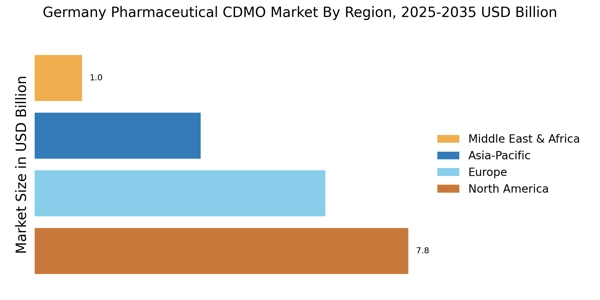
North America is a pivotal region for the pharmaceutical CDMO market, driven by robust R&D investments and a strong regulatory framework. The U.S. holds the largest market share at approximately 45%, followed by Canada with around 20%. The increasing demand for biologics and personalized medicine is propelling growth, alongside favorable government policies that encourage innovation and collaboration in the pharmaceutical sector. The competitive landscape is characterized by major players such as Catalent, Lonza, and Patheon, which dominate the market with their extensive service offerings. The presence of leading pharmaceutical companies in the U.S. fosters a conducive environment for CDMO growth. Additionally, the region benefits from advanced manufacturing technologies and a skilled workforce, further enhancing its position in the global market.

Europe : Strong Regulatory Framework

Europe, particularly Germany, is a significant player in the pharmaceutical CDMO market, driven by stringent regulatory standards and a strong emphasis on quality. Germany holds the largest market share in Europe at approximately 35%, with France following at around 15%. The region's growth is fueled by increasing outsourcing trends among pharmaceutical companies and a focus on innovation in drug development. Regulatory bodies like the European Medicines Agency (EMA) play a crucial role in ensuring compliance and fostering a competitive environment. Germany is home to key players such as Boehringer Ingelheim, BASF, and Evonik, which contribute to the region's robust CDMO landscape. The presence of advanced manufacturing facilities and a skilled workforce enhances the competitive edge of German CDMOs. Furthermore, collaborations between academia and industry are driving innovation, positioning Europe as a leader in pharmaceutical contract manufacturing.

Asia-Pacific : Emerging Market Potential

Asia-Pacific is rapidly emerging as a key player in the pharmaceutical CDMO market, driven by increasing demand for cost-effective manufacturing solutions and a growing pharmaceutical sector. China and India are the largest markets in the region, holding approximately 30% and 20% market shares, respectively. The region's growth is supported by favorable government policies, investments in healthcare infrastructure, and a rising focus on biotechnology and generic drugs. The competitive landscape features a mix of local and international players, with companies like WuXi AppTec and Samsung Biologics leading the charge. The presence of a large pool of skilled labor and lower production costs further enhance the attractiveness of the region for pharmaceutical outsourcing. As the demand for innovative therapies increases, Asia-Pacific is poised for significant growth in the CDMO sector, making it a focal point for global pharmaceutical companies.

Middle East and Africa : Resource-Rich Frontier

The Middle East and Africa region is witnessing a gradual rise in the pharmaceutical CDMO market, driven by increasing investments in healthcare and pharmaceutical manufacturing. Countries like South Africa and the UAE are leading the market, with South Africa holding approximately 10% of the regional share. The growth is supported by government initiatives aimed at enhancing local manufacturing capabilities and reducing dependency on imports. Regulatory reforms are also being implemented to streamline processes and attract foreign investments. The competitive landscape is evolving, with local players beginning to establish themselves alongside international firms. The presence of key players such as Aspen Pharmacare and Julphar is indicative of the region's potential. As the demand for affordable healthcare solutions grows, the CDMO market in the Middle East and Africa is expected to expand, offering opportunities for both local and global companies.

Germany Pharmaceutical CDMO Market Regional Image

Key Players and Competitive Insights

The competitive dynamics within the pharmaceutical CDMO market in Germany are characterized by a blend of innovation, strategic partnerships, and a focus on sustainability. Key players such as Boehringer Ingelheim (DE), Evonik (DE), and Lonza (CH) are actively shaping the landscape through their operational strategies. Boehringer Ingelheim (DE) emphasizes innovation in biologics and has been expanding its capabilities in cell and gene therapies, which are increasingly in demand. Evonik (DE) focuses on sustainable production methods and has been investing in green chemistry to enhance its service offerings. Lonza (CH), on the other hand, is leveraging its extensive network to optimize supply chains and improve efficiency, thereby positioning itself as a leader in the market.
The market structure appears moderately fragmented, with several players vying for market share. Key business tactics include localizing manufacturing to reduce lead times and enhance responsiveness to client needs. Supply chain optimization is also a critical focus, as companies seek to mitigate risks and improve reliability. The collective influence of these strategies by major players contributes to a competitive environment that is both dynamic and evolving.
In November 2025, Boehringer Ingelheim (DE) announced a strategic partnership with a leading biotech firm to co-develop a novel gene therapy platform. This collaboration is expected to enhance their capabilities in the rapidly growing gene therapy sector, potentially positioning them as a frontrunner in this niche market. The strategic importance of this partnership lies in its potential to accelerate the development of innovative therapies, thereby meeting the increasing demand for advanced treatment options.
In December 2025, Evonik (DE) launched a new initiative aimed at reducing carbon emissions in its production processes. This initiative aligns with global sustainability trends and reflects the company's commitment to environmentally friendly practices. By adopting greener technologies, Evonik (DE) not only enhances its market appeal but also addresses the growing regulatory pressures surrounding sustainability in the pharmaceutical industry.
In January 2026, Lonza (CH) revealed plans to expand its manufacturing footprint in Germany by investing €100 million in a new facility dedicated to the production of high-potency active pharmaceutical ingredients (HPAPIs). This expansion is strategically significant as it allows Lonza (CH) to cater to the increasing demand for specialized pharmaceuticals, thereby solidifying its competitive position in the market.
As of January 2026, current trends in the pharmaceutical CDMO market are increasingly defined by digitalization, sustainability, and the integration of artificial intelligence (AI) into manufacturing processes. Strategic alliances are becoming more prevalent, as companies recognize the value of collaboration in enhancing innovation and operational efficiency. Looking ahead, competitive differentiation is likely to evolve from traditional price-based competition to a focus on technological advancements, innovative solutions, and reliable supply chains. This shift underscores the importance of adaptability and forward-thinking strategies in maintaining a competitive edge.

Key Companies in the Germany Pharmaceutical CDMO Market include

Industry Developments

In March 2022, Acanthus Research Inc., which provides high-end reference standards and organic synthesis services, launched Acanthus Pharma solution, a CMDO solution for pharmaceutical and biotech services.

In October 2022, Medipost announced the establishment of a new CDMO company for cell and gene therapy products in the Korean market. Medipost intends to launch such services as a one-stop solution for the development of pharmaceutical and biopharmaceutical goods.

In April 2023, The Bridgewest Group, a global private investment firm that deals with life science software and contract development and manufacturing organizations, created a new Sterile injectables CDMO, NovaCina. NovaCina turns the product into a full-scale commercial product.

Future Outlook

Germany Pharmaceutical CDMO Market Future Outlook

The Germany pharmaceutical CDMO market is projected to grow at a 4.18% CAGR from 2025 to 2035, driven by increasing outsourcing and technological advancements.

New opportunities lie in:

  • Expansion of biologics manufacturing capabilities Investment in advanced analytics for process optimization Development of sustainable packaging solutions for pharmaceuticals

By 2035, the market is expected to be robust, driven by innovation and strategic partnerships.

Market Segmentation

Germany Pharmaceutical CDMO Market End Use Outlook

  • Pharmaceutical Companies
  • Biotechnology Firms
  • Research Institutions
  • Contract Research Organizations

Germany Pharmaceutical CDMO Market Application Outlook

  • Active Pharmaceutical Ingredient
  • Formulation Development
  • Packaging Services
  • Quality Control
  • Regulatory Affairs

Germany Pharmaceutical CDMO Market Service Type Outlook

  • Process Development
  • Analytical Services
  • Manufacturing Services
  • Supply Chain Management

Report Scope

MARKET SIZE 2024 8.04(USD Billion)
MARKET SIZE 2025 8.41(USD Billion)
MARKET SIZE 2035 12.62(USD Billion)
COMPOUND ANNUAL GROWTH RATE (CAGR) 4.18% (2024 - 2035)
REPORT COVERAGE Revenue Forecast, Competitive Landscape, Growth Factors, and Trends
BASE YEAR 2024
Market Forecast Period 2025 - 2035
Historical Data 2019 - 2024
Market Forecast Units USD Billion
Key Companies Profiled Boehringer Ingelheim (DE), BASF (DE), Famar (FR), Recipharm (SE), Lonza (CH), Evonik (DE), Siegfried (CH), Wacker Chemie (DE), Aenova (DE)
Segments Covered Application, End Use, Service Type
Key Market Opportunities Expansion of biologics manufacturing capabilities in the germany pharmaceutical cdmo market.
Key Market Dynamics Growing demand for customized drug development services drives competition among Germany's pharmaceutical Contract Development and Manufacturing Organizations.
Countries Covered Germany
Leave a Comment

FAQs

What is the current valuation of the Germany pharmaceutical CDMO market?

The market valuation was 8.04 USD Billion in 2024.

What is the projected market size for the Germany pharmaceutical CDMO market by 2035?

The market is projected to reach 12.62 USD Billion by 2035.

What is the expected CAGR for the Germany pharmaceutical CDMO market during the forecast period?

The expected CAGR for the market from 2025 to 2035 is 4.18%.

Which companies are considered key players in the Germany pharmaceutical CDMO market?

Key players include Boehringer Ingelheim, BASF, Famar, Recipharm, Lonza, Evonik, Siegfried, Wacker Chemie, and Aenova.

What are the main application segments in the Germany pharmaceutical CDMO market?

Main application segments include Active Pharmaceutical Ingredients, Formulation Development, Packaging Services, Quality Control, and Regulatory Affairs.

Download Free Sample

Kindly complete the form below to receive a free sample of this Report

Compare Licence

×
Features License Type
Single User Multiuser License Enterprise User
Price $4,950 $5,950 $7,250
Maximum User Access Limit 1 User Upto 10 Users Unrestricted Access Throughout the Organization
Free Customization
Direct Access to Analyst
Deliverable Format
Platform Access
Discount on Next Purchase 10% 15% 15%
Printable Versions