×
Request Free Sample ×

Kindly complete the form below to receive a free sample of this Report

* Please use a valid business email

Leading companies partner with us for data-driven Insights

clients tt-cursor
Hero Background

Germany Packaging Printing Market

ID: MRFR/PCM/55360-HCR
200 Pages
Snehal Singh
February 2026

Germany Packaging Printing Market Research Report By Technology (flexography, gravure, digital) and By Application (food & beverage, personal care, pharmaceutical, others)-Forecast to 2035

Share:
Download PDF ×

We do not share your information with anyone. However, we may send you emails based on your report interest from time to time. You may contact us at any time to opt-out.

Germany Packaging Printing Market Infographic
Purchase Options

Germany Packaging Printing Market Summary

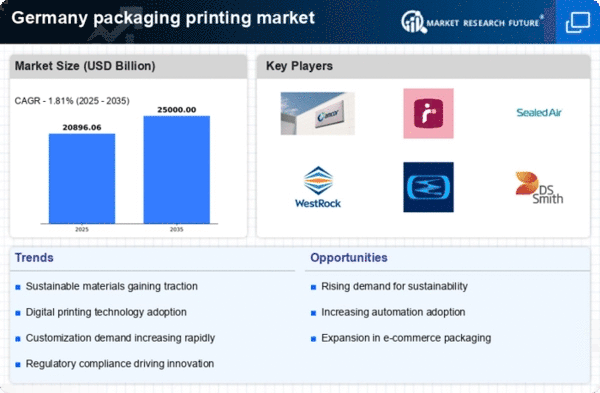
As per Market Research Future analysis, the Germany packaging printing market Size was estimated at 20524.57 USD Billion in 2024. The Germany packaging printing market industry is projected to grow from 20896.06 USD Billion in 2025 to 25000.0 USD Billion by 2035, exhibiting a compound annual growth rate (CAGR) of 1.8% during the forecast period 2025 - 2035

Key Market Trends & Highlights

The Germany packaging printing market is experiencing a transformative shift towards sustainability and digitalization.

  • Sustainability initiatives are increasingly shaping packaging printing strategies across various sectors.
  • Digital printing adoption is on the rise, enhancing customization capabilities for brands and consumers alike.
  • The e-commerce sector is driving demand for innovative packaging solutions, particularly in the fastest-growing segments.
  • Technological advancements in printing and consumer demand for customization are key drivers propelling market growth.

Market Size & Forecast

2024 Market Size 20524.57 (USD Billion)
2035 Market Size 25000.0 (USD Billion)
CAGR (2025 - 2035) 1.81%

Major Players

Amcor (AU), Mondi (GB), Sealed Air (US), WestRock (US), Smurfit Kappa (IE), DS Smith (GB), Graphic Packaging Holding (US), International Paper (US), Ball Corporation (US)

Our Impact
Enabled $4.3B Revenue Impact for Fortune 500 and Leading Multinationals
Partnering with 2000+ Global Organizations Each Year
30K+ Citations by Top-Tier Firms in the Industry

Germany Packaging Printing Market Trends

The packaging printing market in Germany is currently experiencing a dynamic evolution, driven by various factors including technological advancements and changing consumer preferences. The shift towards sustainable practices is particularly noteworthy, as businesses increasingly seek eco-friendly materials and processes. This trend aligns with broader environmental goals, reflecting a growing awareness among consumers regarding the impact of packaging on the environment. Consequently, companies are investing in innovative printing technologies that not only enhance product visibility but also reduce waste and energy consumption. Moreover, the rise of e-commerce has significantly influenced the packaging printing market. As online shopping continues to expand, the demand for customized packaging solutions has surged. This shift necessitates a more agile approach to production, allowing for shorter runs and personalized designs. Additionally, the integration of digital printing technologies is facilitating this transition, enabling businesses to respond swiftly to market demands. Overall, the current landscape of the packaging printing market in Germany appears to be characterized by a blend of sustainability and innovation, positioning it for future growth and adaptation to evolving consumer needs.

Sustainability Initiatives

The emphasis on sustainable packaging solutions is becoming increasingly prominent. Companies are adopting eco-friendly materials and processes to meet consumer demand for environmentally responsible products. This trend is likely to shape the future of the packaging printing market, as businesses strive to reduce their carbon footprint.

Digital Printing Adoption

The integration of digital printing technologies is transforming production capabilities. This shift allows for greater customization and shorter production runs, catering to the needs of diverse consumer preferences. As digital solutions become more accessible, their impact on the packaging printing market is expected to grow.

E-commerce Influence

The expansion of e-commerce is driving demand for innovative packaging solutions. Businesses are focusing on creating unique and functional packaging that enhances the customer experience. This trend is likely to continue, as online shopping remains a key driver of growth in the packaging printing market.

Germany Packaging Printing Market Drivers

Consumer Demand for Customization

The packaging printing market is witnessing a surge in consumer demand for personalized and customized packaging solutions. In Germany, consumers increasingly prefer products that reflect their individual preferences, which has prompted manufacturers to adopt flexible printing technologies. This trend is evident in the rise of short-run printing capabilities, allowing brands to create unique packaging designs tailored to specific target audiences. Market data indicates that customized packaging can enhance consumer engagement by up to 20%, making it a vital strategy for businesses. As companies strive to differentiate themselves in a competitive landscape, the ability to offer bespoke packaging solutions is likely to drive growth in the packaging printing market.

Regulatory Compliance and Standards

In Germany, stringent regulations regarding packaging materials and waste management are significantly influencing the packaging printing market. The implementation of the Packaging Act mandates that companies adhere to specific recycling and sustainability standards. This regulatory environment compels businesses to invest in eco-friendly materials and printing processes, which may initially increase costs but ultimately leads to long-term savings and market competitiveness. Compliance with these regulations is not merely a legal obligation; it is becoming a market differentiator. Companies that proactively align with these standards are likely to enhance their brand reputation and customer loyalty, thereby fostering growth in the packaging printing market.

E-commerce Growth and Packaging Needs

The rapid expansion of e-commerce in Germany is reshaping the packaging printing market. As online shopping continues to gain traction, the demand for effective and protective packaging solutions is increasing. E-commerce businesses require packaging that not only safeguards products during transit but also enhances the unboxing experience for consumers. This shift is prompting packaging printers to innovate and develop solutions that cater to the unique needs of e-commerce. Market analysis suggests that the e-commerce packaging segment could account for over 30% of the total packaging printing market by 2026. Consequently, companies that adapt to these evolving packaging requirements are likely to thrive in the competitive landscape.

Growth of the Food and Beverage Sector

The food and beverage sector in Germany is a significant driver of the packaging printing market. With the increasing demand for packaged food products, manufacturers are seeking innovative packaging solutions that not only preserve product quality but also attract consumers. The market for food packaging is projected to grow at a CAGR of 4.5% over the next five years, indicating a robust opportunity for packaging printers. Additionally, the trend towards convenience and ready-to-eat meals is further fueling the need for effective packaging solutions. As companies in the food and beverage industry prioritize branding and shelf appeal, the packaging printing market is likely to benefit from this upward trajectory.

Technological Advancements in Printing

The packaging printing market in Germany is experiencing a notable transformation due to rapid technological advancements. Innovations such as digital printing and automation are enhancing production efficiency and reducing costs. For instance, the adoption of advanced printing technologies has led to a reduction in waste by approximately 30%, which is crucial for sustainability efforts. Furthermore, these technologies enable shorter production runs, allowing companies to respond swiftly to market demands. As a result, businesses are increasingly investing in state-of-the-art printing equipment, which is projected to drive market growth. The integration of smart technologies, such as IoT, is also anticipated to optimize supply chain management within the packaging printing market, thereby improving overall operational efficiency.


Market Segment Insights

By Material Type: Plastic (Largest) vs. Paper (Fastest-Growing)

In the material type segment, plastic leads the market with a significant share, dominating the packaging landscape. Paper follows as a strong contender, rapidly gaining ground due to increasing sustainability practices in consumer preferences. Metal and glass, while important, hold smaller shares, appealing to niche markets. Growth trends indicate a shift towards eco-friendly materials, with paper seeing the fastest growth as companies adapt to consumer demand for sustainability. The introduction of innovative, recyclable materials is driving this change, while plastic remains strong due to its versatility and cost-effectiveness. Regulatory pressures and environmental awareness are reshaping the dynamics of the Germany packaging printing market.

Plastic (Dominant) vs. Paper (Emerging)

Plastic is the dominant material in the Germany packaging printing market, known for its versatility, lightweight properties, and cost-effectiveness. It is widely used across various sectors, contributing to its large market presence. However, paper is emerging as a strong competitor, fueled by a growing trend towards eco-friendliness and sustainability. The rise of biodegradable and recyclable options in packaging has positioned paper as an attractive alternative, especially among environmentally conscious consumers. Both materials serve distinct market needs, with plastic offering durability and paper presenting a sustainable choice.

By Printing Technology: Flexographic Printing (Largest) vs. Digital Printing (Fastest-Growing)

In the Germany packaging printing market, Flexographic Printing holds a significant share, making it the largest segment due to its efficiency in high-volume printing and its capability to print on various substrates. Digital Printing, although smaller in market share, is rapidly gaining traction thanks to its flexibility and shorter production runs, appealing to brands looking for customization and quick turnaround times. The growth trends in printing technology are strongly influenced by the increasing demand for sustainable packaging solutions alongside advancements in digital printing technology. Brands are shifting toward eco-friendly materials, and as consumer preferences evolve towards personalized products, Digital Printing is positioned as the fastest-growing segment. Flexographic Printing continues to benefit from its cost-effectiveness for mass production, ensuring its dominant presence in the market.

Flexographic Printing (Dominant) vs. Digital Printing (Emerging)

Flexographic Printing stands out as the dominant force in the Germany packaging printing market, primarily due to its versatility in handling different substrates and its cost-effectiveness for large volume runs. It utilizes quick-drying inks and is well-suited for long printing runs, which strengthens its appeal for packaging large quantities efficiently. Digital Printing, on the other hand, is an emerging segment characterized by its on-demand production capabilities, enabling brands to produce custom packaging with minimal setup costs. This technology appeals particularly to smaller brands and those focusing on limited edition runs or personalized packaging, thus complementing the established methods by providing flexibility and innovation in design.

By End Use Industry: Food and Beverage (Largest) vs. Pharmaceuticals (Fastest-Growing)

In the Germany packaging printing market, the Food and Beverage sector holds the largest market share due to its extensive demand for diverse packaging solutions, driven by consumer preferences for convenience and sustainability. This segment's prominence is attributed to the increased consumption of packaged foods and beverages, which require innovative and rigid packaging solutions to meet safety and aesthetic requirements. The Pharmaceuticals segment, while smaller, is emerging rapidly, as packaging innovations are crucial for compliance and product differentiation in a highly regulated environment. The growth trends in these segments are influenced by changing consumer behavior and regulatory standards. The Food and Beverage sector continues to innovate with sustainable practices, while the Pharmaceuticals segment is focusing on eco-friendly packaging to enhance product appeal and regulatory compliance. The demand for smart packaging solutions, particularly in Pharmaceuticals, is expected to rise, offering functionalities like tamper-evidence and anti-counterfeiting, thereby driving market growth.

Food and Beverage (Dominant) vs. Pharmaceuticals (Emerging)

The Food and Beverage segment dominates the Germany packaging printing market due to its expansive range of products that require distinctive packaging solutions. This includes everything from flexible packaging for snacks to rigid containers for beverages, emphasizing design and functionality. On the other hand, the Pharmaceuticals sector is emerging with a significant influence, as it requires precision-engineered packaging that ensures product integrity and safety. This segment is characterized by innovations aimed at enhancing product visibility and compliance with strict regulatory requirements, making it essential for pharmaceutical brands to adopt advanced packaging technologies. As the market evolves, both segments are expected to leverage technology to meet consumer demands and sustainability goals.

By Packaging Type: Labels (Largest) vs. Flexible Packaging (Fastest-Growing)

In the Germany packaging printing market, Labels capture the largest share due to their widespread application across various industries, including food, beverages, and cosmetics. Their versatility and branding capabilities have made them the preferred choice for many manufacturers. Meanwhile, Flexible Packaging is rapidly gaining traction, appealing to consumers' demand for convenience and sustainability, thus witnessing significant growth in its market share. The growth trends in this segment are driven by innovative packaging solutions that enhance product shelf life while appealing to eco-conscious consumers. Rigid Packaging remains stable in market presence, but the rising preference for Lightweight and sustainable options is pushing the sector towards flexibility and design improvements. Additionally, Corrugated Boxes remain a reliable choice for shipping and storage, but must adapt to the changing market dynamics that prioritize lightweight and sustainable alternatives.

Labels (Dominant) vs. Flexible Packaging (Emerging)

Labels stand as the dominant segment in the Germany packaging printing market, characterized by their adaptability and crucial role in branding and consumer engagement. They encompass a variety of printing techniques, making them versatile for different sectors. On the other hand, Flexible Packaging is emerging as a strong contender, driven by trends favoring lightweight, resource-efficient solutions. This segment appeals particularly to brands focusing on sustainability without compromising on product visibility. As manufacturers increasingly adopt eco-friendly practices, both segments are likely to evolve, but Labels will maintain a stronghold due to their established market presence.

Get more detailed insights about Germany Packaging Printing Market

Key Players and Competitive Insights

The packaging printing market in Germany is characterized by a dynamic competitive landscape, driven by innovation, sustainability, and digital transformation. Key players such as Amcor (AU), Mondi (GB), and Sealed Air (US) are actively shaping the market through strategic initiatives. Amcor (AU) focuses on sustainable packaging solutions, leveraging advanced materials to reduce environmental impact. Mondi (GB) emphasizes innovation in product design and functionality, aiming to enhance customer experience while maintaining eco-friendly practices. Sealed Air (US) is investing in automation and smart packaging technologies, which positions it favorably in a market increasingly oriented towards efficiency and sustainability. Collectively, these strategies indicate a shift towards environmentally responsible practices and technological advancements, which are becoming essential for competitive differentiation.The business tactics employed by these companies reflect a concerted effort to optimize operations and enhance market presence. Localizing manufacturing and optimizing supply chains are prevalent strategies, allowing companies to respond swiftly to market demands while minimizing costs. The competitive structure of the market appears moderately fragmented, with several key players exerting influence. This fragmentation suggests that while dominant firms hold substantial market shares, there remains ample opportunity for smaller entities to carve out niches through specialized offerings.

In October Amcor (AU) announced a partnership with a leading technology firm to develop biodegradable packaging solutions. This strategic move underscores Amcor's commitment to sustainability and positions it to meet the growing consumer demand for eco-friendly products. The collaboration is expected to enhance Amcor's product portfolio and strengthen its market position in Germany, where sustainability is increasingly prioritized by consumers and regulators alike.

In September Mondi (GB) launched a new line of recyclable packaging products aimed at the food sector. This initiative not only aligns with the company's sustainability goals but also responds to the rising demand for recyclable materials in food packaging. By introducing these products, Mondi (GB) is likely to capture a larger share of the market, appealing to environmentally conscious consumers and businesses.

In August Sealed Air (US) unveiled a new smart packaging solution that integrates IoT technology to monitor product conditions during transit. This innovation is poised to enhance supply chain efficiency and reduce waste, addressing a critical concern in the packaging industry. By adopting such advanced technologies, Sealed Air (US) is likely to differentiate itself from competitors, offering added value to customers through improved product integrity and tracking capabilities.

As of November the competitive trends in the packaging printing market are increasingly defined by digitalization, sustainability, and the integration of AI technologies. Strategic alliances among key players are shaping the landscape, fostering innovation and enhancing operational efficiencies. The shift from price-based competition to a focus on innovation, technology, and supply chain reliability is evident. Companies that prioritize these aspects are likely to thrive in an evolving market, where consumer preferences are rapidly changing towards sustainable and technologically advanced solutions.

Key Companies in the Germany Packaging Printing Market include

Industry Developments

The Germany Packaging Printing Market has witnessed notable developments recently, particularly focusing on sustainability and innovation. Companies like Mondi Group and Sappi are investing in eco-friendly packaging solutions, responding to increasing consumer demand for sustainable options. In August 2023, Amcor announced plans to expand its production facilities in Germany, aiming to streamline operations and increase capacity for flexible packaging products.

Additionally, in September 2023, Ball Corporation introduced advanced printing techniques tailored for beverage cans, enhancing visual appeal and brand identity.In terms of mergers and acquisitions, Crown Holdings completed its acquisition of a smaller firm in July 2023 to bolster its packaging portfolio in Germany, thus positioning itself competitively within the sector.

The market dynamics have also shifted due to a surge in online shopping, pushing companies like Graphic Packaging Holding Company and Smurfit Kappa to adapt their offerings to meet e-commerce packaging needs.

The German government's emphasis on sustainability initiatives and recycling has created fertile ground for companies like Constantia Flexibles and Huhtamaki to innovate and capture new market opportunities, reflecting a broader trend towards environmentally responsible practices in the industry.

Future Outlook

Germany Packaging Printing Market Future Outlook

The packaging printing market in Germany is projected to grow at 1.81% CAGR from 2025 to 2035, driven by sustainability trends, technological advancements, and increasing consumer demand.

New opportunities lie in:

  • Invest in eco-friendly printing materials to capture the growing sustainable market.
  • Develop smart packaging solutions integrating QR codes for enhanced consumer engagement.
  • Expand digital printing capabilities to meet the demand for short-run and customized packaging.

By 2035, the packaging printing market is expected to be well-positioned for sustained growth and innovation.

Market Segmentation

Germany Packaging Printing Market Material Type Outlook

  • Plastic
  • Paper
  • Metal
  • Glass

Germany Packaging Printing Market Packaging Type Outlook

  • Labels
  • Flexible Packaging
  • Rigid Packaging
  • Corrugated Boxes

Germany Packaging Printing Market End Use Industry Outlook

  • Food and Beverage
  • Pharmaceuticals
  • Cosmetics
  • Consumer Goods

Germany Packaging Printing Market Printing Technology Outlook

  • Flexographic Printing
  • Digital Printing
  • Rotogravure Printing
  • Offset Printing

Report Scope

MARKET SIZE 2024 20524.57(USD Billion)
MARKET SIZE 2025 20896.06(USD Billion)
MARKET SIZE 2035 25000.0(USD Billion)
COMPOUND ANNUAL GROWTH RATE (CAGR) 1.81% (2025 - 2035)
REPORT COVERAGE Revenue Forecast, Competitive Landscape, Growth Factors, and Trends
BASE YEAR 2024
Market Forecast Period 2025 - 2035
Historical Data 2019 - 2024
Market Forecast Units USD Billion
Key Companies Profiled Amcor (AU), Mondi (GB), Sealed Air (US), WestRock (US), Smurfit Kappa (IE), DS Smith (GB), Graphic Packaging Holding (US), International Paper (US), Ball Corporation (US)
Segments Covered Material Type, Printing Technology, End Use Industry, Packaging Type
Key Market Opportunities Adoption of sustainable materials and digital printing technologies enhances growth in the packaging printing market.
Key Market Dynamics Technological advancements drive innovation in packaging printing, enhancing efficiency and sustainability in production processes.
Countries Covered Germany
Leave a Comment

FAQs

What is the expected market size of the Germany Packaging Printing Market in 2024?

The Germany Packaging Printing Market is expected to be valued at 15.0 USD Billion in 2024.

What will be the market size of the Germany Packaging Printing Market by 2035?

By 2035, the Germany Packaging Printing Market is projected to reach a value of 30.0 USD Billion.

What is the expected CAGR for the Germany Packaging Printing Market from 2025 to 2035?

The expected CAGR for the Germany Packaging Printing Market from 2025 to 2035 is 6.504%.

Which technology segment is expected to dominate the Germany Packaging Printing Market?

The flexography technology segment is anticipated to dominate the market, with a value of 5.0 USD Billion in 2024 and 10.0 USD Billion by 2035.

What is the projected market size of the gravure technology segment in 2024?

The gravure technology segment is projected to be valued at 4.0 USD Billion in 2024.

How much is the digital technology segment expected to grow by 2035?

The digital technology segment is expected to grow to 12.0 USD Billion by 2035, up from 6.0 USD Billion in 2024.

Who are the key players in the Germany Packaging Printing Market?

Key players in the market include Mondi Group, Sappi, PackTech, Amcor, and Ball Corporation.

What is the current market value of the flexography segment in 2024?

The current market value of the flexography segment in 2024 is 5.0 USD Billion.

What growth opportunities exist within the Germany Packaging Printing Market?

Growth opportunities can be found in innovative packaging solutions and increasing demand from various industries.

What challenges might impact the growth of the Germany Packaging Printing Market?

Challenges such as rising raw material costs and environmental regulations may impact market growth.

Download Free Sample

Kindly complete the form below to receive a free sample of this Report

Compare Licence

×
Features License Type
Single User Multiuser License Enterprise User
Price $4,950 $5,950 $7,250
Maximum User Access Limit 1 User Upto 10 Users Unrestricted Access Throughout the Organization
Free Customization
Direct Access to Analyst
Deliverable Format
Platform Access
Discount on Next Purchase 10% 15% 15%
Printable Versions