×
Request Free Sample ×

Kindly complete the form below to receive a free sample of this Report

* Please use a valid business email

Leading companies partner with us for data-driven Insights

clients tt-cursor
Hero Background

Germany Malware Protection Market

ID: MRFR/ICT/58925-HCR
200 Pages
Aarti Dhapte
February 2026

Germany Malware Protection Market Size, Share and Trends Analysis Report By Component (Solution, Services), By Deployment (Cloud, On-Premise), By Organization Size (SMEs, Large Enterprises), By Application (Endpoint Protection, Network Protection, Database Protection, Web Protection, Email Protection) and By Industry Vertical (BFSI, IT & Telecom, Government & Defense, Retail, Education, Healthcare & Life sciences, Others)- Forecast to 2035

Share:
Download PDF ×

We do not share your information with anyone. However, we may send you emails based on your report interest from time to time. You may contact us at any time to opt-out.

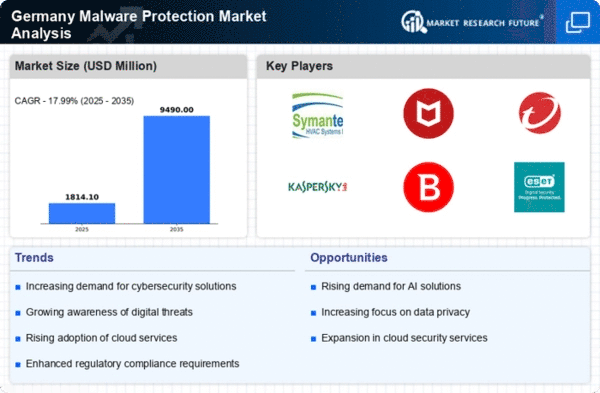
Germany Malware Protection Market Infographic
Purchase Options

Germany Malware Protection Market Summary

As per Market Research Future analysis, the Germany malware protection market Size was estimated at 1537.5 USD Million in 2024. The Malware Protection market is projected to grow from 1814.1 USD Million in 2025 to 9490.0 USD Million by 2035, exhibiting a compound annual growth rate (CAGR) of 17.9% during the forecast period 2025 - 2035

Key Market Trends & Highlights

The Germany malware protection market is experiencing robust growth driven by increasing cybersecurity investments and regulatory compliance demands.

  • The market is witnessing a surge in investment in cybersecurity solutions, reflecting a proactive approach to threat mitigation.
  • Regulatory compliance is significantly driving demand for malware protection services, particularly in the financial and healthcare sectors.
  • The integration of AI and machine learning technologies is enhancing the effectiveness of malware protection solutions, making them more adaptive to evolving threats.
  • Rising cyber threats and increased digital transformation are key drivers propelling the growth of the malware protection market in Germany.

Market Size & Forecast

2024 Market Size 1537.5 (USD Million)
2035 Market Size 9490.0 (USD Million)
CAGR (2025 - 2035) 17.99%

Major Players

Symantec (US), McAfee (US), Trend Micro (JP), Kaspersky Lab (RU), Bitdefender (RO), ESET (SK), Panda Security (ES), Sophos (GB), Webroot (US)

Our Impact
Enabled $4.3B Revenue Impact for Fortune 500 and Leading Multinationals
Partnering with 2000+ Global Organizations Each Year
30K+ Citations by Top-Tier Firms in the Industry

Germany Malware Protection Market Trends

The malware protection market is currently experiencing notable growth. This growth is driven by increasing cyber threats and the rising need for robust security solutions. Organizations across various sectors are prioritizing the implementation of advanced malware protection systems to safeguard sensitive data and maintain operational integrity. This heightened awareness of cybersecurity risks is prompting businesses to invest in comprehensive protection strategies, which include not only software solutions but also employee training and awareness programs. As a result, the demand for innovative technologies and services in this sector is on the rise, reflecting a shift towards proactive security measures. In addition, regulatory frameworks in Germany are evolving to address the complexities of digital security. Compliance with data protection laws is becoming increasingly critical for businesses, which further fuels the demand for effective malware protection solutions. Companies are seeking to align their security practices with legal requirements, thereby enhancing their overall resilience against cyber threats. This trend indicates a growing recognition of the importance of cybersecurity as a fundamental component of business strategy, ensuring that organizations are better equipped to face the challenges posed by an ever-changing digital landscape.

Increased Investment in Cybersecurity Solutions

Organizations are allocating more resources towards advanced malware protection technologies. This trend reflects a broader recognition of the necessity for comprehensive security measures to combat evolving cyber threats.

Regulatory Compliance Driving Demand

The evolving regulatory landscape in Germany is compelling businesses to adopt stringent malware protection measures. Compliance with data protection laws is becoming a priority, leading to increased investments in security solutions.

Integration of AI and Machine Learning

The incorporation of artificial intelligence and machine learning into malware protection systems is gaining traction. These technologies enhance threat detection capabilities, allowing for quicker responses to potential security breaches.

Germany Malware Protection Market Drivers

Rising Cyber Threats

The malware protection market in Germany is experiencing growth due to the increasing frequency and sophistication of cyber threats. Reports indicate that cybercrime costs the German economy approximately €100 billion annually, highlighting the urgent need for robust malware protection solutions. As businesses and individuals face a growing array of malware attacks, including ransomware and phishing schemes, the demand for effective cybersecurity measures intensifies. This trend is further supported by the fact that 70% of German companies have reported experiencing at least one cyber incident in the past year. Consequently, organizations are prioritizing investments in malware protection technologies to safeguard their digital assets and maintain operational integrity. The rising cyber threats thus serve as a significant driver for the malware protection market, compelling stakeholders to seek advanced solutions that can mitigate risks and enhance security postures.

Increased Digital Transformation

The ongoing digital transformation across various sectors in Germany is a key driver for the malware protection market. As organizations increasingly adopt cloud computing, IoT devices, and remote work solutions, the attack surface for cybercriminals expands. A survey indicates that 60% of German businesses have accelerated their digital initiatives, leading to a heightened focus on cybersecurity. This shift necessitates the implementation of comprehensive malware protection strategies to address vulnerabilities associated with new technologies. Moreover, the integration of digital tools in everyday operations has made it imperative for companies to protect sensitive data from potential breaches. The malware protection market is thus poised for growth as businesses recognize the importance of securing their digital environments against evolving threats, ensuring compliance with data protection regulations, and maintaining customer trust.

Regulatory Frameworks and Compliance

The regulatory landscape in Germany plays a crucial role in shaping the malware protection market. With stringent data protection laws, such as the General Data Protection Regulation (GDPR), organizations are compelled to implement robust cybersecurity measures to ensure compliance. Non-compliance can result in hefty fines, reaching up to €20 million or 4% of annual global turnover, whichever is higher. This regulatory pressure drives businesses to invest in effective malware protection solutions to safeguard personal data and avoid legal repercussions. Furthermore, the German Federal Office for Information Security (BSI) provides guidelines and recommendations that further emphasize the importance of cybersecurity. As companies strive to meet these regulatory requirements, the malware protection market is likely to see sustained growth, as organizations seek to align their security practices with legal obligations and industry standards.

Growing Awareness of Cybersecurity Risks

In Germany, there is a notable increase in awareness regarding cybersecurity risks among businesses and consumers alike. Educational initiatives and high-profile cyber incidents have contributed to a heightened understanding of the potential consequences of inadequate malware protection. As a result, organizations are more inclined to invest in cybersecurity solutions, with the malware protection market witnessing a surge in demand. Recent studies suggest that 80% of German companies are now prioritizing cybersecurity in their strategic planning, reflecting a cultural shift towards proactive risk management. This growing awareness not only drives investments in malware protection technologies but also encourages collaboration between public and private sectors to enhance overall cybersecurity resilience. Consequently, the malware protection market is likely to benefit from this increased focus on risk mitigation and the establishment of a more secure digital landscape.

Technological Advancements in Cybersecurity

Technological advancements are significantly influencing the malware protection market in Germany. Innovations in artificial intelligence, machine learning, and behavioral analytics are enhancing the capabilities of malware protection solutions. These technologies enable organizations to detect and respond to threats more effectively, reducing the time to mitigate potential breaches. As a result, the malware protection market is witnessing a shift towards more sophisticated solutions that leverage these advancements. Reports indicate that the adoption of AI-driven security tools is expected to grow by 30% in the coming years, reflecting the increasing reliance on technology to combat cyber threats. Additionally, the integration of automation in malware protection processes allows for more efficient threat management, further driving market growth. Consequently, the continuous evolution of technology serves as a vital driver for the malware protection market, as organizations seek to stay ahead of emerging threats and enhance their security frameworks.

Market Segment Insights

By Component: Solutions (Largest) vs. Services (Fastest-Growing)

In the Germany malware protection market, the Solutions segment holds the largest share, driven by an increasing demand for comprehensive protection against sophisticated cyber threats. This dominance can be attributed to organizations prioritizing software solutions that offer robust detection and response capabilities, making them a preferred choice for security investments. Conversely, the Services segment is recognized as the fastest-growing area, reflecting the rising trend towards managed security services. Organizations are increasingly outsourcing their cybersecurity needs to focus on core competencies, resulting in heightened demand for consulting, support, and maintenance services that facilitate effective malware protection in an evolving threat landscape.

Solutions (Dominant) vs. Services (Emerging)

The Solutions segment stands out as dominant within the Germany malware protection market, characterized by its comprehensive offerings, including antivirus, anti-malware, and endpoint protection solutions. These solutions aim to provide proactive defenses against a variety of cyber threats, ensuring the integrity of systems and data. On the other hand, the Services segment is emerging rapidly, featuring managed security services, incident response, and security consulting. This shift towards services reflects a market trend where businesses prefer leveraging expert providers to enhance their security posture, optimize resource allocation, and remain vigilant against new malware threats.

By Deployment: Cloud (Largest) vs. On-Premise (Fastest-Growing)

In the Germany malware protection market, the distribution of deployment options highlights the dominance of the cloud segment, capturing a significant share of overall deployments. On-premise solutions, while smaller in market share, are essential for organizations prioritizing control and security. As cyber threats evolve, businesses are increasingly recognizing the need for robust malware protection, influencing their choice of deployment method. The growth trends within this segment indicate a robust shift towards cloud-based solutions that offer scalability and flexibility. Factors driving this change include the rapid digital transformation across various industries and the rising demand for remote work solutions. On-premise deployments are also witnessing growth, especially among enterprises that require stringent data control measures, making them an appealing choice for security-conscious organizations.

Cloud (Dominant) vs. On-Premise (Emerging)

Cloud deployment in the malware protection landscape is characterized by its ability to provide extensive coverage and real-time updates, making it the preferred choice for many organizations facing complex cyber threats. The ease of integration with existing systems and the availability of managed services enhance its appeal. On the other hand, on-premise solutions are emerging strongly due to their appeal to organizations desiring full control over their data and security infrastructure. This segment is gaining traction, especially among industries with strict compliance requirements, indicating that while cloud remains dominant, on-premise deployments are carving out a substantial niche by addressing specific security concerns.

By Organization Size: SMEs (Largest) vs. Large Enterprises (Fastest-Growing)

In the Germany malware protection market, SMEs hold the largest share, benefiting from their high demand for cost-effective and efficient malware solutions. This segment comprises a significant portion of the market, as these smaller organizations seek to enhance their cybersecurity measures to protect against increasing threats. Meanwhile, large enterprises, though having a smaller market share comparatively, are experiencing rapid growth as they invest heavily in advanced malware protection technologies to safeguard their extensive digital infrastructures. The growth trends indicate a strong push from SMEs toward adopting comprehensive security solutions driven by rising cyber threats and regulatory compliance requirements. Conversely, large enterprises are leading the way as the fastest-growing segment, fueled by their need for scalable and robust security systems. As both segments evolve, they demonstrate the importance of tailored solutions to address unique operational challenges.

SMEs: Dominant vs. Large Enterprises: Emerging

SMEs in the Germany malware protection market are characterized by their agility and target-oriented approach, seeking affordable yet reliable security solutions to combat cyber threats. Their position as the dominant segment reflects their reliance on service providers that cater specifically to their needs. On the other hand, large enterprises represent an emerging force, focusing on integrating advanced technologies such as AI and machine learning into their security framework. This demographic is increasingly prioritizing comprehensive solutions that address complex threats. Both segments are vital, with SMEs focusing on fundamental protection and large enterprises pushing the envelope toward innovative security practices.

By Application: Endpoint Protection (Largest) vs. Network Protection (Fastest-Growing)

In the Germany malware protection market, Endpoint Protection emerges as the dominant segment, holding the largest market share compared to Network Protection, which is quickly gaining traction. Other segments such as Database Protection, Web Protection, and Email Protection serve essential roles but do not match the extensive adoption rates seen in Endpoint and Network Protection. The distribution of market shares showcases the critical need for robust endpoint security solutions amid increasing cyber threats. The growth trends within this market are primarily driven by the escalating frequency of cyberattacks and the need for enhanced security measures. The rise of remote work and global digital connectivity has amplified the demand for Network Protection solutions, contributing to its status as the fastest-growing segment. Companies are increasingly investing in comprehensive security strategies to safeguard their networks and endpoints from sophisticated malware attacks, thereby fostering a competitive landscape focused on innovation and efficiency.

Endpoint Protection (Dominant) vs. Network Protection (Emerging)

Endpoint Protection has established itself as the dominant player within the Germany malware protection market, primarily due to its ability to secure end-user devices against an array of malware threats. This segment is characterized by advanced technologies such as AI-driven threat detection, which enhances real-time monitoring and response capabilities. In contrast, Network Protection, though emerging, is gaining momentum as organizations seek to fortify their network perimeters against evolving cybersecurity risks. This segment emphasizes the importance of safeguarding data flow across various channels, utilizing sophisticated firewalls and intrusion detection systems. Both segments complement each other, creating a comprehensive security posture that addresses the multifaceted challenges posed by cyber threats.

By Industry Vertical: BFSI (Largest) vs. Healthcare & Life Sciences (Fastest-Growing)

The Germany malware protection market displays a diverse distribution across its various industry verticals. The BFSI sector remains the dominant segment, capturing a significant market share due to its critical need for security measures against potential threats. Following closely are IT & Telecom and Government & Defense, which also hold substantial shares owing to regulatory requirements and the necessity for safeguarding sensitive information. In contrast, the Healthcare & Life Sciences sector is emerging as the fastest-growing segment, driven by increased digitization and the growing importance of patient data security. Retail and Education sectors are also expanding, influenced by rising cyber threats and the need for robust protection solutions. Factors such as regulatory compliance and evolving security landscapes contribute to the growth of these segments.

BFSI (Dominant) vs. Healthcare & Life Sciences (Emerging)

The BFSI sector stands as the dominant player in the Germany malware protection market, heavily investing in cybersecurity solutions due to the high stakes associated with financial data security and compliance requirements. Financial institutions require advanced malware protection to guard against sophisticated cyber threats, ensuring the integrity and confidentiality of sensitive information. On the other hand, Healthcare & Life Sciences is rapidly becoming an emerging sector in this market, as the digitization of health records and the growing interconnectedness of medical devices create new vulnerabilities. This sector is increasingly prioritizing cybersecurity to protect patient data and meet regulatory standards, thus driving growth and innovation in malware protection solutions.

Get more detailed insights about Germany Malware Protection Market

Key Players and Competitive Insights

The malware protection market in Germany is characterized by a dynamic competitive landscape, driven by increasing cyber threats and a growing emphasis on digital security. Key players such as Symantec (US), Kaspersky Lab (RU), and Trend Micro (JP) are at the forefront, each adopting distinct strategies to enhance their market presence. Symantec (US) focuses on innovation through advanced threat detection technologies, while Kaspersky Lab (RU) emphasizes regional partnerships to bolster its service offerings. Trend Micro (JP) is actively pursuing digital transformation initiatives, which collectively shape a competitive environment that is increasingly reliant on technological advancements and strategic collaborations.In terms of business tactics, companies are localizing their operations to better cater to the German market, optimizing supply chains to enhance efficiency. The market structure appears moderately fragmented, with several players vying for market share. However, the influence of major companies is substantial, as they set benchmarks for quality and innovation, thereby impacting the overall competitive dynamics.

In October Kaspersky Lab (RU) announced a strategic partnership with a leading German telecommunications provider to enhance cybersecurity solutions for small and medium-sized enterprises (SMEs). This collaboration is significant as it not only expands Kaspersky's reach within the SME sector but also aligns with the growing demand for tailored cybersecurity solutions in Germany. Such partnerships are likely to enhance customer trust and brand loyalty, crucial factors in a market where competition is fierce.

In September Trend Micro (JP) launched a new AI-driven malware detection system aimed at improving response times to emerging threats. This initiative underscores the company's commitment to leveraging cutting-edge technology to stay ahead of cybercriminals. The integration of AI into their offerings may provide a competitive edge, as it allows for more proactive threat management, which is increasingly vital in today’s fast-evolving threat landscape.

In November Symantec (US) unveiled a comprehensive suite of cloud-based security solutions tailored for enterprises, reflecting a strategic pivot towards cloud security. This move is indicative of the broader trend towards digitalization, as organizations increasingly migrate to cloud environments. By focusing on cloud security, Symantec positions itself to capture a growing segment of the market that prioritizes flexible and scalable security solutions.

As of November the competitive trends in the malware protection market are heavily influenced by digitalization, AI integration, and sustainability initiatives. Strategic alliances are becoming more prevalent, as companies recognize the need for collaborative approaches to tackle complex cybersecurity challenges. Looking ahead, competitive differentiation is likely to evolve from traditional price-based strategies to a focus on innovation, technological advancements, and supply chain reliability, as organizations seek to establish themselves as leaders in a rapidly changing landscape.

Key Companies in the Germany Malware Protection Market include

Industry Developments

In October 2024, Sophos bought SecureWorks for $859 million. This made its global Extended Detection and Response (XDR) and MDR capabilities even better. The unified platform improves the malware protection and incident response services that businesses in Germany and all over Europe can use. 

Germany BSI says you should stop using Kaspersky products.The German Federal Office for Information Security (BSI) has told public institutions and operators of critical infrastructure not to use Kaspersky antivirus because they don't trust it and it could be unsafe. 

As a result, German companies have moved to other options like Sophos, Bitdefender, and ESET. Bitdefender is offering identity protection solutions for consumers across Europe.In February 2023, Bitdefender launched its Premium Security Plus suite across Europe, including Germany. It includes an antimalware program, a VPN, a password manager, and their Identity Protection Score tool for keeping an eye on breaches and protecting yourself before they happen.

Future Outlook

Germany Malware Protection Market Future Outlook

The Malware Protection Market is projected to grow at a 17.99% CAGR from 2025 to 2035, driven by increasing cyber threats, regulatory compliance, and technological advancements.

New opportunities lie in:

  • Development of AI-driven malware detection tools
  • Expansion of subscription-based security services
  • Integration of malware protection in IoT devices

By 2035, The malware protection market is projected to show substantial growth and innovation.

Market Segmentation

Germany Malware Protection Market Component Outlook

  • Solutions
  • Services

Germany Malware Protection Market Deployment Outlook

  • Cloud
  • On-Premise

Germany Malware Protection Market Application Outlook

  • Endpoint Protection
  • Network Protection
  • Database Protection
  • Web Protection
  • Email Protection

Germany Malware Protection Market Industry Vertical Outlook

  • BFSI
  • IT & Telecom
  • Government & Defense
  • Retail
  • Education
  • Healthcare & Life Sciences
  • Others

Germany Malware Protection Market Organization Size Outlook

  • SMEs
  • Large Enterprises

Report Scope

MARKET SIZE 2024 1537.5(USD Million)
MARKET SIZE 2025 1814.1(USD Million)
MARKET SIZE 2035 9490.0(USD Million)
COMPOUND ANNUAL GROWTH RATE (CAGR) 17.99% (2025 - 2035)
REPORT COVERAGE Revenue Forecast, Competitive Landscape, Growth Factors, and Trends
BASE YEAR 2024
Market Forecast Period 2025 - 2035
Historical Data 2019 - 2024
Market Forecast Units USD Million
Key Companies Profiled Symantec (US), McAfee (US), Trend Micro (JP), Kaspersky Lab (RU), Bitdefender (RO), ESET (SK), Panda Security (ES), Sophos (GB), Webroot (US)
Segments Covered Component, Deployment, Organization Size, Application, Industry Vertical
Key Market Opportunities Integration of artificial intelligence in malware protection solutions enhances threat detection and response capabilities.
Key Market Dynamics Rising demand for advanced malware protection solutions driven by increasing cyber threats and regulatory compliance in Germany.
Countries Covered Germany
Leave a Comment

FAQs

What is the current size of the Germany Malware Protection Market in 2024?

The Germany Malware Protection Market is expected to be valued at 1.72 USD Billion in 2024.

What is the projected market value for the Germany Malware Protection Market by 2035?

By 2035, the Germany Malware Protection Market is anticipated to reach a value of 11.24 USD Billion.

What is the expected compound annual growth rate (CAGR) of the Germany Malware Protection Market from 2025 to 2035?

The expected CAGR for the Germany Malware Protection Market from 2025 to 2035 is 18.594%.

Who are the major players in the Germany Malware Protection Market?

Key players in the Germany Malware Protection Market include Sophos, Avast, Bitdefender, Fortinet, Kaspersky Lab, and Symantec among others.

How much is the Germany Malware Protection Market solutions segment expected to be worth in 2035?

The solutions segment of the Germany Malware Protection Market is projected to be valued at 6.96 USD Billion in 2035.

What is the estimated value of the services segment of the Germany Malware Protection Market in 2024?

In 2024, the services segment of the Germany Malware Protection Market is estimated to be valued at 0.68 USD Billion.

What growth opportunities are projected for the Germany Malware Protection Market?

The growth opportunities for the Germany Malware Protection Market are driven by increasing cyber threats and demand for advanced security solutions.

What impact do current global trends have on the Germany Malware Protection Market?

Current global trends emphasize the need for enhanced cybersecurity measures and are positively influencing the Germany Malware Protection Market.

What are the key factors driving market growth in the Germany Malware Protection Market?

Key drivers of growth in the Germany Malware Protection Market include rising cybersecurity incidents and a growing reliance on technology.

Which component is experiencing the most significant growth in the Germany Malware Protection Market?

The solutions component is experiencing significant growth in the Germany Malware Protection Market due to increased investments in technology.

Download Free Sample

Kindly complete the form below to receive a free sample of this Report

Compare Licence

×
Features License Type
Single User Multiuser License Enterprise User
Price $4,950 $5,950 $7,250
Maximum User Access Limit 1 User Upto 10 Users Unrestricted Access Throughout the Organization
Free Customization
Direct Access to Analyst
Deliverable Format
Platform Access
Discount on Next Purchase 10% 15% 15%
Printable Versions