×
Request Free Sample ×

Kindly complete the form below to receive a free sample of this Report

* Please use a valid business email

Leading companies partner with us for data-driven Insights

clients tt-cursor
Hero Background

Germany ERP Software Market

ID: MRFR/ICT/44246-HCR
200 Pages
Aarti Dhapte
February 2026

Germany ERP Software Market Research Report By Type (Water, Carbonated Water, Flavored Water, Functional Water), By Packaging (Plastic Bottle), and By Application (Filter Bottle Washers, Filler Capper, Blow Molder, Shrink Wrapper)-Forecast to 2035

Share:
Download PDF ×

We do not share your information with anyone. However, we may send you emails based on your report interest from time to time. You may contact us at any time to opt-out.

Germany ERP Software Market Infographic
Purchase Options

Germany ERP Software Market Summary

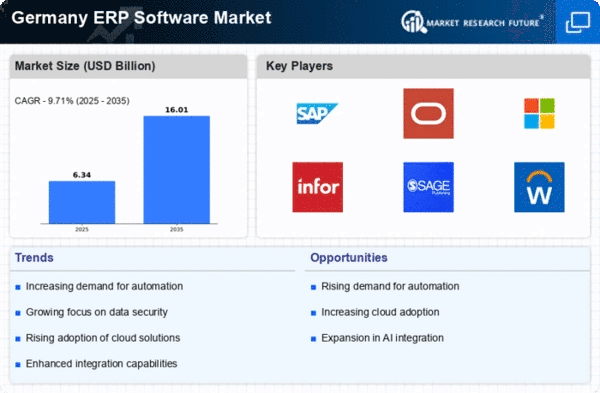
As per Market Research Future analysis, the Germany ERP Software Market Size was estimated at 5.78 USD Billion in 2024. The Germany erp software market is projected to grow from 6.34 USD Billion in 2025 to 16.01 USD Billion by 2035, exhibiting a compound annual growth rate (CAGR) of 9.7% during the forecast period 2025 - 2035

Key Market Trends & Highlights

The Germany ERP software market is experiencing a robust shift towards cloud-based solutions and customization.

  • Cloud adoption continues to rise, indicating a strong preference for flexible and scalable ERP solutions.
  • Customization and personalization are becoming increasingly vital as businesses seek tailored functionalities to meet specific needs.
  • The manufacturing sector remains the largest segment, while the retail sector is emerging as the fastest-growing segment in the ERP landscape.
  • Technological advancements and a focus on regulatory compliance are driving the market forward, enhancing integration and cost efficiency.

Market Size & Forecast

2024 Market Size 5.78 (USD Billion)
2035 Market Size 16.01 (USD Billion)
CAGR (2025 - 2035) 9.71%

Major Players

SAP (DE), Oracle (US), Microsoft (US), Infor (US), Sage (GB), Workday (US), NetSuite (US), Epicor (US)

Our Impact
Enabled $4.3B Revenue Impact for Fortune 500 and Leading Multinationals
Partnering with 2000+ Global Organizations Each Year
30K+ Citations by Top-Tier Firms in the Industry

Germany ERP Software Market Trends

The erp software market in Germany is currently experiencing a notable transformation, driven by advancements in technology and evolving business needs. Companies are increasingly recognizing the value of integrated solutions that streamline operations, enhance productivity, and provide real-time insights. This shift is largely influenced by the growing demand for automation and data analytics, which are becoming essential for maintaining competitive advantage. As organizations seek to optimize their processes, the adoption of cloud-based solutions is gaining traction, allowing for greater flexibility and scalability. Furthermore, the emphasis on sustainability and compliance is prompting businesses to invest in software that aligns with regulatory requirements and environmental standards. In addition, the erp software market is witnessing a rise in customization and personalization. Businesses are looking for solutions that can be tailored to their specific requirements, enabling them to address unique challenges and opportunities. This trend is further supported by the increasing collaboration between software providers and Market Research Future, fostering innovation and enhancing the overall user experience. As the landscape continues to evolve, it appears that the erp software market will play a crucial role in shaping the future of business operations in Germany, facilitating growth and efficiency across various sectors.

Cloud Adoption

The shift towards cloud-based solutions is becoming increasingly prevalent in the erp software market. Organizations are recognizing the benefits of flexibility, scalability, and cost-effectiveness that cloud systems offer. This trend is likely to enhance collaboration and accessibility, allowing businesses to operate more efficiently.

Customization and Personalization

There is a growing demand for tailored solutions within the erp software market. Companies are seeking software that can be customized to meet their specific operational needs. This trend indicates a shift towards more user-centric designs, enhancing functionality and user satisfaction.

Focus on Compliance and Sustainability

The emphasis on regulatory compliance and sustainability is shaping the erp software market. Businesses are increasingly investing in solutions that not only meet legal requirements but also support environmentally friendly practices. This trend suggests a broader commitment to corporate responsibility.

Germany ERP Software Market Drivers

Regulatory Compliance

Regulatory compliance remains a significant driver in the ERP software market, particularly in Germany, where businesses face stringent regulations. The need to comply with laws such as the General Data Protection Regulation (GDPR) and various industry-specific standards compels organizations to invest in robust ERP systems. These systems facilitate compliance by automating reporting processes and ensuring data integrity. As of 2025, it is estimated that around 70% of German companies prioritize compliance features in their ERP solutions. This focus on regulatory compliance not only mitigates risks but also enhances operational transparency, making it a crucial factor in the ERP software market.

Focus on Cost Efficiency

Cost efficiency is a critical driver influencing the ERP software market. German companies are under constant pressure to optimize their operational costs while maintaining high-quality service delivery. ERP systems provide tools for automating processes, reducing manual labor, and minimizing errors, which can lead to significant cost savings. As of 2025, it is estimated that businesses utilizing ERP solutions can reduce operational costs by up to 25%. This focus on cost efficiency is driving organizations to invest in ERP software that not only streamlines operations but also enhances profitability, making it a vital consideration in the ERP software market.

Technological Advancements

The rapid pace of technological advancements is a key driver in the ERP software market. Innovations in artificial intelligence (AI), machine learning, and data analytics are transforming how businesses operate. In Germany, companies are increasingly adopting these technologies to enhance operational efficiency and decision-making processes. The integration of AI into ERP systems allows for predictive analytics, which can improve inventory management and customer relationship management. As of 2025, the ERP software market in Germany is projected to grow at a CAGR of approximately 8.5%, driven by these technological advancements. This growth indicates a strong demand for sophisticated ERP solutions that can leverage new technologies to provide competitive advantages.

Increased Demand for Integration

The growing demand for integration capabilities is a notable driver in the ERP software market. Businesses in Germany are increasingly seeking solutions that can seamlessly integrate with existing systems and third-party applications. This trend is driven by the need for real-time data access and improved collaboration across departments. As organizations adopt various software solutions, the ability to integrate these systems becomes essential for maintaining operational efficiency. In 2025, it is projected that over 60% of German enterprises will prioritize integration features when selecting ERP software. This demand for integration highlights the importance of flexibility and adaptability in ERP solutions.

Shift Towards Remote Work Solutions

The shift towards remote work solutions is reshaping the ERP software market landscape. In Germany, organizations are increasingly adopting ERP systems that support remote access and collaboration among distributed teams. This trend is driven by the need for flexibility and the ability to maintain productivity regardless of location. As of 2025, it is anticipated that approximately 55% of German companies will prioritize ERP solutions that offer robust remote work capabilities. This shift not only enhances employee satisfaction but also enables businesses to adapt to changing work environments, making it a significant driver in the ERP software market.

Market Segment Insights

By Deployment Model: Cloud-Based (Largest) vs. On-Premises (Fastest-Growing)

In the Germany erp software market, the deployment model landscape is predominantly shaped by the Cloud-Based segment, which commands a substantial market share due to its scalability, flexibility, and reduced upfront costs. On-Premises solutions, while still significant, are increasingly losing ground to newer cloud technologies as businesses move towards digital transformation and remote work solutions. The Hybrid deployment model offers a balance, appealing to businesses seeking a transitional approach, combining the security of On-Premises with the convenience of Cloud-Based services. Growth trends indicate a compelling shift towards cloud adoption, primarily driven by organizations prioritizing operational efficiency and cost-effectiveness. The ongoing digital transformation initiatives and the increasing demand for real-time data access are enhancing the appeal of Cloud-Based solutions. Conversely, the On-Premises segment is witnessing a resurgence as industries requiring stringent data control and compliance become more pronounced. This evolving landscape is setting the stage for heightened competition and innovation across all deployment models.

Cloud-Based (Dominant) vs. On-Premises (Emerging)

Cloud-Based deployment solutions are leading the charge in the Germany erp software market, characterized by their ability to offer scalable resources, automatic updates, and enhanced collaboration features. They provide businesses with the agility needed to adapt to changing market demands. In contrast, On-Premises systems, while considered emerging, are experiencing a revival driven by sectors that prioritize data security and regulatory compliance. These On-Premises solutions provide organizations with complete control over their data environment, catering to specific business needs. This comparison highlights a dynamic sector where Cloud-Based options are preferred for their modern conveniences, while On-Premises systems reestablish their value for organizations wary of cloud vulnerabilities.

By Business Size: Medium Enterprises (Largest) vs. Small Enterprises (Fastest-Growing)

In the Germany erp software market, medium enterprises hold the largest share due to their significant operational requirements and resource availability. They leverage robust ERP solutions to streamline operations, manage resources effectively, and enhance decision-making processes. In contrast, small enterprises, while having a smaller market share, are rapidly adopting ERP solutions, indicating a growing trend toward technology integration even among smaller businesses. Growth trends in this segment are being driven by the increasing need for operational efficiency and digital transformation. Medium enterprises are focusing on scalable solutions that can adapt to their evolving needs, while small enterprises are motivated by cost-effective ERP options that offer flexibility and ease of use. This dual focus on enhancing efficiency and embracing technology fosters a robust growth environment for both segments.

Medium Enterprises: Dominant vs. Small Enterprises: Emerging

Medium enterprises play a dominant role in the Germany erp software market as they have the necessary infrastructure to effectively implement complex ERP solutions. They often seek comprehensive systems that cater to their varied operational needs, enhancing productivity and integration across departments. Meanwhile, small enterprises are emerging rapidly, motivated by the need for affordable and user-friendly ERP systems that can support their growth ambitions. This segment is characterized by a willingness to adopt innovative solutions that offer scalability as their operations expand. The contrasting characteristics highlight a market where medium enterprises stand as the bulwark of stability, while small enterprises are driving dynamic changes.

By Functionality: Financial Management (Largest) vs. Human Resource Management (Fastest-Growing)

In the Germany erp software market, Financial Management holds the largest share, reflecting its vital role in business operations. Following closely, Supply Chain Management and Customer Relationship Management show significant contributions, while Human Resource Management is rapidly gaining traction, reflecting a shift in organizational focus towards employee engagement and management. The growth trends within the functionality segment indicate a robust demand for integrated solutions that streamline operations and enhance productivity. Specifically, the Human Resource Management sector is driven by the need for improved workforce management and digital transformation initiatives. On the other hand, Financial Management's position is bolstered by the constant need for compliance and financial transparency, maintaining its dominance in the market.

Financial Management: Dominant vs. Human Resource Management: Emerging

Financial Management in the Germany erp software market is characterized by comprehensive solutions that cater to budgeting, forecasting, and reporting needs, making it indispensable for organizations aiming for financial visibility. This segment ensures effective resource allocation and regulatory compliance, which are critical in today's competitive landscape. On the contrary, Human Resource Management is characterized by its rapid evolution through digitization and automation, offering platforms that focus on recruitment, employee experience, and performance management. The increasing emphasis on workforce analytics and employee retention strategies further drives its emergence, positioning it as a necessary tool for companies that wish to foster a motivated workforce and adapt to changing labor market dynamics.

By Industry: Manufacturing (Largest) vs. Healthcare (Fastest-Growing)

In the Germany erp software market, the Manufacturing segment holds the largest share, primarily driven by the robust industrial infrastructure and the need for efficient production processes. On the other hand, the Healthcare segment is witnessing significant growth as the demand for digital solutions in patient management and healthcare administration escalates, positioning it as a key player in the evolving landscape. Growth trends indicate that the Manufacturing sector is increasingly adopting smart technologies and automation, contributing to its dominant position. Meanwhile, the Healthcare segment is expanding rapidly, fueled by regulatory changes and technological advancements. The focus on improving healthcare outcomes and operational efficiencies is likely to drive the adoption of ERP solutions in this sector, emphasizing its emerging importance within the overall market.

Manufacturing (Dominant) vs. Retail (Emerging)

The Manufacturing segment is characterized by its well-established processes and reliance on advanced technologies to streamline operations, making it a dominant force in the market. This segment benefits from high-volume production demands, necessitating comprehensive ERP solutions that can integrate various business functions. Conversely, the Retail segment is emerging rapidly as businesses transition to digital platforms to enhance customer experiences. The shift towards e-commerce and omnichannel strategies is driving the need for versatile ERP solutions that cater to inventory management and customer engagement, making Retail a critical area of growth.

Get more detailed insights about Germany ERP Software Market

Key Players and Competitive Insights

The ERP software market in Germany is characterized by a dynamic competitive landscape, driven by rapid technological advancements and increasing demand for integrated business solutions. Key players such as SAP (DE), Oracle (US), and Microsoft (US) are at the forefront, each adopting distinct strategies to enhance their market presence. SAP (DE) continues to leverage its strong local roots, focusing on innovation and customer-centric solutions, while Oracle (US) emphasizes cloud-based offerings and strategic acquisitions to bolster its portfolio. Microsoft (US) is increasingly integrating AI capabilities into its ERP solutions, aiming to provide enhanced analytics and automation features, which collectively shape a competitive environment that prioritizes technological advancement and customer engagement.
The business tactics employed by these companies reflect a concerted effort to optimize operations and enhance customer satisfaction. The market structure appears moderately fragmented, with a mix of established players and emerging startups. This fragmentation allows for diverse offerings, yet the influence of major players remains substantial, as they set benchmarks for innovation and service quality. Localizing solutions to meet specific regional needs and optimizing supply chains are common tactics that enhance competitiveness and responsiveness to market demands.
In October 2025, SAP (DE) announced a strategic partnership with a leading AI firm to enhance its ERP solutions with advanced machine learning capabilities. This move is likely to position SAP (DE) as a frontrunner in the integration of AI within ERP systems, potentially attracting a broader customer base seeking cutting-edge technology. The partnership underscores SAP's commitment to innovation and its strategy to remain competitive in a rapidly evolving market.
In September 2025, Oracle (US) completed the acquisition of a prominent cloud-based ERP provider, which is expected to expand its market share significantly. This acquisition not only enhances Oracle's product offerings but also strengthens its position in the cloud segment, aligning with the growing trend towards digital transformation. The strategic importance of this acquisition lies in Oracle's ability to offer a more comprehensive suite of services, catering to the increasing demand for integrated solutions.
In August 2025, Microsoft (US) launched a new version of its ERP software that incorporates advanced analytics and AI-driven insights. This release is indicative of Microsoft's strategy to differentiate itself through technological innovation, aiming to provide businesses with actionable insights that drive efficiency and decision-making. The introduction of these features is likely to enhance customer loyalty and attract new clients seeking modern solutions.
As of November 2025, the ERP software market is witnessing trends that emphasize digitalization, sustainability, and AI integration. Strategic alliances are increasingly shaping the competitive landscape, as companies recognize the value of collaboration in driving innovation. The shift from price-based competition to a focus on technological differentiation and supply chain reliability is evident, suggesting that future competitive dynamics will hinge on the ability to innovate and adapt to changing market conditions.

Key Companies in the Germany ERP Software Market include

Industry Developments

The Germany ERP Software Market has seen significant developments recently. Notably, Oracle announced plans to expand its cloud services in Germany, enhancing local data centers to meet rising demand for secure ERP solutions. In September 2023, SAP launched an innovative upgrade to its S/4HANA suite, emphasizing sustainability features to align with Germany's commitment to green technology. A noteworthy merger occurred in August 2023 when Dassault Systmes acquired a German logistics technology firm to strengthen its ERP capabilities in supply chain management. Additionally, Microsoft's cloud ERP offerings gained traction among mid-sized businesses in Germany, contributing to their market valuation growth.

This increased investment in ERP platforms reflects the strategic focus of companies like Unit4 and Infor on industries integral to Germany's economic landscape, such as manufacturing and services. The market has exhibited a robust growth trajectory despite economic uncertainties, with major players like Epicor and Plex investing in localized solutions tailored to German enterprises. The German Federal Ministry for Economic Affairs also emphasizes digitalization in its policies, stimulating further interest and competition in the ERP space. These developments underscore the dynamic nature of the ERP software environment in Germany as companies adapt to evolving industry demands.


Future Outlook

Germany ERP Software Market Future Outlook

The ERP software market in Germany is projected to grow at a 9.71% CAGR from 2025 to 2035, driven by digital transformation, cloud adoption, and enhanced data analytics capabilities.

New opportunities lie in:

  • Integration of AI-driven analytics for real-time decision-making.
  • Development of industry-specific ERP solutions for niche markets.
  • Expansion of subscription-based pricing models to enhance customer retention.

By 2035, the ERP software market is expected to be robust, reflecting substantial growth and innovation.

Market Segmentation

Germany ERP Software Market Industry Outlook

  • Manufacturing
  • Retail
  • Healthcare
  • Education

Germany ERP Software Market Business Size Outlook

  • Small Enterprises
  • Medium Enterprises
  • Large Enterprises

Germany ERP Software Market Functionality Outlook

  • Financial Management
  • Supply Chain Management
  • Human Resource Management
  • Customer Relationship Management

Germany ERP Software Market Deployment Model Outlook

  • On-Premises
  • Cloud-Based
  • Hybrid

Report Scope

MARKET SIZE 2024 5.78(USD Billion)
MARKET SIZE 2025 6.34(USD Billion)
MARKET SIZE 2035 16.01(USD Billion)
COMPOUND ANNUAL GROWTH RATE (CAGR) 9.71% (2025 - 2035)
REPORT COVERAGE Revenue Forecast, Competitive Landscape, Growth Factors, and Trends
BASE YEAR 2024
Market Forecast Period 2025 - 2035
Historical Data 2019 - 2024
Market Forecast Units USD Billion
Key Companies Profiled SAP (DE), Oracle (US), Microsoft (US), Infor (US), Sage (GB), Workday (US), NetSuite (US), Epicor (US)
Segments Covered Deployment Model, Business Size, Functionality, Industry
Key Market Opportunities Integration of artificial intelligence and automation in the erp software market enhances operational efficiency and decision-making.
Key Market Dynamics Growing demand for cloud-based ERP solutions driven by digital transformation initiatives in the German market.
Countries Covered Germany
Leave a Comment

FAQs

What is the expected market size of the Germany ERP Software Market in 2024?

The Germany ERP Software Market is expected to be valued at 5.2 USD Billion in 2024.

What will the market size of the Germany ERP Software Market be in 2035?

By 2035, the Germany ERP Software Market is anticipated to reach a value of 12.0 USD Billion.

What is the expected CAGR for the Germany ERP Software Market from 2025 to 2035?

The expected CAGR for the Germany ERP Software Market from 2025 to 2035 is 7.898%.

Which companies are the major players in the Germany ERP Software Market?

Key players in the market include Oracle, SAP, Workday, Microsoft, and Infor among others.

What will be the market size for Water ERP Software in Germany by 2035?

The market size for Water ERP Software in Germany is projected to reach 3.0 USD Billion by 2035.

What is the expected market size for Carbonated Water ERP Software in 2024?

The expected market size for Carbonated Water ERP Software in 2024 is 1.2 USD Billion.

How much is the Functional Water ERP Software market expected to grow by 2035?

The Functional Water ERP Software market is expected to grow to 4.3 USD Billion by 2035.

What impact do current market trends have on the Germany ERP Software Market?

Current market trends reflect increasing digitalization and demand for integrated software solutions.

How is the Germany ERP Software Market expected to perform in the coming years?

The market is expected to experience steady growth attributed to a rising need for efficient business processes.

What are some key challenges faced by the Germany ERP Software Market?

Challenges include adapting to rapid technological changes and managing data security concerns.

Download Free Sample

Kindly complete the form below to receive a free sample of this Report

Compare Licence

×
Features License Type
Single User Multiuser License Enterprise User
Price $4,950 $5,950 $7,250
Maximum User Access Limit 1 User Upto 10 Users Unrestricted Access Throughout the Organization
Free Customization
Direct Access to Analyst
Deliverable Format
Platform Access
Discount on Next Purchase 10% 15% 15%
Printable Versions