×
Request Free Sample ×

Kindly complete the form below to receive a free sample of this Report

* Please use a valid business email

Leading companies partner with us for data-driven Insights

clients tt-cursor
Hero Background

France Trade Surveillance Systems Market

ID: MRFR/ICT/61007-HCR
200 Pages
Aarti Dhapte
February 2026

France Trade Surveillance Systems Market Size, Share and Research Report: By Application (Market Surveillance, Transaction Monitoring, Employee Surveillance, Compliance Management), By Deployment Mode (On-Premises, Cloud-Based), By End User (Financial Institutions, Trading Firms, Regulatory Authorities, Corporate Entities), and By Component (Software, Hardware, Services)- Industry Forecast to 2035

Share:
Download PDF ×

We do not share your information with anyone. However, we may send you emails based on your report interest from time to time. You may contact us at any time to opt-out.

France Trade Surveillance Systems Market Infographic
Purchase Options

France Trade Surveillance Systems Market Summary

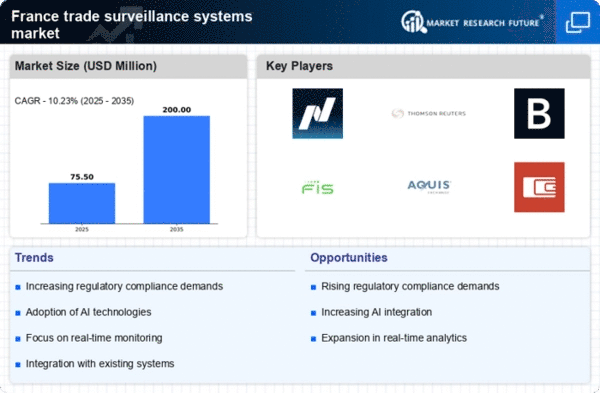
As per Market Research Future analysis, the France trade surveillance-systems market Size was estimated at 68.49 USD Million in 2024. The France trade surveillance-systems market is projected to grow from 75.5 USD Million in 2025 to 200.0 USD Million by 2035, exhibiting a compound annual growth rate (CAGR) of 10.2% during the forecast period 2025 - 2035

Key Market Trends & Highlights

The France trade surveillance-systems market is experiencing robust growth driven by regulatory demands and technological advancements.

  • The market is characterized by increasing regulatory compliance pressure, necessitating advanced surveillance solutions.
  • Technological advancements are reshaping the landscape, with a notable shift towards data analytics integration for enhanced monitoring.
  • The largest segment in this market is the financial services sector, while the fastest-growing segment is expected to be the cryptocurrency trading sector.
  • Key market drivers include rising incidences of market abuse and the growing demand for real-time monitoring solutions.

Market Size & Forecast

2024 Market Size 68.49 (USD Million)
2035 Market Size 200.0 (USD Million)
CAGR (2025 - 2035) 10.23%

Major Players

Nasdaq (US), Thomson Reuters (CA), Bloomberg (US), FIS (US), Aquis Exchange (GB), Cinnober (SE), Actico (DE), Verafin (CA)

Our Impact
Enabled $4.3B Revenue Impact for Fortune 500 and Leading Multinationals
Partnering with 2000+ Global Organizations Each Year
30K+ Citations by Top-Tier Firms in the Industry

France Trade Surveillance Systems Market Trends

The trade surveillance-systems market is currently experiencing a notable evolution, driven by the increasing complexity of financial transactions and the growing demand for regulatory compliance. In France, regulatory bodies are intensifying their scrutiny of trading activities, which necessitates the implementation of advanced surveillance technologies. This shift appears to be influenced by the need for firms to mitigate risks associated with market manipulation and insider trading. As a result, organizations are investing in sophisticated systems that can analyze vast amounts of data in real-time, ensuring adherence to legal requirements while enhancing operational efficiency. Moreover, the integration of artificial intelligence and machine learning into trade surveillance-systems is becoming more prevalent. These technologies seem to offer enhanced capabilities for detecting anomalies and suspicious activities, thereby improving the overall effectiveness of monitoring processes. The French market is likely to see a rise in demand for solutions that not only comply with existing regulations but also adapt to evolving market conditions. This trend indicates a shift towards more proactive and intelligent surveillance mechanisms, which could redefine how firms approach compliance and risk management in the financial sector.

Regulatory Compliance Pressure

The trade surveillance-systems market is witnessing increased pressure from regulatory authorities in France. This trend is characterized by stricter enforcement of compliance measures, compelling firms to adopt advanced surveillance technologies. Organizations are focusing on systems that can efficiently monitor trading activities and ensure adherence to legal standards.

Technological Advancements

There is a growing emphasis on integrating cutting-edge technologies within the trade surveillance-systems market. The adoption of artificial intelligence and machine learning is becoming more common, as these innovations enhance the ability to detect irregularities and suspicious behavior. This trend suggests a move towards more sophisticated monitoring solutions.

Data Analytics Integration

The incorporation of advanced data analytics into trade surveillance-systems is gaining traction. Firms are increasingly seeking solutions that can process large datasets in real-time, allowing for timely identification of potential risks. This trend indicates a shift towards data-driven decision-making in compliance and risk management.

France Trade Surveillance Systems Market Drivers

Increasing Regulatory Scrutiny

The trade surveillance-systems market in France is experiencing heightened regulatory scrutiny, driven by the need for financial institutions to comply with stringent regulations. Authorities such as the Autorite des Marches Financiers (AMF) are enforcing rigorous compliance measures to mitigate risks associated with market manipulation and insider trading. This regulatory environment compels firms to invest in advanced surveillance systems to ensure adherence to legal requirements. As a result, the market is projected to grow at a CAGR of approximately 8% over the next five years, reflecting the increasing demand for compliance solutions. The trade surveillance-systems market is thus positioned to benefit from this trend, as organizations seek to enhance their monitoring capabilities and reduce the risk of regulatory penalties.

Rising Incidences of Market Abuse

The trade surveillance-systems market is significantly influenced by the rising incidences of market abuse in France. With the financial landscape becoming increasingly complex, instances of fraud, insider trading, and market manipulation have surged. This trend has prompted financial institutions to adopt sophisticated surveillance systems to detect and prevent such activities. According to recent data, the cost of market abuse to the financial sector can reach billions of euros annually, underscoring the necessity for effective monitoring solutions. Consequently, the trade surveillance-systems market is likely to see robust growth as firms prioritize the implementation of technologies that can identify suspicious trading patterns and ensure market integrity.

Growing Demand for Real-Time Monitoring

The demand for real-time monitoring solutions is a key driver in the trade surveillance-systems market. As trading activities become more dynamic, financial institutions in France are increasingly recognizing the importance of immediate detection of irregularities. Real-time surveillance systems allow firms to respond swiftly to potential threats, thereby minimizing risks associated with market abuse. This shift towards proactive monitoring is expected to propel the market forward, with projections indicating a growth rate of around 10% in the coming years. The trade surveillance-systems market is thus adapting to these evolving needs, as organizations prioritize systems that provide timely insights and enhance decision-making processes.

Technological Integration and Innovation

The trade surveillance-systems market in France is witnessing a wave of technological integration and innovation. Financial institutions are increasingly leveraging artificial intelligence (AI) and machine learning (ML) to enhance their surveillance capabilities. These technologies enable the analysis of vast amounts of trading data in real-time, allowing for quicker identification of anomalies and potential compliance breaches. The integration of advanced analytics is expected to drive market growth, with estimates suggesting a potential increase in market size by 15% over the next few years. The trade surveillance-systems market is thus evolving, as firms seek to adopt cutting-edge solutions that not only meet regulatory requirements but also improve operational efficiency.

Increased Focus on Data Privacy and Security

In the context of the trade surveillance-systems market, there is an increased focus on data privacy and security among financial institutions in France. With the implementation of regulations such as the General Data Protection Regulation (GDPR), firms are compelled to ensure that their surveillance systems not only comply with market regulations but also protect sensitive customer data. This dual requirement is driving investments in advanced security features within surveillance systems. The trade surveillance-systems market is likely to benefit from this trend, as organizations seek solutions that balance compliance with robust data protection measures, potentially leading to a market growth of 12% over the next few years.


Market Segment Insights

By Application: Transaction Monitoring (Largest) vs. Compliance Management (Fastest-Growing)

In the France trade surveillance-systems market, Transaction Monitoring holds a significant share, establishing itself as the largest segment. This dominance can be attributed to the increasing importance of monitoring financial transactions to ensure compliance and detect fraudulent activities. Employee Surveillance and Market Surveillance also contribute to the market but lag behind in terms of market share, highlighting a clear preference among businesses for robust transaction monitoring solutions. Looking forward, the Compliance Management segment is emerging as the fastest-growing area within the France trade surveillance-systems market. Driving factors include heightened regulatory scrutiny and the need for businesses to adhere to complex compliance requirements. Increasing demand for automated compliance solutions reinforces this growth, positioning it as a crucial investment area for firms looking to strengthen their surveillance capabilities and avert regulatory risks.

Transaction Monitoring (Dominant) vs. Compliance Management (Emerging)

Transaction Monitoring serves as the dominant segment in the France trade surveillance-systems market, characterized by its focus on tracking and analyzing financial transactions to prevent fraud and ensure compliance. This segment benefits from advanced technologies such as AI and machine learning, enabling businesses to efficiently identify suspicious patterns and anomalies. On the other hand, Compliance Management is gaining traction as an emerging segment, driven by the increasing regulatory landscape and the necessity for organizations to maintain compliance with evolving laws. This shift reflects companies' commitment to mitigating risks and sustaining operational integrity, thus positioning Compliance Management as an essential component of their overarching surveillance strategies.

By Deployment Mode: On-Premises (Largest) vs. Cloud-Based (Fastest-Growing)

In the France trade surveillance-systems market, the On-Premises segment holds the largest share, driven by the preference for traditional infrastructure among established financial institutions. Many firms favor on-premises solutions for their perceived security and compliance advantages, especially when handling sensitive data within local environments. Conversely, the Cloud-Based segment, while currently smaller, is experiencing rapid growth as organizations increasingly adopt flexible and scalable solutions that reduce upfront costs and facilitate remote operations. The growth trends in deployment modes are influenced largely by technological advancements and changing operational needs. The Cloud-Based solution is gaining traction due to its agility and ability to integrate innovative technologies such as AI and big data analytics. Key drivers include the ongoing digital transformation across sectors and the need for real-time monitoring, pushing businesses to consider cloud options, thus positioning Cloud-Based as the fastest-growing segment in the market.

On-Premises (Dominant) vs. Cloud-Based (Emerging)

The On-Premises deployment mode remains dominant in the France trade surveillance-systems market, appealing primarily to firms prioritizing data control and regulatory adherence. Organizations using on-premises solutions benefit from enhanced security measures and tailored integrations with existing legacy systems, ensuring compliance with strict local regulations. In contrast, Cloud-Based solutions are emerging rapidly, attracting businesses seeking lower maintenance costs, easy scalability, and enhanced collaboration. These systems offer a modern alternative, providing firms the flexibility to adapt to changing market demands while leveraging advanced features that enhance surveillance capabilities. This dynamic indicates a shift towards modern operational frameworks, where Cloud-Based solutions are positioned for significant growth as they address the evolving needs of the market.

By End User: Financial Institutions (Largest) vs. Trading Firms (Fastest-Growing)

In the France trade surveillance-systems market, Financial Institutions hold the largest market share, attributed to their extensive operations and regulatory compliance needs. Trading Firms closely follow, capturing a significant portion of the market, driven by their increasing transaction volumes and the necessity for robust surveillance solutions to mitigate risks associated with trading activities. Regulatory Authorities and Corporate Entities comprise smaller portions of the market, focusing on compliance and enterprise-level applications respectively. The growth of the segment is propelled by innovations in technology and increasing regulatory frameworks imposing stringent monitoring requirements. Trading Firms are experiencing rapid expansion as they adopt advanced surveillance systems to ensure compliance and enhance operational efficiency. Simultaneously, Financial Institutions continue to invest heavily in upgrading their surveillance capabilities in response to evolving market dynamics and regulatory pressures, making them a critical component of this market.

Financial Institutions (Dominant) vs. Trading Firms (Emerging)

Financial Institutions are characterized by their strong regulatory oversight and substantial investment in compliance frameworks, positioning them as the dominant force in the market. Their necessity for robust risk management tools drives the demand for sophisticated trade surveillance systems. On the other hand, Trading Firms, although emerging, are rapidly adapting to technological advancements, seeking innovative solutions to optimize their trading strategies and reduce risks. The dynamic nature of trading necessitates these firms enhance their surveillance capabilities swiftly. Both segments illustrate distinct yet pivotal roles in maintaining market integrity and ensuring compliance within the France trade surveillance-systems market.

By Component: Software (Largest) vs. Services (Fastest-Growing)

In the France trade surveillance-systems market, the distribution of market share among component values reveals that software stands as the largest segment. This dominance is largely attributed to its essential role in data analytics and compliance tracking, which are crucial in trade surveillance. Hardware and services follow, but their shares are notably smaller, reflecting the software's pivotal role in enhancing operational efficiency and regulatory adherence. Growth trends in this segment indicate that while software remains dominant, services are emerging as the fastest-growing area. This growth is driven by the increasing need for customized solutions and real-time surveillance capabilities. As regulatory environments become more complex, the demand for integrated services that complement software offerings is expected to rise, creating new opportunities in the market.

Software (Dominant) vs. Services (Emerging)

Software is characterized by its robust capabilities in data management, analytics, and compliance features. It dominates the France trade surveillance-systems market thanks to its flexibility and ability to integrate with various data sources for optimal surveillance. Meanwhile, services are emerging as critical components due to their role in providing support, customization, and ongoing training to users. The need for enhanced real-time monitoring and tailored solutions is prompting a shift towards service-oriented offerings, making them crucial for organizations looking to adapt swiftly to market changes. This dual focus on software and services illustrates the market's evolution, with each segment playing distinct yet complementary roles.

Get more detailed insights about France Trade Surveillance Systems Market

Key Players and Competitive Insights

The trade surveillance-systems market in France is characterized by a dynamic competitive landscape, driven by the increasing regulatory scrutiny and the need for enhanced compliance measures among financial institutions. Key players such as Nasdaq (US), Thomson Reuters (CA), and Bloomberg (US) are at the forefront, leveraging their technological prowess to innovate and expand their service offerings. Nasdaq (US) has positioned itself as a leader in providing advanced analytics and real-time monitoring solutions, while Thomson Reuters (CA) focuses on integrating AI capabilities into its surveillance systems to enhance detection accuracy. Bloomberg (US) emphasizes its comprehensive data analytics and reporting tools, which are crucial for compliance in a rapidly evolving regulatory environment. Collectively, these strategies foster a competitive environment that prioritizes technological advancement and regulatory compliance, shaping the market's trajectory.In terms of business tactics, companies are increasingly localizing their operations to better serve the French market, optimizing supply chains to enhance efficiency and responsiveness. The market appears moderately fragmented, with several players vying for market share, yet the influence of major companies remains substantial. This competitive structure allows for a diverse range of solutions, catering to various segments within the financial sector, from investment banks to asset management firms.

In October Nasdaq (US) announced a strategic partnership with a leading French financial institution to develop a tailored surveillance solution aimed at enhancing compliance with local regulations. This collaboration is significant as it not only strengthens Nasdaq's foothold in the French market but also demonstrates its commitment to addressing specific regional compliance challenges. Such partnerships are likely to enhance customer trust and expand market reach.

In September Thomson Reuters (CA) launched an upgraded version of its surveillance platform, incorporating machine learning algorithms to improve anomaly detection. This upgrade is pivotal as it reflects the growing trend towards AI integration in surveillance systems, enabling clients to respond more swiftly to potential compliance breaches. The emphasis on advanced technology positions Thomson Reuters as a forward-thinking player in the market, likely attracting clients seeking cutting-edge solutions.

In August Bloomberg (US) expanded its trade surveillance capabilities by acquiring a smaller tech firm specializing in blockchain analytics. This acquisition is indicative of the increasing importance of blockchain technology in trade surveillance, as it offers enhanced transparency and traceability. By integrating these capabilities, Bloomberg aims to provide a more comprehensive solution that meets the evolving needs of its clients, thereby reinforcing its competitive edge.

As of November the trade surveillance-systems market is witnessing trends such as digitalization, sustainability, and the integration of AI technologies. Strategic alliances among key players are shaping the competitive landscape, fostering innovation and collaboration. Looking ahead, it appears that competitive differentiation will increasingly hinge on technological innovation and supply chain reliability, rather than solely on price. Companies that prioritize these aspects are likely to thrive in an environment where regulatory compliance and operational efficiency are paramount.

Key Companies in the France Trade Surveillance Systems Market include

Industry Developments

Recent developments in the France Trade Surveillance Systems Market have indicated a robust demand for enhanced compliance and risk management solutions, particularly due to increased regulatory scrutiny. NICE Actimize was acknowledged as the global leader in a prominent trade surveillance and monitoring assessment in November 2023, securing the top spot in technology and client impact metrics for the fourth consecutive year. 

According to a prominent industry impact report that assessed vendor performance and solution coverage in March 2024, NICE Actimize's SURVEIL-X Holistic Conduct Surveillance Suite achieved best-in-class rankings in a variety of surveillance categories, including trade, communications, crypto, and commodities. In May 2025, NICE Actimize improved the context-aware detection of market-abuse risks across written and verbal communications by integrating generative AI capabilities, known as Actimize Intelligence, into its SURVEIL-X platform.

Future Outlook

France Trade Surveillance Systems Market Future Outlook

The Trade Surveillance Systems Market in France is projected to grow at a 10.23% CAGR from 2025 to 2035, driven by regulatory compliance and technological advancements.

New opportunities lie in:

  • Integration of AI-driven analytics for real-time monitoring
  • Development of customizable surveillance solutions for niche markets
  • Expansion into emerging sectors like cryptocurrency trading

By 2035, the market is expected to achieve robust growth and enhanced technological integration.

Market Segmentation

France Trade Surveillance Systems Market End User Outlook

  • Financial Institutions
  • Trading Firms
  • Regulatory Authorities
  • Corporate Entities

France Trade Surveillance Systems Market Component Outlook

  • Software
  • Hardware
  • Services

France Trade Surveillance Systems Market Application Outlook

  • Market Surveillance
  • Transaction Monitoring
  • Employee Surveillance
  • Compliance Management

France Trade Surveillance Systems Market Deployment Mode Outlook

  • On-Premises
  • Cloud-Based

Report Scope

MARKET SIZE 2024 68.49(USD Million)
MARKET SIZE 2025 75.5(USD Million)
MARKET SIZE 2035 200.0(USD Million)
COMPOUND ANNUAL GROWTH RATE (CAGR) 10.23% (2025 - 2035)
REPORT COVERAGE Revenue Forecast, Competitive Landscape, Growth Factors, and Trends
BASE YEAR 2024
Market Forecast Period 2025 - 2035
Historical Data 2019 - 2024
Market Forecast Units USD Million
Key Companies Profiled Nasdaq (US), Thomson Reuters (CA), Bloomberg (US), FIS (US), Aquis Exchange (GB), Cinnober (SE), Actico (DE), Verafin (CA)
Segments Covered Application, Deployment Mode, End User, Component
Key Market Opportunities Integration of advanced analytics and artificial intelligence in trade surveillance-systems market enhances compliance and risk management.
Key Market Dynamics Rising regulatory scrutiny drives demand for advanced trade surveillance systems in the financial sector.
Countries Covered France
Leave a Comment

FAQs

What is the expected market size of the France Trade Surveillance Systems Market in 2024?

The France Trade Surveillance Systems Market is expected to be valued at 68.4 million USD in 2024.

What will be the market value of the France Trade Surveillance Systems Market by 2035?

By 2035, the market value is projected to reach 205.2 million USD.

What is the expected CAGR for the France Trade Surveillance Systems Market from 2025 to 2035?

The market is expected to grow at a CAGR of 10.503% from 2025 to 2035.

Which application has the highest projected market value in 2035?

Market Surveillance is projected to have the highest value at 60.0 million USD in 2035.

What will be the market size for Transaction Monitoring in 2024?

The market size for Transaction Monitoring is estimated to be 18.0 million USD in 2024.

Who are the key players in the France Trade Surveillance Systems Market?

Key players include Thomson Reuters, NICE Actimize, Accenture, and IBM among others.

What is the expected market size for Employee Surveillance in 2035?

The market size for Employee Surveillance is anticipated to reach 45.0 million USD by 2035.

What is the projected market value of Compliance Management in 2024?

The projected market value for Compliance Management in 2024 is 15.4 million USD.

How does the France Trade Surveillance Systems Market's growth rate compare to other regions?

The market's growth rate is anticipated to be robust with significant opportunities, particularly from 2025 to 2035.

What impact does the current global scenario have on the France Trade Surveillance Systems Market?

The current global scenario presents both challenges and opportunities impacting market landscape and growth.

Download Free Sample

Kindly complete the form below to receive a free sample of this Report

Compare Licence

×
Features License Type
Single User Multiuser License Enterprise User
Price $4,950 $5,950 $7,250
Maximum User Access Limit 1 User Upto 10 Users Unrestricted Access Throughout the Organization
Free Customization
Direct Access to Analyst
Deliverable Format
Platform Access
Discount on Next Purchase 10% 15% 15%
Printable Versions