×
Request Free Sample ×

Kindly complete the form below to receive a free sample of this Report

* Please use a valid business email

Leading companies partner with us for data-driven Insights

clients tt-cursor
Hero Background

France Iris Recognition Market

ID: MRFR/ICT/58711-HCR
200 Pages
Aarti Dhapte
February 2026

France Iris Recognition Market Size, Share and Trends Analysis Report By Application (Identity Verification, Time and Attendance, Access Control, Financial Services, Healthcare), By End Use (Government, BFSI, Retail, Healthcare Facilities, Education), By Technology (Hardware-based Iris Recognition, Software-based Iris Recognition, Mobile Iris Recognition, Cloud-based Iris Recognition) and By Component (Cameras, Processors, Software, Illuminators)-Forecast to 2035

Share:
Download PDF ×

We do not share your information with anyone. However, we may send you emails based on your report interest from time to time. You may contact us at any time to opt-out.

France Iris Recognition Market Infographic
Purchase Options

France Iris Recognition Market Summary

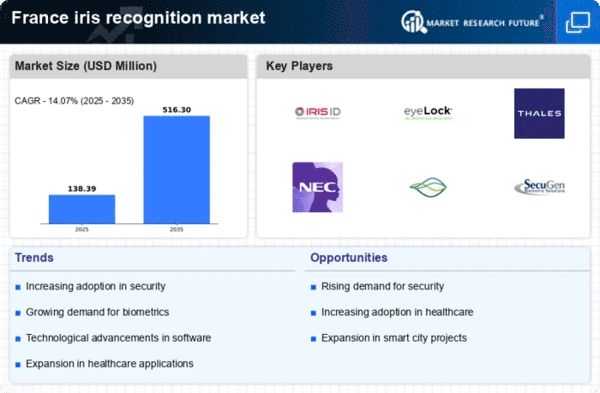
As per Market Research Future analysis, the France Iris Recognition Market size was estimated at 121.32 USD Million in 2024. The Iris Recognition market is projected to grow from 138.39 USD Million in 2025 to 516.3 USD Million by 2035, exhibiting a compound annual growth rate (CAGR) of 14.0% during the forecast period 2025 - 2035

Key Market Trends & Highlights

The France iris recognition market is experiencing robust growth driven by technological advancements and increasing security concerns.

  • The market is witnessing a rising demand for biometric security solutions, particularly in the healthcare and financial sectors.
  • Integration with smart devices is becoming a prominent trend, enhancing user convenience and accessibility.
  • Regulatory support for biometric technologies is fostering a favorable environment for market expansion, especially in urban areas.
  • Key market drivers include increasing security concerns and government initiatives that promote the adoption of iris recognition technologies.

Market Size & Forecast

2024 Market Size 121.32 (USD Million)
2035 Market Size 516.3 (USD Million)
CAGR (2025 - 2035) 14.07%

Major Players

Iris ID (KR), EyeLock (US), Gemalto (NL), NEC Corporation (JP), IrisGuard (GB), SecuGen (US), Crossmatch (US), Aware (US)

Our Impact
Enabled $4.3B Revenue Impact for Fortune 500 and Leading Multinationals
Partnering with 2000+ Global Organizations Each Year
30K+ Citations by Top-Tier Firms in the Industry

France Iris Recognition Market Trends

The market is experiencing notable growth, driven by advancements in biometric technology and increasing demand for secure identification methods. In France, the integration of iris recognition systems into various sectors, including security, healthcare, and banking, is becoming more prevalent. This trend is largely influenced by the need for enhanced security measures and the growing concerns regarding identity theft and fraud. As organizations seek to protect sensitive information, the adoption of iris recognition technology is likely to rise, offering a reliable solution for authentication and access control. Moreover, the regulatory landscape in France is evolving to accommodate the use of biometric data, which may further propel the France Iris Recognition Market. Government initiatives aimed at improving public safety and streamlining processes in various industries are expected to foster an environment conducive to the implementation of iris recognition systems. As these technologies become more accessible and affordable, their application across different sectors is anticipated to expand, potentially leading to increased competition among providers and innovation in the field. Overall, the future of the iris recognition market appears promising, with significant opportunities for growth and development in the coming years.

Rising Demand for Biometric Security Solutions

There is a surge in demand for biometric security solutions in the iris recognition market. Organizations across various sectors are increasingly adopting these technologies to enhance security protocols and protect sensitive data. This trend is particularly evident in sectors such as finance and healthcare, where safeguarding personal information is paramount.

Integration with Smart Devices

There is a growing trend towards the integration of iris recognition technology with smart devices. As consumers become more accustomed to biometric authentication, manufacturers are incorporating iris recognition features into smartphones and other personal devices. This integration is likely to drive consumer acceptance and expand the market.

Regulatory Support for Biometric Technologies

The regulatory environment in France is becoming more supportive of biometric technologies, including iris recognition. Government policies aimed at promoting security and efficiency are facilitating the adoption of these systems. This regulatory backing may encourage more organizations to invest in iris recognition solutions, further stimulating market growth.

France Iris Recognition Market Drivers

Rising Consumer Awareness

Consumer awareness regarding biometric security solutions is on the rise in France, contributing to the growth of the iris recognition market. As individuals become more informed about the benefits of biometric identification, including enhanced security and convenience, the demand for such technologies is expected to increase. In 2025, it is projected that consumer adoption of iris recognition systems will rise, particularly in sectors like retail and personal devices. This trend indicates a shift towards more secure and user-friendly identification methods, as consumers seek to protect their personal information. The growing awareness of privacy concerns and the need for secure transactions are likely to drive the iris recognition market forward, as businesses respond to consumer preferences for advanced security solutions.

Technological Advancements

Technological advancements play a pivotal role in shaping the iris recognition market in France. Innovations in imaging technology, artificial intelligence, and machine learning are enhancing the accuracy and efficiency of iris recognition systems. These advancements enable faster processing times and improved user experiences, making the technology more appealing to various industries. In 2025, the market is expected to benefit from the integration of advanced algorithms that can analyze iris patterns with unprecedented precision. This evolution not only boosts the performance of existing systems but also opens avenues for new applications in sectors such as law enforcement and border control. As technology continues to evolve, the iris recognition market is likely to witness increased adoption rates, driven by the demand for cutting-edge security solutions.

Increasing Security Concerns

The iris recognition market in France is experiencing growth driven by escalating security concerns across various sectors. Organizations are increasingly adopting biometric solutions to enhance security measures, particularly in sensitive areas such as banking, healthcare, and government facilities. The need for robust identification systems is underscored by rising incidents of identity theft and fraud. In 2025, the market is projected to reach approximately €300 million, reflecting a compound annual growth rate (CAGR) of around 15% over the next five years. This trend indicates a strong shift towards advanced biometric technologies, with iris recognition being at the forefront due to its accuracy and reliability. As security threats evolve, the demand for sophisticated identification methods is likely to intensify, further propelling the iris recognition market in France.

Growing Adoption in Healthcare

The healthcare sector in France is increasingly recognizing the potential of the iris recognition market for enhancing patient identification and data security. With the rise of electronic health records and the need for secure access to sensitive patient information, iris recognition systems offer a reliable solution. By 2025, it is anticipated that the healthcare segment will account for a substantial share of the iris recognition market, driven by the need for accurate patient identification and the prevention of medical fraud. The ability to quickly and accurately verify patient identities can lead to improved patient care and operational efficiency. As healthcare providers seek to implement more secure and efficient systems, the iris recognition market is poised for significant growth in this sector.

Government Initiatives and Funding

Government initiatives in France are significantly influencing the iris recognition market. The French government is actively promoting the adoption of biometric technologies to enhance national security and streamline public services. Funding programs aimed at research and development in biometric solutions are likely to bolster the market's growth. In 2025, it is expected that government contracts for iris recognition systems will increase, particularly in areas such as border control and law enforcement. This support not only provides financial backing but also encourages collaboration between public and private sectors, fostering innovation within the iris recognition market. As government policies evolve to embrace advanced security measures, the market is likely to expand in response to these initiatives.


Market Segment Insights

By Application: Identity Verification (Largest) vs. Time and Attendance (Fastest-Growing)

In the France iris recognition market, Identity Verification stands out as the largest segment, commanding a significant portion of the market share. This segment continues to dominate due to the increasing demand for secure identification solutions in various sectors, particularly in governmental and corporate environments. Time and Attendance, while smaller in share, is rapidly gaining traction as organizations prioritize efficient attendance monitoring and workplace security, propelling this segment to the forefront of growth. Growth trends indicate a robust expansion in the Time and Attendance segment, driven by advancements in technology and the need for more reliable attendance tracking mechanisms. The adoption of iris recognition for personnel management is being fueled by rising security concerns and regulatory requirements, reflecting a broader trend towards automation and enhanced employee monitoring solutions. As businesses seek to streamline operations and enhance security levels, this segment is poised for substantial development in the coming years.

Identity Verification: Dominant vs. Time and Attendance: Emerging

Identity Verification is recognized as the dominant segment in the France iris recognition market, primarily due to its extensive application in security-sensitive areas such as banking, government services, and border control. This segment leverages advanced biometric technology to provide a seamless and secure identification process, ensuring enhanced verification protocols. Conversely, the Time and Attendance segment is emerging rapidly as organizations increasingly adopt biometric solutions to improve workplace efficiency and reduce attendance fraud. This segment is characterized by its adaptability to various organizational needs and its ability to integrate with existing HR systems, making it attractive for businesses aiming to enhance operational efficiency.

By End Use: Government (Largest) vs. BFSI (Fastest-Growing)

In the France iris recognition market, the distribution of market share among the various end-use segments reveals a significant dominance of the government sector, which heavily relies on biometric verification for security and identity management. This segment is followed by BFSI, retail, healthcare facilities, and education, each playing a crucial role in the adoption of iris recognition technology. The retail and healthcare sectors, while smaller, are rapidly increasing their utilization of biometric systems to enhance customer experience and improve patient security. Growth trends in the France iris recognition market are driven by the increasing need for enhanced security measures across multiple sectors. The government sector, representing the largest share, continues to invest in advanced iris recognition systems to prevent fraud and ensure accurate identification. Meanwhile, the BFSI sector emerges as the fastest-growing segment with its focus on secure transactions and customer onboarding processes, thus catalyzing innovation and technological advancements in biometric solutions.

Government (Dominant) vs. BFSI (Emerging)

The government segment stands out as the dominant force in the France iris recognition market due to its extensive application in national security, border control, and access management. This sector's longstanding commitment to implementing cutting-edge biometric technologies positions it as a leader in market share. In contrast, the BFSI segment, though emerging, is witnessing rapid growth fueled by the increasing emphasis on secure banking transactions and identity verification. Financial institutions are adopting iris recognition for improving customer onboarding and reducing fraudulent activities, thus driving significant investment in innovative biometric solutions. As these two segments evolve, their unique characteristics and growth trajectories are shaping the landscape of the iris recognition market.

By Technology: Hardware-based Iris Recognition (Largest) vs. Mobile Iris Recognition (Fastest-Growing)

In the France iris recognition market, Hardware-based Iris Recognition currently holds the largest share, reflecting its established presence in security applications. Software-based Iris Recognition, while significant, is positioned slightly behind, with its applications expanding in various industries. Mobile Iris Recognition is gaining traction rapidly due to the increasing adoption of mobile devices integrated with biometric security features, which enhances user convenience and accessibility. Growth trends indicate that Mobile Iris Recognition is the fastest-growing segment, driven by the rising demand for secure and easy-to-use authentication methods in consumer electronics. The ongoing advancements in technology, such as improved software algorithms and cost-effective hardware solutions, are supporting the growth of both Hardware and Software-based Iris Recognition, contributing to a competitive landscape within the market.

Technology: Hardware-based Iris Recognition (Dominant) vs. Mobile Iris Recognition (Emerging)

Hardware-based Iris Recognition is recognized as the dominant segment within the France iris recognition market, serving critical roles in high-security environments such as airports and government facilities. Its robust architecture offers a high level of accuracy and reliability, which is paramount in identity verification. Conversely, Mobile Iris Recognition represents an emerging trend that capitalizes on the proliferation of smartphones and tablets equipped with advanced biometric systems. This segment is characterized by its ease of deployment and user-friendly interfaces, appealing to a wide range of applications from personal security to access control in various sectors. This juxtaposition highlights the contrasting yet complementary nature of these two segments.

By Component: Cameras (Largest) vs. Software (Fastest-Growing)

In the France iris recognition market, the distribution of market share among component segments shows that Cameras take a leading position due to their critical role in capturing high-quality iris images. This segment is followed by Processors, which provide the necessary computational power, while Software holds a significant share due to the demand for advanced algorithms in recognition processes. Illuminators, though essential for enhancing image clarity, contribute a smaller portion to the overall market share. Growth trends in this segment reveal a sharp uptrend in Software solutions, which are becoming increasingly sophisticated, making it the fastest-growing component as organizations seek improved accuracy and efficiency in iris recognition. The rise in demand for biometric solutions across various sectors, including security and access control, drives innovation and adoption of Cameras and Processors, ensuring sustained growth in the market.

Cameras (Dominant) vs. Software (Emerging)

Cameras are the dominant component in the France iris recognition market, as they are vital for capturing the intricate details necessary for accurate identification. Advanced sensor technology and improved image processing capabilities enhance their effectiveness, thus maintaining their leading position. In contrast, Software is emerging rapidly, driven by the ongoing advancements in artificial intelligence and machine learning, which are significantly enhancing iris recognition accuracy and speed. As organizations embrace biometric technologies, the demand for innovative Software solutions grows, positioning it as a crucial player in the market's future, potentially overshadowing traditional dominance by Cameras.

Get more detailed insights about France Iris Recognition Market

Key Players and Competitive Insights

The iris recognition market in France is characterized by a dynamic competitive landscape, driven by technological advancements and increasing demand for secure identification solutions. Key players such as Iris ID (Korea), EyeLock (US), and NEC Corporation (Japan) are actively shaping the market through strategic initiatives. Iris ID (Korea) focuses on innovation in biometric technology, emphasizing the development of high-accuracy recognition systems. Meanwhile, EyeLock (US) has positioned itself as a leader in the integration of iris recognition with IoT devices, enhancing user accessibility and security. NEC Corporation (Japan) is leveraging its extensive experience in biometric solutions to expand its market presence, particularly in government and enterprise sectors, thereby influencing the competitive dynamics significantly.The business tactics employed by these companies reflect a trend towards localization and supply chain optimization. The market appears moderately fragmented, with several players vying for market share. However, the collective influence of major companies is notable, as they engage in partnerships and collaborations to enhance their technological capabilities and market reach. This competitive structure fosters an environment where innovation is paramount, and companies are incentivized to differentiate their offerings.

In October IrisGuard (GB) announced a strategic partnership with a leading European bank to implement iris recognition technology for secure banking transactions. This collaboration is expected to enhance customer security and streamline the authentication process, indicating a growing trend towards biometric solutions in the financial sector. The strategic importance of this partnership lies in its potential to set a new standard for security in banking, thereby positioning IrisGuard as a frontrunner in the financial services market.

In September SecuGen (US) launched a new line of iris recognition devices designed for mobile applications. This move reflects a strategic pivot towards catering to the increasing demand for mobile biometric solutions, particularly in sectors such as healthcare and law enforcement. The introduction of these devices is likely to enhance SecuGen's competitive edge by addressing the evolving needs of users who require portable and efficient identification methods.

In August Crossmatch (US) expanded its operations in France by establishing a local manufacturing facility. This strategic decision aims to reduce lead times and enhance supply chain efficiency, allowing Crossmatch to respond more swiftly to market demands. The establishment of local manufacturing capabilities is indicative of a broader trend towards regional production, which may enhance competitiveness by lowering costs and improving service delivery.

As of November the iris recognition market is witnessing trends such as digitalization, AI integration, and a growing emphasis on sustainability. Strategic alliances among key players are increasingly shaping the competitive landscape, fostering innovation and collaboration. The shift from price-based competition to a focus on technological advancement and supply chain reliability is evident. Companies are likely to differentiate themselves through innovative solutions that address emerging security challenges, thereby redefining competitive dynamics in the market.

Key Companies in the France Iris Recognition Market include

Industry Developments

Recent developments in the France Iris Recognition Market indicate a burgeoning interest in biometric security technologies. The market is witnessing a significant uptick in the adoption of iris recognition solutions across various sectors, including financial services and law enforcement, driven by increasing security concerns.

Key players like IDEMIA and Gemalto are expanding their presence in France, with ongoing collaborations with governmental agencies to enhance national security measures. As of July 2023, Accelica announced a partnership with Thales Group to develop advanced iris recognition systems that utilize artificial intelligence, aiming to improve identification accuracy across crowded environments.

Additionally, in August 2023, Iris ID launched a new product line specifically designed for access control in corporate environments, further showcasing innovation in this space. The market has seen notable growth, with a valuation increase attributed to the heightened demand for secure identification solutions, particularly in light of recent EU regulations mandating stronger identity verification processes. Mergers and acquisitions remain minimal, but the competitive landscape is evolving, with companies such as Microsoft and NEC Corporation actively exploring strategic alliances to enhance their biometric offering within France's regulatory framework.

Future Outlook

France Iris Recognition Market Future Outlook

The iris recognition market is projected to grow at 14.07% CAGR from 2025 to 2035, driven by advancements in biometric technology and increasing security demands.

New opportunities lie in:

  • Integration of iris recognition in mobile payment systems
  • Development of customized iris recognition solutions for healthcare
  • Expansion of iris recognition applications in smart city infrastructure

By 2035, the iris recognition market is expected to achieve substantial growth and innovation.

Market Segmentation

France Iris Recognition Market End Use Outlook

  • Government
  • BFSI
  • Retail
  • Healthcare Facilities
  • Education

France Iris Recognition Market Component Outlook

  • Cameras
  • Processors
  • Software
  • Illuminators

France Iris Recognition Market Technology Outlook

  • Hardware-based Iris Recognition
  • Software-based Iris Recognition
  • Mobile Iris Recognition
  • Cloud-based Iris Recognition

France Iris Recognition Market Application Outlook

  • Identity Verification
  • Time and Attendance
  • Access Control
  • Financial Services
  • Healthcare

Report Scope

MARKET SIZE 2024 121.32(USD Million)
MARKET SIZE 2025 138.39(USD Million)
MARKET SIZE 2035 516.3(USD Million)
COMPOUND ANNUAL GROWTH RATE (CAGR) 14.07% (2025 - 2035)
REPORT COVERAGE Revenue Forecast, Competitive Landscape, Growth Factors, and Trends
BASE YEAR 2024
Market Forecast Period 2025 - 2035
Historical Data 2019 - 2024
Market Forecast Units USD Million
Key Companies Profiled Iris ID (KR), EyeLock (US), Gemalto (NL), NEC Corporation (JP), IrisGuard (GB), SecuGen (US), Crossmatch (US), Aware (US)
Segments Covered Application, End Use, Technology, Component
Key Market Opportunities Integration of iris recognition technology in security systems enhances user authentication and access control.
Key Market Dynamics Rising demand for secure biometric solutions drives innovation and competition in the iris recognition market.
Countries Covered France
Leave a Comment

FAQs

What is the expected market size of the France Iris Recognition Market in 2024?

The France Iris Recognition Market is expected to be valued at 204.04 million USD in 2024.

What will be the market value of the France Iris Recognition Market by 2035?

By 2035, the market is anticipated to reach a value of 634.04 million USD.

What is the expected CAGR for the France Iris Recognition Market from 2025 to 2035?

The expected CAGR for the France Iris Recognition Market from 2025 to 2035 is 10.857%.

Which application segment is projected to have the highest market share in 2035?

The Access Control application segment is projected to have a market share of 160.0 million USD by 2035.

What is the projected market value for Identity Verification in 2024?

The market value for the Identity Verification segment is estimated to be 45.0 million USD in 2024.

Who are the key players in the France Iris Recognition Market?

Key players in the market include Euclyde, Iris ID, HID Global, and IDEMIA among others.

How much is the Time and Attendance application expected to be worth in 2035?

The Time and Attendance application is projected to be worth 130.0 million USD in 2035.

What is the estimated market value for Financial Services in 2024?

The Financial Services application is expected to have a market value of 30.0 million USD in 2024.

What is driving the growth of the France Iris Recognition Market?

Growth drivers include increased demand for secure identity verification and advancements in biometric technology.

What is the projected market value for Healthcare in 2035?

The Healthcare application is projected to reach a market value of 104.04 million USD by 2035.

Download Free Sample

Kindly complete the form below to receive a free sample of this Report

Compare Licence

×
Features License Type
Single User Multiuser License Enterprise User
Price $4,950 $5,950 $7,250
Maximum User Access Limit 1 User Upto 10 Users Unrestricted Access Throughout the Organization
Free Customization
Direct Access to Analyst
Deliverable Format
Platform Access
Discount on Next Purchase 10% 15% 15%
Printable Versions