×
Request Free Sample ×

Kindly complete the form below to receive a free sample of this Report

* Please use a valid business email

Leading companies partner with us for data-driven Insights

clients tt-cursor
Hero Background

China Iris Recognition Market

ID: MRFR/ICT/58714-HCR
200 Pages
Aarti Dhapte
February 2026

China Iris Recognition Market Research Report By Application (Identity Verification, Time and Attendance, Access Control, Financial Services, Healthcare), By End Use (Government, BFSI, Retail, Healthcare Facilities, Education), By Technology (Hardware-based Iris Recognition, Software-based Iris Recognition, Mobile Iris Recognition, Cloud-based Iris Recognition) and By Component (Cameras, Processors, Software, Illuminators)-Forecast to 2035

Share:
Download PDF ×

We do not share your information with anyone. However, we may send you emails based on your report interest from time to time. You may contact us at any time to opt-out.

China Iris Recognition Market Infographic
Purchase Options

China Iris Recognition Market Summary

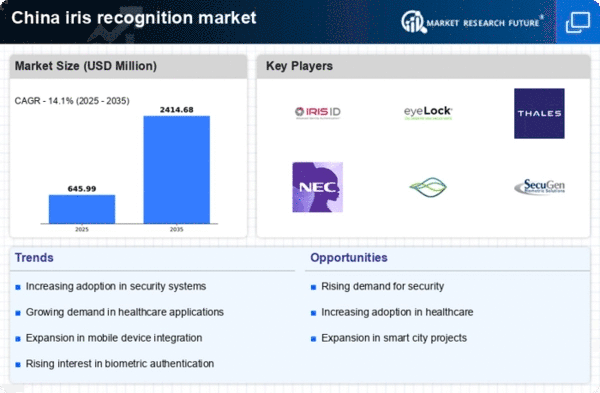
As per Market Research Future analysis, the China iris recognition market Size was estimated at 566.16 USD Million in 2024. The China iris recognition market is projected to grow from 645.99 USD Million in 2025 to 2414.68 USD Million by 2035, exhibiting a compound annual growth rate (CAGR) of 14% during the forecast period 2025 - 2035

Key Market Trends & Highlights

The China iris recognition market is poised for substantial growth driven by technological advancements and increasing security concerns.

  • Technological advancements in image processing are enhancing the accuracy and efficiency of iris recognition systems.
  • The largest segment in the market is the government sector, which is increasingly adopting biometric solutions for security purposes.
  • The fastest-growing segment is the consumer electronics sector, driven by the integration of iris recognition in smart devices.
  • Key market drivers include the rising demand for biometric security solutions and government initiatives supporting the adoption of advanced technologies.

Market Size & Forecast

2024 Market Size 566.16 (USD Million)
2035 Market Size 2414.68 (USD Million)
CAGR (2025 - 2035) 14.1%

Major Players

Iris ID (KR), EyeLock (US), Gemalto (NL), NEC Corporation (JP), IrisGuard (GB), SecuGen (US), Crossmatch (US), SRI International (US)

Our Impact
Enabled $4.3B Revenue Impact for Fortune 500 and Leading Multinationals
Partnering with 2000+ Global Organizations Each Year
30K+ Citations by Top-Tier Firms in the Industry

China Iris Recognition Market Trends

The iris recognition market is experiencing notable growth, driven by advancements in biometric technology and increasing demand for secure identification methods. In recent years, the emphasis on security has intensified, leading to a surge in the adoption of iris recognition systems across various sectors, including finance, healthcare, and public safety. The technology offers a high level of accuracy and reliability, making it an attractive option for organizations seeking to enhance their security protocols. Furthermore, the integration of artificial intelligence and machine learning into iris recognition systems is expected to improve performance and user experience, thereby expanding its applications. In addition, the regulatory environment in China is evolving to support the implementation of biometric technologies. Government initiatives aimed at enhancing national security and streamlining identification processes are likely to further propel the growth of the iris recognition market. As organizations increasingly recognize the benefits of iris recognition, the market is poised for continued expansion, with innovations and improvements in technology playing a crucial role in shaping its future. The increasing focus on privacy and data protection will also influence the development of this market, as stakeholders seek to balance security needs with ethical considerations.

Technological Advancements

Recent innovations in iris recognition technology are enhancing accuracy and speed, making systems more efficient. The integration of AI and machine learning is particularly noteworthy, as it allows for real-time processing and improved user experience. These advancements are likely to attract more sectors to adopt iris recognition solutions.

Regulatory Support

The regulatory landscape in China is becoming more favorable for biometric technologies. Government initiatives aimed at improving security and identification processes are expected to drive the adoption of iris recognition systems. This support may lead to increased investment and development in the market.

Growing Security Concerns

As security threats evolve, organizations are increasingly seeking robust identification methods. The iris recognition market is positioned to benefit from this trend, as it offers a high level of accuracy and reliability. The demand for secure access control in various sectors is likely to fuel market growth.

China Iris Recognition Market Drivers

Integration with Smart Devices

The integration of iris recognition technology with smart devices is emerging as a significant driver for the iris recognition market in China. As the Internet of Things (IoT) continues to expand, the demand for seamless and secure user authentication methods is increasing. Smart devices, including smartphones and tablets, are increasingly incorporating iris recognition features to enhance user experience and security. This trend is expected to propel the market forward, as consumers become more aware of the advantages of biometric authentication. The iris recognition market is likely to see a substantial increase in adoption rates, particularly among tech-savvy consumers who prioritize convenience and security. Furthermore, the potential for integration with other biometric modalities, such as facial recognition, may further enhance the appeal of iris recognition technology in the consumer electronics sector.

Government Initiatives and Investments

Government initiatives and investments in biometric technologies are playing a crucial role in shaping the iris recognition market in China. The Chinese government has been actively promoting the adoption of advanced security measures across various sectors, including public safety and border control. Significant funding has been allocated to develop and implement iris recognition systems in critical infrastructure, which is expected to drive market growth. The iris recognition market is likely to benefit from these initiatives, as they not only enhance national security but also foster public trust in biometric technologies. Additionally, the government's focus on digital transformation and smart city initiatives may further accelerate the deployment of iris recognition systems in urban environments, creating new opportunities for market players.

Advancements in Image Processing Technologies

Advancements in image processing technologies are significantly influencing the iris recognition market in China. The development of sophisticated algorithms and machine learning techniques has improved the accuracy and speed of iris recognition systems, making them more appealing to various industries. Enhanced image processing capabilities allow for better recognition rates even in challenging conditions, such as low light or motion. This technological evolution is likely to drive the adoption of iris recognition solutions in sectors such as security, banking, and access control. The iris recognition market stands to benefit from these advancements, as organizations increasingly seek reliable and efficient biometric solutions to meet their security needs. As technology continues to evolve, the potential for further innovations in iris recognition systems may open new avenues for growth and application.

Rising Awareness of Privacy and Data Security

As concerns regarding privacy and data security continue to rise, the iris recognition market in China is witnessing a shift in consumer attitudes towards biometric technologies. Individuals are becoming increasingly aware of the importance of safeguarding their personal information, leading to a greater acceptance of iris recognition as a secure identification method. This growing awareness is likely to drive demand for iris recognition solutions across various sectors, including finance and healthcare, where data protection is paramount. The iris recognition market is thus positioned to capitalize on this trend, as organizations seek to implement robust security measures that align with consumer expectations. Furthermore, the potential for iris recognition technology to provide a non-intrusive and efficient means of identification may further enhance its appeal in a privacy-conscious society.

Increasing Demand for Biometric Security Solutions

The iris recognition market in China is experiencing a notable surge in demand for biometric security solutions. This trend is largely driven by the increasing need for secure identification methods across various sectors, including banking, healthcare, and government. As organizations seek to enhance their security protocols, the adoption of iris recognition technology is becoming more prevalent. According to recent estimates, the market is projected to grow at a CAGR of approximately 20% over the next five years. This growth is indicative of a broader shift towards advanced biometric systems, which are perceived as more reliable and efficient compared to traditional methods. The iris recognition market is thus positioned to benefit from this heightened focus on security, as businesses and institutions prioritize the protection of sensitive information and assets.


Market Segment Insights

By Application: Identity Verification (Largest) vs. Healthcare (Fastest-Growing)

In the China iris recognition market, Identity Verification holds the largest share among various applications, dominating the sector with its widespread adoption in security and authentication processes. Following closely is Time and Attendance and Access Control, which are also significant contributors, reflecting an increasing inclination towards biometric systems in the business environment. Financial Services also showcase a notable market presence as organizations seek to enhance transactional security. The growth trends within this segment are markedly driven by advancements in technology along with rising security concerns. The healthcare sector, being the fastest-growing, encapsulates the increasing integration of iris recognition for patient verification, thereby improving operational efficiency and safeguarding patient data. Moreover, continuous investments in biometric technologies contribute to expanding applications across various fields, further fuelling market growth.

Identity Verification (Dominant) vs. Healthcare (Emerging)

Identity Verification is the dominant application in the market, leveraging iris recognition technology to streamline identification processes across various sectors. This application not only enhances security protocols but also facilitates a more user-friendly experience for consumers, making it a preferred choice for firms demanding robust authentication methods. In contrast, Healthcare stands as an emerging segment, rapidly adopting iris recognition for patient ID management. With the escalating need for secure and efficient patient interactions, the healthcare sector is swiftly recognizing the benefits of iris biometrics. Both segments underline a significant shift towards innovative security solutions, emphasizing the role of biometric authentication in today’s digital landscape.

By End Use: Government (Largest) vs. BFSI (Fastest-Growing)

In the China iris recognition market, the Government segment holds the largest market share, driven by increasing security demands and a push for more advanced biometric solutions. This segment is highly utilized in various governmental functions, including border control and law enforcement, making it a critical area of focus for technology adoption. On the other hand, the BFSI segment is the fastest-growing area within the market, fueled by the rising need for secure customer authentication and fraud prevention measures. Banks and financial institutions are increasingly integrating iris recognition technologies to enhance security while providing seamless user experiences, propelling exponential growth in this sector.

Government: Dominant vs. BFSI: Emerging

The Government sector is characterized by significant investments in biometric technologies aimed at improving security and efficiency. With applications ranging from identification at borders to secure access to governmental databases, it represents the most established segment in the China iris recognition market. In contrast, the BFSI sector is emerging rapidly, encouraged by advancements in technology and increasing consumer awareness of security issues. This segment is gaining traction as financial institutions seek sophisticated solutions to combat identity theft and improve customer onboarding processes, highlighting its potential for future growth.

By Technology: Hardware-based Iris Recognition (Largest) vs. Software-based Iris Recognition (Fastest-Growing)

The China iris recognition market exhibits a diverse landscape, with Hardware-based Iris Recognition leading in market share due to its widespread application in security and access control systems. This segment benefits from established technologies and a solid customer base, driving its dominance. In contrast, Software-based Iris Recognition is gaining momentum, appealing to users seeking flexible and cost-effective solutions, thus accounting for a significant portion of the market share. Growth trends indicate a rapid increase in the adoption of Software-based Iris Recognition as companies prioritize integrated solutions that can be easily scaled. The rise of mobile and cloud technologies further propels this segment, enabling secure and efficient iris recognition applications. As organizations invest in biometrics for enhanced security, the push towards digitization in the China iris recognition market positions software solutions as pivotal drivers of growth.

Iris Recognition Technology: Hardware-based (Dominant) vs. Software-based (Emerging)

The Hardware-based Iris Recognition segment remains the dominating force in the China iris recognition market, favored for its robustness and reliability in physical security applications. This technology is often utilized in critical areas like border control and high-security access points, benefiting from the established credibility of hardware solutions. On the other hand, the Software-based Iris Recognition segment emerges as a versatile and rapidly evolving player, driven by the demand for integration into various platforms including mobile devices and cloud applications. This segment is characterized by its flexibility and the ability to offer cost-effective solutions, making it appealing to businesses looking for scalable and efficient biometric identification methods. Together, these segments highlight the dual approach of hardware strength and software adaptability within the market.

By Component: Cameras (Largest) vs. Processors (Fastest-Growing)

In the China iris recognition market, the distribution of market share among components reveals that Cameras hold the largest share, driven by their crucial role in capturing high-quality images for accurate identification. This segment's dominance is attributed to advancements in imaging technology and integration with various systems. Following closely are Processors, which, while not the largest, are recognized as the fastest-growing segment. Their importance in handling data processing and enhancing the performance of iris recognition systems cannot be overstated. The growth trends in this segment are fueled by the rapid development of artificial intelligence and machine learning technologies that enhance the efficiency and accuracy of iris recognition systems. Increasing demand for security solutions in various sectors, including banking and healthcare, is further propelling investments in software and illuminators, which are also essential components in the overall landscape. As businesses seek more reliable and sophisticated security measures, the push for innovative component technologies is expected to continue.

Cameras: Dominant vs. Processors: Emerging

Cameras are the dominant force in the component segment, offering unparalleled image quality and reliability necessary for effective iris recognition. Their integration into various security systems has been seamless, leading to widespread adoption across industries. In contrast, Processors, while currently in an emerging phase, are experiencing rapid development due to the need for faster data processing capabilities. Their role in managing and interpreting the captured data from Cameras is critical, driving innovations that enable quicker identification processes. As technology progresses, both segments are set to evolve, but Cameras will likely maintain their lead until the advancements in Processors reach a more mature stage.

Get more detailed insights about China Iris Recognition Market

Key Players and Competitive Insights

The iris recognition market is currently characterized by a dynamic competitive landscape, driven by technological advancements and increasing demand for secure biometric solutions. Key players such as Iris ID (Korea), EyeLock (US), and NEC Corporation (Japan) are strategically positioning themselves through innovation and regional expansion. For instance, Iris ID (Korea) focuses on enhancing its product offerings with advanced algorithms, while NEC Corporation (Japan) emphasizes partnerships with local governments to integrate iris recognition systems into public safety initiatives. These strategies collectively shape a competitive environment that is increasingly focused on technological differentiation and market penetration.In terms of business tactics, companies are localizing manufacturing and optimizing supply chains to enhance operational efficiency. The market appears moderately fragmented, with several players vying for market share. However, the influence of major companies is significant, as they leverage their technological expertise and established networks to create barriers for new entrants. This competitive structure fosters an environment where innovation and strategic partnerships are crucial for success.

In October EyeLock (US) announced a collaboration with a leading technology firm to develop a new iris recognition platform aimed at enhancing security in mobile devices. This strategic move is likely to position EyeLock at the forefront of biometric technology, catering to the growing demand for secure authentication methods in consumer electronics. The partnership underscores the importance of integrating iris recognition into everyday technology, potentially expanding EyeLock's market reach.

In September NEC Corporation (Japan) launched a new iris recognition solution tailored for the financial sector, designed to streamline customer onboarding processes. This initiative reflects NEC's commitment to addressing specific industry needs and enhancing user experience. By targeting the financial sector, NEC aims to capitalize on the increasing demand for secure and efficient identity verification solutions, thereby strengthening its competitive position.

In August IrisGuard (UK) secured a contract with a government agency to implement its iris recognition technology for border control. This development highlights the growing reliance on biometric solutions for national security and immigration management. By successfully deploying its technology in such critical applications, IrisGuard is likely to enhance its reputation and market presence, further solidifying its role in the iris recognition landscape.

As of November current trends in the iris recognition market include a strong emphasis on digitalization, AI integration, and sustainability. Strategic alliances are increasingly shaping the competitive landscape, as companies recognize the value of collaboration in driving innovation. Looking ahead, competitive differentiation is expected to evolve, with a shift from price-based competition to a focus on technological advancements and supply chain reliability. This transition may redefine market dynamics, compelling companies to invest in R&D and forge strategic partnerships to maintain a competitive edge.

Key Companies in the China Iris Recognition Market include

Industry Developments

The China Iris Recognition Market is experiencing significant growth driven by advancements in technology and increasing demand for security solutions. Tsinghua Tongfang and Dahua Technology continue to innovate in the field, enhancing their iris recognition systems for various applications, including public safety and banking. In July 2023, Gemalto announced a collaboration with NEC Corporation to develop integrated solutions that leverage iris recognition technology for secure identity verification.

Aware and Sensory are expanding their presence, focusing on integrating AI capabilities with iris recognition, thereby improving accuracy and user experience. In terms of mergers and acquisitions, in June 2023, 3M acquired a minor stake in Iris ID, enhancing its biometric business presence in China.

Hikvision, known for its surveillance technology, reported substantial growth, capitalizing on rising government investments in smart city initiatives. Furthermore, the rapid adoption of iris recognition in various sectors indicates a strengthening market position, influenced by the robust support from the Chinese government’s push towards digital transformation. With companies like Zhejiang Dahua Technology and IDEMIA leading the way, the sector is rapidly evolving, marking a crucial period for the iris recognition technology landscape in China.

Future Outlook

China Iris Recognition Market Future Outlook

The iris recognition market is projected to grow at 14.1% CAGR from 2025 to 2035, driven by advancements in biometric technology, increasing security concerns, and government initiatives.

New opportunities lie in:

  • Integration of iris recognition in mobile payment systems
  • Development of customized biometric security solutions for enterprises
  • Expansion of iris recognition applications in healthcare access control

By 2035, the iris recognition market is expected to achieve substantial growth and widespread adoption.

Market Segmentation

China Iris Recognition Market End Use Outlook

  • Government
  • BFSI
  • Retail
  • Healthcare Facilities
  • Education

China Iris Recognition Market Component Outlook

  • Cameras
  • Processors
  • Software
  • Illuminators

China Iris Recognition Market Technology Outlook

  • Hardware-based Iris Recognition
  • Software-based Iris Recognition
  • Mobile Iris Recognition
  • Cloud-based Iris Recognition

China Iris Recognition Market Application Outlook

  • Identity Verification
  • Time and Attendance
  • Access Control
  • Financial Services
  • Healthcare

Report Scope

MARKET SIZE 2024 566.16(USD Million)
MARKET SIZE 2025 645.99(USD Million)
MARKET SIZE 2035 2414.68(USD Million)
COMPOUND ANNUAL GROWTH RATE (CAGR) 14.1% (2025 - 2035)
REPORT COVERAGE Revenue Forecast, Competitive Landscape, Growth Factors, and Trends
BASE YEAR 2024
Market Forecast Period 2025 - 2035
Historical Data 2019 - 2024
Market Forecast Units USD Million
Key Companies Profiled Iris ID (KR), EyeLock (US), Gemalto (NL), NEC Corporation (JP), IrisGuard (GB), SecuGen (US), Crossmatch (US), SRI International (US)
Segments Covered Application, End Use, Technology, Component
Key Market Opportunities Integration of iris recognition in mobile devices enhances security and user experience.
Key Market Dynamics Rising demand for secure biometric solutions drives innovation and competition in the iris recognition market.
Countries Covered China
Leave a Comment

FAQs

What is the expected market size of the China Iris Recognition Market in 2024?

The China Iris Recognition Market is expected to be valued at 1.09 billion USD in 2024.

What will the market size be for the China Iris Recognition Market by 2035?

By 2035, the China Iris Recognition Market is projected to reach approximately 3.85 billion USD.

What is the expected compound annual growth rate (CAGR) for the China Iris Recognition Market from 2025 to 2035?

The expected CAGR for the China Iris Recognition Market from 2025 to 2035 is 12.157 percent.

Which application holds the largest market share in 2024 and what is its value?

The Identity Verification application holds the largest market share in 2024, valued at 0.4 billion USD.

What is the expected market value for the Access Control application in 2035?

The Access Control application is expected to be valued at 0.74 billion USD by 2035.

Who are the key players in the China Iris Recognition Market?

Key players in the market include Tsinghua Tongfang, Gemalto, Dahua Technology, and NEC Corporation.

What market value does the Time and Attendance application have in 2024?

The Time and Attendance application is valued at 0.25 billion USD in 2024.

What market size can be expected for Financial Services application by 2035?

The Financial Services application is expected to reach approximately 0.51 billion USD by 2035.

What is the projected market value for the Healthcare application in 2035?

The Healthcare application is anticipated to be valued at 0.24 billion USD in 2035.

What are the growth drivers for the China Iris Recognition Market?

Growth drivers include increasing demand for secure identity verification and advancements in iris recognition technology.

Download Free Sample

Kindly complete the form below to receive a free sample of this Report

Compare Licence

×
Features License Type
Single User Multiuser License Enterprise User
Price $4,950 $5,950 $7,250
Maximum User Access Limit 1 User Upto 10 Users Unrestricted Access Throughout the Organization
Free Customization
Direct Access to Analyst
Deliverable Format
Platform Access
Discount on Next Purchase 10% 15% 15%
Printable Versions