×
Request Free Sample ×

Kindly complete the form below to receive a free sample of this Report

* Please use a valid business email

Leading companies partner with us for data-driven Insights

clients tt-cursor
Hero Background

Canada Iris Recognition Market

ID: MRFR/ICT/58712-HCR
200 Pages
Aarti Dhapte
February 2026

Canada Iris Recognition Market Size, Share and Trends Analysis Report By Application (Identity Verification, Time and Attendance, Access Control, Financial Services, Healthcare), By End Use (Government, BFSI, Retail, Healthcare Facilities, Education), By Technology (Hardware-based Iris Recognition, Software-based Iris Recognition, Mobile Iris Recognition, Cloud-based Iris Recognition) and By Component (Cameras, Processors, Software, Illuminators)-Forecast to 2035

Share:
Download PDF ×

We do not share your information with anyone. However, we may send you emails based on your report interest from time to time. You may contact us at any time to opt-out.

Canada Iris Recognition Market Infographic
Purchase Options

Canada Iris Recognition Market Summary

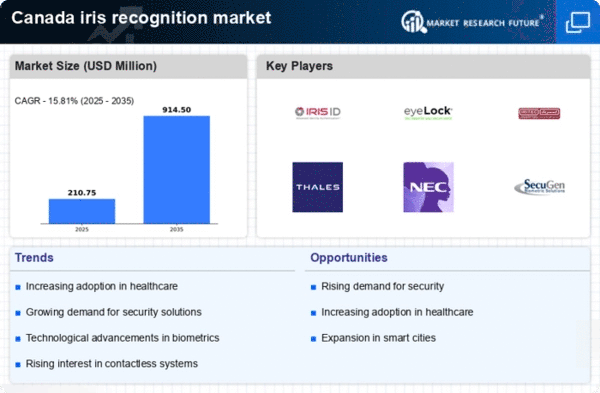
As per Market Research Future analysis, the Canada iris recognition market Size was estimated at 181.98 USD Million in 2024. The Canada iris recognition market is projected to grow from 210.75 USD Million in 2025 to 914.5 USD Million by 2035, exhibiting a compound annual growth rate (CAGR) of 15.8% during the forecast period 2025 - 2035

Key Market Trends & Highlights

The Canada iris recognition market is poised for substantial growth driven by technological advancements and increasing security demands.

  • The largest segment in the Canada iris recognition market is the security applications sector, which is experiencing heightened adoption rates.
  • Mobile technology integration is emerging as a key trend, facilitating the use of iris recognition in various smart devices.
  • Privacy and data protection concerns are shaping consumer preferences, leading to a more cautious approach in biometric implementations.
  • Rising demand for biometric security solutions and government initiatives are significant drivers propelling market expansion.

Market Size & Forecast

2024 Market Size 181.98 (USD Million)
2035 Market Size 914.5 (USD Million)
CAGR (2025 - 2035) 15.81%

Major Players

Iris ID (KR), EyeLock (US), IriTech (KR), Gemalto (NL), NEC Corporation (JP), SecuGen (US), Cognitec Systems (DE), SRI International (US)

Our Impact
Enabled $4.3B Revenue Impact for Fortune 500 and Leading Multinationals
Partnering with 2000+ Global Organizations Each Year
30K+ Citations by Top-Tier Firms in the Industry

Canada Iris Recognition Market Trends

The iris recognition market is experiencing notable growth, driven by advancements in biometric technology and increasing demand for secure identification methods. In Canada, the adoption of iris recognition systems is becoming more prevalent across various sectors, including government, healthcare, and financial services. This trend is largely attributed to the need for enhanced security measures and the ability to streamline processes. As organizations seek to protect sensitive information and improve user experience, iris recognition technology offers a reliable solution that minimizes the risk of identity fraud. Moreover, the regulatory landscape in Canada is evolving to support the integration of biometric systems. Government initiatives aimed at promoting digital identity verification are likely to bolster the adoption of iris recognition solutions. The emphasis on privacy and data protection is also shaping the market, as consumers become more aware of their rights regarding personal information. Consequently, companies are investing in developing robust systems that comply with regulations while providing efficient and user-friendly experiences. Overall, the iris recognition market is poised for continued expansion, reflecting the growing importance of biometric solutions in various applications.

Increased Adoption in Security Applications

The iris recognition market is witnessing a surge in adoption within security applications. Organizations are increasingly implementing biometric systems to enhance access control and identity verification processes. This trend is particularly evident in sectors such as government and finance, where safeguarding sensitive data is paramount. The reliability and accuracy of iris recognition technology make it an attractive option for institutions aiming to bolster their security measures.

Integration with Mobile Technology

There is a noticeable trend towards integrating iris recognition technology with mobile devices. As smartphones and tablets become ubiquitous, manufacturers are exploring ways to incorporate biometric authentication features. This integration not only enhances user convenience but also addresses security concerns associated with mobile transactions. The iris recognition market is likely to benefit from this convergence, as consumers seek more secure methods for accessing their devices and applications.

Focus on Privacy and Data Protection

The iris recognition market is increasingly influenced by a heightened focus on privacy and data protection. As consumers become more aware of their rights regarding personal information, companies are prioritizing compliance with regulations. This trend is prompting the development of iris recognition systems that emphasize user consent and data security. Organizations are investing in technologies that ensure the ethical use of biometric data, thereby fostering trust among users.

Canada Iris Recognition Market Drivers

Government Initiatives and Regulations

Government initiatives and regulations are playing a crucial role in shaping the iris recognition market in Canada. The Canadian government has been actively promoting the use of biometric technologies to enhance national security and streamline identification processes. For example, initiatives aimed at modernizing border control and immigration processes are increasingly incorporating iris recognition systems. This regulatory support is likely to drive investment in the iris recognition market, as public and private sectors collaborate to implement these technologies. Additionally, the establishment of standards and guidelines for biometric data usage is expected to foster consumer confidence, further propelling market growth. As a result, the iris recognition market is poised to benefit from a favorable regulatory environment that encourages innovation and adoption.

Growing Awareness of Identity Theft and Fraud

The rising awareness of identity theft and fraud is significantly impacting the iris recognition market in Canada. As incidents of cybercrime continue to escalate, individuals and organizations are becoming more vigilant about securing their identities. This heightened awareness is driving the demand for robust biometric solutions, including iris recognition technology, which offers a higher level of security compared to traditional methods. The iris recognition market is likely to see increased adoption as consumers and businesses seek to mitigate risks associated with identity theft. Furthermore, educational campaigns and public discussions surrounding the importance of secure identification are expected to contribute to the growth of the market. As more people recognize the vulnerabilities of conventional identification methods, the appeal of iris recognition systems is likely to strengthen.

Rising Demand for Biometric Security Solutions

The iris recognition market in Canada is experiencing a notable surge in demand for biometric security solutions. This trend is largely driven by the increasing need for enhanced security measures across various sectors, including banking, healthcare, and government. As organizations seek to protect sensitive data and ensure secure access, the adoption of iris recognition technology is becoming more prevalent. According to recent estimates, the biometric security market in Canada is projected to grow at a CAGR of approximately 15% over the next five years. This growth is indicative of a broader shift towards advanced security systems, where iris recognition plays a pivotal role in safeguarding personal and organizational information. The iris recognition market is thus positioned to benefit significantly from this rising demand, as more entities recognize the advantages of implementing biometric solutions.

Technological Advancements in Iris Recognition

Technological advancements are significantly influencing the iris recognition market in Canada. Innovations in imaging technology, algorithms, and processing capabilities are enhancing the accuracy and speed of iris recognition systems. These improvements are making the technology more accessible and appealing to various industries, including law enforcement and border control. For instance, the introduction of high-resolution cameras and sophisticated software has led to a reduction in false acceptance rates, thereby increasing user trust in these systems. The iris recognition market is likely to see a substantial uptick in adoption rates as these technologies continue to evolve. Furthermore, the integration of artificial intelligence and machine learning into iris recognition systems is expected to further enhance their capabilities, making them more efficient and reliable for end-users.

Integration of Iris Recognition in Smart Devices

The integration of iris recognition technology in smart devices is emerging as a key driver for the iris recognition market in Canada. With the proliferation of smartphones and tablets equipped with advanced biometric capabilities, consumers are increasingly seeking secure and convenient authentication methods. The iris recognition market is benefiting from this trend, as manufacturers incorporate iris scanning features into their devices to enhance user experience and security. This integration not only provides a seamless way to unlock devices but also offers secure access to sensitive applications and data. As consumer preferences shift towards biometric authentication, the demand for iris recognition technology is expected to rise. Moreover, the potential for iris recognition to be utilized in various applications, such as mobile payments and secure online transactions, further underscores its relevance in the evolving landscape of smart technology.


Market Segment Insights

By Application: Identity Verification (Largest) vs. Time and Attendance (Fastest-Growing)

In the Canada iris recognition market, identity verification dominates the application segment, accounting for a significant share due to its extensive use in secure authentication processes across various sectors. Time and attendance applications are gaining traction, particularly in corporate environments, highlighting their potential for growth and enhanced operational efficiency. The market is witnessing shifts as organizations prioritize biometric solutions for both identity verification and attendance tracking. Growth trends in the Canada iris recognition market are driven by increasing demand for secure access control systems coupled with advancements in biometric technology. The adoption of iris recognition in financial services and healthcare is also on the rise, as these sectors seek to improve security and streamline processes. Factors such as regulatory compliance and the need for enhanced security measures continue to propel market growth, positioning time and attendance applications as a rapidly evolving area within the sector.

Identity Verification (Dominant) vs. Time and Attendance (Emerging)

Identity verification stands as the dominant application within the segment, characterized by its widespread implementation in various industries, particularly in securing systems against unauthorized access. Organizations prioritize robust identity verification methods, making iris recognition a preferred choice for ensuring high levels of security. In contrast, time and attendance applications are emerging as a vital component for businesses looking to enhance workforce management. The integration of iris recognition technology in attendance systems offers seamless and accurate tracking, appealing to companies striving for efficiency and precision. As these applications evolve, their roles within industries are expected to expand, driven by ever-evolving security needs and operational efficiencies.

By End Use: Government (Largest) vs. BFSI (Fastest-Growing)

The Canada iris recognition market exhibits a diverse segmentation in its end-use applications. The government sector holds the largest share, leveraging iris recognition for security and identification purposes in public services and law enforcement. Following the government, the BFSI (Banking, Financial Services, and Insurance) sector is gaining traction, increasingly adopting iris recognition technologies for enhanced security and fraud prevention in transactions and account accesses. In terms of growth trends, the BFSI sector is emerging as the fastest-growing segment within the Canada iris recognition market. This growth is primarily driven by a rising need for robust authentication processes and the growing acceptance of biometric solutions among consumers for secure banking operations. Additionally, the ongoing digital transformation within financial services enhances the demand for reliable identification solutions, propelling the adoption of iris recognition technologies.

Government (Dominant) vs. Healthcare Facilities (Emerging)

The government segment remains the dominant player in the Canada iris recognition market, leveraging advanced biometric technologies for identity verification and secure access to services. Governments utilize iris recognition for various applications, including border control and national security. Conversely, healthcare facilities represent an emerging segment, gradually integrating iris recognition for secure patient identification and access to sensitive health information. This trend is motivated by the healthcare sector's increasing focus on enhancing patient privacy and preventing identity theft. Furthermore, the unique characteristics of iris biometrics, such as accuracy and non-intrusiveness, make it an attractive option for healthcare providers seeking to secure patient data and enhance operational efficiency.

By Technology: Hardware-based Iris Recognition (Largest) vs. Software-based Iris Recognition (Fastest-Growing)

The Canada iris recognition market displays a varied landscape with hardware-based iris recognition taking the lead in market share. This segment benefits from established technology and considerable investment in physical security applications, making it a trusted choice for high-security industries. Software-based solutions, although currently holding a smaller share, are rapidly gaining traction due to advancements in AI and machine learning, which enhance their capabilities. As biometric systems continue to evolve, the growth of software-based iris recognition is significantly driven by the increasing demand for integrated security solutions across various sectors, including healthcare and banking. Additionally, the advent of mobile and cloud technologies is creating new opportunities for deployment. This trend suggests a shift in consumer preference towards more flexible and intelligent systems that can be easily integrated into existing infrastructures.

Technology: Hardware-based (Dominant) vs. Software-based (Emerging)

Hardware-based iris recognition systems are characterized by their reliability and precision, often used in secure environments such as airports and government buildings. These systems rely on specialized cameras and hardware to capture iris patterns, offering a high level of accuracy and security. In contrast, software-based iris recognition is emerging as a flexible alternative, utilizing advanced algorithms that can operate on various devices, making them adaptable for widespread use in mobile applications. The growth of this segment is fueled by the increasing digitization and the need for enhanced user authentication processes. Software solutions are particularly appealing to sectors seeking cost-effective, scalable biometric options without heavy reliance on physical hardware.

By Component: Cameras (Largest) vs. Software (Fastest-Growing)

In the Canada iris recognition market, the distribution of market share is predominantly influenced by cameras, which hold the largest segment due to their critical role in the accuracy and reliability of iris recognition systems. Cameras are widely adopted across various applications, facilitating their dominant position. Conversely, software has emerged as the fastest-growing segment, benefitting from advancements in artificial intelligence and machine learning, which have enhanced the capabilities and operational efficiency of iris recognition technology. Growth trends indicate a strong shift toward integrated solutions that combine hardware and software for seamless performance. The demand for enhanced security solutions and biometric verification has driven innovation in software, making it an attractive area for investment. The rapid development of imaging technology also supports camera segment expansion, while the software's adaptability to diverse applications positions it for continued growth in the coming years.

Cameras: Dominant vs. Software: Emerging

Cameras dominate the Canada iris recognition market due to their essential function in capturing high-quality images for accurate identification. These devices are engineered to operate under various lighting conditions and are increasingly equipped with advanced features like high resolution and infrared capabilities. In contrast, software serves as an emerging segment, leveraging innovations in artificial intelligence to improve image processing, recognition rates, and user interfaces. The software segment is characterized by continuous updates and enhancements to adapt to evolving security needs. With the increasing integration of software solutions in physical security systems, its growth is propelled further by a growing demand for biometric systems across multiple sectors, including banking, healthcare, and security services.

Get more detailed insights about Canada Iris Recognition Market

Key Players and Competitive Insights

The iris recognition market in Canada is characterized by a dynamic competitive landscape, driven by technological advancements and increasing demand for secure identification solutions. Key players such as Iris ID (Korea), EyeLock (US), and NEC Corporation (Japan) are at the forefront, each adopting distinct strategies to enhance their market presence. Iris ID (Korea) focuses on innovation, particularly in developing advanced biometric systems that integrate seamlessly with existing security infrastructures. EyeLock (US) emphasizes partnerships with technology firms to expand its product offerings, while NEC Corporation (Japan) leverages its extensive experience in AI and machine learning to enhance the accuracy and efficiency of its iris recognition systems. Collectively, these strategies contribute to a competitive environment that is increasingly centered on technological differentiation and strategic collaborations.In terms of business tactics, companies are increasingly localizing manufacturing and optimizing supply chains to enhance operational efficiency. The market structure appears moderately fragmented, with several players vying for market share. This fragmentation allows for a diverse range of solutions, catering to various sectors such as government, healthcare, and finance. The collective influence of these key players shapes the market dynamics, as they compete not only on technology but also on service delivery and customer engagement.

In October EyeLock (US) announced a strategic partnership with a leading cybersecurity firm to enhance its iris recognition technology's security features. This collaboration is significant as it aims to address growing concerns over data breaches and identity theft, positioning EyeLock as a leader in secure biometric solutions. The partnership is expected to bolster EyeLock's market position by integrating advanced cybersecurity measures into its product line, thereby appealing to a broader customer base.

In September NEC Corporation (Japan) launched a new iris recognition system designed specifically for the healthcare sector, which integrates with electronic health records. This move is particularly strategic, as it addresses the increasing need for secure patient identification in healthcare settings. By focusing on this niche market, NEC Corporation not only diversifies its offerings but also enhances its reputation as a provider of tailored biometric solutions.

In August Iris ID (Korea) expanded its operations into the Canadian market by establishing a local office aimed at better serving its North American clients. This expansion reflects a strategic focus on regional growth and customer engagement, allowing Iris ID to respond more effectively to local market demands. The establishment of a local presence is likely to enhance customer trust and facilitate quicker service delivery, thereby strengthening Iris ID's competitive edge.

As of November the competitive trends in the iris recognition market are increasingly defined by digitalization, AI integration, and a growing emphasis on sustainability. Strategic alliances are becoming more prevalent, as companies recognize the need to collaborate to innovate and meet evolving customer expectations. Looking ahead, competitive differentiation is expected to shift from price-based competition to a focus on technological innovation, reliability, and supply chain efficiency. This evolution suggests that companies that prioritize R&D and strategic partnerships will likely emerge as leaders in the market.

Key Companies in the Canada Iris Recognition Market include

Industry Developments

Recent developments in the Canada Iris Recognition Market have showcased significant advancements and collaborations among key players. Companies such as M2SYS Technology and HID Global have made strides in enhancing iris recognition technologies, focusing on higher accuracy and adaptability for various applications within government security and commercial sectors. A notable acquisition occurred in March 2023, when IDEMIA announced its acquisition of a biometric rival enhances their portfolio in iris recognition solutions, aligning with the Canadian government's push for advanced identification solutions.

Citing an increase in demand, Advanced Biometrics and Innovatrics reported growth in market valuation, driven by the increasing adoption of contactless biometric systems, particularly within public safety and healthcare. Over the past couple of years, the Canadian market has witnessed notable events, including expanded partnerships aimed at integrating biometric systems into national identification frameworks. The growing focus on privacy and secure identification methods has also led to a surge in investments in Research and Development from companies like Gemalto and Crossmatch, driving innovation and competitive positioning in the market landscape.

Future Outlook

Canada Iris Recognition Market Future Outlook

The iris recognition market is projected to grow at a 15.81% CAGR from 2025 to 2035, driven by advancements in biometric technology and increasing security demands.

New opportunities lie in:

  • Integration of iris recognition in mobile payment systems
  • Development of customized biometric security solutions for enterprises
  • Expansion of iris recognition applications in healthcare access control

By 2035, the iris recognition market is expected to be robust, driven by innovative applications and increasing adoption.

Market Segmentation

Canada Iris Recognition Market End Use Outlook

  • Government
  • BFSI
  • Retail
  • Healthcare Facilities
  • Education

Canada Iris Recognition Market Component Outlook

  • Cameras
  • Processors
  • Software
  • Illuminators

Canada Iris Recognition Market Technology Outlook

  • Hardware-based Iris Recognition
  • Software-based Iris Recognition
  • Mobile Iris Recognition
  • Cloud-based Iris Recognition

Canada Iris Recognition Market Application Outlook

  • Identity Verification
  • Time and Attendance
  • Access Control
  • Financial Services
  • Healthcare

Report Scope

MARKET SIZE 2024 181.98(USD Million)
MARKET SIZE 2025 210.75(USD Million)
MARKET SIZE 2035 914.5(USD Million)
COMPOUND ANNUAL GROWTH RATE (CAGR) 15.81% (2025 - 2035)
REPORT COVERAGE Revenue Forecast, Competitive Landscape, Growth Factors, and Trends
BASE YEAR 2024
Market Forecast Period 2025 - 2035
Historical Data 2019 - 2024
Market Forecast Units USD Million
Key Companies Profiled Iris ID (KR), EyeLock (US), IriTech (KR), Gemalto (NL), NEC Corporation (JP), SecuGen (US), Cognitec Systems (DE), SRI International (US)
Segments Covered Application, End Use, Technology, Component
Key Market Opportunities Integration of iris recognition technology in security systems enhances user authentication and access control.
Key Market Dynamics Growing demand for secure biometric solutions drives innovation in iris recognition technology across various sectors.
Countries Covered Canada
Leave a Comment

FAQs

What is the estimated market size of the Canada Iris Recognition Market in 2024?

The Canada Iris Recognition Market is expected to be valued at 350.0 million USD in 2024.

What is the projected market size for the Canada Iris Recognition Market by 2035?

By 2035, the Canada Iris Recognition Market is projected to reach a value of 1100.0 million USD.

What is the expected compound annual growth rate (CAGR) for the Canada Iris Recognition Market from 2025 to 2035?

The expected CAGR for the Canada Iris Recognition Market from 2025 to 2035 is 10.971 percent.

Which application is forecasted to have the highest market value in 2035 within the Canada Iris Recognition Market?

The Identity Verification application is forecasted to have the highest market value of 320.0 million USD in 2035.

What is the estimated market value of the Access Control application in 2024?

The Access Control application is estimated to be valued at 80.0 million USD in 2024.

Who are the major players in the Canada Iris Recognition Market?

Major players in the Canada Iris Recognition Market include M2SYS Technology, IriTech, Innovatrics, and IDEMIA, among others.

What is the projected market value of the Financial Services application by 2035?

The Financial Services application is projected to reach a market value of 180.0 million USD by 2035.

How much is the Time and Attendance application expected to grow between 2024 and 2035?

The Time and Attendance application is expected to grow from 70.0 million USD in 2024 to 200.0 million USD by 2035.

What challenges does the Canada Iris Recognition Market face in the coming years?

Challenges may include privacy concerns and technological barriers that could affect adoption rates.

Is there a significant growth opportunity in the Healthcare application of the Canada Iris Recognition Market?

Yes, the Healthcare application is projected to grow from 40.0 million USD in 2024 to 150.0 million USD by 2035.

Download Free Sample

Kindly complete the form below to receive a free sample of this Report

Compare Licence

×
Features License Type
Single User Multiuser License Enterprise User
Price $4,950 $5,950 $7,250
Maximum User Access Limit 1 User Upto 10 Users Unrestricted Access Throughout the Organization
Free Customization
Direct Access to Analyst
Deliverable Format
Platform Access
Discount on Next Purchase 10% 15% 15%
Printable Versions