×
Request Free Sample ×

Kindly complete the form below to receive a free sample of this Report

* Please use a valid business email

Leading companies partner with us for data-driven Insights

clients tt-cursor
Hero Background

France Hepatitis B Treatment Market

ID: MRFR/HC/48830-HCR
200 Pages
Garvit Vyas
February 2026

France Hepatitis B Treatment Market Research Report By Drug Type (Nucleoside Analogues, Interferons, Combination Therapy), By Route of Administration (Oral, Injection, Intravenous), By Patient Type (Chronic Hepatitis B Patients, Acute Hepatitis B Patients, Asymptomatic Hepatitis B Carriers) andBy Distribution Channel (Hospital Pharmacies, Retail Pharmacies, Online Pharmacies) - Growth & Industry Forecast 2025 To 2035

Share:
Download PDF ×

We do not share your information with anyone. However, we may send you emails based on your report interest from time to time. You may contact us at any time to opt-out.

France Hepatitis B Treatment Market Infographic
Purchase Options

France Hepatitis B Treatment Market Summary

As per Market Research Future analysis, the France Hepatitis B Treatment Market size was estimated at 183.72 USD Million in 2024. The Hepatitis B-treatment market is projected to grow from 194.32 USD Million in 2025 to 340.49 USD Million by 2035, exhibiting a compound annual growth rate (CAGR) of 5.7% during the forecast period 2025 - 2035

Key Market Trends & Highlights

The France hepatitis B treatment market is experiencing a transformative shift driven by technological advancements and increased awareness.

  • Advancements in antiviral therapies are reshaping treatment protocols, enhancing patient outcomes.
  • The largest segment in the market is the antiviral therapy segment, which continues to dominate due to its effectiveness.
  • Integration of digital health solutions is gaining traction, particularly among younger demographics seeking convenient care.
  • Rising prevalence of hepatitis B and government initiatives are key drivers propelling market growth.

Market Size & Forecast

2024 Market Size 183.72 (USD Million)
2035 Market Size 340.49 (USD Million)
CAGR (2025 - 2035) 5.77%

Major Players

Gilead Sciences (US), AbbVie (US), Bristol-Myers Squibb (US), Merck & Co. (US), GlaxoSmithKline (GB), Roche (CH), Johnson & Johnson (US), Novartis (CH)

Our Impact
Enabled $4.3B Revenue Impact for Fortune 500 and Leading Multinationals
Partnering with 2000+ Global Organizations Each Year
30K+ Citations by Top-Tier Firms in the Industry

France Hepatitis B Treatment Market Trends

The the hepatitis B treatment market is currently experiencing notable developments., driven by advancements in medical research and increasing awareness of the disease. In France, the prevalence of hepatitis B remains a public health concern, prompting healthcare authorities to implement comprehensive screening and vaccination programs. These initiatives aim to reduce transmission rates and improve patient outcomes. Furthermore, the introduction of novel antiviral therapies has transformed treatment protocols, offering patients more effective options with fewer side effects. This evolution in treatment strategies appears to enhance adherence and overall management of the disease. Moreover, the France Hepatitis B Treatment Market is influenced by the growing emphasis on personalized medicine. Tailoring treatment plans to individual patient profiles may lead to improved efficacy and safety. Additionally, the integration of digital health technologies, such as telemedicine and mobile health applications, is likely to facilitate better patient engagement and monitoring. As healthcare providers adapt to these innovations, the market is poised for further growth, reflecting a commitment to addressing the challenges posed by hepatitis B in France. The ongoing collaboration between public health entities and pharmaceutical companies suggests a proactive approach to combating this viral infection, ultimately aiming for a reduction in its burden on society.

Advancements in Antiviral Therapies

Recent developments in antiviral treatments are reshaping the hepatitis b-treatment market. New therapies demonstrate enhanced efficacy and safety profiles, which may lead to improved patient adherence and outcomes. These innovations are crucial in addressing the needs of patients and healthcare providers alike.

Increased Focus on Screening and Vaccination

The emphasis on screening and vaccination programs is becoming more pronounced. Public health initiatives aim to identify at-risk populations and ensure access to preventive measures. This proactive approach is likely to reduce transmission rates and improve overall public health.

Integration of Digital Health Solutions

The incorporation of digital health technologies is transforming patient management in the hepatitis b-treatment market. Telemedicine and mobile health applications facilitate better patient engagement and monitoring, potentially leading to improved treatment adherence and outcomes.

France Hepatitis B Treatment Market Drivers

Growing Awareness and Education

The growing awareness and education surrounding hepatitis B play a pivotal role in driving the hepatitis b-treatment market. Increased public knowledge about the disease, its transmission, and the importance of treatment has led to a rise in screening and diagnosis rates. Educational campaigns conducted by healthcare organizations and non-profits have been instrumental in informing the public about the risks associated with hepatitis B. This heightened awareness encourages individuals to seek medical advice and treatment, thereby expanding the patient base for the hepatitis b-treatment market. Furthermore, healthcare professionals are becoming more adept at recognizing and managing hepatitis B, which may lead to improved treatment rates. As awareness continues to grow, the market is expected to experience a corresponding increase in demand for effective treatment options.

Rising Prevalence of Hepatitis B

The increasing prevalence of hepatitis B in France is a critical driver for the hepatitis b-treatment market. Recent estimates indicate that approximately 0.5-1% of the French population is chronically infected with hepatitis B. This growing patient population necessitates effective treatment options, thereby propelling market growth. The rising awareness of hepatitis B and its potential complications, such as liver cirrhosis and hepatocellular carcinoma, further emphasizes the need for timely intervention. Consequently, healthcare providers are more inclined to adopt innovative treatment modalities, which could lead to an expansion of the hepatitis b-treatment market. As the healthcare system in France continues to prioritize infectious disease management, the demand for hepatitis B therapies is likely to increase, creating opportunities for pharmaceutical companies to introduce new products and improve existing treatment regimens.

Emerging Research and Development

Emerging research and development initiatives are crucial drivers of the hepatitis b-treatment market. Ongoing clinical trials and studies focused on novel antiviral agents and therapeutic strategies are paving the way for new treatment options. In France, several research institutions and pharmaceutical companies are actively engaged in developing innovative therapies that target hepatitis B. The potential for breakthroughs in treatment could significantly alter the landscape of the hepatitis b-treatment market. For instance, the exploration of combination therapies and immune-modulating agents may enhance treatment efficacy and patient outcomes. As these research efforts progress, they are likely to attract investment and collaboration, further stimulating growth in the hepatitis b-treatment market. The commitment to advancing research underscores the importance of addressing hepatitis B as a public health priority.

Government Initiatives and Funding

Government initiatives aimed at combating hepatitis B significantly influence the hepatitis b-treatment market. In France, public health campaigns and funding allocations for hepatitis B awareness and treatment programs have been on the rise. The French government has implemented strategies to enhance screening and treatment accessibility, which may lead to an increase in diagnosed cases and subsequently, treatment uptake. For instance, the allocation of €10 million for hepatitis B initiatives in recent years illustrates the commitment to addressing this public health issue. Such funding not only supports the development of new therapies but also facilitates the distribution of existing treatments, thereby expanding the market. As these initiatives continue to evolve, they are likely to create a more favorable environment for the hepatitis b-treatment market, encouraging innovation and improving patient outcomes.

Technological Advancements in Treatment

Technological advancements in treatment methodologies are reshaping the hepatitis b-treatment market. Innovations in drug formulation and delivery systems have led to the development of more effective antiviral therapies. For example, the introduction of long-acting injectable formulations has the potential to improve adherence among patients, which is crucial for managing chronic hepatitis B. Additionally, advancements in diagnostic technologies enable earlier detection and monitoring of the disease, facilitating timely treatment interventions. The integration of these technologies into clinical practice may enhance treatment outcomes and patient satisfaction. As the healthcare landscape in France continues to embrace technological progress, the hepatitis b-treatment market is likely to benefit from these advancements, leading to increased investment and research in novel therapeutic options.


Market Segment Insights

By Drug Type: Nucleoside Analogues (Largest) vs. Combination Therapy (Fastest-Growing)

In the France hepatitis b-treatment market, the market share distribution indicates that Nucleoside Analogues have established themselves as the largest segment, primarily due to their effectiveness and accessibility. This class of drugs is widely used by healthcare professionals, leading to significant adoption rates across various patient demographics. On the other hand, Combination Therapy, while not yet dominating the market, shows remarkable growth potential as it addresses the limitations of monotherapy, leading to better patient outcomes. As a result, this segment is gaining traction among practitioners seeking innovative treatment options. Growth trends within this segment reflect an increasing shift towards personalized medicine and tailored therapies, which is propelling the demand for Combination Therapy. This approach not only enhances treatment efficacy but also minimizes the risk of drug resistance in patients. Moreover, the introduction of new guidelines by healthcare authorities and advancements in clinical research are expected to further accelerate the growth of these drug types, making them an attractive area for investment and development in the France hepatitis b-treatment market.

Nucleoside Analogues (Dominant) vs. Combination Therapy (Emerging)

Nucleoside Analogues are characterized by their ability to inhibit viral replication effectively, making them a staple in the treatment protocols for hepatitis B. Their dominant position is attributed to their established clinical efficacy, favorable safety profile, and ease of administration. In contrast, Combination Therapy is emerging as a crucial component in treatment regimens, particularly for patients with antiviral resistance or those not achieving optimal results with monotherapy. This approach combines multiple mechanisms of action, which not only improves overall treatment outcomes but also reduces the chances of viral relapse. The ongoing research into optimizing these combinations will likely solidify their role in future treatment strategies.

By Route of Administration: Oral (Largest) vs. Injection (Fastest-Growing)

In the France hepatitis b-treatment market, the route of administration segment showcases a diverse distribution, with Oral administration taking the lead as the largest segment. This method is preferred due to its ease of use and patient compliance, contributing significantly to its market share. In contrast, Injection methods are steadily gaining traction, showing a notable increase in adoption as healthcare providers emphasize efficiency and rapid therapeutic effects. Growth trends in this segment are influenced by several factors, including technological advancements in drug delivery systems and evolving patient preferences. The increase in chronic hepatitis b cases in France further propels the demand for effective treatment options. As healthcare systems evolve, the Injection route is likely to drive innovation and streamline treatment protocols, showcasing its potential for growth.

Oral (Dominant) vs. Injection (Emerging)

Oral administration has established itself as the dominant method for delivering hepatitis b treatments, primarily due to its convenience and improved patient adherence. This method allows patients to take medications in the comfort of their homes, which enhances the overall treatment experience. As healthcare providers focus on fostering better compliance, Oral medications are likely to maintain a strong foothold in the treatment landscape. Conversely, the Injection route is emerging as a competitive alternative, offering rapid therapeutic effects and is increasingly considered for patients requiring immediate intervention. This method is particularly attractive in acute situations where rapid onset of action is critical, thereby enabling healthcare providers to customize treatment plans according to individual patient needs.

By Patient Type: Chronic Hepatitis B Patients (Largest) vs. Acute Hepatitis B Patients (Fastest-Growing)

Chronic Hepatitis B patients represent the largest segment within the France hepatitis b-treatment market, highlighting their significant market share compared to Acute Hepatitis B patients. The distribution indicates that chronic cases necessitate long-term management strategies, thus ensuring sustained demand for therapeutic interventions. The Asymptomatic Hepatitis B carriers, while present in the market, hold a smaller share due to their lesser engagement with treatment services, ultimately affecting their impact on overall market dynamics. The growth trends in this segment show that Acute Hepatitis B patients are emerging as the fastest-growing group, driven by increased screening and awareness campaigns. Factors such as better diagnosis methodologies and government initiatives are encouraging early detection, leading to an uptick in treatment adoption. Additionally, innovative pharmaceutical developments targeting this group are positioned to enhance treatment accessibility and efficacy, contributing positively to market expansion.

Chronic Hepatitis B Patients (Dominant) vs. Acute Hepatitis B Patients (Emerging)

Chronic Hepatitis B patients dominate the France hepatitis b-treatment market due to their high prevalence, necessitating ongoing care and long-term treatment plans. This group often requires a variety of therapies to manage their condition effectively, positioning them at the core of market strategies for providers. On the other hand, Acute Hepatitis B patients are emerging as a focus for healthcare providers, propelled by awareness efforts that aim to promote early diagnosis and treatment. This segment, while currently smaller, is growing rapidly as healthcare systems emphasize the importance of addressing acute infections to prevent chronic progression. The interplay between these segments indicates a dynamic market landscape characterized by different medical needs and treatment approaches.

By Distribution Channel: Hospital Pharmacies (Largest) vs. Online Pharmacies (Fastest-Growing)

In the France hepatitis b-treatment market, Hospital Pharmacies currently hold the largest share of the distribution channel segment. They are preferred for their comprehensive inventory and the ability to provide personalized care, making them essential for patients requiring consistent access to hepatitis B treatments. Retail Pharmacies follow closely, providing convenience for patients, but online pharmacies have seen rapid growth in recent years as they offer flexibility and ease of access, catering to a more tech-savvy demographic. Growth trends indicate a significant shift towards Online Pharmacies, which are emerging as the fastest-growing segment due to the rising trend of telemedicine and e-pharmacy services. Factors driving this growth include increased digital engagement among patients, better home delivery services, and favorable regulations promoting online health services. The adaptability of Online Pharmacies to incorporate digital tools has made them a competitive player in the hepatitis B treatment landscape.

Hospital Pharmacies (Dominant) vs. Online Pharmacies (Emerging)

Hospital Pharmacies dominate the France hepatitis b-treatment market by providing a robust framework for managing complex treatments, ensuring patient adherence through direct professional support. Their established relationships with healthcare providers and comprehensive medication management bolster their position. In contrast, Online Pharmacies are emerging by capitalizing on changing consumer behaviors, especially post-pandemic, where convenience and safety have become paramount. They employ advanced technology to streamline patient interfaces, which enhances the user experience and fosters loyalty. This duality in the segment encourages a competitive market where both traditional and digital approaches cater to a diverse patient base, ensuring accessibility and efficiency.

Get more detailed insights about France Hepatitis B Treatment Market

Key Players and Competitive Insights

The hepatitis b-treatment market in France exhibits a dynamic competitive landscape, characterized by a blend of innovation and strategic partnerships among key players. Major companies such as Gilead Sciences (US), AbbVie (US), and Bristol-Myers Squibb (US) are at the forefront, each leveraging distinct operational focuses. Gilead Sciences (US) emphasizes research and development, particularly in antiviral therapies, while AbbVie (US) has been expanding its portfolio through strategic acquisitions. Bristol-Myers Squibb (US) appears to be concentrating on enhancing its immunotherapy offerings, which may provide a competitive edge in the treatment landscape. Collectively, these strategies contribute to a robust competitive environment, fostering advancements in treatment options and patient care.
In terms of business tactics, companies are increasingly localizing manufacturing and optimizing supply chains to enhance efficiency and responsiveness to market demands. The market structure is moderately fragmented, with several players vying for market share, yet the influence of major companies remains substantial. This competitive structure allows for a diverse range of treatment options, catering to varying patient needs while driving innovation across the sector.
In October 2025, Gilead Sciences (US) announced a collaboration with a French biotech firm to develop a novel hepatitis B vaccine. This strategic move is significant as it not only enhances Gilead's research capabilities but also positions the company to potentially lead in preventive therapies, which could reshape treatment paradigms. The collaboration underscores the importance of local partnerships in fostering innovation and addressing regional health challenges.
In September 2025, AbbVie (US) launched a new marketing campaign aimed at increasing awareness of hepatitis B treatment options among healthcare providers in France. This initiative reflects AbbVie's commitment to education and outreach, which may enhance patient access to therapies. By focusing on provider engagement, AbbVie seeks to solidify its market presence and drive adoption of its treatment solutions.
In August 2025, Bristol-Myers Squibb (US) expanded its clinical trial program for a new combination therapy targeting hepatitis B. This expansion is crucial as it indicates the company's dedication to advancing treatment efficacy and exploring innovative therapeutic approaches. The results from these trials could potentially lead to significant advancements in patient outcomes, further establishing Bristol-Myers Squibb as a leader in the market.
As of November 2025, current trends in the hepatitis b-treatment market are increasingly defined by digitalization, sustainability, and the integration of artificial intelligence (AI) in drug development. Strategic alliances are becoming more prevalent, enabling companies to pool resources and expertise to accelerate innovation. Looking ahead, competitive differentiation is likely to evolve, shifting from traditional price-based competition to a focus on technological advancements, innovative treatment solutions, and reliable supply chains. This transition may ultimately enhance patient care and drive growth within the market.

Key Companies in the France Hepatitis B Treatment Market include

Industry Developments

The France Hepatitis B Treatment Market has seen notable developments recently. In August 2023, Gilead Sciences received regulatory approval for a new antiviral therapy specifically targeting Hepatitis B, which is expected to enhance treatment options available in France. This approval follows significant advancements in Hepatitis B research over the past few years, particularly with Roche and Merck and Co. expanding their portfolios to include innovative treatment modalities.

The market is experiencing growth, driven by increased awareness of Hepatitis B and the introduction of more effective therapies by companies such as AbbVie and Bristol-Myers Squibb. In terms of mergers and acquisitions, no significant deals have been reported in the last few months, specifically involving companies working in the French Hepatitis B landscape.

The recent market dynamics have led to an increased collaboration among pharmaceutical companies, enhancing their Research and Development efforts. Additionally, France's healthcare system continues to prioritize infectious diseases, thereby supporting the market's expansion through better reimbursement policies and public health initiatives. Overall, these factors are set to impact the competitive landscape and treatment accessibility in the French Hepatitis B Treatment Market in the immediate future.

Future Outlook

France Hepatitis B Treatment Market Future Outlook

The the Hepatitis B Treatment Market is projected to grow. at a 5.77% CAGR from 2025 to 2035, driven by advancements in antiviral therapies and increasing awareness.

New opportunities lie in:

  • Development of personalized treatment regimens based on genetic profiling.
  • Expansion of telehealth services for remote patient monitoring.
  • Investment in innovative drug delivery systems to enhance patient compliance.

By 2035, the market is expected to achieve substantial growth, reflecting evolving treatment paradigms.

Market Segmentation

France Hepatitis B Treatment Market Drug Type Outlook

  • Nucleoside Analogues
  • Interferons
  • Combination Therapy

France Hepatitis B Treatment Market Patient Type Outlook

  • Chronic Hepatitis B Patients
  • Acute Hepatitis B Patients
  • Asymptomatic Hepatitis B Carriers

France Hepatitis B Treatment Market Distribution Channel Outlook

  • Hospital Pharmacies
  • Retail Pharmacies
  • Online Pharmacies

France Hepatitis B Treatment Market Route of Administration Outlook

  • Oral
  • Injection
  • Intravenous

Report Scope

MARKET SIZE 2024 183.72(USD Million)
MARKET SIZE 2025 194.32(USD Million)
MARKET SIZE 2035 340.49(USD Million)
COMPOUND ANNUAL GROWTH RATE (CAGR) 5.77% (2025 - 2035)
REPORT COVERAGE Revenue Forecast, Competitive Landscape, Growth Factors, and Trends
BASE YEAR 2024
Market Forecast Period 2025 - 2035
Historical Data 2019 - 2024
Market Forecast Units USD Million
Key Companies Profiled Gilead Sciences (US), AbbVie (US), Bristol-Myers Squibb (US), Merck & Co. (US), GlaxoSmithKline (GB), Roche (CH), Johnson & Johnson (US), Novartis (CH)
Segments Covered Drug Type, Route of Administration, Patient Type, Distribution Channel
Key Market Opportunities Emerging therapies and digital health solutions enhance patient engagement in the hepatitis b-treatment market.
Key Market Dynamics Rising demand for innovative therapies drives competition and regulatory scrutiny in the hepatitis B treatment market.
Countries Covered France
Leave a Comment

FAQs

What is the projected market size of the France Hepatitis B Treatment Market in 2024?

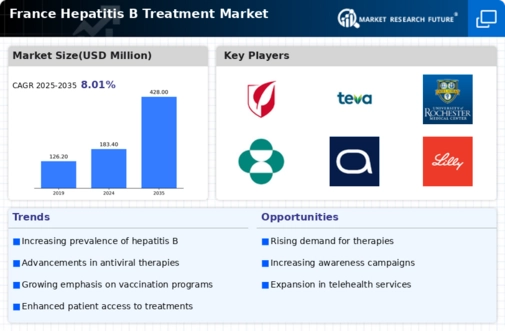
The projected market size of the France Hepatitis B Treatment Market in 2024 is valued at 183.38 million USD.

What will be the market value of the France Hepatitis B Treatment Market by 2035?

By 2035, the France Hepatitis B Treatment Market is expected to reach a value of 428.0 million USD.

What is the expected compound annual growth rate (CAGR) for the France Hepatitis B Treatment Market from 2025 to 2035?

The expected CAGR for the France Hepatitis B Treatment Market from 2025 to 2035 is 8.01%.

Which drug type segment will have the largest market value in 2035?

The Nucleoside Analogues segment is projected to have the largest market value in 2035, estimated at 210.0 million USD.

What market value is anticipated for the Interferons segment in 2024?

The Interferons segment is anticipated to have a market value of 50.0 million USD in 2024.

Which companies are considered key players in the France Hepatitis B Treatment Market?

Key players in the France Hepatitis B Treatment Market include Gilead Sciences, Roche, Merck & Co, and AbbVie among others.

What is the market value for Combination Therapy segment projected for 2035?

The market value for the Combination Therapy segment is projected to reach 118.0 million USD by 2035.

What growth opportunities exist in the France Hepatitis B Treatment Market?

There are growth opportunities in emerging treatment technologies and increased awareness about Hepatitis B.

What trends are influencing the France Hepatitis B Treatment Market currently?

Current trends include advancements in drug development and growing government initiatives to combat Hepatitis B.

How is the competitive landscape of the France Hepatitis B Treatment Market organized?

The competitive landscape includes a mix of established pharmaceutical companies and emerging biotech firms focusing on Hepatitis B treatments.

Download Free Sample

Kindly complete the form below to receive a free sample of this Report

Compare Licence

×
Features License Type
Single User Multiuser License Enterprise User
Price $4,950 $5,950 $7,250
Maximum User Access Limit 1 User Upto 10 Users Unrestricted Access Throughout the Organization
Free Customization
Direct Access to Analyst
Deliverable Format
Platform Access
Discount on Next Purchase 10% 15% 15%
Printable Versions