×
Request Free Sample ×

Kindly complete the form below to receive a free sample of this Report

* Please use a valid business email

Leading companies partner with us for data-driven Insights

clients tt-cursor
Hero Background

France Construction 4.0 Market

ID: MRFR/ICT/57843-HCR
200 Pages
Aarti Dhapte
February 2026

France Construction 4.0 Market Research Report By Solution (Hardware, Software, Services), By Technology (IoT, Artificial Intelligence, Industrial Robots, Others), By Application (Predictive Maintenance, Fleet Management, Asset Monitoring, Wearables, Others) and By End User (Residential, Non-residential)-Forecast to 2035

Share:
Download PDF ×

We do not share your information with anyone. However, we may send you emails based on your report interest from time to time. You may contact us at any time to opt-out.

France Construction 4.0 Market Infographic
Purchase Options

France Construction 4.0 Market Summary

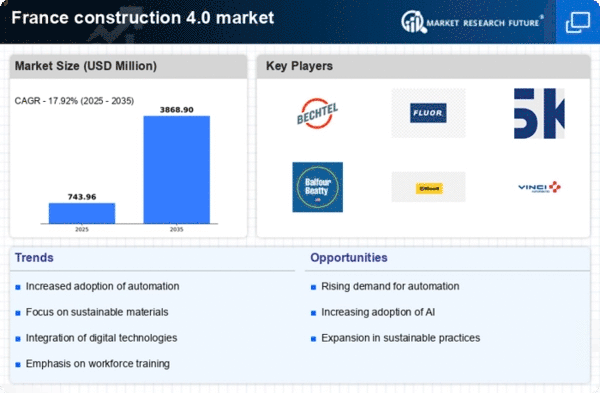
As per Market Research Future analysis, the construction 4.0 market size was estimated at 630.9 USD Million in 2024. the France Construction 4.0 Market is projected to grow from 743.96 USD Million in 2025 to 3868.9 USD Million by 2035, exhibiting a compound annual growth rate (CAGR) of 17.9% during the forecast period 2025 - 2035

Key Market Trends & Highlights

The France construction 4.0 market is experiencing a robust shift towards digitalization and sustainability.

  • Digital transformation is reshaping the construction landscape, enhancing efficiency and project management.
  • Sustainability initiatives are gaining traction, with a notable increase in green building practices across the sector.
  • The largest segment in the market is prefabrication, while the fastest-growing segment is smart infrastructure.
  • Technological advancements in construction and rising demand for prefabrication are key drivers propelling market growth.

Market Size & Forecast

2024 Market Size 630.9 (USD Million)
2035 Market Size 3868.9 (USD Million)
CAGR (2025 - 2035) 17.92%

Major Players

Bechtel (US), Fluor Corporation (US), Skanska (SE), Balfour Beatty (GB), Kiewit Corporation (US), VINCI (FR), AECOM (US), Larsen & Toubro (IN), China State Construction Engineering (CN)

Our Impact
Enabled $4.3B Revenue Impact for Fortune 500 and Leading Multinationals
Partnering with 2000+ Global Organizations Each Year
30K+ Citations by Top-Tier Firms in the Industry

France Construction 4.0 Market Trends

the construction 4.0 market is experiencing a transformative phase marked by the integration of advanced technologies and innovative practices. This evolution is driven by the increasing demand for efficiency, sustainability, and enhanced productivity within the sector. The adoption of digital tools, such as Building Information Modeling (BIM) and Internet of Things (IoT) applications, appears to be reshaping traditional construction methodologies. Furthermore, the emphasis on sustainable building practices is likely to influence project designs and material selections, aligning with broader environmental goals. As stakeholders seek to optimize resources and reduce waste, the France Construction 4.0 Market is poised for significant advancements. In addition, the regulatory landscape is evolving to support these technological advancements. Government initiatives aimed at promoting smart construction practices may provide a conducive environment for innovation. The focus on training and upskilling the workforce is also crucial, as it ensures that professionals are equipped to navigate the complexities of modern construction techniques. Overall, the construction 4-0 market is on a trajectory that suggests a shift towards more integrated, efficient, and sustainable practices, reflecting the changing needs of society and the economy.

Digital Transformation

The construction 4-0 market is witnessing a surge in digital transformation, with technologies like BIM and IoT becoming integral to project management. These tools facilitate real-time data sharing and collaboration, enhancing decision-making processes and project outcomes.

Sustainability Initiatives

Sustainability initiatives are gaining traction within the construction 4-0 market, as stakeholders prioritize eco-friendly materials and energy-efficient designs. This trend aligns with global efforts to reduce carbon footprints and promote sustainable development.

Regulatory Support

Regulatory support is evolving to foster innovation in the construction 4-0 market. Government policies are increasingly encouraging the adoption of smart technologies and sustainable practices, creating a favorable environment for industry growth.

France Construction 4.0 Market Drivers

Focus on Workforce Development

A focus on workforce development is becoming increasingly critical in the construction 4-0 market. As the industry evolves with new technologies, there is a pressing need for skilled labor that can operate advanced machinery and software. In France, initiatives aimed at training and upskilling workers are gaining traction, with government programs supporting vocational training in construction technologies. This emphasis on workforce development is essential for ensuring that the labor force is equipped to meet the demands of modern construction practices. By investing in human capital, companies can enhance productivity and innovation, thereby strengthening their position in the construction 4-0 market.

Rising Demand for Prefabrication

The rising demand for prefabrication is reshaping the construction 4-0 market. Prefabricated components are being recognized for their ability to reduce construction time and waste, leading to more efficient project execution. In France, the prefabrication market is expected to grow at a CAGR of 15% over the next five years, driven by the need for faster delivery and cost-effective solutions. This trend is particularly evident in residential and commercial projects, where speed and quality are paramount. As construction firms adapt to this demand, they are likely to invest in advanced manufacturing techniques, further enhancing their capabilities within the construction 4-0 market.

Investment in Smart Infrastructure

Investment in smart infrastructure is a key driver for the construction 4-0 market. The French government has allocated substantial funds towards the development of smart cities, which integrate advanced technologies into urban planning and construction. This initiative aims to improve energy efficiency, reduce carbon emissions, and enhance the quality of life for residents. Reports indicate that the smart city market in France is projected to reach €100 billion by 2025, reflecting a growing commitment to sustainable urban development. As a result, construction firms are increasingly focusing on smart infrastructure projects, which not only align with national goals but also present lucrative opportunities within the construction 4-0 market.

Technological Advancements in Construction

The construction 4-0 market is experiencing a surge in technological advancements, particularly in automation and robotics. These innovations are streamlining processes, enhancing productivity, and reducing labor costs. For instance, the integration of Building Information Modeling (BIM) has been shown to improve project delivery times by up to 30%. Furthermore, the adoption of drones for site surveys and inspections is becoming commonplace, allowing for real-time data collection and analysis. This technological evolution not only increases efficiency but also enhances safety on construction sites. As companies in the construction 4-0 market embrace these technologies, they are likely to gain a competitive edge, positioning themselves favorably in the evolving landscape of the industry.

Sustainability and Green Building Practices

Sustainability and green building practices are increasingly influencing the construction 4-0 market. With growing awareness of environmental issues, there is a strong push towards eco-friendly construction methods and materials. In France, regulations are becoming more stringent, requiring new buildings to meet specific energy efficiency standards. The market for green building materials is projected to grow by 20% annually, reflecting a shift towards sustainable practices. This trend not only addresses environmental concerns but also appeals to consumers who prioritize sustainability. As a result, construction firms are likely to adopt greener practices, positioning themselves favorably within the construction 4-0 market.


Market Segment Insights

By Solution: Services (Largest) vs. Hardware (Fastest-Growing)

The France construction 4-0 market shows a diverse distribution among its solution segments, with Services holding the largest market share. This segment is supported by the increasing demand for specialized consultancy and project management services tailored to the evolving requirements of the construction industry. In contrast, Hardware is witnessing rapid growth, driven by advancements in construction technologies and the need for enhanced infrastructure solutions to meet the modern demands of construction projects. Growth trends indicate that the Services segment will continue to thrive due to a rise in complex construction projects that require expert guidance and management. Conversely, the Hardware segment is propelled by innovation in smart construction tools and equipment, which are essential for optimizing efficiency and structural performance. Both segments are expected to flourish as the market adapts to new technological advancements and practices that enhance project delivery and execution.

Services (Dominant) vs. Hardware (Emerging)

In the France construction 4-0 market, the Services segment stands out as the dominant force, catering to a wide range of needs from consulting to specialized project management. This segment benefits from the increasing complexity of construction projects, which require tailored solutions that can enhance effectiveness and efficiency. On the other hand, Hardware is emerging as a significant player due to the proliferation of advanced equipment and tools that promise improved operational performance. As construction companies seek to leverage cutting-edge technology and materials, Hardware is positioned to capture a larger market share, offering innovative solutions that complement service offerings and meet contemporary construction challenges.

By Technology: IoT (Largest) vs. Artificial Intelligence (Fastest-Growing)

In the France construction 4-0 market, the distribution of market share among the technology segment values reveals that IoT leads as the largest segment, significantly enhancing operational efficiencies and connectivity in construction processes. Meanwhile, Artificial Intelligence is recognized as the fastest-growing segment, increasingly being adopted for its data-driven decision-making capabilities and predictive analytics, which streamline project management and resource allocation. Industrial Robots also play a crucial role, albeit at a smaller share, focused on automation and precision in construction tasks, while other innovative technologies gradually carve out their niches. The growth trends in the technology segment are prominently driven by the rising demand for automation and smart solutions within construction operations. IoT technology fosters improvements in real-time monitoring and asset management, attracting substantial investments. Artificial Intelligence is rapidly gaining traction due to its ability to analyze vast datasets, providing insights that enhance quality control and cost-effectiveness. This combination of IoT solutions and AI capabilities not only heightens productivity but also addresses critical challenges such as labor shortages, leading to an overall positive outlook for the technology segment in this market.

IoT (Dominant) vs. Artificial Intelligence (Emerging)

In the France construction 4-0 market, IoT has emerged as the dominant technology segment, facilitating seamless communication and data exchange across various construction operations. Its ability to connect machinery, tools, and workforce enhances efficiency and reduces downtime. On the other hand, Artificial Intelligence is seen as an emerging force, utilizing machine learning algorithms to analyze project data and optimize performance. This technology enhances safety protocols and predictive maintenance strategies, positioning it as a critical driver of innovation in construction. The synergy between IoT's connectivity and AI's analytical prowess is expected to redefine industry standards, promoting smarter, more efficient construction practices.

By Application: Predictive Maintenance (Largest) vs. Fleet Management (Fastest-Growing)

In the France construction 4-0 market, the application segment showcases a diverse distribution of market share among its values. Predictive Maintenance leads the pack, capturing a substantial portion of the market. Fleet Management follows closely, gaining traction with its increasing adoption among construction entities that seek to optimize resource usage and reduce operational costs. Asset Monitoring, Wearables, and Others present innovative solutions, yet their market shares remain relatively smaller in comparison. The growth trends in the application segment are fueled by technological advancements and the increasing focus on data-driven decision-making. Predictive Maintenance benefits from emerging IoT technologies that enhance equipment uptime and minimize failure risks. Fleet Management is positioned as the fastest-growing area, propelled by a surge in demand for optimized logistics and real-time monitoring solutions, catering to the evolving needs of the industry.

Predictive Maintenance (Dominant) vs. Fleet Management (Emerging)

Predictive Maintenance represents a dominant force in the France construction 4-0 market, primarily due to its robust capabilities in preventing equipment failures through timely maintenance interventions. Utilizing advanced analytics and IoT connectivity, this segment significantly enhances operational efficiency, minimizing downtime and repair costs. Conversely, Fleet Management, while still emerging, showcases rapid growth driven by the necessity for effective resource tracking and fleet optimization. This segment harnesses real-time data to improve logistical operations, making it increasingly essential for construction businesses aiming to boost productivity and reduce expenditures. As technological adoption accelerates, both segments are expected to play pivotal roles in the market's evolution.

By End User: Residential (Largest) vs. Non-residential (Fastest-Growing)

In the France construction 4-0 market, the market share distribution highlights the dominance of the residential segment, which significantly outpaces its non-residential counterpart. This is primarily driven by an increase in housing demand, coupled with trends toward urbanization and population growth. As a result, the residential segment has maintained a leading position, capturing substantial market share, while the non-residential segment continues to grow at a rapid pace due to rising investments in infrastructure and commercial projects. The growth trends for these segments reveal interesting dynamics; the residential segment is expected to continue thriving, supported by government initiatives and evolving consumer preferences towards sustainable living environments. Meanwhile, the non-residential segment is marked as the fastest-growing, attributed to increasing commercial activities and infrastructure development. Innovations in construction technology and materials are further propelling growth in this segment, creating a competitive landscape that benefits both sectors.

Residential (Dominant) vs. Non-residential (Emerging)

The residential segment in the France construction 4-0 market is characterized by its widespread appeal and substantial market presence, driven by factors such as increasing housing demands and supportive government policies aimed at promoting home ownership. This segment remains dominant, showcasing resilience in adapting to market changes. Conversely, the non-residential segment is emerging with rapid growth, fostering development across infrastructure, commercial buildings, and institutional projects. Despite starting from a smaller base, its growth is being propelled by rising urbanization, increased commercial investments, and innovations in construction techniques, positioning it as a key player in shaping the future landscape of the construction market.

Get more detailed insights about France Construction 4.0 Market

Key Players and Competitive Insights

The construction 4-0 market in France is characterized by a dynamic competitive landscape, driven by technological advancements and a growing emphasis on sustainability. Major players such as VINCI (FR), Bechtel (US), and Skanska (SE) are at the forefront, each adopting distinct strategies to enhance their market positioning. VINCI (FR) focuses on integrating digital solutions into its operations, aiming to streamline project management and improve efficiency. Bechtel (US), on the other hand, emphasizes strategic partnerships and collaborations to expand its service offerings, while Skanska (SE) is heavily investing in sustainable construction practices, reflecting a broader industry trend towards eco-friendly solutions. Collectively, these strategies not only enhance individual company profiles but also contribute to a more competitive and innovative market environment.Key business tactics within this market include localizing manufacturing and optimizing supply chains to reduce costs and improve responsiveness. The competitive structure appears moderately fragmented, with several key players exerting influence over various segments. This fragmentation allows for a diverse range of offerings, yet the presence of major firms like AECOM (US) and Balfour Beatty (GB) ensures that competition remains robust, pushing all players towards continuous improvement and innovation.

In October VINCI (FR) announced a significant investment in a new digital platform aimed at enhancing project delivery through real-time data analytics. This move is strategically important as it positions VINCI (FR) to leverage data-driven insights, potentially reducing project timelines and costs while improving overall project quality. Such advancements are likely to set a new standard in the industry, compelling competitors to adopt similar technologies to maintain relevance.

In September Bechtel (US) entered into a joint venture with a local French firm to develop a large-scale infrastructure project. This strategic alliance not only facilitates knowledge transfer and local expertise but also enhances Bechtel's (US) ability to navigate regulatory landscapes effectively. The collaboration underscores the importance of local partnerships in executing complex projects, particularly in a market that values regional insights and compliance.

In August Skanska (SE) launched a new initiative focused on carbon-neutral construction practices, aiming to reduce emissions across its projects by 50% by 2030. This initiative reflects a growing trend towards sustainability in the construction sector, as clients increasingly demand environmentally responsible practices. Skanska's (SE) proactive approach may serve as a competitive differentiator, appealing to environmentally conscious stakeholders and clients.

As of November the competitive trends in the construction 4-0 market are increasingly defined by digitalization, sustainability, and the integration of AI technologies. Strategic alliances are becoming more prevalent, enabling companies to pool resources and expertise to tackle complex challenges. Looking ahead, it appears that competitive differentiation will increasingly hinge on innovation and technological advancements rather than solely on price. Companies that prioritize supply chain reliability and sustainable practices are likely to emerge as leaders in this evolving landscape.

Key Companies in the France Construction 4.0 Market include

Industry Developments

Recent developments in the France Construction 4.0 Market highlight a significant push toward digital transformation and sustainability. Companies such as LafargeHolcim and Saint-Gobain are increasingly integrating advanced technologies like artificial intelligence and the Internet of Things into their operations, promoting efficiency in construction processes.

VINCI renewed its partnership with AgroParisTech, Mines ParisPSL, and École des Ponts ParisTech in December 2023. The company has committed €6 million over a five-year period to support research in the areas of building energy efficiency, biodiversity, sustainable mobility, and the use of AI in decarbonizing buildings and mobility systems. Eiffage.comIn January 2024, Eiffage Construction reorganized its off-site division into a standalone "Eiffage Construction Hors-Site" division.

This division combines its expertise in prefabrication, including wood modules, container modules, and factory-built bathroom units, to streamline industrialized, low-waste construction workflows.In 2024, Eiffage Construction further developed its smart modular construction methods, which combine timber, steel, and concrete in factory-prefabricated modules. This approach was applied to urban projects such as the Smartseille eco-neighborhood and was supported by its Phosphore R&D program.

This approach enables faster construction with reduced energy and carbon emissions.In 2024–2025, Eiffage Construction implemented AI-driven innovations, such as smart totems equipped with wireless sensors for real-time monitoring of concrete life-cycle performance, and piloted wearable exoskeleton technology to enhance on-site safety and reduce worker fatigue.In late 2023, Cadwork informatik AG, a Swiss leader in timber-focused BIM/CAM software, released version 30 of its platform. This update further enhanced its IFC-based 3D design, 4D scheduling, 5D costing, and 6D execution tools, thereby reinforcing the digitization of timber construction throughout Europe..

Future Outlook

France Construction 4.0 Market Future Outlook

The construction 4-0 market in France is poised for growth at 17.92% CAGR from 2025 to 2035, driven by technological advancements and sustainability initiatives.

New opportunities lie in:

  • Integration of AI-driven project management tools
  • Development of smart building materials
  • Expansion of modular construction techniques

By 2035, the market is expected to achieve substantial growth and innovation.

Market Segmentation

France Construction 4.0 Market End User Outlook

  • Residential
  • Non-residential

France Construction 4.0 Market Solution Outlook

  • Hardware
  • Software
  • Services

France Construction 4.0 Market Technology Outlook

  • IoT
  • Artificial Intelligence
  • Industrial Robots
  • Others

France Construction 4.0 Market Application Outlook

  • Predictive Maintenance
  • Fleet Management
  • Asset Monitoring
  • Wearables
  • Others

Report Scope

MARKET SIZE 2024 630.9(USD Million)
MARKET SIZE 2025 743.96(USD Million)
MARKET SIZE 2035 3868.9(USD Million)
COMPOUND ANNUAL GROWTH RATE (CAGR) 17.92% (2025 - 2035)
REPORT COVERAGE Revenue Forecast, Competitive Landscape, Growth Factors, and Trends
BASE YEAR 2024
Market Forecast Period 2025 - 2035
Historical Data 2019 - 2024
Market Forecast Units USD Million
Key Companies Profiled Bechtel (US), Fluor Corporation (US), Skanska (SE), Balfour Beatty (GB), Kiewit Corporation (US), VINCI (FR), AECOM (US), Larsen & Toubro (IN), China State Construction Engineering (CN)
Segments Covered Solution, Technology, Application, End User
Key Market Opportunities Integration of advanced automation and digital technologies enhances efficiency in the construction 4-0 market.
Key Market Dynamics Technological advancements drive efficiency and sustainability in the construction 4-0 market, reshaping competitive dynamics.
Countries Covered France
Leave a Comment

FAQs

What is the expected market size of the France Construction 4.0 Market in 2024?

The France Construction 4.0 Market is expected to be valued at 397.14 million USD in 2024.

What is the projected market size of the France Construction 4.0 Market by 2035?

By 2035, the France Construction 4.0 Market is projected to reach a value of 2206.06 million USD.

What is the expected compound annual growth rate (CAGR) for the France Construction 4.0 Market from 2025 to 2035?

The expected CAGR for the France Construction 4.0 Market from 2025 to 2035 is 16.868%.

Which segment within the France Construction 4.0 Market is expected to have the highest growth by 2035?

The Software segment is expected to see significant growth, valued at 875.54 million USD by 2035.

What is the estimated value of the Hardware segment in the France Construction 4.0 Market for the year 2024?

In 2024, the Hardware segment of the France Construction 4.0 Market is valued at approximately 119.14 million USD.

Who are the key players in the France Construction 4.0 Market?

Major players in the market include LafargeHolcim, Vinci, Eiffage, and Saint-Gobain.

What market value is expected for Services in the France Construction 4.0 Market by 2035?

By 2035, the Services segment is expected to reach a market value of 672.4 million USD.

What are the growth drivers for the France Construction 4.0 Market?

Key growth drivers include advancements in technology and increasing automation in construction processes.

What is the projected market size for Software in the France Construction 4.0 Market in 2024?

The Software segment is projected to be valued at 157.14 million USD in 2024.

How do global economic conditions impact the France Construction 4.0 Market?

Current global economic conditions can influence investment and innovation within the France Construction 4.0 Market.

Download Free Sample

Kindly complete the form below to receive a free sample of this Report

Compare Licence

×
Features License Type
Single User Multiuser License Enterprise User
Price $4,950 $5,950 $7,250
Maximum User Access Limit 1 User Upto 10 Users Unrestricted Access Throughout the Organization
Free Customization
Direct Access to Analyst
Deliverable Format
Platform Access
Discount on Next Purchase 10% 15% 15%
Printable Versions