×
Request Free Sample ×

Kindly complete the form below to receive a free sample of this Report

* Please use a valid business email

Leading companies partner with us for data-driven Insights

clients tt-cursor
Hero Background

France Biopharmaceuticals Market

ID: MRFR/MED/49170-HCR
200 Pages
Rahul Gotadki
February 2026

France Biopharmaceuticals Market Research Report By Product Type (Monoclonal Antibodies, Recombinant Proteins, Vaccines, Cellular Therapies), By Application (Oncology, Autoimmune Diseases, Infectious Diseases, Cardiovascular Diseases), By End-use (Hospitals, Biotechnology Companies, Pharmaceutical Companies), and By Route of Administration (Intravenous, Subcutaneous, Intramuscular) - Growth & Industry Forecast 2025 To 2035

Share:
Download PDF ×

We do not share your information with anyone. However, we may send you emails based on your report interest from time to time. You may contact us at any time to opt-out.

France Biopharmaceuticals Market Infographic
Purchase Options

France Biopharmaceuticals Market Summary

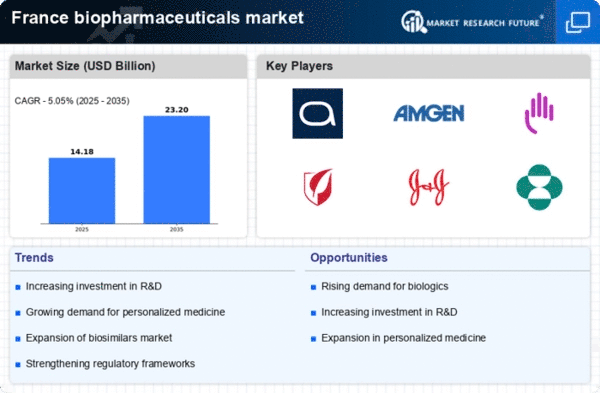
As per Market Research Future analysis, the France biopharmaceuticals market Size was estimated at 13.5 USD Billion in 2024. The France biopharmaceuticals market is projected to grow from 14.18 USD Billion in 2025 to 23.2 USD Billion by 2035, exhibiting a compound annual growth rate (CAGR) of 5.0% during the forecast period 2025 - 2035

Key Market Trends & Highlights

The France biopharmaceuticals market is experiencing robust growth driven by innovation and increasing healthcare demands.

  • The market is witnessing a rise in personalized medicine, catering to individual patient needs.
  • Investment in R&D is increasing, reflecting a commitment to advancing biopharmaceutical technologies.
  • Biologics production is expanding, indicating a shift towards more complex therapeutic solutions.
  • Key drivers include growing demand for targeted therapies and advancements in biotechnology.

Market Size & Forecast

2024 Market Size 13.5 (USD Billion)
2035 Market Size 23.2 (USD Billion)
CAGR (2025 - 2035) 5.05%

Major Players

AbbVie (US), Amgen (US), Bristol-Myers Squibb (US), Gilead Sciences (US), Johnson & Johnson (US), Merck & Co. (US), Novartis (CH), Roche (CH), Sanofi (FR), Takeda Pharmaceutical (JP)

Our Impact
Enabled $4.3B Revenue Impact for Fortune 500 and Leading Multinationals
Partnering with 2000+ Global Organizations Each Year
30K+ Citations by Top-Tier Firms in the Industry

France Biopharmaceuticals Market Trends

The biopharmaceuticals market in France is currently experiencing a dynamic evolution, driven by advancements in biotechnology and an increasing focus on personalized medicine. The landscape is characterized by a growing number of biopharmaceutical companies, which are actively engaged in research and development to create innovative therapies. This trend is further supported by favorable government policies and funding initiatives aimed at fostering innovation within the sector. As a result, the market is witnessing a surge in the development of biologics, including monoclonal antibodies and gene therapies, which are becoming increasingly integral to treatment protocols across various therapeutic areas. Moreover, the regulatory environment in France appears to be adapting to the rapid pace of biopharmaceutical innovation. Regulatory bodies are streamlining approval processes for new therapies, which may enhance the speed at which novel treatments reach the market. Additionally, collaborations between academic institutions and industry players are likely to bolster research efforts, leading to the emergence of new biopharmaceutical products. Overall, the biopharmaceuticals market in France seems poised for substantial growth, driven by technological advancements and a supportive ecosystem that encourages innovation and collaboration.

Rise of Personalized Medicine

The biopharmaceuticals market is witnessing a notable shift towards personalized medicine, where treatments are tailored to individual patient profiles. This trend is fueled by advancements in genomics and biotechnology, enabling the development of targeted therapies that improve patient outcomes. As healthcare providers increasingly adopt personalized approaches, the demand for biopharmaceuticals that cater to specific genetic markers is likely to grow.

Increased Investment in R&D

Investment in research and development within the biopharmaceuticals market is on the rise, as companies seek to innovate and bring new therapies to market. This trend is supported by government initiatives that promote funding for biopharmaceutical research. Enhanced collaboration between public and private sectors may further accelerate the development of groundbreaking therapies, positioning France as a leader in biopharmaceutical innovation.

Expansion of Biologics Production

The production of biologics is expanding within the biopharmaceuticals market, driven by the increasing demand for biologic therapies. This trend reflects a broader shift in treatment paradigms, as biologics are recognized for their efficacy in treating complex diseases. The establishment of advanced manufacturing facilities in France may enhance the capacity to produce these therapies, ensuring a steady supply to meet growing market needs.

France Biopharmaceuticals Market Drivers

Advancements in Biotechnology

Technological advancements in biotechnology are significantly influencing the biopharmaceuticals market in France. Innovations such as CRISPR gene editing and monoclonal antibody development are paving the way for new therapeutic options. The French biotechnology sector is expected to grow at a CAGR of 10% over the next five years, driven by increased collaboration between research institutions and biopharmaceutical companies. These advancements not only enhance the efficacy of treatments but also reduce production costs, making therapies more accessible. As a result, the biopharmaceuticals market is likely to see a surge in novel products that leverage these cutting-edge technologies.

Rising Healthcare Expenditure

Healthcare expenditure in France is on the rise, which is positively impacting the biopharmaceuticals market. In 2025, total healthcare spending is projected to reach €300 billion, with a significant portion allocated to pharmaceuticals. This increase in funding allows for greater access to innovative biopharmaceutical products, as well as improved patient care. The French government is also focusing on enhancing healthcare infrastructure, which further supports the growth of the biopharmaceuticals market. As more resources are directed towards healthcare, the demand for advanced therapies is likely to escalate, driving market expansion.

Growing Demand for Targeted Therapies

The biopharmaceuticals market in France is experiencing a notable increase in demand for targeted therapies. This trend is driven by the rising prevalence of chronic diseases and the need for more effective treatment options. In 2025, the market for targeted therapies is projected to reach approximately €5 billion, reflecting a growth rate of around 8% annually. Patients and healthcare providers are increasingly favoring therapies that offer personalized treatment plans, which are often more effective and have fewer side effects. This shift towards precision medicine is reshaping the landscape of the biopharmaceuticals market, as companies invest in developing innovative solutions tailored to individual patient needs.

Collaboration Between Public and Private Sectors

Collaboration between public and private sectors is emerging as a vital driver for the biopharmaceuticals market in France. Partnerships between government agencies, research institutions, and biopharmaceutical companies are fostering innovation and accelerating the development of new therapies. In 2025, it is expected that such collaborations will lead to the introduction of at least 20 new biopharmaceutical products. These alliances not only enhance research capabilities but also facilitate the sharing of resources and expertise, ultimately benefiting the biopharmaceuticals market. This collaborative approach is likely to yield significant advancements in treatment options and improve patient outcomes.

Regulatory Support for Biopharmaceutical Innovations

The regulatory environment in France is becoming increasingly supportive of biopharmaceutical innovations, which is a crucial driver for the market. The French government has implemented policies aimed at expediting the approval process for new drugs, particularly those that address unmet medical needs. In 2025, it is anticipated that the number of new biopharmaceutical products approved will increase by 15%, fostering a more dynamic market landscape. This regulatory support not only encourages investment in research and development but also enhances the competitiveness of the biopharmaceuticals market on an international scale.


Market Segment Insights

By Product Type: Monoclonal Antibodies (Largest) vs. Cellular Therapies (Fastest-Growing)

In the France biopharmaceuticals market, Monoclonal Antibodies hold the largest market share, reflecting their established role in therapeutic treatments. They continue to dominate the sector, benefiting from widespread utilization across various disease categories, including oncology and autoimmune disorders. In contrast, Cellular Therapies are emerging with a rapidly increasing share, driven by innovative treatments and increased acceptance among healthcare providers. Growth in the biopharmaceuticals sector is fueled by advancements in research and development, particularly in personalized medicine. The rise in chronic diseases and an aging population further amplify the demand for effective treatment options. Additionally, supportive government policies and investments in biotechnological research contribute to the accelerated growth of these segments. As new therapies gain approval, both Monoclonal Antibodies and Cellular Therapies are expected to shape the future landscape of the France biopharmaceuticals market.

Monoclonal Antibodies (Dominant) vs. Cellular Therapies (Emerging)

Monoclonal Antibodies represent a dominant force in the market, characterized by their precision targeting of specific antigens with high efficacy in treatment. Their ability to provide tailored therapies has positioned them as a primary choice for clinicians. In contrast, Cellular Therapies are viewed as an emerging segment, revolutionizing treatment paradigms with the potential for curative outcomes in previously challenging conditions. This new wave of therapies is fueled by the extensive research and clinical trials showcasing their effectiveness in regenerative medicine and cancer treatment. The innovative approaches in Cellular Therapies are attracting significant investment, further propelling their growth as they gain recognition in mainstream therapeutic protocols.

By Application: Oncology (Largest) vs. Autoimmune Diseases (Fastest-Growing)

The France biopharmaceuticals market showcases a diverse landscape across application segments, with oncology commanding a significant share. Oncology treatments continue to lead due to the prevalence of cancer cases and the increasing investments in research and development. Autoimmune diseases are gaining attention as well, holding a substantial portion of the market, delving deeper into personalized treatment approaches and advanced therapies that cater to patient-specific needs. Growth trends in the France biopharmaceuticals market reveal that while oncology remains the largest segment, the autoimmune diseases segment is rapidly emerging as the fastest-growing. Factors driving this growth include heightened awareness of autoimmune disorders, innovations in biologics and biosimilars, as well as favorable regulatory environments that encourage new product development. This dynamic shift is likely to reshape market strategies in the coming years as companies pivot towards developing targeted therapies across these lifesciences fields.

Oncology (Dominant) vs. Autoimmune Diseases (Emerging)

Oncology is recognized as the dominant application within the France biopharmaceuticals market. It is characterized by extensive research and an array of therapeutic options, including monoclonal antibodies, immune checkpoint inhibitors, and personalized medicine approaches. With ongoing clinical trials and partnerships focusing on innovative treatments, oncology remains at the forefront of biopharmaceutical advancements. In contrast, autoimmune diseases represent an emerging application segment, showcasing robust growth driven by advancements in diagnostics and treatment methodologies. The increasing incidence of autoimmune disorders combined with the successful launch of new therapeutics is positioning this segment for significant future growth. Comprehensive treatment plans are evolving, emphasizing personalized therapies that target the underlying immunological mechanisms.

By End-use: Hospitals (Largest) vs. Biotechnology Companies (Fastest-Growing)

In the France biopharmaceuticals market, the distribution of market share among the end-use segments indicates that hospitals command the largest share. Their significant role in administering biopharmaceutical products contributes to their dominance, as they cater to a wide range of patient needs and treatment methods. Conversely, biotechnology companies are experiencing rapid growth, driven by innovations in biologics and personalized medicine, making them an increasingly vital player in the market. Growth trends in the end-use segment are being propelled by several factors, including the rising prevalence of chronic diseases, advancements in technology enabling more effective treatments, and a heightened focus on healthcare quality. Hospitals are expanding their capacities and services, seeking to incorporate the latest biopharmaceutical therapies into patient care. Meanwhile, biotechnology companies are leveraging research and development to introduce cutting-edge therapies, thus catering to a growing patient base and reflecting a trend toward personalized approaches in treatment.

Hospitals (Dominant) vs. Biotechnology Companies (Emerging)

Hospitals are positioned as the dominant force in the France biopharmaceuticals market, given their extensive infrastructure and essential role in healthcare delivery. They not only administer biopharmaceuticals but also collaborate with pharmaceutical companies to enhance treatment options. On the other hand, biotechnology companies represent an emerging force, focusing on research and development to create novel therapies. Their agile nature allows them to respond quickly to market needs and innovate, making them key players in the future of biopharmaceuticals. Both segment values showcase distinct characteristics, with hospitals benefiting from established systems and biotechnology companies promising disruptive advancements.

By Route of Administration: Intravenous (Largest) vs. Subcutaneous (Fastest-Growing)

The France biopharmaceuticals market exhibits a diverse distribution among its key routes of administration. Intravenous administration holds the largest market share, driven by its effectiveness in delivering high concentrations of therapeutics rapidly into the bloodstream. This route remains the preferred choice for hospitals and clinics, especially for critical care treatments. Conversely, subcutaneous administration is witnessing significant growth, reflecting changing preferences toward patient-friendly options that allow for self-administration and improved patient compliance. Several factors contribute to the growth trends within this segment. Increasing demand for biologics and monoclonal antibodies, which are predominantly administered intravenously, fuels IV usage. On the other hand, advancements in needle technology and the development of convenient pre-filled syringes are propelling the subcutaneous segment to new heights. As patients increasingly seek treatment options that enhance comfort, the subcutaneous route is gaining prominence, paving the way for innovative solutions in the France biopharmaceuticals market.

Intravenous (Dominant) vs. Subcutaneous (Emerging)

Intravenous administration stands as the dominant route in the France biopharmaceuticals market, particularly favored in acute care settings where rapid action is essential. This method allows healthcare professionals to administer drugs with high precision and control. Its established protocols and familiarity among medical staff contribute to its sustained dominance. In contrast, subcutaneous administration is emerging as a viable alternative, gaining traction due to its convenience and potential for home-based therapy. Patients benefit from the ease of self-injection, reducing hospital visits and enhancing overall satisfaction. This shift toward subcutaneous methods is influenced by innovations in drug formulations that enhance bioavailability and stability, positioning it as a critical player in the evolving landscape of this market.

Get more detailed insights about France Biopharmaceuticals Market

Key Players and Competitive Insights

The biopharmaceuticals market in France is characterized by a dynamic competitive landscape, driven by innovation, regulatory advancements, and increasing healthcare demands. Major players such as Sanofi (FR), Roche (CH), and AbbVie (US) are strategically positioned to leverage their extensive research capabilities and established market presence. Sanofi (FR) focuses on expanding its portfolio through innovative therapies, particularly in rare diseases and immunology, while Roche (CH) emphasizes personalized medicine and diagnostics. AbbVie (US) continues to enhance its market share through strategic acquisitions and a robust pipeline of biologics, indicating a collective shift towards specialized treatments that cater to evolving patient needs.
The market structure appears moderately fragmented, with a mix of established giants and emerging players. Key tactics employed by these companies include localizing manufacturing to enhance supply chain efficiency and optimizing distribution networks to meet regional demands. This localized approach not only reduces operational costs but also aligns with the growing emphasis on sustainability and environmental responsibility within the industry. The collective influence of these major players shapes a competitive environment where innovation and operational excellence are paramount.
In September 2025, Sanofi (FR) announced a strategic partnership with a leading biotech firm to co-develop a novel gene therapy aimed at treating a rare genetic disorder. This collaboration underscores Sanofi's commitment to advancing its gene therapy capabilities and expanding its therapeutic offerings. The partnership is expected to enhance Sanofi's R&D capabilities and accelerate the development timeline, positioning the company favorably in a niche market with high unmet needs.
In October 2025, Roche (CH) launched a new digital health platform designed to integrate real-time patient data into clinical decision-making processes. This initiative reflects Roche's focus on digital transformation and its commitment to enhancing patient outcomes through data-driven insights. By leveraging advanced analytics and AI, Roche aims to streamline treatment pathways and improve the overall efficiency of healthcare delivery, thereby reinforcing its competitive edge in the biopharmaceuticals sector.
In August 2025, AbbVie (US) completed the acquisition of a promising biotech startup specializing in monoclonal antibody therapies. This acquisition is strategically significant as it not only expands AbbVie's product pipeline but also enhances its capabilities in immunotherapy, a rapidly growing segment within the biopharmaceuticals market. The integration of innovative technologies and expertise from the startup is likely to bolster AbbVie's position as a leader in the development of next-generation therapies.
As of November 2025, the competitive trends in the biopharmaceuticals market are increasingly defined by digitalization, sustainability, and the integration of AI technologies. Strategic alliances are becoming more prevalent, enabling companies to pool resources and expertise to drive innovation. The shift from price-based competition to a focus on technological advancement and supply chain reliability is evident, suggesting that future competitive differentiation will hinge on the ability to deliver innovative solutions that meet the complex needs of patients and healthcare systems.

Key Companies in the France Biopharmaceuticals Market include

Industry Developments

The France Biopharmaceuticals Market has recently experienced significant developments, particularly with companies such as Sanofi and AstraZeneca driving innovation and investment in biologic treatments.

In September 2023, Sanofi launched a new monoclonal antibody for cardiovascular diseases, reinforcing its commitment to advancing therapeutic options in the French healthcare landscape. Moreover, Pfizer announced a collaborative agreement in August 2023 with local biotech firms to enhance vaccine development capabilities, showcasing the integration of partnerships for research advancements.

On the acquisition front, in July 2023, Merck acquired a French biotech firm specializing in immunotherapy, aiming to bolster its portfolio in the oncology sector.

In recent years, the market has seen a steady growth trajectory, with France’s biopharmaceuticals sector reaching a valuation of approximately €62 billion in 2022, driven by a surge in Research and Development investment and a favorable regulatory environment that promotes innovation.

Additionally, the French government initiated programs in 2021 to strengthen local biomanufacturing capabilities, aiming to support pandemic preparedness and boost domestic production of biopharmaceuticals. These strategic initiatives are significantly shaping the future of the biopharmaceutical landscape in France.

Future Outlook

France Biopharmaceuticals Market Future Outlook

The Biopharmaceuticals Market in France is projected to grow at a 5.05% CAGR from 2025 to 2035, driven by innovation, regulatory support, and increasing healthcare demands.

New opportunities lie in:

  • Development of personalized medicine platforms for targeted therapies.
  • Expansion of telehealth services for remote patient monitoring.
  • Investment in biomanufacturing technologies to enhance production efficiency.

By 2035, the biopharmaceuticals market is expected to achieve robust growth and innovation.

Market Segmentation

France Biopharmaceuticals Market End-use Outlook

  • Hospitals
  • Biotechnology Companies
  • Pharmaceutical Companies

France Biopharmaceuticals Market Application Outlook

  • Oncology
  • Autoimmune Diseases
  • Infectious Diseases
  • Cardiovascular Diseases

France Biopharmaceuticals Market Product Type Outlook

  • Monoclonal Antibodies
  • Recombinant Proteins
  • Vaccines
  • Cellular Therapies

France Biopharmaceuticals Market Route of Administration Outlook

  • Intravenous
  • Subcutaneous
  • Intramuscular

Report Scope

MARKET SIZE 2024 13.5(USD Billion)
MARKET SIZE 2025 14.18(USD Billion)
MARKET SIZE 2035 23.2(USD Billion)
COMPOUND ANNUAL GROWTH RATE (CAGR) 5.05% (2025 - 2035)
REPORT COVERAGE Revenue Forecast, Competitive Landscape, Growth Factors, and Trends
BASE YEAR 2024
Market Forecast Period 2025 - 2035
Historical Data 2019 - 2024
Market Forecast Units USD Billion
Key Companies Profiled AbbVie (US), Amgen (US), Bristol-Myers Squibb (US), Gilead Sciences (US), Johnson & Johnson (US), Merck & Co. (US), Novartis (CH), Roche (CH), Sanofi (FR), Takeda Pharmaceutical (JP)
Segments Covered Product Type, Application, End-use, Route of Administration
Key Market Opportunities Advancements in personalized medicine and biologics drive growth in the biopharmaceuticals market.
Key Market Dynamics Rising investment in Research and Development drives innovation in the biopharmaceuticals market, enhancing competitive dynamics.
Countries Covered France
Leave a Comment

FAQs

What is the expected market size of the France Biopharmaceuticals Market in 2024?

The France Biopharmaceuticals Market is expected to be valued at 15.73 USD Billion in 2024.

What is the projected CAGR for the France Biopharmaceuticals Market from 2025 to 2035?

The France Biopharmaceuticals Market is projected to have a CAGR of 5.802% from 2025 to 2035.

What will the market size of the France Biopharmaceuticals Market reach by 2035?

By 2035, the France Biopharmaceuticals Market is expected to reach a valuation of 29.25 USD Billion.

Which product type contributes the largest market share in 2024?

In 2024, Monoclonal Antibodies will contribute the largest market share at 6.5 USD Billion.

What will be the market size of Recombinant Proteins in 2035?

Recombinant Proteins are expected to reach a market size of 7.5 USD Billion by 2035.

Who are the key players in the France Biopharmaceuticals Market?

Major players include Biogen, Pfizer, Amgen, Roche, and Sanofi among others.

What is the anticipated market size for Vaccines in 2024?

The anticipated market size for Vaccines in 2024 is 3.0 USD Billion.

What growth opportunities exist within the France Biopharmaceuticals Market?

Growth opportunities include advancements in drug development and increased demand for biologics.

What is the expected market size of Cellular Therapies in 2035?

Cellular Therapies are expected to have a market size of 3.75 USD Billion by 2035.

What challenges may impact the France Biopharmaceuticals Market in the upcoming years?

Challenges may include regulatory hurdles and high research and development costs.

Download Free Sample

Kindly complete the form below to receive a free sample of this Report

Compare Licence

×
Features License Type
Single User Multiuser License Enterprise User
Price $4,950 $5,950 $7,250
Maximum User Access Limit 1 User Upto 10 Users Unrestricted Access Throughout the Organization
Free Customization
Direct Access to Analyst
Deliverable Format
Platform Access
Discount on Next Purchase 10% 15% 15%
Printable Versions