×
Request Free Sample ×

Kindly complete the form below to receive a free sample of this Report

* Please use a valid business email

Leading companies partner with us for data-driven Insights

clients tt-cursor
Hero Background
English
Chinese
French
Japanese
Korean
German
Spanish

Filled Fluoropolymer Market Share

ID: MRFR/CnM/9231-HCR
100 Pages
Priya Nagrale
October 2025

Filled Fluoropolymer Market Research Report Information By End Use (Oil & GAs, Automotive & Transportation, Healthcare, Electrical & Electronics, Chemical Processing, Other) Forecast 2030

Share:
Download PDF ×

We do not share your information with anyone. However, we may send you emails based on your report interest from time to time. You may contact us at any time to opt-out.

Filled Fluoropolymer Market Infographic
Purchase Options

Market Share

Filled Fluoropolymer Market Share Analysis

The Filled Fluoropolymer Market is a powerful area portrayed by extraordinary rivalry, and organizations inside this industry utilize different market share situating systems to acquire an upper hand. One predominant methodology is separation, where organizations endeavor to recognize their items from rivals through novel elements or worth added ascribes. For example, a few organizations center around creating filled fluoropolymers with upgraded mechanical properties, like expanded rigidity or wear opposition, to take care of explicit modern applications. This procedure permits them to target specialty markets and fabricate a standing for conveying specific arrangements.

Another key procedure includes cost authority, where organizations plan to turn into the minimal expense makers in the Filled Fluoropolymer Market. By upgrading creation processes, obtaining materials proficiently, and accomplishing economies of scale, these organizations can offer serious costs while keeping up with productivity. Cost administration is especially successful in markets where value responsiveness is high, and clients focus on cost-viability over different variables. Notwithstanding, accomplishing and supporting expense initiative requires ceaseless functional enhancements and a sharp spotlight on productivity all through the worth chain.

Development assumes a critical part in market share situating inside the Filled Fluoropolymer Market. Organizations put vigorously in innovative work to make novel definitions, producing strategies, or applications for filled fluoropolymers. By presenting imaginative items, organizations can catch the consideration of clients searching for state of the art arrangements and remain in front of contenders. Development can likewise add to building major areas of strength for a property portfolio, giving an upper hand and defending market share in the long haul.

Key organizations and coordinated efforts are progressively normal in the Filled Fluoropolymer Market as organizations look to use each other's assets. Working together with providers, merchants, or corresponding organizations can upgrade an organization's capacities and market reach. For instance, an organization gaining practical experience in the development of filled fluoropolymers could frame organizations with providers of specialty added substances to make novel mixes with predominant execution qualities. Such joint efforts can bring about a more exhaustive item offering and extended market presence.

Geological extension is one more market share situating system utilized by organizations in the Filled Fluoropolymer Market. As interest for superior execution polymers develops all around the world, organizations might investigate new markets by laying out auxiliaries, dispersion organizations, or key collusions in areas with undiscovered possibility. This approach permits organizations to broaden their client base, decrease reliance on unambiguous markets, and profit by arising open doors in various geological regions.

Author
Priya Nagrale
Senior Research Analyst

With an experience of over five years in market research industry (Chemicals & Materials domain), I gather and analyze market data from diverse sources to produce results, which are then presented back to a client. Also, provide recommendations based on the findings. As a Senior Research Analyst, I perform quality checks (QC) for market estimations, QC for reports, and handle queries and work extensively on client customizations. Also, handle the responsibilities of client proposals, report planning, report finalization, and execution

Leave a Comment

FAQs

What growth rate global filled fluoropolymer market would register in the future?

The global filled fluoropolymer market would register a growth of 6%.

Which industry will play a crucial role in taking the filled fluoropolymermarket ahead

The oil & gas industrywill play a prominent role in taking the market forward.

What is the key driving restraining factor for the global filled fluoropolymer market?

Related regulatory environmental and health concerns could restrain the market.

Which region would enjoy the upper hand in the filled fluoropolymermarket?

The Asia-Pacific filled fluoropolymer market would enjoy the upper hand in the filled fluoropolymer market.

Which Asia Pacific country would set the trend in the filled fluoropolymer market?

China, as the largest consumer, would set the trend.

Market Summary

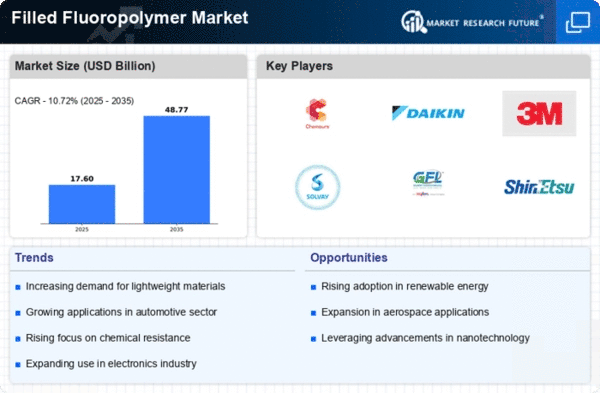
As per MRFR analysis, the Filled Fluoropolymer Market Size was estimated at 15.9 USD Billion in 2024. The Filled Fluoropolymer industry is projected to grow from 17.61 USD Billion in 2025 to 48.77 USD Billion by 2035, exhibiting a compound annual growth rate (CAGR) of 10.72 during the forecast period 2025 - 2035.

Key Market Trends & Highlights

The Filled Fluoropolymer Market is poised for growth driven by sustainability and technological advancements.

  • North America remains the largest market for filled fluoropolymers, driven by robust demand in the chemical processing sector.
  • Asia-Pacific is emerging as the fastest-growing region, with significant advancements in the electronics segment.
  • The chemical processing segment continues to dominate, while the aerospace segment is witnessing rapid growth due to increased applications.
  • Rising demand in chemical processing and innovations in material science are key drivers propelling market expansion.

Market Size & Forecast

2024 Market Size 15.9 (USD Billion)
2035 Market Size 48.77 (USD Billion)
CAGR (2025 - 2035) 10.72%
Largest Regional Market Share in 2024 North America

Major Players

Chemours (US), Daikin Industries (JP), 3M (US), Solvay (BE), Gujarat Fluorochemicals (IN), Shin-Etsu Chemical (JP), Kureha Corporation (JP), Saint-Gobain (FR), Mitsubishi Chemical (JP)

Market Trends

The Filled Fluoropolymer Market is currently experiencing a notable transformation, driven by advancements in material science and increasing demand across various industries. These polymers, known for their exceptional chemical resistance and thermal stability, are finding applications in sectors such as automotive, aerospace, and electronics. As industries seek to enhance performance and durability, the adoption of filled fluoropolymers is likely to rise, suggesting a shift towards more specialized and high-performance materials. Furthermore, the growing emphasis on sustainability may influence the market dynamics, as manufacturers explore eco-friendly alternatives and production methods. In addition, the Filled Fluoropolymer Market appears to be influenced by technological innovations that enhance the properties of these materials. The integration of fillers, such as glass fibers and carbon black, is enhancing the mechanical strength and thermal conductivity of fluoropolymers. This trend indicates a potential for expanded applications, particularly in high-stress environments. As the market evolves, collaboration between manufacturers and research institutions may foster the development of novel formulations, further driving growth and diversification in the sector.

Sustainability Initiatives

The Filled Fluoropolymer Market is witnessing a growing trend towards sustainability, as manufacturers increasingly prioritize eco-friendly practices. This shift is characterized by the development of bio-based fillers and recyclable materials, which aim to reduce environmental impact while maintaining performance standards. Companies are likely to invest in sustainable production methods, reflecting a broader commitment to environmental responsibility.

Technological Advancements

Technological innovations are playing a crucial role in shaping the Filled Fluoropolymer Market. Enhanced processing techniques and the introduction of advanced fillers are improving the performance characteristics of these materials. This trend suggests that manufacturers are focusing on creating high-performance products that meet the evolving demands of various industries, potentially leading to new applications.

Market Diversification

The Filled Fluoropolymer Market is experiencing diversification as new applications emerge across different sectors. Industries such as healthcare, food processing, and renewable energy are increasingly recognizing the benefits of filled fluoropolymers. This trend indicates a broadening of the market landscape, as companies seek to explore untapped opportunities and cater to specific industry needs.

Filled Fluoropolymer Market Market Drivers

Market Growth Projections

The Global Filled Fluoropolymer Market Industry is projected to experience substantial growth over the coming years. With a market value anticipated to reach 3.43 USD Billion in 2024 and further expand to 6.69 USD Billion by 2035, the industry is poised for a robust trajectory. The compound annual growth rate of 6.26% from 2025 to 2035 underscores the increasing demand for filled fluoropolymers across various sectors. This growth is driven by factors such as advancements in manufacturing technologies, rising applications in electronics, and a heightened focus on sustainability. The market's expansion reflects the critical role filled fluoropolymers play in meeting the evolving needs of diverse industries.

Regulatory Support and Standards

The Global Filled Fluoropolymer Market Industry is benefiting from supportive regulatory frameworks and standards that promote the use of high-performance materials. Governments and industry bodies are establishing regulations that encourage the adoption of advanced materials in various applications, particularly in sectors such as aerospace, automotive, and chemical processing. These regulations often emphasize safety, performance, and environmental considerations, driving manufacturers to incorporate filled fluoropolymers into their products. As compliance with these standards becomes increasingly critical, the market is likely to see sustained growth, with a focus on materials that meet stringent regulatory requirements.

Increased Focus on Sustainability

Sustainability is becoming a pivotal driver in the Global Filled Fluoropolymer Market Industry. As industries strive to reduce their environmental impact, the demand for materials that offer longevity and reduce waste is rising. Filled fluoropolymers, known for their durability and resistance to degradation, align well with these sustainability goals. Companies are increasingly adopting these materials to enhance the lifespan of their products, thereby minimizing the need for frequent replacements. This shift towards sustainable practices is likely to bolster market growth, as organizations recognize the long-term benefits of investing in high-quality materials that contribute to environmental conservation.

Rising Applications in Electronics

The Global Filled Fluoropolymer Market Industry is witnessing a surge in applications within the electronics sector. The unique dielectric properties of filled fluoropolymers make them ideal for insulating materials in electronic components. As the demand for miniaturized and high-performance electronic devices increases, manufacturers are turning to filled fluoropolymers to meet these requirements. This trend is expected to drive market growth, with a projected compound annual growth rate of 6.26% from 2025 to 2035. The integration of filled fluoropolymers in electronic applications not only enhances performance but also contributes to the longevity and reliability of devices, further solidifying their market position.

Growing Demand in Chemical Processing

The Global Filled Fluoropolymer Market Industry is experiencing heightened demand in the chemical processing sector. This is largely due to the unique properties of filled fluoropolymers, such as their exceptional chemical resistance and thermal stability. Industries that handle aggressive chemicals are increasingly adopting these materials to enhance the durability and lifespan of their equipment. For instance, filled fluoropolymers are utilized in linings for pipes and tanks, which are crucial in preventing leaks and corrosion. As a result, the market is projected to reach 3.43 USD Billion in 2024, reflecting a robust growth trajectory driven by the need for reliable materials in challenging environments.

Advancements in Manufacturing Technologies

Technological advancements in the production of filled fluoropolymers are significantly influencing the Global Filled Fluoropolymer Market Industry. Innovations in manufacturing processes, such as improved compounding techniques and extrusion methods, have led to enhanced material properties and performance. These advancements allow for the production of filled fluoropolymers with tailored characteristics, catering to specific applications in various industries, including automotive and aerospace. As manufacturers adopt these new technologies, the market is likely to expand, with projections indicating a growth to 6.69 USD Billion by 2035. This growth is indicative of the increasing reliance on high-performance materials in demanding applications.

Market Segment Insights

By Application: Chemical Processing (Largest) vs. Aerospace (Fastest-Growing)

The Filled Fluoropolymer Market is predominantly driven by the application of filled fluoropolymers in chemical processing, which holds the largest market share among segmented applications. This dominance is attributed to the superior chemical resistance and thermal stability offered by fluoropolymers, making them essential for manufacturing environments that require handling corrosive substances. Other notable applications include electrical insulation and automotive, which also play significant roles but have lower market shares compared to chemical processing. Aerospace is emerging as the fastest-growing application segment, primarily fueled by the increasing demand for lightweight and high-performance materials in aircraft manufacturing. The focus on enhancing fuel efficiency and reducing emissions has led to the expanded use of filled fluoropolymers in aerospace components, marking a significant trend as aviation technology evolves.

Chemical Processing (Dominant) vs. Aerospace (Emerging)

In the Filled Fluoropolymer Market, chemical processing stands out as the dominant application due to its critical role in industries that require materials with exceptional chemical resistance and durability. Filled fluoropolymers are extensively used in pipe linings, gaskets, and seals to handle aggressive chemicals and high temperatures. In contrast, aerospace is considered an emerging application, driven by recent advancements in aviation technology that require lightweight materials without compromising strength. As manufacturers look to optimize performance and efficiency, the use of filled fluoropolymers is becoming increasingly popular in aircraft components, including insulations and seals, highlighting a shift towards innovative solutions in aerospace engineering.

By End Use Industry: Pharmaceuticals (Largest) vs. Electronics (Fastest-Growing)

The Filled Fluoropolymer Market is notably dominated by the Pharmaceuticals segment, which commands a significant share of the overall market. This dominance arises from the increasing applications of filled fluoropolymers in drug packaging and medical devices, where their chemical resistance and non-reactive properties ensure product integrity. Following closely, the Electronics segment is experiencing rapid growth due to the rising demand for electronic components that require high-performance materials capable of withstanding extreme temperatures and corrosive environments. In terms of growth trends, the shift towards advanced manufacturing techniques in Pharmaceuticals is driving the need for more sophisticated materials, which filled fluoropolymers can provide. For Electronics, the trend favors miniaturization and efficiency, necessitating materials that not only perform well but also help to reduce weight. Both segments are poised for growth influenced by technology advancements and an increased focus on sustainability within the industry.

Pharmaceuticals: Dominant vs. Electronics: Emerging

The Pharmaceuticals sector stands out as the dominant player in the Filled Fluoropolymer Market, primarily due to its expansive application in the medical field, which is bolstered by strict regulatory standards demanding high-quality, non-contaminating materials. Filled fluoropolymers are integral in drug delivery systems, providing stability and reliability. Contrarily, the Electronics segment is emerging rapidly, propelled by technological innovations and the need for superior thermal and chemical resistance in modern electronic devices. These materials lend critical performance attributes to products such as connectors, insulators, and circuit boards, making them highly sought after in the rapidly evolving electronics landscape.

By Form: Films (Largest) vs. Coatings (Fastest-Growing)

In the Filled Fluoropolymer Market, the segment breakdown reveals that Films hold the largest market share, driven by their vast applications across various industries including automotive and electronics. Meanwhile, Coatings have emerged as a significant segment, acquiring a substantial share due to their versatility and specialized properties that cater to demanding environments, thus capturing the interest of manufacturers seeking advanced solutions.

Films (Dominant) vs. Coatings (Emerging)

Films are the dominant segment within the Filled Fluoropolymer Market, recognized for their exceptional durability and resistance to extreme temperatures and chemicals. This makes them a preferred choice for applications in the automotive, aerospace, and chemical processing industries. On the other hand, Coatings represent an emerging segment with a rapidly increasing demand, attributed to their ability to enhance the performance of various substrates. Coatings offer not only protection against corrosion and wear but also improve the aesthetic and functional properties of products, positioning them as a vital choice for manufacturers aiming to innovate.

By Filler Type: Glass Fiber (Largest) vs. Carbon Fiber (Fastest-Growing)

In the Filled Fluoropolymer Market, Glass Fiber stands out as the largest segment, commanding a significant portion of market share due to its wide applicability across various industries, including automotive and aerospace. Carbon Fiber, while currently smaller in market share, is recognized as the fastest-growing segment, driven by advancements in lightweight materials and high-performance applications. The demand for lightweight yet durable solutions is pushing Carbon Fiber forward as industries seek ways to improve efficiency and performance.

Glass Fiber (Dominant) vs. Carbon Fiber (Emerging)

Glass Fiber has established itself as a dominant player in the Filled Fluoropolymer Market, leveraging its excellent mechanical strength and thermal resistance to serve high-demand sectors effectively. It is widely used in applications where durability and weight reduction are critical, making it a preferred choice among manufacturers. Conversely, Carbon Fiber, while emerging, is quickly gaining traction due to its superior strength-to-weight ratio, which is increasingly vital in high-performance materials for industries like aerospace and automotive. As technology progresses, Carbon Fiber's unique properties are setting the stage for rapid growth, positioning it as a future leader in specialized applications.

Get more detailed insights about Filled Fluoropolymer Market Research Report—Global Forecast till 2035

Regional Insights

North America : Market Leader in Innovation

North America continues to lead the filled fluoropolymer market, holding a significant share of 7.95 in 2024. The region's growth is driven by increasing demand in industries such as aerospace, automotive, and electronics, where high-performance materials are essential. Regulatory support for advanced materials and sustainability initiatives further catalyze market expansion, making it a hub for innovation and development. The competitive landscape in North America is robust, featuring key players like Chemours, 3M, and Solvay. These companies are investing heavily in R&D to enhance product offerings and meet stringent regulatory standards. The U.S. remains the largest market, followed by Canada and Mexico, where the presence of advanced manufacturing facilities supports the growth of filled fluoropolymers. The region's focus on high-quality standards and technological advancements positions it favorably for future growth.

Europe : Emerging Market with Potential

Europe's filled fluoropolymer market is poised for growth, with a market size of 4.8 in 2024. The region benefits from a strong industrial base and increasing demand for high-performance materials in sectors like automotive, chemical processing, and energy. Regulatory frameworks promoting sustainability and innovation are key drivers, encouraging investments in advanced materials and technologies. Leading countries in this region include Germany, France, and the UK, where major players like Solvay and Saint-Gobain are actively expanding their product lines. The competitive landscape is characterized by a mix of established companies and emerging startups, fostering innovation. The European market is also influenced by stringent environmental regulations, pushing manufacturers to develop eco-friendly fluoropolymer solutions. "The European market is adapting to new regulations that prioritize sustainability and performance in material selection," European Commission report.

Asia-Pacific : Rapid Growth and Adoption

The Asia-Pacific region is witnessing rapid growth in the filled fluoropolymer market, with a market size of 2.85 in 2024. This growth is fueled by increasing industrialization, urbanization, and demand for high-performance materials in sectors such as electronics, automotive, and construction. Government initiatives promoting manufacturing and innovation are also significant catalysts for market expansion in this region. Key players in Asia-Pacific include Daikin Industries, Shin-Etsu Chemical, and Gujarat Fluorochemicals, which are focusing on enhancing production capabilities and expanding their market reach. Countries like China, Japan, and India are leading the charge, with substantial investments in R&D and manufacturing. The competitive landscape is evolving, with both multinational corporations and local firms vying for market share, making it a dynamic environment for filled fluoropolymers.

Middle East and Africa : Emerging Market with Challenges

The Middle East and Africa region is gradually emerging in the filled fluoropolymer market, with a market size of 0.4 in 2024. The growth is primarily driven by increasing industrial activities and the need for high-performance materials in sectors like oil and gas, construction, and automotive. However, challenges such as limited manufacturing capabilities and regulatory hurdles may hinder rapid growth in this region. Countries like South Africa and the UAE are at the forefront of this market, with local players beginning to establish a presence. The competitive landscape is still developing, with opportunities for international companies to enter and expand. As the region invests in infrastructure and industrialization, the demand for filled fluoropolymers is expected to rise, presenting a significant opportunity for growth in the coming years.

Key Players and Competitive Insights

The Filled Fluoropolymer Market is currently characterized by a dynamic competitive landscape, driven by increasing demand across various industries such as automotive, electronics, and chemical processing. Key players are actively engaging in strategies that emphasize innovation, sustainability, and regional expansion. For instance, Chemours (US) has positioned itself as a leader in product development, focusing on high-performance materials that cater to the evolving needs of its customers. Similarly, Daikin Industries (JP) is leveraging its technological expertise to enhance its product offerings, particularly in the realm of environmentally friendly solutions. These strategic orientations collectively contribute to a competitive environment that is increasingly focused on meeting stringent regulatory standards while also addressing customer demands for advanced materials.In terms of business tactics, companies are increasingly localizing manufacturing to reduce lead times and optimize supply chains. This approach appears to be particularly effective in a market that is moderately fragmented, where the collective influence of key players shapes pricing and availability. The emphasis on supply chain optimization is evident as firms seek to mitigate risks associated with global disruptions, thereby enhancing their operational resilience.

In November 3M (US) announced a significant investment in expanding its production capabilities for filled fluoropolymers in North America. This strategic move is likely aimed at meeting the growing demand from the automotive sector, which is increasingly adopting advanced materials for lightweight and durable components. The expansion not only enhances 3M's market presence but also aligns with its commitment to sustainability by reducing transportation emissions associated with long-distance shipping.

In October Solvay (BE) launched a new line of filled fluoropolymers designed specifically for high-temperature applications in the aerospace industry. This introduction underscores Solvay's focus on innovation and its ability to cater to niche markets that require specialized materials. The strategic importance of this launch lies in its potential to capture a larger share of the aerospace sector, which is increasingly prioritizing performance and reliability in material selection.

In September Gujarat Fluorochemicals (IN) entered into a strategic partnership with a leading automotive manufacturer to develop custom fluoropolymer solutions. This collaboration is indicative of a broader trend where companies are forming alliances to enhance their product offerings and meet specific industry needs. Such partnerships not only facilitate knowledge sharing but also enable quicker responses to market demands, thereby strengthening competitive positioning.

As of December the competitive trends in the Filled Fluoropolymer Market are increasingly defined by digitalization, sustainability, and the integration of advanced technologies such as AI. Strategic alliances are playing a crucial role in shaping the current landscape, allowing companies to pool resources and expertise. Looking ahead, it is anticipated that competitive differentiation will evolve from traditional price-based competition to a focus on innovation, technological advancements, and supply chain reliability. This shift is likely to redefine how companies position themselves in the market, emphasizing the importance of adaptability and forward-thinking strategies.

Key Companies in the Filled Fluoropolymer Market include

Industry Developments

Future Outlook

Filled Fluoropolymer Market Future Outlook

The Filled Fluoropolymer Market is projected to grow at a 10.72% CAGR from 2025 to 2035, driven by increasing demand in chemical processing, electronics, and automotive sectors.

New opportunities lie in:

  • Development of high-performance filled fluoropolymer composites for aerospace applications.
  • Expansion into emerging markets with tailored product offerings.
  • Investment in R&D for innovative filled fluoropolymer solutions targeting renewable energy sectors.

By 2035, the Filled Fluoropolymer Market is expected to achieve substantial growth and diversification.

Market Segmentation

Filled Fluoropolymer Market Form Outlook

  • Sheets
  • Films
  • Coatings
  • Gaskets
  • Seals

Filled Fluoropolymer Market Application Outlook

  • Chemical Processing
  • Electrical Insulation
  • Aerospace
  • Automotive
  • Food Processing

Filled Fluoropolymer Market Filler Type Outlook

  • Glass Fiber
  • Carbon Fiber
  • Metallic Fillers
  • Ceramic Fillers
  • Mineral Fillers

Filled Fluoropolymer Market End Use Industry Outlook

  • Pharmaceuticals
  • Electronics
  • Automotive
  • Food and Beverage
  • Oil and Gas

Report Scope

MARKET SIZE 202415.9(USD Billion)
MARKET SIZE 202517.61(USD Billion)
MARKET SIZE 203548.77(USD Billion)
COMPOUND ANNUAL GROWTH RATE (CAGR)10.72% (2025 - 2035)
REPORT COVERAGERevenue Forecast, Competitive Landscape, Growth Factors, and Trends
BASE YEAR2024
Market Forecast Period2025 - 2035
Historical Data2019 - 2024
Market Forecast UnitsUSD Billion
Key Companies ProfiledChemours (US), Daikin Industries (JP), 3M (US), Solvay (BE), Gujarat Fluorochemicals (IN), Shin-Etsu Chemical (JP), Kureha Corporation (JP), Saint-Gobain (FR), Mitsubishi Chemical (JP)
Segments CoveredApplication, End Use Industry, Form, Filler Type
Key Market OpportunitiesGrowing demand for high-performance materials in aerospace and automotive applications drives Filled Fluoropolymer Market opportunities.
Key Market DynamicsRising demand for high-performance materials drives innovation and competition in the filled fluoropolymer market.
Countries CoveredNorth America, Europe, APAC, South America, MEA

FAQs

What growth rate global filled fluoropolymer market would register in the future?

The global filled fluoropolymer market would register a growth of 6%.

Which industry will play a crucial role in taking the filled fluoropolymermarket ahead

The oil & gas industrywill play a prominent role in taking the market forward.

What is the key driving restraining factor for the global filled fluoropolymer market?

Related regulatory environmental and health concerns could restrain the market.

Which region would enjoy the upper hand in the filled fluoropolymermarket?

The Asia-Pacific filled fluoropolymer market would enjoy the upper hand in the filled fluoropolymer market.

Which Asia Pacific country would set the trend in the filled fluoropolymer market?

China, as the largest consumer, would set the trend.

  1. SECTION I: EXECUTIVE SUMMARY AND KEY HIGHLIGHTS
    1. | 1.1 EXECUTIVE SUMMARY
    2. | 1.1.1 Market Overview
    3. | 1.1.2 Key Findings
    4. | 1.1.3 Market Segmentation
    5. | 1.1.4 Competitive Landscape
    6. | 1.1.5 Challenges and Opportunities
    7. | 1.1.6 Future Outlook
  2. SECTION II: SCOPING, METHODOLOGY AND MARKET STRUCTURE
    1. | 2.1 MARKET INTRODUCTION
    2. | 2.1.1 Definition
    3. | 2.1.2 Scope of the study
    4. |-- 2.1.2.1 Research Objective
    5. |-- 2.1.2.2 Assumption
    6. |-- 2.1.2.3 Limitations
    7. | 2.2 RESEARCH METHODOLOGY
    8. | 2.2.1 Overview
    9. | 2.2.2 Data Mining
    10. | 2.2.3 Secondary Research
    11. | 2.2.4 Primary Research
    12. |-- 2.2.4.1 Primary Interviews and Information Gathering Process
    13. |-- 2.2.4.2 Breakdown of Primary Respondents
    14. | 2.2.5 Forecasting Model
    15. | 2.2.6 Market Size Estimation
    16. |-- 2.2.6.1 Bottom-Up Approach
    17. |-- 2.2.6.2 Top-Down Approach
    18. | 2.2.7 Data Triangulation
    19. | 2.2.8 Validation
  3. SECTION III: QUALITATIVE ANALYSIS
    1. | 3.1 MARKET DYNAMICS
    2. | 3.1.1 Overview
    3. | 3.1.2 Drivers
    4. | 3.1.3 Restraints
    5. | 3.1.4 Opportunities
    6. | 3.2 MARKET FACTOR ANALYSIS
    7. | 3.2.1 Value chain Analysis
    8. | 3.2.2 Porter's Five Forces Analysis
    9. |-- 3.2.2.1 Bargaining Power of Suppliers
    10. |-- 3.2.2.2 Bargaining Power of Buyers
    11. |-- 3.2.2.3 Threat of New Entrants
    12. |-- 3.2.2.4 Threat of Substitutes
    13. |-- 3.2.2.5 Intensity of Rivalry
    14. | 3.2.3 COVID-19 Impact Analysis
    15. |-- 3.2.3.1 Market Impact Analysis
    16. |-- 3.2.3.2 Regional Impact
    17. |-- 3.2.3.3 Opportunity and Threat Analysis
  4. SECTION IV: QUANTITATIVE ANALYSIS
    1. | 4.1 Chemicals and Materials, BY Application (USD Billion)
    2. | 4.1.1 Chemical Processing
    3. | 4.1.2 Electrical Insulation
    4. | 4.1.3 Aerospace
    5. | 4.1.4 Automotive
    6. | 4.1.5 Food Processing
    7. | 4.2 Chemicals and Materials, BY End Use Industry (USD Billion)
    8. | 4.2.1 Pharmaceuticals
    9. | 4.2.2 Electronics
    10. | 4.2.3 Automotive
    11. | 4.2.4 Food and Beverage
    12. | 4.2.5 Oil and Gas
    13. | 4.3 Chemicals and Materials, BY Form (USD Billion)
    14. | 4.3.1 Sheets
    15. | 4.3.2 Films
    16. | 4.3.3 Coatings
    17. | 4.3.4 Gaskets
    18. | 4.3.5 Seals
    19. | 4.4 Chemicals and Materials, BY Filler Type (USD Billion)
    20. | 4.4.1 Glass Fiber
    21. | 4.4.2 Carbon Fiber
    22. | 4.4.3 Metallic Fillers
    23. | 4.4.4 Ceramic Fillers
    24. | 4.4.5 Mineral Fillers
    25. | 4.5 Chemicals and Materials, BY Region (USD Billion)
    26. | 4.5.1 North America
    27. |-- 4.5.1.1 US
    28. |-- 4.5.1.2 Canada
    29. | 4.5.2 Europe
    30. |-- 4.5.2.1 Germany
    31. |-- 4.5.2.2 UK
    32. |-- 4.5.2.3 France
    33. |-- 4.5.2.4 Russia
    34. |-- 4.5.2.5 Italy
    35. |-- 4.5.2.6 Spain
    36. |-- 4.5.2.7 Rest of Europe
    37. | 4.5.3 APAC
    38. |-- 4.5.3.1 China
    39. |-- 4.5.3.2 India
    40. |-- 4.5.3.3 Japan
    41. |-- 4.5.3.4 South Korea
    42. |-- 4.5.3.5 Malaysia
    43. |-- 4.5.3.6 Thailand
    44. |-- 4.5.3.7 Indonesia
    45. |-- 4.5.3.8 Rest of APAC
    46. | 4.5.4 South America
    47. |-- 4.5.4.1 Brazil
    48. |-- 4.5.4.2 Mexico
    49. |-- 4.5.4.3 Argentina
    50. |-- 4.5.4.4 Rest of South America
    51. | 4.5.5 MEA
    52. |-- 4.5.5.1 GCC Countries
    53. |-- 4.5.5.2 South Africa
    54. |-- 4.5.5.3 Rest of MEA
  5. SECTION V: COMPETITIVE ANALYSIS
    1. | 5.1 Competitive Landscape
    2. | 5.1.1 Overview
    3. | 5.1.2 Competitive Analysis
    4. | 5.1.3 Market share Analysis
    5. | 5.1.4 Major Growth Strategy in the Chemicals and Materials
    6. | 5.1.5 Competitive Benchmarking
    7. | 5.1.6 Leading Players in Terms of Number of Developments in the Chemicals and Materials
    8. | 5.1.7 Key developments and growth strategies
    9. |-- 5.1.7.1 New Product Launch/Service Deployment
    10. |-- 5.1.7.2 Merger & Acquisitions
    11. |-- 5.1.7.3 Joint Ventures
    12. | 5.1.8 Major Players Financial Matrix
    13. |-- 5.1.8.1 Sales and Operating Income
    14. |-- 5.1.8.2 Major Players R&D Expenditure. 2023
    15. | 5.2 Company Profiles
    16. | 5.2.1 Chemours (US)
    17. |-- 5.2.1.1 Financial Overview
    18. |-- 5.2.1.2 Products Offered
    19. |-- 5.2.1.3 Key Developments
    20. |-- 5.2.1.4 SWOT Analysis
    21. |-- 5.2.1.5 Key Strategies
    22. | 5.2.2 Daikin Industries (JP)
    23. |-- 5.2.2.1 Financial Overview
    24. |-- 5.2.2.2 Products Offered
    25. |-- 5.2.2.3 Key Developments
    26. |-- 5.2.2.4 SWOT Analysis
    27. |-- 5.2.2.5 Key Strategies
    28. | 5.2.3 3M (US)
    29. |-- 5.2.3.1 Financial Overview
    30. |-- 5.2.3.2 Products Offered
    31. |-- 5.2.3.3 Key Developments
    32. |-- 5.2.3.4 SWOT Analysis
    33. |-- 5.2.3.5 Key Strategies
    34. | 5.2.4 Solvay (BE)
    35. |-- 5.2.4.1 Financial Overview
    36. |-- 5.2.4.2 Products Offered
    37. |-- 5.2.4.3 Key Developments
    38. |-- 5.2.4.4 SWOT Analysis
    39. |-- 5.2.4.5 Key Strategies
    40. | 5.2.5 Gujarat Fluorochemicals (IN)
    41. |-- 5.2.5.1 Financial Overview
    42. |-- 5.2.5.2 Products Offered
    43. |-- 5.2.5.3 Key Developments
    44. |-- 5.2.5.4 SWOT Analysis
    45. |-- 5.2.5.5 Key Strategies
    46. | 5.2.6 Shin-Etsu Chemical (JP)
    47. |-- 5.2.6.1 Financial Overview
    48. |-- 5.2.6.2 Products Offered
    49. |-- 5.2.6.3 Key Developments
    50. |-- 5.2.6.4 SWOT Analysis
    51. |-- 5.2.6.5 Key Strategies
    52. | 5.2.7 Kureha Corporation (JP)
    53. |-- 5.2.7.1 Financial Overview
    54. |-- 5.2.7.2 Products Offered
    55. |-- 5.2.7.3 Key Developments
    56. |-- 5.2.7.4 SWOT Analysis
    57. |-- 5.2.7.5 Key Strategies
    58. | 5.2.8 Saint-Gobain (FR)
    59. |-- 5.2.8.1 Financial Overview
    60. |-- 5.2.8.2 Products Offered
    61. |-- 5.2.8.3 Key Developments
    62. |-- 5.2.8.4 SWOT Analysis
    63. |-- 5.2.8.5 Key Strategies
    64. | 5.2.9 Mitsubishi Chemical (JP)
    65. |-- 5.2.9.1 Financial Overview
    66. |-- 5.2.9.2 Products Offered
    67. |-- 5.2.9.3 Key Developments
    68. |-- 5.2.9.4 SWOT Analysis
    69. |-- 5.2.9.5 Key Strategies
    70. | 5.3 Appendix
    71. | 5.3.1 References
    72. | 5.3.2 Related Reports

Chemicals and Materials Market Segmentation

Chemicals and Materials By Application (USD Billion, 2025-2035)

  • Chemical Processing
  • Electrical Insulation
  • Aerospace
  • Automotive
  • Food Processing

Chemicals and Materials By End Use Industry (USD Billion, 2025-2035)

  • Pharmaceuticals
  • Electronics
  • Automotive
  • Food and Beverage
  • Oil and Gas

Chemicals and Materials By Form (USD Billion, 2025-2035)

  • Sheets
  • Films
  • Coatings
  • Gaskets
  • Seals

Chemicals and Materials By Filler Type (USD Billion, 2025-2035)

  • Glass Fiber
  • Carbon Fiber
  • Metallic Fillers
  • Ceramic Fillers
  • Mineral Fillers
Infographic

Free Sample Request

Kindly complete the form below to receive a free sample of this Report

Get Free Sample

Customer Strories

Compare Licence

×
Features License Type
Single User Multiuser License Enterprise User
Price $4,950 $5,950 $7,250
Maximum User Access Limit 1 User Upto 10 Users Unrestricted Access Throughout the Organization
Free Customization
Direct Access to Analyst
Deliverable Format
Platform Access
Discount on Next Purchase 10% 15% 15%
Printable Versions