×
Request Free Sample ×

Kindly complete the form below to receive a free sample of this Report

* Please use a valid business email

Leading companies partner with us for data-driven Insights

clients tt-cursor
Hero Background

Europe Air Freight Market

ID: MRFR/PCM/19856-HCR
128 Pages
Sejal Akre
February 2026

Europe Air Freight Market Research Report: Information By Type (Domestic Air Freight And International Air Freight), By End-User (Airport-To-Airport Service And Door-To-Door Service)–and Europe Market Forecast Till 2035

Share:
Download PDF ×

We do not share your information with anyone. However, we may send you emails based on your report interest from time to time. You may contact us at any time to opt-out.

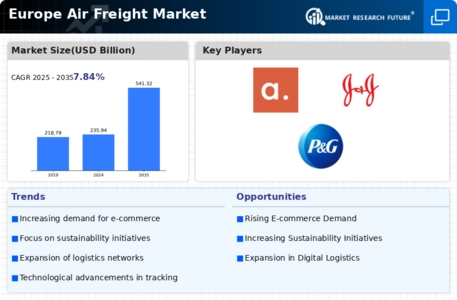
Europe Air Freight Market Infographic
Purchase Options

Europe Air Freight Market Summary

As per analysis, the Europe Air Freight Market is projected to grow from USD 23.73 Billion in 2025 to USD 31.48 Billion by 2035, exhibiting a compound annual growth rate (CAGR) of 2.9% during the forecast period (2025 - 2035).

Key Market Trends & Highlights

The Europe Air Freight Market is currently experiencing robust growth driven by e-commerce and technological advancements.

  • Germany remains the largest market for air freight, showcasing a strong demand for express services.
  • The UK is emerging as the fastest-growing region, particularly in the economy service segment.
  • Express services dominate the market, while perishable goods are witnessing the fastest growth in demand.
  • E-commerce expansion and consumer expectations for speed are key drivers influencing market dynamics.

Market Size & Forecast

2024 Market Size 23.0 (USD Billion)
2035 Market Size 31.48 (USD Billion)
CAGR (2025 - 2035) 2.9%

Major Players

DHL (DE), Kuehne + Nagel (CH), Air France-KLM (FR), Lufthansa Cargo (DE), UPS (US), FedEx (US), IAG Cargo (GB), DB Schenker (DE), Cargolux (LU)

Our Impact
Enabled $4.3B Revenue Impact for Fortune 500 and Leading Multinationals
Partnering with 2000+ Global Organizations Each Year
30K+ Citations by Top-Tier Firms in the Industry

Europe Air Freight Market Trends

The Europe Air Freight Market is currently experiencing a dynamic transformation, driven by various factors that influence logistics and transportation. The demand for air freight services appears to be on the rise, as businesses increasingly seek faster delivery options to meet consumer expectations. This trend is likely fueled by the growth of e-commerce, which necessitates efficient supply chain solutions. Additionally, the market is characterized by a heightened focus on sustainability, with companies exploring eco-friendly practices to reduce their carbon footprint. This shift towards greener logistics may reshape operational strategies within the sector. Moreover, advancements in technology are playing a pivotal role in enhancing the efficiency of air freight operations. Innovations such as automated systems and real-time tracking are becoming more prevalent, allowing for improved visibility and management of shipments. The integration of digital platforms is also facilitating smoother communication between stakeholders, which could lead to more streamlined processes. As the Europe Air Freight Market continues to evolve, it is essential for industry players to adapt to these changes to remain competitive and responsive to market demands.

E-commerce Growth

The rise of e-commerce in Europe is significantly impacting the air freight sector. As online shopping becomes increasingly popular, businesses are compelled to utilize air freight services to ensure timely deliveries. This trend is likely to continue, as consumer preferences shift towards faster shipping options.

Sustainability Initiatives

There is a growing emphasis on sustainability within the Europe Air Freight Market. Companies are exploring eco-friendly practices, such as using alternative fuels and optimizing routes to minimize emissions. This focus on environmental responsibility may influence operational decisions and partnerships.

Technological Advancements

Technological innovations are transforming air freight operations in Europe. The adoption of automated systems and real-time tracking solutions is enhancing efficiency and visibility in logistics. These advancements may lead to improved communication among stakeholders and more effective shipment management.

Europe Air Freight Market Drivers

E-commerce Expansion

The rapid expansion of e-commerce in Europe is a pivotal driver for the Europe Air Freight Market. As online shopping continues to gain traction, the demand for swift and reliable delivery services has surged. In 2025, the European e-commerce market was valued at approximately 800 billion euros, with projections indicating a growth rate of around 10% annually. This growth necessitates efficient air freight solutions to meet consumer expectations for fast shipping. Major players in the e-commerce sector, such as Amazon and Alibaba, are increasingly relying on air freight to ensure timely deliveries across the continent. Consequently, the Europe Air Freight Market is likely to experience heightened activity as logistics providers adapt to the evolving landscape of consumer behavior.

Global Trade Dynamics

The dynamics of The Air Freight Industry. As European countries engage in international trade, the demand for air freight services to transport goods across borders remains robust. In 2025, Europe accounted for approximately 30% of global air freight traffic, underscoring its importance in the international logistics network. Trade agreements, such as the EU-Japan Economic Partnership Agreement, facilitate smoother trade flows, further bolstering the need for efficient air freight solutions. This interconnectedness suggests that fluctuations in The Air Freight Industry, necessitating adaptability from logistics providers.

Regulatory Frameworks

The regulatory frameworks governing air freight operations in Europe play a crucial role in shaping the Europe Air Freight Market. The European Union has implemented various regulations aimed at enhancing safety, security, and environmental sustainability within the air transport sector. For instance, the EU Emissions Trading System (ETS) mandates that airlines monitor and report their carbon emissions, which could influence operational costs. Additionally, the Single European Sky initiative aims to streamline air traffic management, potentially increasing efficiency and reducing delays. These regulatory measures may compel air freight companies to innovate and invest in more sustainable practices, thereby impacting the overall dynamics of the Europe Air Freight Market.

Technological Innovations

Technological innovations are transforming the landscape of the Europe Air Freight Market. Advancements in automation, artificial intelligence, and data analytics are enhancing operational efficiency and reducing costs. For example, the implementation of automated sorting systems in cargo facilities has significantly expedited the processing of shipments. Furthermore, the use of AI-driven predictive analytics allows logistics companies to optimize routes and manage inventory more effectively. According to industry reports, the adoption of such technologies could lead to a 20% reduction in operational costs for air freight companies by 2027. As these technologies continue to evolve, they are likely to reshape the competitive landscape of the Europe Air Freight Market.

Consumer Expectations for Speed

Consumer expectations for rapid delivery are increasingly influencing the Europe Air Freight Market. As customers demand faster shipping options, air freight has become a preferred choice for time-sensitive deliveries. A survey conducted in late 2025 indicated that over 70% of European consumers prioritize delivery speed when making online purchases. This trend is prompting retailers and logistics companies to enhance their air freight capabilities to meet these expectations. Consequently, the Europe Air Freight Market is likely to see an uptick in demand for express services, as businesses strive to maintain competitiveness in a market where speed is paramount.

Market Segment Insights

By Service Type: Express Service (Largest) vs. Economy Service (Fastest-Growing)

In the Europe Air Freight Market, the service type segment is characterized by a diverse array of offerings. The Express Service segment holds the largest market share, catering to time-sensitive shipments, which is crucial for industries like e-commerce and pharmaceuticals. In contrast, the Standard and Charter Services follow, providing essential logistics solutions that support varying customer needs. Meanwhile, Economy Service is gaining traction, appealing to price-sensitive customers looking for cost-effective shipping options.

Express Service (Dominant) vs. Economy Service (Emerging)

The Express Service segment is a powerhouse in the air freight market, renowned for its rapid transit times and reliability. Catering largely to e-commerce and urgent delivery sectors, it dominates due to its ability to meet stringent delivery schedules. On the other hand, the Economy Service is emerging as a popular strategy among businesses seeking balance between cost and service quality. It offers slower transit times but significantly lower prices, appealing to a different customer base. Together, these segments illustrate the diverse needs within the logistics landscape, with Express Service leading the charge while Economy Service steadily gains market share.

By Cargo Type: General Cargo (Largest) vs. Perishable Goods (Fastest-Growing)

In the Europe Air Freight Market, the distribution among cargo types illustrates a clear dominance of General Cargo, which forms a substantial portion of the total air freight transport. This segment benefits from the broad range of items it encompasses, from textiles to electronics. In contrast, Perishable Goods have emerged as a dynamic segment, characterized by its growth due to increasing demand in the food supply chain and growing consumer expectations for freshness and product quality.

General Cargo (Dominant) vs. Perishable Goods (Emerging)

General Cargo remains dominant in the Europe Air Freight Market, accounting for a significant share. This category includes a wide variety of non-specialty goods, providing flexibility and adaptability to freight services. On the other hand, Perishable Goods represent an emerging segment driven by market needs for speedy transportation of fresh fruits, vegetables, and other time-sensitive products. The trend toward e-commerce is also propelling growth in this segment as retailers seek to meet consumer demand for fresh products delivered quickly. As a result, companies are investing in specialized facilities and technologies to ensure quality and timely delivery.

By End User: E-commerce (Largest) vs. Aerospace (Fastest-Growing)

In the Europe Air Freight Market, E-commerce emerges as the largest end-user segment, driven by the surge in online shopping trends. This segment accounts for a significant proportion of the market share, influenced by increasing consumer demand for timely deliveries and rapid fulfillment services. E-commerce firms are increasingly leveraging air freight to ensure quick turnaround times, especially for high-demand products. On the other hand, Aerospace is identified as the fastest-growing end-user segment, reflecting considerable advancements in air transportation technology and the escalating demand for air freight services concerning aircraft parts and maintenance activities.

E-commerce (Dominant) vs. Aerospace (Emerging)

E-commerce continues to dominate the Europe Air Freight Market, characterized by its robust infrastructure and a strong network of logistics providers skilled in rapid delivery. This sector thrives on innovations in e-logistics, enabling seamless order processing and distribution. Conversely, Aerospace, while currently an emerging segment, is experiencing rapid growth due to increased air travel demand and the expansion of aviation sectors. Manufacturers and service providers in this domain are focusing on enhancing their supply chains, creating a ripple effect on air freight activities as they seek to optimize air transport solutions for critical aerospace components and services.

By Shipment Size: Small Shipments (Largest) vs. Large Shipments (Fastest-Growing)

In the Europe Air Freight Market, the distribution of shipment sizes reveals that small shipments dominate the segment, capturing a significant portion of the overall market share. This preference for small shipments can be attributed to their cost-effectiveness and efficiency, allowing businesses to manage inventory more flexibly and respond swiftly to market demands. Conversely, medium and large shipments are gradually gaining traction, with increasing demand for larger deliveries driven by e-commerce and the global supply chain requirements. The growth trends in the shipment size segment are notable, particularly for large shipments, which are identified as the fastest-growing segment. Factors contributing to this growth include the rise of international trade and the growing need for rapid delivery of bulk goods, which is becoming essential in a fast-paced business environment. As businesses expand and seek to optimize logistics, the inclination towards larger shipments is expected to continue, showcasing a shift in market dynamics that favors larger scales of operation.

Small Shipments (Dominant) vs. Large Shipments (Emerging)

Small shipments are positioned as the dominant force in the Europe Air Freight Market, catering to a wide range of industries that require quick and efficient delivery of products. They are characterized by their adaptability to meet the immediate needs of businesses, offering advantages such as lower shipping costs and faster transit times. On the other hand, large shipments are emerging as a significant player in the market, driven by factors like increasing international trade and the rising demand for bulk shipments. While they are currently less prevalent than small shipments, their growth potential is substantial due to the globalization of supply chains and the need for timely delivery of goods at scale. This dynamic creates a competitive landscape where small and large shipments coexist, each fulfilling distinct but crucial roles in the air freight ecosystem.

By Transportation Mode: Airline (Largest) vs. Integrated Carrier (Fastest-Growing)

In the Europe Air Freight Market, the distribution of market share among transportation modes shows that Airlines hold the largest portion, primarily due to their established networks and extensive service offerings. Freight Forwarders compete closely, leveraging their logistics expertise to optimize shipping solutions. Integrated Carriers, while currently smaller in terms of share, are gaining momentum rapidly, particularly in sectors requiring time-sensitive deliveries and full-service logistics solutions.

Airline (Dominant) vs. Integrated Carrier (Emerging)

Airlines serve as the dominant force in the Europe Air Freight Market, well-known for their reliability and extensive reach. They benefit from established routes and higher capacity to handle both long-haul and short-haul shipments effectively. On the other hand, Integrated Carriers represent an emerging trend within this market segment, focusing on providing end-to-end solutions that integrate transportation, warehousing, and distribution. Their rise is attributed to innovations in logistics technology and a growing demand for expedited shipping services, making them a vital player in the evolving air freight landscape.

Get more detailed insights about Europe Air Freight Market

Regional Insights

Germany : Strong Infrastructure and Demand Growth

Germany holds a commanding 6.5% market share in the European air freight sector, driven by robust industrial output and a strategic geographical location. Key growth drivers include the rise in e-commerce, increased demand for just-in-time delivery, and government initiatives promoting logistics efficiency. Regulatory policies favoring air transport and investments in airport infrastructure further enhance market potential, making it a hub for international trade.

UK : E-commerce Fuels Market Expansion

The UK air freight market accounts for 5.0% of the European share, bolstered by a thriving e-commerce sector and strong consumer demand. Growth is supported by government policies aimed at enhancing trade agreements post-Brexit, alongside investments in logistics infrastructure. The demand for rapid delivery services continues to rise, reflecting changing consumption patterns and a shift towards online shopping.

France : Diverse Industries Drive Growth

France captures 4.0% of the European air freight market, with Paris and Lyon as key logistics centers. The growth is driven by diverse industries, including pharmaceuticals and automotive, which require efficient transport solutions. Government initiatives to improve air cargo regulations and infrastructure investments are pivotal. The competitive landscape features major players like Air France-KLM and DHL, enhancing service offerings.

Russia : Infrastructure Development is Key

With a 3.5% market share, Russia's air freight sector is on the rise, driven by infrastructure development and increasing trade with Asia. Key growth drivers include government investments in airport facilities and logistics hubs. Demand for air freight is growing, particularly in sectors like energy and technology, reflecting a shift towards faster delivery methods in a vast country.

Italy : Manufacturing Sector Boosts Demand

Italy holds a 2.5% share in the air freight market, with Milan and Rome as central hubs. The manufacturing sector, particularly fashion and automotive, drives demand for air transport. Government initiatives to streamline customs processes and enhance logistics infrastructure are crucial for growth. The competitive landscape includes major players like DHL and UPS, catering to diverse industry needs.

Spain : Tourism and Trade Drive Demand

Spain's air freight market, with a 1.5% share, is evolving, driven by tourism and agricultural exports. Key cities like Madrid and Barcelona serve as logistics hubs. The growth is supported by government policies promoting trade and investment in airport infrastructure. The competitive landscape features local and international players, adapting to the increasing demand for perishable goods and rapid delivery services.

Rest of Europe : Diverse Markets with Unique Needs

The Rest of Europe accounts for a modest 0.5% of the air freight market, characterized by niche opportunities in smaller countries. Growth is driven by local industries such as agriculture and technology, with varying demand patterns. Regulatory frameworks differ significantly, impacting market dynamics. The competitive landscape includes regional players adapting to specific local needs and challenges.


Key Players and Competitive Insights

The Air Freight Market in Europe is characterized by a dynamic competitive landscape, driven by increasing demand for expedited shipping solutions and the ongoing evolution of e-commerce. Major players such as DHL (DE), Kuehne + Nagel (CH), and Air France-KLM (FR) are strategically positioning themselves to capitalize on these growth opportunities. DHL (DE) emphasizes innovation through its investment in digital logistics solutions, enhancing operational efficiency and customer experience. Kuehne + Nagel (CH) focuses on sustainability initiatives, aiming to reduce carbon emissions across its supply chain, which resonates with the growing environmental consciousness among consumers. Meanwhile, Air France-KLM (FR) is enhancing its network capabilities through strategic partnerships, thereby expanding its reach and service offerings. Collectively, these strategies contribute to a competitive environment that is increasingly focused on technological advancement and sustainability.

In terms of business tactics, companies are localizing their operations to better serve regional markets, optimizing supply chains to enhance efficiency, and investing in technology to streamline processes. The market structure appears moderately fragmented, with a mix of large multinational corporations and smaller regional players. The collective influence of key players shapes competitive dynamics, as they vie for market share through differentiated service offerings and operational excellence.

In December 2025, DHL (DE) announced the launch of a new digital platform aimed at improving visibility and tracking for air freight shipments. This strategic move is likely to enhance customer satisfaction by providing real-time updates and transparency, which are increasingly demanded by clients in the logistics sector. The platform's integration of advanced analytics may also facilitate better decision-making and operational efficiency.

In November 2025, Kuehne + Nagel (CH) unveiled its ambitious plan to achieve carbon neutrality by 2030, which includes investing in sustainable aviation fuel (SAF) and optimizing its logistics network. This initiative not only positions the company as a leader in sustainability but also aligns with the growing regulatory pressures and consumer expectations for environmentally responsible practices. The potential long-term benefits include enhanced brand loyalty and a competitive edge in a market that is progressively prioritizing sustainability.

In October 2025, Air France-KLM (FR) entered into a strategic alliance with a leading technology firm to develop AI-driven solutions for cargo management. This partnership is expected to streamline operations and improve predictive analytics capabilities, thereby enhancing service reliability and efficiency. The integration of AI into their operations may provide a significant competitive advantage, particularly in optimizing routing and capacity management.

As of January 2026, current trends in the Air Freight Market are heavily influenced by digitalization, sustainability, and the integration of AI technologies. Strategic alliances are increasingly shaping the competitive landscape, allowing companies to leverage shared resources and expertise. The shift from price-based competition to a focus on innovation, technology, and supply chain reliability is evident, suggesting that future differentiation will hinge on the ability to adapt to these evolving market demands.

Key Companies in the Europe Air Freight Market include

Industry Developments

In May 2023, UPS announced the acquisition of Freightex, a digital freight brokerage company in the United Kingdom, in order to strengthen its position in the European air freight industry.

In March 2023, Lufthansa Cargo announced the debut of a new digital booking tool, "myAirCargo," for the easy and transparent booking of air freight shipments.

In February 2023, DHL Global Forwarding established a cooperation with AeroVironment to build electric vertical takeoff and landing (eVTOL) aircraft for cargo transportation.

In January 2023, FedEx Express announced the opening of a new air route between the United States and Asia to fulfill the rising demand for air freight services in the region.

Future Outlook

Europe Air Freight Market Future Outlook

The Europe Air Freight Market is projected to grow at a 2.9% CAGR from 2025 to 2035, driven by e-commerce expansion, technological advancements, and increased demand for rapid delivery services.

New opportunities lie in:

  • Investment in automated cargo handling systems to enhance efficiency.
  • Development of specialized air freight services for pharmaceuticals and perishables.
  • Partnerships with e-commerce platforms to streamline logistics and distribution.

By 2035, the Europe Air Freight Market is expected to be robust, driven by innovation and strategic partnerships.

Market Segmentation

Europe Air Freight Market End User Outlook

  • E-commerce
  • Automotive
  • Aerospace
  • Healthcare

Europe Air Freight Market Cargo Type Outlook

  • General Cargo
  • Perishable Goods
  • Pharmaceuticals
  • Dangerous Goods

Europe Air Freight Market Service Type Outlook

  • Express Service
  • Standard Service
  • Economy Service
  • Charter Service

Europe Air Freight Market Shipment Size Outlook

  • Small Shipments
  • Medium Shipments
  • Large Shipments

Europe Air Freight Market Transportation Mode Outlook

  • Airline
  • Freight Forwarder
  • Integrated Carrier

Report Scope

MARKET SIZE 202423.0(USD Billion)
MARKET SIZE 202523.73(USD Billion)
MARKET SIZE 203531.48(USD Billion)
COMPOUND ANNUAL GROWTH RATE (CAGR)2.9% (2024 - 2035)
REPORT COVERAGERevenue Forecast, Competitive Landscape, Growth Factors, and Trends
BASE YEAR2024
Market Forecast Period2025 - 2035
Historical Data2019 - 2024
Market Forecast UnitsUSD Billion
Key Companies ProfiledDHL (DE), Kuehne + Nagel (CH), Air France-KLM (FR), Lufthansa Cargo (DE), UPS (US), FedEx (US), IAG Cargo (GB), DB Schenker (DE), Cargolux (LU)
Segments CoveredService Type, Cargo Type, End User, Shipment Size, Transportation Mode
Key Market OpportunitiesIntegration of advanced logistics technologies enhances efficiency in the Europe Air Freight Market.
Key Market DynamicsRising demand for sustainable logistics solutions drives innovation in the Europe Air Freight Market.
Countries CoveredGermany, UK, France, Russia, Italy, Spain, Rest of Europe

Market Highlights

Author
Sejal Akre
Senior Research Analyst

She has over 5 years of rich experience, in market research and consulting providing valuable market insights to client. Hands on expertise in management consulting, and extensive knowledge in domain including ICT, Automotive & Transportation and Aerospace & Defense. She is skilled in Go-to market strategy, industry analysis, market sizing, in depth company profiling, competitive intelligence & benchmarking and value chain amongst others.

Leave a Comment

FAQs

What is the current valuation of the Europe Air Freight Market?

The Europe Air Freight Market was valued at 23.0 USD Billion in 2024.

Download Free Sample

Kindly complete the form below to receive a free sample of this Report

Compare Licence

×
Features License Type
Single User Multiuser License Enterprise User
Price $4,950 $5,950 $7,250
Maximum User Access Limit 1 User Upto 10 Users Unrestricted Access Throughout the Organization
Free Customization
Direct Access to Analyst
Deliverable Format
Platform Access
Discount on Next Purchase 10% 15% 15%
Printable Versions