×
Request Free Sample ×

Kindly complete the form below to receive a free sample of this Report

* Please use a valid business email

Leading companies partner with us for data-driven Insights

clients tt-cursor
Hero Background
English
Chinese
French
Japanese
Korean
German
Spanish

Ethylene Carbonate Market Analysis

ID: MRFR/CnM/5866-CR
111 Pages
Chitranshi Jaiswal
February 2023

Ethylene Carbonate Market Size, Share & Industry Analysis Research Report Information By Form (Solid and Liquid), Applications (Lithium Battery Electrolytes, Lubricants, Plasticizers, Surface Coatings, Chemical Intermediates, Fiber Processing Agents, Dyes and Others), End-Use Industry (Automotive, Oil & Gas, Textile, Chemical, Medical, Personal Care & Hygiene, Agriculture and Others) And By Region (North America, Europe, Asia-Pacific, and Middle East & Africa, Latin America) - Forecast Till 2035

Share:
Download PDF ×

We do not share your information with anyone. However, we may send you emails based on your report interest from time to time. You may contact us at any time to opt-out.

Ethylene Carbonate Market Infographic
Purchase Options

Market Analysis

In-depth Analysis of Ethylene Carbonate Market Industry Landscape

The ethylene carbonate market is subject to various market dynamics that influence its growth, demand, and pricing. Ethylene carbonate is a chemical compound primarily used as a solvent and in electrolytes for lithium batteries, among other applications. Several factors contribute to the market dynamics of ethylene carbonate, including supply and demand, pricing trends, regulatory policies, technological advancements, and market competition.

The global market has employed more key employers to enhance their expansion across the world. The introduction of new products like lithium-sulfur batteries is an excellent option for market players to increase their businesses.As a result, the report says that introducing new products has brought a massive change in global market growth.

Supply and demand dynamics play a crucial role in determining the overall market conditions for ethylene carbonate. The availability of raw materials, such as ethylene oxide and carbon dioxide, directly affects the production capacity of ethylene carbonate manufacturers. Additionally, the demand for ethylene carbonate is driven by its widespread use in industries such as electronics, pharmaceuticals, and personal care products. Factors such as economic growth, industrialization, and technological advancements influence the demand for products that contain ethylene carbonate, thereby impacting market dynamics.

Pricing trends in the ethylene carbonate market are influenced by various factors, including raw material costs, production capacity, supply-demand dynamics, and market competition. Fluctuations in the prices of ethylene oxide and carbon dioxide, which are key raw materials for ethylene carbonate production, can affect the overall cost of production and subsequently impact pricing in the market. Moreover, changes in demand patterns or disruptions in the supply chain can also lead to price volatility in the ethylene carbonate market.

Regulatory policies and standards play a significant role in shaping the ethylene carbonate market dynamics. Government regulations regarding product quality, safety, environmental impact, and usage restrictions can affect the manufacturing, distribution, and consumption of ethylene carbonate. Compliance with regulatory requirements is essential for ethylene carbonate manufacturers to ensure market access and sustain competitiveness. Additionally, evolving regulatory frameworks, such as restrictions on hazardous chemicals or promotion of green chemistry practices, may drive innovation and adoption of alternative materials, thereby influencing market dynamics.

Technological advancements and innovations in production processes can impact the ethylene carbonate market dynamics by enhancing efficiency, reducing costs, and expanding application possibilities. Manufacturers are constantly investing in research and development to improve their production methods, develop new products, and explore novel applications for ethylene carbonate. Advancements in battery technology, for example, have increased the demand for ethylene carbonate as a key component in electrolytes for lithium-ion batteries, driving market growth and innovation in this segment.

Market competition also plays a crucial role in shaping the dynamics of the ethylene carbonate market. The presence of multiple manufacturers and suppliers competing for market share can lead to price competition, product differentiation, and innovation. Companies may adopt strategies such as mergers and acquisitions, partnerships, and product diversification to gain a competitive edge in the market. Additionally, market dynamics may be influenced by factors such as the entry of new players, changes in market share, and shifting customer preferences.

Overall, the ethylene carbonate market is subject to various dynamic factors that impact its growth, demand, and pricing. Supply and demand dynamics, pricing trends, regulatory policies, technological advancements, and market competition all play a significant role in shaping the market landscape. Understanding these dynamics is essential for stakeholders in the ethylene carbonate industry to make informed decisions and navigate market challenges effectively.

Author
Chitranshi Jaiswal
Research Analyst Level I

In her 3 years of experience in the market research field, she has handled critical cross-domain projects. She has an in-depth knowledge of market estimation & analysis, problem-solving, primary as well as secondary research, and team management.She holds an engineering degree and is an MBA professional from a well-known university, capable of evaluating the market and competitive conditions. An exceptional strategist with excellent communication skills and a passion for delivering cutting-edge & practical insights for the market. Proficient in multi-tasking, and can successfully deal with competing demands, while maintaining complete confidentiality. Generated business through active client and project development, networking, and high-quality responses. Her knowledge and skills have helped in making solid business decisions, securing funding from investors, and avoiding business failures.

Leave a Comment

FAQs

How much is the Ethylene Carbonate market?

Ethylene Carbonate Market crossed a valuation of USD 0.73 Billion in 2024

What is the growth rate of the Ethylene Carbonate market?

Ethylene Carbonate Market is projected to register a CAGR of 9.21% from 2025-2035

Which region held the largest market share in the Ethylene Carbonate market?

Asia Pacific had a dominantshare inthe market

Who are the key players in the Ethylene Carbonate market?

OUCC, Toagosei Co., Ltd, Mitsubishi Chemical Corporation, Zibo Donghai Industries Co., Ltd, ALFA AESAR,BASF SE Huntsman International LLC, Merck KGaA, New Japan Chemical Co., Ltd, Shandong Senjie Cleantech Co., Ltd, PANAX ETEC, Tokyo Chemical Industry Co., Ltd

Which end use industry had the largest market share in the Ethylene Carbonate market?

automotive, medical, chemical, and industrial, EC in solid form is frequently used

Market Summary

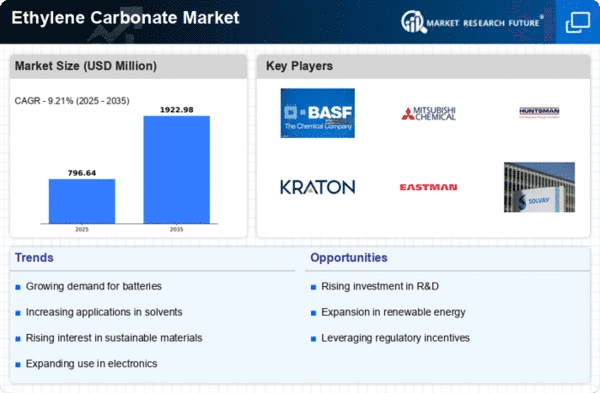
As per MRFR analysis, the Ethylene Carbonate Market Size was estimated at 729.46 USD Million in 2024. The Ethylene Carbonate industry is projected to grow from 796.65 USD Million in 2025 to 1922.98 USD Million by 2035, exhibiting a compound annual growth rate (CAGR) of 9.21 during the forecast period 2025 - 2035.

Key Market Trends & Highlights

The Ethylene Carbonate Market is poised for substantial growth driven by technological advancements and increasing demand in various applications.

  • North America remains the largest market for ethylene carbonate, primarily due to its extensive use in automotive applications. The Asia-Pacific region is emerging as the fastest-growing market, fueled by rising demand in electronics and renewable energy storage solutions. The solvent segment continues to dominate the market, while the electrolyte segment is experiencing rapid growth due to advancements in battery technology. Key market drivers include the rising demand in electric vehicles and regulatory support for sustainable materials, which are shaping market dynamics.

Market Size & Forecast

2024 Market Size 729.46 (USD Million)
2035 Market Size 1922.98 (USD Million)
CAGR (2025 - 2035) 9.21%
Largest Regional Market Share in 2024 Asia-Pacific

Major Players

<p>BASF SE (DE), Mitsubishi Chemical Corporation (JP), Shenzhen Capchem Technology Co., Ltd. (CN), Huntsman Corporation (US), Kraton Corporation (US), Eastman Chemical Company (US), Solvay S.A. (BE), Tianjin Cangzhou Dahua Group Co., Ltd. (CN), Guangzhou Tinci Materials Technology Co., Ltd. (CN)</p>

Market Trends

The Ethylene Carbonate Market is currently experiencing a dynamic phase characterized by evolving applications and increasing demand across various sectors. This compound, known for its versatility, is utilized in industries such as electronics, automotive, and pharmaceuticals. The growing emphasis on sustainable practices and eco-friendly materials is likely to drive innovation in production methods, potentially leading to enhanced efficiency and reduced environmental impact. Furthermore, the rise of electric vehicles and advancements in battery technology may further bolster the demand for ethylene carbonate, as it serves as a key solvent in lithium-ion batteries. In addition to these developments, the Ethylene Carbonate Market appears to be influenced by regulatory frameworks aimed at promoting safer chemical usage. As industries adapt to these regulations, there may be a shift towards more sustainable sourcing and production processes. This transition could foster collaboration among manufacturers, researchers, and policymakers, ultimately leading to a more robust and resilient market. Overall, the Ethylene Carbonate Market is poised for growth, driven by innovation, sustainability, and regulatory compliance.

Sustainable Production Practices

The Ethylene Carbonate Market is witnessing a trend towards sustainable production methods. Manufacturers are increasingly adopting eco-friendly practices to minimize environmental impact. This shift is driven by consumer demand for greener products and regulatory pressures, prompting companies to innovate in their processes.

Expansion in Battery Applications

There is a notable increase in the use of ethylene carbonate in battery technologies, particularly in lithium-ion batteries. As the demand for electric vehicles rises, the Ethylene Carbonate Market is likely to expand, with this compound playing a crucial role in enhancing battery performance and efficiency.

Regulatory Influence on Market Dynamics

Regulatory frameworks are shaping the Ethylene Carbonate Market by promoting safer chemical practices. Compliance with these regulations is encouraging manufacturers to explore alternative sourcing and production methods, which may lead to a more sustainable and responsible market landscape.

Ethylene Carbonate Market Market Drivers

Rising Demand in Battery Applications

The Global Ethylene Carbonate Market Industry experiences a notable surge in demand due to its applications in lithium-ion batteries. As the world shifts towards electric vehicles and renewable energy storage, ethylene carbonate serves as a vital solvent in electrolyte formulations. The increasing adoption of electric vehicles is projected to drive the market, with the industry expected to reach 0.73 USD Billion in 2024. This trend suggests a robust growth trajectory, as manufacturers seek efficient and sustainable materials to enhance battery performance and longevity.

Market Segment Insights

By Application: Solvent (Largest) vs. Electrolyte (Fastest-Growing)

<p>The Ethylene Carbonate Market exhibits a diverse distribution across various application segments, with solvent usage dominating the landscape. This application captures the largest market share, leveraging its versatile properties and established utility in various industrial processes. Other applications, such as electrolytes, <a href="https://www.marketresearchfuture.com/reports/plasticizers-market-2295">plasticizers</a>, intermediates, and additives, also contribute significantly to market dynamics, with electrolytes gaining traction due to their vital role in lithium-ion batteries. In terms of growth trends, the demand for ethylene carbonate as an electrolyte is projected to accelerate, primarily driven by the burgeoning electric vehicle market and the increasing demand for energy storage solutions. Conversely, solvent applications remain steady, supported by ongoing industrial activities. The overall application landscape in the Ethylene Carbonate Market reflects a healthy interplay between established and innovative use cases, catering to a wide array of industries.</p>

<p>Solvent (Dominant) vs. Electrolyte (Emerging)</p>

<p>The solvent segment stands out as the dominant application in the Ethylene Carbonate Market, owing to its indispensable role in various chemical processes and formulations across industries. Its unique solvent properties facilitate a range of applications, from coatings to cleaning agents, thus driving its persistent demand. On the other hand, the electrolyte segment is emerging as a significant player, particularly with the acceleration of electric vehicle and battery technologies. The rapid growth of the green energy sector is fostering advancements in electrolyte applications, making <a href="https://www.marketresearchfuture.com/reports/ethylene-market-931">ethylene</a> carbonate increasingly vital in battery formulations. This juxtaposition highlights the market's dual reliance on established solvent applications while also embracing innovation through the expanding electrolyte sector.</p>

By End Use: Automotive (Largest) vs. Electronics (Fastest-Growing)

<p>In the Ethylene Carbonate Market, the 'End Use' segment showcases a diverse landscape. The Automotive sector holds a significant market share due to the increasing demand for electric vehicles and energy storage solutions, where ethylene carbonate plays a crucial role as a solvent and electrolyte. Following closely is the Electronics sector, which is rapidly gaining traction, characterized by the rising integration of ethylene carbonate in batteries and electronic devices that require high-performance materials. As the industry evolves, certain trends are driving the growth within these segments. The push for environmentally friendly alternatives in automotive applications amplifies ethylene carbonate's appeal, while advancements in electronics innovation spur demand for high-purity solvents and coatings. The Pharmaceuticals segment also presents opportunities, driven by the need for specialized chemical solutions. Overall, the End Use segment reflects dynamic shifts propelled by advancements in technology and sustainability efforts.</p>

<p>Pharmaceuticals (Dominant) vs. Coatings (Emerging)</p>

<p>The Pharmaceuticals sector represents a dominant force within the Ethylene Carbonate Market, leveraging its high purity and solvent properties to enhance drug formulation processes. Ethylene carbonate's capabilities in improving solubility and stability make it an essential ingredient in the pharmaceutical landscape, frequently utilized in various medicinal applications. Conversely, the Coatings sector is regarded as an emerging area, fueled by increasing demand for advanced coatings with enhanced durability and chemical resistance. As a versatile solvent, ethylene carbonate is consistently being incorporated into formulations that cater to the performance requirements of modern coatings, appealing to manufacturers looking to improve their product's longevity and functionality. As both sectors continue to develop, their intersection may yield innovative applications, positioning them as crucial players in the future of the Ethylene Carbonate Market.</p>

By Type: Battery Grade (Largest) vs. Pharmaceutical Grade (Fastest-Growing)

<p>In the Ethylene Carbonate Market, the segment distribution shows that Battery Grade holds the largest market share, driven by the increasing demand for electric vehicles and energy storage systems. Industrial Grade also maintains a considerable presence, while Electronic Grade caters to specific applications in electronics. Pharmaceutical Grade, though smaller, is gaining traction due to the growing pharmaceutical industry and the need for specialized solvents and intermediates. Growth trends indicate a significant boost in the Battery Grade segment as advancements in battery technology continue to expand its applications. The Pharmaceutical Grade segment is emerging rapidly, fueled by innovations in drug development and the increasing focus on high-purity solvents. As sustainability and efficiency become priorities in manufacturing, the demand for these grades is set to grow substantially, positioning them for robust expansion in the foreseeable future.</p>

<p>Battery Grade: Dominant vs. Pharmaceutical Grade: Emerging</p>

<p>Battery Grade ethylene carbonate is characterized by its superior purity and performance in lithium-ion batteries, making it a crucial component for energy storage solutions. Its dominance is largely attributed to the rise of electric vehicles and renewable energy storage systems, leading to increased investments in battery technologies. On the other hand, Pharmaceutical Grade ethylene carbonate is gaining prominence as it meets the stringent requirements of the pharmaceutical industry, providing high-quality solvents for drug formulation and synthesis. This segment is poised for rapid growth, driven by innovations in pharmaceutical applications and a rising demand for specialized chemical products. The interplay of these two segments illustrates the evolving landscape of the Ethylene Carbonate Market, with each catering to distinct yet growing needs.</p>

By Form: Liquid (Largest) vs. Solid (Fastest-Growing)

<p>In the Ethylene Carbonate Market, the distribution among the forms reveals Liquid as the largest segment, commanding significant market share. This is primarily driven by the versatility of Liquid ethylene carbonate, which is extensively used in applications such as solvents, electrolytes for batteries, and various chemical reactions. Solid and Powder forms, while smaller in market share, are rapidly gaining traction due to their specific applications in the pharmaceutical and chemical industries, catering to niche markets and specialized needs.</p>

<p>Form: Liquid (Dominant) vs. Solid (Emerging)</p>

<p>Liquid ethylene carbonate remains the dominant form in the market owing to its superior solubility and compatibility with various chemical compositions. It plays a crucial role in sectors such as battery manufacturing and solvents, enhancing overall product performance. On the other hand, the Solid form of ethylene carbonate is categorized as an emerging segment, gaining momentum for its increasing use in solid-state batteries and specialty chemicals. Its ability to serve targeted applications in pharmaceuticals, coupled with ongoing research and development efforts, positions Solid as a flexible and promising form within the industry, indicating potential growth in the coming years.</p>

By Production Method: Chemical Synthesis (Largest) vs. Recycling (Fastest-Growing)

<p>The Ethylene Carbonate Market exhibits a diverse distribution of production methods, with chemical synthesis holding the largest share. This method is characterized by its efficiency and scalability, allowing for large quantities of ethylene carbonate to be produced consistently. In contrast, recycling, though currently smaller in market share, is gaining traction as industries strive for sustainable practices and waste minimization, particularly in the wake of global environmental concerns. Growth trends within this segment indicate a shift towards more sustainable production practices, with recycling leading as the fastest-growing method. The push for circular economy principles is driving innovations in recycling technologies, which are being adopted to reclaim ethylene carbonate from used materials. Additionally, biotechnological processes, while emerging, are positioned to complement these methods as they offer eco-friendly alternatives, further diversifying the market landscape.</p>

<p>Chemical Synthesis (Dominant) vs. Biotechnological Processes (Emerging)</p>

<p>Chemical synthesis remains the dominant production method in the Ethylene Carbonate Market due to its established processes and cost-effectiveness. It utilizes well-known chemical reactions to convert raw materials into ethylene carbonate, making it highly reliable for large-scale production. This method benefits from economies of scale, ensuring consistent product quality. On the other hand, biotechnological processes are emerging as a viable alternative, leveraging biological systems for production. These processes have the potential to utilize renewable resources, aligning with increasing regulatory pressures for sustainability. While still in the developmental stage, advancements in biotechnological methods could play a crucial role in the future landscape of the ethylene carbonate market, particularly as demand for environmentally friendly products continues to rise.</p>

Get more detailed insights about Ethylene Carbonate Market Research Report - Global Forecast till 2035

Regional Insights

North America : Innovation and Sustainability Focus

The North American Ethylene Carbonate market is projected to reach $145.0 million by 2025, driven by increasing demand in battery applications and sustainable solutions. Regulatory support for green chemistry and eco-friendly products is enhancing market growth. The region's focus on innovation, particularly in electric vehicle (EV) batteries, is a significant growth driver, as manufacturers seek high-performance electrolytes that meet stringent environmental standards. Leading countries in this region include the US and Canada, where major players like Huntsman Corporation and Eastman Chemical Company are actively investing in R&D. The competitive landscape is characterized by a mix of established companies and emerging startups, all vying for market share. The presence of key players ensures a robust supply chain, facilitating the growth of the Ethylene Carbonate market in North America.

Europe : Regulatory Support and Innovation

Europe's Ethylene Carbonate market is expected to grow significantly, reaching €180.0 million by 2025. The region benefits from strong regulatory frameworks promoting sustainable chemicals and renewable energy sources. The European Union's Green Deal and REACH regulations are pivotal in driving demand for eco-friendly materials, particularly in the automotive and electronics sectors, where Ethylene Carbonate is increasingly utilized as a solvent and electrolyte. Germany, France, and the UK are leading countries in this market, with key players like BASF SE and Solvay S.A. spearheading innovation. The competitive landscape is marked by collaborations between chemical manufacturers and technology firms, enhancing product offerings. The presence of established companies ensures a stable supply chain, while ongoing investments in R&D are expected to further boost market growth in Europe.

Asia-Pacific : Dominant Market Leader

The Asia-Pacific region dominates the Ethylene Carbonate market, with a projected size of $350.0 million by 2025. This growth is fueled by rapid industrialization, increasing demand for electric vehicles, and a shift towards sustainable materials. Countries like China and Japan are at the forefront, with government initiatives supporting the development of green technologies and battery production, which are critical for the region's market expansion. China is the largest market, hosting key players such as Shenzhen Capchem Technology Co., Ltd. and Tianjin Cangzhou Dahua Group Co., Ltd. The competitive landscape is vibrant, with numerous local and international companies vying for market share. The presence of established manufacturers and ongoing investments in innovation are expected to sustain the region's leadership in the Ethylene Carbonate market.

Middle East and Africa : Emerging Market Potential

The Middle East and Africa (MEA) Ethylene Carbonate market is projected to reach $54.46 million by 2025, driven by increasing industrial applications and a growing focus on sustainable solutions. The region's economic diversification efforts and investments in renewable energy are catalyzing demand for Ethylene Carbonate, particularly in battery manufacturing and electronics. Regulatory frameworks are gradually evolving to support green chemistry initiatives, enhancing market prospects. Leading countries in this region include South Africa and the UAE, where local manufacturers are beginning to establish a foothold in the market. The competitive landscape is still developing, with opportunities for both local and international players. As the region continues to invest in infrastructure and technology, the Ethylene Carbonate market is expected to witness significant growth in the coming years.

Key Players and Competitive Insights

The Ethylene Carbonate Market is currently characterized by a dynamic competitive landscape, driven by increasing demand for sustainable solvents and electrolytes in battery applications. Key players such as BASF SE (Germany), Mitsubishi Chemical Corporation (Japan), and Shenzhen Capchem Technology Co., Ltd. (China) are strategically positioning themselves through innovation and regional expansion. These companies are focusing on enhancing their product portfolios and optimizing their supply chains to meet the growing needs of various industries, including automotive and electronics. Their collective strategies are shaping a competitive environment that emphasizes sustainability and technological advancement.In terms of business tactics, companies are increasingly localizing manufacturing to reduce lead times and enhance supply chain efficiency. The market appears moderately fragmented, with several players vying for market share. However, the influence of major companies is significant, as they leverage their resources to optimize production processes and invest in research and development. This competitive structure suggests that while there is room for smaller players, the dominance of established firms is likely to shape market trends.


In November BASF SE (Germany) announced a partnership with a leading battery manufacturer to develop advanced electrolyte solutions utilizing ethylene carbonate. This collaboration is expected to enhance the performance of lithium-ion batteries, thereby positioning BASF as a key player in the growing electric vehicle market. The strategic importance of this partnership lies in its potential to drive innovation and meet the increasing demand for high-performance battery materials.Similarly, in October 2025, Mitsubishi Chemical Corporation (Japan) unveiled a new production facility dedicated to the manufacturing of ethylene carbonate in Southeast Asia. This expansion is aimed at catering to the rising demand in the region, particularly from the electronics and automotive sectors. The establishment of this facility underscores Mitsubishi's commitment to regional growth and its strategy to enhance supply chain resilience.


In September Shenzhen Capchem Technology Co., Ltd. (China) launched a new line of eco-friendly ethylene carbonate products, targeting the growing market for sustainable chemicals. This initiative reflects a broader trend towards sustainability within the industry and positions Capchem as a forward-thinking player committed to environmental responsibility. The introduction of these products is likely to attract environmentally conscious consumers and businesses, further enhancing Capchem's market presence.


As of December the Ethylene Carbonate Market is witnessing trends such as digitalization, sustainability, and the integration of AI technologies. Strategic alliances among key players are increasingly shaping the competitive landscape, fostering innovation and collaboration. The shift from price-based competition to a focus on technological advancement and supply chain reliability is evident. Companies that prioritize innovation and sustainability are likely to differentiate themselves in this evolving market, suggesting a future where competitive advantage is defined by the ability to adapt to changing consumer preferences and regulatory landscapes.

Key Companies in the Ethylene Carbonate Market include

Industry Developments

In February 2022: Lotte Chemical announced the building of a new factory in Daesan, South Korea, for the production of high-purity organic solvents like ethylene carbonate, which are used in electric vehicle batteries as part of its USD 502 million investment in the sustainable speciality materials industry.

In May 2021: Lotte Chemical, a significant chemical firm with headquarters in South Korea, said that it would produce electrolyte organic solvents at high-purity ethylene oxide facilities in order to manufacture ingredients for electric vehicle batteries. Over 30% of electrolytes are made up of organic solvents; imports are heavily reliant on this region. The firm said that the board has approved spending 210 billion won, or USD 185 million, to develop a facility that will manufacture organic solvents used in electrolytes such as dimethyl carbonate and ethylene carbonate by the second half of 2023.

Lithium ions are helped by organic solvents to move between the cathode and anode with ease.

In August 2023: Covestro AG announced that it is developing a new process for producing ethylene carbonate from renewable ethylene. The new process is expected to reduce the carbon footprint of ethylene carbonate production by up to 70%. Covestro expects to start commercial production of ethylene carbonate using the new process in 2025.

Future Outlook

Ethylene Carbonate Market Future Outlook

<p>The Ethylene Carbonate Market is poised for growth at a 9.21% CAGR from 2025 to 2035, driven by increasing demand in battery applications, solvent usage, and eco-friendly alternatives.</p>

New opportunities lie in:

  • <p>Expansion into emerging markets with tailored product offerings. Development of high-performance battery-grade ethylene carbonate. Strategic partnerships with electric vehicle manufacturers for supply agreements.</p>

<p>By 2035, the Ethylene Carbonate Market is expected to solidify its position as a key player in sustainable chemical solutions.</p>

Market Segmentation

Ethylene Carbonate Market Form Outlook

  • Liquid
  • Solid
  • Powder

Ethylene Carbonate Market Type Outlook

  • Industrial Grade
  • Battery Grade
  • Pharmaceutical Grade
  • Electronic Grade

Ethylene Carbonate Market End Use Outlook

  • Automotive
  • Electronics
  • Aerospace
  • Pharmaceuticals
  • Coatings

Ethylene Carbonate Market Application Outlook

  • Solvent
  • Electrolyte
  • Plasticizer
  • Intermediate
  • Additive

Ethylene Carbonate Market Production Method Outlook

  • Chemical Synthesis
  • Recycling
  • Biotechnological Processes

Report Scope

MARKET SIZE 2024 729.46(USD Million)
MARKET SIZE 2025 796.65(USD Million)
MARKET SIZE 2035 1922.98(USD Million)
COMPOUND ANNUAL GROWTH RATE (CAGR) 9.21% (2025 - 2035)
REPORT COVERAGE Revenue Forecast, Competitive Landscape, Growth Factors, and Trends
BASE YEAR 2024
Market Forecast Period 2025 - 2035
Historical Data 2019 - 2024
Market Forecast Units USD Million
Key Companies Profiled BASF SE (DE), Mitsubishi Chemical Corporation (JP), Shenzhen Capchem Technology Co., Ltd. (CN), Huntsman Corporation (US), Kraton Corporation (US), Eastman Chemical Company (US), Solvay S.A. (BE), Tianjin Cangzhou Dahua Group Co., Ltd. (CN), Guangzhou Tinci Materials Technology Co., Ltd. (CN)
Segments Covered Application, End Use, Type, Form, Production Method
Key Market Opportunities Growing demand for sustainable solvents and electrolytes in battery applications drives Ethylene Carbonate Market opportunities.
Key Market Dynamics Rising demand for electric vehicles drives growth in the Ethylene Carbonate Market due to its role in battery applications.
Countries Covered North America, Europe, APAC, South America, MEA

FAQs

How much is the Ethylene Carbonate market?

Ethylene Carbonate Market crossed a valuation of USD 0.73 Billion in 2024

What is the growth rate of the Ethylene Carbonate market?

Ethylene Carbonate Market is projected to register a CAGR of 9.21% from 2025-2035

Which region held the largest market share in the Ethylene Carbonate market?

Asia Pacific had a dominantshare inthe market

Who are the key players in the Ethylene Carbonate market?

OUCC, Toagosei Co., Ltd, Mitsubishi Chemical Corporation, Zibo Donghai Industries Co., Ltd, ALFA AESAR,BASF SE Huntsman International LLC, Merck KGaA, New Japan Chemical Co., Ltd, Shandong Senjie Cleantech Co., Ltd, PANAX ETEC, Tokyo Chemical Industry Co., Ltd

Which end use industry had the largest market share in the Ethylene Carbonate market?

automotive, medical, chemical, and industrial, EC in solid form is frequently used

  1. SECTION I: EXECUTIVE SUMMARY AND KEY HIGHLIGHTS
    1. | 1.1 EXECUTIVE SUMMARY
    2. | 1.1.1 Market Overview
    3. | 1.1.2 Key Findings
    4. | 1.1.3 Market Segmentation
    5. | 1.1.4 Competitive Landscape
    6. | 1.1.5 Challenges and Opportunities
    7. | 1.1.6 Future Outlook
  2. SECTION II: SCOPING, METHODOLOGY AND MARKET STRUCTURE
    1. | 2.1 MARKET INTRODUCTION
    2. | 2.1.1 Definition
    3. | 2.1.2 Scope of the study
    4. |-- 2.1.2.1 Research Objective
    5. |-- 2.1.2.2 Assumption
    6. |-- 2.1.2.3 Limitations
    7. | 2.2 RESEARCH METHODOLOGY
    8. | 2.2.1 Overview
    9. | 2.2.2 Data Mining
    10. | 2.2.3 Secondary Research
    11. | 2.2.4 Primary Research
    12. |-- 2.2.4.1 Primary Interviews and Information Gathering Process
    13. |-- 2.2.4.2 Breakdown of Primary Respondents
    14. | 2.2.5 Forecasting Model
    15. | 2.2.6 Market Size Estimation
    16. |-- 2.2.6.1 Bottom-Up Approach
    17. |-- 2.2.6.2 Top-Down Approach
    18. | 2.2.7 Data Triangulation
    19. | 2.2.8 Validation
  3. SECTION III: QUALITATIVE ANALYSIS
    1. | 3.1 MARKET DYNAMICS
    2. | 3.1.1 Overview
    3. | 3.1.2 Drivers
    4. | 3.1.3 Restraints
    5. | 3.1.4 Opportunities
    6. | 3.2 MARKET FACTOR ANALYSIS
    7. | 3.2.1 Value chain Analysis
    8. | 3.2.2 Porter's Five Forces Analysis
    9. |-- 3.2.2.1 Bargaining Power of Suppliers
    10. |-- 3.2.2.2 Bargaining Power of Buyers
    11. |-- 3.2.2.3 Threat of New Entrants
    12. |-- 3.2.2.4 Threat of Substitutes
    13. |-- 3.2.2.5 Intensity of Rivalry
    14. | 3.2.3 COVID-19 Impact Analysis
    15. |-- 3.2.3.1 Market Impact Analysis
    16. |-- 3.2.3.2 Regional Impact
    17. |-- 3.2.3.3 Opportunity and Threat Analysis
  4. SECTION IV: QUANTITATIVE ANALYSIS
    1. | 4.1 Chemicals and Materials, BY Application (USD Million)
    2. | 4.1.1 Solvent
    3. | 4.1.2 Electrolyte
    4. | 4.1.3 Plasticizer
    5. | 4.1.4 Intermediate
    6. | 4.1.5 Additive
    7. | 4.2 Chemicals and Materials, BY End Use (USD Million)
    8. | 4.2.1 Automotive
    9. | 4.2.2 Electronics
    10. | 4.2.3 Aerospace
    11. | 4.2.4 Pharmaceuticals
    12. | 4.2.5 Coatings
    13. | 4.3 Chemicals and Materials, BY Type (USD Million)
    14. | 4.3.1 Industrial Grade
    15. | 4.3.2 Battery Grade
    16. | 4.3.3 Pharmaceutical Grade
    17. | 4.3.4 Electronic Grade
    18. | 4.4 Chemicals and Materials, BY Form (USD Million)
    19. | 4.4.1 Liquid
    20. | 4.4.2 Solid
    21. | 4.4.3 Powder
    22. | 4.5 Chemicals and Materials, BY Production Method (USD Million)
    23. | 4.5.1 Chemical Synthesis
    24. | 4.5.2 Recycling
    25. | 4.5.3 Biotechnological Processes
    26. | 4.6 Chemicals and Materials, BY Region (USD Million)
    27. | 4.6.1 North America
    28. |-- 4.6.1.1 US
    29. |-- 4.6.1.2 Canada
    30. | 4.6.2 Europe
    31. |-- 4.6.2.1 Germany
    32. |-- 4.6.2.2 UK
    33. |-- 4.6.2.3 France
    34. |-- 4.6.2.4 Russia
    35. |-- 4.6.2.5 Italy
    36. |-- 4.6.2.6 Spain
    37. |-- 4.6.2.7 Rest of Europe
    38. | 4.6.3 APAC
    39. |-- 4.6.3.1 China
    40. |-- 4.6.3.2 India
    41. |-- 4.6.3.3 Japan
    42. |-- 4.6.3.4 South Korea
    43. |-- 4.6.3.5 Malaysia
    44. |-- 4.6.3.6 Thailand
    45. |-- 4.6.3.7 Indonesia
    46. |-- 4.6.3.8 Rest of APAC
    47. | 4.6.4 South America
    48. |-- 4.6.4.1 Brazil
    49. |-- 4.6.4.2 Mexico
    50. |-- 4.6.4.3 Argentina
    51. |-- 4.6.4.4 Rest of South America
    52. | 4.6.5 MEA
    53. |-- 4.6.5.1 GCC Countries
    54. |-- 4.6.5.2 South Africa
    55. |-- 4.6.5.3 Rest of MEA
  5. SECTION V: COMPETITIVE ANALYSIS
    1. | 5.1 Competitive Landscape
    2. | 5.1.1 Overview
    3. | 5.1.2 Competitive Analysis
    4. | 5.1.3 Market share Analysis
    5. | 5.1.4 Major Growth Strategy in the Chemicals and Materials
    6. | 5.1.5 Competitive Benchmarking
    7. | 5.1.6 Leading Players in Terms of Number of Developments in the Chemicals and Materials
    8. | 5.1.7 Key developments and growth strategies
    9. |-- 5.1.7.1 New Product Launch/Service Deployment
    10. |-- 5.1.7.2 Merger & Acquisitions
    11. |-- 5.1.7.3 Joint Ventures
    12. | 5.1.8 Major Players Financial Matrix
    13. |-- 5.1.8.1 Sales and Operating Income
    14. |-- 5.1.8.2 Major Players R&D Expenditure. 2023
    15. | 5.2 Company Profiles
    16. | 5.2.1 BASF SE (DE)
    17. |-- 5.2.1.1 Financial Overview
    18. |-- 5.2.1.2 Products Offered
    19. |-- 5.2.1.3 Key Developments
    20. |-- 5.2.1.4 SWOT Analysis
    21. |-- 5.2.1.5 Key Strategies
    22. | 5.2.2 Mitsubishi Chemical Corporation (JP)
    23. |-- 5.2.2.1 Financial Overview
    24. |-- 5.2.2.2 Products Offered
    25. |-- 5.2.2.3 Key Developments
    26. |-- 5.2.2.4 SWOT Analysis
    27. |-- 5.2.2.5 Key Strategies
    28. | 5.2.3 Shenzhen Capchem Technology Co., Ltd. (CN)
    29. |-- 5.2.3.1 Financial Overview
    30. |-- 5.2.3.2 Products Offered
    31. |-- 5.2.3.3 Key Developments
    32. |-- 5.2.3.4 SWOT Analysis
    33. |-- 5.2.3.5 Key Strategies
    34. | 5.2.4 Huntsman Corporation (US)
    35. |-- 5.2.4.1 Financial Overview
    36. |-- 5.2.4.2 Products Offered
    37. |-- 5.2.4.3 Key Developments
    38. |-- 5.2.4.4 SWOT Analysis
    39. |-- 5.2.4.5 Key Strategies
    40. | 5.2.5 Kraton Corporation (US)
    41. |-- 5.2.5.1 Financial Overview
    42. |-- 5.2.5.2 Products Offered
    43. |-- 5.2.5.3 Key Developments
    44. |-- 5.2.5.4 SWOT Analysis
    45. |-- 5.2.5.5 Key Strategies
    46. | 5.2.6 Eastman Chemical Company (US)
    47. |-- 5.2.6.1 Financial Overview
    48. |-- 5.2.6.2 Products Offered
    49. |-- 5.2.6.3 Key Developments
    50. |-- 5.2.6.4 SWOT Analysis
    51. |-- 5.2.6.5 Key Strategies
    52. | 5.2.7 Solvay S.A. (BE)
    53. |-- 5.2.7.1 Financial Overview
    54. |-- 5.2.7.2 Products Offered
    55. |-- 5.2.7.3 Key Developments
    56. |-- 5.2.7.4 SWOT Analysis
    57. |-- 5.2.7.5 Key Strategies
    58. | 5.2.8 Tianjin Cangzhou Dahua Group Co., Ltd. (CN)
    59. |-- 5.2.8.1 Financial Overview
    60. |-- 5.2.8.2 Products Offered
    61. |-- 5.2.8.3 Key Developments
    62. |-- 5.2.8.4 SWOT Analysis
    63. |-- 5.2.8.5 Key Strategies
    64. | 5.2.9 Guangzhou Tinci Materials Technology Co., Ltd. (CN)
    65. |-- 5.2.9.1 Financial Overview
    66. |-- 5.2.9.2 Products Offered
    67. |-- 5.2.9.3 Key Developments
    68. |-- 5.2.9.4 SWOT Analysis
    69. |-- 5.2.9.5 Key Strategies
    70. | 5.3 Appendix
    71. | 5.3.1 References
    72. | 5.3.2 Related Reports

Chemicals and Materials Market Segmentation

Chemicals and Materials By Application (USD Million, 2025-2035)

  • Solvent
  • Electrolyte
  • Plasticizer
  • Intermediate
  • Additive

Chemicals and Materials By End Use (USD Million, 2025-2035)

  • Automotive
  • Electronics
  • Aerospace
  • Pharmaceuticals
  • Coatings

Chemicals and Materials By Type (USD Million, 2025-2035)

  • Industrial Grade
  • Battery Grade
  • Pharmaceutical Grade
  • Electronic Grade

Chemicals and Materials By Form (USD Million, 2025-2035)

  • Liquid
  • Solid
  • Powder

Chemicals and Materials By Production Method (USD Million, 2025-2035)

  • Chemical Synthesis
  • Recycling
  • Biotechnological Processes
Infographic

Free Sample Request

Kindly complete the form below to receive a free sample of this Report

Get Free Sample

Customer Strories

Compare Licence

×
Features License Type
Single User Multiuser License Enterprise User
Price $4,950 $5,950 $7,250
Maximum User Access Limit 1 User Upto 10 Users Unrestricted Access Throughout the Organization
Free Customization
Direct Access to Analyst
Deliverable Format
Platform Access
Discount on Next Purchase 10% 15% 15%
Printable Versions