×
Request Free Sample ×

Kindly complete the form below to receive a free sample of this Report

* Please use a valid business email

Leading companies partner with us for data-driven Insights

clients tt-cursor
Hero Background

Earth Observation Satellite Market

ID: MRFR/AD/4512-HCR
100 Pages
Swapnil Palwe
February 2026

Earth Observation Satellite Market Size, Share, Industry Trend & Analysis Research Report Information by Applications (Infrastructure, Environment Monitoring, Energy, Natural Resources Monitoring, Maritime, Disaster Management, & Others), Payload Type, and Region Global Forecast to 2032

Share:
Download PDF ×

We do not share your information with anyone. However, we may send you emails based on your report interest from time to time. You may contact us at any time to opt-out.

Earth Observation Satellite Market Infographic
Purchase Options

Earth Observation Satellite Market Summary

As per MRFR analysis, the Earth Observation Satellite Market Size was estimated at 13.0 USD Billion in 2024. The Earth Observation Satellite industry is projected to grow from 14.2 in 2025 to 35.6 by 2035, exhibiting a compound annual growth rate (CAGR) of 9.63% during the forecast period 2025 - 2035.

Key Market Trends & Highlights

The Earth Observation Satellite Market is experiencing robust growth driven by technological advancements and increasing demand across various sectors.

  • Technological advancements in satellite design are enhancing the capabilities and efficiency of Earth observation systems.
  • North America remains the largest market, while the Asia-Pacific region is emerging as the fastest-growing area for satellite applications.
  • The agriculture segment dominates the market, whereas the disaster management segment is witnessing the most rapid growth.
  • Key market drivers include rising demand for disaster management and increasing applications in agriculture, reflecting the critical role of Earth observation in these sectors.

Market Size & Forecast

2024 Market Size 13.0 (USD Billion)
2035 Market Size 35.6 (USD Billion)
CAGR (2025 - 2035) 9.63%

Major Players

Maxar Technologies (US), Airbus Defence and Space (FR), Planet Labs (US), Northrop Grumman (US), Thales Alenia Space (FR), Spire Global (US), BlackSky Global (US), Satellite Imaging Corporation (US)

Our Impact
Enabled $4.3B Revenue Impact for Fortune 500 and Leading Multinationals
Partnering with 2000+ Global Organizations Each Year
30K+ Citations by Top-Tier Firms in the Industry

Earth Observation Satellite Market Trends

The Earth Observation Satellite Market is currently experiencing a transformative phase, driven by advancements in technology and increasing demand for data analytics. The proliferation of satellite constellations has enhanced the ability to monitor environmental changes, urban development, and agricultural practices. This market appears to be expanding as various sectors recognize the value of satellite imagery for decision-making processes within the satellite-based earth observation market ecosystem. Furthermore, the integration of artificial intelligence and machine learning into satellite data processing is likely to improve the accuracy and efficiency of data interpretation, thereby attracting a broader range of users.

In addition, the growing emphasis on sustainability and climate change mitigation is propelling investments in Earth observation technologies. Governments and private entities are increasingly utilizing satellite data to track deforestation, monitor water resources, and assess natural disasters. This trend suggests a shift towards more proactive measures in environmental management. As the Earth Observation Satellite Market continues to evolve, it may play a crucial role in addressing global challenges, fostering collaboration among nations, and promoting informed policy-making. Regional initiatives such as the satellite-based earth observation market in europe also contribute significantly to innovation and sustainability-focused programs.

Technological Advancements

Recent innovations in satellite technology are enhancing the capabilities of Earth observation systems. The development of smaller, more efficient satellites allows for increased frequency of data collection, which is essential for real-time monitoring and analysis. These advancements strengthen overall satellite based earth observation market prospects to 2026, supporting early adoption and deployment across commercial and government sectors.

Growing Demand for Environmental Monitoring

There is an increasing need for accurate environmental monitoring, driven by global concerns regarding climate change and resource management. Earth Observation Satellites are being utilized to gather critical data on atmospheric conditions, land use changes, and natural disasters. This trend indicates a heightened awareness of the importance of sustainable practices and the role of satellite data in supporting these efforts.

Expansion of Commercial Satellite Services

The Earth Observation Satellite Market is witnessing a surge in commercial satellite services, as private companies enter the sector. This expansion is fostering competition and innovation, leading to the development of new applications and services. The involvement of commercial entities suggests a shift towards a more diverse and dynamic market landscape, with potential benefits for various industries.

Earth Observation Satellite Market Drivers

Market Growth Projections

The Global Earth Observation Satellite Industry is projected to experience substantial growth over the next decade. With a market value of 0.29 USD Billion in 2024, it is anticipated to reach 0.7 USD Billion by 2035. This growth is underpinned by a compound annual growth rate (CAGR) of 8.21% from 2025 to 2035. Factors contributing to this expansion include increasing demand for satellite data across various sectors, advancements in technology, and heightened government support. The market's trajectory indicates a promising future, as stakeholders recognize the critical role of Earth observation satellites in addressing global challenges.

Government Initiatives and Funding

Government initiatives and funding significantly influence the Global Earth Observation Satellite Industry. Many countries are investing in satellite programs to enhance their capabilities in monitoring and managing natural resources. For instance, the United States government has allocated substantial budgets for NASA and NOAA satellite missions, which provide critical data for weather forecasting and climate research. These investments not only support national interests but also foster international collaboration in satellite data sharing. As a result, the market is expected to grow, with projections indicating a rise from 0.29 USD Billion in 2024 to 0.7 USD Billion by 2035, driven by increased government support and funding.

Growing Applications in Agriculture

The application of Earth observation satellites in agriculture is rapidly expanding, contributing to the growth of the Global Earth Observation Satellite Industry. Farmers and agronomists utilize satellite imagery for precision agriculture, enabling them to monitor crop health, optimize resource usage, and improve yields. For example, satellite data can help identify areas of drought or pest infestations, allowing for timely interventions. This trend is likely to continue, with the market projected to grow from 0.29 USD Billion in 2024 to 0.7 USD Billion by 2035, as more agricultural stakeholders recognize the benefits of satellite technology in enhancing food security and sustainability.

Advancements in Satellite Technology

Technological advancements play a pivotal role in shaping the Global Earth Observation Satellite Industry. Innovations in satellite design, miniaturization, and sensor technology enhance data collection capabilities. For example, the deployment of small satellites, or CubeSats, allows for more frequent and cost-effective data acquisition. These advancements not only improve the quality of data but also expand the range of applications, including agriculture, urban planning, and disaster management. As technology continues to evolve, the market is poised for growth, with an anticipated increase in market value from 0.29 USD Billion in 2024 to 0.7 USD Billion by 2035, reflecting the growing reliance on satellite data across various sectors.

Emerging Markets and Global Collaboration

Emerging markets are increasingly recognizing the value of Earth observation satellites, which is driving growth in the Global Earth Observation Satellite Industry. Countries in Asia, Africa, and South America are investing in satellite technology to address local challenges such as urbanization, resource management, and disaster response. Collaborative efforts, such as the Group on Earth Observations, facilitate data sharing and capacity building among nations. This trend suggests a robust growth trajectory, with the market expected to expand from 0.29 USD Billion in 2024 to 0.7 USD Billion by 2035, reflecting the global commitment to leveraging satellite data for sustainable development.

Increasing Demand for Environmental Monitoring

The Global Earth Observation Satellite Industry experiences a surge in demand for environmental monitoring solutions. Governments and organizations are increasingly utilizing satellite data to track climate change, deforestation, and natural disasters. For instance, the European Space Agency's Copernicus program provides critical data for monitoring land use and environmental changes. This heightened focus on sustainability and environmental protection is expected to drive the market's growth, with projections indicating a market value of 0.29 USD Billion in 2024, potentially reaching 0.7 USD Billion by 2035. The compound annual growth rate (CAGR) of 8.21% from 2025 to 2035 underscores the importance of satellite technology in addressing global environmental challenges.

Market Segment Insights

By Application: Agriculture (Largest) vs. Disaster Management (Fastest-Growing)

The Earth Observation Satellite Market is segmented into various applications, among which Agriculture holds the largest share. The increased demand for precision farming and crop monitoring has positioned Agriculture as a key player in the market. Other segments, including Forestry and Urban Planning, also contribute significantly but do not compare to the expansive scope of Agriculture's utility in optimizing yield and resources. Disaster Management is the fastest-growing segment, driven by the increasing frequency of natural disasters and the need for timely information. Urban Planning follows due to its relevance in infrastructure development and sustainability efforts. As technology advances, real-time data from Earth observation satellites enhances decision-making in these sectors, fueling their growth and adoption in the market.

Agriculture (Dominant) vs. Disaster Management (Emerging)

In the Earth Observation Satellite Market, Agriculture is the dominant application due to its essential role in enhancing food security and improving farming efficiency. The integration of satellite data into agricultural practices facilitates precision farming, enabling farmers to monitor crop health, soil conditions, and weather patterns effectively. Conversely, Disaster Management is emerging rapidly due to heightened awareness about climate change and environmental disasters. With increasing reliance on real-time satellite imagery for emergency response and recovery efforts, this segment is gaining traction. Both sectors leverage advanced satellite technologies, but Agriculture remains foundational in market leadership.

By End Use: Government (Largest) vs. Commercial (Fastest-Growing)

The Earth Observation Satellite Market is primarily segmented into four end-use categories: Government, Commercial, Research Institutions, and Non-Governmental Organizations (NGOs). Among these, the Government sector holds the largest share, driven by investments in surveillance, disaster management, and environmental monitoring. The Commercial sector is also significantly growing, capturing an increasing share of the market as private companies leverage satellite data for applications in agriculture, mapping, and telecommunications.

Government (Dominant) vs. Commercial (Emerging)

The Government sector represents the dominant force in the Earth Observation Satellite Market, utilizing satellite technology for national security, public safety, and resource management. This segment benefits from substantial budget allocations and long-term contracts with satellite manufacturers, ensuring a steady demand for satellite services. Conversely, the Commercial sector is emerging robustly, characterized by a surge in private investments and innovations. Companies are increasingly employing satellite data for various applications, including urban planning and climate monitoring, thereby fostering competition and technological advancements. This dynamic landscape signifies a shift towards a more competitive environment where commercial entities are poised to play a crucial role in the future of Earth observation.

By Technology: Optical (Largest) vs. Radar (Fastest-Growing)

The Earth Observation Satellite Market is significantly shaped by its technology segment, with Optical technology leading in market share due to its widespread application in imaging and surveillance. Radar technology follows closely, known for its proficiency in all-weather conditions and night operations. Meanwhile, emerging technologies like Lidar and Hyperspectral are gaining traction, yet they still represent a smaller proportion of the overall market. As satellite capabilities expand, the competition among these technologies intensifies, influencing strategic investments and advancements.

Technology: Optical (Dominant) vs. Radar (Emerging)

Optical technology has established itself as the dominant force in the Earth Observation Satellite Market, leveraging high-resolution imaging capabilities for applications ranging from environmental monitoring to disaster management. Meanwhile, Radar technology, while not as prevalent, is quickly emerging due to its ability to provide consistent data irrespective of weather conditions and daylight, making it highly valuable for tasks like military reconnaissance and agricultural assessment. The unique features of Optical and Radar satellites lead to their respective applications in various sectors, pushing companies to innovate and enhance satellite functionalities to cater to diverse user needs.

By Platform Type: Satellite (Largest) vs. Airborne (Fastest-Growing)

In the Earth Observation Satellite Market, the platform type segment is dominated by satellite-based systems, which hold a significant share due to their extensive range and high-resolution imaging capabilities. Ground-based and airborne systems represent smaller fractions of the market but play crucial roles in specific applications, such as local monitoring and immediate data collection. The diversity in platform types allows for comprehensive data collection, catering to various industries including agriculture, environmental monitoring, and national defense. The growth trends within this segment are primarily driven by advances in satellite technology, reduced launch costs, and a rising demand for real-time data across multiple sectors. Airborne platforms are emerging rapidly, fueled by innovations in drone technology and increasing applications in disaster response and surveillance. As a result, while satellites maintain a dominant presence, airborne systems are quickly gaining traction and are expected to see significant growth in the coming years.

Satellite (Dominant) vs. Airborne (Emerging)

Satellite platforms are the cornerstone of the Earth Observation Satellite Market, providing vast coverage and high-quality data for numerous applications, including climate monitoring and urban planning. Their maturity and reliability make them the preferred choice for long-term monitoring and data continuity. Conversely, airborne platforms, utilizing technologies such as drones and piloted aircraft, offer flexibility and rapid deployment capabilities. They excel in capturing high-resolution data for localized studies, making them particularly valuable for urgent applications like disaster response. The increasing coupling of airborne with satellite data enhances the usability and richness of datasets, positioning airborne platforms as a vital emerging segment in this evolving market.

By Data Type: Imagery (Largest) vs. Weather Data (Fastest-Growing)

The Earth Observation Satellite Market showcases a diverse range of data type segments, prominently featuring Imagery as the largest contributor. This segment captures a significant share of the market, leveraging advanced imaging technologies to provide high-resolution insights for various applications such as urban planning, agriculture, and natural resource management. Following closely are Geospatial and Environmental Monitoring, both critical for informed decision-making and disaster response. Weather Data is witnessing a robust growth trajectory, reflecting the increasing reliance on satellite technology for accurate forecasting and climate analysis. Growth trends in the data type segment are intrinsically linked to technological advancements and the rising demand for real-time information. The proliferation of satellite constellations is enabling faster data acquisition and processing, enhancing the accessibility of Imagery and Geospatial data. Additionally, Environmental Monitoring is gaining traction due to heightened awareness surrounding climate change, driving initiatives that leverage satellite data for sustainable development. Weather Data is positioned as the fastest-growing segment, fueled by advancements in predictive analytics and the necessity for precise weather forecasting in various industries, including agriculture and disaster management.

Environmental Monitoring (Dominant) vs. Geospatial (Emerging)

Environmental Monitoring stands out as a dominant force within the Earth Observation Satellite Market, benefitting from various government initiatives and private sector investments aimed at tackling climate-related challenges. This segment focuses on tracking environmental changes such as deforestation, air quality, and water resources, utilizing advanced satellite technologies for comprehensive data collection. In contrast, Geospatial data is emerging rapidly as businesses increasingly recognize the value of spatial insights for strategic decision-making. As technology evolves, Geospatial data offers innovative applications across sectors like transportation, logistics, and urban planning, marking it as a critical area for future investment and development.

Get more detailed insights about Earth Observation Satellite Market

Regional Insights

North America : Market Leader in Innovation

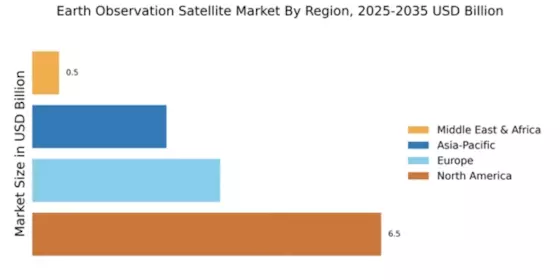
North America continues to lead the Earth Observation Satellite Market, holding a significant market share of 6.5 billion in 2024. The region's growth is driven by increasing demand for satellite imagery across various sectors, including agriculture, defense, and urban planning. Regulatory support from agencies like NASA and NOAA further catalyzes advancements in satellite technology and data accessibility, enhancing market dynamics. The competitive landscape is robust, with key players such as Maxar Technologies, Planet Labs, and Northrop Grumman dominating the market. The U.S. government’s investment in satellite programs and partnerships with private firms fosters innovation and technological advancements. This synergy between public and private sectors positions North America as a powerhouse in the Earth Observation Satellite Market, ensuring continued growth and leadership.

Europe : Emerging Hub for Satellite Technology

Europe's Earth Observation Satellite Market is poised for growth, with a market size of 3.5 billion. The region benefits from strong regulatory frameworks and initiatives like the Copernicus program, which promotes the use of satellite data for environmental monitoring and disaster management. Increasing awareness of climate change and the need for sustainable practices drive demand for satellite imagery across various sectors, including agriculture and urban planning. Leading countries such as France, Germany, and the UK are at the forefront of this market, with key players like Airbus Defence and Space and Thales Alenia Space contributing to technological advancements. The competitive landscape is characterized by collaborations between government agencies and private firms, enhancing innovation and market penetration. As Europe continues to invest in satellite technology, it solidifies its position as a key player in The Earth Observation Satellite.

Asia-Pacific : Rapidly Growing Market Potential

The Asia-Pacific Earth Observation Satellite Market, valued at 2.5 billion, is witnessing rapid growth driven by increasing investments in satellite technology and rising demand for data analytics. Countries like China and India are significantly enhancing their satellite capabilities, focusing on applications in agriculture, urban development, and disaster management. Government initiatives and funding are crucial in supporting these advancements, creating a favorable regulatory environment for market expansion. This trend also highlights opportunities within the china satellite-based earth observation market, which continues to gain strategic importance globally. China and India are leading the charge in this region, with companies like Spire Global and BlackSky Global emerging as key players. The competitive landscape is evolving, with a mix of established firms and startups innovating in satellite technology. This dynamic environment is expected to attract further investments, positioning Asia-Pacific as a vital player in The Earth Observation Satellite.

Middle East and Africa : Untapped Market with Potential

The Middle East and Africa region represents an untapped market in the Earth Observation Satellite sector, with a market size of 0.5 billion. The growth is driven by increasing interest in satellite data for agriculture, urban planning, and environmental monitoring. Governments are beginning to recognize the value of satellite technology, leading to initiatives aimed at enhancing data accessibility and utilization across various sectors. Countries like South Africa and the UAE are taking the lead in developing satellite capabilities, with investments in local satellite programs. The competitive landscape is still emerging, with a mix of local startups and international players looking to establish a foothold. As awareness of the benefits of satellite data grows, the region is expected to see increased investment and development in the Earth Observation Satellite Market.

Earth Observation Satellite Market Regional Image

Key Players and Competitive Insights

The Earth Observation Satellite Market is currently characterized by a dynamic competitive landscape, driven by advancements in technology, increasing demand for data analytics, and a growing emphasis on sustainability. Key players such as Maxar Technologies (US), Airbus Defence and Space (FR), and Planet Labs (US) are strategically positioned to leverage these trends. Maxar Technologies (US) focuses on enhancing its satellite imaging capabilities through innovative technologies, while Airbus Defence and Space (FR) emphasizes partnerships to expand its service offerings. Planet Labs (US) is notable for its agile approach to satellite deployment, which allows for rapid data acquisition and processing, thereby shaping a competitive environment that prioritizes speed and efficiency.In terms of business tactics, companies are increasingly localizing manufacturing and optimizing supply chains to enhance operational efficiency. The market appears moderately fragmented, with several key players exerting influence over specific segments. This fragmentation allows for niche players to thrive, while larger companies consolidate their positions through strategic partnerships and technological advancements.
In November Maxar Technologies (US) announced a collaboration with a leading environmental organization to provide high-resolution satellite imagery for climate monitoring. This partnership is strategically significant as it aligns with global sustainability goals and positions Maxar as a key player in the climate data sector, potentially enhancing its market share and reputation.
In October Airbus Defence and Space (FR) launched a new satellite designed specifically for agricultural monitoring, which is expected to provide farmers with critical data to optimize crop yields. This move not only diversifies Airbus's portfolio but also reflects a growing trend towards utilizing satellite data for precision agriculture, indicating a shift in market focus towards sector-specific applications.
In September Planet Labs (US) expanded its satellite constellation, increasing its imaging capacity significantly. This expansion is crucial as it enhances Planet's ability to provide timely and comprehensive data to various industries, including urban planning and disaster response, thereby reinforcing its competitive edge in the market.
As of December current trends in the Earth Observation Satellite Market include a strong emphasis on digitalization, sustainability, and the integration of artificial intelligence (AI) into data processing. Strategic alliances are increasingly shaping the competitive landscape, allowing companies to pool resources and expertise. Looking ahead, competitive differentiation is likely to evolve from traditional price-based competition to a focus on innovation, technological advancements, and supply chain reliability, suggesting a transformative shift in how companies position themselves in the market.

Key Companies in the Earth Observation Satellite Market include

Industry Developments

  • Q2 2024: SpaceX wins $1.8 billion U.S. spy satellite contract SpaceX secured a $1.8 billion contract from the U.S. National Reconnaissance Office to build and launch at least 100 spy satellites, with six launches already completed in 2024.
  • Q2 2024: NASA awards $476 million contract for commercial satellite data acquisition NASA announced a $476 million contract to acquire commercial Earth observation satellite data, supporting its research and monitoring programs.
  • Q2 2024: NGA launches $290 million program for global monitoring analytics The NGA initiated a $290 million program to acquire analytics for continuous global monitoring, leveraging commercial Earth observation satellite data providers.
  • Q2 2024: Pixxel raises $36 million Series B to expand hyperspectral satellite constellation Indian startup Pixxel closed a $36 million Series B funding round to accelerate deployment of its hyperspectral Earth observation satellites.
  • Q1 2024: Maxar Technologies and Satellogic announce strategic partnership for data analytics Maxar Technologies and Satellogic entered a partnership to jointly offer advanced Earth observation data analytics to government and commercial clients.
  • Q2 2024: Indonesia signs multi-million dollar contract for new Earth observation satellites The Indonesian government signed a contract with an international consortium to acquire new Earth observation satellites for environmental and disaster monitoring.
  • Q2 2024: Capella Space secures $60 million in new funding for SAR satellite expansion Capella Space raised $60 million in a funding round to expand its synthetic aperture radar (SAR) satellite constellation for global Earth observation.
  • Q1 2024: BlackSky Technology wins $50 million contract with U.S. Department of Defense BlackSky Technology was awarded a $50 million contract to provide real-time geospatial intelligence and Earth observation data to the U.S. Department of Defense.
  • Q2 2024: Morocco signs deal for advanced Earth observation satellite system Morocco finalized an agreement to procure a new advanced Earth observation satellite system to enhance its agricultural and security monitoring capabilities.
  • Q1 2024: Planet Labs launches new high-resolution Earth observation satellites Planet Labs successfully launched a new batch of high-resolution Earth observation satellites, expanding its global imaging capabilities.
  • Q2 2024: Poland invests in national Earth observation satellite program The Polish government announced a major investment in a national Earth observation satellite program to support environmental and security initiatives.
  • Q2 2024: OroraTech opens new satellite manufacturing facility in Munich OroraTech inaugurated a new manufacturing facility in Munich to scale production of its wildfire monitoring Earth observation satellites.

The report for Global Earth Observation Satellite Market of Market Research Future comprises extensive primary research along with the detailed analysis of qualitative as well as quantitative aspects by various industry experts, key opinion leaders to gain the deeper insight of the market and industry performance. The report gives the clear picture of current market scenario which includes historical and projected market size in terms of value and volume, technological advancement, macro economic and governing factors in the market. The report provides details information and strategies of the top key players in the industry.

The report also gives a broad study of the different market segments and regions.


Future Outlook

Earth Observation Satellite Market Future Outlook

The Earth Observation Satellite Market is projected to grow at a 9.63% CAGR from 2025 to 2035, driven by advancements in technology, increasing demand for environmental monitoring, and enhanced data analytics capabilities.

New opportunities lie in:

  • Development of AI-driven analytics platforms for satellite data interpretation. Expansion of satellite-based agricultural monitoring services for precision farming. Partnerships with governments for disaster management and response solutions.

By 2035, the Earth Observation Satellite Market is expected to be robust, driven by innovative applications and strategic partnerships.

Market Segmentation

Earth Observation Satellite Market End Use Outlook

  • Government
  • Commercial
  • Research Institutions
  • Non-Governmental Organizations

Earth Observation Satellite Market Technology Outlook

  • Remote Sensing
  • Geographic Information Systems
  • Data Analytics
  • Artificial Intelligence

Earth Observation Satellite Market Application Outlook

  • Agriculture
  • Forestry
  • Urban Planning
  • Disaster Management
  • Climate Monitoring

Earth Observation Satellite Market Service Type Outlook

  • Data Acquisition
  • Data Processing
  • Consulting Services
  • Training and Support

Earth Observation Satellite Market Satellite Type Outlook

  • Optical Satellites
  • Radar Satellites
  • Hyperspectral Satellites
  • Multispectral Satellites

Report Scope

MARKET SIZE 2024 13.0(USD Billion)
MARKET SIZE 2025 14.2(USD Billion)
MARKET SIZE 2035 35.6(USD Billion)
COMPOUND ANNUAL GROWTH RATE (CAGR) 9.63% (2025 - 2035)
REPORT COVERAGE Revenue Forecast, Competitive Landscape, Growth Factors, and Trends
BASE YEAR 2024
Market Forecast Period 2025 - 2035
Historical Data 2019 - 2024
Market Forecast Units USD Billion
Key Companies Profiled Maxar Technologies (US), Airbus Defence and Space (FR), Planet Labs (US), Northrop Grumman (US), Thales Alenia Space (FR), Spire Global (US), BlackSky Global (US), Satellite Imaging Corporation (US)
Segments Covered Application, End Use, Satellite Type, Technology, Service Type
Key Market Opportunities Integration of artificial intelligence in Earth Observation Satellite Market enhances data analysis and decision-making capabilities.
Key Market Dynamics Technological advancements and regulatory changes drive competition and innovation in the Earth Observation Satellite Market.
Countries Covered North America, Europe, APAC, South America, MEA

Market Highlights

Author
Author Profile
Swapnil Palwe
Team Lead - Research

With a technical background as Bachelor's in Mechanical Engineering, with MBA in Operations Management , Swapnil has 6+ years of experience in market research, consulting and analytics with the tasks of data mining, analysis, and project execution. He is the POC for our clients, for their consulting projects running under the Automotive/A&D domain. Swapnil has worked on major projects in verticals such as Aerospace & Defense, Automotive and many other domain projects. He has worked on projects for fortune 500 companies' syndicate and consulting projects along with several government projects.

Leave a Comment

FAQs

What is the projected market valuation of the Earth Observation Satellite Market by 2035?

<p>The Earth Observation Satellite Market is projected to reach a valuation of 35.6 USD Billion by 2035.</p>

What was the market valuation of the Earth Observation Satellite Market in 2024?

<p>In 2024, the Earth Observation Satellite Market was valued at 13.0 USD Billion.</p>

What is the expected CAGR for the Earth Observation Satellite Market during the forecast period 2025 - 2035?

<p>The expected CAGR for the Earth Observation Satellite Market during the forecast period 2025 - 2035 is 9.63%.</p>

Which companies are considered key players in the Earth Observation Satellite Market?

<p>Key players in the Earth Observation Satellite Market include Maxar Technologies, Airbus Defence and Space, Planet Labs, and Northrop Grumman.</p>

What are the primary applications of Earth observation satellites?

<p>Primary applications include agriculture, forestry, urban planning, disaster management, and climate monitoring.</p>

How does the market valuation for agriculture compare to climate monitoring in 2025?

In 2025, the market valuation for agriculture is expected to be between 3.0 and 8.0 USD Billion, while climate monitoring is projected to range from 3.5 to 11.6 USD Billion.

What is the market segmentation by end use for Earth observation satellites?

The market segmentation by end use includes government, commercial, research institutions, and non-governmental organizations.

What technology types are utilized in the Earth Observation Satellite Market?

Technology types utilized include optical, radar, hyperspectral, and lidar.

What is the projected valuation for the satellite platform type by 2035?

The projected valuation for the satellite platform type is expected to reach between 7.0 and 19.6 USD Billion by 2035.

What data types are relevant in the Earth Observation Satellite Market?

Relevant data types include imagery, geospatial data, environmental monitoring, and weather data.

Research Approach

Earth Observation Satellite Market

Market Research Future (MRFR) has adopted a methodical and systematic approach to develop the report on the Earth Observation Satellite Market. The research and analysis conducted include a study of both the primary and the secondary research. The primary research consists of inputs from industry professionals and experts such as CEOs, VPs, Directors, and executives. The secondary research includes reliable sources of information such as industry journals, white papers, and websites, and will include governmental sources. The data used for economic modelling is derived from national statistics databases of various countries.

Tertiary information consists of the analysis of the data and building a relationship between two variables from different sources to estimate the potential economic magnitude of the market. All the details have been assessed using superior and proven research methodology and assumptions. The details have been further cross-checked with the help of trusted published sources. Furthermore, research outputs from established economic models have been leveraged to deduce sensible inferences about the Earth Observation Satellite Market.

Information Procurement Process

Primary and Secondary Data

The secondary sources of data have been extensively used to identify market dynamics of the Earth Observation Satellite Market. Data triangulation and market breakdown were carried out to complete primary and secondary research. Secondary research sources include reliable published sources of industry information.

Primary data and secondary data have been used to review, analyse and research the Earth Observation Satellite Market. To garner primary data, several interviews and interactions were also conducted with the market experts, who provided valuable insights into the market. A syndicated approach was applied in the market assessment process. The market was segmented according to components, type, end user, and region. It also provides an insight into the key developments of the market within different regions. A demand-side as well as a supply-side approach is used to describe the various facets of the Earth Observation Satellite Market.

Research Approaches Used

The Earth Observation Satellite Market is studied by using various methods such as bottom-up approach, top-down approach, factor analysis, and time-series analysis to arrive at an accurate forecast.

Bottom-Up Approach

The bottom-up approach provides exact numbers of the market, based on individual units of the Earth Observation Satellite Market. This was validated and corroborated using the Down Approach.

Top Down Approach

The top-down approach is used to validate the bottom-up approach. The total market size of the Global Earth Observation Satellite Market is estimated based on the total global sales of satellites used in earth observation.

Factor Analysis

Factor analysis is used to estimate the influence of external factors. These factors such as regulations, policies, technical advancements, upcoming trends or current challenges, have direct or indirect impacts on the Global Earth Observation Satellite Market.

Time-Series Analysis

Time-series analysis is used to examine the data points at particular intervals of time. This is used to understand changes in the market over different time periods, which helps in analyzing the growth trajectory of the market.

Data Triangulation

The Global Earth Observation Satellite Market is studied by considering both the demand side and the supply side dynamics. The demand is met by analyzing the data points collected through surveys, field research, interviews, and secondary research. The supply is determined through primary and secondary research. The data points are triangulated to arrive at accurate data points about the market.

Research Strategy

The research methodology adopted by MRFR consists of a combination of two distinct approaches namely – primary & secondary research. The primary research has been taken into consideration due to its ability to provide relevant & reliable data. The secondary research includes the feed of different journals and articles, which helps in clarifying various larger-picture dynamics related to the Global Earth Observation Satellite Market.

Download Free Sample

Kindly complete the form below to receive a free sample of this Report

Compare Licence

×
Features License Type
Single User Multiuser License Enterprise User
Price $4,950 $5,950 $7,250
Maximum User Access Limit 1 User Upto 10 Users Unrestricted Access Throughout the Organization
Free Customization
Direct Access to Analyst
Deliverable Format
Platform Access
Discount on Next Purchase 10% 15% 15%
Printable Versions