×
Request Free Sample ×

Kindly complete the form below to receive a free sample of this Report

* Please use a valid business email

Leading companies partner with us for data-driven Insights

clients tt-cursor
Hero Background

US Commercial Earth Observation CEO Market

ID: MRFR/AD/19304-HCR
100 Pages
Garvit Vyas
February 2026

US Commercial Earth Observation CEO Market Size, Share, Industry Trend & Analysis Research Report: By End Use (Government,Commercial Enterprises,Research Institutions,Non-Governmental Organizations), By Data Type (Satellite Imagery,Aerial Imagery,LiDAR Data,Ground-Based Data), By Application (Agriculture,Forestry,Urban Planning,Disaster Management,Environmental Monitoring) and By Deployment Model (On-Premises,Cloud-Based,Hybrid) - Forecast to 2035

Share:
Download PDF ×

We do not share your information with anyone. However, we may send you emails based on your report interest from time to time. You may contact us at any time to opt-out.

US Commercial Earth Observation CEO Market Infographic
Purchase Options

US Commercial Earth Observation CEO Market Summary

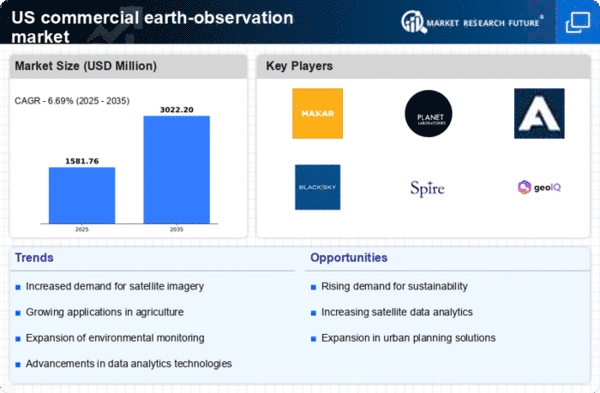
As per Market Research Future analysis, the US commercial earth-observation-ceo market size was estimated at 1482.57 USD Million in 2024. The US commercial earth-observation-ceo market is projected to grow from 1581.76 USD Million in 2025 to 3022.2 USD Million by 2035, exhibiting a compound annual growth rate (CAGR) of 6.6% during the forecast period 2025 - 2035

Key Market Trends & Highlights

The US commercial earth-observation market is experiencing robust growth driven by technological advancements and increasing demand for environmental monitoring.

  • Technological advancements in satellite systems are enhancing data collection capabilities and accuracy.
  • The largest segment in the market is environmental monitoring, while agriculture is the fastest-growing segment due to rising demand for precision farming.
  • Collaboration between public and private sectors is fostering innovation and expanding service offerings in the market.
  • Key market drivers include growing applications in agriculture and climate change mitigation efforts, which are propelling market expansion.

Market Size & Forecast

2024 Market Size 1482.57 (USD Million)
2035 Market Size 3022.2 (USD Million)
CAGR (2025 - 2035) 6.69%

Major Players

Maxar Technologies (US), Planet Labs (US), Airbus Defence and Space (DE), BlackSky Global (US), Spire Global (US), GeoIQ (US), Satellite Imaging Corporation (US), EOS Data Analytics (UA)

Our Impact
Enabled $4.3B Revenue Impact for Fortune 500 and Leading Multinationals
Partnering with 2000+ Global Organizations Each Year
30K+ Citations by Top-Tier Firms in the Industry

US Commercial Earth Observation CEO Market Trends

The commercial earth-observation-ceo market is currently experiencing a notable transformation, driven by advancements in satellite technology and increasing demand for high-resolution imagery. This sector appears to be expanding as various industries recognize the value of earth observation data for applications such as agriculture, urban planning, and environmental monitoring. The integration of artificial intelligence and machine learning into data analysis processes is likely enhancing the capabilities of service providers, allowing for more precise insights and timely decision-making. Furthermore, government initiatives aimed at promoting space exploration and satellite deployment are contributing to the growth of this market, suggesting a robust future ahead. In addition, the commercial earth-observation-ceo market seems to be influenced by the rising awareness of climate change and the need for sustainable practices. Organizations are increasingly utilizing earth observation data to monitor environmental changes, assess natural disasters, and manage resources more effectively. This trend indicates a shift towards data-driven strategies that prioritize sustainability and resilience. As the market evolves, collaboration between private companies and governmental agencies may further enhance the accessibility and application of earth observation data, potentially leading to innovative solutions for pressing global challenges.

Technological Advancements in Satellite Systems

Recent innovations in satellite technology are significantly enhancing the capabilities of the commercial earth-observation-ceo market. New satellite designs are being developed to provide higher resolution imagery and more frequent data collection. This evolution allows for improved monitoring of land use, climate patterns, and urban development, thereby meeting the growing demands of various sectors.

Increased Demand for Environmental Monitoring

There is a rising trend in the commercial earth-observation-ceo market focused on environmental monitoring. Organizations are increasingly leveraging earth observation data to track changes in ecosystems, assess the impact of climate change, and manage natural resources. This heightened awareness of environmental issues is driving demand for accurate and timely data.

Collaboration Between Public and Private Sectors

the commercial earth-observation-ceo market is seeing collaboration between public entities and private companies. Such partnerships are fostering innovation and expanding the reach of earth observation services. By combining resources and expertise, stakeholders are likely to enhance data accessibility and develop new applications that address societal challenges.

US Commercial Earth Observation CEO Market Drivers

Advancements in Data Analytics

the commercial earth-observation-ceo market benefits from advancements in data analytics technologies. The ability to process and analyze vast amounts of satellite data has improved significantly, enabling more accurate insights and predictions. Companies are increasingly adopting big data analytics and machine learning techniques to extract valuable information from earth observation data. This trend is likely to enhance the market's appeal across various sectors, including agriculture, forestry, and disaster management. As analytics capabilities continue to evolve, the market may see a rise in demand for sophisticated data solutions, potentially increasing its overall value.

Climate Change Mitigation Efforts

the urgency of addressing climate change is propelling the commercial earth-observation-ceo market. Governments and organizations are increasingly leveraging satellite data to monitor environmental changes, assess natural disasters, and implement mitigation strategies. The market is projected to grow as stakeholders seek reliable data to inform policy decisions and climate action plans. Recent estimates suggest that climate-related applications constitute nearly 20% of the market. This trend indicates a growing recognition of the importance of earth observation in understanding and combating climate change, thereby enhancing the market's relevance.

Growing Applications in Agriculture

the commercial earth-observation-ceo market is experiencing a surge in demand due to applications in agriculture. Farmers and agribusinesses are increasingly utilizing satellite imagery to monitor crop health, optimize irrigation, and manage resources efficiently. This trend is driven by the need for precision agriculture, which can enhance yield and reduce costs. According to recent data, the agricultural sector accounts for approximately 30% of the total market share in the commercial earth-observation-ceo market. As technology advances, the integration of AI and machine learning with satellite data is expected to further enhance decision-making processes in farming, thereby propelling market growth.

Regulatory Support and Funding Initiatives

Regulatory support and funding initiatives from the US government are playing a pivotal role in the growth of the commercial earth-observation-ceo market. Various programs and grants are being introduced to promote the use of satellite data for public benefit, including environmental monitoring and disaster response. This support is likely to encourage private sector investment and innovation in earth observation technologies. Recent government reports indicate that funding for earth observation projects has increased by approximately 15% over the past year. Such initiatives are expected to bolster the market, making it more attractive for new entrants and established players alike.

Urban Planning and Infrastructure Development

Urbanization in the US is accelerating, leading to increased demand for effective urban planning and infrastructure development. the commercial earth-observation-ceo market provides crucial data for city planners and developers. Satellite imagery assists in land use planning, transportation management, and environmental impact assessments. Recent statistics indicate that urban planning applications represent around 25% of the market. As cities expand, the reliance on accurate and timely data from earth observation systems is likely to grow, fostering innovation and efficiency in urban development projects.


Market Segment Insights

By Application: Agriculture (Largest) vs. Disaster Management (Fastest-Growing)

In the US commercial earth-observation-ceo market, Agriculture holds the largest share among the application segments, capitalizing on advanced satellite imagery and analytics tools to drive efficiency in crop management and yield optimization. In addition to Agriculture, Forestry and Urban Planning are significant, but they trail behind when it comes to market share. Environmental Monitoring is gaining traction as well, especially amid rising climate concerns. Looking at growth trends, Disaster Management is the fastest-growing segment, fueled by increasing investments in technology for emergency response, risk assessment, and recovery planning. The heightened frequency of natural disasters in recent years has further driven this growth, prompting organizations to leverage earth observation data for real-time insights and effective decision-making. As awareness and necessity for environmental sustainability rises, Urban Planning and Environmental Monitoring are also projected to experience substantial growth in the coming years.

Agriculture: Crop Management (Dominant) vs. Disaster Response (Emerging)

In the segment of Agriculture, Crop Management technology leverages satellite data for precision farming, enabling farmers to optimize resources and enhance productivity. This dominant segment is characterized by its integration with IoT and AI, delivering actionable insights that lead to better yield and resource management. Conversely, Disaster Response serves as an emerging segment, increasingly focused on utilizing earth observation to support timely interventions and mitigation strategies during emergencies. Organizations are recognizing the potential of aerial images and data analytics in minimizing response times and enhancing preparedness, which, coupled with growing governmental and organizational focus on disaster resilience, positions Disaster Response well for rapid growth in the US commercial earth-observation-ceo market.

By Data Type: Satellite Imagery (Largest) vs. Aerial Imagery (Fastest-Growing)

In the US commercial earth-observation-ceo market, Satellite Imagery leads the segment distribution, capturing a significant portion of market share due to its established technology and extensive applications across various industries. Following closely is Aerial Imagery, which has been steadily gaining traction owing to advancements in drone technology and cost-effective data collection methods. LiDAR Data and Ground-Based Data, while important, hold smaller segments of the marketplace as they cater to more specialized applications and require higher investments in technology. The growth trends indicate a robust shift towards Aerial Imagery as the fastest-growing segment, primarily driven by increased demand for real-time data and the enhancement of drone capabilities. The push for sustainability and the need for precise geographical data further fuel the growth of LiDAR Data, which is witnessing rising adoption in environmental monitoring and urban planning. Satellite Imagery continues to evolve, integrating AI to enhance data analysis, ensuring its position as a dominant player throughout the forecast period.

Satellite Imagery (Dominant) vs. Aerial Imagery (Emerging)

Satellite Imagery remains the dominant segment within the US commercial earth-observation-ceo market, widely used for nationwide monitoring, agricultural assessments, and environmental studies. Its comprehensive spatial coverage and high-resolution capabilities make it essential for various sectors, including defense and urban planning. Conversely, Aerial Imagery is becoming an emerging force, providing detailed and localized insights with the advancement of drone technology. Businesses are increasingly leveraging Aerial Imagery for specific project needs, making it a flexible and cost-effective alternative. While Satellite Imagery provides a macro view, Aerial Imagery excels in capturing micro-level details, supporting the growing trend towards precision in data-driven decision-making.

By End Use: Government (Largest) vs. Commercial Enterprises (Fastest-Growing)

In the US commercial earth-observation-ceo market, the Government segment holds the largest share, absorbing a significant portion of the market demand. This segment benefits from extensive funding and a wide range of applications in national security, environmental monitoring, and disaster response. Meanwhile, Commercial Enterprises are carving a niche for themselves, supported by increasing demand for data analytics and satellite imagery across various industries. The growth trends within these segments are shaped by technological advancements and a shift towards data-driven decision-making. Government agencies continue to invest in more sophisticated earth-observation technologies, ensuring their dominant position. Simultaneously, Commercial Enterprises are rapidly emerging, driven by innovations such as artificial intelligence and machine learning, enabling them to utilize earth-observation data for competitive advantages.

Government (Dominant) vs. Non-Governmental Organizations (Emerging)

The Government segment in the US commercial earth-observation-ceo market is characterized by its comprehensive use of satellite data for diverse applications, from surveillance and reconnaissance to environmental protection. This dominance arises from substantial governmental investments aimed at enhancing national security and managing natural resources effectively. On the other hand, Non-Governmental Organizations (NGOs) are emerging as key players in this sector, leveraging earth-observation data for advocacy and sustainable development. While they may not hold as significant market share as the Government, NGOs utilize innovative strategies to address global challenges such as climate change and disaster management, thus establishing themselves in an ever-evolving landscape.

By Deployment Model: Cloud-Based (Largest) vs. On-Premises (Fastest-Growing)

In the US commercial earth-observation-ceo market, the deployment model exhibits a diverse landscape, with cloud-based solutions taking the largest share due to their scalability and cost-effectiveness. On-premises models, while historically popular, are now facing pressure from the rapidly evolving cloud technology, which offers enhanced data processing capabilities and operational efficiency. The hybrid deployment model also shows significant adoption, appealing to users who desire a balanced approach between cloud and on-premises solutions. Growth trends indicate a shift towards cloud-based deployments driven by increasing demand for real-time data access and advanced analytics. Organizations are leaning towards cloud platforms for their flexibility and quick deployment times. Meanwhile, the on-premises segment is witnessing a resurgence among businesses with stringent data security requirements, making it the fastest-growing segment as firms seek to mitigate risks associated with data privacy and compliance.

Cloud-Based (Dominant) vs. On-Premises (Emerging)

Cloud-based deployment in the US commercial earth-observation-ceo market provides unmatched flexibility, allowing users to access vast datasets from anywhere while accommodating varying computational needs. This model's dominance is propelled by the necessity for rapid data processing and collaborative tools that facilitate timely decision-making. Conversely, the on-premises model is emerging as an alternative for organizations requiring stringent control over their data due to regulatory obligations. These on-premises solutions, although traditionally viewed as rigid, are gaining traction among sectors focused on enhanced security and customization, creating a niche market with dedicated compliance protocols.

Get more detailed insights about US Commercial Earth Observation CEO Market

Key Players and Competitive Insights

The commercial earth-observation market in the US is characterized by a dynamic competitive landscape, driven by advancements in satellite technology, increasing demand for geospatial data, and a growing emphasis on sustainability. Key players such as Maxar Technologies (US), Planet Labs (US), and BlackSky Global (US) are at the forefront, each adopting distinct strategies to enhance their market positioning. Maxar Technologies (US) focuses on innovation through the development of high-resolution imaging capabilities, while Planet Labs (US) emphasizes rapid data acquisition and analytics. BlackSky Global (US) leverages its real-time data capabilities to cater to various sectors, including agriculture and disaster response, thereby shaping a competitive environment that prioritizes technological advancement and customer-centric solutions.The market structure appears moderately fragmented, with several players vying for market share. Companies are increasingly localizing manufacturing and optimizing supply chains to enhance operational efficiency. This competitive structure allows for a diverse range of offerings, enabling customers to select from various service providers based on specific needs. The collective influence of these key players fosters a competitive atmosphere where innovation and responsiveness to market demands are paramount.

In October Maxar Technologies (US) announced a strategic partnership with a leading AI firm to enhance its satellite imagery analytics capabilities. This collaboration is likely to bolster Maxar's position in the market by integrating advanced AI technologies, enabling more precise data interpretation and expanding its service offerings. Such strategic moves indicate a trend towards leveraging AI to improve operational efficiencies and customer insights.

In September Planet Labs (US) launched a new satellite constellation aimed at increasing its data capture frequency. This expansion is significant as it positions Planet Labs to provide near-real-time data, which is increasingly sought after by industries such as agriculture and urban planning. The ability to deliver timely insights could enhance customer loyalty and attract new clients, thereby strengthening its competitive edge.

In August BlackSky Global (US) secured a multi-million dollar contract with a government agency for real-time monitoring services. This contract not only underscores the growing reliance on satellite data for national security and environmental monitoring but also highlights BlackSky's strategic focus on government partnerships. Such engagements are likely to enhance its credibility and market presence, further solidifying its role in the competitive landscape.

As of November current trends in the commercial earth-observation market include a pronounced shift towards digitalization, sustainability, and the integration of AI technologies. Strategic alliances are increasingly shaping the competitive landscape, allowing companies to pool resources and expertise. Looking ahead, competitive differentiation is expected to evolve, with a greater emphasis on innovation and technology rather than solely on price. Companies that can reliably deliver advanced solutions while maintaining robust supply chains are likely to thrive in this rapidly changing environment.

Key Companies in the US Commercial Earth Observation CEO Market include

Future Outlook

US Commercial Earth Observation CEO Market Future Outlook

The commercial earth-observation market is projected to grow at a 6.69% CAGR from 2025 to 2035, driven by advancements in satellite technology and increasing demand for data analytics.

New opportunities lie in:

  • Development of AI-driven analytics platforms for enhanced data interpretation.
  • Expansion of subscription-based satellite imagery services for diverse industries.
  • Partnerships with governmental agencies for environmental monitoring projects.

By 2035, the market is expected to achieve substantial growth, driven by innovative solutions and strategic collaborations.

Market Segmentation

US Commercial Earth Observation CEO Market End Use Outlook

  • Government
  • Commercial Enterprises
  • Research Institutions
  • Non-Governmental Organizations

US Commercial Earth Observation CEO Market Data Type Outlook

  • Satellite Imagery
  • Aerial Imagery
  • LiDAR Data
  • Ground-Based Data

US Commercial Earth Observation CEO Market Application Outlook

  • Agriculture
  • Forestry
  • Urban Planning
  • Disaster Management
  • Environmental Monitoring

US Commercial Earth Observation CEO Market Deployment Model Outlook

  • On-Premises
  • Cloud-Based
  • Hybrid

Report Scope

MARKET SIZE 2024 1482.57(USD Million)
MARKET SIZE 2025 1581.76(USD Million)
MARKET SIZE 2035 3022.2(USD Million)
COMPOUND ANNUAL GROWTH RATE (CAGR) 6.69% (2025 - 2035)
REPORT COVERAGE Revenue Forecast, Competitive Landscape, Growth Factors, and Trends
BASE YEAR 2024
Market Forecast Period 2025 - 2035
Historical Data 2019 - 2024
Market Forecast Units USD Million
Key Companies Profiled Maxar Technologies (US), Planet Labs (US), Airbus Defence and Space (DE), BlackSky Global (US), Spire Global (US), GeoIQ (US), Satellite Imaging Corporation (US), EOS Data Analytics (UA)
Segments Covered Application, Data Type, End Use, Deployment Model
Key Market Opportunities Integration of advanced analytics and artificial intelligence in the commercial earth-observation-ceo market.
Key Market Dynamics Technological advancements drive competitive dynamics in the commercial earth-observation market, enhancing data accessibility and application.
Countries Covered US
Leave a Comment
Download Free Sample

Kindly complete the form below to receive a free sample of this Report

Compare Licence

×
Features License Type
Single User Multiuser License Enterprise User
Price $4,950 $5,950 $7,250
Maximum User Access Limit 1 User Upto 10 Users Unrestricted Access Throughout the Organization
Free Customization
Direct Access to Analyst
Deliverable Format
Platform Access
Discount on Next Purchase 10% 15% 15%
Printable Versions