×
Request Free Sample ×

Kindly complete the form below to receive a free sample of this Report

* Please use a valid business email

Leading companies partner with us for data-driven Insights

clients tt-cursor
Hero Background

China Fiber Cement Board Market

ID: MRFR/PCM/55324-HCR
200 Pages
Varsha More
February 2026

China Fiber Cement Board Market Research Report By Product Type (High Density Board (HDB), Medium Density Board (MDF), Low Density Board (LDB)), By Raw Material (Silica, Cement, Cellulose Fiber, Additives, Others), By Application (Siding, Roofing, Mounting And Trim, Tiles Wall, Flooring, Curtain Wall, Other), By Production Process (Hatschek Process, Extrusion Process, Pertile Process), and By End-use (Residential, Commercial)- Forecast to 2035

Share:
Download PDF ×

We do not share your information with anyone. However, we may send you emails based on your report interest from time to time. You may contact us at any time to opt-out.

China Fiber Cement Board Market Infographic
Purchase Options

China Fiber Cement Board Market Summary

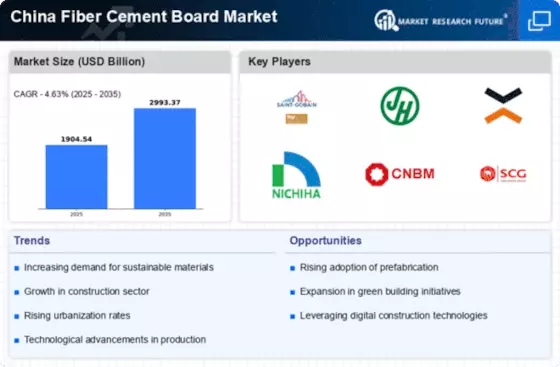
As per analysis, the China Fiber Cement Board Market is projected to grow from USD 1,913.09 Billion in 2025 to USD 2,993.37 Billion by 2035, exhibiting a compound annual growth rate (CAGR) of 4.63% during the forecast period (2025 - 2035).

Key Market Trends & Highlights

The China Fiber Cement Board Market is poised for growth driven by sustainability and technological advancements.

  • The residential segment remains the largest contributor to the market, reflecting a strong demand for durable building materials.
  • Infrastructure development is the fastest-growing segment, indicating a shift towards enhanced urbanization and construction projects.
  • Fiber cement siding continues to dominate the market, while fiber cement trim is emerging as the fastest-growing category.
  • Sustainability initiatives and urbanization are key drivers propelling the market forward, highlighting the importance of eco-friendly construction solutions.

Market Size & Forecast

2024 Market Size 1820.26 (USD Billion)
2035 Market Size 2993.37 (USD Billion)
CAGR (2025 - 2035) 4.63%

Major Players

Saint-Gobain (FR), James Hardie (AU), Etex Group (BE), Nichiha Corporation (JP), China National Building Material Group (CN), Siam Cement Group (TH), Hume Cemboard (MY), GAF Materials Corporation (US), Cembrit Holding A/S (DK)

Our Impact
Enabled $4.3B Revenue Impact for Fortune 500 and Leading Multinationals
Partnering with 2000+ Global Organizations Each Year
30K+ Citations by Top-Tier Firms in the Industry

China Fiber Cement Board Market Trends

The China Fiber Cement Board Market is currently experiencing a notable transformation, driven by increasing demand for sustainable building materials and advancements in manufacturing technologies. As urbanization continues to accelerate, the construction sector in China is witnessing a shift towards eco-friendly solutions, with fiber cement boards emerging as a preferred choice due to their durability, fire resistance, and low maintenance requirements. This trend aligns with the government's initiatives to promote green building practices, which further enhances the market's growth potential. Additionally, the rising awareness among consumers regarding the environmental impact of construction materials is likely to bolster the adoption of fiber cement boards in various applications, including residential, commercial, and industrial projects. Moreover, the competitive landscape of the China Fiber Cement Board Market is evolving, with numerous domestic and international players striving to capture market share. Innovations in product design and functionality are becoming increasingly prevalent, as manufacturers seek to differentiate their offerings. The integration of advanced technologies in production processes is expected to improve efficiency and reduce costs, thereby making fiber cement boards more accessible to a broader range of consumers. As the market continues to mature, it appears poised for sustained growth, driven by a combination of regulatory support, consumer preferences, and technological advancements.

Sustainability Focus

The emphasis on sustainable construction practices is reshaping the China Fiber Cement Board Market. With increasing regulations aimed at reducing carbon footprints, manufacturers are prioritizing eco-friendly materials and processes. This trend is likely to enhance the appeal of fiber cement boards, which are recognized for their environmental benefits.

Technological Advancements

Innovations in production techniques are significantly impacting the China Fiber Cement Board Market. Enhanced manufacturing processes are leading to improved product quality and performance. As companies adopt cutting-edge technologies, the efficiency of fiber cement board production is expected to rise, potentially lowering costs and expanding market reach.

Diverse Applications

The versatility of fiber cement boards is driving their adoption across various sectors in China. From residential buildings to commercial spaces, the material's adaptability is becoming increasingly recognized. This trend suggests a growing acceptance of fiber cement boards in diverse construction projects, further solidifying their market presence.

China Fiber Cement Board Market Drivers

Technological Innovations

Technological advancements play a pivotal role in shaping the China Fiber Cement Board Market. Innovations in manufacturing processes have led to the production of high-performance fiber cement boards that offer enhanced durability, moisture resistance, and fireproof qualities. In recent years, the introduction of automated production lines has increased efficiency and reduced costs, making fiber cement boards more accessible to a broader range of consumers. The market is projected to grow at a compound annual growth rate (CAGR) of 7% from 2026 to 2031, driven by these technological improvements. As manufacturers continue to invest in research and development, the quality and variety of fiber cement boards are expected to expand, further stimulating market growth.

Sustainability Initiatives

The China Fiber Cement Board Market is experiencing a notable shift towards sustainability, driven by increasing environmental awareness among consumers and regulatory bodies. The Chinese government has implemented stringent regulations aimed at reducing carbon emissions and promoting eco-friendly building materials. Fiber cement boards, known for their durability and low environmental impact, align well with these initiatives. In 2025, the market for sustainable building materials in China was valued at approximately USD 15 billion, with fiber cement boards capturing a significant share due to their recyclable nature and energy-efficient production processes. This trend is likely to continue, as both consumers and businesses prioritize sustainable practices, thereby propelling the growth of the fiber cement board market in China.

Government Policies and Incentives

Government policies and incentives significantly influence the China Fiber Cement Board Market. The Chinese government has introduced various initiatives to promote the use of advanced building materials, including fiber cement boards, as part of its broader strategy to enhance construction quality and safety. Subsidies and tax incentives for manufacturers adopting eco-friendly practices have encouraged the production of fiber cement boards. In 2025, approximately 30% of fiber cement board manufacturers benefited from such incentives, leading to increased production capacity and market competitiveness. As these policies continue to evolve, they are expected to create a favorable environment for the growth of the fiber cement board market in China, attracting both domestic and foreign investments.

Diverse Applications in Construction

The versatility of fiber cement boards is a significant driver for the China Fiber Cement Board Market. These boards are utilized in a wide array of applications, including exterior cladding, interior wall partitions, and roofing solutions. The construction sector in China is increasingly adopting fiber cement boards due to their aesthetic appeal and functional benefits. In 2025, the market for fiber cement boards in residential construction alone was estimated at USD 3 billion, reflecting their growing popularity among builders and architects. As the demand for innovative building solutions rises, fiber cement boards are likely to see expanded usage across various sectors, including commercial and industrial construction, thereby enhancing market prospects.

Urbanization and Infrastructure Development

Rapid urbanization in China is a critical driver for the Fiber Cement Board Market. As urban areas expand, the demand for residential and commercial buildings increases, necessitating the use of versatile and durable construction materials. The Chinese government has committed to significant infrastructure investments, with plans to allocate over USD 1 trillion towards urban development projects by 2030. Fiber cement boards are favored for their lightweight properties and resistance to weathering, making them ideal for various applications in urban construction. This growing urban landscape is expected to bolster the demand for fiber cement boards, as builders seek materials that can withstand the rigors of urban environments while providing aesthetic appeal.


Market Segment Insights

By Application: Residential (Largest) vs. Infrastructure (Fastest-Growing)

In the China Fiber Cement Board Market, the application segment is predominantly led by the residential sector, which comprises a significant portion of overall demand. The commercial sector follows, catering to office buildings and retail spaces, while industrial applications are relatively smaller. Infrastructure projects, although currently a minor segment, are increasingly contributing to market dynamics as urbanization accelerates, reflecting changing construction needs across the nation.

Infrastructure: (Emerging) vs. Residential (Dominant)

The residential segment is established as the dominant application within the China Fiber Cement Board Market, driven by expanding housing projects and increasing demand for durable, low-maintenance building materials. Conversely, the infrastructure segment is emerging rapidly due to government initiatives aimed at enhancing urban infrastructure, including roads, bridges, and public facilities. As urban population density grows, the need for resilient construction solutions is fuelling fiber cement board adoption in infrastructure projects, where its properties such as strength and weather-resistance make it an attractive choice for builders and planners.

By Product Type: Fiber Cement Siding (Largest) vs. Fiber Cement Trim (Fastest-Growing)

In the China Fiber Cement Board market, the distribution of market share among various product types reveals a clear hierarchy, with Fiber Cement Siding occupying the largest share. This segment has established itself as a favorite among builders and homeowners alike, thanks to its durability and aesthetic appeal. Following closely, Fiber Cement Backer Board and Fiber Cement Roofing also hold significant portions of the market, while Fiber Cement Trim emerges as a smaller yet increasingly noticeable segment.

Market Position: Fiber Cement Siding (Dominant) vs. Fiber Cement Trim (Emerging)

Fiber Cement Siding is the dominant segment in the China Fiber Cement Board market, primarily due to its superior durability, weather resistance, and low maintenance requirements, making it a preferred choice in both residential and commercial applications. On the other hand, Fiber Cement Trim is an emerging segment that has gained traction due to the rising demand for aesthetically pleasing finishing options. As architects and homeowners increasingly seek to enhance exterior aesthetics and sustainability, Fiber Cement Trim is rapidly adapting design features and functionality, positioning itself as a key player in upcoming construction trends.

By End Use: Construction (Largest) vs. Renovation (Fastest-Growing)

In the China Fiber Cement Board Market, the 'End Use' segment shows a significant distribution in demand across various applications. The construction sector stands out as the largest contributor, capitalizing on rapid urbanization and infrastructural development. The demand for fiber cement boards in this sector has been propelled by their durability, aesthetic appeal, and eco-friendliness. Meanwhile, the renovation segment is witnessing a rapid growth trend, as homeowners and businesses opt to upgrade their spaces with sustainable materials that offer aesthetic enhancements and improved functionality.

Construction: Dominant vs. Renovation: Emerging

Within the End Use segment, construction holds a dominant position, driven by extensive public and private infrastructure projects across China. Fiber cement boards are favored for their resistance to weathering, fireproof properties, and ability to meet diverse architectural needs. On the other hand, renovation emerges as a rapidly growing segment, fueled by increasing disposable incomes and a rising awareness of eco-friendly building materials. Homeowners are increasingly drawn to fiber cement boards for remodeling projects, given their versatility and the long-term benefits they offer in terms of maintenance and durability. This juxtaposition highlights the contrasting yet complementary roles these segments play in the broader market.

Get more detailed insights about China Fiber Cement Board Market

Key Players and Competitive Insights

The Fiber Cement Board Market in China is characterized by a dynamic competitive landscape, driven by increasing demand for sustainable building materials and innovative construction solutions. Key players such as Saint-Gobain (FR), James Hardie (AU), and China National Building Material Group (CN) are actively shaping the market through strategic initiatives. Saint-Gobain (FR) focuses on enhancing its product portfolio with eco-friendly solutions, while James Hardie (AU) emphasizes technological advancements in manufacturing processes. China National Building Material Group (CN) is leveraging its extensive distribution network to expand its market reach, indicating a trend towards regional dominance and operational efficiency among these companies.

The competitive structure of the market appears moderately fragmented, with several players vying for market share. Key tactics such as localizing manufacturing and optimizing supply chains are prevalent among leading companies. This localization strategy not only reduces operational costs but also enhances responsiveness to regional market demands. The collective influence of these strategies fosters a competitive environment where innovation and efficiency are paramount, allowing companies to differentiate themselves in a crowded marketplace.

In November 2025, Saint-Gobain (FR) announced the launch of a new line of fiber cement boards designed specifically for high-performance insulation. This strategic move is significant as it aligns with the growing emphasis on energy efficiency in construction, potentially positioning the company as a leader in sustainable building solutions. The introduction of these products may enhance Saint-Gobain's competitive edge by appealing to environmentally conscious consumers and builders.

In December 2025, James Hardie (AU) revealed plans to invest $50 million in expanding its manufacturing capabilities in China. This investment is likely to bolster the company's production capacity and improve supply chain efficiencies, enabling it to meet the rising demand for fiber cement boards in the region. Such a strategic expansion underscores James Hardie's commitment to maintaining a strong market presence and responding effectively to local market dynamics.

In January 2026, China National Building Material Group (CN) entered into a strategic partnership with a leading technology firm to integrate AI-driven analytics into its production processes. This collaboration is poised to enhance operational efficiency and product quality, reflecting a broader trend towards digital transformation in the industry. By adopting advanced technologies, the company aims to streamline its operations and improve decision-making processes, which could lead to a more agile and responsive business model.

As of January 2026, the Fiber Cement Board Market is witnessing a shift towards digitalization, sustainability, and AI integration, which are defining current competitive trends. Strategic alliances are increasingly shaping the landscape, allowing companies to pool resources and expertise. The competitive differentiation is likely to evolve from traditional price-based competition to a focus on innovation, technology, and supply chain reliability. This transition suggests that companies that prioritize these aspects will be better positioned to thrive in the future.

Key Companies in the China Fiber Cement Board Market include

Industry Developments

In recent months, the China Fiber Cement Board Market has experienced significant developments driven by rising construction activities and an increasing demand for sustainable building materials. Companies such as Cembrit Holding and James Hardie Industries are expanding their foothold in this market, with initiatives aimed at enhancing product innovation and sustainability.

Current affairs indicate that major players, including Saint-Gobain and Etex Group, are focusing on sustainable production processes as environmental regulations tighten in China. Notable mergers and acquisitions have yet to emerge for the specified companies within this sector.

However, the overall market valuation has increased as demand for fiber cement board applications in residential and commercial buildings rises. For instance, in early 2021, Nichiha Corporation reported a significant increase in sales attributed to heightened interest in fiber cement products, reflecting a positive trend in market growth.

Additionally, ongoing government policies in China promoting green building materials are influencing the industry landscape, urging companies to adapt and innovate for longer-term market competitiveness.

Future Outlook

China Fiber Cement Board Market Future Outlook

The China Fiber Cement Board Market is projected to grow at a 4.63% CAGR from 2025 to 2035, driven by urbanization, construction demand, and sustainability trends.

New opportunities lie in:

  • Expansion into prefabricated construction solutions
  • Development of eco-friendly fiber cement products
  • Investment in advanced manufacturing technologies for efficiency

By 2035, the market is expected to solidify its position as a leader in sustainable building materials.

Market Segmentation

China Fiber Cement Board Market End Use Outlook

  • Construction
  • Renovation
  • Repair
  • Maintenance

China Fiber Cement Board Market Application Outlook

  • Residential
  • Commercial
  • Industrial
  • Infrastructure

China Fiber Cement Board Market Product Type Outlook

  • Fiber Cement Siding
  • Fiber Cement Backer Board
  • Fiber Cement Trim
  • Fiber Cement Roofing

Report Scope

MARKET SIZE 20241820.26(USD Billion)
MARKET SIZE 20251913.09(USD Billion)
MARKET SIZE 20352993.37(USD Billion)
COMPOUND ANNUAL GROWTH RATE (CAGR)4.63% (2024 - 2035)
REPORT COVERAGERevenue Forecast, Competitive Landscape, Growth Factors, and Trends
BASE YEAR2024
Market Forecast Period2025 - 2035
Historical Data2019 - 2024
Market Forecast UnitsUSD Billion
Key Companies ProfiledSaint-Gobain (FR), James Hardie (AU), Etex Group (BE), Nichiha Corporation (JP), China National Building Material Group (CN), Siam Cement Group (TH), Hume Cemboard (MY), GAF Materials Corporation (US), Cembrit Holding A/S (DK)
Segments CoveredApplication, Product Type, End Use
Key Market OpportunitiesGrowing demand for sustainable building materials drives innovation in the China Fiber Cement Board Market.
Key Market DynamicsRising demand for sustainable construction materials drives innovation in China's Fiber Cement Board Market.
Countries CoveredChina
Leave a Comment

FAQs

What is the projected market valuation of the China Fiber Cement Board Market by 2035?

The projected market valuation for the China Fiber Cement Board Market is 2993.37 USD Billion by 2035.

What was the overall market valuation of the China Fiber Cement Board Market in 2024?

The overall market valuation of the China Fiber Cement Board Market was 1820.26 USD Billion in 2024.

What is the expected CAGR for the China Fiber Cement Board Market during the forecast period 2025 - 2035?

The expected CAGR for the China Fiber Cement Board Market during the forecast period 2025 - 2035 is 4.63%.

Which application segment had the highest valuation in the China Fiber Cement Board Market?

The Infrastructure application segment had the highest valuation, ranging from 620.26 to 1093.37 USD Billion.

What are the key players in the China Fiber Cement Board Market?

Key players in the market include Saint-Gobain, James Hardie, Etex Group, and China National Building Material Group.

How does the valuation of the Fiber Cement Backer Board segment compare to others?

The Fiber Cement Backer Board segment is valued between 546.09 and 850.0 USD Billion, indicating strong market performance.

What is the projected valuation for the Residential application segment by 2035?

The projected valuation for the Residential application segment is expected to range from 500.0 to 800.0 USD Billion by 2035.

Which product type is anticipated to have the highest market valuation?

Fiber Cement Roofing is anticipated to have the highest market valuation, projected between 728.08 and 1263.37 USD Billion.

What is the expected valuation for the Renovation end-use segment by 2035?

The expected valuation for the Renovation end-use segment is projected to range from 550.0 to 850.0 USD Billion by 2035.

How does the performance of the Industrial application segment compare to the Commercial segment?

The Industrial application segment is valued between 300.0 and 500.0 USD Billion, while the Commercial segment ranges from 400.0 to 600.0 USD Billion.

Download Free Sample

Kindly complete the form below to receive a free sample of this Report

Compare Licence

×
Features License Type
Single User Multiuser License Enterprise User
Price $4,950 $5,950 $7,250
Maximum User Access Limit 1 User Upto 10 Users Unrestricted Access Throughout the Organization
Free Customization
Direct Access to Analyst
Deliverable Format
Platform Access
Discount on Next Purchase 10% 15% 15%
Printable Versions