×
Request Free Sample ×

Kindly complete the form below to receive a free sample of this Report

* Please use a valid business email

Leading companies partner with us for data-driven Insights

clients tt-cursor
Hero Background

Canada Robot Software Market

ID: MRFR/ICT/59865-HCR
200 Pages
Aarti Dhapte
February 2026

Canada Robot Software Market Research Report By Vertical (BFSI, Retail & E-commerce, Government, Healthcare, Logistics, Manufacturing, IT & Telecommunication), By Robot Type (Industrial Robots, Service Robots), By Deployment (On-premise, On-cloud) and By Organization Size (Small & Medium Enterprises, Large Enterprises)- Forecast to 2035

Share:
Download PDF ×

We do not share your information with anyone. However, we may send you emails based on your report interest from time to time. You may contact us at any time to opt-out.

Canada Robot Software Market Infographic
Purchase Options

Canada Robot Software Market Summary

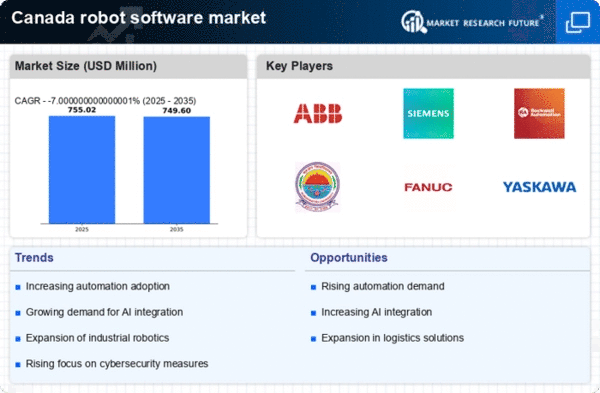
As per Market Research Future analysis, the Canada robot software market Size was estimated at 755.55 USD Million in 2024. The Canada robot software market is projected to grow from 755.02 USD Million in 2025 to 749.6 USD Million by 2035, exhibiting a compound annual growth rate (CAGR) of 0.07% during the forecast period 2025 - 2035

Key Market Trends & Highlights

The Canada robot software market is experiencing robust growth driven by technological advancements and increasing automation demands.

  • The manufacturing sector remains the largest segment, showcasing a notable increase in robot software adoption.
  • Healthcare applications are emerging as the fastest-growing segment, reflecting a shift towards automation in patient care.
  • Customization and integration of robot software are becoming critical as businesses seek tailored solutions to enhance operational efficiency.
  • Key market drivers include rising demand for automation and government initiatives supporting technological advancements.

Market Size & Forecast

2024 Market Size 755.55 (USD Million)
2035 Market Size 749.6 (USD Million)
CAGR (2025 - 2035) -0.07%

Major Players

ABB (CH), Siemens (DE), Rockwell Automation (US), KUKA (DE), Fanuc (JP), Yaskawa Electric (JP), Intuitive Surgical (US), Boston Dynamics (US), NVIDIA (US)

Our Impact
Enabled $4.3B Revenue Impact for Fortune 500 and Leading Multinationals
Partnering with 2000+ Global Organizations Each Year
30K+ Citations by Top-Tier Firms in the Industry

Canada Robot Software Market Trends

The robot software market is currently experiencing a dynamic evolution, driven by advancements in artificial intelligence and automation technologies. In Canada, industries such as manufacturing, healthcare, and logistics are increasingly adopting robotic solutions to enhance operational efficiency and reduce costs. This trend appears to be fueled by a growing emphasis on digital transformation, as organizations seek to integrate smart technologies into their workflows. Furthermore, the Canadian government is actively supporting innovation in robotics through funding initiatives and research programs, which may further accelerate market growth. In addition, the demand for customized robotic solutions is on the rise, as businesses look for tailored applications that meet their specific needs. This shift towards personalization suggests that software developers are likely to focus on creating adaptable and scalable solutions. As the robot software market continues to mature, collaboration between technology providers and end-users is expected to play a crucial role in shaping future developments. Overall, the landscape appears promising, with numerous opportunities for growth and innovation in the coming years.

Increased Adoption in Manufacturing

The robot software market is witnessing a notable increase in adoption within the manufacturing sector. Companies are leveraging robotic systems to streamline production processes, enhance precision, and minimize human error. This trend indicates a shift towards automation as a means to improve productivity and competitiveness.

Growth in Healthcare Applications

There is a growing interest in the application of robotic software within the healthcare sector. Hospitals and clinics are exploring robotic solutions for tasks such as surgery, patient monitoring, and logistics. This trend suggests a potential for improved patient outcomes and operational efficiency.

Focus on Customization and Integration

The demand for customized robotic solutions is becoming more pronounced. Businesses are seeking software that can be tailored to their unique operational requirements. This trend highlights the importance of integration capabilities, as companies aim to incorporate robotic systems seamlessly into existing workflows.

Canada Robot Software Market Drivers

Rising Demand for Automation

The robot software market in Canada experiences a notable surge in demand for automation across various sectors. Industries such as manufacturing, logistics, and agriculture are increasingly adopting robotic solutions to enhance efficiency and reduce operational costs. According to recent data, the automation market in Canada is projected to grow at a CAGR of approximately 10% over the next five years. This trend indicates a strong inclination towards integrating robotic systems, which in turn drives the demand for sophisticated robot software. As companies seek to streamline processes and improve productivity, the robot software market is likely to benefit significantly from this growing demand for automation.

Government Initiatives and Funding

Government initiatives and funding significantly influence the robot software market in Canada. Various federal and provincial programs aim to promote research and development in robotics and automation. For example, the Canadian government has allocated substantial resources to support innovation in the technology sector, including robotics. This financial backing encourages startups and established companies to invest in developing advanced robot software solutions. The robot software market stands to gain from these initiatives, as increased funding can lead to accelerated innovation and the introduction of cutting-edge products. The potential for government support indicates a favorable environment for growth in the coming years.

Expansion of E-commerce and Logistics

The expansion of e-commerce and logistics sectors is driving growth in the robot software market in Canada. As online shopping continues to gain popularity, companies are increasingly relying on robotic systems to manage inventory, fulfill orders, and streamline supply chain operations. The logistics industry, in particular, is adopting automated solutions to enhance efficiency and reduce delivery times. Recent estimates suggest that the e-commerce sector in Canada could reach a value of $50 billion by 2026, further fueling the demand for advanced robot software. This trend indicates a robust opportunity for the robot software market to develop tailored solutions that meet the evolving needs of e-commerce and logistics.

Growing Focus on Safety and Compliance

Safety and compliance are becoming increasingly critical in the robot software market in Canada. As industries adopt robotic solutions, ensuring that these systems adhere to safety regulations and standards is paramount. Companies are investing in software that not only enhances operational efficiency but also prioritizes safety protocols. This trend is particularly evident in sectors such as manufacturing and healthcare, where compliance with strict regulations is essential. The robot software market is likely to see a rise in demand for software solutions that incorporate safety features and compliance tracking, reflecting a broader commitment to workplace safety and regulatory adherence.

Technological Advancements in Robotics

Technological advancements play a crucial role in shaping the robot software market in Canada. Innovations in artificial intelligence, machine learning, and sensor technologies are enhancing the capabilities of robotic systems. These advancements enable robots to perform complex tasks with greater precision and adaptability. For instance, the integration of AI algorithms allows robots to learn from their environments and improve their performance over time. As a result, the robot software market is witnessing an influx of new software solutions designed to leverage these technologies. The continuous evolution of robotics technology suggests a promising future for the market, with potential growth rates exceeding 15% annually.


Market Segment Insights

By Vertical: Healthcare (Largest) vs. Retail & e-commerce (Fastest-Growing)

In the Canada robot software market, the vertical segment showcases a diverse distribution of market share. The healthcare sector stands out as the largest contributor, benefiting from significant investments in automation to enhance patient care and operational efficiency. Meanwhile, the retail & e-commerce sector is rapidly gaining ground, driven by an increasing demand for automated solutions that enhance customer experience and streamline operations during peak shopping seasons. Growth trends indicate that sectors such as healthcare and retail & e-commerce will continue to flourish due to escalating requirements for automation and advanced analytics. The rise of technology adoption, coupled with the need for efficiency, positions these sectors for substantial growth. Moreover, regulatory support in the healthcare domain and innovation in retail technology are strong drivers fueling this expansion.

Healthcare (Dominant) vs. Retail & e-commerce (Emerging)

The healthcare sector in the Canada robot software market is recognized as the dominant force, characterized by its extensive deployment of robotic solutions aimed at automating patient management, surgical procedures, and administration tasks. This segment thrives on the continuous need for improved patient outcomes and operational efficiencies. Conversely, the retail & e-commerce sector is an emerging segment, marked by its aggressive adoption of robotic technologies to enhance inventory management and customer service through automated checkouts and personalized shopping experiences. While healthcare enjoys a historical foundation in robotics, the retail sector's innovative applications signify its potential to rapidly reshape the market landscape as it capitalizes on evolving consumer expectations and technological advancements.

By Type: Industrial Robots (Largest) vs. Service Robots (Fastest-Growing)

The Canada robot software market exhibits a diverse distribution in segment value with industrial robots holding the largest market share. This domination is due to their widespread application in manufacturing and heavy industries. Conversely, service robots are witnessing a rapid growth in their market presence, reflecting the increasing demand for automation in sectors like healthcare, retail, and hospitality, marking a significant shift in market dynamics. Growth trends in the sector are driven by advances in AI and machine learning, which are enhancing the functionalities of robotic systems. Furthermore, the rising emphasis on efficiency and productivity in various industries is propelling the adoption of both industrial and service robots. Government initiatives and increased investments in robotics R&D are also contributing to a favorable environment for market expansion.

Industrial Robots (Dominant) vs. Service Robots (Emerging)

Industrial robots have established themselves as the dominant force in the Canada robot software market, marked by their robustness and versatility in performing repetitive tasks with high precision. They are primarily utilized in manufacturing, where automation significantly boosts productivity and reduces operational costs. In contrast, service robots are emerging as a progressive segment, characterized by their adaptability in diverse applications like cleaning, delivery, and customer service. This evolution is fueled by technological advancements and growing consumer acceptance, driving the demand for service robots in various industries. As both segments evolve, the interplay between these technologies is expected to shape the future landscape of robotics in Canada.

By Deployment: On-cloud (Largest) vs. On-premise (Fastest-Growing)

In the Canada robot software market, the distribution of market share between On-premise and On-cloud deployment methods shows a clear preference for On-cloud solutions, which have emerged as the largest segment. As businesses lean towards flexible and scalable options, On-cloud software has captivated the majority of users, driven by the need for remote access and ease of integration. Meanwhile, On-premise solutions, though smaller in market share, are witnessing growth as companies seek to maintain control over their infrastructure and sensitive data. The growth trends for these deployment segments illustrate the evolving landscape of software integration in the Canada robot software market. The increasing adoption of cloud technologies is fueled by advancements in internet connectivity and cybersecurity measures, making On-cloud solutions more appealing for organizations aiming for operational efficiency. Conversely, On-premise deployment is rapidly emerging as companies prioritize tailored solutions, emphasizing security and compliance. This dual demand showcases the diverse needs of various industries in the automation space.

Deployment: On-cloud (Dominant) vs. On-premise (Emerging)

On-cloud deployment is dominant within the Canada robot software market, primarily due to its ability to offer businesses scalable solutions, facilitating enhanced collaboration and access across different geographical locations. This model allows for continuous updates and improvements, which is critical in a fast-paced tech environment. In contrast, On-premise deployment is emerging as a favored option among certain sectors, particularly those with stringent data security requirements. Businesses choosing On-premise solutions value control over custom configurations and direct management of their IT resources. This clear distinction between On-cloud and On-premise reflects varying organizational priorities regarding accessibility, control, integration, and data security.

By Organization Size: Small and Medium Size Enterprises (Largest) vs. Large Enterprises (Fastest-Growing)

In the Canada robot software market, Small and Medium Size Enterprises dominate the landscape, capturing the largest share of overall market revenue. These companies leverage cost-effective solutions to automate processes, leading to increased adoption rates across various sectors. On the other hand, Large Enterprises are rapidly growing, focusing on advanced and customizable solutions that cater to complex operational needs. This dynamic has created a competitive environment where smaller organizations are eager to embrace affordable technologies while larger entities push for innovative integrations. Growth trends in this segment are driven by several factors. Small and Medium Size Enterprises benefit from accessibility to user-friendly software that supports their operational efficiency and scalability. Meanwhile, Large Enterprises are expanding due to their substantial investments in research and development, fostering innovation in robotic software applications. The demand for sophisticated, integrated solutions makes Large Enterprises key players, while Small and Medium Size Enterprises maintain a strong foothold by adapting to market changes and evolving customer needs.

Small and Medium Size Enterprises (Dominant) vs. Large Enterprises (Emerging)

Small and Medium Size Enterprises in the Canada robot software market are characterized by their ability to quickly adapt to new technologies and integrate cost-effective solutions. These firms tend to prioritize functionalities that enhance operational efficiency, allowing them to remain competitive despite limited resources. Conversely, Large Enterprises, though emerging in this sector, focus on developing complex and specialized software solutions that meet higher demands. Their significant financial backing enables substantial investment into cutting-edge technology, which is pivotal for driving innovation and improving productivity. The interplay between these two segments shapes the overall market landscape, as Small and Medium Size Enterprises leverage emerging technologies while larger firms push for market expansion through advanced software offerings.

Get more detailed insights about Canada Robot Software Market

Key Players and Competitive Insights

The robot software market exhibits a dynamic competitive landscape characterized by rapid technological advancements and increasing demand across various sectors. Key players such as ABB (CH), Siemens (DE), and Rockwell Automation (US) are strategically positioned to leverage innovation and digital transformation. ABB (CH) focuses on enhancing its automation solutions through advanced robotics and AI integration, while Siemens (DE) emphasizes sustainability and energy efficiency in its offerings. Rockwell Automation (US) is actively pursuing partnerships to expand its software capabilities, thereby enhancing its competitive edge. Collectively, these strategies foster a robust environment where innovation and operational efficiency are paramount.In terms of business tactics, companies are increasingly localizing manufacturing and optimizing supply chains to enhance responsiveness to market demands. The competitive structure of the market appears moderately fragmented, with several key players exerting substantial influence. This fragmentation allows for diverse offerings and fosters competition, driving continuous improvement and innovation among market participants.

In October ABB (CH) announced a strategic partnership with a leading AI firm to develop next-generation robotic solutions aimed at the manufacturing sector. This collaboration is expected to enhance ABB's capabilities in machine learning and predictive maintenance, thereby solidifying its position as a leader in automation technology. The strategic importance of this partnership lies in its potential to significantly reduce operational downtime and improve efficiency for clients.

In September Siemens (DE) launched a new software platform designed to integrate seamlessly with existing industrial systems, promoting interoperability and data exchange. This initiative is crucial as it aligns with the growing trend towards digitalization in manufacturing, enabling companies to harness data for improved decision-making. The launch reflects Siemens' commitment to providing comprehensive solutions that address the evolving needs of the market.

In August Rockwell Automation (US) expanded its software portfolio by acquiring a startup specializing in cloud-based robotics management. This acquisition is likely to enhance Rockwell's offerings in remote monitoring and control, catering to the increasing demand for flexible and scalable solutions. The strategic move underscores Rockwell's focus on integrating cutting-edge technology to meet the needs of modern manufacturing environments.

As of November current trends in the robot software market are heavily influenced by digitalization, sustainability, and AI integration. Strategic alliances are increasingly shaping the competitive landscape, allowing companies to pool resources and expertise to drive innovation. Looking ahead, competitive differentiation is expected to evolve, with a notable shift from price-based competition towards a focus on technological innovation, reliability in supply chains, and sustainable practices. This transition may redefine market dynamics, compelling companies to prioritize long-term value creation over short-term gains.

Key Companies in the Canada Robot Software Market include

Industry Developments

Recent developments in the Canada Robot Software Market show a growing interest from major players like Omron, NVIDIA, and Amazon Robotics, spurred by advancements in artificial intelligence and automation. In July 2023, Honeywell launched a new software suite aimed at enhancing operational efficiency in industrial robotics, showcasing the trend towards integrating software solutions with physical hardware. Current affairs in the market have also been influenced by government initiatives supporting technology innovation, with funding announced for automation projects that include major companies such as Siemens and Yaskawa Electric, facilitating a push for modernization in Canadian industries. 

The Canadian government continues to promote robotics through grants and support for Research and Development, assisting startups and established firms alike. There have been significant mergers and acquisitions, notably in September 2022 when Rockwell Automation acquired Plex Systems to enhance its software capabilities, which strengthens its market position. Additionally, the market valuation has seen a positive trend, with companies like ABB and Universal Robots reporting increased revenue growth due to rising demand for automation across sectors, significantly impacting the competitive landscape and pushing innovation further into the Canadian robotics ecosystem.

Future Outlook

Canada Robot Software Market Future Outlook

The Robot software Market in Canada is projected to experience a decline of -0.07% CAGR from 2025 to 2035, driven by automation advancements and evolving industry needs.

New opportunities lie in:

  • Development of AI-driven predictive maintenance software for industrial robots.
  • Integration of cloud-based platforms for real-time data analytics in robotics.
  • Expansion of robotic process automation solutions in small to medium enterprises.

By 2035, the market is expected to stabilize, adapting to new technological demands.

Market Segmentation

Canada Robot Software Market Type Outlook

  • Industrial Robots
  • Service Robots

Canada Robot Software Market Vertical Outlook

  • BFSI
  • Retail & e-commerce
  • Government
  • Healthcare
  • Logistics
  • Manufacturing
  • IT & Telecommunication

Canada Robot Software Market Deployment Outlook

  • On-premise
  • On-cloud

Canada Robot Software Market Organization Size Outlook

  • Small and Medium Size Enterprises
  • Large Enterprises

Report Scope

MARKET SIZE 2024 755.55(USD Million)
MARKET SIZE 2025 755.02(USD Million)
MARKET SIZE 2035 749.6(USD Million)
COMPOUND ANNUAL GROWTH RATE (CAGR) -0.07% (2025 - 2035)
REPORT COVERAGE Revenue Forecast, Competitive Landscape, Growth Factors, and Trends
BASE YEAR 2024
Market Forecast Period 2025 - 2035
Historical Data 2019 - 2024
Market Forecast Units USD Million
Key Companies Profiled ABB (CH), Siemens (DE), Rockwell Automation (US), KUKA (DE), Fanuc (JP), Yaskawa Electric (JP), Intuitive Surgical (US), Boston Dynamics (US), NVIDIA (US)
Segments Covered Vertical, Type, Deployment, Organization Size
Key Market Opportunities Integration of artificial intelligence in automation processes enhances efficiency in the robot software market.
Key Market Dynamics Growing demand for automation drives innovation in robot software, influenced by regulatory advancements and competitive pressures.
Countries Covered Canada
Leave a Comment

FAQs

What is the expected market size of the Canada Robot Software Market in 2024?

The Canada Robot Software Market is expected to be valued at 755 million USD in 2024.

How much is the Canada Robot Software Market projected to grow by 2035?

By 2035, the market is projected to reach a value of 2300 million USD.

What is the CAGR for the Canada Robot Software Market from 2025 to 2035?

The expected CAGR for the Canada Robot Software Market during this period is 10.657%.

Which verticals are the largest contributors to the Canada Robot Software Market in 2024?

In 2024, the largest contributors include Healthcare valued at 220 million USD, Retail & E-commerce at 160 million USD, and BFSI at 120 million USD.

Who are the key players in the Canada Robot Software Market?

Major players in the market include Omron, NVIDIA, Amazon Robotics, Honeywell, and Fanuc, among others.

What is the projected market value for the Healthcare vertical by 2035?

The Healthcare vertical is expected to reach a market value of 670 million USD by 2035.

What is the market size for the Logistics vertical in 2024?

In 2024, the Logistics vertical is valued at 155 million USD.

Which vertical is anticipated to experience the highest growth by 2035?

The Retail & E-commerce vertical is projected to grow to 490 million USD by 2035, indicating significant growth potential.

What challenges may impact the growth of the Canada Robot Software Market?

Challenges may include technological integration, high operational costs, and regulatory hurdles affecting market expansion.

What opportunities exist in the Canada Robot Software Market?

There are substantial opportunities in automation solutions across industries, particularly in healthcare and logistics sectors.

Download Free Sample

Kindly complete the form below to receive a free sample of this Report

Compare Licence

×
Features License Type
Single User Multiuser License Enterprise User
Price $4,950 $5,950 $7,250
Maximum User Access Limit 1 User Upto 10 Users Unrestricted Access Throughout the Organization
Free Customization
Direct Access to Analyst
Deliverable Format
Platform Access
Discount on Next Purchase 10% 15% 15%
Printable Versions