×
Request Free Sample ×

Kindly complete the form below to receive a free sample of this Report

* Please use a valid business email

Leading companies partner with us for data-driven Insights

clients tt-cursor
Hero Background

Canada Interactive Voice Response Market

ID: MRFR/ICT/59054-HCR
200 Pages
Aarti Dhapte
February 2026

Canada Interactive Voice Response Market Size, Share and Trends Analysis Report By Solution (Call Routing, Outbound, Self-Service), By Technology (Speech Based, Touch Tone Based, Text to Speech), By Service (Maintenance & Support) and By Deployment (Cloud, On-Premise)-Forecast to 2035

Share:
Download PDF ×

We do not share your information with anyone. However, we may send you emails based on your report interest from time to time. You may contact us at any time to opt-out.

Canada Interactive Voice Response Market Infographic
Purchase Options

Canada Interactive Voice Response Market Summary

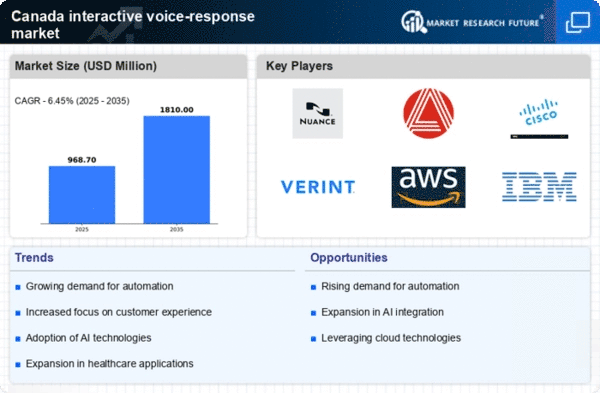
As per Market Research Future analysis, the Canada Interactive Voice Response Market size was estimated at 910.0 USD Million in 2024. The Interactive Voice-response market is projected to grow from 968.7 USD Million in 2025 to 1810.0 USD Million by 2035, exhibiting a compound annual growth rate (CAGR) of 6.4% during the forecast period 2025 - 2035

Key Market Trends & Highlights

The Canada interactive voice-response market is experiencing robust growth driven by technological advancements and evolving customer expectations.

  • AI integration is transforming the interactive voice-response landscape, enhancing automation and efficiency.
  • The focus on data privacy is becoming increasingly critical as consumers demand greater security in their interactions.
  • The largest segment in this market is customer support automation, while the fastest-growing segment is e-commerce support solutions.
  • Technological advancements in communication and the rising demand for customer support automation are key drivers of market growth.

Market Size & Forecast

2024 Market Size 910.0 (USD Million)
2035 Market Size 1810.0 (USD Million)
CAGR (2025 - 2035) 6.45%

Major Players

Nuance Communications (US), Avaya (US), Cisco Systems (US), Verint Systems (US), Amazon Web Services (US), IBM (US), Google Cloud (US), Mitel Networks (CA)

Our Impact
Enabled $4.3B Revenue Impact for Fortune 500 and Leading Multinationals
Partnering with 2000+ Global Organizations Each Year
30K+ Citations by Top-Tier Firms in the Industry

Canada Interactive Voice Response Market Trends

The Canada Interactive Voice Response Market is currently experiencing notable growth. This growth is driven by advancements in technology and an increasing demand for automated customer service solutions. Organizations across various sectors are adopting these systems to enhance operational efficiency and improve customer engagement. The integration of artificial intelligence and machine learning into interactive voice-response systems is particularly noteworthy. It allows for more personalized interactions and a better understanding of customer needs. This trend appears to be reshaping how businesses communicate with their clients, leading to a more streamlined experience. Moreover, the regulatory environment in Canada is evolving, with a focus on data privacy and security. This has implications for the interactive voice-response market, as companies must ensure compliance with stringent regulations while implementing these technologies. The emphasis on user experience is also becoming increasingly important, as customers expect seamless interactions. As a result, businesses are investing in sophisticated voice recognition technologies and analytics to refine their services. Overall, the interactive voice-response market is poised for continued expansion, reflecting broader trends in automation and customer service enhancement.

AI Integration

The incorporation of artificial intelligence into interactive voice-response systems is transforming customer interactions. AI enables more natural conversations, allowing systems to understand and respond to inquiries with greater accuracy, likely enhancing user satisfaction and operational efficiency.

Focus on Data Privacy

With growing concerns over data security, the interactive voice-response market is adapting to comply with stringent regulations. Companies are prioritizing the protection of customer information, which may influence the design and implementation of these systems.

Enhanced User Experience

There is a strong emphasis on improving user experience within the interactive voice-response market. Businesses are investing in advanced voice recognition technologies to create more intuitive and engaging interactions, which could lead to higher customer retention rates.

Canada Interactive Voice Response Market Drivers

Growing E-commerce and Remote Services

The interactive voice-response market is experiencing growth driven by the expansion of e-commerce and remote services in Canada. As more consumers turn to online shopping and remote interactions, businesses are compelled to enhance their customer service capabilities. The rise in e-commerce sales, which reached approximately $40 billion in 2025, has led to an increased reliance on automated customer service solutions, including interactive voice-response systems. These systems facilitate efficient handling of inquiries related to orders, returns, and support, thereby improving customer satisfaction. Additionally, the trend towards remote services necessitates robust communication solutions that can operate effectively in a digital environment. As a result, the interactive voice-response market is likely to see continued growth as businesses adapt to the evolving landscape of consumer behavior.

Regulatory Compliance and Data Security

The interactive voice-response market is influenced by the increasing focus on regulatory compliance and data security in Canada. With stringent regulations governing data protection, businesses are compelled to adopt solutions that ensure compliance while maintaining customer trust. The interactive voice-response market is adapting to these requirements by incorporating advanced security features, such as encryption and secure data handling protocols. As organizations strive to protect sensitive customer information, the demand for secure voice-response systems is expected to rise. This trend is particularly relevant in sectors like healthcare and finance, where data breaches can have severe consequences. Consequently, the interactive voice-response market is likely to see growth as companies prioritize compliance and security in their customer interaction strategies.

Technological Advancements in Communication

The interactive voice-response market is experiencing a surge due to rapid technological advancements in communication systems. Innovations in artificial intelligence and machine learning are enhancing the capabilities of voice-response systems, allowing for more natural interactions. In Canada, the adoption of cloud-based solutions is on the rise, with a projected growth rate of 15% annually. This shift enables businesses to implement scalable and cost-effective voice-response solutions. Furthermore, the integration of natural language processing is improving the accuracy of voice recognition, which is crucial for customer satisfaction. As companies increasingly seek to streamline operations and reduce costs, the demand for sophisticated interactive voice-response systems is likely to grow. This positions the market for substantial expansion in the coming years.

Rising Demand for Customer Support Automation

The interactive voice-response market is being driven by the increasing demand for customer support automation across various sectors in Canada. Businesses are recognizing the need to enhance customer service efficiency while managing operational costs. According to recent data, approximately 60% of Canadian companies are investing in automated customer service solutions, including interactive voice-response systems. This trend is particularly evident in industries such as telecommunications and banking, where customer interactions are frequent and complex. By automating routine inquiries, companies can allocate human resources to more complex issues, thereby improving overall service quality. The growing emphasis on customer experience is likely to propel the adoption of interactive voice-response systems, making them a vital component of modern customer service strategies.

Shift Towards Omnichannel Customer Engagement

The interactive voice-response market is benefiting from the shift towards omnichannel customer engagement strategies among Canadian businesses. Companies are increasingly recognizing the importance of providing a seamless customer experience across multiple channels, including voice, chat, and social media. This trend is prompting the integration of interactive voice-response systems with other communication platforms, allowing for a cohesive customer journey. As businesses aim to meet the expectations of tech-savvy consumers, the demand for versatile voice-response solutions is likely to increase. Recent studies indicate that organizations employing omnichannel strategies can achieve a 20% increase in customer retention rates. Therefore, the interactive voice-response market is positioned to thrive as companies seek to enhance their engagement capabilities.


Market Segment Insights

By Technology: Speech Recognition (Largest) vs. Natural Language Processing (Fastest-Growing)

In the Canada interactive voice-response market, Speech Recognition is the leading technology segment, boasting significant market share due to its widespread adoption across various industries like customer service and healthcare. Touch Tone Input continues to play a crucial role, especially in traditional applications, while Text-to-Speech complements these technologies by enhancing user interaction. Natural Language Processing, although currently smaller in share, is rapidly gaining traction as businesses seek more advanced conversational interfaces to improve customer engagement. The growth trends in the Canada interactive voice-response market are largely driven by advancements in Artificial Intelligence and machine learning, which enhance the capabilities of Speech Recognition and Natural Language Processing. Increasing demand for automated customer service solutions and cost-cutting measures in organizations are also fueling investments in these technologies. Furthermore, the shift towards omnichannel communication strategies is pushing the adoption of integrated voice-response systems that utilize these advanced technologies to provide seamless customer experiences.

Technology: Speech Recognition (Dominant) vs. Natural Language Processing (Emerging)

Speech Recognition is a dominant force in the Canada interactive voice-response market, known for enabling efficient and accurate voice-based interactions. Its ability to streamline customer service operations makes it an essential technology across diverse sectors. In contrast, Natural Language Processing is an emerging technology that focuses on enabling machines to understand and respond to human language more intuitively. While currently capturing a smaller market segment, its rapid growth rate reflects the increasing importance of conversational AI in enhancing user experience and engagement. As organizations seek more sophisticated interaction techniques, Natural Language Processing is expected to play a pivotal role in shaping the future landscape of voice-response technologies.

By Deployment Type: Cloud-based (Largest) vs. On-premise (Fastest-Growing)

In the Canada interactive voice-response market, the distribution of market share among deployment types shows that cloud-based solutions hold the largest share due to their scalability and flexibility. This enables businesses to adopt these systems without the constraints of physical infrastructure. On-premise deployments, while historically significant, are now experiencing robust competition from hybrid solutions that cater to the needs of organizations looking for tailored configurations. Growth trends within this segment indicate a shift towards cloud-based solutions, driven by advances in technology and user preferences for lower maintenance costs. Hybrid solutions are emerging rapidly as businesses seek more control over their data while still leveraging the cloud's advantages. The increasing demand for seamless integration with existing systems is also propelling the hybrid deployment type forward as organizations adapt to changing technological landscapes.

Cloud-based (Dominant) vs. On-premise (Emerging)

Cloud-based interactive voice-response systems are currently dominant in the Canada interactive voice-response market, favored for their flexibility and reduced upfront costs. These solutions allow organizations to quickly scale operations, adapt to changing needs, and implement advanced technologies with ease. On the other hand, on-premise systems are emerging, offering businesses greater control over data and infrastructure. This traditional approach appeals to sectors with strict data compliance requirements. As organizations weigh the pros and cons, the trend indicates a blend of both types, allowing for custom-tailored solutions that foster innovation while mitigating risks.

By Component: Software (Largest) vs. Hardware (Fastest-Growing)

In the Canada interactive voice-response market, the software segment holds the largest market share, reflecting the critical role of intelligent software solutions in enhancing customer interactions. Hardware follows as a substantial contributor, but its share is eclipsed by the software segment's dominance, highlighting a clear preference for software-driven systems over standalone hardware products. The growth trajectory for these segments reveals that while software continues to be the mainstay, hardware is experiencing rapid developments. This shift is driven by advancements in technology and increasing investments in voice recognition hardware solutions, which enhance user experience. As businesses seek to automate customer service processes, the hardware segment is likely to see accelerated adoption alongside its software counterpart.

Software (Dominant) vs. Hardware (Emerging)

Within the Canada interactive voice-response market, software is recognized as the dominant component, characterized by its ability to integrate AI and machine learning for improved customer interactions. This segment thrives on ongoing advancements that continuously refine natural language processing and voice recognition capabilities. In contrast, the hardware aspect is emerging, focusing on innovative devices designed to support the software solutions. These devices are tailored to enhance the overall functionality of voice-response systems and are increasingly becoming crucial in supporting complex interactions. As businesses recognize the importance of a comprehensive solution combining both software and hardware, the emerging hardware segment is poised for substantial growth, complementing the established dominance of software.

By End Use: BFSI (Largest) vs. Healthcare (Fastest-Growing)

In the Canada interactive voice-response market, the BFSI sector commands a significant portion of market share, driven by the increasing demand for efficient customer service solutions in banking and financial services. As the industry adapts to digital transformation, the deployment of IVR systems ensures improved service delivery, leading to a higher proportion of market utilization among competitors. Conversely, the healthcare sector, while smaller in market share, is experiencing rapid growth. The rising focus on patient engagement and the need for automated appointment scheduling have positioned the healthcare segment to leverage IVR technology for enhanced operational efficiency. Growth trends indicate that the BFSI sector's established presence is bolstered by regulatory compliance requirements and the necessity for 24/7 customer support. Meanwhile, the healthcare segment is fueled by technological advancements and the increasing adoption of telehealth solutions. These dynamics are fostering innovations in IVR functionalities, with player investments focusing on customizable solutions to cater to the specific needs of each sector, thus enabling both segments to expand their footprint in the competitive landscape of the market.

BFSI (Dominant) vs. Healthcare (Emerging)

The BFSI sector is a dominant force within the Canada interactive voice-response market, characterized by its robust infrastructure and a clear focus on customer satisfaction. Financial institutions consistently invest in IVR systems to streamline operations, minimizing human intervention in routine inquiries while effectively managing large volumes of customer interactions. Features such as account balance inquiries and transaction alerts are pivotal contributors to enhancing user experience. In contrast, the healthcare sector is emerging as a vital player, increasingly adopting IVR solutions to tackle appointment scheduling, patient reminders, and follow-up care. This sector's growth is driven by the necessity for improved patient engagement and operational efficiencies, leading to tailored IVR implementations that cater specifically to healthcare providers' needs.

Get more detailed insights about Canada Interactive Voice Response Market

Key Players and Competitive Insights

The interactive voice-response market is currently characterized by a dynamic competitive landscape, driven by advancements in artificial intelligence (AI) and increasing demand for enhanced customer engagement solutions. Major players such as Nuance Communications (US), Avaya (US), and Mitel Networks (CA) are strategically positioning themselves through innovation and partnerships. Nuance Communications (US) focuses on AI-driven solutions, enhancing user experience through natural language processing, while Avaya (US) emphasizes cloud-based services to improve operational efficiency. Mitel Networks (CA) is leveraging its regional expertise to expand its market share, indicating a trend towards localized solutions that cater to specific customer needs. Collectively, these strategies contribute to a competitive environment that is increasingly reliant on technological advancements and customer-centric approaches.Key business tactics within the market include supply chain optimization and the localization of services to better meet regional demands. The competitive structure appears moderately fragmented, with several key players vying for market share. This fragmentation allows for diverse offerings, yet the influence of major companies remains substantial, as they set benchmarks for innovation and service quality. The interplay between established firms and emerging players fosters a vibrant ecosystem, where agility and responsiveness to market changes are crucial.

In October Nuance Communications (US) announced a partnership with a leading telecommunications provider to integrate its AI-driven voice solutions into their customer service platforms. This strategic move is likely to enhance the scalability of Nuance's offerings, allowing for broader adoption across various sectors. The partnership underscores the importance of collaboration in driving technological advancements and improving customer interactions.

In September Avaya (US) launched a new cloud-based interactive voice-response system designed to streamline customer interactions for small to medium-sized enterprises. This initiative reflects Avaya's commitment to democratizing access to advanced communication technologies, potentially increasing its market penetration among smaller businesses. The launch signifies a shift towards more accessible solutions that cater to a wider audience, thereby enhancing competitive positioning.

In August Mitel Networks (CA) expanded its operations by acquiring a regional competitor, which is expected to bolster its market presence in Canada. This acquisition not only enhances Mitel's service capabilities but also allows for the integration of innovative technologies from the acquired firm. Such strategic actions indicate a trend towards consolidation in the market, where companies seek to enhance their competitive edge through mergers and acquisitions.

As of November the competitive trends shaping the interactive voice-response market include a pronounced focus on digitalization, sustainability, and the integration of AI technologies. Strategic alliances are increasingly pivotal, as companies recognize the value of collaboration in fostering innovation and enhancing service delivery. Looking ahead, competitive differentiation is likely to evolve, with a shift from price-based competition to a focus on technological innovation, reliability in supply chains, and the ability to deliver tailored customer experiences. This evolution suggests that companies must continuously adapt to maintain relevance in an ever-changing market landscape.

Key Companies in the Canada Interactive Voice Response Market include

Industry Developments

Recent developments in the Canada Interactive Voice Response Market have shown significant growth and transformation, particularly with key players such as Telus International, Genesys, and Nuance Communications enhancing their offerings. In September 2023, Telus International announced a strategic partnership with a leading AI provider to improve its voice solutions, thus boosting customer engagement. Meanwhile, Genesys and Avaya collaborated on an initiative to integrate their platforms, providing enhanced omnichannel customer service experiences.

In August 2023, Nuance Communications expanded its presence in Canada by launching innovative solutions tailored to healthcare providers, addressing specific needs within the industry. Growth in the market valuation of companies such as NICE Systems and Verint Systems is being fueled by a rising demand for automated customer service solutions.

Notably, in June 2023, Cisco Systems reported a substantial increase in revenue attributed to its Interactive Voice Response services. Furthermore, Mitel Networks and RingCentral have been active in upgrading their systems to include AI-driven features, reflecting the ongoing digital transformation in the region. These developments have underlined Canada's commitment to advancing technology while ensuring a robust customer service landscape across various sectors.

Future Outlook

Canada Interactive Voice Response Market Future Outlook

The Interactive Voice Response Market in Canada is projected to grow at a 6.45% CAGR from 2025 to 2035, driven by advancements in AI and customer engagement strategies.

New opportunities lie in:

  • Integration of AI-driven analytics for personalized customer interactions.
  • Development of multi-language support systems to enhance accessibility.
  • Expansion into healthcare for patient management and appointment scheduling.

By 2035, the market is expected to achieve robust growth, driven by innovative solutions and increased adoption.

Market Segmentation

Canada Interactive Voice Response Market End Use Outlook

  • BFSI
  • Healthcare
  • Telecom
  • Retail
  • IT and Software

Canada Interactive Voice Response Market Component Outlook

  • Software
  • Hardware
  • Services

Canada Interactive Voice Response Market Technology Outlook

  • Speech Recognition
  • Touch Tone Input
  • Natural Language Processing
  • Text-to-Speech

Canada Interactive Voice Response Market Deployment Type Outlook

  • On-premise
  • Cloud-based
  • Hybrid

Report Scope

MARKET SIZE 2024 910.0(USD Million)
MARKET SIZE 2025 968.7(USD Million)
MARKET SIZE 2035 1810.0(USD Million)
COMPOUND ANNUAL GROWTH RATE (CAGR) 6.45% (2025 - 2035)
REPORT COVERAGE Revenue Forecast, Competitive Landscape, Growth Factors, and Trends
BASE YEAR 2024
Market Forecast Period 2025 - 2035
Historical Data 2019 - 2024
Market Forecast Units USD Million
Key Companies Profiled Nuance Communications (US), Avaya (US), Cisco Systems (US), Verint Systems (US), Amazon Web Services (US), IBM (US), Google Cloud (US), Mitel Networks (CA)
Segments Covered Technology, Deployment Type, Component, End Use
Key Market Opportunities Integration of artificial intelligence enhances customer experience in the interactive voice-response market.
Key Market Dynamics Rising demand for personalized customer experiences drives innovation in the interactive voice-response market.
Countries Covered Canada
Leave a Comment

FAQs

What is the expected market size of the Canada Interactive Voice Response Market in 2024?

The Canada Interactive Voice Response Market is expected to be valued at 1.09 billion USD in 2024.

What will the market value be in 2035 for the Canada Interactive Voice Response Market?

The market is projected to reach a value of 2.2 billion USD by 2035.

What is the expected compound annual growth rate (CAGR) for the Canada Interactive Voice Response Market from 2025 to 2035?

The expected CAGR for this market is 6.575% during the period from 2025 to 2035.

Which segment is expected to hold the largest market share in 2035?

The Call Routing segment is anticipated to hold the largest market share, valued at 0.9 billion USD in 2035.

What will the Outbound segment's market size be by 2035?

The Outbound segment is expected to reach a market size of 0.54 billion USD in 2035.

How much is the Self-Service segment projected to be worth in 2035?

The Self-Service segment is projected to be valued at 0.76 billion USD by 2035.

Who are the prominent players in the Canada Interactive Voice Response Market?

Major players include Telus International, Genesys, Nuance Communications, and Avaya among others.

What opportunities are driving growth in the Canada Interactive Voice Response Market?

The market growth is driven by the increasing demand for efficient customer service and automation solutions.

What challenges does the Canada Interactive Voice Response Market currently face?

Challenges include managing customer expectations and integrating advanced technologies effectively.

What impact do emerging trends have on the Canada Interactive Voice Response Market?

Emerging trends such as AI integration are expected to enhance efficiency and customer experience in the market.

Download Free Sample

Kindly complete the form below to receive a free sample of this Report

Compare Licence

×
Features License Type
Single User Multiuser License Enterprise User
Price $4,950 $5,950 $7,250
Maximum User Access Limit 1 User Upto 10 Users Unrestricted Access Throughout the Organization
Free Customization
Direct Access to Analyst
Deliverable Format
Platform Access
Discount on Next Purchase 10% 15% 15%
Printable Versions