×
Request Free Sample ×

Kindly complete the form below to receive a free sample of this Report

* Please use a valid business email

Leading companies partner with us for data-driven Insights

clients tt-cursor
Hero Background

Japan Interactive Voice Response Market

ID: MRFR/ICT/59052-HCR
200 Pages
Aarti Dhapte
February 2026

Japan Interactive Voice Response Market Size, Share and Trends Analysis Report By Solution (Call Routing, Outbound, Self-Service), By Technology (Speech Based, Touch Tone Based, Text to Speech), By Service (Maintenance & Support) and By Deployment (Cloud, On-Premise)-Forecast to 2035

Share:
Download PDF ×

We do not share your information with anyone. However, we may send you emails based on your report interest from time to time. You may contact us at any time to opt-out.

Japan Interactive Voice Response Market Infographic
Purchase Options

Japan Interactive Voice Response Market Summary

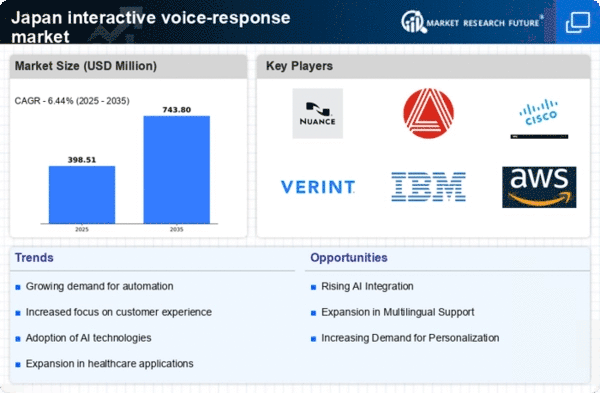
As per Market Research Future analysis, the Japan interactive voice-response market Size was estimated at 374.4 USD Million in 2024. The Japan interactive voice-response market is projected to grow from 398.51 USD Million in 2025 to 743.8 USD Million by 2035, exhibiting a compound annual growth rate (CAGR) of 6.4% during the forecast period 2025 - 2035

Key Market Trends & Highlights

The Japan interactive voice-response market is experiencing robust growth driven by technological advancements and evolving customer expectations.

  • The integration of AI technologies is transforming the interactive voice-response landscape, enhancing efficiency and user experience.
  • The largest segment in the market is the customer engagement solutions, while the fastest-growing segment is cloud-based interactive voice-response systems.
  • Regulatory support for digital transformation is fostering innovation and adoption across various industries in Japan.
  • Rising demand for automation and advancements in natural language processing are key drivers propelling market expansion.

Market Size & Forecast

2024 Market Size 374.4 (USD Million)
2035 Market Size 743.8 (USD Million)
CAGR (2025 - 2035) 6.44%

Major Players

Nuance Communications (US), Avaya (US), Cisco Systems (US), Verint Systems (US), IBM (US), Amazon Web Services (US), Google Cloud (US), Mitel Networks (CA), Aspect Software (US)

Our Impact
Enabled $4.3B Revenue Impact for Fortune 500 and Leading Multinationals
Partnering with 2000+ Global Organizations Each Year
30K+ Citations by Top-Tier Firms in the Industry

Japan Interactive Voice Response Market Trends

The interactive voice-response market in Japan is currently experiencing notable growth, driven by advancements in technology and increasing demand for automated customer service solutions. Businesses across various sectors are adopting these systems to enhance customer engagement and streamline operations. The integration of artificial intelligence and machine learning into voice-response systems appears to be a key factor in improving user experience and operational efficiency. As organizations seek to reduce costs while maintaining high service levels, the appeal of interactive voice-response systems continues to rise. Moreover, the regulatory environment in Japan is evolving, with government initiatives promoting digital transformation across industries. This shift is likely to encourage more companies to invest in interactive voice-response technology. The focus on enhancing customer satisfaction and operational efficiency suggests that the market will continue to expand. As businesses increasingly recognize the value of these systems, the interactive voice-response market is poised for further development, potentially leading to innovative applications and improved functionalities in the near future.

Integration of AI Technologies

The incorporation of artificial intelligence into interactive voice-response systems is transforming how businesses interact with customers. AI enhances the ability of these systems to understand and respond to user queries more effectively, leading to improved customer satisfaction. This trend indicates a shift towards more personalized and efficient service delivery.

Regulatory Support for Digital Transformation

Government initiatives in Japan are fostering an environment conducive to the adoption of interactive voice-response technology. Policies aimed at promoting digital innovation are likely to encourage businesses to invest in these systems, thereby enhancing operational efficiency and customer engagement.

Focus on Customer Experience

There is a growing emphasis on improving customer experience within the interactive voice-response market. Companies are increasingly recognizing the importance of providing seamless and intuitive interactions, which may lead to higher customer retention rates and loyalty.

Japan Interactive Voice Response Market Drivers

Rising Demand for Automation

The interactive voice-response market in Japan experiences a notable surge in demand for automation solutions. Businesses increasingly seek to streamline operations and enhance efficiency, leading to a greater reliance on automated systems. This trend is particularly evident in sectors such as telecommunications and customer service, where companies aim to reduce operational costs and improve response times. According to recent data, the automation of customer interactions can lead to a reduction in handling time by up to 30%. As organizations recognize the potential for increased productivity and customer satisfaction, the interactive voice-response market is poised for significant growth.

Growing Adoption of Cloud-Based Solutions

The shift towards cloud-based solutions is reshaping the interactive voice-response market in Japan. Organizations are increasingly migrating their operations to the cloud, seeking flexibility, scalability, and cost-effectiveness. This transition allows businesses to deploy interactive voice-response systems without the need for extensive on-premises infrastructure. Recent statistics indicate that cloud adoption in the technology sector has reached 70% in Japan, underscoring the trend's momentum. As more companies embrace cloud technologies, the interactive voice-response market is expected to expand, driven by the demand for accessible and efficient communication solutions.

Advancements in Natural Language Processing

Natural language processing (NLP) technologies are evolving rapidly, significantly impacting the interactive voice-response market in Japan. Enhanced NLP capabilities allow systems to understand and process human language more effectively, leading to improved user experiences. This advancement is crucial as consumers increasingly expect seamless interactions with automated systems. The market for NLP in Japan is projected to grow at a CAGR of 20% over the next five years, indicating a strong shift towards more sophisticated voice-response solutions. As businesses adopt these technologies, the interactive voice-response market is likely to witness substantial innovation and expansion.

Regulatory Changes Favoring Digital Solutions

Recent regulatory changes in Japan are fostering an environment conducive to the growth of the interactive voice-response market. The government is actively promoting digital transformation initiatives, encouraging businesses to adopt innovative technologies. These regulations aim to enhance operational efficiency and improve service delivery across various sectors. As a result, companies are increasingly investing in interactive voice-response systems to comply with new standards and improve customer interactions. The interactive voice-response market is likely to thrive as organizations adapt to these regulatory shifts, positioning themselves for future success.

Increased Investment in Customer Engagement Solutions

In Japan, there is a marked increase in investment directed towards customer engagement solutions, which directly influences the interactive voice-response market. Companies are recognizing the importance of maintaining strong customer relationships and are allocating resources to enhance their engagement strategies. This trend is reflected in a reported 15% increase in spending on customer interaction technologies over the past year. As organizations strive to provide personalized and efficient service, the interactive voice-response market stands to benefit from this heightened focus on customer engagement.


Market Segment Insights

By Technology: Speech Recognition (Largest) vs. Natural Language Processing (Fastest-Growing)

In the Japan interactive voice-response market, Speech Recognition holds the largest share due to its widespread adoption across various sectors such as customer service, healthcare, and education. Its effectiveness in understanding user commands has solidified its position, making it a preferred choice for businesses aiming to enhance user interaction. Conversely, Natural Language Processing (NLP) has emerged as the fastest-growing segment as it enables more human-like interactions, driving demand in increasingly sophisticated applications like virtual assistants and chatbots. Growth trends reflect a shift towards advanced technologies that facilitate seamless communication. The rise of AI and machine learning enhances both Speech Recognition and NLP capabilities, leading to improved accuracy and user satisfaction. Factors such as the digital transformation of industries and heightened consumer expectations for intuitive interfaces are propelling investments in these technologies. As businesses prioritize customer engagement, the evolution of these voice-response solutions will remain critical.

Technology: Speech Recognition (Dominant) vs. Natural Language Processing (Emerging)

Speech Recognition is the dominant force within the Japan interactive voice-response market, recognized for its accuracy and efficiency in parsing spoken commands. Its applications range from automated customer service lines to accessibility tools, showcasing versatility that appeals to a broad audience. In contrast, Natural Language Processing is an emerging force, characterized by its capability to understand and respond to complex human language. This technology is advancing quickly, driven by integration with AI systems that offer more personalized user experiences. As more companies seek to leverage these capabilities, the competition in the market is expected to intensify, fostering innovation and expansion in both segments.

By Deployment Type: Cloud-based (Largest) vs. On-premise (Fastest-Growing)

In the Japan interactive voice-response market, the market share distribution among deployment types reveals that cloud-based solutions hold the largest share due to their scalability and lower upfront costs, making them attractive to businesses of all sizes. On-premise systems, while traditionally popular for their control and security, are experiencing a shift as more companies transition to cloud solutions, reflecting the growing preference for flexible deployment options. Growth trends in this segment are driven primarily by the increasing adoption of cloud technologies and the need for businesses to enhance operational efficiency. The hybrid deployment model is also gaining traction, as organizations seek to balance the benefits of both on-premise and cloud solutions. As digital transformation accelerates, the interactive voice-response systems are expected to evolve, offering more innovative features that cater to customer needs while leveraging cloud advantages.

Cloud-based (Dominant) vs. On-premise (Emerging)

In the cloud-based segment of the Japan interactive voice-response market, its dominant position is attributed to the flexibility and cost-effectiveness it offers. Businesses are increasingly favoring cloud deployments for their ability to rapidly scale and integrate with existing systems, making them ideal for dynamic and growing operations. Conversely, on-premise solutions are emerging as companies regain interest in retaining direct control of their IVR systems, prioritizing data security and customization. While not as prevalent as cloud, on-premise systems still appeal to sectors sensitive to data privacy. The hybrid model bridges these two, allowing organizations to reap the benefits of both paradigms, catering to varied operational requirements.

By Component: Software (Largest) vs. Services (Fastest-Growing)

In the Japan interactive voice-response market, the software segment dominates with a significant share, reflecting the high demand for advanced voice applications and AI integrations. This segment holds a commanding position due to the increasing reliance on automated solutions across various industries, facilitating seamless customer interactions and improving overall user experience. On the other hand, the services segment is rapidly gaining traction as businesses invest in comprehensive support, customization, and maintenance solutions to optimize their voice-response systems. This shift towards service-oriented models supports the adoption of interactive technologies and enhances the value proposition for end-users. As organizations prioritize customer engagement and operational efficiency, the growth trends within the Japan interactive voice-response market highlight an accelerated demand for both software and service components. The software segment is driven by innovations in AI and voice recognition technologies, while the service segment capitalizes on businesses' needs for reliable support and tailored solutions. This dual trend illustrates a thriving ecosystem where software advancements fuel service growth, catering to evolving customer expectations and operational requirements.

Software (Dominant) vs. Services (Emerging)

The software segment is a dominant force in the Japan interactive voice-response market, characterized by its advanced capabilities and integration of cutting-edge technologies. It encompasses various solutions, from basic IVR systems to sophisticated AI-driven applications that enhance customer experiences through personalized interactions. As businesses seek to innovate and differentiate themselves, the demand for robust software solutions remains strong. In contrast, the services segment is emerging rapidly as organizations recognize the importance of ongoing support, system integration, and customization to achieve optimal performance. This emerging trend signifies a shift towards more comprehensive, user-centric approaches where services complement the software, addressing the changing demands of businesses and their clientele.

By End Use: Healthcare (Largest) vs. BFSI (Fastest-Growing)

In the Japan interactive voice-response market, the distribution of market share among the key end-use sectors reveals that Healthcare holds the largest share, benefiting from the increased demand for automated systems in patient care and administrative processes. Following closely, the BFSI sector is witnessing rapid adoption of voice-response systems to enhance customer engagement and streamline operations due to the need for efficient service delivery in financial transactions. Growth trends in this segment are largely driven by technological advancements and increasing consumer expectations for seamless communication. The rise of AI and machine learning in voice-response systems is facilitating more personalized interactions, particularly in the Healthcare sector, while the BFSI sector is focusing on security innovations to maintain consumer trust. This synergy of technology and necessity positions both sectors for ongoing growth in the market.

Healthcare: Dominant vs. BFSI: Emerging

The Healthcare sector in the Japan interactive voice-response market is characterized by its substantial reliance on automation and efficiency in handling inquiries, appointments, and patient feedback. Healthcare providers are increasingly adopting these systems to improve patient experiences and reduce wait times. In contrast, the BFSI sector is emerging rapidly, fueled by a growing emphasis on customer service and digital transformation. This sector is integrating voice-response systems to facilitate banking services and enhance user interaction through secure and efficient communication channels. Both sectors, while at different stages, highlight the versatility and transformative potential of voice response technology in addressing specific industry needs and improving operational efficiency.

Get more detailed insights about Japan Interactive Voice Response Market

Key Players and Competitive Insights

The interactive voice-response market in Japan is characterized by a dynamic competitive landscape, driven by rapid technological advancements and increasing demand for automated customer service solutions. Key players such as Nuance Communications (US), Avaya (US), and IBM (US) are strategically positioned to leverage innovations in artificial intelligence and machine learning, enhancing their offerings. These companies focus on digital transformation initiatives, aiming to improve customer engagement and operational efficiency. Their collective strategies not only foster competition but also push the market towards more sophisticated and user-friendly solutions.In terms of business tactics, companies are increasingly localizing their operations to better cater to the unique preferences of Japanese consumers. This localization, coupled with supply chain optimization, allows for more agile responses to market demands. The competitive structure of the market appears moderately fragmented, with several players vying for market share, yet the influence of major companies remains substantial, shaping industry standards and customer expectations.

In October Nuance Communications (US) announced a partnership with a leading telecommunications provider in Japan to enhance its voice recognition capabilities. This strategic move is likely to bolster Nuance's market presence by integrating advanced voice technologies into existing customer service frameworks, thereby improving user experience and operational efficiency. Such partnerships may also facilitate the adoption of AI-driven solutions across various sectors, further solidifying Nuance's competitive edge.

In September Avaya (US) launched a new cloud-based interactive voice-response system tailored for the Japanese market. This initiative reflects Avaya's commitment to innovation and its understanding of local market needs. By offering customizable solutions, Avaya aims to attract a broader customer base, potentially increasing its market share in a region where personalized service is highly valued. This move underscores the importance of adaptability in a rapidly evolving technological landscape.

In August IBM (US) expanded its AI-driven customer engagement platform to include advanced analytics features specifically designed for Japanese enterprises. This expansion is indicative of IBM's strategy to integrate cutting-edge technology into its offerings, enhancing the decision-making capabilities of businesses. By focusing on analytics, IBM positions itself as a leader in providing actionable insights, which could be a game-changer for companies looking to optimize their customer interactions.

As of November the competitive trends in the interactive voice-response market are increasingly defined by digitalization, sustainability, and the integration of AI technologies. Strategic alliances among key players are shaping the landscape, fostering innovation and enhancing service delivery. The shift from price-based competition to a focus on technological advancement and supply chain reliability is evident, suggesting that future differentiation will hinge on the ability to innovate and adapt to changing consumer expectations.

Key Companies in the Japan Interactive Voice Response Market include

Industry Developments

In recent developments, Japan's Interactive Voice Response Market has been marked by increased investments in AI and automation technologies. Companies such as SAP and Oracle are emphasizing the integration of artificial intelligence to enhance customer service efficiency, reflecting a broader trend towards digital transformation across the sector. In terms of acquisitions, Mizuho Financial Group made headlines in June 2023 by acquiring a minority stake in a voice solutions startup, amplifying its digital service capabilities.

Moreover, Cisco Systems in July 2023 expanded its cloud solutions portfolio through a strategic partnership with local technology firms, further indicating the growing competitive landscape. Significant market valuation growth has been noted, with companies like Genesys and NTT Data reporting substantial revenue increases attributed to enhanced voice response systems.

The Japanese government has actively encouraged the development of advanced communication technologies, which has stimulated further growth in the market. Additionally, advancements in speech recognition technologies have had a notable impact on improving customer experiences, resulting in a growing preference for interactive voice response systems across various industries such as finance and telecommunications.

Future Outlook

Japan Interactive Voice Response Market Future Outlook

The Interactive Voice Response Market in Japan is projected to grow at a 6.44% CAGR from 2025 to 2035, driven by advancements in AI and customer engagement strategies.

New opportunities lie in:

  • Integration of AI-driven analytics for personalized customer interactions.
  • Development of multi-language support systems to enhance user experience.
  • Expansion into healthcare for patient management and appointment scheduling.

By 2035, the market is expected to achieve substantial growth, reflecting evolving consumer demands and technological advancements.

Market Segmentation

Japan Interactive Voice Response Market End Use Outlook

  • BFSI
  • Healthcare
  • Telecom
  • Retail
  • IT and Software

Japan Interactive Voice Response Market Component Outlook

  • Software
  • Hardware
  • Services

Japan Interactive Voice Response Market Technology Outlook

  • Speech Recognition
  • Touch Tone Input
  • Natural Language Processing
  • Text-to-Speech

Japan Interactive Voice Response Market Deployment Type Outlook

  • On-premise
  • Cloud-based
  • Hybrid

Report Scope

MARKET SIZE 2024 374.4(USD Million)
MARKET SIZE 2025 398.51(USD Million)
MARKET SIZE 2035 743.8(USD Million)
COMPOUND ANNUAL GROWTH RATE (CAGR) 6.44% (2025 - 2035)
REPORT COVERAGE Revenue Forecast, Competitive Landscape, Growth Factors, and Trends
BASE YEAR 2024
Market Forecast Period 2025 - 2035
Historical Data 2019 - 2024
Market Forecast Units USD Million
Key Companies Profiled Nuance Communications (US), Avaya (US), Cisco Systems (US), Verint Systems (US), IBM (US), Amazon Web Services (US), Google Cloud (US), Mitel Networks (CA), Aspect Software (US)
Segments Covered Technology, Deployment Type, Component, End Use
Key Market Opportunities Integration of artificial intelligence enhances customer experience in the interactive voice-response market.
Key Market Dynamics Rising demand for personalized customer experiences drives innovation in the interactive voice-response market.
Countries Covered Japan
Leave a Comment

FAQs

What is the expected market size of the Japan Interactive Voice Response Market by 2024?

The Japan Interactive Voice Response Market is expected to be valued at 390.0 million USD by 2024.

What is the projected market size of the Japan Interactive Voice Response Market by 2035?

By 2035, the overall market is anticipated to reach approximately 900.0 million USD.

What is the expected CAGR for the Japan Interactive Voice Response Market from 2025 to 2035?

The expected CAGR for the Japan Interactive Voice Response Market from 2025 to 2035 is 7.899%.

Which segment of the Japan Interactive Voice Response Market is expected to grow the most by 2035?

The Self-Service segment is projected to grow to 420.0 million USD by 2035, indicating significant growth.

What is the market value of the Call Routing segment of the Japan Interactive Voice Response Market in 2024?

The Call Routing segment is valued at 120.0 million USD in the year 2024.

Who are the major players in the Japan Interactive Voice Response Market?

Key players in the market include SAP, Oracle, Mizuho Financial Group, and Genesys, among others.

What is the expected market value for the Outbound segment of the Japan Interactive Voice Response Market by 2035?

The Outbound segment is expected to reach approximately 210.0 million USD by 2035.

What challenges might the Japan Interactive Voice Response Market face in the coming years?

Challenges may include technological advancements and integration with other digital solutions.

How does the growth rate of the Japan Interactive Voice Response Market compare regionally?

The Japan Interactive Voice Response Market is expected to grow steadily, reflecting positive regional demand for customer interaction solutions.

What growth opportunities exist within the Japan Interactive Voice Response Market?

Opportunities lie in the increased adoption of AI technologies and enhanced customer engagement strategies.

Download Free Sample

Kindly complete the form below to receive a free sample of this Report

Compare Licence

×
Features License Type
Single User Multiuser License Enterprise User
Price $4,950 $5,950 $7,250
Maximum User Access Limit 1 User Upto 10 Users Unrestricted Access Throughout the Organization
Free Customization
Direct Access to Analyst
Deliverable Format
Platform Access
Discount on Next Purchase 10% 15% 15%
Printable Versions