×
Request Free Sample ×

Kindly complete the form below to receive a free sample of this Report

* Please use a valid business email

Leading companies partner with us for data-driven Insights

clients tt-cursor
Hero Background

South Korea Interactive Voice Response Market

ID: MRFR/ICT/59050-HCR
200 Pages
Aarti Dhapte
February 2026

South Korea Interactive Voice Response Market Size, Share and Trends Analysis Report By Solution (Call Routing, Outbound, Self-Service), By Technology (Speech Based, Touch Tone Based, Text to Speech), By Service (Maintenance & Support) and By Deployment (Cloud, On-Premise) - Forecast to 2035

Share:
Download PDF ×

We do not share your information with anyone. However, we may send you emails based on your report interest from time to time. You may contact us at any time to opt-out.

South Korea Interactive Voice Response Market Infographic
Purchase Options

South Korea Interactive Voice Response Market Summary

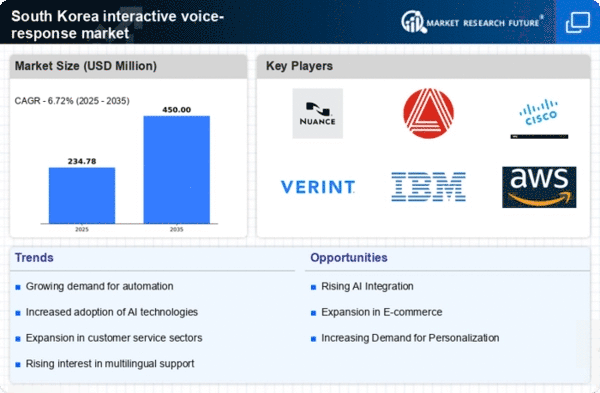
As per Market Research Future analysis, the South Korea interactive voice-response market Size was estimated at 220.0 USD Million in 2024. The South Korea interactive voice-response market is projected to grow from 234.78 USD Million in 2025 to 450.0 USD Million by 2035, exhibiting a compound annual growth rate (CAGR) of 6.7% during the forecast period 2025 - 2035

Key Market Trends & Highlights

The South Korea interactive voice-response market is poised for substantial growth driven by technological advancements and evolving customer expectations.

  • AI integration is transforming the interactive voice-response landscape, enhancing user interactions and operational efficiency.
  • Omni-channel solutions are becoming increasingly vital, allowing seamless customer experiences across various platforms.
  • The largest segment in the market is the e-commerce sector, while the fastest-growing segment is anticipated to be digital services.
  • Technological advancements in voice recognition and rising demand for customer experience enhancement are key drivers of market growth.

Market Size & Forecast

2024 Market Size 220.0 (USD Million)
2035 Market Size 450.0 (USD Million)
CAGR (2025 - 2035) 6.72%

Major Players

Nuance Communications (US), Avaya (US), Cisco Systems (US), Verint Systems (US), IBM (US), Amazon Web Services (US), Google Cloud (US), Aspect Software (US)

Our Impact
Enabled $4.3B Revenue Impact for Fortune 500 and Leading Multinationals
Partnering with 2000+ Global Organizations Each Year
30K+ Citations by Top-Tier Firms in the Industry

South Korea Interactive Voice Response Market Trends

The interactive voice-response market in South Korea is currently experiencing notable growth, driven by advancements in artificial intelligence and machine learning technologies. These innovations enhance the capabilities of voice-response systems, allowing for more natural interactions and improved customer experiences. As businesses increasingly adopt these systems, the demand for efficient customer service solutions rises. This trend is particularly evident in sectors such as telecommunications, finance, and retail, where companies seek to streamline operations and reduce costs. Furthermore, the integration of voice-response systems with other digital platforms appears to be a key factor in their growing popularity, as organizations aim to provide seamless service across multiple channels. In addition, the regulatory environment in South Korea is evolving to support the expansion of the interactive voice-response market. Government initiatives aimed at promoting digital transformation and enhancing technological infrastructure are likely to foster further growth. As organizations recognize the potential of voice-response systems to improve customer engagement and operational efficiency, investment in this technology is expected to increase. Overall, the interactive voice-response market in South Korea seems poised for continued expansion, driven by technological advancements and supportive policies.

AI Integration

The integration of artificial intelligence into interactive voice-response systems is transforming how businesses interact with customers. AI enhances the ability of these systems to understand and respond to complex queries, leading to improved customer satisfaction. This trend is particularly relevant in South Korea, where consumers increasingly expect personalized and efficient service.

Omni-channel Solutions

There is a growing trend towards the development of omni-channel solutions within the interactive voice-response market. Businesses are seeking to create cohesive customer experiences across various platforms, including voice, chat, and social media. This approach allows for more effective communication and engagement with customers, reflecting the diverse preferences of South Korean consumers.

Regulatory Support

The South Korean government is actively promoting the adoption of interactive voice-response technologies through supportive regulations and initiatives. This regulatory environment encourages businesses to invest in advanced voice-response systems, facilitating innovation and enhancing the overall market landscape. As a result, companies are more likely to explore new applications and functionalities.

South Korea Interactive Voice Response Market Drivers

Increased Adoption of Cloud-Based Solutions

The shift towards cloud-based solutions is significantly influencing the interactive voice-response market in South Korea. Organizations are increasingly migrating their operations to the cloud, which offers scalability, flexibility, and cost-effectiveness. This transition allows businesses to deploy interactive voice-response systems without the need for extensive on-premises infrastructure. As of 2025, it is estimated that over 60% of new interactive voice-response implementations will be cloud-based. This trend not only reduces operational costs but also enhances the ability to integrate with other digital platforms, thereby driving growth in the interactive voice-response market.

Expansion of E-commerce and Digital Services

The rapid expansion of e-commerce and digital services in South Korea is significantly impacting the interactive voice-response market. As more consumers turn to online shopping and digital platforms for services, businesses are compelled to adopt interactive voice-response systems to manage customer inquiries efficiently. This shift is evident in the reported 30% increase in online transactions over the past year, prompting companies to enhance their customer support capabilities. The interactive voice-response market is thus likely to benefit from this trend, as organizations seek to provide timely and effective assistance to their customers in a digital-first environment.

Growing Focus on Data Security and Compliance

As the interactive voice-response market expands in South Korea, there is an increasing focus on data security and compliance with regulations. Businesses are becoming more aware of the need to protect customer data and ensure compliance with local laws. This heightened awareness is driving investments in secure interactive voice-response systems that incorporate robust security features. Companies that prioritize data protection are likely to gain a competitive edge, as consumers are more inclined to engage with businesses that demonstrate a commitment to safeguarding their information. This trend is expected to bolster the interactive voice-response market as organizations seek to enhance their security measures.

Technological Advancements in Voice Recognition

The interactive voice-response market is experiencing a surge due to rapid advancements in voice recognition technology. In South Korea, the integration of artificial intelligence and machine learning algorithms has significantly enhanced the accuracy and efficiency of voice recognition systems. This improvement allows businesses to provide more personalized and responsive customer service, which is crucial in a competitive market. As of 2025, the market is projected to grow at a CAGR of approximately 15%, driven by the increasing demand for automated customer interactions. Companies are investing heavily in these technologies to streamline operations and reduce costs, indicating a robust future for the interactive voice-response market.

Rising Demand for Customer Experience Enhancement

In South Korea, the interactive voice-response market is being propelled by a growing emphasis on enhancing customer experience. Businesses are increasingly recognizing the importance of providing seamless and efficient customer interactions. As consumer expectations evolve, companies are adopting interactive voice-response systems to ensure quick resolution of inquiries and complaints. This trend is reflected in a reported 20% increase in customer satisfaction scores among organizations that have implemented such systems. The interactive voice-response market is thus positioned to thrive as businesses prioritize customer-centric strategies, leading to greater investment in these technologies.


Market Segment Insights

By Technology: Speech Recognition (Largest) vs. Natural Language Processing (Fastest-Growing)

In the South Korea interactive voice-response market, Speech Recognition currently leads with significant market share, driven by widespread adoption across various industries. Following closely are technologies like Touch Tone Input and Natural Language Processing, which are gaining traction as organizations seek more advanced interface solutions for customer interaction. Text-to-Speech also plays a crucial role, providing additional functionality to IVR systems. The growth trends indicate a robust increase in Natural Language Processing as businesses look to enhance customer engagement through more intuitive and conversational interfaces. The rise of AI and machine learning is a key driver, allowing NLP solutions to evolve rapidly. Speech Recognition remains dominant, yet the increasing demand for seamless user experience positions NLP as a pivotal technology for future developments in the sector.

Technology: Speech Recognition (Dominant) vs. Natural Language Processing (Emerging)

Speech Recognition is the dominant technology in the South Korea interactive voice-response market, enabling systems to convert spoken language into text, which drastically improves user interaction. It finds extensive applications in customer support and automated services, ensuring high accuracy and efficiency. On the other hand, Natural Language Processing represents an emerging and rapidly growing sector, focusing on the interaction between computers and humans through spoken language. As businesses increasingly implement AI-driven solutions for improved customer service, the demand for NLP is surging, positioning it as a key player in the evolution of voice-response systems.

By Deployment Type: Cloud-based (Largest) vs. Hybrid (Fastest-Growing)

The South Korea interactive voice-response market showcases a significant market share distribution among different deployment types. Currently, the cloud-based segment stands out as the largest, capturing the attention of many enterprises due to its scalability and lower initial investment costs. Meanwhile, the hybrid deployment type, which combines both on-premise and cloud solutions, is gaining traction among organizations looking for flexibility and enhanced security, thus witnessing a steady increase in its market share. In recent years, growth trends indicate a rising demand for hybrid and cloud-based solutions as businesses strive to enhance their operational efficiency and customer engagement strategies. The rapid advancements in technology and the increasing number of startups in the region are driving this growth. Furthermore, the COVID-19 pandemic accelerated the adoption of cloud technologies, highlighting the need for businesses to adapt to changing consumer preferences and remote operations, thereby contributing to the hybrid model's emergence as a fast-growing choice.

Cloud-based (Dominant) vs. Hybrid (Emerging)

The cloud-based deployment type has established itself as a dominant force in the South Korea interactive voice-response market, favored for its flexibility and cost-effective nature. Organizations can scale services quickly and manage resources efficiently without significant hardware investments. This deployment model allows businesses to adapt to varying demand levels seamlessly. In contrast, the hybrid model is rapidly emerging as a viable option for companies desiring a blend of both on-premise reliability and cloud-based agility. It caters to organizations that require specific data security measures while also benefiting from the cloud's scalability. As businesses become more tech-savvy, the hybrid deployment is gaining momentum, appealing to those who seek a tailored mix of both solutions.

By Component: Software (Largest) vs. Hardware (Fastest-Growing)

In the South Korea interactive voice-response market, the distribution of market share among component segments reveals software as the dominant player, commanding a considerable share. Hardware follows as a significant segment, though its prominence is rising more slowly compared to software. Services, while essential, contribute a smaller fraction to the overall market landscape but remain crucial for ensuring the effective deployment and operation of both hardware and software solutions. Amid evolving consumer preferences and technological advancements, the growth trend in this market segment is largely driven by increased demand for automated customer service solutions and enhanced user experience through sophisticated software offerings. Conversely, hardware is witnessing rapid growth due to technological innovation and the continuous need to upgrade systems for better efficiency. As organizations prioritize automation and customer engagement, the services component will also see growth as firms seek to optimize their IVR solutions.

Software (Dominant) vs. Hardware (Emerging)

The software segment serves as the dominant force within the South Korea interactive voice-response market, characterized by innovations in artificial intelligence and machine learning integration that deliver advanced functionalities. These software solutions not only streamline interactions but also provide analytics for businesses, enabling improved decision-making. Meanwhile, the hardware segment is emerging, fueled by the necessity for updated infrastructure to support advanced software applications. Companies are recognizing the importance of physical components that can enhance efficiency and reliability in IVR systems. As the market evolves, investments in both segments are likely to increase, addressing the growing demand for high-performance interactive voice-response systems.

By End Use: BFSI (Largest) vs. Healthcare (Fastest-Growing)

In the South Korea interactive voice-response market, the BFSI sector holds the largest market share among end-use segments, reflecting the critical need for efficient customer service solutions in banking and financial services. The sector's investment in IVR solutions is driven by the increasing demand for automated customer interactions, ensuring rapid response times and reduced operational costs. On the other hand, the healthcare segment is identified as the fastest-growing, propelled by the surge in telehealth and remote patient management services. As healthcare providers focus on enhancing patient experiences while managing an influx of patients, IVR technologies are being rapidly adopted to streamline operations and provide timely information to patients, contributing to the segment's strong growth trajectory.

BFSI (Dominant) vs. Healthcare (Emerging)

The BFSI sector stands out as the dominant force in the South Korea interactive voice-response market, characterized by significant investments in technology to enhance customer engagement and satisfaction. This segment prioritizes automation for services like account inquiries, transaction processing, and fraud detection, leading to improved customer retention. In contrast, the healthcare segment is emerging rapidly, spurred by innovations in telemedicine and care management. It focuses on using IVR systems to facilitate appointment scheduling, patient reminders, and informational services, thus addressing the evolving needs of patients and healthcare providers. Both segments showcase a commitment to leveraging IVR solutions to foster efficient communication, though they operate with distinct priorities and growth dynamics.

Get more detailed insights about South Korea Interactive Voice Response Market

Key Players and Competitive Insights

The interactive voice-response market in South Korea is characterized by a dynamic competitive landscape, driven by rapid technological advancements and increasing demand for automated customer service solutions. Key players such as Nuance Communications (US), Avaya (US), and Cisco Systems (US) are at the forefront, each adopting distinct strategies to enhance their market presence. Nuance Communications (US) focuses on innovation through AI-driven solutions, aiming to improve customer engagement and operational efficiency. Avaya (US) emphasizes partnerships with local firms to tailor its offerings to the unique needs of South Korean businesses, while Cisco Systems (US) leverages its extensive networking capabilities to integrate voice-response systems with broader communication platforms. Collectively, these strategies contribute to a competitive environment that is increasingly centered on technological integration and customer-centric solutions.In terms of business tactics, companies are increasingly localizing their operations to better serve the South Korean market. This includes optimizing supply chains and enhancing service delivery through localized support. The market structure appears moderately fragmented, with several key players vying for dominance. However, the influence of major companies is substantial, as they set benchmarks for innovation and service quality that smaller firms strive to meet.

In October Nuance Communications (US) announced a strategic partnership with a leading South Korean telecommunications provider to enhance its AI capabilities in voice-response systems. This collaboration is expected to facilitate the development of more sophisticated, context-aware customer interactions, thereby solidifying Nuance's position in the market. The strategic importance of this partnership lies in its potential to leverage local expertise and infrastructure, which could significantly enhance service delivery and customer satisfaction.

In September Avaya (US) launched a new cloud-based voice-response solution tailored specifically for the South Korean retail sector. This initiative aims to streamline customer interactions and improve operational efficiency for retailers facing increasing competition. The launch underscores Avaya's commitment to addressing sector-specific needs, which may provide a competitive edge in a market that values customization and responsiveness.

In August Cisco Systems (US) expanded its voice-response offerings by integrating advanced analytics capabilities into its existing platforms. This move is designed to provide businesses with deeper insights into customer interactions, enabling them to refine their service strategies. The integration of analytics is likely to enhance Cisco's value proposition, as companies increasingly seek data-driven solutions to improve customer engagement.

As of November the competitive trends in the interactive voice-response market are heavily influenced by digitalization, AI integration, and a growing emphasis on sustainability. Strategic alliances are becoming more prevalent, as companies recognize the need to collaborate to enhance their technological capabilities and market reach. Looking ahead, competitive differentiation is expected to evolve, shifting from traditional price-based competition to a focus on innovation, technology, and supply chain reliability. This transition may redefine how companies position themselves in the market, emphasizing the importance of advanced solutions and customer-centric approaches.

Key Companies in the South Korea Interactive Voice Response Market include

Industry Developments

Recent developments in the South Korea Interactive Voice Response Market have showcased significant advancements and activity among major players. LG Uplus is actively enhancing its customer service through the implementation of advanced voice recognition technology in its IVR systems. Woori Bank has also introduced updated IVR solutions to streamline customer interactions, ensuring higher efficiency. In a move reflecting consolidation in the industry, SK Telecom announced an acquisition of certain assets related to voice automation in March 2023. Meanwhile, Daum Kakao has invested in cognitive cloud solutions to improve automated customer interactions. 

Tmap Mobility and KT Corporation have been collaborating to enhance their IVR offerings, focusing on mobility solutions. Notably, Naver Corporation has expanded its capacity in the IVR market by integrating AI solutions to better cater to consumer needs. The valuation in this sector is growing, fueled by increased demand for automation and improved customer service experiences, with firms such as Samsung SDS and LG CNS contributing significantly to this growth.

Over the past few years, the rise of mobile and online services has rapidly transformed the customer interaction landscape in South Korea, showcasing the critical role of Interactive Voice Response systems in the evolving market.

Future Outlook

South Korea Interactive Voice Response Market Future Outlook

The Interactive Voice Response Market in South Korea is projected to grow at a 6.72% CAGR from 2025 to 2035, driven by advancements in AI and customer engagement strategies.

New opportunities lie in:

  • Integration of AI-driven analytics for personalized customer interactions.
  • Development of multi-language support systems to enhance user accessibility.
  • Expansion into healthcare for automated patient communication solutions.

By 2035, the market is expected to achieve substantial growth, driven by innovative applications and technology advancements.

Market Segmentation

South Korea Interactive Voice Response Market End Use Outlook

  • BFSI
  • Healthcare
  • Telecom
  • Retail
  • IT and Software

South Korea Interactive Voice Response Market Component Outlook

  • Software
  • Hardware
  • Services

South Korea Interactive Voice Response Market Technology Outlook

  • Speech Recognition
  • Touch Tone Input
  • Natural Language Processing
  • Text-to-Speech

South Korea Interactive Voice Response Market Deployment Type Outlook

  • On-premise
  • Cloud-based
  • Hybrid

Report Scope

MARKET SIZE 2024 220.0(USD Million)
MARKET SIZE 2025 234.78(USD Million)
MARKET SIZE 2035 450.0(USD Million)
COMPOUND ANNUAL GROWTH RATE (CAGR) 6.72% (2025 - 2035)
REPORT COVERAGE Revenue Forecast, Competitive Landscape, Growth Factors, and Trends
BASE YEAR 2024
Market Forecast Period 2025 - 2035
Historical Data 2019 - 2024
Market Forecast Units USD Million
Key Companies Profiled Nuance Communications (US), Avaya (US), Cisco Systems (US), Verint Systems (US), IBM (US), Amazon Web Services (US), Google Cloud (US), Aspect Software (US)
Segments Covered Technology, Deployment Type, Component, End Use
Key Market Opportunities Integration of artificial intelligence enhances customer engagement in the interactive voice-response market.
Key Market Dynamics Rising demand for automated customer service solutions drives innovation in the interactive voice-response market.
Countries Covered South Korea
Leave a Comment

FAQs

What is the expected market size of the South Korea Interactive Voice Response Market by 2024?

The expected market size of the South Korea Interactive Voice Response Market by 2024 is valued at 300.0 USD Million.

What will be the projected market value of the South Korea Interactive Voice Response Market in 2035?

The projected market value of the South Korea Interactive Voice Response Market in 2035 is estimated to reach 1200.0 USD Million.

What is the expected CAGR for the South Korea Interactive Voice Response Market between 2025 and 2035?

The expected CAGR for the South Korea Interactive Voice Response Market between 2025 and 2035 is 13.431%.

Which segment is the largest in the South Korea Interactive Voice Response Market?

The largest segment in the South Korea Interactive Voice Response Market is Call Routing, valued at 100.0 USD Million in 2024 and projected to reach 400.0 USD Million by 2035.

What are the key applications within the South Korea Interactive Voice Response Market?

The key applications within the South Korea Interactive Voice Response Market include Call Routing, Outbound, and Self-Service.

What is the market size for the Outbound segment by 2035?

The market size for the Outbound segment of the South Korea Interactive Voice Response Market is projected to reach 320.0 USD Million by 2035.

Which companies are considered major players in the South Korea Interactive Voice Response Market?

Major players in the South Korea Interactive Voice Response Market include LG Uplus, Woori Bank, SK Telecom, and Naver Corporation.

What is the expected market value for the Self-Service segment by 2035?

The expected market value for the Self-Service segment of the South Korea Interactive Voice Response Market by 2035 is 480.0 USD Million.

How does the South Korea Interactive Voice Response Market grow in response to emerging trends?

The South Korea Interactive Voice Response Market is anticipated to grow significantly due to emerging trends such as enhanced automation and user personalization.

What challenges does the South Korea Interactive Voice Response Market face?

Challenges faced by the South Korea Interactive Voice Response Market include quickly evolving technology and the need for seamless integration with existing systems.

Download Free Sample

Kindly complete the form below to receive a free sample of this Report

Compare Licence

×
Features License Type
Single User Multiuser License Enterprise User
Price $4,950 $5,950 $7,250
Maximum User Access Limit 1 User Upto 10 Users Unrestricted Access Throughout the Organization
Free Customization
Direct Access to Analyst
Deliverable Format
Platform Access
Discount on Next Purchase 10% 15% 15%
Printable Versions