×
Request Free Sample ×

Kindly complete the form below to receive a free sample of this Report

* Please use a valid business email

Leading companies partner with us for data-driven Insights

clients tt-cursor
Hero Background

Canada Hydropower Market

ID: MRFR/EnP/46947-HCR
200 Pages
Chitranshi Jaiswal
February 2026

Canada Hydropower Market Research Report By Capacity (Mini Hydropower, Micro & Pico Hydropower, Small Hydropower, Large & Medium Hydropower), By Component (Electromechanical Equipment, Electric & Power Infrastructure, Civil Construction, Others) and By End User (Industrial, Utility, Others)-Forecast to 2035

Share:
Download PDF ×

We do not share your information with anyone. However, we may send you emails based on your report interest from time to time. You may contact us at any time to opt-out.

Canada Hydropower Market Infographic
Purchase Options

Canada Hydropower Market Summary

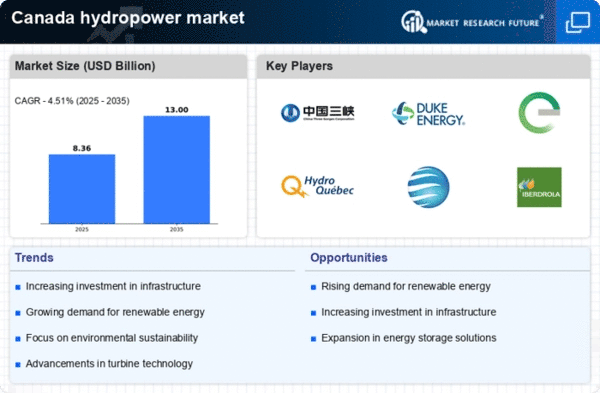
As per Market Research Future analysis, the Canada hydropower market Size was estimated at 8.0 USD Billion in 2024. The Canada hydropower market is projected to grow from 8.36 USD Billion in 2025 to 13.0 USD Billion by 2035, exhibiting a compound annual growth rate (CAGR) of 4.5% during the forecast period 2025 - 2035

Key Market Trends & Highlights

The Canada hydropower market is poised for growth driven by technological advancements and regulatory support.

  • Technological advancements are enhancing efficiency and reducing costs in hydropower generation.
  • Regulatory support is fostering a favorable environment for investment in renewable energy projects.
  • The largest segment in the market is large-scale hydropower, while small-scale hydropower is the fastest-growing segment.
  • Investment in infrastructure and growing demand for renewable energy are key drivers propelling market expansion.

Market Size & Forecast

2024 Market Size 8.0 (USD Billion)
2035 Market Size 13.0 (USD Billion)
CAGR (2025 - 2035) 4.51%

Major Players

China Three Gorges Corporation (CN), Duke Energy Corporation (US), Enel Green Power (IT), Hydro-Québec (CA), Statkraft AS (NO), Iberdrola S.A. (ES), Electricité de France (FR), RusHydro (RU)

Our Impact
Enabled $4.3B Revenue Impact for Fortune 500 and Leading Multinationals
Partnering with 2000+ Global Organizations Each Year
30K+ Citations by Top-Tier Firms in the Industry

Canada Hydropower Market Trends

The hydropower market in Canada is characterized by a robust infrastructure and a commitment to renewable energy sources. As of November 2025, hydropower remains a cornerstone of the country's energy strategy, contributing significantly to electricity generation. The vast river systems and favorable geography provide an ideal environment for hydropower development. This sector not only supports energy needs but also plays a crucial role in reducing greenhouse gas emissions. The government actively promotes investments in this area, indicating a strong policy framework aimed at enhancing sustainability and energy security. In recent years, there has been a noticeable shift towards modernization and efficiency improvements within the hydropower market. Technological advancements are being integrated to optimize performance and reduce operational costs. Additionally, the focus on environmental stewardship has led to innovative practices that minimize ecological impacts. Stakeholders are increasingly recognizing the importance of balancing energy production with ecological preservation, which may lead to new regulatory frameworks and investment opportunities in the future. Overall, the hydropower market in Canada appears poised for continued growth and evolution, driven by both technological innovation and a commitment to sustainable practices.

Technological Advancements

The hydropower market is experiencing a wave of technological innovations aimed at enhancing efficiency and reducing costs. These advancements include improved turbine designs and automation systems that optimize energy production. As a result, operators can achieve higher output with lower environmental impact, aligning with sustainability goals.

Regulatory Support

Government policies are increasingly favoring the hydropower market, with initiatives designed to promote renewable energy sources. This regulatory support may include financial incentives, streamlined permitting processes, and commitments to reduce carbon emissions, fostering a favorable environment for investment and development.

Environmental Considerations

There is a growing emphasis on environmental stewardship within the hydropower market. Stakeholders are focusing on minimizing ecological impacts through innovative practices and technologies. This trend suggests a potential shift towards more sustainable operations, which could reshape project planning and execution.

Canada Hydropower Market Drivers

Technological Innovations

Technological innovations are playing a pivotal role in shaping the hydropower market in Canada. The advent of advanced turbine designs and digital monitoring systems has the potential to significantly enhance efficiency and reduce operational costs. For instance, the implementation of smart grid technologies allows for better integration of hydropower with other renewable sources, optimizing energy distribution. Moreover, innovations in energy storage solutions are likely to address the intermittency issues associated with renewable energy. As these technologies continue to evolve, they may lead to increased investment in hydropower projects, thereby expanding the market. The focus on research and development in this sector suggests a promising future for the hydropower market, as stakeholders seek to leverage these advancements for improved performance.

Investment in Infrastructure

The hydropower market in Canada is experiencing a surge in investment aimed at modernizing and expanding existing infrastructure. With an estimated $10 billion allocated for hydropower projects over the next decade, stakeholders are focusing on enhancing efficiency and capacity. This investment is crucial as it supports the transition to renewable energy sources, aligning with Canada's commitment to reduce greenhouse gas emissions by 40-45% by 2030. The infrastructure development not only boosts the hydropower market but also creates job opportunities, thereby stimulating local economies. Furthermore, the integration of advanced technologies in infrastructure projects is expected to improve energy output and reliability, making hydropower a more attractive option for energy generation in Canada.

Government Incentives and Policies

Government incentives and policies are crucial drivers for the hydropower market in Canada. The federal and provincial governments have introduced various programs aimed at promoting renewable energy development. For example, the Clean Energy Fund provides financial support for innovative projects, while tax incentives encourage private investment in hydropower. These policies not only facilitate the growth of the hydropower market but also align with Canada's broader environmental goals. The commitment to reducing carbon emissions and transitioning to sustainable energy sources is reflected in these initiatives. As a result, the hydropower market is likely to benefit from a favorable regulatory environment that encourages investment and innovation, ultimately leading to increased capacity and efficiency.

Growing Demand for Renewable Energy

The increasing demand for renewable energy sources is a significant driver for the hydropower market in Canada. As the country aims to achieve net-zero emissions by 2050, hydropower is positioned as a key player in the energy mix. Recent statistics indicate that hydropower accounts for approximately 60% of Canada's electricity generation, highlighting its importance. The shift towards cleaner energy solutions is prompting both public and private sectors to invest in hydropower projects. This growing demand is likely to lead to the development of new facilities and the expansion of existing ones, thereby enhancing the overall capacity of the hydropower market. Additionally, the public's increasing awareness of climate change and the need for sustainable energy sources further fuels this demand.

Public Support for Renewable Initiatives

Public support for renewable energy initiatives is a significant driver of the hydropower market in Canada. As awareness of climate change and environmental issues grows, citizens are increasingly advocating for sustainable energy solutions. Surveys indicate that a majority of Canadians support the expansion of renewable energy sources, including hydropower. This public backing is influencing government policies and corporate strategies, leading to increased investment in hydropower projects. Furthermore, community engagement in hydropower initiatives fosters a sense of ownership and responsibility towards local energy resources. The positive perception of hydropower as a clean and reliable energy source is likely to bolster its development, thereby enhancing the hydropower market in the coming years.


Market Segment Insights

By Capacity: Large & Medium Hydropower (Largest) vs. Small Hydropower (Fastest-Growing)

In the Canada hydropower market, the capacity segment is primarily dominated by Large & Medium Hydropower, which holds the largest share due to its ability to generate significant energy output and cater to extensive electricity demands. Meanwhile, Small Hydropower follows, gaining traction as an essential part of the renewable energy landscape. Mini Hydropower and Micro & Pico Hydropower segments represent niche markets, focusing on localized energy generation with smaller capacities. Growth trends in the Canada hydropower market are favoring Small Hydropower, which is emerging as the fastest-growing segment. This growth is driven by increasing investments in renewable energy infrastructure and government initiatives promoting sustainability. Additionally, advancements in technology are enhancing the efficiency of Small Hydropower systems, making them more attractive to both investors and communities seeking energy independence. As environmental concerns become paramount, Small Hydropower's role in decentralized energy generation is becoming increasingly significant.

Large & Medium Hydropower (Dominant) vs. Small Hydropower (Emerging)

Large & Medium Hydropower stands as the dominant force in the capacity segment, representing established facilities with substantial energy output capabilities, thereby meeting large-scale electricity demands effectively. These systems typically involve reservoir-based generation that ensures reliability and base load power supply. In contrast, Small Hydropower is considered an emerging segment, focusing on utilizing smaller rivers and streams for energy, thus fostering local energy solutions that are less invasive to the environment. The adaptability and reduced ecological footprint of Small Hydropower installations make them appealing in a market increasingly focused on sustainability and community engagement.

By Component: Electromechanical Equipment (Largest) vs. Electric & Power Infrastructure (Fastest-Growing)

In the Canada hydropower market, the component segment exhibits a diverse distribution among its values. Electromechanical Equipment occupies the largest share, reflecting its critical role in the operational efficiency and reliability of hydropower systems. This segment encompasses turbines, generators, and other mechanical equipment necessary for energy conversion. Electric & Power Infrastructure follows closely, constituting a significant portion as it includes essential grid management systems that enhance energy distribution. Growth trends in the component segment are primarily driven by technological advancements and increased investments in renewable energy. The need for sustainable power solutions has accelerated the demand for Electric & Power Infrastructure, making it the fastest-growing segment. Additionally, rising government initiatives towards green energy and efficiency improvements are propelling the expansion of Electromechanical Equipment, ensuring these components remain pivotal to the sector's evolution.

Electromechanical Equipment (Dominant) vs. Electric & Power Infrastructure (Emerging)

Electromechanical Equipment stands as the dominant value within the component segment, characterized by its established presence and extensive application in the hydropower sector. This equipment is crucial for converting kinetic energy into electrical energy, showcasing high reliability and durability. Conversely, Electric & Power Infrastructure is emerging with rapid growth potential, focusing on modernizing grid networks and integrating smart technologies. As the demand for increased efficiency and renewable integration rises, Electric & Power Infrastructure is gaining traction, driven by innovations in energy management systems and regulatory support. Together, these values illustrate the versatile landscape of the Canada hydropower market's component segment.

By End User: Utility (Largest) vs. Industrial (Fastest-Growing)

In the Canada hydropower market, the distribution of end users showcases that the utility segment holds the largest share, dominating the landscape. This segment primarily consists of large-scale operators involved in electricity generation and distribution, playing a critical role in the overall energy infrastructure. Following closely, the industrial segment is emerging as a significant player, contributing robustly to the market but still trailing behind utilities in terms of market share. Growth trends indicate a promising uptick for the industrial segment, driven by increasing energy demands and a shift towards sustainable energy solutions. Factors such as technological advancements and government policies favoring renewable energy are propelling industrial users to invest more in hydropower. Meanwhile, utilities continue to expand their operations, benefiting from both traditional and innovative hydropower technologies to meet burgeoning consumer needs, showcasing a healthy competition between the segments.

Utility (Dominant) vs. Industrial (Emerging)

The utility segment in the Canada hydropower market stands out as the dominant force, encompassing major entities that supply electricity to the grid. These companies often have significant infrastructure and technological expertise, allowing them to harness hydropower efficiently. In contrast, the industrial segment is emerging with increasing investments from manufacturing and processing sectors looking to reduce their carbon footprint. This segment is characterized by its agility in adopting new technologies and sustainability practices, positioning itself as a critical player in achieving energy efficiency and meeting government regulations. The interplay between these segments highlights a dynamic shift in energy sourcing, with utilities adapting to changing demands while industries capitalize on the benefits of renewable energy.

Get more detailed insights about Canada Hydropower Market

Key Players and Competitive Insights

The hydropower market in Canada is characterized by a competitive landscape that is increasingly shaped by sustainability initiatives and technological advancements. Key players such as Hydro-Québec (CA), Duke Energy Corporation (US), and Enel Green Power (IT) are actively pursuing strategies that emphasize innovation and regional expansion. Hydro-Québec (CA), for instance, focuses on enhancing its renewable energy portfolio, while Duke Energy Corporation (US) is investing in digital transformation to optimize operational efficiency. Enel Green Power (IT) is also expanding its footprint in Canada, indicating a trend towards greater collaboration and investment in renewable energy sources, which collectively enhances the competitive dynamics of the market.
The business tactics employed by these companies reflect a moderately fragmented market structure, where localized strategies and supply chain optimization play crucial roles. Companies are increasingly localizing their operations to better align with regional regulations and community needs. This approach not only fosters goodwill but also enhances operational efficiency. The collective influence of these key players suggests a market that is responsive to both regulatory pressures and consumer demand for sustainable energy solutions.
In October 2025, Hydro-Québec (CA) announced a partnership with local indigenous communities to co-develop new hydropower projects. This strategic move underscores the importance of community engagement in project development and reflects a growing trend towards inclusive energy solutions. By involving indigenous communities, Hydro-Québec (CA) not only enhances its social license to operate but also potentially accelerates project timelines and reduces opposition.
In September 2025, Duke Energy Corporation (US) launched a new digital platform aimed at improving the efficiency of its hydropower operations. This initiative is significant as it leverages advanced analytics and AI to optimize water usage and energy production. The integration of digital technologies into traditional hydropower operations may lead to substantial cost savings and improved environmental performance, positioning Duke Energy Corporation (US) as a leader in the digital transformation of the energy sector.
In August 2025, Enel Green Power (IT) secured a major contract to develop a new hydropower facility in British Columbia. This development is indicative of the company's aggressive expansion strategy in North America, aiming to capitalize on the region's abundant water resources. The strategic importance of this contract lies in its potential to significantly increase Enel's renewable energy output, thereby enhancing its competitive position in the Canadian market.
As of November 2025, the hydropower market is witnessing trends that emphasize digitalization, sustainability, and strategic alliances. Companies are increasingly forming partnerships to leverage shared resources and expertise, which is reshaping the competitive landscape. The shift from price-based competition to a focus on innovation, technology, and supply chain reliability is evident. Moving forward, competitive differentiation will likely hinge on the ability to integrate advanced technologies and foster sustainable practices, ensuring that companies remain agile and responsive to evolving market demands.

Key Companies in the Canada Hydropower Market include

Industry Developments

Recent developments in the Canada Hydropower Market reflect a growing investment and emphasis on renewable energy. Hydro Québec has been actively working on projects that enhance renewable energy capacities, showcasing the company's commitment to sustainability. In August 2023, TransAlta Corporation announced plans to enhance its hydropower facilities in Alberta, contributing to cleaner energy generation. Simultaneously, BC Hydro is undertaking initiatives to upgrade its infrastructure to improve efficiency and reliability in delivering hydropower across the region. Merger and acquisition activity remains dynamic, with Northland Power Inc. completing the acquisition of a significant hydropower project in British Columbia in July 2023.

Alberta Power Ltd. is exploring collaborative ventures to develop new hydropower projects in conjunction with other renewable sources. The market valuation for companies such as Brookfield Renewable Partners L.P. and Manitoba Hydro has seen growth, driven by increasing demand for renewable energy sources in Canada, reflecting public and governmental support for transitioning to greener energy alternatives over the past few years. Overall, the focus on investment in new technology and infrastructure developments marks a robust expansion phase for the sector, prioritizing environmental sustainability across its operations.


Future Outlook

Canada Hydropower Market Future Outlook

The Hydropower Market in Canada is projected to grow at a 4.51% CAGR from 2025 to 2035, driven by renewable energy policies, technological advancements, and increasing energy demands.

New opportunities lie in:

  • Investment in smart grid technologies for enhanced energy distribution efficiency.
  • Development of small-scale hydropower projects in remote areas.
  • Partnerships with local governments for sustainable infrastructure initiatives.

By 2035, the hydropower market is expected to solidify its role as a key energy source in Canada.

Market Segmentation

Canada Hydropower Market Capacity Outlook

  • Mini Hydropower
  • Micro & Pico Hydropower
  • Small Hydropower
  • Large & Medium Hydropower

Canada Hydropower Market End User Outlook

  • Industrial
  • Utility
  • Others

Canada Hydropower Market Component Outlook

  • Electromechanical Equipment
  • Electric & Power Infrastructure
  • Civil Construction
  • Others

Report Scope

MARKET SIZE 2024 8.0(USD Billion)
MARKET SIZE 2025 8.36(USD Billion)
MARKET SIZE 2035 13.0(USD Billion)
COMPOUND ANNUAL GROWTH RATE (CAGR) 4.51% (2025 - 2035)
REPORT COVERAGE Revenue Forecast, Competitive Landscape, Growth Factors, and Trends
BASE YEAR 2024
Market Forecast Period 2025 - 2035
Historical Data 2019 - 2024
Market Forecast Units USD Billion
Key Companies Profiled China Three Gorges Corporation (CN), Duke Energy Corporation (US), Enel Green Power (IT), Hydro-Québec (CA), Statkraft AS (NO), Iberdrola S.A. (ES), Electricité de France (FR), RusHydro (RU)
Segments Covered Capacity, Component, End User
Key Market Opportunities Integration of advanced turbine technologies enhances efficiency in the hydropower market.
Key Market Dynamics Regulatory shifts and technological advancements drive growth and competition in Canada's hydropower market.
Countries Covered Canada
Leave a Comment

FAQs

What is the expected market size of the Canada Hydropower Market in 2024?

In 2024, the Canada Hydropower Market is expected to be valued at 6.16 billion USD.

What will be the projected market size of the Canada Hydropower Market by 2035?

By 2035, the Canada Hydropower Market is projected to reach approximately 10.15 billion USD.

What is the expected compound annual growth rate (CAGR) for the Canada Hydropower Market from 2025 to 2035?

The Canada Hydropower Market is anticipated to grow at a CAGR of 4.645% from 2025 to 2035.

Which segment will have the largest market share in the Canada Hydropower Market by capacity in 2024?

The Large & Medium Hydropower segment is expected to hold the largest market share, valued at 2.4 billion USD in 2024.

What will be the market value of the Mini Hydropower segment by 2035?

The Mini Hydropower segment is projected to reach a market value of 1.86 billion USD by 2035.

Who are the key players in the Canada Hydropower Market?

Key players in the Canada Hydropower Market include companies like Emera Incorporated, Hydro One Inc., and Manitoba Hydro.

What is the market value of the Small Hydropower segment in 2024?

The Small Hydropower segment is valued at 1.5 billion USD in 2024.

What is the anticipated market growth rate for the Micro & Pico Hydropower segment from 2025 to 2035?

The Micro & Pico Hydropower segment is expected to grow to a market value of 1.58 billion USD by 2035.

What challenges are expected in the Canada Hydropower Market over the next decade?

Challenges in the market may include regulatory hurdles and environmental concerns impacting project approvals.

How is the Canada Hydropower Market positioned in terms of opportunities for future investments?

The Canada Hydropower Market presents significant opportunities for investments, especially in renewable energy expansion and innovation.

Download Free Sample

Kindly complete the form below to receive a free sample of this Report

Compare Licence

×
Features License Type
Single User Multiuser License Enterprise User
Price $4,950 $5,950 $7,250
Maximum User Access Limit 1 User Upto 10 Users Unrestricted Access Throughout the Organization
Free Customization
Direct Access to Analyst
Deliverable Format
Platform Access
Discount on Next Purchase 10% 15% 15%
Printable Versions