×
Request Free Sample ×

Kindly complete the form below to receive a free sample of this Report

* Please use a valid business email

Leading companies partner with us for data-driven Insights

clients tt-cursor
Hero Background

Canada Digital Business Card Market

ID: MRFR/ICT/44340-HCR
200 Pages
Aarti Dhapte
February 2026

Canada Digital Business Card Market Research Report By Type (Individual User, Business User, Enterprise User), By Platform (iOS, Android, Web), By Pricing (Monthly, Yearly, One Time) and By Application (Business Owners, Sales Entrepreneurs, Marketing Agencies, Events and Travels, Software IT, Education and Training, Finance Realtors, Health Beauty, Consultants, Others) - Forecast to 2035

Share:
Download PDF ×

We do not share your information with anyone. However, we may send you emails based on your report interest from time to time. You may contact us at any time to opt-out.

Canada Digital Business Card Market Infographic
Purchase Options

Canada Digital Business Card Market Summary

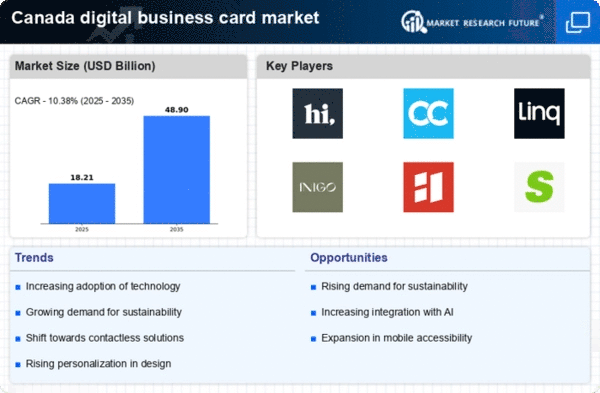
As per Market Research Future analysis, the Canada Digital Business Card Market size was estimated at 16.5 USD Billion in 2024. The Canada digital business-card market is projected to grow from 18.21 USD Billion in 2025 to 48.9 USD Billion by 2035, exhibiting a compound annual growth rate (CAGR) of 10.3% during the forecast period 2025 - 2035

Key Market Trends & Highlights

The Canada digital business-card market is experiencing a transformative shift towards sustainability and technological integration.

  • The largest segment in the Canada digital business-card market is the corporate sector, while the fastest-growing segment is the freelance and gig economy.
  • A notable trend is the increasing emphasis on mobile accessibility, allowing users to share digital cards seamlessly via smartphones.
  • Sustainability is becoming a focal point, with businesses prioritizing eco-friendly digital solutions over traditional paper cards.
  • The growing demand for contactless solutions and increased focus on networking efficiency are key drivers propelling market growth.

Market Size & Forecast

2024 Market Size 16.5 (USD Billion)
2035 Market Size 48.9 (USD Billion)
CAGR (2025 - 2035) 10.38%

Major Players

HiHello (US), CamCard (CN), Linq (US), Inigo (US), Haystack (US), Switchit (US), Blinq (US), CardMunch (US)

Our Impact
Enabled $4.3B Revenue Impact for Fortune 500 and Leading Multinationals
Partnering with 2000+ Global Organizations Each Year
30K+ Citations by Top-Tier Firms in the Industry

Canada Digital Business Card Market Trends

The Canada Digital Business Card Market is experiencing notable growth, driven by the increasing demand for innovative networking solutions. As professionals seek efficient ways to share contact information, digital business cards offer a modern alternative to traditional paper cards. This shift is influenced by the rising adoption of smartphones and mobile applications, which facilitate easy access and sharing of digital cards. Furthermore, the emphasis on sustainability is prompting businesses and individuals to consider eco-friendly options, making digital cards an appealing choice. In addition, the integration of advanced technologies such as QR codes and NFC (Near Field Communication) is enhancing the functionality of digital business cards. These features allow users to share their information seamlessly, creating a more interactive experience. As the workforce becomes increasingly mobile and remote, the relevance of digital business cards continues to grow. This trend suggests a shift in how networking is approached, with a focus on convenience and accessibility. Overall, the digital business-card market appears poised for continued expansion as it aligns with contemporary professional needs and preferences.

Sustainability Focus

The digital business-card market reflects a growing emphasis on sustainability. As environmental concerns rise, many individuals and organizations are opting for digital solutions to reduce paper waste. This trend aligns with broader societal shifts towards eco-friendly practices, making digital cards an attractive alternative.

Technological Integration

Advancements in technology are significantly shaping the digital business-card market. Features such as QR codes and NFC capabilities enhance user experience by enabling quick and easy sharing of information. This integration of technology is likely to drive further adoption among professionals.

Mobile Accessibility

The increasing reliance on mobile devices is transforming how professionals network. Digital business cards are designed for easy access and sharing via smartphones, catering to the needs of a mobile workforce. This trend indicates a shift towards more dynamic and flexible networking solutions.

Canada Digital Business Card Market Drivers

Rising Environmental Awareness

The digital business card market is also influenced by rising environmental awareness among Canadian consumers and businesses. As sustainability becomes a priority, many professionals are opting for digital alternatives to traditional paper cards. This shift is indicative of a broader trend towards eco-friendly practices in various industries. Data shows that around 70% of Canadians are more likely to choose digital solutions that reduce paper waste. Consequently, the digital business-card market is positioned to thrive as environmentally conscious individuals seek sustainable options for networking. This growing preference for digital cards aligns with the values of a significant portion of the Canadian population, potentially leading to increased market penetration.

Shift Towards Remote Work Culture

The digital business card market is experiencing a transformation due to the shift towards a remote work culture in Canada. As more professionals work from home or adopt hybrid models, the need for traditional networking methods is diminishing. Digital business cards provide a practical solution for remote networking, allowing individuals to connect seamlessly without the need for physical meetings. Recent statistics reveal that 50% of Canadian workers prefer using digital tools for networking in a remote environment. This shift is expected to drive the digital business-card market, as professionals increasingly rely on digital solutions to maintain their professional relationships.

Growing Demand for Contactless Solutions

The digital business-card market is experiencing a notable surge in demand for contactless solutions, particularly in Canada. As businesses and professionals seek to minimize physical interactions, the adoption of digital business cards is becoming increasingly prevalent. This shift is driven by the need for convenience and safety, as individuals prefer to share contact information through digital means. Recent data indicates that approximately 45% of Canadian professionals have adopted digital business cards, reflecting a significant trend towards contactless networking. This growing demand is likely to propel the digital business-card market forward, as more individuals recognize the benefits of easy sharing and eco-friendliness associated with digital formats.

Increased Focus on Networking Efficiency

In the competitive landscape of Canadian business, the digital business card market is benefiting from an increased focus on networking efficiency. Professionals are constantly seeking ways to streamline their networking efforts, and digital business cards offer a solution that enhances connectivity. With features such as instant updates and easy sharing via smartphones, these cards facilitate quicker exchanges of information. Recent surveys suggest that 60% of Canadian professionals believe that digital business cards improve their networking efficiency. This emphasis on effective networking is likely to drive further growth in the digital business-card market, as businesses recognize the value of maintaining up-to-date contact information.

Technological Advancements in Digital Solutions

Technological advancements are playing a crucial role in shaping the digital business card market. Innovations in mobile applications and cloud-based services are enhancing the functionality and user experience of digital business cards. Features such as customizable designs, integration with social media, and analytics tools are becoming standard offerings. In Canada, the market for mobile applications is projected to grow by 15% annually, indicating a robust environment for digital business-card solutions. As technology continues to evolve, the digital business-card market is likely to expand, attracting more users who seek modern and efficient ways to manage their professional identities.


Market Segment Insights

By Type: Individual User (Largest) vs. Business User (Fastest-Growing)

In the Canada digital business-card market, the distribution among segment values reveals that Individual Users currently hold the largest market share. This segment's appeal stems from its simplicity and user-friendly features, attracting many users seeking to digitize their networking approach. Business Users, while smaller in comparison, are experiencing rapid growth due to the increasing need for digital transformation within companies. Business Users favor scalability and integration capabilities, making this segment increasingly significant. Growth trends indicate that the demand for digital business cards is primarily driven by the shift towards digital communication and remote networking. The Enterprise User segment also shows potential, as larger organizations seek comprehensive solutions for their branding and networking. The rise in mobile device penetration and the trend of paperless solutions continue to fuel the growth of Business Users, making them the fastest-growing segment in the market.

Individual User: Dominant vs. Business User: Emerging

The Individual User segment in the Canada digital business-card market represents the dominant force with its intuitive design and personalized features, appealing to professionals and individuals who wish to share their contact information seamlessly. This segment is characterized by ease of use and customization options, allowing users to create distinct digital identities. In contrast, the Business User segment is emerging as a formidable competitor, driven by businesses recognizing the importance of modern networking tools. This segment focuses on features such as analytics, integrations with CRM systems, and enhanced branding opportunities, targeting small to medium enterprises looking to enhance their digital presence.

By Platform: iOS (Largest) vs. Android (Fastest-Growing)

The Canada digital business-card market exhibits a dynamic distribution among its platform segment values. iOS has established itself as the largest platform, capturing a significant share through its popularity among professionals looking for seamless integration with Apple devices. Meanwhile, Android is gaining traction and is recognized as the fastest-growing platform, appealing to a broader audience due to its diverse range of devices and accessibility. Growth trends indicate that while iOS remains dominant, Android's rapid adoption is driven by its cost-effectiveness and customizable features. The increasing trend of digitalization in networking and business interactions is pushing users towards platforms that offer innovative solutions. As more individuals and businesses recognize the benefits of digital business cards, competition between these platforms is expected to intensify, further shaping the market landscape.

Platform: iOS (Dominant) vs. Android (Emerging)

iOS is the dominant player in the Canada digital business-card market, known for its user-friendly interface and strong ecosystem integration. The platform appeals particularly to professionals who value design and functionality, enabling users to create visually appealing and interactive digital cards effortlessly. Conversely, Android is an emerging contender, characterized by its flexibility and widespread availability across various devices. It caters to a more diverse user base, with features that allow for extensive customization and branding opportunities. As these platforms compete, their growth will be influenced by evolving user preferences and technological advancements, making the segment increasingly dynamic.

By Pricing: Monthly (Largest) vs. Yearly (Fastest-Growing)

In the Canada digital business-card market, the pricing segment exhibits a diverse distribution among its values. Monthly pricing options currently hold the largest share, appealing to customers who prefer flexibility and lower upfront costs. Meanwhile, yearly plans are gaining traction as businesses recognize the long-term value and cost savings associated with committing to a longer subscription period. The one-time payment option remains relevant but captures a smaller portion of the market due to its infrequent nature. Growth trends within this segment reveal a strong shift towards subscription models, particularly for yearly plans, which are emerging as the fastest-growing option. This growth is driven by the increasing demand for continuous access to digital business solutions and the ease of maintaining updated information through regular renewals. Monthly subscriptions sustain their popularity for startups and individual professionals, while longer commitments appeal more to established businesses seeking stable solutions.

Monthly (Dominant) vs. Yearly (Emerging)

In the Canada digital business-card market, the monthly pricing model stands as the dominant force, capturing a significant share of customers who prioritize flexibility and minimal commitment. This model allows users to manage their expenses more effectively, catering particularly to freelancers and small startups. On the other hand, the yearly subscription option is emerging rapidly, appealing to larger enterprises that value the benefits of long-term planning and reduced costs over time. This segment's appeal is bolstered by features like enhanced analytics and support, attracting a more substantial user base and fostering customer loyalty. Both models serve distinct needs but co-exist, reflecting a market oriented towards diverse customer preferences.

By Application: Business Owners (Largest) vs. Sales Entrepreneurs (Fastest-Growing)

In the Canada digital business-card market, the application segment reveals a diverse distribution of market share among various categories. Business Owners lead the segment, capitalizing on the need for networking and professional representation, while Sales Entrepreneurs closely follow, leveraging digital cards for enhanced client engagement and relationship building. Other notable segments include Marketing Agencies and Events and Travels, which also hold substantial shares, reflecting a growing trend toward digital solutions in traditionally analog industries. Growth trends in the Canada digital business-card market are primarily driven by the increasing reliance on digital solutions across sectors. Business Owners are seeking innovative alternatives to traditional cards for branding and professional networking, while Sales Entrepreneurs are adopting digital cards for their rapid scalability and ability to personalize outreach. Industries like Education and Training, Finance & Realtors, and Health & Beauty are also joining the trend, recognizing the benefits of digital transformation in enhancing customer interactions and operational efficiency.

Business Owners (Dominant) vs. Sales Entrepreneurs (Emerging)

Business Owners represent a dominant force in the Canada digital business-card market, utilizing digital cards to establish and maintain professional connections. This segment thrives on the ability to seamlessly share contact information and professional credentials, contributing to their competitive edge in networking. Conversely, Sales Entrepreneurs are emerging as a dynamic force, rapidly adopting digital business cards to elevate their sales strategies. This segment benefits from innovations that allow for quick updates and personalized designs, making it a preferred choice for engaging clients. Together, these segments reflect the evolving landscape of networking, where convenience and customization play pivotal roles in fostering professional relationships.

Get more detailed insights about Canada Digital Business Card Market

Key Players and Competitive Insights

The digital business-card market is currently characterized by a dynamic competitive landscape, driven by technological advancements and evolving consumer preferences. Key players such as HiHello (US), Linq (US), and Haystack (US) are at the forefront, each adopting distinct strategies to enhance their market presence. HiHello (US) focuses on innovation through continuous feature enhancements, while Linq (US) emphasizes user experience and integration with other digital tools. Haystack (US), on the other hand, is leveraging partnerships to expand its reach and improve service offerings. Collectively, these strategies contribute to a competitive environment that is increasingly centered around user-centric solutions and technological integration.
In terms of business tactics, companies are increasingly localizing their operations to better cater to regional markets, which appears to be a response to the diverse needs of consumers. The market structure is moderately fragmented, with several players vying for market share. This fragmentation allows for a variety of offerings, but it also intensifies competition among key players, who must continuously innovate to maintain their positions.
In October 2025, HiHello (US) announced a strategic partnership with a leading CRM provider to enhance its digital business-card functionalities. This move is likely to streamline user workflows and integrate contact management more effectively, positioning HiHello (US) as a more comprehensive solution for professionals seeking to manage their networking efforts efficiently. The partnership may also attract new users who prioritize seamless integration with existing tools.
In September 2025, Linq (US) launched a new feature that allows users to create personalized QR codes for their digital business cards. This innovation not only enhances user engagement but also reflects a growing trend towards personalization in digital networking. By enabling users to customize their QR codes, Linq (US) is likely to differentiate itself in a crowded market, appealing to a demographic that values unique branding.
In August 2025, Haystack (US) expanded its service offerings by introducing a subscription model that provides users with advanced analytics on their networking activities. This strategic shift may enhance user retention and attract businesses looking for data-driven insights into their networking efforts. By focusing on analytics, Haystack (US) positions itself as a thought leader in the digital business-card space, potentially reshaping how users perceive the value of digital networking tools.
As of November 2025, the competitive trends in the digital business-card market are increasingly influenced by digitalization, sustainability, and AI integration. Strategic alliances are becoming more prevalent, as companies recognize the value of collaboration in enhancing their service offerings. Looking ahead, competitive differentiation is likely to evolve from traditional price-based competition to a focus on innovation, technology, and supply chain reliability. This shift suggests that companies will need to invest in cutting-edge solutions and robust partnerships to remain competitive in an ever-evolving market.

Key Companies in the Canada Digital Business Card Market include

Industry Developments

In the Canada Digital Business Card Market, several recent developments have captured attention. Companies such as CardDroid, Haystack, and HiHello are continuously innovating their offerings to cater to the increasing demand for digital networking solutions, especially in a post-pandemic world where virtual interactions have surged. The market has seen substantial growth, with valuations rising significantly, reflecting a shift in how Canadians manage business connections. 

Inigo and Bizcard have reported enhanced user engagement as businesses prioritize digital solutions for networking. While there have been no reported acquisitions among these specific companies in recent months, the overall market landscape remains dynamic, fueled by rising competition.

Notably, Zapsign's recent partnership with government agencies is noteworthy as it aims to enhance digital identity verification, aligning with Canada's push for digital transformation. In terms of significant happenings, in September 2022, many Canadian businesses transitioned toward adopting digital business cards, marking a pivotal shift in networking strategies. 

This change is indicative of a broader trend towards sustainability, as companies seek eco-friendly alternatives to traditional paper cards. The increasing inclination towards digital solutions underscores the evolving nature of professional networking in Canada.


Future Outlook

Canada Digital Business Card Market Future Outlook

The digital business-card market in Canada is projected to grow at a 10.38% CAGR from 2025 to 2035, driven by technological advancements and increasing demand for eco-friendly solutions.

New opportunities lie in:

  • Integration of AI-driven analytics for user engagement insights.
  • Development of customizable templates for niche industries.
  • Partnerships with networking platforms for seamless sharing capabilities.

By 2035, the market is expected to be robust, reflecting substantial growth and innovation.

Market Segmentation

Canada Digital Business Card Market Type Outlook

  • Individual User
  • Business User
  • Enterprise User

Canada Digital Business Card Market Pricing Outlook

  • Monthly
  • Yearly
  • One Time

Canada Digital Business Card Market Platform Outlook

  • iOS
  • Android
  • Web

Canada Digital Business Card Market Application Outlook

  • Business Owners
  • Sales Entrepreneurs
  • Marketing Agencies
  • Events and Travels
  • Software & IT
  • Education and Training
  • Finance & Realtors
  • Health & Beauty
  • Consultants
  • Others

Report Scope

MARKET SIZE 2024 16.5(USD Billion)
MARKET SIZE 2025 18.21(USD Billion)
MARKET SIZE 2035 48.9(USD Billion)
COMPOUND ANNUAL GROWTH RATE (CAGR) 10.38% (2025 - 2035)
REPORT COVERAGE Revenue Forecast, Competitive Landscape, Growth Factors, and Trends
BASE YEAR 2024
Market Forecast Period 2025 - 2035
Historical Data 2019 - 2024
Market Forecast Units USD Billion
Key Companies Profiled HiHello (US), CamCard (CN), Linq (US), Inigo (US), Haystack (US), Switchit (US), Blinq (US), CardMunch (US)
Segments Covered Type, Platform, Pricing, Application
Key Market Opportunities Integration of augmented reality features enhances user engagement in the digital business-card market.
Key Market Dynamics Growing demand for digital business cards driven by technological advancements and evolving consumer preferences in Canada.
Countries Covered Canada
Leave a Comment

FAQs

What is the expected market size of the Canada Digital Business Card Market by 2024?

The expected market size of the Canada Digital Business Card Market by 2024 is valued at 19.05 USD Billion.

What will the projected market value of the Canada Digital Business Card Market be in 2035?

The projected market value of the Canada Digital Business Card Market in 2035 is estimated to be 54.42 USD Billion.

What is the expected compound annual growth rate (CAGR) for the Canada Digital Business Card Market from 2025 to 2035?

The expected compound annual growth rate (CAGR) for the Canada Digital Business Card Market from 2025 to 2035 is 10.011%.

Which segment of the Canada Digital Business Card Market is anticipated to have the highest value in 2035?

In 2035, the Business User segment of the Canada Digital Business Card Market is anticipated to have the highest value at 20.5 USD Billion.

Who are the major players in the Canada Digital Business Card Market?

Major players in the Canada Digital Business Card Market include CardDroid, Haystack, Knowee, and LinkedIn among others.

What is the expected market size for Individual Users in the Canada Digital Business Card Market by 2035?

The expected market size for Individual Users in the Canada Digital Business Card Market by 2035 is 14.0 USD Billion.

How will the Enterprise User segment perform in terms of market value by 2024?

The Enterprise User segment of the Canada Digital Business Card Market is valued at 6.55 USD Billion by 2024.

What are the growth drivers for the Canada Digital Business Card Market?

Key growth drivers for the Canada Digital Business Card Market include increasing digitalization and the demand for sustainable networking solutions.

What opportunities exist for the Canada Digital Business Card Market in the coming years?

There are significant opportunities for the Canada Digital Business Card Market as businesses increasingly adopt digital solutions for networking and marketing.

What challenges might the Canada Digital Business Card Market face in its growth?

Challenges for the Canada Digital Business Card Market may include users' resistance to change and concerns about data privacy.

Download Free Sample

Kindly complete the form below to receive a free sample of this Report

Compare Licence

×
Features License Type
Single User Multiuser License Enterprise User
Price $4,950 $5,950 $7,250
Maximum User Access Limit 1 User Upto 10 Users Unrestricted Access Throughout the Organization
Free Customization
Direct Access to Analyst
Deliverable Format
Platform Access
Discount on Next Purchase 10% 15% 15%
Printable Versions