×
Request Free Sample ×

Kindly complete the form below to receive a free sample of this Report

* Please use a valid business email

Leading companies partner with us for data-driven Insights

clients tt-cursor
Hero Background

Canada Data Center Infrastructure Market

ID: MRFR/ICT/44349-HCR
200 Pages
Garvit Vyas
February 2026

Canada Data Center Infrastructure Market Size, Share and Trends Analysis Report By Components (Hardware, Software, Service), By User Type (Small, Medium-Sized Enterprises, Large-Scale Enterprises), By Deployment (On-cloud, On-premises), and By End User (BFSI, IT Telecom, Retail, Healthcare) - Forecast to 2035.

Share:
Download PDF ×

We do not share your information with anyone. However, we may send you emails based on your report interest from time to time. You may contact us at any time to opt-out.

Canada Data Center Infrastructure Market Infographic
Purchase Options

Canada Data Center Infrastructure Market Summary

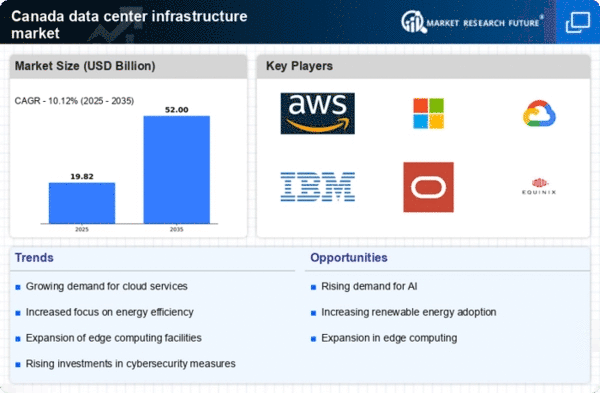
As per Market Research Future analysis, the Canada data center infrastructure market size was estimated at 18.0 USD Billion in 2024. The Canada data center-infrastructure market is projected to grow from 19.82 USD Billion in 2025 to 52.0 USD Billion by 2035, exhibiting a compound annual growth rate (CAGR) of 10.1% during the forecast period 2025 - 2035

Key Market Trends & Highlights

The Canada The Canada data center infrastructure market is undergoing a transformative shift towards hybrid solutions and energy efficiency.

  • The market is witnessing a rise in hybrid infrastructure solutions, catering to diverse business needs.
  • There is a growing emphasis on energy efficiency as organizations seek to reduce operational costs and environmental impact.
  • Enhanced data security measures are becoming increasingly critical in response to rising cyber threats.
  • Key market drivers include the growing demand for cloud services and advancements in cooling technologies.

Market Size & Forecast

2024 Market Size 18.0 (USD Billion)
2035 Market Size 52.0 (USD Billion)
CAGR (2025 - 2035) 10.12%

Major Players

Amazon Web Services (US), Microsoft (US), Google Cloud (US), IBM (US), Oracle (US), Equinix (US), Digital Realty (US), Alibaba Cloud (CN), NTT Communications (JP)

Our Impact
Enabled $4.3B Revenue Impact for Fortune 500 and Leading Multinationals
Partnering with 2000+ Global Organizations Each Year
30K+ Citations by Top-Tier Firms in the Industry

Canada Data Center Infrastructure Market Trends

The data center infrastructure market is currently experiencing a transformative phase, driven by the increasing demand for cloud computing and digital services. As organizations across various sectors seek to enhance their operational efficiency, the reliance on robust data center infrastructure becomes paramount. This shift is further fueled by the growing emphasis on data security and compliance with stringent regulations. Consequently, investments in advanced technologies such as virtualization, automation, and energy-efficient systems are on the rise. The market landscape is evolving, with a notable trend towards hybrid solutions that combine on-premises and cloud resources, allowing businesses to optimize their IT strategies. In addition, the focus on sustainability is reshaping the data center-infrastructure market. Companies are increasingly prioritizing eco-friendly practices, leading to the adoption of renewable energy sources and innovative cooling techniques. This commitment to sustainability not only addresses environmental concerns but also aligns with corporate social responsibility goals. As the market continues to mature, stakeholders are likely to explore new partnerships and collaborations to enhance service offerings and meet the diverse needs of clients. Overall, the data center-infrastructure market is poised for growth, driven by technological advancements and a commitment to sustainability.

Rise of Hybrid Infrastructure Solutions

The trend towards hybrid infrastructure solutions is gaining traction as organizations seek to balance on-premises and cloud resources. This approach allows for greater flexibility and scalability, enabling businesses to adapt to changing demands while optimizing costs. Hybrid solutions facilitate seamless integration of various services, enhancing overall operational efficiency.

Emphasis on Energy Efficiency

Energy efficiency is becoming a critical focus within the data center-infrastructure market. Companies are increasingly investing in technologies that reduce energy consumption and minimize carbon footprints. This trend not only addresses environmental concerns but also leads to significant cost savings in the long run.

Enhanced Data Security Measures

With the rise in cyber threats, there is a heightened emphasis on data security within the data center-infrastructure market. Organizations are implementing advanced security protocols and technologies to safeguard sensitive information. This trend reflects a broader commitment to compliance and risk management, ensuring that data remains protected against potential breaches.

Canada Data Center Infrastructure Market Drivers

Emergence of Edge Computing

The rise of edge computing is reshaping the data center-infrastructure market landscape. As the demand for real-time data processing and low-latency applications increases, organizations in Canada are exploring edge computing solutions. This trend is driven by the proliferation of IoT devices and the need for localized data processing. By 2025, it is projected that edge computing will account for 30% of all data processed, necessitating the development of infrastructure that supports distributed computing environments. This shift presents opportunities for data center providers to expand their offerings and cater to the evolving needs of businesses. The data center-infrastructure market is thus poised to adapt to this emerging paradigm, as companies seek to leverage edge computing for enhanced operational efficiency.

Growing Demand for Cloud Services

The increasing reliance on cloud computing is a pivotal driver for the data center-infrastructure market. As businesses in Canada transition to cloud-based solutions, the demand for robust data center infrastructure intensifies. In 2025, it is estimated that cloud services will account for approximately 70% of IT spending in the country. This shift necessitates the development of scalable and efficient data centers to support the growing volume of data and applications. Consequently, providers are investing heavily in infrastructure upgrades to meet these demands, which is likely to propel the market forward. The data center-infrastructure market is thus positioned to benefit from this trend, as organizations seek to enhance their operational capabilities and ensure seamless access to cloud resources.

Advancements in Cooling Technologies

Innovations in cooling technologies are emerging as a crucial driver for the data center-infrastructure market. As data centers in Canada expand, the need for efficient cooling solutions becomes paramount to manage heat generated by high-density computing. Advanced cooling systems, such as liquid cooling and free-air cooling, are gaining traction due to their potential to reduce energy consumption and operational costs. It is estimated that implementing these technologies can lower cooling energy costs by up to 30%. This shift not only enhances the sustainability of data centers but also aligns with the growing emphasis on energy efficiency within the data center-infrastructure market. As organizations seek to optimize their operations, the adoption of advanced cooling technologies is likely to accelerate.

Regulatory Compliance and Data Sovereignty

In Canada, stringent regulations regarding data protection and privacy are influencing the data center-infrastructure market. Organizations are increasingly required to comply with laws such as the Personal Information Protection and Electronic Documents Act (PIPEDA). This regulatory landscape compels businesses to invest in local data centers to ensure data sovereignty and compliance. As a result, the demand for data center infrastructure that adheres to these regulations is on the rise. It is projected that by 2026, compliance-related investments in data center infrastructure will increase by 25%. This trend underscores the importance of regulatory compliance in shaping the infrastructure landscape, as companies prioritize secure and compliant data storage solutions.

Increased Focus on Disaster Recovery Solutions

The growing awareness of the need for robust disaster recovery solutions is significantly impacting the data center-infrastructure market. Canadian businesses are recognizing the importance of ensuring business continuity in the face of potential disruptions, such as natural disasters or cyberattacks. As a result, investments in data center infrastructure that supports effective disaster recovery strategies are on the rise. It is anticipated that the market for disaster recovery services will grow by 20% annually through 2027. This trend highlights the necessity for organizations to implement resilient infrastructure capable of safeguarding critical data and applications. Consequently, the data center-infrastructure market is likely to see increased demand for solutions that enhance disaster recovery capabilities.


Market Segment Insights

By Component: Hardware (Largest) vs. Software (Fastest-Growing)

In the Canada data center-infrastructure market, the component segment is primarily dominated by hardware, which accounts for a significant share of the market. Software follows as a substantial segment, focusing on innovative solutions to enhance operational efficiency. Services complement these two core components, representing an essential part of the support and maintenance framework necessary for data center operations. Each component plays a pivotal role, shaping the overall effectiveness and performance of data center infrastructure in the region. Growth trends within the component segment present a compelling picture, particularly highlighting the accelerating advancements in software solutions. This growth is driven by the increasing demand for cloud computing and virtualization technologies, as organizations seek to optimize infrastructure costs and improve scalability. The hardware segment continues to thrive, bolstered by advancements in storage and processing technologies. Furthermore, the services market sees a steady rise as businesses require robust support to manage increasingly complex infrastructures.

Hardware: Dominant vs. Software: Emerging

In the Canada data center-infrastructure market, hardware stands out as the dominant component, leveraging its integral role in the setup and operation of data centers. Characterized by continuous advancements in technology, hardware includes servers, storage systems, and networking devices that form the backbone of any data center configuration. On the other hand, software emerges as a critical aspect, reflecting the ongoing transition towards automated solutions and intelligent infrastructure management. This segment focuses on applications that enhance functionality, security, and management capabilities of data centers. The interplay between these two segments is essential, as hardware provides the necessary platform for software innovations to realize their full potential, driving both efficiency and performance.

By Data Center Type: Colocation Data Center (Largest) vs. Edge Data Center (Fastest-Growing)

In the Canada data center-infrastructure market, the distribution of market share among different data center types reveals that Colocation Data Centers hold the largest share, driven by increasing demand for outsourced IT solutions. Enterprise Data Centers follow, catering to large organizations with significant infrastructure needs. Meanwhile, Edge Data Centers are rapidly gaining traction, primarily due to the surge in IoT devices and the need for low-latency processing in various applications, including smart cities and autonomous vehicles. Growth trends indicate a shift towards integrated solutions as businesses embrace digital transformation and seek more flexible deployment options. The rise of Cloud Computing is also bolstering the Cloud Data Center segment, as organizations look for scalable solutions. Additionally, the heightened focus on sustainability is prompting investments in energy-efficient Edge Data Centers, marking them as a key growth area in the coming years.

Colocation Data Center (Dominant) vs. Edge Data Center (Emerging)

Colocation Data Centers are characterized by their ability to offer shared infrastructure resources, providing businesses access to high-performance facilities without the need for significant upfront investment. This model has made them an attractive choice for both small and large enterprises looking to enhance their operational efficiency. As the dominant segment within the Canada data center-infrastructure market, Colocation Data Centers are bolstered by strong demand for cloud services and outsourcing solutions. In contrast, Edge Data Centers are emerging as critical players, positioned to support the growing requirements of localized data processing. Their ability to provide rapid data processing close to end-users is essential for applications such as real-time analytics, providing a complementary balance to traditional data center offerings.

By Tier Type: Tier 3 (Largest) vs. Tier 4 (Fastest-Growing)

In the Canada data center-infrastructure market, Tier 3 facilities dominate the landscape, providing a robust balance of redundancy and usability. They hold the largest market share due to their ability to meet the increasing demands for uptime and reliability in data processing. Tier 2 and Tier 1 facilities follow, offering less redundancy and lower costs, which appeal to specific market segments looking for economical solutions. However, as enterprises grow more dependent on cloud services, Tier 4's share is expanding rapidly as well. The growth trends in this segment are shaped by heightened demands for data security and round-the-clock operations. As businesses shift towards more resilient infrastructure, Tier 4 data centers are witnessing unprecedented growth, driven by advancements in technology and increasing investments in cloud computing. Furthermore, regulatory requirements and the need for sustainable practices are pushing facilities to adopt higher tier classifications, ensuring they are equipped for future challenges.

Tier 3 (Dominant) vs. Tier 4 (Emerging)

Tier 3 data centers are recognized for their high availability, providing redundant power and cooling systems to ensure continuous operations. This dominance is primarily due to their compatibility with most enterprises' needs for reliability and scalability, making them a staple in the Canada data center-infrastructure market. Conversely, Tier 4 data centers, though emerging, are rapidly gaining traction due to their superior resilience and fault tolerance. These facilities are designed for uninterrupted service, thereby appealing to mission-critical applications where downtime must be minimized. As organizations continue to prioritize data integrity and uptime, the inclination toward Tier 4 solutions is expected to escalate, significantly influencing the market dynamics.

By Vertical: IT & Telecom (Largest) vs. Healthcare (Fastest-Growing)

In the Canada data center-infrastructure market, the IT & Telecom segment holds the largest share, driven by the increasing demand for connectivity and digital services. This segment is vital for supporting cloud solutions, big data analytics, and various communications technologies, thus dominating the market landscape. Healthcare also presents significant growth opportunities due to the rising reliance on health IT solutions and telemedicine, positioning it as the fastest-growing segment. Currently, the growth trends in these verticals are influenced by digital transformation initiatives across industries. IT & Telecom continues to expand as businesses shift to cloud-based services and enhance network capabilities. Meanwhile, the Healthcare sector is advancing with innovations in electronic health records and data security, fostering growth and investment in data center infrastructures to support these critical technologies.

IT & Telecom: Dominant vs. Healthcare: Emerging

The IT & Telecom sector is the dominant player in the Canada data center-infrastructure market, characterized by its expansive infrastructure and extensive investments in network capabilities. It caters to a vast array of services, including cloud computing, mobile applications, and communication services. On the other hand, the Healthcare segment is emerging rapidly, driven by technological advancements and a shift towards digital health solutions. This segment focuses on robust data management systems and secure environments for sensitive patient information. Both segments exhibit distinct characteristics where IT & Telecom is established and comprehensive, while Healthcare is rapidly evolving with innovations that require substantial infrastructural support.

Get more detailed insights about Canada Data Center Infrastructure Market

Key Players and Competitive Insights

The data center-infrastructure market in Canada is characterized by a dynamic competitive landscape, driven by rapid technological advancements and increasing demand for cloud services. Major players such as Amazon Web Services (US), Microsoft (US), and Google Cloud (US) are at the forefront, leveraging their extensive resources to enhance service offerings and expand their market presence. These companies focus on innovation and strategic partnerships, which collectively shape a competitive environment that is increasingly reliant on digital transformation and sustainability initiatives.
Key business tactics employed by these companies include localizing operations and optimizing supply chains to enhance efficiency and responsiveness to market demands. The market structure appears moderately fragmented, with a mix of established giants and emerging players. This fragmentation allows for diverse service offerings, yet the influence of key players remains substantial, as they set industry standards and drive technological advancements.
In October 2025, Amazon Web Services (US) announced the opening of a new data center in Toronto, aimed at enhancing its cloud service capabilities in the region. This strategic move is likely to bolster AWS's competitive edge by providing localized services that cater to the growing demand for cloud solutions among Canadian enterprises. The establishment of this facility underscores AWS's commitment to regional expansion and its focus on meeting customer needs through enhanced service delivery.
In September 2025, Microsoft (US) unveiled its new sustainability initiative, which includes a commitment to achieving carbon negativity by 2030. This initiative is expected to resonate well with environmentally conscious consumers and businesses, positioning Microsoft as a leader in sustainable practices within the data center-infrastructure market. The emphasis on sustainability not only enhances brand reputation but also aligns with global trends towards greener technology solutions.
In August 2025, Google Cloud (US) entered into a strategic partnership with a Canadian telecommunications provider to enhance its network infrastructure. This collaboration is anticipated to improve service reliability and speed for customers, thereby strengthening Google Cloud's market position. Such partnerships are indicative of a broader trend where companies seek to leverage local expertise to enhance their service offerings and operational efficiency.
As of November 2025, the competitive trends in the data center-infrastructure market are increasingly defined by digitalization, sustainability, and the integration of artificial intelligence. Strategic alliances are becoming pivotal in shaping the landscape, as companies collaborate to enhance their technological capabilities and service offerings. Looking ahead, competitive differentiation is likely to evolve from traditional price-based competition to a focus on innovation, technology, and supply chain reliability, reflecting the changing priorities of consumers and businesses alike.

Key Companies in the Canada Data Center Infrastructure Market include

Industry Developments

In the Canadian Data Center Infrastructure Market, recent developments highlight a growing trend towards modernization and sustainability. Companies like Digital Realty and Equinix are expanding their footprint in Canada, driven by increasing demand for cloud services and data storage. Notably, in September 2023, NTT Communications announced plans for a new data center in Toronto to enhance its service offerings amidst a surge in digitalization. Additionally, in October 2023, Microsoft disclosed innovations in their data center operations focusing on energy efficiency, contributing to an overall shift towards sustainable technologies.

In terms of mergers and acquisitions, Oracle acquired a local firm in July 2023 to bolster its cloud capabilities, with significant implications for enhancing their service delivery in Canada. The growth in market valuation for companies such as Amazon Web Services and Google Cloud has significantly augmented the overall market as Canadian enterprises continue to pivot toward cloud computing solutions. Over the last two years, Canada has also seen substantial investments, particularly in Quebec and Ontario, driven by favorable governmental policies and incentives aimed at encouraging infrastructure development.

Future Outlook

Canada Data Center Infrastructure Market Future Outlook

The data center-infrastructure market is projected to grow at a 10.12% CAGR from 2025 to 2035, driven by increased demand for cloud services, energy efficiency, and advanced technologies.

New opportunities lie in:

  • Development of energy-efficient cooling solutions for data centers.
  • Investment in modular data center designs for rapid deployment.
  • Expansion of edge computing infrastructure to enhance service delivery.

By 2035, the market is expected to achieve robust growth, driven by technological advancements and evolving customer needs.

Market Segmentation

Canada Data Center Infrastructure Market Vertical Outlook

  • IT & Telecom
  • Healthcare
  • Financial Services
  • Retail
  • Manufacturing
  • Energy
  • Government
  • Others

Canada Data Center Infrastructure Market Component Outlook

  • Hardware
  • Software
  • Services

Canada Data Center Infrastructure Market Tier Type Outlook

  • Tier 1
  • Tier 2
  • Tier 3
  • Tier 4

Canada Data Center Infrastructure Market Data Center Type Outlook

  • Enterprise Data Center
  • Colocation Data Center
  • Cloud Data Center
  • Edge Data Center

Report Scope

MARKET SIZE 2024 18.0(USD Billion)
MARKET SIZE 2025 19.82(USD Billion)
MARKET SIZE 2035 52.0(USD Billion)
COMPOUND ANNUAL GROWTH RATE (CAGR) 10.12% (2025 - 2035)
REPORT COVERAGE Revenue Forecast, Competitive Landscape, Growth Factors, and Trends
BASE YEAR 2024
Market Forecast Period 2025 - 2035
Historical Data 2019 - 2024
Market Forecast Units USD Billion
Key Companies Profiled Amazon Web Services (US), Microsoft (US), Google Cloud (US), IBM (US), Oracle (US), Equinix (US), Digital Realty (US), Alibaba Cloud (CN), NTT Communications (JP)
Segments Covered Component, Data Center Type, Tier Type, Vertical
Key Market Opportunities Adoption of sustainable energy solutions drives growth in the data center-infrastructure market.
Key Market Dynamics Growing demand for energy-efficient solutions drives innovation in the data center-infrastructure market.
Countries Covered Canada
Leave a Comment

FAQs

What is the expected market size of the Canada Data Center Infrastructure Market in 2024?

The Canada Data Center Infrastructure Market is expected to be valued at 25.0 USD Billion in 2024.

What is the projected market size for the Canada Data Center Infrastructure Market by 2035?

By 2035, the Canada Data Center Infrastructure Market is anticipated to reach a valuation of 80.0 USD Billion.

What is the compound annual growth rate (CAGR) for the Canada Data Center Infrastructure Market from 2025 to 2035?

The market is forecasted to grow at a CAGR of 11.153% from 2025 to 2035.

Which component of the Canada Data Center Infrastructure Market has the largest projected value in 2024?

In 2024, the Hardware component is projected to be valued at 8.5 USD Billion, making it the largest component.

What are the expected values for Software and Service components in the Canada Data Center Infrastructure Market in 2024?

The Software component is expected to be valued at 6.0 USD Billion, while the Service component is projected to be valued at 10.5 USD Billion in 2024.

Who are the key players in the Canada Data Center Infrastructure Market?

Major players in the market include Alibaba Cloud, Oracle, CyrusOne, DigiKey, Rackspace, NTT Communications, and IBM among others.

What is the projected value of the Hardware component in the Canada Data Center Infrastructure Market by 2035?

The Hardware component is expected to grow significantly, reaching 27.0 USD Billion by 2035.

What are the projected values for Software and Service components in the Canada Data Center Infrastructure Market by 2035?

The Software component is expected to be valued at 20.0 USD Billion and the Service component at 33.0 USD Billion by 2035.

What growth opportunities exist in the Canada Data Center Infrastructure Market?

Key growth opportunities lie in the increasing demand for cloud services, data storage solutions, and technological advancements in data center efficiency.

What challenges might the Canada Data Center Infrastructure Market face in the coming years?

The market may face challenges such as regulatory constraints, energy consumption concerns, and competition among key players.

Download Free Sample

Kindly complete the form below to receive a free sample of this Report

Compare Licence

×
Features License Type
Single User Multiuser License Enterprise User
Price $4,950 $5,950 $7,250
Maximum User Access Limit 1 User Upto 10 Users Unrestricted Access Throughout the Organization
Free Customization
Direct Access to Analyst
Deliverable Format
Platform Access
Discount on Next Purchase 10% 15% 15%
Printable Versions