×
Request Free Sample ×

Kindly complete the form below to receive a free sample of this Report

* Please use a valid business email

Leading companies partner with us for data-driven Insights

clients tt-cursor
Hero Background

Canada Car Rental Market

ID: MRFR/AT/44190-HCR
200 Pages
Garvit Vyas
February 2026

Canada Car Rental Market Research Report By Booking Type (Online Booking, Offline Booking), By Duration (Short Term, Long Term), By Vehicle Type (Luxury, Executive, Economy, SUVs, Others), By Application (Leisure/Tourism, Business) andBy End User (Self- Driven, Chauffeur-Driven) - Growth & Industry Forecast 2025 To 2035

Share:
Download PDF ×

We do not share your information with anyone. However, we may send you emails based on your report interest from time to time. You may contact us at any time to opt-out.

Canada Car Rental Market Infographic
Purchase Options

Canada Car Rental Market Summary

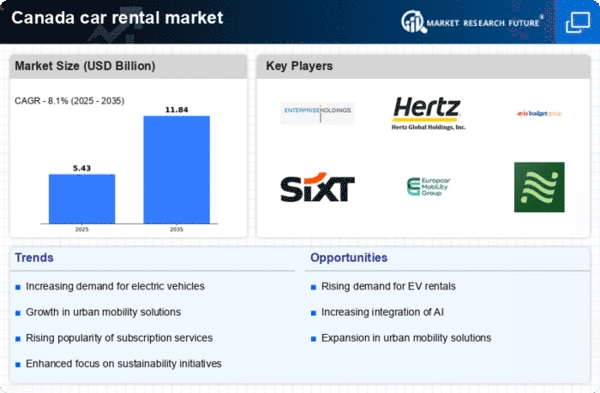
As per Market Research Future analysis, the Canada car rental market Size was estimated at 5.02 USD Billion in 2024. The Canada car rental market is projected to grow from 5.43 USD Billion in 2025 to 11.84 USD Billion by 2035, exhibiting a compound annual growth rate (CAGR) of 8% during the forecast period 2025 - 2035

Key Market Trends & Highlights

The Canada car rental market is experiencing a shift towards flexibility and sustainability.

  • The demand for flexible rental options is increasing as consumers seek convenience and adaptability.
  • Technological advancements in booking systems are enhancing user experiences and streamlining operations.
  • There is a growing focus on eco-friendly vehicles as consumers become more environmentally conscious.
  • Rising urbanization and tourism growth are key drivers propelling the market forward.

Market Size & Forecast

2024 Market Size 5.02 (USD Billion)
2035 Market Size 11.84 (USD Billion)
CAGR (2025 - 2035) 8.1%

Major Players

Enterprise Holdings (US), Hertz Global Holdings (US), Avis Budget Group (US), Sixt SE (DE), Europcar Mobility Group (FR), National Car Rental (US), Alamo Rent A Car (US), Budget Rent a Car (US)

Our Impact
Enabled $4.3B Revenue Impact for Fortune 500 and Leading Multinationals
Partnering with 2000+ Global Organizations Each Year
30K+ Citations by Top-Tier Firms in the Industry

Canada Car Rental Market Trends

The car rental market in Canada is currently experiencing a dynamic evolution, driven by various factors that influence consumer preferences and operational strategies. The increasing demand for flexible transportation options appears to be a significant driver, as individuals seek alternatives to traditional ownership models. This shift is likely influenced by urbanization trends, where residents in metropolitan areas prioritize convenience and accessibility. Additionally, advancements in technology, such as mobile applications and online booking systems, facilitate seamless rental experiences, enhancing customer satisfaction. Furthermore, environmental considerations are becoming more prominent, with a growing number of consumers expressing interest in eco-friendly vehicle options, which may lead to a shift in fleet compositions among rental companies. In the current landscape, the car rental market is also adapting to changing travel patterns. The rise of remote work and the associated decrease in business travel could suggest a potential reallocation of resources within the industry. Companies may focus more on leisure travel segments, which have shown resilience and growth. Moreover, partnerships with ride-sharing services and public transportation systems indicate a trend towards integrated mobility solutions, allowing consumers to choose from a variety of transportation modes. As these trends unfold, the car rental market is likely to continue evolving, reflecting the diverse needs and preferences of Canadian consumers.

Increased Demand for Flexible Rentals

The car rental market is witnessing a notable rise in demand for flexible rental options. Consumers are increasingly favoring short-term rentals over long-term commitments, driven by a desire for convenience and adaptability. This trend is particularly evident in urban areas, where individuals seek immediate access to vehicles without the responsibilities associated with ownership.

Technological Advancements in Booking

Technological innovations are reshaping the car rental market, with mobile applications and online platforms enhancing the booking process. These advancements streamline customer interactions, allowing for quicker reservations and improved user experiences. As technology continues to evolve, rental companies are likely to invest in digital solutions to meet consumer expectations.

Focus on Eco-Friendly Vehicles

There is a growing emphasis on sustainability within the car rental market, as consumers increasingly prioritize eco-friendly vehicle options. This trend may lead rental companies to expand their fleets with hybrid and electric vehicles, aligning with the environmental values of their clientele. Such a shift could also enhance the market's appeal to environmentally conscious travelers.

Canada Car Rental Market Drivers

Tourism Growth

Tourism in Canada is experiencing a notable resurgence, which is likely to bolster the car rental market. In 2025, the Canadian tourism sector is expected to generate over $100 billion in revenue, with a substantial portion attributed to car rentals. Tourists often seek the convenience of rental vehicles to explore diverse landscapes and attractions across the country. This trend suggests that rental companies may need to adapt their services to accommodate the influx of visitors, potentially leading to increased competition and innovation within the car rental market.

Rising Urbanization

The ongoing trend of urbanization in Canada appears to be a significant driver for the car rental market. As more individuals migrate to urban centers, the demand for rental vehicles increases, particularly for short-term use. Urban residents often prefer renting over owning due to limited parking and high ownership costs. In 2025, urban areas are projected to house approximately 81% of Canada's population, which could lead to a heightened reliance on rental services. This shift may encourage rental companies to expand their fleets and diversify their offerings to cater to urban dwellers, thereby enhancing the overall car rental market.

Technological Integration

The integration of advanced technology in the car rental market is transforming the way consumers interact with rental services. Innovations such as mobile apps, contactless rentals, and real-time vehicle tracking are becoming increasingly prevalent. In 2025, it is anticipated that 60% of rental transactions will occur through digital platforms, indicating a shift towards a more tech-savvy consumer base. This technological evolution may compel rental companies to invest in digital infrastructure and enhance user experiences, thereby shaping the future of the car rental market.

Sustainability Initiatives

The growing emphasis on sustainability in Canada is influencing consumer preferences, which may drive the car rental market towards eco-friendly options. As environmental awareness increases, rental companies are likely to expand their fleets to include hybrid and electric vehicles. In 2025, it is estimated that 25% of new car rentals will be electric, reflecting a shift towards greener alternatives. This trend suggests that the car rental market must adapt to meet the evolving expectations of environmentally conscious consumers, potentially leading to innovative business models and partnerships.

Corporate Travel Resurgence

The corporate travel sector in Canada is witnessing a revival, which could positively impact the car rental market. As businesses resume travel for meetings and conferences, the demand for rental vehicles is likely to rise. In 2025, corporate travel spending is projected to reach $30 billion, with a significant share allocated to transportation services. This resurgence may prompt rental companies to enhance their corporate offerings, including tailored packages and loyalty programs, thereby strengthening their position within the car rental market.


Market Segment Insights

By Booking Type: Online Booking (Largest) vs. Offline Booking (Fastest-Growing)

In the Canada car rental market, online booking has emerged as the largest segment, commanding a significant portion of the overall market share. This growth is driven by increasing internet penetration and consumer preferences for the convenience and speed that online platforms offer. Conversely, offline booking, while smaller in comparison, is witnessing rapid growth due to a resurgence in traditional consumer preferences and the personalized service it provides. The trend towards online booking is fortified by technological advancements and the evolution of user-friendly applications, enabling seamless reservations. However, offline booking is gaining traction, especially among consumers who value direct interaction and personalized assistance. This dynamic suggests a shifting landscape where convenience coexists with traditional consumer preferences, indicating diverse market needs.

Online Booking: Dominant vs. Offline Booking: Emerging

Online booking in the Canada car rental market is characterized by its dominance, driven by a tech-savvy consumer base that prioritizes convenience and efficiency. This segment utilizes advanced digital platforms, enabling customers to make reservations quickly and effortlessly from their devices. In contrast, offline booking, while emerging and growing rapidly, caters to consumers seeking a more traditional approach, valuing personal interaction and bespoke service. This segment appeals to various demographics including older consumers who may prefer face-to-face engagements. Together, these two segments reflect the evolving preferences of Canadian consumers, where digital convenience meets personalized service.

By Duration: Short Term (Largest) vs. Long Term (Fastest-Growing)

In the Canada car rental market, the distribution of market share between short term and long term rentals reveals a dominant preference for short term options. This segment caters to travelers seeking flexibility, often accounting for a significant portion of rentals due to demand from both business and leisure travelers. The short term rentals are especially popular in urban centers and during peak tourist seasons, thereby securing their position as the largest segment in the market. On the other hand, long term rentals are emerging as the fastest-growing segment in the Canada car rental market. This growth can be attributed to various factors, including increased mobility needs from consumers for extended durations, the rise of remote working leading to temporary relocation, and companies seeking cost-effective solutions for transportation needs. As a result, long term rentals are witnessing increased interest from both businesses and individuals, driving innovation and competition in the segment.

Rental Duration: Short Term (Dominant) vs. Long Term (Emerging)

Short term rentals dominate the Canada car rental market primarily due to their convenience and flexibility, appealing to tourists and business travelers alike. This segment is characterized by a wide variety of vehicle options and competitive pricing, making it attractive for short trips and events. Additionally, rental locations are strategically situated in urban areas and airports, enhancing accessibility for customers. In contrast, long term rentals are rapidly emerging as a viable alternative, particularly for customers in need of a vehicle for extended periods. This segment typically offers discounted rates for longer commitments and appeals to businesses looking for economical transportation solutions for employees on long assignments. The shifting consumer behavior towards longer rental periods signifies a changing dynamic in the market, with long term options gaining traction at an impressive rate.

By Vehicle Type: SUVs (Largest) vs. Luxury (Fastest-Growing)

The Canada car rental market shows a diverse distribution among vehicle types, with SUVs commanding the largest market share due to their popularity among travelers seeking comfort and space. Economy cars follow closely, favored for their affordability, while the Luxury segment, although smaller, is rapidly gaining traction, appealing to a segment of customers willing to spend more for premium experiences. Executive and Other vehicle types occupy niche markets, contributing to the overall diversity of choices available in the sector. Growth trends indicate a significant shift towards SUVs, driven by increasing consumer preference for versatile vehicles that cater to both personal and family use. Meanwhile, the Luxury segment emerges as the fastest-growing category, propelled by rising disposable incomes and an increasing inclination towards high-end services. Factors influencing this growth include changing travel habits, evolving customer expectations, and enhanced marketing efforts by rental companies to promote premium offerings.

SUVs (Dominant) vs. Luxury (Emerging)

SUVs remain the dominant vehicle type within the Canada car rental market, characterized by their spacious interiors, robust performance, and suitability for varied terrains. This segment appeals to families and travelers who prioritize convenience and comfort, driving its sustained popularity. Conversely, the Luxury segment is emerging rapidly, attracting affluent customers seeking unique rental experiences. This segment is defined by high-quality vehicles, superior customer service, and experiential offerings that cater to luxury seekers. As both segments navigate a landscape influenced by customer preferences and economic factors, their market positions reflect distinct consumer desires within the broader car rental landscape.

By Application: Leisure/Tourism (Largest) vs. Business (Fastest-Growing)

In the Canada car rental market, the application segment is predominantly driven by leisure and tourism activities, holding the largest market share. This segment appeals to families, tourists, and individuals looking for flexibility in their travel plans. Business rentals, while smaller in market share, are growing rapidly as companies increasingly recognize the benefits of rental solutions for employee travel, meetings, and client entertainment. The growth trends in the application segment indicate a significant shift towards leisure rentals due to an increase in travel and tourism. The growth of the business segment is also notable as more organizations opt for rentals over purchasing vehicles, driven by cost-effectiveness and convenience. Technological advancements and the rise of digital booking platforms further enhance accessibility and attractiveness of both leisure and business rentals.

Leisure/Tourism (Dominant) vs. Business (Emerging)

Leisure/Tourism rentals dominate the market, characterized by a wide range of vehicle options, competitive pricing, and an emphasis on customer service. This segment caters to tourists seeking convenience and flexibility, often providing additional services such as GPS rental and roadside assistance. In contrast, the business rental segment is emerging rapidly, fueled by the need for efficient travel solutions for professionals. Businesses favor rentals for their economic advantages, and tailored packages that meet specific corporate needs are becoming more prevalent. Together, these segments represent a dynamic interplay that shapes the overall landscape of the Canada car rental market.

By End User: Self-Driven (Largest) vs. Chauffeur-Driven (Fastest-Growing)

The Canada car rental market showcases diverse preferences among users. Currently, the Self-Driven segment dominates, accounting for a significant share, appealing to individuals seeking independence and flexibility in their travel. Meanwhile, the Chauffeur-Driven segment, while smaller, is rapidly gaining traction due to an increasing demand for convenience and luxury. This shift reflects changing consumer attitudes towards time management and a preference for comfort during travel. Growth trends reveal a notable acceleration in the Chauffeur-Driven segment, driven by an increase in business travel and urbanization. The rise of technology and mobile applications has also played a crucial role in facilitating easy access to chauffeur services. As consumers prioritize their time, the demand for chauffeur services is expected to grow, positioning this segment for significant expansion in the upcoming years.

Self-Driven (Dominant) vs. Chauffeur-Driven (Emerging)

In the Canada car rental market, the Self-Driven segment is characterized by its appeal to a wide range of consumers, from tourists seeking exploration to business travelers valuing flexibility. This segment benefits from a variety of vehicle options, catering to different preferences and budgets. In contrast, Chauffeur-Driven services are emerging rapidly, appealing especially to corporate clients and high-end travelers who prefer a seamless travel experience. As urban centers in Canada become busier, the ease of booking a chauffeur service via apps is attracting more users, creating a new preference among those prioritizing luxury and efficiency. Both segments reflect diverse user needs and are positioned to shape the future landscape of the rental market.

Get more detailed insights about Canada Car Rental Market

Key Players and Competitive Insights

The car rental market in Canada is characterized by a competitive landscape that is increasingly shaped by innovation, digital transformation, and sustainability initiatives. Major players such as Enterprise Holdings (US), Hertz Global Holdings (US), and Avis Budget Group (US) are actively refining their strategies to enhance customer experience and operational efficiency. Enterprise Holdings (US) has focused on expanding its fleet with electric vehicles (EVs), aligning with the growing consumer demand for sustainable transportation options. Hertz Global Holdings (US) has been investing in technology to streamline the rental process, thereby improving customer satisfaction and operational speed. Avis Budget Group (US) is also leveraging partnerships with tech firms to enhance its digital platforms, which collectively indicates a shift towards a more tech-driven rental experience.The business tactics employed by these companies reflect a moderately fragmented market structure, where local adaptations and supply chain optimization play crucial roles. The competitive dynamics suggest that while these key players dominate, there remains room for smaller, niche companies to carve out their market share through specialized services or localized offerings. The collective influence of these major players is significant, as they set industry standards and drive innovation, which smaller firms often follow.
In October Hertz Global Holdings (US) announced a partnership with a leading tech company to integrate AI-driven solutions into its rental process. This strategic move aims to enhance customer interactions and streamline operations, potentially reducing wait times and improving overall service quality. The integration of AI is likely to position Hertz as a frontrunner in customer service excellence within the car rental sector.
In September Avis Budget Group (US) launched a new initiative focused on expanding its electric vehicle fleet across major Canadian cities. This initiative not only responds to the increasing consumer preference for eco-friendly options but also aligns with governmental policies promoting sustainability. By enhancing its EV offerings, Avis Budget Group is likely to attract a broader customer base while reinforcing its commitment to environmental responsibility.
In August Enterprise Holdings (US) unveiled a new digital platform designed to simplify the booking process for customers. This platform incorporates user-friendly features and personalized recommendations, which may significantly enhance customer engagement and retention. The emphasis on digital solutions reflects a broader trend in the industry towards leveraging technology to meet evolving consumer expectations.
As of November the car rental market is witnessing a pronounced shift towards digitalization, sustainability, and the integration of advanced technologies such as AI. Strategic alliances among key players are increasingly shaping the competitive landscape, fostering innovation and enhancing service delivery. The evolution of competitive differentiation appears to be moving away from traditional price-based competition towards a focus on technological advancements, customer experience, and supply chain reliability. This trend suggests that companies that prioritize innovation and sustainability will likely emerge as leaders in the market.

Key Companies in the Canada Car Rental Market include

Industry Developments

The Canada Car Rental Market has seen notable developments recently, particularly with key players like Enterprise Holdings, Avis Budget Group, and Hertz Global Holdings actively adapting to changing consumer trends and preferences. Growth in this sector has been stimulated by an increasing demand for eco-friendly vehicles, prompting companies such as Green Motion to expand their electric and hybrid options. The market is also witnessing changes in rental pricing structures as companies aim to remain competitive amid fluctuating travel patterns post-pandemic.

In June 2023, Alamo Rent A Car, and National Car Rental strengthened their offerings in Canada, enhancing customer experiences through technology-driven solutions, including mobile app reservations and digital check-ins. Notably, the car rental sector continues to evolve with more emphasis on sustainability, with fleets increasingly incorporating electric vehicles. Notable incidents from the last couple of years include U-Haul’s significant expansion in March 2022, where it opened multiple new locations across Canada, further solidifying its market presence. The overall market valuation has surged, reflecting the sector’s resilience and adaptability in an ever-changing economic landscape.

Future Outlook

Canada Car Rental Market Future Outlook

The Car Rental Market in Canada is projected to grow at an 8.1% CAGR from 2025 to 2035, driven by technological advancements, increased travel demand, and evolving consumer preferences.

New opportunities lie in:

  • Integration of AI-driven pricing algorithms for dynamic pricing strategies. Expansion of electric vehicle (EV) rental options to meet sustainability demands. Development of subscription-based rental models for flexible consumer access.

By 2035, the car rental market is expected to be robust, reflecting significant growth and innovation.

Market Segmentation

Canada Car Rental Market Duration Outlook

  • Short Term
  • Long Term

Canada Car Rental Market End User Outlook

  • Self-Driven
  • Chauffeur-Driven

Canada Car Rental Market Application Outlook

  • Leisure/Tourism
  • Business

Canada Car Rental Market Booking Type Outlook

  • Offline Booking
  • Online Booking

Canada Car Rental Market Vehicle Type Outlook

  • Luxury
  • Executive
  • Economy
  • SUV's
  • Others

Report Scope

MARKET SIZE 2024 5.02(USD Billion)
MARKET SIZE 2025 5.43(USD Billion)
MARKET SIZE 2035 11.84(USD Billion)
COMPOUND ANNUAL GROWTH RATE (CAGR) 8.1% (2025 - 2035)
REPORT COVERAGE Revenue Forecast, Competitive Landscape, Growth Factors, and Trends
BASE YEAR 2024
Market Forecast Period 2025 - 2035
Historical Data 2019 - 2024
Market Forecast Units USD Billion
Key Companies Profiled Enterprise Holdings (US), Hertz Global Holdings (US), Avis Budget Group (US), Sixt SE (DE), Europcar Mobility Group (FR), National Car Rental (US), Alamo Rent A Car (US), Budget Rent a Car (US)
Segments Covered Booking Type, Duration, Vehicle Type, Application, End User
Key Market Opportunities Integration of electric vehicles and sustainable practices in the car rental market.
Key Market Dynamics Growing demand for electric vehicles drives innovation and competition in the car rental market.

Countries Covered Canada
Leave a Comment

FAQs

What is the projected market size of the Canada Car Rental Market by 2024?

The Canada Car Rental Market is expected to be valued at 5.33 USD Billion in 2024.

What will be the market size of the Canada Car Rental Market by 2035?

By 2035, the market is projected to reach a valuation of 12.55 USD Billion.

What is the expected CAGR for the Canada Car Rental Market from 2025 to 2035?

The expected CAGR for the market during this period is 8.104%.

What are the key players in the Canada Car Rental Market?

Major players in the market include Green Motion, Thrifty Car Rental, Dollar Rent A Car, and Avis Budget Group.

What is the market size for online booking in the Canada Car Rental Market in 2024?

The online booking segment is valued at 3.19 USD Billion in 2024.

How much is the offline booking segment of the Canada Car Rental Market expected to be worth in 2035?

The offline booking segment is expected to reach 5.18 USD Billion by 2035.

What will the value of the online booking segment be in 2035?

The online booking segment is projected to be valued at 7.37 USD Billion in 2035.

What opportunities exist for growth in the Canada Car Rental Market?

Emerging trends and evolving consumer preferences present significant growth opportunities in the market.

What growth factors are driving the Canada Car Rental Market?

Increased travel demand and a growing preference for car rentals over ownership are key growth drivers.

What impact do regional factors have on the Canada Car Rental Market's growth?

Regional factors, including urbanization and tourism, significantly influence the market's growth trajectory.

Download Free Sample

Kindly complete the form below to receive a free sample of this Report

Compare Licence

×
Features License Type
Single User Multiuser License Enterprise User
Price $4,950 $5,950 $7,250
Maximum User Access Limit 1 User Upto 10 Users Unrestricted Access Throughout the Organization
Free Customization
Direct Access to Analyst
Deliverable Format
Platform Access
Discount on Next Purchase 10% 15% 15%
Printable Versions