
×
Request Free Sample ×

Kindly complete the form below to receive a free sample of this Report

* Please use a valid business email

Leading companies partner with us for data-driven Insights

clients tt-cursor
Hero Background
English
Chinese
French
Japanese
Korean
German
Spanish

Automotive Tire Market Share

ID: MRFR/AT/1655-CR
106 Pages
Sejal Akre
December 2020

Automotive Tire Market Research Report Information By Rim Size (13"_15", 16"_18", 19"_21", >21"), By Season (Winter, Summer, All-Season), By Propulsion Type (ICE, EV), By Vehicle Type (Passenger Cars, LCV, HCV), By Distribution Channel (OEM, Aftermarket) And By Region (North America, Europe, Asia-Pacific, And Rest Of The World) –Market Forecast Till 2035

Share:
Download PDF ×

We do not share your information with anyone. However, we may send you emails based on your report interest from time to time. You may contact us at any time to opt-out.

Automotive Tire Market Infographic
×
Automotive Tire Market Infographic Full View
Purchase Options

Market Share

Automotive Tire Market Share Analysis

The market for automotive tires is very competitive, so companies that want to do well need to find ways to get market share. There are many ways for businesses to try to get a bigger share of the market. Get noticed by making new things. Tire companies that work with tech spend a lot of money to make new tires that work better, last longer, and are safer. Business can find their market, bring in customers looking for specific benefits, and build a loyal customer base by giving customers something they can't get anywhere else. It can make a big difference in the market where tires stand if they get new tread patterns that grip better or new materials that last longer. Price strategy is another good way to do things. People who want to beat the others pay close attention to how they set their prices. They could become the cost winner if they sold tires for less than their rivals. The goal of this plan is to get a bigger part of the market by appealing to people who care about price. Also, if you want the best things, names that cost a lot may charge more for them because they believe in quality, brand image, and better performance. Sometimes sales, discounts, and group deals can help people change their minds, which can help you get more of the market. How well a business promotes and sells itself can also change its position in the market. Marketing is how businesses get people to know about them, show off their best products, and connect with buyers on an emotional level. When people see a good brand, they might think of quality, dependability, and trust, which could make them decide to buy or not. Tire companies do a lot of different things to stand out and get people's attention. Some of these things are to get famous sports to endorse their tires, run interesting ads, and get involved in community projects. Going to new places and focusing on certain types of people are also ways to get a bigger part of the market. Businesses may try to grow in new areas or places that have a lot of open potential. Still, they might change their products to meet the needs and wants of certain groups of customers. For example, they might make tough tires for off-road vehicles or high-performance tires for people who like fast cars. This helps businesses get a bigger share of the market in small towns, which is good for them in general. Last but not least, the market for automotive tires is very competitive, which is why businesses try a lot of different strategies to get a bigger share of it. Making new products, selling to specific groups of people, charging fair prices, sending their goods in smart ways, and giving their goods clever names are all ways that tire companies try to get a big share of the market. In order to stay ahead in the car tire business, you will need to change and adapt these plans to fit the needs of buyers and the market.

Author
Sejal Akre
Senior Research Analyst

She has over 5 years of rich experience, in market research and consulting providing valuable market insights to client. Hands on expertise in management consulting, and extensive knowledge in domain including ICT, Automotive & Transportation and Aerospace & Defense. She is skilled in Go-to market strategy, industry analysis, market sizing, in depth company profiling, competitive intelligence & benchmarking and value chain amongst others.

Leave a Comment

FAQs

How much is the automotive tire market?

The Automotive Tire Marketsize was valued at USD 120.5 Billion in 2022.

What is the growth rate of the automotive tire market?

The global market is projected to grow at a CAGR of 10.42% during the forecast period, 2025-2034.

Which region held the largest market share in the automotive tire market?

North America had the largest share of the global market

Who are the key players in the automotive tire market?

The key players in the market are Kurho Tire (South Korea) , Giti Tire (Singapore), Maxxis International (Taiwan) . Nexen Tire Corporation (South Korea).

Which vehicle type led the automotive tire market?

The passenger cars category dominated the market in 2022.

Which distribution channel had the largest market share in the automotive tire market?

The aftermarket category had the largest share of the global market.

Market Summary

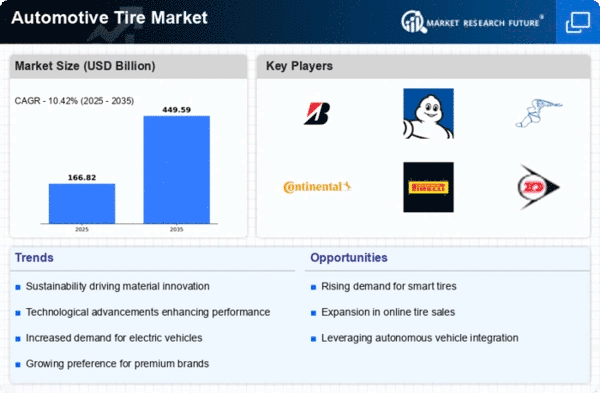
As per MRFR analysis, the Automotive Tire Market Size was estimated at 151.08 USD Billion in 2024. The Automotive Tire industry is projected to grow from 166.83 USD Billion in 2025 to 449.59 USD Billion by 2035, exhibiting a compound annual growth rate (CAGR) of 10.42 during the forecast period 2025 - 2035.

Key Market Trends & Highlights

The Automotive Tire Market is currently experiencing a dynamic shift towards sustainability and technological innovation.

  • North America remains the largest market for automotive tires, driven by robust vehicle production and consumer demand.
  • The Asia-Pacific region is the fastest-growing market, reflecting increasing urbanization and rising disposable incomes.
  • Passenger cars dominate the market, while light commercial vehicles are witnessing the most rapid growth in demand.
  • Key market drivers include the rising focus on safety standards and the growing trend towards sustainability and eco-friendly products.

Market Size & Forecast

2024 Market Size 151.08 (USD Billion)
2035 Market Size 449.59 (USD Billion)
CAGR (2025 - 2035) 10.42%
Largest Regional Market Share in 2024 Asia-Pacific

Major Players

<p>Bridgestone (JP), Michelin (FR), Goodyear (US), Continental (DE), Pirelli (IT), Dunlop (GB), Hankook (KR), Yokohama (JP), Toyo (JP)</p>

Market Trends

The Automotive Tire Market is currently experiencing a dynamic evolution, driven by various factors that influence consumer preferences and technological advancements. The increasing emphasis on sustainability and environmental consciousness appears to be reshaping the landscape, as manufacturers strive to develop eco-friendly tire options. Additionally, the rise of electric vehicles is likely to create new demands for specialized tires that cater to the unique requirements of these vehicles. This shift may lead to innovations in tire design and materials, enhancing performance while reducing environmental impact. Moreover, the integration of smart technologies into tires is becoming more prevalent, suggesting a trend towards enhanced safety and performance monitoring. Features such as tire pressure monitoring systems and real-time data analytics are gaining traction, potentially improving vehicle safety and efficiency. As the Automotive Tire Market continues to adapt to these changes, it seems poised for growth, with opportunities for both established players and new entrants to capitalize on emerging trends and consumer demands.

Sustainability Initiatives

The Automotive Tire Market is witnessing a notable shift towards sustainability, as manufacturers increasingly focus on producing eco-friendly tires. This trend encompasses the use of renewable materials and the implementation of recycling programs, which aim to minimize environmental impact. As consumers become more environmentally conscious, the demand for sustainable tire options is likely to rise.

Technological Advancements

Innovations in tire technology are transforming the Automotive Tire Market, with advancements in materials and design enhancing performance and safety. The introduction of smart tires equipped with sensors and data analytics capabilities is becoming more common. These technologies may provide real-time information on tire conditions, potentially improving vehicle safety and efficiency.

Electric Vehicle Compatibility

The growing prevalence of electric vehicles is influencing the Automotive Tire Market, as specialized tires designed for electric vehicles are emerging. These tires are engineered to accommodate the unique characteristics of electric vehicles, such as weight distribution and torque delivery. This trend suggests a potential for growth in the market segment dedicated to electric vehicle tires.

Automotive Tire Market Market Drivers

Market Growth Projections

The Global Automotive Tire Market Industry is projected to witness substantial growth in the coming years. With a market value of 151.1 USD Billion in 2024, it is anticipated to expand significantly, reaching 449.6 USD Billion by 2035. This growth trajectory indicates a compound annual growth rate of 10.42% from 2025 to 2035, reflecting the increasing demand for tires driven by various factors such as vehicle production, technological advancements, and changing consumer preferences. The market's expansion is likely to create new opportunities for manufacturers and suppliers, fostering a competitive landscape that encourages innovation and quality improvements.

Growing Vehicle Production

The Global Automotive Tire Market Industry is experiencing growth driven by an increase in vehicle production worldwide. In 2024, the market is valued at 151.1 USD Billion, reflecting the rising demand for tires as more vehicles are manufactured. Countries such as China and India are leading in vehicle production, contributing significantly to this growth. As automotive manufacturers ramp up production to meet consumer demand, the need for high-quality tires becomes paramount. This trend is likely to continue, with projections indicating that the market could reach 449.6 USD Billion by 2035, suggesting a robust expansion in the automotive sector.

Rising Demand for Electric Vehicles

The increasing adoption of electric vehicles (EVs) is significantly influencing the Global Automotive Tire Market Industry. As governments worldwide implement policies to promote EV usage, the demand for specialized tires designed for electric vehicles is on the rise. These tires are engineered to support the unique weight distribution and performance characteristics of EVs, ensuring safety and efficiency. The growing EV market is expected to contribute substantially to the overall tire market, with projections indicating a potential market size of 449.6 USD Billion by 2035. This trend underscores the importance of adapting tire offerings to meet the evolving needs of the automotive landscape.

Increasing Focus on Safety Regulations

The Global Automotive Tire Market Industry is also influenced by the increasing focus on safety regulations across various regions. Governments are implementing stricter standards for tire performance, durability, and safety, compelling manufacturers to enhance their product offerings. Compliance with these regulations not only ensures consumer safety but also fosters innovation in tire design and technology. As manufacturers invest in meeting these standards, the market is likely to experience growth, with projections suggesting a compound annual growth rate of 10.42% from 2025 to 2035. This regulatory environment is expected to drive the demand for high-quality, compliant tires.

Technological Advancements in Tire Manufacturing

Technological innovations in tire manufacturing are a pivotal driver for the Global Automotive Tire Market Industry. Advancements such as the development of eco-friendly materials and smart tires equipped with sensors enhance performance and safety. These innovations not only improve fuel efficiency but also extend the lifespan of tires, appealing to environmentally conscious consumers. As manufacturers adopt these technologies, the market is poised for growth, potentially achieving a compound annual growth rate of 10.42% from 2025 to 2035. This shift towards advanced tire technology is likely to reshape consumer preferences and drive market dynamics.

Expansion of E-commerce and Online Sales Channels

The expansion of e-commerce and online sales channels is reshaping the Global Automotive Tire Market Industry. Consumers increasingly prefer the convenience of purchasing tires online, leading to a surge in online tire retailers. This shift not only broadens market access but also enhances competition among tire manufacturers, driving innovation and pricing strategies. As more consumers turn to digital platforms for tire purchases, the market is likely to see an increase in sales volume and revenue. This trend aligns with the projected growth of the market, which could reach 449.6 USD Billion by 2035, reflecting the changing dynamics of consumer behavior.

Market Segment Insights

By Application: Passenger Car (Largest) vs. Light Commercial Vehicle (Fastest-Growing)

<p>In the Automotive Tire Market, the segment distribution reveals that Passenger Cars command the largest market share, accounting for a significant portion of total tire sales. This popularity stems from the widespread use of passenger vehicles globally, supported by increasing consumer demand for personal mobility and comfort. Conversely, Light Commercial Vehicles are rapidly gaining traction, contributing an increasingly notable share as e-commerce and delivery services expand.</p>

<p>Passenger Car (Dominant) vs. Light Commercial Vehicle (Emerging)</p>

<p>Passenger Cars stand as the dominant force in the Automotive Tire Market, characterized by high demand for diverse tire options that cater to style and performance. They often influence tire technology innovations, pushing manufacturers to enhance fuel efficiency and safety features. On the other hand, Light Commercial Vehicles are emerging robustly, driven by the rise of logistics and last-mile delivery services. This segment is characterized by a growing need for durable tires capable of supporting heavier loads and diverse road conditions, positioning it as a key area of growth within the market.</p>

By Tire Type: Radial Tire (Largest) vs. Run Flat Tire (Fastest-Growing)

<p>In the Automotive Tire Market, the Radial Tire segment continues to dominate, holding the largest market share among various tire types. This dominance is driven by the widespread adoption of radial tires in passenger vehicles, which offer superior performance, fuel efficiency, and comfort compared to traditional tire designs. Meanwhile, the Run Flat Tire segment, though smaller in comparison, is quickly gaining popularity, particularly among luxury and performance vehicles seeking enhanced safety features. The growth trends in the tire type segment are influenced by consumer preferences shifting towards safety and performance. The Run Flat Tire's rapid expansion can be attributed to increasing awareness of tire safety, as these tires allow vehicles to continue driving even after a puncture. Additionally, advancements in tire technology and rising demand for all-season usability further propel the growth of Radial and Run Flat Tires, as manufacturers continually innovate to meet evolving consumer expectations.</p>

<p>Radial Tire (Dominant) vs. Run Flat Tire (Emerging)</p>

<p>Radial Tires are distinguished by their construction, which features layers of fabric that run perpendicular to the direction of travel, resulting in superior handling, tread wear, and fuel economy. They dominate the Automotive Tire Market due to their versatility, offering excellent performance across various weather conditions. In contrast, Run Flat Tires are engineered to enable drivers to maintain mobility after a loss of pressure, making them particularly appealing for safety-conscious consumers. As vehicle manufacturers increasingly incorporate Run Flat technologies into their designs, they are emerging as an important market segment, driven by the demand for high-performance tires that do not compromise on safety. Both tire types cater to distinct consumer needs, shaping the future direction of the automotive tire landscape.</p>

By End Use: Replacement (Largest) vs. Original Equipment Manufacturer (Fastest-Growing)

<p>The Automotive Tire Market is broadly categorized by end use, with the replacement segment commanding the largest share. This segment is driven by a significant demand for vehicle maintenance and the growing aging vehicle population. The original equipment manufacturer (OEM) segment follows closely, providing tires for new vehicles before they enter the replacement market. E-commerce has emerged as a notable channel for tire distribution, gaining traction as consumers increasingly prefer online shopping for their vehicle needs. As vehicle ownership continues to rise, all segments are expected to evolve to meet varied consumer demands and preferences, reshaping market dynamics. In terms of growth trends, OEM is rapidly gaining momentum, driven by the expansion of electric vehicles and innovative tire technologies aimed to enhance performance and sustainability. Fleet and retail segments are also experiencing positive momentum as companies and consumers prioritize efficient solutions for travel. The e-commerce channel has been notably disrupted by consumer shifts towards online purchasing, further driving growth across these segments. Technology advancements and changing consumer behaviors will play a crucial role in shaping the future of tire end-use applications as each segment adapts to meet the demands of an evolving automotive landscape.</p>

<p>Replacement (Dominant) vs. E-commerce (Emerging)</p>

<p>The replacement tire segment stands out as the dominant force in the Automotive Tire Market, fueled by the need for regular vehicle maintenance and the preferences of consumers who prioritize replacing worn tires for safety and performance. This segment caters to a wide array of vehicles, making it essential for consumers. On the other hand, the e-commerce segment is emerging rapidly as a significant player, changing how consumers shop for tires. With increasing reliance on digital platforms, e-commerce provides convenience and competitive pricing, appealing to a tech-savvy generation. As online sales continue to grow, tire retailers are investing in online marketplaces and enhanced consumer experiences to maximize sales opportunities, making the competition between traditional retail and e-commerce more pronounced.</p>

Get more detailed insights about Automotive Tire Market Research Report - Global Forecast till 2035

Regional Insights

North America : Established Market with Innovation

The North American automotive tire market is projected to reach $35.0 billion by 2025, driven by increasing vehicle production and a growing focus on sustainability. Regulatory initiatives aimed at reducing emissions and enhancing fuel efficiency are also propelling demand for advanced tire technologies. The shift towards electric vehicles (EVs) is further influencing tire design and performance standards, creating opportunities for innovation in the sector. Leading countries in this region include the US and Canada, where major players like Goodyear and Michelin dominate the market. The competitive landscape is characterized by a mix of established brands and emerging players, all vying for market share. The presence of robust distribution networks and a focus on R&D are key factors that enhance the competitive edge of these companies, ensuring a dynamic market environment.

Europe : Sustainability and Innovation Focus

Europe's automotive tire market is expected to reach €40.0 billion by 2025, driven by stringent regulations on emissions and a strong push for sustainable practices. The European Union's Green Deal and tire labeling regulations are significant catalysts for innovation, encouraging manufacturers to develop eco-friendly and high-performance tires. This regulatory environment is fostering a shift towards more efficient tire technologies, enhancing overall market growth. Germany, France, and Italy are leading countries in this market, with key players like Continental and Michelin at the forefront. The competitive landscape is marked by a strong emphasis on R&D and collaboration among manufacturers to meet regulatory standards. The presence of numerous tire manufacturers and suppliers ensures a vibrant market, with ongoing investments in technology and sustainability initiatives shaping the future of the industry.

Asia-Pacific : Dominant Market with High Demand

The Asia-Pacific automotive tire market is projected to dominate with a market size of $60.0 billion by 2025, fueled by rapid urbanization and increasing vehicle ownership. Countries like China and India are experiencing significant growth in automotive sales, driving demand for tires. Additionally, government initiatives promoting infrastructure development and vehicle electrification are further enhancing market dynamics. China stands out as the largest market, with major players like Bridgestone and Yokohama leading the charge. The competitive landscape is characterized by a mix of local and international brands, all striving to capture market share. The presence of advanced manufacturing facilities and a focus on innovation are key factors that contribute to the region's strong market position, ensuring continued growth in the automotive tire sector.

Middle East and Africa : Emerging Market with Growth Potential

The Middle East and Africa automotive tire market is expected to reach $16.08 billion by 2025, driven by increasing vehicle sales and infrastructure development. The region's growing population and urbanization are significant factors contributing to the rising demand for tires. Additionally, government investments in transportation infrastructure are expected to further stimulate market growth, creating opportunities for tire manufacturers. Leading countries in this region include South Africa and the UAE, where key players like Dunlop and Hankook are making significant inroads. The competitive landscape is evolving, with both local and international brands competing for market share. The presence of a diverse range of tire products and a focus on quality and performance are essential for capturing consumer interest in this emerging market.

Key Players and Competitive Insights

The Automotive Tire Market is currently characterized by a dynamic competitive landscape, driven by innovation, sustainability, and technological advancements. Major players such as Bridgestone (JP), Michelin (FR), and Goodyear (US) are at the forefront, each adopting distinct strategies to enhance their market positioning. Bridgestone (JP) emphasizes sustainability through its commitment to eco-friendly tire production, while Michelin (FR) focuses on innovation, particularly in developing high-performance tires that cater to electric vehicles. Goodyear (US) is leveraging digital transformation, integrating smart technologies into its products to improve performance and customer engagement. Collectively, these strategies not only enhance individual company profiles but also intensify competition within the market, pushing all players towards greater innovation and efficiency.

Key business tactics in the Automotive Tire Market include localizing manufacturing and optimizing supply chains to enhance responsiveness to regional demands. The market structure appears moderately fragmented, with several key players holding substantial market shares. This fragmentation allows for a diverse range of products and innovations, yet the influence of major companies remains significant, as they set trends that smaller players often follow.

In November 2025, Michelin (FR) announced a strategic partnership with a leading tech firm to develop AI-driven tire monitoring systems. This initiative aims to enhance tire safety and performance by providing real-time data to consumers. The strategic importance of this move lies in Michelin's commitment to integrating advanced technology into its offerings, thereby reinforcing its position as a leader in innovation within the market.

In October 2025, Bridgestone (JP) launched a new line of tires made from sustainable materials, marking a significant step in its sustainability strategy. This initiative not only aligns with global environmental goals but also caters to the increasing consumer demand for eco-friendly products. The launch is expected to strengthen Bridgestone's market presence and appeal to environmentally conscious consumers.

In September 2025, Goodyear (US) expanded its manufacturing capabilities in North America by investing $50 million in a new facility. This expansion is aimed at increasing production efficiency and meeting the growing demand for high-performance tires. The strategic importance of this investment lies in Goodyear's focus on enhancing supply chain reliability and responsiveness, which is crucial in a competitive market.

As of December 2025, current trends in the Automotive Tire Market are heavily influenced by digitalization, sustainability, and the integration of AI technologies. Strategic alliances are increasingly shaping the competitive landscape, as companies collaborate to enhance their technological capabilities and product offerings. Looking ahead, competitive differentiation is likely to evolve from traditional price-based competition to a focus on innovation, technology, and supply chain reliability. This shift underscores the importance of adapting to changing consumer preferences and market dynamics.

Key Companies in the Automotive Tire Market include

Industry Developments

August 9, 2023: Continental reported robust earnings in the Tires group sector and a high order intake of around €8.6 billion in the Automotive sector at the end of the second quarter of 2023. While the Automotive group's earnings fell short of projections mostly because of currency effects and ongoing extra freight expenses, the ContiTech group sector produced strong results. In addition, the second quarter's inflation-related price talks are still going on. Continental has modified its forecast for sales in the Tires group sector and for consolidated sales due to changed market expectations in the tire replacement industry.

The adjusted EBIT margin expectation is still unchanged. As a result, the technology company anticipates higher consolidated earnings in the year's second half.

Future Outlook

Automotive Tire Market Future Outlook

<p>The Automotive Tire Market is projected to grow at a 10.42% CAGR from 2024 to 2035, driven by technological advancements, increasing vehicle production, and rising consumer demand for performance tires.</p>

New opportunities lie in:

  • <p>Expansion of smart tire technology integration in vehicles.</p>
  • <p>Development of eco-friendly tire materials for sustainability.</p>
  • <p>Implementation of subscription-based tire services for fleet management.</p>

<p>By 2035, the market is expected to achieve robust growth, positioning itself as a leader in automotive innovation.</p>

Market Segmentation

Automotive Tire Market End Use Outlook

  • Replacement
  • Original Equipment Manufacturer
  • Fleet
  • Retail
  • E-commerce

Automotive Tire Market Tire Type Outlook

  • Radial Tire
  • Bias Tire
  • Tubeless Tire
  • Run Flat Tire
  • All-Season Tire

Automotive Tire Market Application Outlook

  • Passenger Car
  • Light Commercial Vehicle
  • Heavy Commercial Vehicle
  • Two-Wheeler
  • Off-Road Vehicle

Report Scope

MARKET SIZE 2024151.08(USD Billion)
MARKET SIZE 2025166.83(USD Billion)
MARKET SIZE 2035449.59(USD Billion)
COMPOUND ANNUAL GROWTH RATE (CAGR)10.42% (2024 - 2035)
REPORT COVERAGERevenue Forecast, Competitive Landscape, Growth Factors, and Trends
BASE YEAR2024
Market Forecast Period2025 - 2035
Historical Data2019 - 2024
Market Forecast UnitsUSD Billion
Key Companies ProfiledBridgestone (JP), Michelin (FR), Goodyear (US), Continental (DE), Pirelli (IT), Dunlop (GB), Hankook (KR), Yokohama (JP), Toyo (JP)
Segments CoveredApplication, Tire Type, End Use
Key Market OpportunitiesIntegration of smart tire technologies enhances safety and performance in the Automotive Tire Market.
Key Market DynamicsRising demand for sustainable tire materials drives innovation and competition among manufacturers in the automotive tire sector.
Countries CoveredNorth America, Europe, APAC, South America, MEA

FAQs

How much is the automotive tire market?

The Automotive Tire Marketsize was valued at USD 120.5 Billion in 2022.

What is the growth rate of the automotive tire market?

The global market is projected to grow at a CAGR of 10.42% during the forecast period, 2025-2034.

Which region held the largest market share in the automotive tire market?

North America had the largest share of the global market

Who are the key players in the automotive tire market?

The key players in the market are Kurho Tire (South Korea) , Giti Tire (Singapore), Maxxis International (Taiwan) . Nexen Tire Corporation (South Korea).

Which vehicle type led the automotive tire market?

The passenger cars category dominated the market in 2022.

Which distribution channel had the largest market share in the automotive tire market?

The aftermarket category had the largest share of the global market.

  1. SECTION I: EXECUTIVE SUMMARY AND KEY HIGHLIGHTS
    1. | 1.1 EXECUTIVE SUMMARY
  2. SECTION II: SCOPING, METHODOLOGY AND MARKET STRUCTURE
    1. | 2.1 MARKET INTRODUCTION
    2. | 2.2 RESEARCH METHODOLOGY
  3. SECTION III: QUALITATIVE ANALYSIS
    1. | 3.1 MARKET DYNAMICS
    2. | 3.2 MARKET FACTOR ANALYSIS
  4. SECTION IV: QUANTITATIVE ANALYSIS
    1. | 4.1 Automobile, BY Application (USD Billion)
    2. | 4.2 Automobile, BY Tire Type (USD Billion)
    3. | 4.3 Automobile, BY End Use (USD Billion)
    4. | 4.4 Automobile, BY Region (USD Billion)
  5. SECTION V: COMPETITIVE ANALYSIS
    1. | 5.1 Competitive Landscape
    2. | 5.2 Company Profiles
    3. | 5.3 Appendix

Automotive Tire Market Segmentation

Market Segmentation Overview

  • Detailed segmentation data will be available in the full report
  • Comprehensive analysis by multiple parameters
  • Regional and country-level breakdowns
  • Market size forecasts by segment
Infographic

Free Sample Request

Kindly complete the form below to receive a free sample of this Report

Get Free Sample

Customer Strories

Compare Licence

×
Features License Type
Single User Multiuser License Enterprise User
Price $4,950 $5,950 $7,250
Maximum User Access Limit 1 User Upto 10 Users Unrestricted Access Throughout the Organization
Free Customization
Direct Access to Analyst
Deliverable Format
Platform Access
Discount on Next Purchase 10% 15% 15%
Printable Versions