×
Request Free Sample ×

Kindly complete the form below to receive a free sample of this Report

* Please use a valid business email

Leading companies partner with us for data-driven Insights

clients tt-cursor
Hero Background

Animal Derived Ingredients Market

ID: MRFR/FnB/36692-HCR
128 Pages
Snehal Singh
February 2026

Animal Derived Ingredients Market Size, Share, Industry Trend & Analysis Research Report By Ingredient Type (Meat, Dairy, Eggs, Gelatin, Honey), By Application (FoodBeverage, Cosmetics, Pharmaceuticals, Nutraceuticals), By Source (Cattle, Poultry, Pork, Fish, Goat), By Form (Powder, Liquid, Granule, Paste) andBy Regional (North America, Europe, South America, Asia-Pacific, Middle East and Africa)- Forecast to 2035

Share:
Download PDF ×

We do not share your information with anyone. However, we may send you emails based on your report interest from time to time. You may contact us at any time to opt-out.

Animal Derived Ingredients Market Infographic
Purchase Options

Animal Derived Ingredients Market Summary

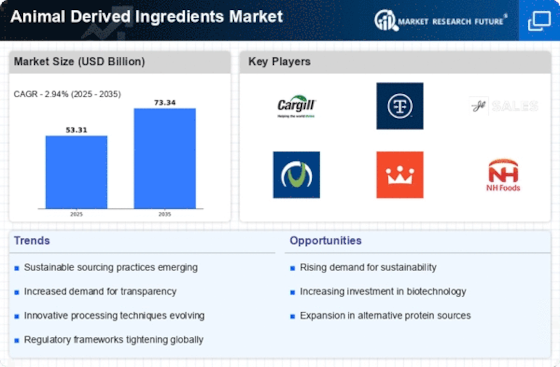
As per Market Research Future analysis, the Animal Derived Ingredients Market Size was estimated at 53.31 USD Billion in 2024. The Animal Derived Ingredients industry is projected to grow from 54.88 USD Billion in 2025 to 73.34 USD Billion by 2035, exhibiting a compound annual growth rate (CAGR) of 2.94% during the forecast period 2025 - 2035

Key Market Trends & Highlights

The Animal Derived Ingredients Market is experiencing a dynamic shift towards sustainability and health consciousness.

  • North America remains the largest market for animal derived ingredients, driven by increasing consumer demand for natural products.
  • The Asia-Pacific region is emerging as the fastest-growing market, reflecting a rising interest in health and wellness among consumers.
  • The meat segment continues to dominate the market, while the dairy segment is witnessing rapid growth due to changing dietary preferences.
  • Key market drivers include the rising demand for natural ingredients and the expansion of the pet food sector, which is influencing market dynamics.

Market Size & Forecast

2024 Market Size 53.31 (USD Billion)
2035 Market Size 73.34 (USD Billion)
CAGR (2025 - 2035) 2.94%

Major Players

Cargill (US), Tyson Foods (US), JBS (BR), Marfrig (BR), Danish Crown (DK), NH Foods (JP), Smithfield Foods (US), Pinnacle Foods (US), Hormel Foods (US)

Our Impact
Enabled $4.3B Revenue Impact for Fortune 500 and Leading Multinationals
Partnering with 2000+ Global Organizations Each Year
30K+ Citations by Top-Tier Firms in the Industry

Animal Derived Ingredients Market Trends

The Animal Derived Ingredients Market is currently experiencing a dynamic evolution, driven by a confluence of consumer preferences, regulatory frameworks, and technological advancements. As awareness regarding health and sustainability grows, there is a noticeable shift towards sourcing ingredients that are not only nutritious but also ethically produced. This market encompasses a wide array of products, including dairy, meat, and gelatin, which are integral to various industries such as food, cosmetics, and pharmaceuticals. The increasing demand for natural and organic products further propels the market, as consumers seek alternatives that align with their values and lifestyle choices. Moreover, the Animal Derived Ingredients Market is likely to witness innovations in processing techniques and supply chain management. These advancements may enhance product quality and safety, addressing consumer concerns regarding food integrity. Additionally, the rise of alternative proteins and plant-based substitutes could influence traditional animal-derived products, prompting manufacturers to adapt their offerings. As the market continues to evolve, stakeholders must remain vigilant to emerging trends and consumer expectations, ensuring that they meet the diverse needs of a conscientious consumer base.

Sustainability Focus

There is a growing emphasis on sustainable sourcing practices within the Animal Derived Ingredients Market. Consumers increasingly prefer products that are ethically produced, leading companies to adopt more transparent supply chains and environmentally friendly practices.

Health Consciousness

The trend towards health and wellness is shaping consumer choices in the Animal Derived Ingredients Market. Ingredients perceived as natural and beneficial are gaining traction, as individuals seek to enhance their diets with nutritious options.

Technological Advancements

Innovations in processing and production technologies are transforming the Animal Derived Ingredients Market. These advancements may improve efficiency, product quality, and safety, allowing companies to better meet consumer demands.

Animal Derived Ingredients Market Drivers

Expansion of the Pet Food Sector

The animal derived ingredients Market is significantly influenced by the expansion of the pet food sector. As pet ownership rates increase, there is a corresponding rise in demand for high-quality pet food products that often contain animal-derived ingredients. The pet food market is projected to grow at a robust rate, with consumers increasingly willing to invest in premium products that promise better nutrition for their pets. This trend is particularly evident in the growing preference for natural and organic pet food options, which often feature animal-derived ingredients. Consequently, the Animal Derived Ingredients Market stands to gain from this burgeoning sector, as manufacturers respond to the evolving preferences of pet owners.

Regulatory Support for Animal Welfare

The Animal Derived Ingredients Market is likely to benefit from increasing regulatory support for animal welfare. As consumers become more aware of ethical sourcing practices, there is a growing demand for transparency in the supply chain. Regulatory bodies are implementing stricter guidelines to ensure humane treatment of animals, which can enhance consumer trust in products containing animal-derived ingredients. This shift towards ethical sourcing may encourage manufacturers to adopt more sustainable practices, thereby positively impacting the Animal Derived Ingredients Market. As a result, companies that prioritize animal welfare may find themselves at a competitive advantage, appealing to a conscientious consumer base.

Rising Demand for Natural Ingredients

The Animal Derived Ingredients Market is experiencing a notable increase in demand for natural ingredients, driven by consumer preferences for clean label products. As consumers become more health-conscious, they are gravitating towards products that contain fewer artificial additives. This trend is reflected in the food and beverage sector, where the market for natural ingredients is projected to grow significantly. According to recent estimates, the market for natural food ingredients is expected to reach substantial figures by 2026, indicating a shift towards more wholesome options. This rising demand for natural ingredients is likely to propel the Animal Derived Ingredients Market, as these ingredients are often perceived as healthier and more sustainable alternatives.

Technological Innovations in Processing

The Animal Derived Ingredients Market is being transformed by technological innovations in processing techniques. Advances in extraction and processing technologies are enabling manufacturers to enhance the quality and functionality of animal-derived ingredients. For instance, improved methods for extracting collagen and gelatin are leading to higher yields and better product characteristics. These innovations not only improve the efficiency of production but also allow for the development of new applications in various sectors, including food, cosmetics, and pharmaceuticals. As these technologies continue to evolve, the Animal Derived Ingredients Market is likely to see an influx of innovative products that meet the changing demands of consumers.

Growth in Nutraceuticals and Functional Foods

The Animal Derived Ingredients Market is poised for growth due to the increasing popularity of nutraceuticals and functional foods. These products, which offer health benefits beyond basic nutrition, are gaining traction among consumers seeking to enhance their well-being. The market for functional foods is projected to expand, with a significant portion attributed to animal-derived ingredients such as collagen, omega-3 fatty acids, and probiotics. These ingredients are recognized for their potential health benefits, including improved joint health and enhanced immune function. As the demand for nutraceuticals continues to rise, the Animal Derived Ingredients Market is likely to benefit from this trend, as manufacturers seek to incorporate these beneficial ingredients into their offerings.


Market Segment Insights

By Type: Meat (Largest) vs. Dairy (Fastest-Growing)

In the Animal Derived Ingredients Market, the segment distribution is notably led by Meat, reflecting its dominance due to the increased consumer preference for high-protein diets and the growing demand for natural and organic ingredients. dairy follows closely, benefiting from its rich nutrient profile and versatility across various applications, including consumer goods and food formulations. Eggs, Gelatin, and Honey also contribute to the market, but their shares are comparatively smaller as they cater more to specific dietary segments or niche applications.

Meat (Dominant) vs. dairy (Emerging)

The Meat segment stands out as a dominant force in the Animal Derived Ingredients Market, thanks to its widespread use in processed foods, personal care products, and dietary supplements. It enjoys strong consumer recognition and loyalty, which further solidifies its market position. Conversely, the Dairy segment is emerging rapidly, driven by the rising demand for functional foods that leverage dairy's health benefits. Innovations in dairy processing and the adoption of dairy alternatives have also opened new avenues for growth, making it an attractive area for investment and development in the market.

By Application: Food & Beverage (Largest) vs. Cosmetics (Fastest-Growing)

In the Animal Derived Ingredients Market, the Application segment is notably dominated by Food & Beverage, which commands the largest share due to its extensive use in flavoring and nutrition enhancement. This segment comprises various ingredients derived from animal sources, such as gelatin, casein, and collagen, that are widely incorporated in food products. On the other hand, Cosmetics, although a smaller segment, is emerging rapidly, driven by the increasing consumer preference for natural ingredients that enhance product efficacy and appeal. The growth trends within this segment are largely influenced by shifting consumer behavior, where natural and ethical sourcing of ingredients is becoming paramount. Food & Beverage continues to grow steadily due to high consumer demand, whereas the Cosmetics sector is witnessing the fastest growth, fueled by innovations in formulations and the rising popularity of cruelty-free and vegan products. Companies in this space are adapting to these trends, thus shaping the future of how animal-derived ingredients are utilized on the market.

Food & Beverage (Dominant) vs. Pharmaceuticals (Emerging)

The Food & Beverage segment remains the dominant force within the Animal Derived Ingredients Market, characterized by its established applications in a wide range of products, from health supplements to premium food items. Its significance is further underscored by consumer trends favoring nutritional enhancements and traditional food products. Conversely, the Pharmaceuticals segment is emerging as a vital player, driven by innovations in formulations and increased healthcare spending. Animal-derived ingredients such as collagen and chondroitin are witnessing heightened demand for their therapeutic benefits, particularly in joint health and wound healing. Both segments exhibit distinct characteristics; while Food & Beverage focuses on broad consumer appeal, Pharmaceuticals is carving out a niche by emphasizing specialized health benefits.

By Source: Cattle (Largest) vs. Fish (Fastest-Growing)

In the Animal Derived Ingredients Market, the source segment distribution highlights Cattle as the dominant contributor, holding a significant portion of the market share due to its extensive utilization in various industries, such as food production and pharmaceuticals. Following Cattle, Poultry and Pork emerge as substantial segments, benefiting from their widespread acceptance in diets worldwide. Fish, while smaller in share, is rapidly gaining traction owing to the increasing demand for sustainable and health-conscious alternatives, reflecting a shift in consumer preferences.

Animal Derived Ingredients Market: Cattle (Dominant) vs. Fish (Emerging)

Cattle-derived ingredients play a critical role in the Animal Derived Ingredients Market, being integral to meat production, dairy products, and various industrial applications. Their established presence makes them a dominant force, supported by robust supply chains and consumer familiarity. Conversely, Fish represents an emerging segment gaining attention for its health benefits, rich omega-3 content, and lower ecological footprint compared to traditional livestock. This shift towards fish signals critical dietary changes and highlights the industry's response to consumer demands for sustainable sourcing and nutrition, presenting opportunities for innovation and expansion.

By Form: Powder (Largest) vs. Liquid (Fastest-Growing)

In the Animal Derived Ingredients Market, the 'Form' segment reveals a diverse landscape. The powder form remains the largest segment, capturing significant market interest due to its versatility and stability. In contrast, the liquid form, while currently smaller in market share, is emerging as the fastest-growing category, driven by consumer demand for easily digestible and convenient nutrition solutions.

Powder: Dominant vs. Liquid: Emerging

Powdered animal-derived ingredients have established themselves as the dominant form in this market, favored for their extended shelf life and ease of incorporation into various products. They are typically used in dietary supplements and functional foods, appealing to consumers seeking concentrated nutrition. On the other hand, liquid forms of animal-derived ingredients are gaining traction as an emerging segment, aligning with trends toward convenience and immediacy in consumption. They offer easier application in industrial processes and consumer products, catering to sectors focused on rapid formulation and deployment.

Get more detailed insights about Animal Derived Ingredients Market

Regional Insights

North America : Market Leader in Innovation

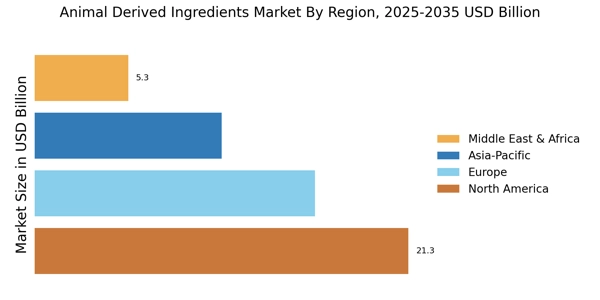
North America is the largest market for animal-derived ingredients, holding approximately 40% of the global market share. The region benefits from advanced agricultural practices, a strong demand for protein-rich diets, and increasing consumer awareness regarding food quality and safety. Regulatory frameworks, such as the USDA guidelines, further support market growth by ensuring high standards in food production and processing. The United States and Canada are the leading countries in this region, with major players like Cargill, Tyson Foods, and Smithfield Foods dominating the landscape. The competitive environment is characterized by innovation in product offerings and sustainability practices. The presence of these key players drives advancements in technology and efficiency, ensuring a robust supply chain for animal-derived ingredients.

Europe : Sustainable Practices in Focus

Europe is the second-largest market for animal-derived ingredients, accounting for approximately 30% of the global share. The region is witnessing a shift towards sustainable practices, driven by consumer demand for ethically sourced products and stringent regulations from the European Food Safety Authority (EFSA). These regulations promote transparency and traceability in the supply chain, enhancing consumer trust and market growth. Leading countries in Europe include Germany, France, and the United Kingdom, where companies like Danish Crown and JBS are prominent. The competitive landscape is marked by a focus on innovation and sustainability, with many firms investing in alternative protein sources and eco-friendly production methods. This trend is reshaping the market dynamics, pushing traditional players to adapt to changing consumer preferences.

Asia-Pacific : Emerging Market Potential

Asia-Pacific is an emerging powerhouse in the animal-derived ingredients market, holding about 20% of the global share. The region's growth is fueled by rising disposable incomes, urbanization, and a growing population that demands protein-rich diets. Countries like China and India are experiencing significant increases in meat consumption, prompting local governments to enhance food safety regulations and production standards to meet this demand. China and Japan are the leading countries in this region, with key players such as NH Foods and local firms expanding their market presence. The competitive landscape is evolving, with both multinational corporations and local businesses vying for market share. Innovations in processing technologies and distribution channels are also contributing to the region's rapid growth, making it a focal point for future investments in the animal-derived ingredients sector.

Middle East and Africa : Untapped Market Opportunities

The Middle East and Africa represent a growing market for animal-derived ingredients, accounting for approximately 10% of the global share. The region's growth is driven by increasing population, urbanization, and a rising middle class that demands higher-quality food products. Regulatory bodies are beginning to implement stricter food safety standards, which are essential for market expansion and consumer confidence. Leading countries include South Africa and the UAE, where local and international players are establishing a foothold. The competitive landscape is characterized by a mix of established companies and new entrants, focusing on meeting the diverse dietary needs of the population. As the market matures, there is a growing emphasis on sustainability and ethical sourcing, which will shape future trends in the region.

Animal Derived Ingredients Market Regional Image

Key Players and Competitive Insights

The Animal Derived Ingredients Market has witnessed significant growth due to rising consumer demand for protein-rich foods and the increasing popularity of animal-based supplements across various industries, including food, nutrition, and pharmaceuticals. The competitive landscape is characterized by numerous players focusing on innovation, product diversification, and sustainability to meet changing consumer preferences. Companies are also investing in technological advancements and supply chain efficiency to gain a competitive edge.
As the market evolves, businesses are increasingly adopting strategies such as mergers and acquisitions, partnerships, and collaborations to strengthen their market position and broaden their product offerings in a landscape that is progressively shifting towards ethical sourcing and environmental consciousness.
Tyson Foods holds a dominant position in the Animal Derived Ingredients Market, leveraging its extensive resources and supply chain capabilities to produce a wide range of animal-based products, including meat, poultry, and processed food items. The company's strengths lie in its well-established brand recognition and market presence, allowing it to appeal to a diverse consumer base. Tyson Foods prioritizes quality and sustainability, which enhances its competitive advantage by aligning with growing consumer expectations for responsibly sourced ingredients.
The company's commitment to research and development helps it innovate and expand its product lines to include healthier options and alternative protein sources, thus diversifying its offerings and enhancing its market share. Tyson Foods consistently invests in efficiency improvements and operational excellence, enabling the company to maintain a strong foothold in the competitive landscape.
JBS is another significant player in the Animal Derived Ingredients Market, recognized for its vast production capacity and extensive distribution network. The company has built a formidable reputation in the meat processing sector, which directly contributes to its strengths in providing high-quality animal-derived ingredients. JBS focuses on sustainable practices and animal welfare, positioning itself favorably among increasingly environmentally aware consumers. The company has also diversified its product range by investing in alternative protein sources, aligning with the shifting market dynamics towards plant-based and hybrid offerings.
JBS's ability to adapt and innovate within the marketplace is further reflected in its commitment to enhancing supply chain transparency and traceability, which are becoming essential factors for consumers when making purchasing decisions. Its expansive presence enables JBS to reach various markets effectively, contributing to its competitive positioning within the industry.

Key Companies in the Animal Derived Ingredients Market include

Industry Developments

Recent developments in the Animal Derived Ingredients Market indicate a notable shift towards enhancing sustainability practices, as companies like Tyson Foods and JBS are investing in eco-friendly processing methods. In particular, Maple Leaf Foods has been aggressively promoting its plant-based alternatives alongside its traditional offerings, signaling a growing demand for diversified product lines. The market is also experiencing growth attributed to the rising consumer preference for high-protein diets, leading to increased production capacities from Cargill and Smithfield Foods.

Noteworthy acquisitions include Hormel Foods' purchase of a prominent meat processor, which is expected to strengthen its supply chain and expand its product portfolio. Seaboard Foods has also made significant strides, recently expanding its operations to cater to the increasing demand for pork products in specific regions.

Furthermore, Marfrig and Bunge have jointly announced plans for a strategic partnership aimed at enhancing their supply chain efficiencies. This wave of mergers and acquisitions is reshaping the landscape, allowing these companies to capitalize on synergies and fulfill evolving consumer preferences. As companies adapt to the market dynamics, they are positioning themselves competitively in response to the growing awareness of sustainability and the demand for animal-derived ingredients.

Future Outlook

Animal Derived Ingredients Market Future Outlook

The Animal Derived Ingredients Market is projected to grow at a 2.94% CAGR from 2025 to 2035, driven by rising demand for natural ingredients and sustainable sourcing practices.

New opportunities lie in:

  • Expansion into plant-based alternatives incorporating animal-derived flavors
  • Development of traceability technologies for ingredient sourcing
  • Strategic partnerships with health and wellness brands for product innovation

By 2035, the market is expected to solidify its position as a key player in the global food industry.

Market Segmentation

Animal Derived Ingredients Market Form Outlook

  • Powder
  • Liquid
  • Granule
  • Paste

Animal Derived Ingredients Market Type Outlook

  • Meat
  • Dairy
  • Eggs
  • Gelatin
  • Honey

Animal Derived Ingredients Market Source Outlook

  • Cattle
  • Poultry
  • Pork
  • Fish
  • Goat

Animal Derived Ingredients Market Application Outlook

  • Food & Beverage
  • Cosmetics
  • Pharmaceuticals
  • Nutraceuticals

Report Scope

MARKET SIZE 202453.31(USD Billion)
MARKET SIZE 202554.88(USD Billion)
MARKET SIZE 203573.34(USD Billion)
COMPOUND ANNUAL GROWTH RATE (CAGR)2.94% (2025 - 2035)
REPORT COVERAGERevenue Forecast, Competitive Landscape, Growth Factors, and Trends
BASE YEAR2024
Market Forecast Period2025 - 2035
Historical Data2019 - 2024
Market Forecast UnitsUSD Billion
Key Companies ProfiledCargill (US), Tyson Foods (US), JBS (BR), Marfrig (BR), Danish Crown (DK), NH Foods (JP), Smithfield Foods (US), Pinnacle Foods (US), Hormel Foods (US)
Segments CoveredIngredient Type, Application, Source, Form, Regional
Key Market OpportunitiesGrowing demand for sustainable sourcing in the Animal Derived Ingredients Market presents significant opportunities for innovation.
Key Market DynamicsRising consumer demand for sustainable sourcing drives innovation in the Animal Derived Ingredients Market.
Countries CoveredNorth America, Europe, APAC, South America, MEA
Leave a Comment

FAQs

What is the current valuation of the Animal Derived Ingredients Market?

The Animal Derived Ingredients Market was valued at 53.31 USD Billion in 2024.

What is the projected market size for the Animal Derived Ingredients Market by 2035?

The market is projected to reach 73.34 USD Billion by 2035.

What is the expected CAGR for the Animal Derived Ingredients Market during the forecast period 2025 - 2035?

The expected CAGR for the market during this period is 2.94%.

Which companies are considered key players in the Animal Derived Ingredients Market?

Key players include Cargill, Tyson Foods, JBS, Marfrig, Danish Crown, NH Foods, Smithfield Foods, Pinnacle Foods, and Hormel Foods.

What are the main segments of the Animal Derived Ingredients Market?

The main segments include Type, Application, Source, and Form.

How much was the Meat segment valued in 2024, and what is its projected value for 2035?

The Meat segment was valued at 20.0 USD Billion in 2024 and is projected to reach 27.0 USD Billion by 2035.

What is the projected value of the Dairy segment by 2035?

The Dairy segment is expected to grow from 15.0 USD Billion in 2024 to 20.0 USD Billion by 2035.

What applications are driving growth in the Animal Derived Ingredients Market?

The Food & Beverage, Cosmetics, Pharmaceuticals, and Nutraceuticals applications are driving market growth.

What is the projected value of the Pharmaceuticals application by 2035?

The Pharmaceuticals application is projected to grow from 15.0 USD Billion in 2024 to 20.0 USD Billion by 2035.

Download Free Sample

Kindly complete the form below to receive a free sample of this Report

Compare Licence

×
Features License Type
Single User Multiuser License Enterprise User
Price $4,950 $5,950 $7,250
Maximum User Access Limit 1 User Upto 10 Users Unrestricted Access Throughout the Organization
Free Customization
Direct Access to Analyst
Deliverable Format
Platform Access
Discount on Next Purchase 10% 15% 15%
Printable Versions