Research Methodology on Truck Rental Market
Market Research Future (MRFR) has conducted extensive research and analysis for the Truck Rental Market report, using secondary data sources such as trusted industry reviews and databases, company websites, and industry associations. Primary sources comprised interviews and surveys of industry decision-makers and industry experts, among many others. For its survey, MRFR employs extensive secondary research, with industry sources such as annual reports, company websites, press releases, databases, and industry white papers. Primary research data includes consumer surveys and feedback from interviews with company executives, industry experts, and opinion leaders.
Market Segmentation
MRFR segments the global truck rental market based on type, end-customers, and region.
By Type:
-Light Duty Truck Rental
- Medium Duty Truck Rental
- Heavy Duty Truck Rental
By End-Users:
-Individuals
- Small and Medium Enterprises
- Corporate and Logistics Companies
Geographically:
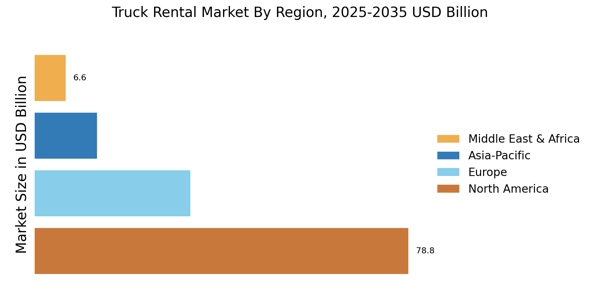
-North America (the U.S. and Canada)
- Europe (the U.K., Germany, France, Italy, and the Rest of Europe)
- Asia-Pacific (China, India, Japan, South Korea, and the Rest of Asia-Pacific)
- Latin America (Brazil, Mexico, and the Rest of Latin America)
- The Middle East and Africa (GCC Countries, Turkey, and the Rest of the Middle East and Africa)
Data Collection and Validation
MRFR has collected and validated data from both primary and secondary sources. Primary sources include interviews with industry experts and surveys of industry representatives. Secondary sources include publications available on the market, government websites, white papers, industry journals, and databases. MRFR has sought to ensure the accuracy and validity of the data collected.
Research Objectives
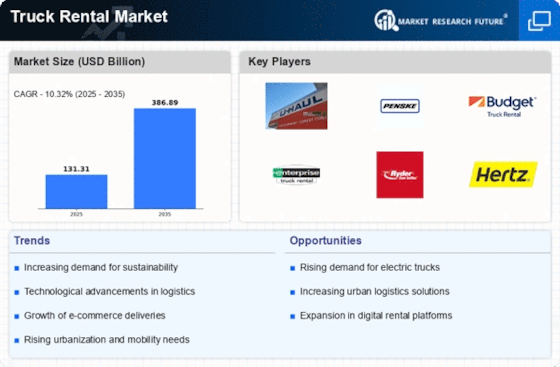
The primary objective of the report is to analyze the global Truck Rental market size, market share, value, and trends, and to present a detailed profile of the major players operating in the market and their key strategies.
The secondary objectives are to assess and analyze the regional market, segmentation, and dynamics; estimate and forecast the current prevailing market, and gain an understanding of the growth prospects of the market and its major segment of the global truck rental market.
Research Assumptions
MRFR has taken into account the following assumptions with regard to this report:
- Market revenues are based on the prices observed in the major truck rental markets
- Unit prices are expected to remain constant over the range of the forecast period
- Market growth is expected to be driven by a combination of macroeconomic and industry-specific factors
Scope of Report
The global Truck Rental Market report covers an in-depth analysis, with a qualitative and quantitative approach. The report covers the market, the market trend, and the key players, including their market share, strategies, and market prospects. The report also provides country-level analysis of the market and provides a forecast for the next five years. The report covers the key segments of the truck rental market, including end-users, types, and regions. It also provides an analysis of the market opportunity for new entrants in the market and a comprehensive value chain analysis for the market.
Data Triangulation and Market Estimation
MRFR has paid particular attention to the accuracy and reliability of the data. The data triangulation process is adopted to estimate the market size, by sourcing and validating data from both primary and secondary sources.
To obtain the overall market size and its segments and sub-segments, market sizing and forecasting were carried out based on bottom-up and top-down approaches. For the top-down approach, the overall market size is estimated using the revenues of the major players in the market and their share of the market. The bottom-up approach is used to estimate the market size and its segments based on the data on the individual market and its subsegments.
The reports of the major players in the market are used to validate the data obtained through the process. The data for the market is further validated by conducting interviews with industry experts, industry stakeholders, market leaders/decision makers, board members, and other key executives.