
Request Free Sample ×

Kindly complete the form below to receive a free sample of this Report

* Please use a valid business email

Leading companies partner with us for data-driven Insights

clients tt-cursor
Hero Background
English
Chinese
French
Japanese
Korean
German
Spanish

Zero Turn Mowers Market Size

ID: MRFR/Equip/9406-HCR
100 Pages
Snehal Singh
Last Updated: April 29, 2026

Zero Turn Mowers Market Research Report By Application (Lawn Maintenance, Landscaping, Golf Courses, Sports Fields), By Engine Type (Gasoline Engine, Diesel Engine, Electric Engine), By Mower Size (Compact, Medium, Large), By End Use (Residential, Commercial, Municipal) and By Regional (North America, Europe, South America, Asia Pacific, Middle East and Africa) - Forecast to 2035

Share:
Download PDF ×

We do not share your information with anyone. However, we may send you emails based on your report interest from time to time. You may contact us at any time to opt-out.

Zero Turn Mowers Market Infographic
Purchase Options

Zero Turn Mowers Size

Zero Turn Mowers Market Growth Projections and Opportunities

The market dynamics of zero-turn mowers showcase a fascinating interplay of factors that drive this specialized segment within the lawn care equipment industry. These maneuverable machines, known for their ability to turn on a dime, have witnessed a surge in demand owing to their efficiency and time-saving features. One key driver of this market is the increasing preference for zero-turn mowers among homeowners and landscaping professionals alike. The maneuverability and speed offered by these mowers make them particularly appealing for maintaining large lawns and intricate landscapes.

Technological advancements play a pivotal role in shaping the zero-turn mower market. Manufacturers are continually integrating cutting-edge features such as GPS navigation, automated mowing patterns, and ergonomic designs to enhance user experience. This not only attracts tech-savvy consumers but also underscores the industry's commitment to innovation. Additionally, the emphasis on eco-friendly solutions has prompted the development of electric and battery-powered zero-turn mowers, aligning with the growing environmental consciousness among consumers.

Another significant factor influencing market dynamics is the expanding trend of online sales channels. The ease of accessibility, coupled with the ability to compare prices and read user reviews, has driven consumers to opt for online platforms to purchase zero-turn mowers. E-commerce platforms have become crucial for manufacturers and distributors, providing a convenient avenue to reach a broader customer base and increase sales. Furthermore, the availability of diverse product ranges and competitive pricing online has intensified market competition, compelling manufacturers to focus on product differentiation and quality.

The overall growth of the landscaping industry and the increasing number of commercial applications for zero-turn mowers contribute substantially to market expansion. Golf courses, sports fields, and municipal parks are among the various sectors that rely on the precision and speed of zero-turn mowers for efficient lawn maintenance. As these sectors continue to invest in advanced equipment for enhanced productivity, the demand for high-performance zero-turn mowers is expected to soar.

However, challenges also loom over the market, notably the cost factor associated with zero-turn mowers. While the benefits of time and labor savings are evident, the initial investment required for these specialized machines can be a deterrent for some potential buyers. Striking a balance between affordability and advanced features remains a key challenge for manufacturers in this competitive landscape.

Moreover, regulatory factors and emission standards could impact the market dynamics of zero-turn mowers. Governments and environmental agencies are increasingly focusing on emissions from small engines, prompting manufacturers to innovate and develop cleaner, more sustainable options. Compliance with stringent regulations is becoming imperative for companies in the zero-turn mower market, influencing their production processes and product offerings.

In conclusion, the market dynamics of zero-turn mowers are shaped by a confluence of factors, including technological advancements, consumer preferences, online sales trends, and industry applications. The continued evolution of these dynamics will likely drive further innovation, ensuring that zero-turn mowers remain at the forefront of the lawn care equipment market. As the industry navigates challenges such as cost considerations and environmental regulations, adaptability and a commitment to customer needs will be essential for sustained growth in this dynamic market.

Zero Turn Mowers Market Size Graph
Author
Author Profile
Snehal Singh
Manager - Research

High acumen in analyzing complex macro & micro markets with more than 6 years of work experience in the field of market research. By implementing her analytical skills in forecasting and estimation into market research reports, she has expertise in Packaging, Construction, and Equipment domains. She handles a team size of 20-25 resources and ensures smooth running of the projects, associated marketing activities, and client servicing.

Leave a Comment

FAQs

What is the projected market valuation for the Zero Turn Mowers Market in 2035?

The projected market valuation for the Zero Turn Mowers Market in 2035 is 6264.85 USD Million.

Which companies are considered key players in the Zero Turn Mowers Market?

<p>Key players in the Zero Turn Mowers Market include Husqvarna, John Deere, Cub Cadet, Exmark, Scag Power Equipment, Bad Boy Mowers, Ferris, Troy-Bilt, and Snapper.</p>

What was the overall market valuation for the Zero Turn Mowers Market in 2024?

The overall market valuation for the Zero Turn Mowers Market in 2024 was 3000.9 USD Million.

What is the expected CAGR for the Zero Turn Mowers Market from 2025 to 2035?

<p>The expected CAGR for the Zero Turn Mowers Market during the forecast period 2025 - 2035 is 6.92%.</p>

How does the Lawn Maintenance segment perform in terms of market valuation?

The Lawn Maintenance segment was valued at 900.0 USD mllion in 2024 and is projected to reach 2000.0 USD million by 2035.

What is the market valuation for the Electric Engine segment in the Zero Turn Mowers Market?

The Electric Engine segment was valued at 1000.9 USD Million in 2024 and is expected to grow to 2264.85 USD Million by 2035.

What are the projected valuations for the Commercial end-use segment by 2035?

The Commercial end-use segment was valued at 1500.0 USD Million in 2024 and is anticipated to reach 3000.0 USD Million by 2035.

What is the market size for Large Zero Turn Mowers in 2024?

The Large Zero Turn Mowers segment was valued at 1800.54 USD Million in 2024 and is projected to grow to 3757.905 USD Million by 2035.

How does the Diesel Engine segment compare to the Gasoline Engine segment in market valuation?

The Diesel Engine segment was valued at 800.0 USD Million in 2024, while the Gasoline Engine segment was valued at 1200.0 USD Million.

What is the projected growth for the Sports Fields application segment by 2035?

<p>The Sports Fields application segment was valued at 700.0 USD Billion in 2024 and is expected to reach 1564.85 USD Billion by 2035.</p>

Market Summary

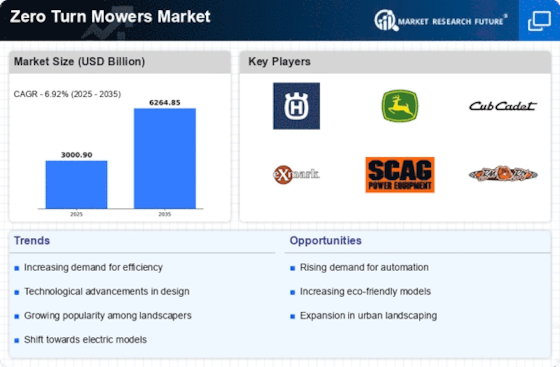
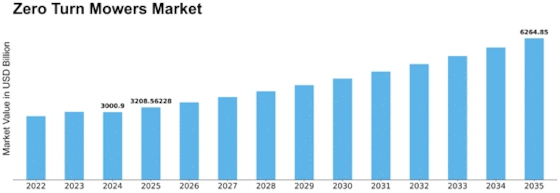
As per Market Research Future analysis, Zero-Turn Mowers Market valued at USD 3000.9 Million in 2024 is projected to reach USD 6264.85 Million by 2035, growing at a CAGR of 6.92% during 2025-2035. Residential segment dominates with 52% share driven by lawn care preferences, while Commercial landscaping grows fastest at 5.8% CAGR fueled by landscaping business expansion and labor cost reduction.

Key Market Trends & Highlights

The Zero Turn Mowers Market is experiencing robust growth driven by technological advancements and shifting consumer preferences.

  • North America remains the largest market for zero turn mowers, driven by a strong demand for lawn maintenance. The Asia-Pacific region is emerging as the fastest-growing market, fueled by increasing urbanization and landscaping needs. The lawn maintenance segment continues to dominate, while the electric engine segment is witnessing rapid growth due to environmental concerns. Technological advancements and changing consumer preferences are key drivers propelling the market forward.

Market Size & Forecast

2024 Market Size 3000.9 (USD Million)
2035 Market Size 6264.85 (USD Million)
CAGR (2025 - 2035) 6.92%
Largest Regional Market Share in 2024 North America

Major Players

Leading market manufacturers in the Zero Turn Mowers are, <a title="Husqvarna" href="https://www.husqvarna.com/us/zero-turn-mowers/" target="_blank" rel="noopener">Husqvarna</a> (SE), <a title="John Deere" href="https://www.deere.com/en/mowers/zero-turn-mowers/" target="_blank" rel="noopener">John Deere</a> (US), <a title="Cub Cadet" href="https://www.cubcadet.com/en_US/lawn-mowers/zero-turn-mowers" target="_blank" rel="noopener">Cub Cadet</a> (US), <a href="https://www.exmark.com/mowers/zero-turn/">Exmark</a>(US), Scag Power Equipment (US), <a title="Bad Boy Mowers" href="https://badboycountry.com/mowers" target="_blank" rel="noopener">Bad Boy Mowers</a> (US), <a href="https://www.ferrismowers.com/na/en_us/products/zero-turn-mowers.html">Ferris</a>(US), Troy-Bilt (US), Snapper (US)

Market Trends

The Zero Turn Mowers Market is currently experiencing a dynamic evolution, driven by advancements in technology and changing consumer preferences. As landscaping and lawn care become increasingly important for both residential and commercial properties, the demand for efficient and versatile mowing solutions rises. Zero turn mowers, known for their maneuverability and speed, are gaining traction among homeowners and professional landscapers alike.

According to recent zero turn mowers market analysis, This market appears to be influenced by a growing emphasis on sustainability, with manufacturers focusing on eco-friendly designs and electric models that reduce emissions and noise pollution. Furthermore, the ongoing zero turn mowers market trends indicate the integration of smart technology into these machines enhances user experience, allowing for precision mowing and improved operational efficiency. In addition to technological advancements, the Zero Turn Mowers Market is also shaped by shifting demographics and lifestyle changes.

Younger generations, who prioritize convenience and efficiency, are increasingly investing in these mowers for their ease of use and time-saving capabilities. This shift has influenced consumer interest in identifying the best zero turn lawn mowers on the market and understanding what are the best zero turn mowers on the market for residential and commercial use. The rise of online retail platforms has further facilitated access to a wider range of products, enabling consumers to make informed purchasing decisions. As the zero turn mowers market size  continues to expand, it is likely that competition will intensify, prompting manufacturers to innovate and differentiate their offerings. Overall, the Zero Turn Mowers Market is poised for growth, reflecting broader trends in consumer behavior and environmental consciousness.

Technological Advancements

The Zero Turn Mowers Market is witnessing a surge in technological innovations, particularly with the integration of smart features. These advancements enhance user experience by providing precision mowing capabilities and improved operational efficiency. Manufacturers are increasingly focusing on developing electric models that align with sustainability goals, appealing to environmentally conscious consumers seeking the best zero turn mowers on the market.

Changing Consumer Preferences

As lifestyles evolve, there is a noticeable shift in consumer preferences towards convenience and efficiency. Younger generations are gravitating towards zero turn mowers for their ease of use and time-saving attributes. This trend indicates a growing market segment that values modern solutions for lawn care.

Expansion of Online Retail

The rise of e-commerce platforms is transforming the way consumers access zero turn mowers. Online retail provides a broader selection of products and allows for informed decision-making. This trend is likely to enhance market competition, as manufacturers strive to capture the attention of tech-savvy consumers.

Zero Turn Mowers Market Market Drivers

Changing Consumer Preferences

Consumer preferences are shifting towards more efficient and user-friendly lawn care solutions, which is positively impacting the Zero Turn Mowers Market. As homeowners increasingly seek to reduce the time and effort spent on lawn maintenance, zero turn mowers are becoming the preferred choice due to their maneuverability and speed. Recent surveys indicate that nearly 60% of consumers prioritize ease of use and efficiency when selecting lawn care equipment. This trend is further fueled by the growing awareness of sustainable practices, as zero turn mowers often provide a cleaner cut and promote healthier lawns. Consequently, the changing consumer landscape is likely to bolster the growth of the Zero Turn Mowers Market.

Expansion of Online Retail Channels

The rise of e-commerce is significantly influencing the Zero Turn Mowers Market. With more consumers turning to online platforms for their purchasing needs, manufacturers and retailers are adapting by enhancing their online presence. Data suggests that online sales of lawn care equipment, including zero turn mowers, have seen a substantial increase, with some reports indicating a growth rate of over 15% annually. This shift not only provides consumers with greater access to a variety of products but also allows for competitive pricing and convenience. As online retail channels continue to expand, they are likely to play a crucial role in shaping the future of the Zero Turn Mowers Market.

Environmental Sustainability Initiatives

The Zero Turn Mowers Market is also being influenced by a growing emphasis on environmental sustainability. As consumers become more environmentally conscious, there is an increasing demand for mowers that are not only efficient but also eco-friendly. Manufacturers are responding by developing electric and hybrid zero turn mowers that produce lower emissions and reduce noise pollution. Recent statistics indicate that the market for electric lawn care equipment is projected to grow significantly, with a focus on sustainable practices. This shift towards environmentally friendly options is likely to drive innovation and growth within the Zero Turn Mowers Market, as consumers seek products that align with their values.

Increased Demand for Landscaping Services

The growing demand for professional landscaping services is a key driver for the Zero Turn Mowers Market. As more homeowners and businesses seek to enhance their outdoor spaces, the need for efficient and effective lawn care equipment becomes paramount. Landscaping companies are increasingly investing in zero turn mowers due to their ability to cover large areas quickly and provide a superior finish. Recent industry reports indicate that the landscaping services market is expected to grow at a compound annual growth rate of approximately 5% over the next few years. This trend suggests that the Zero Turn Mowers Market will benefit from the rising demand for powered lawn mower solutions.

Technological Advancements in Zero Turn Mowers

The Zero Turn Mowers Market is experiencing a notable transformation due to rapid technological advancements. Innovations such as improved engine efficiency, enhanced cutting systems, and the integration of smart technology are becoming increasingly prevalent. For instance, the incorporation of GPS technology and automated mowing systems is streamlining operations, making them more efficient. According to recent data, the market for smart lawn care equipment is projected to grow significantly, with a compound annual growth rate of over 10% in the coming years. These advancements not only enhance the performance of zero turn mowers but also appeal to a tech-savvy consumer base, thereby driving demand in the Zero Turn Mowers Market.

Market Segment Insights

By Application: Lawn Maintenance (Largest) vs. Landscaping (Fastest-Growing)

In the Zero Turn Mowers Market, the application segment exhibits a diverse landscape with significant shares across various categories. Lawn maintenance stands out as the largest application, capturing a robust portion of the market due to its widespread adoption among residential and commercial users. Landscaping follows closely, reflecting a notable presence as well, with specific needs for efficient and high-performance mowing solutions. Golf courses and sports fields are also crucial segments, although they occupy a smaller share of the market, driven by specialized requirements and maintenance standards.

Lawn Maintenance (Dominant) vs. Landscaping (Emerging)

Lawn maintenance is recognized as the dominant segment within the Zero Turn Mowers Market, characterized by its extensive use in residential areas and commercial properties. The need for maintaining aesthetics and lawn health drives its popularity, as users seek efficient and time-saving mowing solutions. Conversely, landscaping is emerging as a fast-growing segment, given the increasing trend of customized outdoor spaces and enhanced landscape design. This growth is fueled by the rising demand for professional landscaping services, where zero turn mowers are preferred for their maneuverability and ability to achieve precise cuts in intricate designs, leading to an overall positive market outlook for this application.

By Engine Type: Gasoline Engine (Largest) vs. Electric Engine (Fastest-Growing)

The Zero Turn Mowers market showcases a diverse landscape in engine types, with gasoline engines holding the largest market share, credited to their established performance and widespread acceptance among traditional users. Diesel engines, while also notable, have a smaller slice of the market, mainly appealing to commercial users requiring durability and extended use. In contrast, <a title="electric engine" href="https://www.marketresearchfuture.com/reports/electric-engine-market-35306" target="_blank" rel="noopener">electric engines</a> are rapidly gaining traction, fueled by the increasing demand for eco-friendly and efficient mowing solutions, making them a significant consideration for new entrants in this segment.

Gasoline Engine (Dominant) vs. Electric Engine (Emerging)

Gasoline engines dominate the Zero Turn Mowers market due to their proven capability, straightforward operation, and long-standing user preference. They offer high power output and are favored for larger, more demanding mowing tasks. In contrast, electric engines are emerging as a promising alternative, particularly among environmentally conscious consumers. Their low noise levels, reduced emissions, and lower operating costs are driving a shift towards this technology. As battery technology continues to improve, electric engines are expected to challenge the dominance of gasoline engines, catering to a growing market segment that values sustainability and efficiency.

By Mower Size: Large (Largest) vs. Compact (Fastest-Growing)

The Zero Turn Mowers Market exhibits a diverse distribution in mower size segments, comprising Compact, Medium, and Large sizes. Currently, the Large size segment commands the majority market share, appealing to commercial operators and large properties due to its efficiency and cutting capability. The Medium segment serves as a balance between maneuverability and power, while the Compact segment has been steadily gaining popularity among residential users due to its ease of use and storage convenience. In recent years, the growth trends within the mower size segments have been influenced by various consumer preferences and landscaping service needs. As urban gardening and smaller residential lawns become increasingly popular, the Compact segment has emerged as the fastest-growing, driven by innovation in design and functionality. Meanwhile, the Large size segment continues to dominate, fueling advances in engineering that enhance performance and durability, catering to professional landscapers and larger landowners.

Large (Dominant) vs. Compact (Emerging)

The Large mower size segment in the Zero Turn Mowers Market is characterized by its robust build and high-performance capabilities, making it a preferred choice for commercial landscapers and large property owners. These mowers are designed for extensive lawn care, offering features such as powerful engines and wide cutting decks that enhance productivity. In contrast, the Compact segment is rapidly emerging, appealing to homeowners with smaller yards or limited storage space. Compact mowers provide versatility and ease of operation, often equipped with advanced technology for optimal maneuverability. As more consumers seek user-friendly and efficient mowing solutions, the Compact segment is set to capture an increasing share of the market, juxtaposing the established dominance of Large mowers.

By End Use: Residential (Largest) vs. Commercial (Fastest-Growing)

In the Zero Turn Mowers Market, the residential segment holds the largest share, driven by an increasing number of homeowners investing in lawn care equipment to enhance their properties. This segment is characterized by a preference for user-friendly features and compact designs, appealing to consumers looking for efficiency and ease of use. Conversely, the commercial segment is gaining rapid traction, as landscaping businesses and contractors seek high-performance mowers to cater to diverse client needs. This growing demand is coupled with an emphasis on durability and advanced technology in mowers.

Residential (Dominant) vs. Commercial (Emerging)

The residential end use segment remains the dominant force in the Zero Turn Mowers Market, as consumers prioritize sleek designs and easy maneuverability for personal lawn care. These mowers are typically lighter and equipped with features that cater to individual homeowners, making them a popular choice for residential upkeep. On the other hand, the commercial segment is emerging rapidly, characterized by larger mower sizes and advanced functionalities designed for professional landscapers. This segment's growth is spurred by the need for enhanced productivity and performance, as commercial users often require heavy-duty equipment that can operate for extended periods on diverse terrains.

Get more detailed insights about Zero Turn Mowers Market Research Report—Global Forecast till 2035

Regional Insights

North America : Market Leader in Innovation

North America is the largest market for zero turn mowers, accounting for approximately 60% of the global market share. The growth is driven by increasing demand for efficient lawn care solutions, particularly in residential and commercial landscaping. Regulatory support for eco-friendly equipment and advancements in mower technology further catalyze market expansion. The U.S. leads this region, followed by Canada, which holds about 15% of the market share. The competitive landscape in North America is robust, featuring key players such as John Deere, Husqvarna, and Cub Cadet. These companies are investing in innovative technologies and sustainable practices to enhance product offerings. The presence of a well-established distribution network and strong consumer preference for high-quality equipment also contribute to the region's dominance in the zero turn mower market.

Europe : Emerging Market with Potential

Europe is witnessing a growing interest in zero turn mowers, driven by increasing urbanization and a shift towards professional landscaping services. The market is expected to capture around 20% of the global share, with countries like Germany and the UK leading the charge. Regulatory initiatives promoting sustainable landscaping practices are also boosting demand for efficient mowing solutions. The market is projected to grow as consumers seek advanced features and eco-friendly options. Germany stands out as the largest market in Europe, followed closely by the UK and France. The competitive landscape includes established brands like Husqvarna and local manufacturers. The presence of key players is complemented by a growing number of startups focusing on innovative designs and technologies. This dynamic environment is fostering healthy competition and driving advancements in the zero turn mower segment.

Middle East and Africa : Untapped Market Potential

The Middle East and Africa region presents untapped potential for zero turn mowers, with a market share of approximately 5%. The growth is primarily driven by increasing investments in landscaping and agricultural sectors, particularly in countries like South Africa and the UAE. Regulatory frameworks promoting sustainable agricultural practices are also contributing to market growth. As urban areas expand, the demand for efficient lawn care solutions is expected to rise significantly. South Africa is the leading market in this region, followed by the UAE. The competitive landscape is characterized by a mix of international brands and emerging local players. Companies like Bad Boy Mowers and Ferris are gaining traction, while local manufacturers are focusing on affordability and adaptability to regional conditions. This evolving market landscape is likely to attract further investments and innovations in the zero turn mower segment.

Key Players and Competitive Insights

The Zero Turn Mowers Market has become increasingly competitive as more manufacturers enter the field with advanced technologies and innovative designs. This market segment, which now includes the growing electric zero turn mower category, has attracted a diverse range of players, from established brands to upcoming firms, each aiming to capture a share of the expanding customer base. Zero-turn mowers are renowned for their exceptional maneuverability and efficiency, making them a popular choice among both commercial landscapers and residential users. As the demand for high-performance and versatile landscaping equipment grows, companies are focusing on research and development to enhance product features while also addressing consumer needs for durability, ease of use, and comfort.

The competitive landscape is characterized by strategic partnerships, collaborations, and marketing efforts as firms look to differentiate their offerings and consolidate their positions in an increasingly crowded market. Bad Boy Mowers has carved a notable presence in the Zero Turn Mowers Market with its commitment to delivering robust and innovative mowing solutions. The company emphasizes high-quality craftsmanship and has developed a reputation for manufacturing heavy-duty mowers that cater to the rigorous demands of commercial and residential applications alike. One of the key strengths of Bad Boy Mowers is its focus on performance, with a range of products designed to maximize mowing efficiency while ensuring user comfort and ease of operation.

Additionally, Bad Boy Mowers has built a loyal customer base by offering excellent after-sales support and a comprehensive warranty on its products, which enhances brand trust and customer retention. The company's diverse portfolio allows it to serve various customer segments, thereby reinforcing its competitive edge in the market. Husqvarna stands out as a prominent player in the Zero Turn Mowers Market, known for its innovative engineering and advanced technology.

The company’s zero-turn mowers are recognized for their reliability, cutting efficiency, and cutting-edge features, making them a preferred choice among professional landscapers and serious hobbyists. Husqvarna leverages its extensive experience in outdoor power equipment to continuously improve its product offerings, which are designed with user-friendly controls, powerful engines, and ergonomic designs. Moreover, Husqvarna has a strong distribution network and a significant presence in various markets, allowing it to reach a wide audience. The company also invests in sustainability initiatives, creating environmentally friendly products that appeal to an increasingly eco-conscious consumer base. This unwavering dedication to innovation and quality positions Husqvarna favorably within the competitive landscape of the Zero Turn Mowers Market.

Key Companies in the Zero Turn Mowers Market include

Industry Developments

The Zero Turn Mowers Market has recently experienced significant developments, especially with major players like Bad Boy Mowers, Husqvarna, and Toro focusing on product innovation and sustainability. Bad Boy Mowers has introduced advanced models with improved fuel efficiency and durability, aligning with the growing consumer demand for environmentally friendly options. Husqvarna has also been expanding its smart technology features, ensuring greater efficiency in lawn care. Meanwhile, Toro has reported an increase in market share due to a surge in consumer interest in robotic mowers, which reflects broader trends toward automation in landscaping.

In terms of mergers and acquisitions, there have been notable movements among companies such as John Deere and Exmark as they seek to consolidate market position and enhance resource capabilities. Given the increasing competition, stakeholders are noting that these strategic alliances could play a crucial role in market growth. The rising demand for residential landscaping and commercial lawn maintenance is expected to further propel the market valuation. Companies like Snapper and Ferris are increasing their production capacities to meet this demand, reflecting a robust outlook for the industry in the short to medium term.

Future Outlook

Zero Turn Mowers Market Future Outlook

The Zero Turn Mowers Market is projected to grow at a 6.92% CAGR from 2025 to 2035, driven by technological advancements, increasing demand for efficient <a title="lawn care" href="https://www.marketresearchfuture.com/reports/lawn-care-market-24865" target="_blank" rel="noopener">lawn care</a>, and rising consumer preferences for landscaping services.

New opportunities lie in:

  • <p>Development of electric zero turn mowers for eco-conscious consumers. Integration of IoT technology for remote monitoring and diagnostics. Expansion into commercial <a title="landscaping services" href="https://www.marketresearchfuture.com/reports/landscaping-services-market-68321" target="_blank" rel="noopener">landscaping services</a> with tailored fleet solutions.</p>

By 2035, the Zero Turn Mowers Market is expected to achieve substantial growth and innovation.

Market Segmentation

Zero Turn Mowers Market End Use Outlook

  • Residential
  • Commercial
  • Municipal

Zero Turn Mowers Market Mower Size Outlook

  • Compact
  • Medium
  • Large

Zero Turn Mowers Market Application Outlook

  • Lawn Maintenance
  • Landscaping
  • Golf Courses
  • Sports Fields

Zero Turn Mowers Market Engine Type Outlook

  • Gasoline Engine
  • Diesel Engine
  • Electric Engine

Report Scope

MARKET SIZE 2024 3000.9(USD Million)
MARKET SIZE 2025 3208.57(USD Million)
MARKET SIZE 2035 6264.85(USD Million)
COMPOUND ANNUAL GROWTH RATE (CAGR) 6.92% (2025 - 2035)
REPORT COVERAGE Revenue Forecast, Competitive Landscape, Growth Factors, and Trends
BASE YEAR 2024
Market Forecast Period 2025 - 2035
Historical Data 2019 - 2024
Market Forecast Units USD Billion
Key Companies Profiled Husqvarna (SE), John Deere (US), Cub Cadet (US), Exmark (US), Scag Power Equipment (US), Bad Boy Mowers (US), Ferris (US), Troy-Bilt (US), Snapper (US)
Segments Covered Application, Engine Type, Mower Size, End Use, Regional
Key Market Opportunities Integration of smart technology and automation in the Zero Turn Mowers Market enhances user experience and efficiency.
Key Market Dynamics Rising consumer preference for efficient landscaping solutions drives innovation and competition in the Zero Turn Mowers market.
Countries Covered North America, Europe, APAC, South America, MEA

FAQs

What is the projected market valuation for the Zero Turn Mowers Market in 2035?

The projected market valuation for the Zero Turn Mowers Market in 2035 is 6264.85 USD Million.

Which companies are considered key players in the Zero Turn Mowers Market?

<p>Key players in the Zero Turn Mowers Market include Husqvarna, John Deere, Cub Cadet, Exmark, Scag Power Equipment, Bad Boy Mowers, Ferris, Troy-Bilt, and Snapper.</p>

What was the overall market valuation for the Zero Turn Mowers Market in 2024?

The overall market valuation for the Zero Turn Mowers Market in 2024 was 3000.9 USD Million.

What is the expected CAGR for the Zero Turn Mowers Market from 2025 to 2035?

<p>The expected CAGR for the Zero Turn Mowers Market during the forecast period 2025 - 2035 is 6.92%.</p>

How does the Lawn Maintenance segment perform in terms of market valuation?

The Lawn Maintenance segment was valued at 900.0 USD mllion in 2024 and is projected to reach 2000.0 USD million by 2035.

What is the market valuation for the Electric Engine segment in the Zero Turn Mowers Market?

The Electric Engine segment was valued at 1000.9 USD Million in 2024 and is expected to grow to 2264.85 USD Million by 2035.

What are the projected valuations for the Commercial end-use segment by 2035?

The Commercial end-use segment was valued at 1500.0 USD Million in 2024 and is anticipated to reach 3000.0 USD Million by 2035.

What is the market size for Large Zero Turn Mowers in 2024?

The Large Zero Turn Mowers segment was valued at 1800.54 USD Million in 2024 and is projected to grow to 3757.905 USD Million by 2035.

How does the Diesel Engine segment compare to the Gasoline Engine segment in market valuation?

The Diesel Engine segment was valued at 800.0 USD Million in 2024, while the Gasoline Engine segment was valued at 1200.0 USD Million.

What is the projected growth for the Sports Fields application segment by 2035?

<p>The Sports Fields application segment was valued at 700.0 USD Billion in 2024 and is expected to reach 1564.85 USD Billion by 2035.</p>

  1. SECTION I: EXECUTIVE SUMMARY AND KEY HIGHLIGHTS |
    1. EXECUTIVE SUMMARY | |
      1. Market Overview | |
      2. Key Findings | |
      3. Market Segmentation | |
      4. Competitive Landscape | |
      5. Challenges and Opportunities | |
      6. Future Outlook 2
  2. SECTION II: SCOPING, METHODOLOGY AND MARKET STRUCTURE |
    1. MARKET INTRODUCTION | |
      1. Definition | |
      2. Scope of the study | | |
    2. RESEARCH METHODOLOGY | |
      1. Overview | |
      2. Data Mining | |
      3. Secondary Research | |
      4. Primary Research | | |
      5. Forecasting Model | |
      6. Market Size Estimation | | |
      7. Data Triangulation | |
      8. Validation 3
  3. SECTION III: QUALITATIVE ANALYSIS |
    1. MARKET DYNAMICS | |
      1. Overview | |
      2. Drivers | |
      3. Restraints | |
      4. Opportunities |
    2. MARKET FACTOR ANALYSIS | |
      1. Value chain Analysis | |
      2. Porter's Five Forces Analysis | | |
      3. COVID-19 Impact Analysis | | |
  4. SECTION IV: QUANTITATIVE ANALYSIS |
    1. Life Sciences, BY Application (USD Billion) | |
      1. Lawn Maintenance | |
      2. Landscaping | |
      3. Golf Courses | |
      4. Sports Fields |
    2. Life Sciences, BY Engine Type (USD Billion) | |
      1. Gasoline Engine | |
      2. Diesel Engine | |
      3. Electric Engine |
    3. Life Sciences, BY Mower Size (USD Billion) | |
      1. Compact | |
      2. Medium | |
      3. Large |
    4. Life Sciences, BY End Use (USD Billion) | |
      1. Residential | |
      2. Commercial | |
      3. Municipal |
    5. Life Sciences, BY Region (USD Billion) | |
      1. North America | | |
      2. Europe | | |
      3. APAC | | |
      4. South America | | |
      5. MEA | | |
  5. SECTION V: COMPETITIVE ANALYSIS |
    1. Competitive Landscape | |
      1. Overview | |
      2. Competitive Analysis | |
      3. Market share Analysis | |
      4. Major Growth Strategy in the Life Sciences | |
      5. Competitive Benchmarking | |
      6. Leading Players in Terms of Number of Developments in the Life Sciences | |
      7. Key developments and growth strategies | | |
      8. Major Players Financial Matrix | | |
    2. Company Profiles | |
      1. Husqvarna (SE) | | |
      2. John Deere (US) | | |
      3. Cub Cadet (US) | | |
      4. Exmark (US) | | |
      5. Scag Power Equipment (US) | | |
      6. Bad Boy Mowers (US) | | |
      7. Ferris (US) | | |
      8. Troy-Bilt (US) | | |
      9. Snapper (US) | | |
    3. Appendix | |
      1. References | |
      2. Related Reports 6 LIST OF FIGURES |
    4. MARKET SYNOPSIS |
    5. NORTH AMERICA MARKET ANALYSIS |
    6. US MARKET ANALYSIS BY APPLICATION |
    7. US MARKET ANALYSIS BY ENGINE TYPE |
    8. US MARKET ANALYSIS BY MOWER SIZE |
    9. US MARKET ANALYSIS BY END USE |
    10. CANADA MARKET ANALYSIS BY APPLICATION |
    11. CANADA MARKET ANALYSIS BY ENGINE TYPE |
    12. CANADA MARKET ANALYSIS BY MOWER SIZE |
    13. CANADA MARKET ANALYSIS BY END USE |
    14. EUROPE MARKET ANALYSIS |
    15. GERMANY MARKET ANALYSIS BY APPLICATION |
    16. GERMANY MARKET ANALYSIS BY ENGINE TYPE |
    17. GERMANY MARKET ANALYSIS BY MOWER SIZE |
    18. GERMANY MARKET ANALYSIS BY END USE |
    19. UK MARKET ANALYSIS BY APPLICATION |
    20. UK MARKET ANALYSIS BY ENGINE TYPE |
    21. UK MARKET ANALYSIS BY MOWER SIZE |
    22. UK MARKET ANALYSIS BY END USE |
    23. FRANCE MARKET ANALYSIS BY APPLICATION |
    24. FRANCE MARKET ANALYSIS BY ENGINE TYPE |
    25. FRANCE MARKET ANALYSIS BY MOWER SIZE |
    26. FRANCE MARKET ANALYSIS BY END USE |
    27. RUSSIA MARKET ANALYSIS BY APPLICATION |
    28. RUSSIA MARKET ANALYSIS BY ENGINE TYPE |
    29. RUSSIA MARKET ANALYSIS BY MOWER SIZE |
    30. RUSSIA MARKET ANALYSIS BY END USE |
    31. ITALY MARKET ANALYSIS BY APPLICATION |
    32. ITALY MARKET ANALYSIS BY ENGINE TYPE |
    33. ITALY MARKET ANALYSIS BY MOWER SIZE |
    34. ITALY MARKET ANALYSIS BY END USE |
    35. SPAIN MARKET ANALYSIS BY APPLICATION |
    36. SPAIN MARKET ANALYSIS BY ENGINE TYPE |
    37. SPAIN MARKET ANALYSIS BY MOWER SIZE |
    38. SPAIN MARKET ANALYSIS BY END USE |
    39. REST OF EUROPE MARKET ANALYSIS BY APPLICATION |
    40. REST OF EUROPE MARKET ANALYSIS BY ENGINE TYPE |
    41. REST OF EUROPE MARKET ANALYSIS BY MOWER SIZE |
    42. REST OF EUROPE MARKET ANALYSIS BY END USE |
    43. APAC MARKET ANALYSIS |
    44. CHINA MARKET ANALYSIS BY APPLICATION |
    45. CHINA MARKET ANALYSIS BY ENGINE TYPE |
    46. CHINA MARKET ANALYSIS BY MOWER SIZE |
    47. CHINA MARKET ANALYSIS BY END USE |
    48. INDIA MARKET ANALYSIS BY APPLICATION |
    49. INDIA MARKET ANALYSIS BY ENGINE TYPE |
    50. INDIA MARKET ANALYSIS BY MOWER SIZE |
    51. INDIA MARKET ANALYSIS BY END USE |
    52. JAPAN MARKET ANALYSIS BY APPLICATION |
    53. JAPAN MARKET ANALYSIS BY ENGINE TYPE |
    54. JAPAN MARKET ANALYSIS BY MOWER SIZE |
    55. JAPAN MARKET ANALYSIS BY END USE |
    56. SOUTH KOREA MARKET ANALYSIS BY APPLICATION |
    57. SOUTH KOREA MARKET ANALYSIS BY ENGINE TYPE |
    58. SOUTH KOREA MARKET ANALYSIS BY MOWER SIZE |
    59. SOUTH KOREA MARKET ANALYSIS BY END USE |
    60. MALAYSIA MARKET ANALYSIS BY APPLICATION |
    61. MALAYSIA MARKET ANALYSIS BY ENGINE TYPE |
    62. MALAYSIA MARKET ANALYSIS BY MOWER SIZE |
    63. MALAYSIA MARKET ANALYSIS BY END USE |
    64. THAILAND MARKET ANALYSIS BY APPLICATION |
    65. THAILAND MARKET ANALYSIS BY ENGINE TYPE |
    66. THAILAND MARKET ANALYSIS BY MOWER SIZE |
    67. THAILAND MARKET ANALYSIS BY END USE |
    68. INDONESIA MARKET ANALYSIS BY APPLICATION |
    69. INDONESIA MARKET ANALYSIS BY ENGINE TYPE |
    70. INDONESIA MARKET ANALYSIS BY MOWER SIZE |
    71. INDONESIA MARKET ANALYSIS BY END USE |
    72. REST OF APAC MARKET ANALYSIS BY APPLICATION |
    73. REST OF APAC MARKET ANALYSIS BY ENGINE TYPE |
    74. REST OF APAC MARKET ANALYSIS BY MOWER SIZE |
    75. REST OF APAC MARKET ANALYSIS BY END USE |
    76. SOUTH AMERICA MARKET ANALYSIS |
    77. BRAZIL MARKET ANALYSIS BY APPLICATION |
    78. BRAZIL MARKET ANALYSIS BY ENGINE TYPE |
    79. BRAZIL MARKET ANALYSIS BY MOWER SIZE |
    80. BRAZIL MARKET ANALYSIS BY END USE |
    81. MEXICO MARKET ANALYSIS BY APPLICATION |
    82. MEXICO MARKET ANALYSIS BY ENGINE TYPE |
    83. MEXICO MARKET ANALYSIS BY MOWER SIZE |
    84. MEXICO MARKET ANALYSIS BY END USE |
    85. ARGENTINA MARKET ANALYSIS BY APPLICATION |
    86. ARGENTINA MARKET ANALYSIS BY ENGINE TYPE |
    87. ARGENTINA MARKET ANALYSIS BY MOWER SIZE |
    88. ARGENTINA MARKET ANALYSIS BY END USE |
    89. REST OF SOUTH AMERICA MARKET ANALYSIS BY APPLICATION |
    90. REST OF SOUTH AMERICA MARKET ANALYSIS BY ENGINE TYPE |
    91. REST OF SOUTH AMERICA MARKET ANALYSIS BY MOWER SIZE |
    92. REST OF SOUTH AMERICA MARKET ANALYSIS BY END USE |
    93. MEA MARKET ANALYSIS |
    94. GCC COUNTRIES MARKET ANALYSIS BY APPLICATION |
    95. GCC COUNTRIES MARKET ANALYSIS BY ENGINE TYPE |
    96. GCC COUNTRIES MARKET ANALYSIS BY MOWER SIZE |
    97. GCC COUNTRIES MARKET ANALYSIS BY END USE |
    98. SOUTH AFRICA MARKET ANALYSIS BY APPLICATION |
    99. SOUTH AFRICA MARKET ANALYSIS BY ENGINE TYPE |
    100. SOUTH AFRICA MARKET ANALYSIS BY MOWER SIZE |
    101. SOUTH AFRICA MARKET ANALYSIS BY END USE |
    102. REST OF MEA MARKET ANALYSIS BY APPLICATION |
    103. REST OF MEA MARKET ANALYSIS BY ENGINE TYPE |
    104. REST OF MEA MARKET ANALYSIS BY MOWER SIZE |
    105. REST OF MEA MARKET ANALYSIS BY END USE |
    106. KEY BUYING CRITERIA OF LIFE SCIENCES |
    107. RESEARCH PROCESS OF MRFR |
    108. DRO ANALYSIS OF LIFE SCIENCES |
    109. DRIVERS IMPACT ANALYSIS: LIFE SCIENCES |
    110. RESTRAINTS IMPACT ANALYSIS: LIFE SCIENCES |
    111. SUPPLY / VALUE CHAIN: LIFE SCIENCES |
    112. LIFE SCIENCES, BY APPLICATION, 2024 (% SHARE) |
    113. LIFE SCIENCES, BY APPLICATION, 2024 TO 2035 (USD Billion) |
    114. LIFE SCIENCES, BY ENGINE TYPE, 2024 (% SHARE) |
    115. LIFE SCIENCES, BY ENGINE TYPE, 2024 TO 2035 (USD Billion) |
    116. LIFE SCIENCES, BY MOWER SIZE, 2024 (% SHARE) |
    117. LIFE SCIENCES, BY MOWER SIZE, 2024 TO 2035 (USD Billion) |
    118. LIFE SCIENCES, BY END USE, 2024 (% SHARE) |
    119. LIFE SCIENCES, BY END USE, 2024 TO 2035 (USD Billion) |
    120. BENCHMARKING OF MAJOR COMPETITORS 7 LIST OF TABLES |
    121. LIST OF ASSUMPTIONS | |
      1. |
    122. North America MARKET SIZE ESTIMATES; FORECAST | |
      1. BY APPLICATION, 2025-2035 (USD Billion) | |
      2. BY ENGINE TYPE, 2025-2035 (USD Billion) | |
      3. BY MOWER SIZE, 2025-2035 (USD Billion) | |
      4. BY END USE, 2025-2035 (USD Billion) |
    123. US MARKET SIZE ESTIMATES; FORECAST | |
      1. BY APPLICATION, 2025-2035 (USD Billion) | |
      2. BY ENGINE TYPE, 2025-2035 (USD Billion) | |
      3. BY MOWER SIZE, 2025-2035 (USD Billion) | |
      4. BY END USE, 2025-2035 (USD Billion) |
    124. Canada MARKET SIZE ESTIMATES; FORECAST | |
      1. BY APPLICATION, 2025-2035 (USD Billion) | |
      2. BY ENGINE TYPE, 2025-2035 (USD Billion) | |
      3. BY MOWER SIZE, 2025-2035 (USD Billion) | |
      4. BY END USE, 2025-2035 (USD Billion) |
    125. Europe MARKET SIZE ESTIMATES; FORECAST | |
      1. BY APPLICATION, 2025-2035 (USD Billion) | |
      2. BY ENGINE TYPE, 2025-2035 (USD Billion) | |
      3. BY MOWER SIZE, 2025-2035 (USD Billion) | |
      4. BY END USE, 2025-2035 (USD Billion) |
    126. Germany MARKET SIZE ESTIMATES; FORECAST | |
      1. BY APPLICATION, 2025-2035 (USD Billion) | |
      2. BY ENGINE TYPE, 2025-2035 (USD Billion) | |
      3. BY MOWER SIZE, 2025-2035 (USD Billion) | |
      4. BY END USE, 2025-2035 (USD Billion) |
    127. UK MARKET SIZE ESTIMATES; FORECAST | |
      1. BY APPLICATION, 2025-2035 (USD Billion) | |
      2. BY ENGINE TYPE, 2025-2035 (USD Billion) | |
      3. BY MOWER SIZE, 2025-2035 (USD Billion) | |
      4. BY END USE, 2025-2035 (USD Billion) |
    128. France MARKET SIZE ESTIMATES; FORECAST | |
      1. BY APPLICATION, 2025-2035 (USD Billion) | |
      2. BY ENGINE TYPE, 2025-2035 (USD Billion) | |
      3. BY MOWER SIZE, 2025-2035 (USD Billion) | |
      4. BY END USE, 2025-2035 (USD Billion) |
    129. Russia MARKET SIZE ESTIMATES; FORECAST | |
      1. BY APPLICATION, 2025-2035 (USD Billion) | |
      2. BY ENGINE TYPE, 2025-2035 (USD Billion) | |
      3. BY MOWER SIZE, 2025-2035 (USD Billion) | |
      4. BY END USE, 2025-2035 (USD Billion) |
    130. Italy MARKET SIZE ESTIMATES; FORECAST | |
      1. BY APPLICATION, 2025-2035 (USD Billion) | |
      2. BY ENGINE TYPE, 2025-2035 (USD Billion) | |
      3. BY MOWER SIZE, 2025-2035 (USD Billion) | |
      4. BY END USE, 2025-2035 (USD Billion) |
    131. Spain MARKET SIZE ESTIMATES; FORECAST | |
      1. BY APPLICATION, 2025-2035 (USD Billion) | |
      2. BY ENGINE TYPE, 2025-2035 (USD Billion) | |
      3. BY MOWER SIZE, 2025-2035 (USD Billion) | |
      4. BY END USE, 2025-2035 (USD Billion) |
    132. Rest of Europe MARKET SIZE ESTIMATES; FORECAST | |
      1. BY APPLICATION, 2025-2035 (USD Billion) | |
      2. BY ENGINE TYPE, 2025-2035 (USD Billion) | |
      3. BY MOWER SIZE, 2025-2035 (USD Billion) | |
      4. BY END USE, 2025-2035 (USD Billion) |
    133. APAC MARKET SIZE ESTIMATES; FORECAST | |
      1. BY APPLICATION, 2025-2035 (USD Billion) | |
      2. BY ENGINE TYPE, 2025-2035 (USD Billion) | |
      3. BY MOWER SIZE, 2025-2035 (USD Billion) | |
      4. BY END USE, 2025-2035 (USD Billion) |
    134. China MARKET SIZE ESTIMATES; FORECAST | |
      1. BY APPLICATION, 2025-2035 (USD Billion) | |
      2. BY ENGINE TYPE, 2025-2035 (USD Billion) | |
      3. BY MOWER SIZE, 2025-2035 (USD Billion) | |
      4. BY END USE, 2025-2035 (USD Billion) |
    135. India MARKET SIZE ESTIMATES; FORECAST | |
      1. BY APPLICATION, 2025-2035 (USD Billion) | |
      2. BY ENGINE TYPE, 2025-2035 (USD Billion) | |
      3. BY MOWER SIZE, 2025-2035 (USD Billion) | |
      4. BY END USE, 2025-2035 (USD Billion) |
    136. Japan MARKET SIZE ESTIMATES; FORECAST | |
      1. BY APPLICATION, 2025-2035 (USD Billion) | |
      2. BY ENGINE TYPE, 2025-2035 (USD Billion) | |
      3. BY MOWER SIZE, 2025-2035 (USD Billion) | |
      4. BY END USE, 2025-2035 (USD Billion) |
    137. South Korea MARKET SIZE ESTIMATES; FORECAST | |
      1. BY APPLICATION, 2025-2035 (USD Billion) | |
      2. BY ENGINE TYPE, 2025-2035 (USD Billion) | |
      3. BY MOWER SIZE, 2025-2035 (USD Billion) | |
      4. BY END USE, 2025-2035 (USD Billion) |
    138. Malaysia MARKET SIZE ESTIMATES; FORECAST | |
      1. BY APPLICATION, 2025-2035 (USD Billion) | |
      2. BY ENGINE TYPE, 2025-2035 (USD Billion) | |
      3. BY MOWER SIZE, 2025-2035 (USD Billion) | |
      4. BY END USE, 2025-2035 (USD Billion) |
    139. Thailand MARKET SIZE ESTIMATES; FORECAST | |
      1. BY APPLICATION, 2025-2035 (USD Billion) | |
      2. BY ENGINE TYPE, 2025-2035 (USD Billion) | |
      3. BY MOWER SIZE, 2025-2035 (USD Billion) | |
      4. BY END USE, 2025-2035 (USD Billion) |
    140. Indonesia MARKET SIZE ESTIMATES; FORECAST | |
      1. BY APPLICATION, 2025-2035 (USD Billion) | |
      2. BY ENGINE TYPE, 2025-2035 (USD Billion) | |
      3. BY MOWER SIZE, 2025-2035 (USD Billion) | |
      4. BY END USE, 2025-2035 (USD Billion) |
    141. Rest of APAC MARKET SIZE ESTIMATES; FORECAST | |
      1. BY APPLICATION, 2025-2035 (USD Billion) | |
      2. BY ENGINE TYPE, 2025-2035 (USD Billion) | |
      3. BY MOWER SIZE, 2025-2035 (USD Billion) | |
      4. BY END USE, 2025-2035 (USD Billion) |
    142. South America MARKET SIZE ESTIMATES; FORECAST | |
      1. BY APPLICATION, 2025-2035 (USD Billion) | |
      2. BY ENGINE TYPE, 2025-2035 (USD Billion) | |
      3. BY MOWER SIZE, 2025-2035 (USD Billion) | |
      4. BY END USE, 2025-2035 (USD Billion) |
    143. Brazil MARKET SIZE ESTIMATES; FORECAST | |
      1. BY APPLICATION, 2025-2035 (USD Billion) | |
      2. BY ENGINE TYPE, 2025-2035 (USD Billion) | |
      3. BY MOWER SIZE, 2025-2035 (USD Billion) | |
      4. BY END USE, 2025-2035 (USD Billion) |
    144. Mexico MARKET SIZE ESTIMATES; FORECAST | |
      1. BY APPLICATION, 2025-2035 (USD Billion) | |
      2. BY ENGINE TYPE, 2025-2035 (USD Billion) | |
      3. BY MOWER SIZE, 2025-2035 (USD Billion) | |
      4. BY END USE, 2025-2035 (USD Billion) |
    145. Argentina MARKET SIZE ESTIMATES; FORECAST | |
      1. BY APPLICATION, 2025-2035 (USD Billion) | |
      2. BY ENGINE TYPE, 2025-2035 (USD Billion) | |
      3. BY MOWER SIZE, 2025-2035 (USD Billion) | |
      4. BY END USE, 2025-2035 (USD Billion) |
    146. Rest of South America MARKET SIZE ESTIMATES; FORECAST | |
      1. BY APPLICATION, 2025-2035 (USD Billion) | |
      2. BY ENGINE TYPE, 2025-2035 (USD Billion) | |
      3. BY MOWER SIZE, 2025-2035 (USD Billion) | |
      4. BY END USE, 2025-2035 (USD Billion) |
    147. MEA MARKET SIZE ESTIMATES; FORECAST | |
      1. BY APPLICATION, 2025-2035 (USD Billion) | |
      2. BY ENGINE TYPE, 2025-2035 (USD Billion) | |
      3. BY MOWER SIZE, 2025-2035 (USD Billion) | |
      4. BY END USE, 2025-2035 (USD Billion) |
    148. GCC Countries MARKET SIZE ESTIMATES; FORECAST | |
      1. BY APPLICATION, 2025-2035 (USD Billion) | |
      2. BY ENGINE TYPE, 2025-2035 (USD Billion) | |
      3. BY MOWER SIZE, 2025-2035 (USD Billion) | |
      4. BY END USE, 2025-2035 (USD Billion) |
    149. South Africa MARKET SIZE ESTIMATES; FORECAST | |
      1. BY APPLICATION, 2025-2035 (USD Billion) | |
      2. BY ENGINE TYPE, 2025-2035 (USD Billion) | |
      3. BY MOWER SIZE, 2025-2035 (USD Billion) | |
      4. BY END USE, 2025-2035 (USD Billion) |
    150. Rest of MEA MARKET SIZE ESTIMATES; FORECAST | |
      1. BY APPLICATION, 2025-2035 (USD Billion) | |
      2. BY ENGINE TYPE, 2025-2035 (USD Billion) | |
      3. BY MOWER SIZE, 2025-2035 (USD Billion) | |
      4. BY END USE, 2025-2035 (USD Billion) |
    151. PRODUCT LAUNCH/PRODUCT DEVELOPMENT/APPROVAL | |
      1. |
    152. ACQUISITION/PARTNERSHIP | |

Life Sciences Market Segmentation

Life Sciences By Application (USD Billion, 2025-2035)

  • Lawn Maintenance
  • Landscaping
  • Golf Courses
  • Sports Fields

Life Sciences By Engine Type (USD Billion, 2025-2035)

  • Gasoline Engine
  • Diesel Engine
  • Electric Engine

Life Sciences By Mower Size (USD Billion, 2025-2035)

  • Compact
  • Medium
  • Large

Life Sciences By End Use (USD Billion, 2025-2035)

  • Residential
  • Commercial
  • Municipal
Infographic

Free Sample Request

Kindly complete the form below to receive a free sample of this Report

Get Free Sample

Customer Strories

Compare Licence

×
Features License Type
Single User Multiuser License Enterprise User
Price $4,950 $5,950 $7,250
Maximum User Access Limit 1 User Upto 10 Users Unrestricted Access Throughout the Organization
Free Customization
Direct Access to Analyst
Deliverable Format
Platform Access
Discount on Next Purchase 10% 15% 15%
Printable Versions