×
Request Free Sample ×

Kindly complete the form below to receive a free sample of this Report

* Please use a valid business email

Leading companies partner with us for data-driven Insights

clients tt-cursor
Hero Background

US Vertical Farming Market

ID: MRFR/SEM/12682-HCR
100 Pages
Garvit Vyas
February 2026

United States Vertical Farming Industry Research Report to 2032

Share:
Download PDF ×

We do not share your information with anyone. However, we may send you emails based on your report interest from time to time. You may contact us at any time to opt-out.

US Vertical Farming Market Infographic
Purchase Options

US Vertical Farming Market Summary

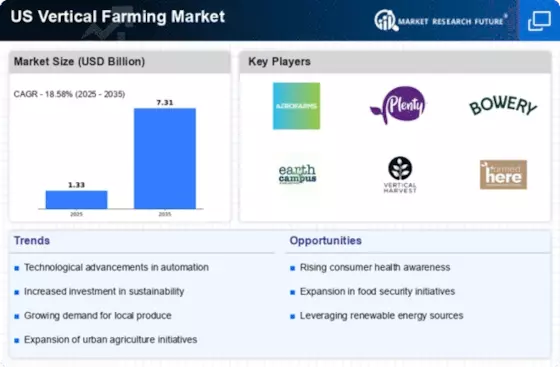
As per analysis, the US Vertical Farming Market is projected to grow from USD 1.35 Billion in 2025 to USD 7.31 Billion by 2035, exhibiting a compound annual growth rate (CAGR) of 18.58% during the forecast period (2025 - 2035).

Key Market Trends & Highlights

The US Vertical Farming Market is poised for substantial growth driven by technological advancements and sustainability initiatives.

  • Hydroponics remains the largest segment, dominating the market with its efficient water usage and crop yield.
  • Aeroponics is emerging as the fastest-growing segment, appealing to urban farmers seeking space-efficient solutions.
  • The food production segment continues to lead in market share, while the pharmaceuticals segment is rapidly gaining traction.
  • Technological innovations and rising consumer demand for fresh produce are key drivers propelling market expansion.

Market Size & Forecast

2024 Market Size 1.12 (USD Billion)
2035 Market Size 7.31 (USD Billion)
CAGR (2025 - 2035) 18.58%

Major Players

AeroFarms (US), Plenty (US), Bowery Farming (US), Green Spirit Farms (US), Vertical Harvest (US), FarmedHere (US), Gotham Greens (US), BrightFarms (US), Little Leaf Farms (US)

Our Impact
Enabled $4.3B Revenue Impact for Fortune 500 and Leading Multinationals
Partnering with 2000+ Global Organizations Each Year
30K+ Citations by Top-Tier Firms in the Industry

US Vertical Farming Market Trends

The US Vertical Farming Market is currently experiencing a transformative phase, characterized by rapid advancements in technology and increasing consumer demand for locally sourced produce. Urbanization trends are driving the need for innovative agricultural solutions that can efficiently utilize limited space while minimizing environmental impact. As cities expand, vertical farming presents a viable alternative to traditional farming methods, allowing for year-round crop production in controlled environments. This shift not only addresses food security concerns but also aligns with sustainability goals, as vertical farms often employ hydroponic and aeroponic systems that reduce water usage and eliminate the need for pesticides. Moreover, the integration of smart technologies, such as IoT and AI, is enhancing operational efficiency within the US Vertical Farming Market. These technologies facilitate real-time monitoring and data analysis, enabling farmers to optimize growth conditions and resource allocation. As a result, vertical farms are becoming more productive and economically viable. The increasing awareness of the benefits of vertical farming among consumers and policymakers is likely to further propel market growth. Overall, the US Vertical Farming Market appears poised for significant expansion, driven by technological innovation and a growing emphasis on sustainable agricultural practices.

Technological Advancements

The US Vertical Farming Market is witnessing a surge in technological innovations that enhance productivity and efficiency. Automation, artificial intelligence, and IoT applications are being integrated into farming practices, allowing for precise monitoring and control of environmental conditions. This trend not only improves crop yields but also reduces labor costs, making vertical farming more economically viable.

Sustainability Focus

There is a growing emphasis on sustainability within the US Vertical Farming Market, as consumers increasingly demand environmentally friendly food sources. Vertical farms utilize less water and land compared to traditional agriculture, aligning with the broader goals of reducing carbon footprints and promoting sustainable practices. This focus on sustainability is likely to attract investment and support from both consumers and policymakers.

Urban Agriculture Integration

The integration of vertical farming into urban landscapes is becoming more prevalent in the US. As cities seek to enhance food security and reduce transportation emissions, vertical farms are being established in urban centers. This trend not only provides fresh produce to local communities but also contributes to the revitalization of urban areas, creating green spaces and promoting community engagement.

US Vertical Farming Market Drivers

Government Support and Policies

The US Vertical Farming Market benefits from supportive government policies aimed at promoting sustainable agriculture. Federal and state governments are increasingly recognizing the potential of vertical farming to address food security and environmental concerns. For instance, various grants and subsidies are available for vertical farming initiatives, encouraging entrepreneurs to invest in this sector. The USDA has also launched programs to support urban agriculture, which includes vertical farming. This governmental backing not only provides financial assistance but also fosters research and development in the field. As policies continue to evolve, they are likely to create a more favorable environment for the growth of the US Vertical Farming Market, potentially leading to increased adoption of vertical farming practices across the nation.

Urbanization and Space Constraints

The US Vertical Farming Market is being propelled by rapid urbanization and the associated space constraints in metropolitan areas. As cities expand, the availability of arable land diminishes, making traditional farming increasingly impractical. Vertical farming offers a viable solution by utilizing vertical space to grow crops in urban settings. This method not only maximizes land use but also reduces transportation costs and emissions associated with food distribution. Current estimates suggest that urban populations in the US will reach 85% by 2030, further intensifying the need for innovative agricultural solutions. As urbanization continues, the US Vertical Farming Market is likely to flourish, providing fresh produce directly to city dwellers.

Environmental Sustainability Initiatives

The US Vertical Farming Market is increasingly aligned with environmental sustainability initiatives aimed at reducing the carbon footprint of food production. Vertical farms utilize significantly less water compared to traditional agriculture, with estimates suggesting a reduction of up to 90%. Additionally, they can be powered by renewable energy sources, further minimizing their environmental impact. As climate change concerns grow, consumers and businesses alike are prioritizing sustainable practices. This shift is likely to encourage more investments in vertical farming technologies that promote eco-friendly practices. Consequently, the US Vertical Farming Market may see accelerated growth as it aligns with broader sustainability goals and attracts environmentally conscious consumers.

Rising Consumer Demand for Fresh Produce

The US Vertical Farming Market is witnessing a notable increase in consumer demand for fresh, locally sourced produce. As consumers become more health-conscious, there is a growing preference for organic and pesticide-free vegetables and fruits. Vertical farms, which can be established in urban areas, provide fresh produce with minimal transportation time, thereby ensuring higher quality and nutritional value. Market data indicates that the demand for locally grown food is projected to grow by 20% over the next five years. This trend is likely to drive the expansion of the US Vertical Farming Market, as more consumers seek out fresh options that align with their health and environmental values.

Technological Innovations in Agriculture

The US Vertical Farming Market is experiencing a surge in technological innovations that enhance productivity and efficiency. Advanced hydroponics, aeroponics, and LED lighting systems are being integrated into vertical farms, allowing for year-round crop production. According to recent data, vertical farms can yield up to 10 times more produce per square foot compared to traditional farming methods. This increase in yield is particularly crucial in urban areas where space is limited. Furthermore, automation and artificial intelligence are being utilized to monitor plant health and optimize resource usage, which could lead to reduced operational costs. As these technologies continue to evolve, they are likely to attract more investments into the US Vertical Farming Market, fostering growth and sustainability.


Market Segment Insights

By Application: Hydroponics (Largest) vs. Aeroponics (Fastest-Growing)

In the US Vertical Farming Market, the application segment is dominated by hydroponics, which captures a significant share due to its efficiency in water usage and nutrient delivery. Hydroponics allows for year-round production with less space, making it attractive to urban farmers. On the other hand, aeroponics, while currently smaller in market share, is gaining traction quickly as more growers adopt advanced technologies to boost crop yields and reduce resource consumption. Aeroponics is the fastest-growing application within the vertical farming sector, driven by increasing consumer demand for fresh produce and sustainable farming practices. As technology advances, aeroponic systems are becoming more affordable and accessible, leading to greater adoption rates. Additionally, the rise of environmental consciousness among consumers is propelling vertical farming, especially in urban areas where space is limited and resources are scarce.

Hydroponics: Dominant vs. Aquaponics: Emerging

Hydroponics is the dominant application in the US Vertical Farming Market, characterized by its efficient use of space and water, allowing for high-density crop production. Its established presence is complemented by robust technological advancements that enhance growth quality and yield. In contrast, aquaponics represents an emerging segment, integrating fish farming with plant cultivation. While aquaponics still lags in market penetration compared to hydroponics, it offers a sustainable and symbiotic farming approach, appealing to eco-conscious consumers. The combination of fish and plant production creates a unique niche, enticing farmers seeking diversification. Both systems showcase innovative solutions to meet the growing food demands while addressing sustainability challenges.

By End Use: Food Production (Largest) vs. Pharmaceuticals (Fastest-Growing)

In the US Vertical Farming Market, Food Production is the predominant segment, holding the largest market share due to increasing consumer demand for fresh, locally grown produce. This segment is expected to continue thriving as urbanization accelerates and sustainability becomes a focal point for consumers and retailers alike. Conversely, the Pharmaceuticals segment is gaining traction, as the need for high-quality plant-based compounds and formulations fuels investment in vertical farming technologies, making it a key player in future market growth. As the demand for organic and sustainable produce skyrockets, Food Production not only holds its ground but is also expanding through innovation and technological advancements. The Pharmaceuticals segment is emerging aggressively, driven by advancements in biotechnology and the growing need for medicinal plants and bioactive compounds, which are easier to cultivate in controlled environments. This dual growth trajectory sets a competitive stage for both segments in the future of vertical farming.

Food Production: Dominant vs. Pharmaceuticals: Emerging

The Food Production segment stands as the dominant force in the US Vertical Farming Market, characterized by its extensive focus on growing leafy greens, herbs, and other crops suited to indoor environments. Its strength lies in its ability to provide fresh produce with minimal environmental impact, appealing to eco-conscious consumers and retailers. On the other hand, the Pharmaceuticals segment represents an emerging opportunity, focusing on the cultivation of plants for medicinal and therapeutic purposes. This segment is gaining momentum through technological innovations that enhance yield and compound quality. Both segments are expected to collaborate as the boundaries between food and pharmaceuticals increasingly blur, driven by consumer interest in holistic health solutions, thus presenting a unique competitive landscape.

By Technology: LED Lighting (Largest) vs. Automation and Robotics (Fastest-Growing)

The technology segment of the US vertical farming market showcases a diversified landscape, where LED lighting leads as the dominant solution due to its energy efficiency and growing adoption for indoor farming applications. Meanwhile, climate control systems and hydroponic systems also command significant shares, catering to the essential needs of environment regulation and nutrient delivery. This distribution highlights the reliance on advanced technologies that enhance yield and operational efficiency in vertical farms. In recent years, the vertical farming sector has witnessed a surge in demand for automation and robotics, positioning it as the fastest-growing segment within technology. This growth trend is driven by the need for efficiency and labor cost reduction amid increasing urbanization and food demand. Innovations in automated planting, harvesting, and monitoring systems are setting new standards for scalability and efficiency, subsequently attracting investments and enhancing market competition.

Technology: LED Lighting (Dominant) vs. Automation and Robotics (Emerging)

LED lighting remains the dominant technology in the vertical farming landscape of the US, largely because it optimally supports plant growth while reducing energy consumption. It offers the flexibility of varying light spectrums tailored to different crop needs, making it a staple for vertical farms. On the other hand, automation and robotics are emerging as crucial components that address the labor challenges faced by the industry. These technologies facilitate the streamlining of operations such as seeding, monitoring, and harvesting, allowing farms to maximize productivity through efficiency and precision. As urban agriculture continues to evolve, the integration of these technologies will play a pivotal role in shaping sustainable farming practices in densely populated areas.

By Crop Type: Leafy Greens (Largest) vs. Microgreens (Fastest-Growing)

In the US Vertical Farming Market, the distribution of market share among crop types reveals that Leafy Greens hold the largest segment, benefitting from consistent demand due to their popularity among health-conscious consumers. This segment includes products such as lettuce and spinach, which are staples in salad mixes and fresh dishes. Following Leafy Greens, Herbs and Microgreens are gaining significant traction, reflecting changing consumer preferences towards fresh, locally sourced ingredients. Herbs, used widely in culinary applications, show a steady presence, while Microgreens are increasingly recognized for their nutritional benefits and culinary versatility, contributing to a dynamic crop type landscape in vertical farming. The growth trends within the US Vertical Farming Market indicate a robust increase in demand for crop types like Microgreens, which are identified as the fastest-growing segment due to their rapid cultivation cycle and increasing use in gourmet dishes and health foods. This rising popularity is driven by changing dietary trends that favor nutrient-dense produce and sustainability practices that promote local sourcing. Moreover, advancements in vertical farming technologies facilitate efficient growth processes for both Leafy Greens and Microgreens. As consumer preferences continue to shift towards freshness and health, these crop types are well-positioned for growth within the vertical farming sector.

Leafy Greens (Dominant) vs. Microgreens (Emerging)

Leafy Greens dominate the US Vertical Farming Market, being the most cultivated and demanded crop type due to their broad application in salads and meals. Their extensive market presence benefits from established supply chains and the familiarity consumers have with these products. In contrast, Microgreens are emerging rapidly, appealing to health-conscious consumers seeking nutrient-rich alternatives. Microgreens, typically harvested early in the plant's life cycle, are lauded for their intense flavors and aesthetic appeal in dishes, making them a favored choice among chefs and home cooks alike. The agility of Microgreens in cultivation methods enables quicker rotations, meeting the demands of a fast-paced market and highlighting an evolving trend towards innovative and diverse crop options in vertical farming.

By Distribution Channel: Online Sales (Largest) vs. Direct Sales (Fastest-Growing)

In the US Vertical Farming Market, the distribution of sales across various channels illustrates a significant trend favoring online platforms. Online sales have emerged as the largest segment, appealing to tech-savvy consumers and urban dwellers seeking convenient options. Direct sales, while smaller in market share, are capturing attention rapidly as consumers increasingly value transparency in sourcing and sustainability. Retail sales retain a crucial presence, leveraging established networks to attract a diverse customer base. The growth trends in this segment are driven by evolving consumer behaviors and technological advancements. Online sales benefit from the expansion of e-commerce and enhanced digital marketing strategies, leading to increased visibility and accessibility of vertical farming products. Meanwhile, direct sales are bolstered by farmers engaging directly with consumers, which fosters community relationships and enhances the perception of freshness and quality. Retail sales continue to adapt, integrating vertical farming produce into existing supply chains, helping to reinforce the demand for locally sourced food products.

Direct Sales (Dominant) vs. Online Sales (Emerging)

In the US Vertical Farming Market, Direct Sales have positioned themselves as a dominant force, appealing to consumers who prioritize sourcing their food directly from growers. This approach fosters trust and ensures a perception of freshness that resonates with health-conscious buyers. By participating in farmers' markets or offering subscription models, vertical farmers are cultivating a loyal customer base. On the other hand, Online Sales is an emerging segment that is increasingly gaining traction. It allows vertical farms to reach a broader audience by leveraging digital channels, offering convenience, and often providing better prices. As the online market expands, providing a seamless shopping experience will be critical for converting casual interest in vertical farming products into sustained purchases.

Get more detailed insights about US Vertical Farming Market

Key Players and Competitive Insights

The Vertical Farming Market in the US is characterized by a dynamic competitive landscape, driven by increasing urbanization, a growing demand for locally sourced produce, and advancements in agricultural technology. Key players such as AeroFarms (US), Plenty (US), and Bowery Farming (US) are at the forefront, each adopting distinct strategies to enhance their market positioning. AeroFarms (US) emphasizes innovation through its proprietary aeroponic technology, which optimizes resource use and maximizes yield. Meanwhile, Plenty (US) focuses on regional expansion, recently establishing new facilities to cater to the rising demand for fresh produce in urban areas. Bowery Farming (US) is leveraging digital transformation, utilizing data analytics to improve crop management and operational efficiency. Collectively, these strategies contribute to a competitive environment that is increasingly focused on sustainability and technological advancement.
In terms of business tactics, companies are localizing manufacturing and optimizing supply chains to enhance efficiency and reduce costs. The market structure appears moderately fragmented, with numerous players vying for market share. However, the influence of major companies is significant, as they set benchmarks for innovation and operational excellence, thereby shaping the competitive dynamics of the market.
In December 2025, AeroFarms (US) announced a partnership with a leading grocery chain to supply fresh greens directly to consumers, marking a strategic move to enhance its distribution network. This collaboration is likely to bolster AeroFarms' market presence and align with the growing consumer preference for locally sourced food. The partnership underscores the importance of strategic alliances in expanding market reach and improving supply chain reliability.
In November 2025, Plenty (US) unveiled its latest vertical farm in San Francisco, which incorporates advanced AI technology to monitor and optimize growing conditions. This facility is expected to significantly increase production capacity while reducing resource consumption. The integration of AI not only enhances operational efficiency but also positions Plenty as a leader in technological innovation within the sector.
In October 2025, Bowery Farming (US) secured a $300 million investment to expand its operations and enhance its technological capabilities. This funding is anticipated to accelerate the development of its smart farming systems, which utilize machine learning to improve crop yields. Such financial backing indicates strong investor confidence in Bowery's growth potential and its commitment to advancing sustainable farming practices.
As of January 2026, current competitive trends in the Vertical Farming Market are heavily influenced by digitalization, sustainability initiatives, and the integration of AI technologies. Strategic alliances are increasingly shaping the landscape, enabling companies to pool resources and expertise. Looking ahead, competitive differentiation is likely to evolve from traditional price-based competition to a focus on innovation, technological advancements, and supply chain reliability. This shift suggests that companies that prioritize these areas will be better positioned to thrive in an increasingly competitive market.

Key Companies in the US Vertical Farming Market include

Future Outlook

US Vertical Farming Market Future Outlook

The US Vertical Farming Market is projected to grow at an 18.58% CAGR from 2025 to 2035, driven by technological advancements, urbanization, and sustainability initiatives.

New opportunities lie in:

  • Integration of AI-driven crop management systems Development of modular vertical farming units for urban areas Partnerships with local grocery chains for fresh produce supply

By 2035, the market is expected to be robust, driven by innovation and strategic partnerships.

Market Segmentation

US Vertical Farming Market End Use Outlook

  • Food Production
  • Pharmaceuticals
  • Research and Development
  • Education

US Vertical Farming Market Crop Type Outlook

  • Leafy Greens
  • Herbs
  • Fruits
  • Microgreens

US Vertical Farming Market Technology Outlook

  • LED Lighting
  • Climate Control Systems
  • Hydroponic Systems
  • Automation and Robotics

US Vertical Farming Market Application Outlook

  • Hydroponics
  • Aeroponics
  • Aquaponics
  • Soil-based Cultivation

US Vertical Farming Market Distribution Channel Outlook

  • Direct Sales
  • Online Sales
  • Retail Sales

Report Scope

MARKET SIZE 2024 1.12(USD Billion)
MARKET SIZE 2025 1.35(USD Billion)
MARKET SIZE 2035 7.31(USD Billion)
COMPOUND ANNUAL GROWTH RATE (CAGR) 18.58% (2024 - 2035)
REPORT COVERAGE Revenue Forecast, Competitive Landscape, Growth Factors, and Trends
BASE YEAR 2024
Market Forecast Period 2025 - 2035
Historical Data 2019 - 2024
Market Forecast Units USD Billion
Key Companies Profiled AeroFarms (US), Plenty (US), Bowery Farming (US), Green Spirit Farms (US), Vertical Harvest (US), FarmedHere (US), Gotham Greens (US), BrightFarms (US), Little Leaf Farms (US)
Segments Covered Application, End Use, Technology, Crop Type, Distribution Channel
Key Market Opportunities Integration of advanced automation technologies enhances efficiency in the US Vertical Farming Market.
Key Market Dynamics Rising consumer demand for locally sourced produce drives innovation and competition in the US Vertical Farming Market.
Countries Covered US
Leave a Comment

FAQs

What is the current valuation of the US Vertical Farming Market?

As of 2024, the US Vertical Farming Market was valued at 1.12 USD Billion.

What is the projected market size for the US Vertical Farming Market by 2035?

The market is expected to reach a valuation of 7.31 USD Billion by 2035.

What is the expected CAGR for the US Vertical Farming Market during the forecast period?

The expected CAGR for the US Vertical Farming Market from 2025 to 2035 is 18.58%.

Which segment is projected to have the highest valuation by application in 2035?

By 2035, the Hydroponics segment is projected to reach a valuation of 2.9 USD Billion.

What are the key applications driving the US Vertical Farming Market?

Key applications include Food Production, Pharmaceuticals, Research and Development, and Education.

Which technology segment is anticipated to grow the most by 2035?

The Automation and Robotics segment is expected to grow to 2.31 USD Billion by 2035.

What crop types are most prevalent in the US Vertical Farming Market?

The most prevalent crop types include Leafy Greens, Herbs, Fruits, and Microgreens.

How are products distributed in the US Vertical Farming Market?

Products are distributed through Direct Sales, Online Sales, and Retail Sales channels.

Who are the key players in the US Vertical Farming Market?

Key players include AeroFarms, Plenty, Bowery Farming, and Gotham Greens, among others.

What is the projected valuation for the Food Production segment by 2035?

The Food Production segment is projected to reach a valuation of 3.67 USD Billion by 2035.

Download Free Sample

Kindly complete the form below to receive a free sample of this Report

Compare Licence

×
Features License Type
Single User Multiuser License Enterprise User
Price $4,950 $5,950 $7,250
Maximum User Access Limit 1 User Upto 10 Users Unrestricted Access Throughout the Organization
Free Customization
Direct Access to Analyst
Deliverable Format
Platform Access
Discount on Next Purchase 10% 15% 15%
Printable Versions