×
Request Free Sample ×

Kindly complete the form below to receive a free sample of this Report

* Please use a valid business email

Leading companies partner with us for data-driven Insights

clients tt-cursor
Hero Background

US Survival Tools Market

ID: MRFR/CG/18253-HCR
128 Pages
Garvit Vyas
February 2026

US Survival Tools Market Size, Share, Industry Trend & Analysis Research Report: By Product Type (Pocket tools, First Aid Kit, Compass, Others), By Application (Hiking, Hunting & Fishing, Camping, Others) andBy Distribution Channel (Specialty Store, Supermarket/Hypermarket, Online store, Others)- Forecast to 2035

Share:
Download PDF ×

We do not share your information with anyone. However, we may send you emails based on your report interest from time to time. You may contact us at any time to opt-out.

US Survival Tools Market Infographic
Purchase Options

US Survival Tools Market Summary

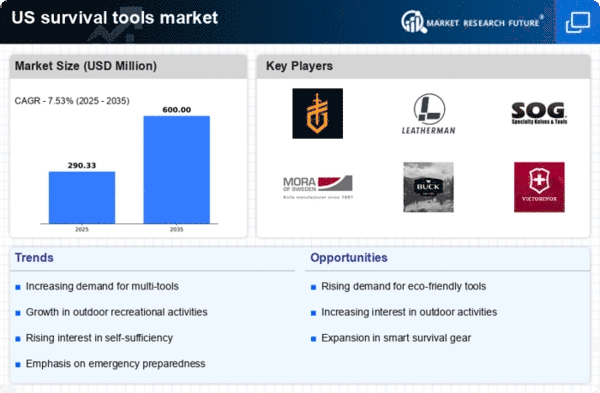
As per Market Research Future analysis, the US survival tools market size was estimated at 270.0 USD Million in 2024. The US survival tools market is projected to grow from 290.33 USD Million in 2025 to 600.0 USD Million by 2035, exhibiting a compound annual growth rate (CAGR) of 7.5% during the forecast period 2025 - 2035

Key Market Trends & Highlights

The US survival tools market is experiencing robust growth driven by heightened awareness and innovation.

  • The market is witnessing an increased focus on emergency preparedness as consumers prioritize safety.
  • Technological advancements in product design are enhancing the functionality and appeal of survival tools.
  • Sustainability and eco-friendly products are gaining traction among environmentally conscious consumers.
  • Rising outdoor recreational activities and increased awareness of natural disasters are key drivers of market growth.

Market Size & Forecast

2024 Market Size 270.0 (USD Million)
2035 Market Size 600.0 (USD Million)
CAGR (2025 - 2035) 7.53%

Major Players

Gerber Gear (US), Leatherman Tool Group (US), SOG Specialty Knives (US), Mora of Sweden (SE), Buck Knives (US), Victorinox (CH), Cold Steel (US), Kershaw Knives (US), Smith & Wesson (US)

Our Impact
Enabled $4.3B Revenue Impact for Fortune 500 and Leading Multinationals
Partnering with 2000+ Global Organizations Each Year
30K+ Citations by Top-Tier Firms in the Industry

US Survival Tools Market Trends

The survival tools market is currently experiencing a notable evolution, driven by a growing awareness of outdoor activities and emergency preparedness among consumers. As individuals increasingly engage in hiking, camping, and other outdoor pursuits, the demand for reliable and efficient survival tools has surged. This trend is further supported by a heightened focus on self-sufficiency and resilience in the face of natural disasters and unforeseen emergencies. Consequently, manufacturers are innovating to create multifunctional tools that cater to diverse needs, enhancing their appeal to a broader audience. Moreover, the rise of social media and online platforms has facilitated the sharing of survival skills and experiences, fostering a community that values preparedness. This cultural shift appears to be influencing purchasing decisions, as consumers seek tools that not only serve practical purposes but also align with their lifestyle choices. As a result, the survival tools market is likely to continue expanding, with an emphasis on quality, durability, and versatility in product offerings. The interplay between consumer preferences and technological advancements suggests a dynamic landscape for the future of this market.

Increased Focus on Emergency Preparedness

There is a growing emphasis on emergency preparedness among consumers, driven by a desire to be equipped for unexpected situations. This trend is reflected in the rising sales of survival kits and essential tools designed for various scenarios, including natural disasters and outdoor adventures.

Technological Advancements in Product Design

Innovations in materials and design are transforming the survival tools market. Manufacturers are increasingly utilizing lightweight, durable materials and integrating technology, such as GPS and solar charging capabilities, into their products, enhancing functionality and user experience.

Sustainability and Eco-Friendly Products

A noticeable shift towards sustainability is evident, with consumers favoring eco-friendly survival tools. This trend is prompting manufacturers to explore sustainable materials and production methods, aligning their offerings with the values of environmentally conscious consumers.

US Survival Tools Market Drivers

Growth of E-commerce Platforms

The expansion of e-commerce platforms in the US is reshaping the survival tools market. Online shopping has become increasingly popular, providing consumers with convenient access to a wide range of survival tools. Data suggests that e-commerce sales in the outdoor and sporting goods sector have seen a significant increase, with online sales accounting for over 30% of total sales in this category. This shift towards online purchasing is likely to benefit the survival tools market, as consumers can easily compare products, read reviews, and make informed decisions. The convenience of e-commerce may also attract new customers who previously relied on traditional retail channels.

Government Initiatives and Support

Government initiatives aimed at promoting emergency preparedness are influencing the survival tools market. Various federal and state programs encourage citizens to be proactive in disaster readiness, which may lead to increased sales of survival tools. For instance, the Federal Emergency Management Agency (FEMA) has launched campaigns to educate the public on the importance of having emergency supplies. This governmental support appears to create a favorable environment for the survival tools market, as it raises awareness and encourages consumers to invest in necessary tools. The potential for collaboration between government agencies and manufacturers could further enhance market growth, as public safety becomes a shared responsibility.

Focus on Personal Safety and Security

The growing emphasis on personal safety and security is a notable driver for the survival tools market. As concerns about crime and personal safety rise, individuals are increasingly seeking tools that enhance their security. This trend is reflected in the rising sales of personal safety devices, such as pepper spray and tactical flashlights, which are often included in survival tool kits. The survival tools market is likely to capitalize on this trend, as consumers prioritize products that not only serve survival purposes but also provide peace of mind. This dual focus on safety and preparedness may lead to innovative product offerings that cater to the evolving needs of consumers.

Rising Outdoor Recreational Activities

The increasing popularity of outdoor recreational activities in the US appears to be a significant driver for the survival tools market. As more individuals engage in camping, hiking, and other outdoor pursuits, the demand for reliable survival tools is likely to rise. According to recent data, the outdoor recreation economy contributed approximately $887 billion to the US economy, indicating a robust market for related products. This trend suggests that consumers are more inclined to invest in high-quality survival tools to ensure safety and preparedness during their adventures. The survival tools market is thus positioned to benefit from this growing interest in outdoor activities, as individuals seek to equip themselves with essential gear that enhances their experience and safety in nature.

Increased Awareness of Natural Disasters

The heightened awareness of natural disasters in the US is driving growth in the survival tools market. With events such as hurricanes, wildfires, and floods becoming more frequent, individuals and families are increasingly prioritizing preparedness. Reports indicate that nearly 60% of Americans feel unprepared for a natural disaster, which suggests a substantial opportunity for the survival tools market. This awareness has led to a surge in demand for emergency kits, first aid supplies, and other essential survival tools. As consumers seek to mitigate risks associated with these disasters, the market is likely to see continued growth, with an emphasis on products that enhance safety and preparedness.


Market Segment Insights

By Product Type: Pocket Tools (Largest) vs. First Aid Kit (Fastest-Growing)

In the US survival tools market, the market share distribution reveals that Pocket Tools hold the largest stake among the segment values, showcasing their popularity and essential nature for outdoor enthusiasts. First Aid Kits follow closely, experiencing significant growth as safety and preparedness become increasingly prioritized among consumers. Compasses and other tools make up the remaining share, indicating a growing interest in more specialized survival gear. Growth trends in the segment are driven by rising outdoor activities and a growing awareness of emergency preparedness. The increasing number of camping, hiking, and survivalist communities has led to a surge in demand for versatile Pocket Tools. Concurrently, First Aid Kits are gaining traction as consumers recognize the importance of safety supplies, making it the fastest-growing segment. This trend points to an evolving market with opportunities for innovation and diversification in product offerings.

Pocket Tools (Dominant) vs. First Aid Kit (Emerging)

Pocket Tools dominate the US survival tools market due to their multifunctional design, portability, and versatility, appealing to both casual users and survivalists. They offer an all-in-one solution for various outdoor tasks, enhancing their desirability. As an emerging segment, First Aid Kits are becoming increasingly essential as consumers prioritize preparedness. With innovations in compact and comprehensive kits, they cater to a diverse range of users, particularly families and adventurers. The focus is shifting to quality and included items, creating more competitive options. Thus, while Pocket Tools maintain their dominance due to established demand, First Aid Kits are positioning themselves for substantial growth as they meet contemporary safety needs.

By Application: Hiking (Largest) vs. Camping (Fastest-Growing)

In the US survival tools market, the application segment showcases a diverse distribution, with hiking being the largest segment due to its strong popularity among outdoor enthusiasts. This demand is supported by a growing community of hikers, which drives the sales of survival tools tailored for hiking adventures. Camping is witnessing significant growth, benefitting from an increasing trend of recreational camping and outdoor activities. The growth trends within this segment reveal that while hiking remains dominant, camping is becoming the fastest-growing application segment. The rise in interest for family camping trips, coupled with improvements in camping gear, attracts a new generation of outdoor enthusiasts. Other segments like hunting and fishing are stable but face challenges from evolving preferences towards hiking and camping experiences.

Hiking (Dominant) vs. Camping (Emerging)

Hiking is the dominant application in the US survival tools market, characterized by a broad range of tools designed for various terrains and conditions. This segment caters to seasoned hikers and newcomers alike, emphasizing lightweight and multifunctional survival tools that enhance the outdoor experience. Conversely, camping is the emerging segment, marked by a surge in interest from families and younger demographics seeking recreation. This segment embraces innovative survival tools that offer convenience and safety during camping trips, reflecting a shift toward enriching outdoor experiences. Both segments, while distinct, share a common objective of ensuring safety and enjoyment in outdoor settings, driving the overall market growth.

By Distribution Channel: Online Store (Largest) vs. Specialty Store (Fastest-Growing)

In the distribution channels of the US survival tools market, Online Stores hold the largest market share, enabling convenience and wide access to consumers. Specialty Stores are gaining traction, catering to enthusiasts and providing expert guidance, which is crucial for informed purchases. The trend indicates a clear consumer preference towards online shopping due to its ease of use and diverse product offerings, while specialty stores address the rising demand for quality and specialized survival tools. Growth trends show a significant shift towards e-commerce, primarily driven by changing consumer habits and the increasing reliance on digital platforms for purchasing decisions. Specialty Stores, despite having a smaller share, are emerging rapidly as they offer unique products that are not commonly found in larger retail outlets. Factors such as outdoor recreational activities' growth and an increased focus on self-sufficiency contribute to the expansion of both segments, particularly Online Stores, which present innovative solutions and extensive inventories.

Online Store (Dominant) vs. Specialty Store (Emerging)

The Online Store segment is currently the dominant channel in the US survival tools market, characterized by its vast selection, convenience, and direct-to-consumer shipping offerings. This segment appeals particularly to consumers seeking ease and accessibility, as it provides a platform for comparisons and reviews. Specialty Stores, while considered an emerging channel, have carved a niche for themselves by focusing on high-quality, curated selections of survival tools and advising customers on the best products for specific needs. These stores often host workshops and events, enhancing consumer engagement and loyalty, which positions them uniquely against their larger online counterparts. Both segments reflect evolving consumer preferences towards purchasing survival tools, balancing convenience with the desire for expertise.

Get more detailed insights about US Survival Tools Market

Key Players and Competitive Insights

The survival tools market in the US is characterized by a competitive landscape that is both dynamic and multifaceted. Key growth drivers include an increasing interest in outdoor activities, heightened awareness of emergency preparedness, and a growing consumer preference for high-quality, durable products. Major players such as Gerber Gear (US), Leatherman Tool Group (US), and SOG Specialty Knives (US) are strategically positioned to leverage these trends. Gerber Gear (US) focuses on innovation, particularly in multi-tools and knives, while Leatherman Tool Group (US) emphasizes product diversification and customer engagement through digital platforms. SOG Specialty Knives (US) appears to be enhancing its market presence through strategic partnerships and collaborations, collectively shaping a competitive environment that prioritizes quality and consumer trust.In terms of business tactics, companies are increasingly localizing manufacturing to reduce lead times and enhance supply chain resilience. The market structure is moderately fragmented, with several key players holding substantial market shares. This fragmentation allows for a variety of product offerings, catering to diverse consumer needs while fostering healthy competition among established brands and emerging entrants.

In October Gerber Gear (US) launched a new line of eco-friendly survival tools made from recycled materials. This initiative not only aligns with the growing consumer demand for sustainable products but also positions the company as a leader in environmental responsibility within the survival tools sector. The strategic importance of this move lies in its potential to attract environmentally conscious consumers and enhance brand loyalty.

In September Leatherman Tool Group (US) announced a partnership with a leading outdoor retailer to create exclusive product lines tailored for adventure enthusiasts. This collaboration is likely to expand Leatherman's reach and strengthen its brand presence in niche markets. By aligning with a retailer that shares its values, Leatherman can effectively tap into a dedicated customer base, thereby driving sales and enhancing customer engagement.

In August SOG Specialty Knives (US) unveiled a new digital platform aimed at enhancing customer interaction and providing personalized product recommendations. This digital transformation is indicative of a broader trend within the industry, where companies are leveraging technology to improve customer experiences. By investing in digital tools, SOG is likely to foster deeper connections with consumers, ultimately driving brand loyalty and sales.

As of November current competitive trends in the survival tools market include a pronounced focus on digitalization, sustainability, and the integration of advanced technologies such as AI. Strategic alliances are increasingly shaping the landscape, enabling companies to pool resources and expertise. Looking ahead, competitive differentiation is expected to evolve, with a shift from price-based competition to a focus on innovation, technology, and supply chain reliability. Companies that can effectively navigate these trends are likely to secure a competitive edge in an ever-evolving market.

Key Companies in the US Survival Tools Market include

Industry Developments

Recent developments in the US Survival Tools Market have been influenced by increasing demand for outdoor recreational activities, contributing to an uptick in sales for companies such as Leatherman Tool Group and Gerber Gear. Throughout 2023, the market has seen heightened interest in multi-tools and survival kits, spurred by growing consumer awareness related to preparedness and emergency response.

In August 2023, Tactical Tailor launched a new line of modular gear, increasing their product portfolio aimed at outdoor enthusiasts and tactical users.Furthermore, ProForce Equipment recently announced a strategic partnership to enhance their distribution channels, allowing for better accessibility to their tactical gear. Acme United Corporation has also been active in expanding its footprint, with an acquisition in July 2023 to integrate outdoor survival tools from a smaller brand, which bolsters their operational capabilities in the survival tools segment.

The overall market valuation for the US Survival Tools Market is projected to grow, reflecting the surge in outdoor activities and an engaged community focusing on survival preparedness. As of late 2023, companies are also navigating supply chain issues, causing fluctuations in product availability.

Future Outlook

US Survival Tools Market Future Outlook

The Survival Tools Market is projected to grow at a 7.53% CAGR from 2025 to 2035, driven by increasing outdoor activities, emergency preparedness awareness, and technological advancements.

New opportunities lie in:

  • Development of smart survival kits with IoT integration
  • Expansion into e-commerce platforms for direct consumer sales
  • Partnerships with outdoor adventure companies for bundled offerings

By 2035, the market is expected to be robust, driven by innovation and strategic partnerships.

Market Segmentation

US Survival Tools Market Application Outlook

  • Hiking
  • Hunting & Fishing
  • Camping
  • Others

US Survival Tools Market Product Type Outlook

  • Pocket Tools
  • First Aid Kit
  • Compass
  • Others

US Survival Tools Market Distribution Channel Outlook

  • Specialty Store
  • Supermarket/Hypermarket
  • Online Store
  • Others

Report Scope

MARKET SIZE 2024 270.0(USD Million)
MARKET SIZE 2025 290.33(USD Million)
MARKET SIZE 2035 600.0(USD Million)
COMPOUND ANNUAL GROWTH RATE (CAGR) 7.53% (2025 - 2035)
REPORT COVERAGE Revenue Forecast, Competitive Landscape, Growth Factors, and Trends
BASE YEAR 2024
Market Forecast Period 2025 - 2035
Historical Data 2019 - 2024
Market Forecast Units USD Million
Key Companies Profiled Gerber Gear (US), Leatherman Tool Group (US), SOG Specialty Knives (US), Mora of Sweden (SE), Buck Knives (US), Victorinox (CH), Cold Steel (US), Kershaw Knives (US), Smith & Wesson (US)
Segments Covered Product Type, Application, Distribution Channel
Key Market Opportunities Integration of smart technology in survival tools enhances user experience and safety.
Key Market Dynamics Rising consumer interest in outdoor activities drives demand for innovative survival tools and equipment.
Countries Covered US
Leave a Comment

FAQs

What is the estimated market size of the US Survival Tools Market in 2024?

The US Survival Tools Market is expected to be valued at 315.0 million USD in 2024.

What is the projected market size of the US Survival Tools Market by 2035?

The market is projected to reach 704.0 million USD by the year 2035.

What is the expected CAGR for the US Survival Tools Market from 2025 to 2035?

The expected CAGR for the US Survival Tools Market during this period is 7.585 percent.

Which product type holds the largest market share in the US Survival Tools Market?

Pocket tools are anticipated to have the largest market share, valued at 120.0 million USD in 2024.

What will be the market value of the First Aid Kit segment in 2035?

The First Aid Kit segment is expected to reach a market value of 200.0 million USD by 2035.

Who are the major players in the US Survival Tools Market?

Key players include Leatherman Tool Group, Victorinox, Kershaw, and Gerber Gear.

What is the anticipated market size for the Compass product type in 2024?

The Compass product type is projected to be valued at 45.0 million USD in 2024.

What factors are driving the growth of the US Survival Tools Market?

Increased outdoor activities and rising safety awareness among consumers are driving market growth.

What challenges does the US Survival Tools Market currently face?

The market faces challenges such as intense competition and rising raw material costs.

What is the market value for 'Others' product type in 2035?

The 'Others' product type segment is expected to reach a value of 129.0 million USD by 2035.

Download Free Sample

Kindly complete the form below to receive a free sample of this Report

Compare Licence

×
Features License Type
Single User Multiuser License Enterprise User
Price $4,950 $5,950 $7,250
Maximum User Access Limit 1 User Upto 10 Users Unrestricted Access Throughout the Organization
Free Customization
Direct Access to Analyst
Deliverable Format
Platform Access
Discount on Next Purchase 10% 15% 15%
Printable Versions