×
Request Free Sample ×

Kindly complete the form below to receive a free sample of this Report

* Please use a valid business email

Leading companies partner with us for data-driven Insights

clients tt-cursor
Hero Background

US Renewable Electricity Market

ID: MRFR/EnP/15674-HCR
100 Pages
MRFR Team
February 2026

US Europe Renewable Electricity Market

Share:
Download PDF ×

We do not share your information with anyone. However, we may send you emails based on your report interest from time to time. You may contact us at any time to opt-out.

US Renewable Electricity Market Infographic
Purchase Options

US Renewable Electricity Market Summary

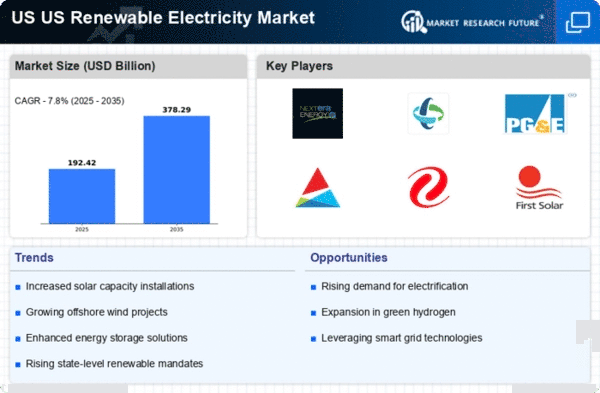
As per analysis, the US Renewable Electricity Market is projected to grow from USD 192.42 Billion in 2025 to USD 378.29 Billion by 2035, exhibiting a compound annual growth rate (CAGR) of 7.07% during the forecast period (2025 - 2035).

Key Market Trends & Highlights

The US Renewable Electricity Market is experiencing robust growth driven by technological advancements and increasing consumer demand.

  • The residential segment remains the largest contributor to renewable electricity adoption, particularly in solar energy.
  • Wind energy is emerging as the fastest-growing segment, with significant investments in infrastructure.
  • Solar photovoltaic technology continues to dominate the market, while energy storage solutions are gaining traction.
  • Government incentives and corporate sustainability initiatives are key drivers propelling market expansion.

Market Size & Forecast

2024 Market Size 178.5 (USD Billion)
2035 Market Size 378.29 (USD Billion)
CAGR (2025 - 2035) 7.07%

Major Players

NextEra Energy (US), Duke Energy (US), Pacific Gas and Electric (US), Exelon Corporation (US), Southern Company (US), Xcel Energy (US), Avangrid (US), First Solar (US), Enphase Energy (US)

Our Impact
Enabled $4.3B Revenue Impact for Fortune 500 and Leading Multinationals
Partnering with 2000+ Global Organizations Each Year
30K+ Citations by Top-Tier Firms in the Industry

US Renewable Electricity Market Trends

The US Renewable Electricity Market is currently experiencing a transformative phase characterized by a robust shift towards sustainable energy sources. This transition is driven by a combination of technological advancements, regulatory support, and increasing consumer demand for cleaner energy options. The integration of renewable resources such as solar, wind, and hydropower into the national grid is becoming more prevalent, reflecting a broader commitment to reducing greenhouse gas emissions and combating climate change. Furthermore, the market is witnessing significant investments in infrastructure and innovation, which are essential for enhancing energy efficiency and reliability. In January 2026, the landscape of the US Renewable Electricity Market appears to be evolving rapidly, with states implementing ambitious renewable portfolio standards and federal incentives aimed at promoting clean energy adoption. The growing awareness of environmental issues among consumers is likely to further accelerate this trend, as individuals and businesses increasingly seek to align their energy consumption with sustainability goals. As a result, the market is poised for continued growth, with potential expansions in capacity and technological integration that could reshape the energy sector in the coming years.

Increased Adoption of Solar Energy

The US Renewable Electricity Market is witnessing a notable rise in solar energy adoption. This trend is fueled by decreasing costs of solar technology and supportive policies at both state and federal levels. As more households and businesses invest in solar installations, the overall capacity of solar energy generation is expected to expand significantly.

Expansion of Wind Energy Infrastructure

Wind energy is becoming a cornerstone of the US Renewable Electricity Market. The development of new wind farms, particularly in regions with favorable wind conditions, indicates a strategic push towards harnessing this resource. Enhanced turbine technology and grid integration efforts are likely to facilitate this growth.

Emergence of Energy Storage Solutions

Energy storage technologies are gaining traction within the US Renewable Electricity Market. As renewable energy sources like solar and wind are inherently variable, the development of advanced storage systems is crucial for ensuring a stable energy supply. This trend suggests a future where energy storage plays a vital role in balancing supply and demand.

US Renewable Electricity Market Drivers

Technological Advancements

Technological advancements play a crucial role in shaping the US Renewable Electricity Market. Innovations in solar photovoltaic (PV) technology, such as bifacial panels and improved energy conversion efficiencies, have made solar energy more competitive with traditional energy sources. Furthermore, the cost of wind energy has decreased significantly due to advancements in turbine design and manufacturing processes. According to the US Energy Information Administration, the levelized cost of electricity (LCOE) for onshore wind has dropped by over 70% since 2009, making it one of the most cost-effective sources of new electricity generation. These technological improvements not only enhance the performance and reliability of renewable energy systems but also contribute to the overall growth and competitiveness of the US Renewable Electricity Market.

Climate Change Mitigation Efforts

The urgency of climate change mitigation is a primary driver of the US Renewable Electricity Market. As the impacts of climate change become increasingly evident, there is a growing consensus on the need to transition to a low-carbon economy. The Biden administration has set ambitious goals to achieve a carbon-free power sector by 2035, which necessitates a substantial increase in renewable energy generation. In 2025, renewable sources accounted for approximately 25% of total electricity generation in the United States, a figure that is projected to rise significantly in the coming years. This commitment to reducing greenhouse gas emissions is likely to spur further investments in renewable technologies and infrastructure, thereby enhancing the overall growth trajectory of the US Renewable Electricity Market.

Government Incentives and Policies

The US Renewable Electricity Market is significantly influenced by government incentives and policies aimed at promoting clean energy. Federal tax credits, such as the Investment Tax Credit (ITC) and the Production Tax Credit (PTC), have been pivotal in driving investments in renewable energy projects. In 2025, the ITC was extended, allowing solar energy projects to benefit from a 30% tax credit, which is expected to stimulate further growth in the solar sector. Additionally, state-level Renewable Portfolio Standards (RPS) mandate utilities to procure a certain percentage of their energy from renewable sources, thereby creating a stable demand for renewable electricity. These policies not only enhance the economic viability of renewable projects but also align with national goals for reducing greenhouse gas emissions, thereby fostering a more sustainable energy landscape.

Corporate Sustainability Initiatives

The increasing emphasis on corporate sustainability initiatives is driving demand within the US Renewable Electricity Market. Many corporations are committing to 100% renewable energy targets, which has led to a surge in corporate power purchase agreements (PPAs) for renewable energy. In 2025, corporate PPAs accounted for nearly 50% of all new renewable energy capacity additions in the United States, reflecting a strong trend towards decarbonization in the corporate sector. Companies are recognizing the financial and reputational benefits of sourcing renewable electricity, which not only helps mitigate climate change but also enhances their brand image. This shift towards sustainability is likely to continue, further propelling the growth of the US Renewable Electricity Market.

Public Awareness and Consumer Demand

Public awareness regarding climate change and environmental sustainability is increasingly influencing the US Renewable Electricity Market. As consumers become more informed about the benefits of renewable energy, there is a growing demand for clean energy solutions. Surveys indicate that a significant majority of Americans support the transition to renewable energy sources, with many willing to pay a premium for green electricity. This shift in consumer preferences is prompting utilities to expand their renewable energy offerings and invest in cleaner technologies. Additionally, community solar projects are gaining traction, allowing consumers to participate in renewable energy generation even if they cannot install solar panels on their properties. This heightened consumer demand is expected to drive further investments in the US Renewable Electricity Market.


Market Segment Insights

By Application: Residential (Largest) vs. Utility Scale (Fastest-Growing)

In the US Renewable Electricity Market, the application segment showcases a diverse landscape with significant contributions from residential, commercial, industrial, and utility scale sectors. The residential sector holds the largest market share, driven by an increased consumer preference for sustainable energy solutions and incentives for solar panel installations. On the other hand, the utility scale application has been rapidly gaining traction, reflecting a shift towards larger, more efficient energy generation facilities that meet increasing demand for renewable energy.

Residential (Dominant) vs. Utility Scale (Emerging)

The residential application segment is characterized by its robust growth, supported by homeowner initiatives and governmental policies. This segment often leverages solar energy installations and energy efficiency programs to reduce carbon footprints. While residential applications dominate the market with their consumer-oriented approach, the utility scale segment is emerging as a significant force. It focuses on large-scale renewable energy projects, such as solar farms and wind farms, which are essential for meeting energy demands at a national level. As grid integration technologies improve, utility scale operations are becoming increasingly competitive, promising rapid expansion in the coming years.

By Technology: Solar Photovoltaic (Largest) vs. Wind Energy (Fastest-Growing)

In the US Renewable Electricity Market, the Solar Photovoltaic segment commands a substantial share, characterized by widespread adoption across residential, commercial, and utility-scale applications. This segment benefits from decreasing costs and significant federal and state incentives, making it the dominant technology in the renewable sector. Wind Energy follows as a strong competitor, with an increasing presence in states rich in wind resources, contributing to its significant market share amidst growing renewable policies.

Technology: Solar Photovoltaic (Dominant) vs. Wind Energy (Emerging)

Solar Photovoltaic technology stands as the dominant force in the US Renewable Electricity Market, driven by advancements in efficiency and technology improvements that have rendered solar installations more accessible to various consumers. Meanwhile, Wind Energy represents an emerging powerhouse, gaining momentum through large-scale projects and strategic investments that harness wind resources efficiently. Both segments face the challenge of infrastructure adaptation and grid integration, highlighting their complementarity in creating a balanced renewable energy portfolio for future energy security.

By Energy Source: Solar (Largest) vs. Wind (Fastest-Growing)

In the US Renewable Electricity Market, Solar energy has established itself as the largest segment, significantly contributing to the overall energy generation landscape. The market share distribution indicates that while Solar remains dominant, Wind energy has rapidly gained traction, reflecting investments and advancements in wind technologies. Biomass and Hydro follow, showcasing their unique roles in diversifying the renewable energy mix.

Solar (Dominant) vs. Wind (Emerging)

Solar energy's dominance in the US market is driven by declining costs, technological advancements, and government incentives, making it accessible for broader adoption. Its extensive applications, from residential rooftops to large-scale solar farms, underline its versatility. Conversely, Wind energy, the fastest-growing segment, benefits from enhanced turbine technology and a favorable regulatory environment. As infrastructure expands, Wind is poised to become crucial in achieving renewable energy targets, leveraging both onshore and offshore developments. Biomass and Hydro play supportive roles, often in conjunction with these leading sources, enhancing energy stability and resilience.

By End Use: Electricity Generation (Largest) vs. Heating (Fastest-Growing)

In the US Renewable Electricity Market, the distribution of market shares among the end-use segments shows that electricity generation retains the largest share, underpinned by significant investments in wind and solar power projects. This stability in electricity generation reflects the country's commitment to transition from fossil fuels to renewable sources, driven by both policy and consumer preferences. Conversely, the heating sector is experiencing rapid growth thanks to technological advancements and increased adoption of renewable heating solutions, showcasing a shift toward more sustainable energy practices.

Heating (Dominant) vs. Transportation (Emerging)

The heating segment, primarily dominated by renewable sources like biomass and heat pumps, plays a crucial role in the overall renewable energy landscape. This segment is characterized by its ability to provide consistent and efficient energy solutions for residential and commercial properties, making it a primary focus for energy efficiency initiatives. In contrast, the transportation segment, although emerging, is gaining traction through the adoption of electric vehicles (EVs) and renewable biofuels. This shift in the transportation sector reflects a growing consumer preference for cleaner, more sustainable options, spurred by advancements in battery technology and the expansion of charging infrastructure.

Get more detailed insights about US Renewable Electricity Market

Key Players and Competitive Insights

The Renewable Electricity Market in the US is characterized by a dynamic competitive landscape, driven by a confluence of regulatory support, technological advancements, and increasing consumer demand for sustainable energy solutions. Major players such as NextEra Energy (US), Duke Energy (US), and Exelon Corporation (US) are at the forefront, each adopting distinct strategies to enhance their market positioning. NextEra Energy (US) focuses on innovation and expansion in renewable energy generation, particularly in wind and solar sectors, while Duke Energy (US) emphasizes regional expansion and grid modernization to improve service reliability. Exelon Corporation (US) is strategically investing in digital transformation initiatives to optimize operations and enhance customer engagement, collectively shaping a competitive environment that prioritizes sustainability and technological integration.

Key business tactics within this market include localizing manufacturing and optimizing supply chains to enhance efficiency and reduce costs. The competitive structure appears moderately fragmented, with a mix of large incumbents and emerging players vying for market share. The collective influence of these key players is significant, as they drive innovation and set industry standards, thereby influencing market dynamics and consumer choices.

In December 2025, NextEra Energy (US) announced a major investment of $1.5 billion in a new solar farm project in Texas, which is expected to generate 1,000 MW of clean energy. This strategic move not only reinforces NextEra's commitment to expanding its renewable portfolio but also positions the company to capitalize on the growing demand for solar energy in the region. The investment is likely to enhance their competitive edge by increasing their capacity and reducing reliance on fossil fuels.

In November 2025, Duke Energy (US) unveiled a partnership with a leading technology firm to develop advanced grid management solutions aimed at improving energy distribution efficiency. This collaboration is indicative of Duke's proactive approach to integrating digital technologies into its operations, which may lead to enhanced service reliability and customer satisfaction. Such initiatives are crucial as they align with the broader industry trend towards smart grid technologies.

In October 2025, Exelon Corporation (US) launched a new initiative focused on energy storage solutions, investing $500 million in battery technology to support its renewable energy projects. This strategic action underscores Exelon's commitment to enhancing grid resilience and integrating renewable sources more effectively. The emphasis on energy storage is particularly relevant as it addresses the intermittency challenges associated with renewable energy generation, thereby strengthening Exelon's market position.

As of January 2026, current competitive trends in the Renewable Electricity Market are increasingly defined by digitalization, sustainability, and the integration of artificial intelligence (AI) into operational frameworks. Strategic alliances among key players are shaping the landscape, fostering innovation and collaborative solutions to meet evolving consumer demands. The competitive differentiation is likely to evolve from traditional price-based competition towards a focus on innovation, technological advancements, and supply chain reliability, as companies strive to establish themselves as leaders in a rapidly changing market.

Key Companies in the US Renewable Electricity Market include

Future Outlook

US Renewable Electricity Market Future Outlook

The US Renewable Electricity Market is projected to grow at a 7.07% CAGR from 2025 to 2035, driven by technological advancements, regulatory support, and increasing demand for clean energy.

New opportunities lie in:

  • Investment in energy storage solutions for grid stability.
  • Development of community solar projects to enhance local engagement.
  • Expansion of electric vehicle charging infrastructure powered by renewables.

By 2035, the market is expected to be robust, driven by innovation and sustainable practices.

Market Segmentation

US Renewable Electricity Market End Use Outlook

  • Electricity Generation
  • Heating
  • Transportation

US Renewable Electricity Market Technology Outlook

  • Solar Photovoltaic
  • Wind Energy
  • Hydropower
  • Geothermal Energy

US Renewable Electricity Market Application Outlook

  • Residential
  • Commercial
  • Industrial
  • Utility Scale

US Renewable Electricity Market Energy Source Outlook

  • Solar
  • Wind
  • Biomass
  • Hydro

Report Scope

MARKET SIZE 2024178.5(USD Billion)
MARKET SIZE 2025192.42(USD Billion)
MARKET SIZE 2035378.29(USD Billion)
COMPOUND ANNUAL GROWTH RATE (CAGR)7.07% (2024 - 2035)
REPORT COVERAGERevenue Forecast, Competitive Landscape, Growth Factors, and Trends
BASE YEAR2024
Market Forecast Period2025 - 2035
Historical Data2019 - 2024
Market Forecast UnitsUSD Billion
Key Companies ProfiledNextEra Energy (US), Duke Energy (US), Pacific Gas and Electric (US), Exelon Corporation (US), Southern Company (US), Xcel Energy (US), Avangrid (US), First Solar (US), Enphase Energy (US)
Segments CoveredApplication, Technology, Energy Source, End Use
Key Market OpportunitiesExpansion of energy storage solutions to enhance grid reliability and support renewable integration.
Key Market DynamicsGrowing regulatory support and technological advancements drive expansion in the US Renewable Electricity Market.
Countries CoveredUS
Leave a Comment
Download Free Sample

Kindly complete the form below to receive a free sample of this Report

Compare Licence

×
Features License Type
Single User Multiuser License Enterprise User
Price $4,950 $5,950 $7,250
Maximum User Access Limit 1 User Upto 10 Users Unrestricted Access Throughout the Organization
Free Customization
Direct Access to Analyst
Deliverable Format
Platform Access
Discount on Next Purchase 10% 15% 15%
Printable Versions