×
Request Free Sample ×

Kindly complete the form below to receive a free sample of this Report

* Please use a valid business email

Leading companies partner with us for data-driven Insights

clients tt-cursor
Hero Background

US Relay Output Module Market

ID: MRFR/SEM/17629-HCR
200 Pages
Garvit Vyas
February 2026

US Relay Output Module Market Size, Share and Research Report by Type (Electromechanical Relay, Solid State Relay, Reed Relay, Hybrid Relay), by End Use (Manufacturing, Oil and Gas, Utilities, Transportation, Telecommunications), by Application (Industrial Automation, Building Automation, Transportation, Telecommunications, Energy Management), by Voltage Rating (Low Voltage, Medium Voltage, High Voltage), by Number of Channels (Single Channel, Dual Channel, Multi Channel) - Industry Forecast till 2035

Share:
Download PDF ×

We do not share your information with anyone. However, we may send you emails based on your report interest from time to time. You may contact us at any time to opt-out.

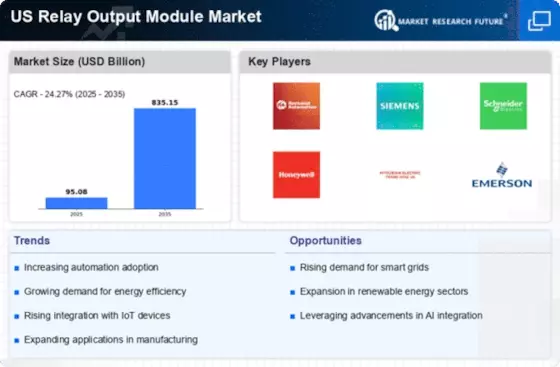
US Relay Output Module Market Infographic
Purchase Options

US Relay Output Module Market Summary

As per analysis, the US Relay Output Module Market is projected to grow from USD 76.51 Billion in 2024 to USD 835.15 Billion by 2035, exhibiting a compound annual growth rate (CAGR) of 24.27% during the forecast period (2025 - 2035).

Key Market Trends & Highlights

The US Relay Output Module Market is experiencing a transformative shift driven by technological advancements and evolving industry needs.

  • The integration of IoT technologies is reshaping the operational landscape of the relay output module market.
  • Energy management emerges as the fastest-growing segment, reflecting a heightened focus on sustainability and efficiency.
  • Industrial automation remains the largest segment, underscoring the critical role of relay output modules in enhancing manufacturing processes.
  • Key market drivers include the rising demand for smart grid solutions and the integration of advanced automation systems, which are pivotal in shaping market dynamics.

Market Size & Forecast

2024 Market Size 76.51 (USD Billion)
2035 Market Size 835.15 (USD Billion)
CAGR (2025 - 2035) 24.27%

Major Players

Rockwell Automation (US), Siemens (US), Schneider Electric (US), Honeywell (US), Mitsubishi Electric (US), Emerson Electric (US), General Electric (US), Panasonic (US), Omron (US)

Our Impact
Enabled $4.3B Revenue Impact for Fortune 500 and Leading Multinationals
Partnering with 2000+ Global Organizations Each Year
30K+ Citations by Top-Tier Firms in the Industry

US Relay Output Module Market Trends

The US Relay Output Module Market is currently experiencing a dynamic evolution, driven by advancements in automation and control systems across various industries. As organizations increasingly adopt smart technologies, the demand for reliable relay output modules is on the rise. These components play a crucial role in interfacing control systems with electrical loads, ensuring efficient operation and safety. The integration of Internet of Things (IoT) capabilities into relay modules is also becoming more prevalent, allowing for enhanced monitoring and control functionalities. This trend indicates a shift towards more intelligent systems that can adapt to changing operational requirements. Moreover, the regulatory landscape in the United States is evolving, with stricter safety and efficiency standards being implemented. This development compels manufacturers to innovate and improve their offerings to comply with these regulations. The emphasis on energy efficiency and sustainability is likely to shape product designs and features in the coming years. As industries strive to reduce their carbon footprint, relay output modules that support energy-saving technologies may gain a competitive edge. Overall, the US Relay Output Module Market appears poised for growth, driven by technological advancements and regulatory pressures that encourage innovation and efficiency.

Integration of IoT Technologies

The incorporation of Internet of Things (IoT) technologies into relay output modules is becoming increasingly prevalent. This trend allows for enhanced connectivity and real-time monitoring, enabling users to optimize performance and maintenance schedules.

Focus on Energy Efficiency

There is a growing emphasis on energy efficiency within the US Relay Output Module Market. Manufacturers are developing products that not only meet regulatory standards but also promote sustainable practices, appealing to environmentally conscious consumers.

Regulatory Compliance and Safety Standards

The evolving regulatory landscape in the United States is influencing the design and functionality of relay output modules. Stricter safety and efficiency standards compel manufacturers to innovate, ensuring their products align with current requirements.

US Relay Output Module Market Drivers

Focus on Renewable Energy Integration

The US Relay Output Module Market is significantly influenced by the increasing focus on renewable energy integration. As the country aims to transition towards sustainable energy sources, relay output modules are becoming vital in managing and controlling renewable energy systems. These modules enable efficient operation and monitoring of solar and wind energy installations, ensuring optimal performance. Recent statistics suggest that the renewable energy sector in the US is expanding rapidly, with investments reaching new heights. This growth is likely to enhance the demand for relay output modules, as they are integral to the successful implementation of renewable energy projects.

Rising Demand for Smart Grid Solutions

The US Relay Output Module Market is witnessing a surge in demand for smart grid solutions. As the energy sector evolves, there is a growing emphasis on the modernization of electrical grids to improve reliability and efficiency. Relay output modules are essential components in smart grid applications, facilitating communication and control between various grid elements. The US government has been actively promoting smart grid initiatives, which are expected to drive investments in related technologies. Market data indicates that the smart grid market in the US is anticipated to reach substantial figures in the coming years, further boosting the demand for relay output modules.

Integration of Advanced Automation Systems

The US Relay Output Module Market is experiencing a notable shift towards advanced automation systems. This trend is driven by the increasing demand for efficient and reliable control systems across various sectors, including manufacturing and energy. As industries adopt automation technologies, the need for relay output modules that can seamlessly integrate with these systems becomes paramount. According to recent data, the automation market in the US is projected to grow significantly, with relay output modules playing a crucial role in enhancing operational efficiency. This integration not only streamlines processes but also reduces operational costs, thereby propelling the growth of the US Relay Output Module Market.

Increased Focus on Safety and Compliance Standards

The US Relay Output Module Market is increasingly shaped by the heightened focus on safety and compliance standards. Regulatory bodies are implementing stringent guidelines to ensure the safe operation of electrical systems, which directly impacts the design and functionality of relay output modules. Manufacturers are compelled to innovate and enhance their products to meet these standards, thereby driving market growth. Data indicates that compliance with safety regulations is becoming a critical factor for end-users when selecting relay output modules. This trend underscores the importance of safety in the US Relay Output Module Market, as it influences purchasing decisions and product development.

Technological Advancements in Relay Output Modules

The US Relay Output Module Market is benefiting from continuous technological advancements in relay output modules. Innovations such as enhanced communication protocols and improved energy efficiency are driving the development of next-generation modules. These advancements enable better performance and reliability, which are critical for various applications, including industrial automation and building management systems. Market analysis indicates that the introduction of smart relay output modules, equipped with features like remote monitoring and control, is likely to attract significant interest from end-users. This trend suggests a promising future for the US Relay Output Module Market as it adapts to evolving technological demands.


Market Segment Insights

By Application: Industrial Automation (Largest) vs. Energy Management (Fastest-Growing)

In the US Relay Output Module Market, the application segments are diversified across Industrial Automation, Building Automation, Transportation, Telecommunications, and Energy Management. Among these, Industrial Automation stands out as the largest segment, effectively capturing a significant share of the market. The robust demand for automated processes in manufacturing and production facilities has solidified its dominance. Meanwhile, Energy Management is emerging as a dynamic force driven by the push for sustainable solutions and energy efficiency practices across various sectors.

Automation: Industrial (Dominant) vs. Energy Management (Emerging)

Industrial Automation remains a formidable segment in the US Relay Output Module Market, characterized by its reliance on automated control systems that enhance operational efficiency and reduce labor costs. This segment is supported by technological advancements such as the Internet of Things (IoT), which facilitate seamless integration and real-time data processing. On the other hand, Energy Management represents an emerging trend within the market, propelled by regulatory pressures and consumer demand for green technologies. This segment focuses on optimizing energy usage through automated systems, thereby aligning with both corporate sustainability goals and national energy policies. As the industry evolves, these segments will continue to adapt and innovate to meet changing demand.

By End Use: Manufacturing (Largest) vs. Telecommunications (Fastest-Growing)

In the US Relay Output Module Market, the End Use segment displays a diverse distribution among key industries. Manufacturing holds the largest market share, driven by the extensive use of relay output modules in automation processes. Following closely, Oil and Gas and Utilities also represent significant portions, influenced by the growing need for reliable control systems. Transportation is an emerging sector, showcasing increasing adoption given the modernization efforts across logistics and public transport. Telecommunications, while currently smaller, is witnessing rapid adoption as infrastructure upgrades begin to incorporate advanced relay solutions.

Manufacturing: Dominant vs. Telecommunications: Emerging

Manufacturing stands as the dominant segment in the US Relay Output Module Market, recognized for its foundational role in automated systems and production lines. This sector relies heavily on relay modules to enhance operational efficiency and ensure robust equipment performance. On the other hand, Telecommunications is classified as an emerging segment, reflecting its rapid growth as the industry evolves towards advanced network infrastructure. Companies are increasingly integrating relay output modules into switching systems and data centers to enhance service reliability, address rising demand, and support the deployment of next-gen connectivity solutions.

By Type: Electromechanical Relay (Largest) vs. Solid State Relay (Fastest-Growing)

In the US Relay Output Module Market, the segment distribution showcases Electromechanical Relays as the largest segment, holding a significant share of the market. Their traditional role in various applications provides reliability and efficiency, making them favored in sectors like industrial automation and automotive. In contrast, Solid State Relays are gaining traction as the fastest-growing segment due to their advantages in speed, durability, and energy efficiency, appealing to modern applications that demand higher performance.

Electromechanical Relay (Dominant) vs. Solid State Relay (Emerging)

Electromechanical Relays are established as the dominant force in the US Relay Output Module Market, characterized by their mechanical switching capabilities, robustness, and versatility in various environments. They are widely utilized across different industries, ensuring reliability in high-load applications. Conversely, Solid State Relays are emerging rapidly, driven by the growing need for energy efficiency and faster switching times in modern electronics. Their absence of moving parts ensures longer life cycles and less maintenance, positioning them as a preferred choice for state-of-the-art applications such as renewable energy systems and advanced industrial controls.

By Voltage Rating: Low Voltage (Largest) vs. Medium Voltage (Fastest-Growing)

In the US Relay Output Module Market, the low voltage segment holds the largest share, driven by widespread applications across various industries. This segment has been favored for its safety, ease of use, and reliability, making it the go-to choice for most relay applications. Conversely, the medium voltage segment, while smaller, is recognized as the fastest-growing due to the increasing demand for automated systems and smart grid technology.

Voltage Category: Low Voltage (Dominant) vs. Medium Voltage (Emerging)

The low voltage segment within the US Relay Output Module Market is characterized by its suitability for a range of applications, from industrial to residential setups. It is designed to operate effectively with lower power levels, ensuring safety and efficiency. On the other hand, the medium voltage segment is emerging rapidly as businesses pivot towards advanced automation solutions. Its growth is driven by technological advancements and the need for reliable power distribution in moderate power settings. Both segments complement each other in various applications, reflecting the diverse needs of the market.

By Number of Channels: Dual Channel (Largest) vs. Multi Channel (Fastest-Growing)

In the US Relay Output Module Market, the distribution of market share among the number of channels is quite distinctive. The Dual Channel segment represents the largest share, benefitting from its balance between performance and complexity, making it the preferred choice for various applications across industries. On the other hand, the Single Channel segment, though traditional, is becoming less favored due to the increasing demand for more flexible solutions. Multi Channel, though currently smaller in terms of market share, is witnessing a rapid uptake as industries seek to enhance functionality and efficiency through advanced multi-channel integration.

Dual Channel (Dominant) vs. Multi Channel (Emerging)

The Dual Channel relay output module stands as the dominant player in the market, characterized by its ability to efficiently handle multiple tasks without compromising on quality or response time. It is favored in settings requiring reliable performance, such as industrial automation and telecommunications. Conversely, the Multi Channel segment is emerging as a new powerhouse, driven by the surge in automation and the need for versatile relay outputs in smart applications. This segment is appealing to tech-savvy industries looking for solutions that offer greater operational efficiency and intelligent control across varied applications. As technological innovations continue to unfold, the Multi Channel segment is poised for significant growth, catering to the evolving needs of the market.

Get more detailed insights about US Relay Output Module Market

Key Players and Competitive Insights

The Relay Output Module Market is characterized by a competitive landscape that is increasingly shaped by technological advancements and strategic collaborations among key players. Major companies such as Rockwell Automation (US), Siemens (US), and Schneider Electric (US) are at the forefront, focusing on innovation and digital transformation to enhance their product offerings. These firms are not only investing in research and development but are also pursuing strategic partnerships to expand their market reach and improve operational efficiencies. The collective strategies of these companies indicate a trend towards integrated solutions that cater to the evolving needs of industries, thereby intensifying competition within the market.
In terms of business tactics, companies are localizing manufacturing to reduce lead times and optimize supply chains, which is crucial in a market that is moderately fragmented. This approach allows them to respond swiftly to customer demands while maintaining cost-effectiveness. The competitive structure is influenced by the presence of both established players and emerging firms, creating a dynamic environment where innovation and customer-centric solutions are paramount.
In December 2025, Rockwell Automation (US) announced a partnership with a leading AI firm to enhance its automation solutions. This strategic move is expected to integrate advanced AI capabilities into their relay output modules, thereby improving operational efficiency and predictive maintenance for clients. Such initiatives not only bolster Rockwell's product portfolio but also position the company as a leader in the digital transformation of industrial automation.
In November 2025, Siemens (US) launched a new line of relay output modules designed specifically for smart grid applications. This product introduction reflects Siemens' commitment to sustainability and energy efficiency, aligning with current market trends that prioritize environmentally friendly solutions. The strategic importance of this launch lies in its potential to capture a growing segment of the market focused on renewable energy and smart infrastructure.
In October 2025, Schneider Electric (US) expanded its manufacturing capabilities in the Midwest, aiming to enhance its supply chain resilience. This expansion is significant as it not only increases production capacity but also allows Schneider to better serve its North American customers. The move underscores the importance of supply chain reliability in maintaining competitive advantage in the relay output module sector.
As of January 2026, the Relay Output Module Market is witnessing trends that emphasize digitalization, sustainability, and the integration of AI technologies. Strategic alliances are becoming increasingly vital, as companies seek to leverage complementary strengths to enhance their offerings. The competitive differentiation is likely to evolve from traditional price-based competition to a focus on innovation, technological advancements, and supply chain reliability, indicating a shift towards a more sophisticated and value-driven market landscape.

Key Companies in the US Relay Output Module Market include

Future Outlook

US Relay Output Module Market Future Outlook

The US Relay Output Module Market is projected to grow at a 24.27% CAGR from 2025 to 2035, driven by automation, IoT integration, and demand for energy-efficient solutions.

New opportunities lie in:

  • Development of smart relay modules for IoT applications. Expansion into renewable energy sectors with specialized relay solutions. Partnerships with automation firms for integrated control systems.

By 2035, the market is expected to be robust, reflecting substantial growth and innovation.

Market Segmentation

US Relay Output Module Market Type Outlook

  • Electromechanical Relay
  • Solid State Relay
  • Reed Relay
  • Hybrid Relay

US Relay Output Module Market End Use Outlook

  • Manufacturing
  • Oil and Gas
  • Utilities
  • Transportation
  • Telecommunications

US Relay Output Module Market Application Outlook

  • Industrial Automation
  • Building Automation
  • Transportation
  • Telecommunications
  • Energy Management

US Relay Output Module Market Voltage Rating Outlook

  • Low Voltage
  • Medium Voltage
  • High Voltage

US Relay Output Module Market Number of Channels Outlook

  • Single Channel
  • Dual Channel
  • Multi Channel

Report Scope

MARKET SIZE 2024 76.51(USD Billion)
MARKET SIZE 2025 97.17(USD Billion)
MARKET SIZE 2035 835.15(USD Billion)
COMPOUND ANNUAL GROWTH RATE (CAGR) 24.27% (2024 - 2035)
REPORT COVERAGE Revenue Forecast, Competitive Landscape, Growth Factors, and Trends
BASE YEAR 2024
Market Forecast Period 2025 - 2035
Historical Data 2019 - 2024
Market Forecast Units USD Billion
Key Companies Profiled Rockwell Automation (US), Siemens (US), Schneider Electric (US), Honeywell (US), Mitsubishi Electric (US), Emerson Electric (US), General Electric (US), Panasonic (US), Omron (US)
Segments Covered Application, End Use, Type, Voltage Rating, Number of Channels
Key Market Opportunities Integration of smart technologies in industrial automation enhances demand for US Relay Output Module Market.
Key Market Dynamics Technological advancements and regulatory changes drive innovation in the US Relay Output Module Market.
Countries Covered US
Leave a Comment

FAQs

What is the current valuation of the US Relay Output Module Market?

The market valuation was 76.51 USD Billion in 2024.

What is the projected market size for the US Relay Output Module Market by 2035?

The projected valuation for 2035 is 835.15 USD Billion.

What is the expected CAGR for the US Relay Output Module Market during the forecast period?

The expected CAGR for the market from 2025 to 2035 is 24.27%.

Which companies are considered key players in the US Relay Output Module Market?

Key players include Rockwell Automation, Siemens, Schneider Electric, Honeywell, Mitsubishi Electric, Emerson Electric, General Electric, Panasonic, and Omron.

What was the valuation of the Industrial Automation segment in 2024?

The Industrial Automation segment was valued at 15.3 USD Billion in 2024.

How much is the Energy Management segment projected to be worth by 2035?

The Energy Management segment is projected to reach 325.15 USD Billion by 2035.

What is the market size of the Electromechanical Relay segment in 2024?

The Electromechanical Relay segment was valued at 30.0 USD Billion in 2024.

What is the projected valuation for the Multi Channel segment by 2035?

The Multi Channel segment is expected to reach 385.15 USD Billion by 2035.

What was the valuation of the Utilities end-use segment in 2024?

The Utilities end-use segment was valued at 20.0 USD Billion in 2024.

How does the projected growth of the US Relay Output Module Market compare to its 2024 valuation?

The market is expected to grow significantly from 76.51 USD Billion in 2024 to 835.15 USD Billion by 2035.

Download Free Sample

Kindly complete the form below to receive a free sample of this Report

Compare Licence

×
Features License Type
Single User Multiuser License Enterprise User
Price $4,950 $5,950 $7,250
Maximum User Access Limit 1 User Upto 10 Users Unrestricted Access Throughout the Organization
Free Customization
Direct Access to Analyst
Deliverable Format
Platform Access
Discount on Next Purchase 10% 15% 15%
Printable Versions