×
Request Free Sample ×

Kindly complete the form below to receive a free sample of this Report

* Please use a valid business email

Leading companies partner with us for data-driven Insights

clients tt-cursor
Hero Background

US Passenger Security Market

ID: MRFR/AD/17556-HCR
100 Pages
Garvit Vyas
February 2026

US Passenger Security Market

Share:
Download PDF ×

We do not share your information with anyone. However, we may send you emails based on your report interest from time to time. You may contact us at any time to opt-out.

US Passenger Security Market Infographic
Purchase Options

US Passenger Security Market Summary

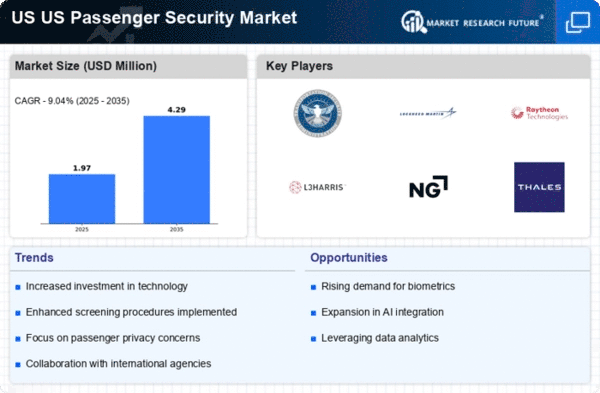
As per analysis, the US Passenger Security Market is projected to grow from USD 1.95 Million in 2025 to USD 4.29 Million by 2035, exhibiting a compound annual growth rate (CAGR) of 8.18% during the forecast period (2025 - 2035).

Key Market Trends & Highlights

The US Passenger Security Market is poised for growth driven by technological advancements and increasing public awareness.

  • The Access Control segment remains the largest contributor to the US Passenger Security Market, reflecting a robust demand for secure entry systems.
  • Screening solutions are emerging as the fastest-growing segment, driven by heightened security measures in various transport sectors.
  • The Aviation sector continues to dominate the market, while Public Transport is rapidly expanding due to increased ridership and security needs.
  • Regulatory compliance and technological advancements in security solutions are key drivers propelling market growth.

Market Size & Forecast

2024 Market Size 1.81 (USD Million)
2035 Market Size 4.29 (USD Million)
CAGR (2025 - 2035) 8.18%

Major Players

Thales Group (FR), L3Harris Technologies (US), Raytheon Technologies (US), Northrop Grumman (US), SAIC (US), Honeywell International (US), Smiths Detection (GB), Aviat Networks (US), Securitas AB (SE)

Our Impact
Enabled $4.3B Revenue Impact for Fortune 500 and Leading Multinationals
Partnering with 2000+ Global Organizations Each Year
30K+ Citations by Top-Tier Firms in the Industry

US Passenger Security Market Trends

The US Passenger Security Market is currently experiencing a transformative phase, driven by advancements in technology and evolving regulatory frameworks. As security threats become increasingly sophisticated, the demand for enhanced passenger screening solutions appears to be on the rise. Innovations such as biometric identification systems and automated screening lanes are being integrated into airport security protocols, potentially improving efficiency and passenger experience. Furthermore, the emphasis on data analytics in security operations suggests a shift towards more proactive measures in threat detection and risk management. In addition to technological advancements, the regulatory landscape is also evolving. The Transportation Security Administration (TSA) continues to refine its policies to address emerging threats, which may lead to the adoption of new security measures. Collaboration between government agencies and private sector stakeholders is likely to foster a more comprehensive approach to passenger safety. As the US Passenger Security Market adapts to these changes, it is poised to enhance the overall security framework while ensuring a seamless travel experience for passengers. This dynamic environment indicates a potential for growth and innovation in the sector, as stakeholders seek to balance security needs with operational efficiency.

Integration of Biometric Technologies

The incorporation of biometric technologies into the US Passenger Security Market is becoming increasingly prevalent. Systems utilizing facial recognition and fingerprint scanning are being deployed to streamline the identification process, thereby reducing wait times and enhancing security measures. This trend reflects a broader movement towards automation and efficiency in passenger screening.

Enhanced Data Analytics for Threat Detection

The utilization of advanced data analytics tools is gaining traction within the US Passenger Security Market. By analyzing patterns and behaviors, security agencies can identify potential threats more effectively. This proactive approach not only improves safety but also optimizes resource allocation, allowing for a more strategic deployment of security personnel.

Collaboration Between Public and Private Sectors

There is a growing trend of collaboration between public agencies and private companies in the US Passenger Security Market. This partnership aims to leverage technological innovations and share best practices, ultimately enhancing the overall security infrastructure. Such cooperation may lead to the development of more robust security solutions tailored to the unique challenges faced by the aviation sector.

US Passenger Security Market Drivers

Regulatory Compliance and Standards

The US Passenger Security Market is heavily influenced by stringent regulatory frameworks and compliance standards established by government agencies such as the Transportation Security Administration (TSA). These regulations mandate the implementation of advanced security measures at airports and other transportation hubs. As of January 2026, the TSA has introduced new guidelines that require enhanced screening processes, which may lead to increased investments in security technologies. The market is projected to grow as stakeholders strive to meet these evolving standards, ensuring passenger safety while maintaining operational efficiency. Compliance with these regulations not only enhances security but also fosters public trust in the transportation system, thereby driving demand for innovative security solutions.

Increased Investment in Infrastructure

The US Passenger Security Market is benefiting from increased investment in infrastructure aimed at enhancing security capabilities. Government initiatives and funding programs are being directed towards upgrading security systems at airports and transit facilities. As of January 2026, the Federal Aviation Administration (FAA) has allocated significant resources for the modernization of security infrastructure, which includes the installation of advanced screening technologies and improved surveillance systems. This influx of investment is expected to bolster the market, as stakeholders seek to create safer travel environments while accommodating growing passenger volumes. Enhanced infrastructure not only improves security but also contributes to overall operational efficiency.

Collaboration Among Security Stakeholders

The US Passenger Security Market is characterized by increasing collaboration among various stakeholders, including government agencies, private security firms, and technology providers. This collaboration is essential for developing comprehensive security strategies that address emerging threats effectively. As of January 2026, partnerships between public and private sectors are becoming more prevalent, leading to the sharing of resources, expertise, and technology. Such collaborations are likely to enhance the overall security landscape, as stakeholders work together to implement innovative solutions that improve passenger safety. This trend indicates a collective commitment to addressing security challenges in a rapidly evolving environment.

Growing Public Awareness of Security Threats

In recent years, there has been a notable increase in public awareness regarding security threats in the US Passenger Security Market. High-profile incidents and media coverage have heightened concerns about safety during travel. As a result, passengers are increasingly demanding more robust security measures at airports and other transit points. This growing awareness is likely to drive investments in security technologies and personnel training, as stakeholders aim to address public concerns effectively. The market may experience growth as organizations respond to this demand by implementing comprehensive security strategies that prioritize passenger safety and confidence.

Technological Advancements in Security Solutions

The US Passenger Security Market is witnessing a surge in technological advancements that enhance security measures. Innovations such as artificial intelligence, machine learning, and advanced imaging technologies are being integrated into security protocols. For instance, the adoption of AI-driven threat detection systems has shown a potential to reduce false alarms by up to 30%, thereby streamlining the screening process. As of January 2026, the market is expected to expand further as stakeholders invest in these cutting-edge technologies to improve efficiency and effectiveness in passenger screening. This trend indicates a shift towards more sophisticated security solutions that not only protect passengers but also optimize operational workflows.


Market Segment Insights

By Application: Access Control (Largest) vs. Screening (Fastest-Growing)

The US Passenger Security Market is characterized by diverse applications, with access control commanding the largest share. This segment is critical for securing entry points in various transportation hubs. Moreover, screening has emerged as the fastest-growing application, driven by increased regulatory measures and technology advancements. Surveillance, incident management, and emergency response also play crucial roles in maintaining safety but lag behind access control and screening in market share. Growth in the US Passenger Security Market is significant, fueled by the rising need for enhanced security protocols and the integration of advanced technologies. Access control benefits from expanding infrastructure and heightened security needs, while screening is propelled by the increasing frequency of air travel and the demand for efficient passenger processing. As security threats evolve, the push for innovation in these applications continues to gain momentum.

Access Control (Dominant) vs. Screening (Emerging)

Access control is the dominant segment within the US Passenger Security Market, recognized for its effectiveness in safeguarding critical areas such as airports and public transport. By employing technologies like biometric systems and smart card access, access control solutions are designed to mitigate unauthorized entry and enhance overall safety. Conversely, screening is an emerging segment, gaining traction with the implementation of advanced imaging technologies and automated screening lanes to expedite passenger flow. This segment is increasingly significant due to the focus on operational efficiency and enhanced traveler experience. As transit systems evolve, both access control and screening are expected to adapt, innovating in response to emerging security concerns and technological advancements.

By End Use: Aviation (Largest) vs. Public Transport (Fastest-Growing)

In the US Passenger Security Market, the Aviation segment holds the majority market share, reflecting the significant investments in security measures at airports and the high volume of air travel. Following closely are the segments of Railway and Maritime, which also contribute to the overall market but do not match the scale of the Aviation sector. Public Transport and Event Security are emerging segments, with growing emphasis on safety, especially in urban environments.

Aviation: Dominant vs. Public Transport: Emerging

The Aviation sector remains the dominant force in the US Passenger Security Market, driven by stringent regulations and a high demand for secure air travel. Enhanced screening technologies and comprehensive threat mitigation strategies define this segment. On the other hand, Public Transport is emerging rapidly, propelled by increasing commuter numbers and a focus on safeguarding public spaces. Investments in smart surveillance, access control systems, and training for personnel highlight the shift toward improved security protocols. As urban populations rise, the Public Transport segment is likely to see continued growth, complementing the established Aviation sector.

By Technology: Biometric Systems (Largest) vs. Video Analytics (Fastest-Growing)

In the US Passenger Security Market, the Technology segment is primarily represented by five key values: Biometric Systems, Video Analytics, Metal Detectors, X-ray Screening, and Artificial Intelligence. Among these, Biometric Systems hold the largest market share due to their widespread adoption and effectiveness in identity verification. Video Analytics, while currently smaller in market share, is witnessing rapid growth driven by advancements in AI and machine learning, enhancing real-time monitoring and threat detection capabilities.

Technology: Biometric Systems (Dominant) vs. Video Analytics (Emerging)

Biometric Systems are currently the dominant technology in the US Passenger Security Market, leveraging fingerprint, facial, and iris recognition to enhance security checks and streamline passenger flow. Their reliability and accuracy are paramount in high-traffic environments like airports. In contrast, Video Analytics is emerging as a significant force, utilizing advanced algorithms to analyze security camera footage for suspicious behavior. The growing focus on public safety and the need for rapid response to potential threats is propelling this technology forward, making it integral to modern security frameworks.

By Service Type: Consulting (Largest) vs. Monitoring (Fastest-Growing)

The US Passenger Security Market demonstrates a varied distribution among its service types, with Consulting holding the largest segment share. This service provides crucial guidance in regulatory compliance and risk management strategies essential for enhancing passenger security. Close behind is Installation, which focuses on implementing security systems effectively. Maintenance remains an integral part of the market, ensuring that existing systems operate at peak performance and meet evolving security standards. The demand for these services reflects the critical nature of security in passenger transport, especially given recent trends in global travel.

Consulting (Dominant) vs. Monitoring (Emerging)

Consulting stands out as a dominant service in the US Passenger Security Market, primarily due to its strategic importance in navigating complex regulatory environments. This service type helps organizations optimize their security frameworks through expert insights and tailored solutions. In contrast, Monitoring is rapidly emerging as a vital service, fueled by advancements in technology that enable real-time surveillance and threat detection. As the industry shifts towards proactive risk management, Monitoring services are increasingly sought after. Their adaptability and alignment with the latest technological trends position them advantageously for growth, driven by the rising demand for enhanced security measures in passenger transport.

By Component: Cameras (Largest) vs. Sensors (Fastest-Growing)

In the U.S. Passenger Security Market, the component segment distribution reveals that cameras currently hold the largest market share. This is due to their critical role in surveillance and threat detection, as they are integral to maintaining security in various transportation hubs. Alongside cameras, the use of sensors is increasing, demonstrating significant growth, driven by advancements in technology and increasing awareness of safety protocols in passenger transportation. The growth trends within this segment are influenced by an escalating demand for enhanced security measures in airports and public transit systems. The integration of state-of-the-art technologies, such as AI and machine learning, in both cameras and sensors is shaping their evolution, thereby creating new opportunities for innovation and expanding the market landscape.

Cameras (Dominant) vs. Access Control Systems (Emerging)

Cameras remain the dominant force in the component segment of the U.S. Passenger Security Market, attributed to their efficiency in real-time monitoring and evidence collection. They provide critical support in threat identification and response strategies, establishing a strong deterrent against potential hazards. In contrast, access control systems are emerging as a vital component, focusing on regulating entry to secure areas, thus bolstering overall security protocols. While they may not yet have the market presence of cameras, advancements in technology are positioning access control systems as increasingly essential, with features such as biometric identification and remote management capabilities gaining traction. This combination of innovation and demand highlights their growing importance in ensuring passenger safety.

Get more detailed insights about US Passenger Security Market

Key Players and Competitive Insights

The Passenger Security Market is characterized by a dynamic competitive landscape, driven by the increasing demand for advanced security solutions across various transportation sectors. Key players are focusing on innovation, strategic partnerships, and technological advancements to enhance their market positioning. Companies such as Thales Group (FR), L3Harris Technologies (US), and Raytheon Technologies (US) are at the forefront, leveraging their expertise in digital transformation and integrated security systems to meet evolving customer needs. Their collective strategies not only foster competition but also push the boundaries of technological capabilities within the market.

In terms of business tactics, companies are increasingly localizing manufacturing and optimizing supply chains to enhance operational efficiency. The market appears moderately fragmented, with several key players exerting substantial influence. This structure allows for a diverse range of offerings, catering to various segments within the Passenger Security Market. The interplay between established firms and emerging players is likely to intensify, as companies seek to differentiate themselves through innovative solutions and customer-centric approaches.

In December 2025, Thales Group (FR) announced a partnership with a leading technology firm to develop next-generation biometric security systems. This strategic move is expected to enhance Thales's capabilities in providing seamless and secure passenger experiences, aligning with global trends towards increased automation and biometric verification in security processes. The partnership signifies a commitment to innovation and positions Thales as a leader in the integration of advanced technologies in passenger security.

In November 2025, L3Harris Technologies (US) unveiled a new AI-driven surveillance system designed to improve threat detection in transportation hubs. This development underscores the company's focus on leveraging artificial intelligence to enhance security measures. By integrating AI into their systems, L3Harris aims to provide more efficient and effective security solutions, potentially setting a new standard in the industry.

In October 2025, Raytheon Technologies (US) expanded its portfolio by acquiring a cybersecurity firm specializing in transportation security solutions. This acquisition is likely to bolster Raytheon's capabilities in protecting critical infrastructure from cyber threats, which is increasingly vital in the context of digitalization in the Passenger Security Market. The move reflects a broader trend of convergence between physical and cybersecurity, emphasizing the importance of comprehensive security solutions.

As of January 2026, current trends in the Passenger Security Market are heavily influenced by digitalization, sustainability, and the integration of AI technologies. Strategic alliances are becoming more prevalent, as companies recognize the need for collaborative approaches to address complex security challenges. Looking ahead, competitive differentiation is expected to evolve, with a shift from price-based competition to a focus on innovation, technological advancements, and supply chain reliability. This transition may redefine the competitive landscape, as companies strive to offer unique value propositions that resonate with increasingly discerning customers.

Key Companies in the US Passenger Security Market include

Future Outlook

US Passenger Security Market Future Outlook

The US Passenger Security Market is projected to grow at an 8.18% CAGR from 2025 to 2035, driven by technological advancements, regulatory changes, and increasing passenger volumes.

New opportunities lie in:

  • Integration of AI-driven threat detection systems
  • Expansion of biometric identification solutions
  • Development of mobile security applications for real-time alerts

By 2035, the market is expected to be robust, driven by innovation and heightened security demands.

Market Segmentation

US Passenger Security Market End Use Outlook

  • Aviation
  • Railway
  • Maritime
  • Public Transport
  • Event Security

US Passenger Security Market Component Outlook

  • Cameras
  • Sensors
  • Software
  • Alarm Systems
  • Access Control Systems

US Passenger Security Market Technology Outlook

  • Biometric Systems
  • Video Analytics
  • Metal Detectors
  • X-ray Screening
  • Artificial Intelligence

US Passenger Security Market Application Outlook

  • Access Control
  • Surveillance
  • Screening
  • Incident Management
  • Emergency Response

US Passenger Security Market Service Type Outlook

  • Consulting
  • Installation
  • Maintenance
  • Training
  • Monitoring

Report Scope

MARKET SIZE 20241.81(USD Million)
MARKET SIZE 20251.95(USD Million)
MARKET SIZE 20354.29(USD Million)
COMPOUND ANNUAL GROWTH RATE (CAGR)8.18% (2024 - 2035)
REPORT COVERAGERevenue Forecast, Competitive Landscape, Growth Factors, and Trends
BASE YEAR2024
Market Forecast Period2025 - 2035
Historical Data2019 - 2024
Market Forecast UnitsUSD Million
Key Companies ProfiledThales Group (FR), L3Harris Technologies (US), Raytheon Technologies (US), Northrop Grumman (US), SAIC (US), Honeywell International (US), Smiths Detection (GB), Aviat Networks (US), Securitas AB (SE)
Segments CoveredApplication, End Use, Technology, Service Type, Component
Key Market OpportunitiesIntegration of advanced biometrics and artificial intelligence enhances efficiency in the US Passenger Security Market.
Key Market DynamicsRegulatory changes and technological advancements drive innovation in the US Passenger Security Market.
Countries CoveredUS
Leave a Comment
Download Free Sample

Kindly complete the form below to receive a free sample of this Report

Compare Licence

×
Features License Type
Single User Multiuser License Enterprise User
Price $4,950 $5,950 $7,250
Maximum User Access Limit 1 User Upto 10 Users Unrestricted Access Throughout the Organization
Free Customization
Direct Access to Analyst
Deliverable Format
Platform Access
Discount on Next Purchase 10% 15% 15%
Printable Versions