×
Request Free Sample ×

Kindly complete the form below to receive a free sample of this Report

* Please use a valid business email

Leading companies partner with us for data-driven Insights

clients tt-cursor
Hero Background

US Packaging Market

ID: MRFR/PCM/18693-HCR
100 Pages
Garvit Vyas
February 2026

US Packaging Market Research Report By End-User (Food, Beverage, Pharmaceutical, Beauty and Personal Care, Industrial, Others), By Packaging Type (Flexible Packaging, Rigid Packaging), By Packaging Material (Plastics, Paper and Paperboard, Metal, Glass), By Printing Technology (Offset, Flexography, Screen, Gravure, Digital) - Forecast to 2035

Share:
Download PDF ×

We do not share your information with anyone. However, we may send you emails based on your report interest from time to time. You may contact us at any time to opt-out.

US Packaging Market Infographic
Purchase Options

US Packaging Market Summary

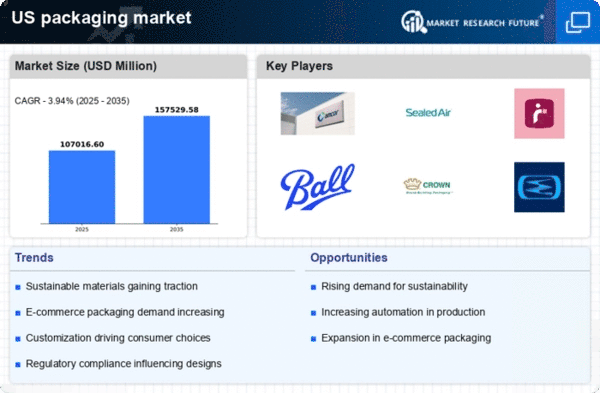
As per Market Research Future analysis, the US packaging market Size was estimated at 102959.98 USD Million in 2024. The US packaging market is projected to grow from 107016.6 USD Million in 2025 to 157529.58 USD Million by 2035, exhibiting a compound annual growth rate (CAGR) of 3.9% during the forecast period 2025 - 2035

Key Market Trends & Highlights

The US packaging market is experiencing a transformative shift towards sustainability and technological integration.

  • Sustainability initiatives are becoming increasingly central to packaging strategies across various sectors.
  • Technological advancements are driving innovation in materials and processes, enhancing efficiency and reducing waste.
  • Customization and personalization are gaining traction, particularly in the food and beverage segment, which is the largest in the market.
  • E-commerce growth and consumer preferences for convenience are major drivers influencing the packaging landscape, particularly in the fastest-growing personal care segment.

Market Size & Forecast

2024 Market Size 102959.98 (USD Million)
2035 Market Size 157529.58 (USD Million)
CAGR (2025 - 2035) 3.94%

Major Players

Amcor (AU), Sealed Air (US), Mondi (GB), Ball Corporation (US), Crown Holdings (US), Smurfit Kappa (IE), WestRock (US), International Paper (US), DS Smith (GB)

Our Impact
Enabled $4.3B Revenue Impact for Fortune 500 and Leading Multinationals
Partnering with 2000+ Global Organizations Each Year
30K+ Citations by Top-Tier Firms in the Industry

US Packaging Market Trends

The packaging market in the United States is currently experiencing a dynamic transformation, driven by evolving consumer preferences and regulatory pressures. Sustainability has emerged as a pivotal factor, with manufacturers increasingly adopting eco-friendly materials and practices. This shift not only aligns with consumer demand for environmentally responsible products but also addresses regulatory requirements aimed at reducing waste and promoting recycling. As a result, companies are investing in innovative packaging solutions that minimize environmental impact while maintaining functionality and aesthetic appeal. Moreover, technological advancements are reshaping the landscape of the packaging market. Automation and smart packaging technologies are gaining traction, enhancing efficiency and providing consumers with interactive experiences. These innovations facilitate better inventory management and improve supply chain transparency. The integration of digital printing and customization options further allows brands to differentiate themselves in a competitive marketplace. Overall, the current trends indicate a robust evolution in the packaging market, characterized by a strong emphasis on sustainability and technological integration, which are likely to shape its future trajectory.

Sustainability Initiatives

There is a notable emphasis on sustainable practices within the packaging market. Companies are increasingly utilizing biodegradable and recyclable materials to meet consumer expectations and comply with environmental regulations. This trend reflects a broader commitment to reducing carbon footprints and promoting circular economy principles.

Technological Advancements

The integration of advanced technologies is transforming the packaging market. Automation, smart packaging, and digital printing are enhancing operational efficiency and enabling personalized consumer experiences. These innovations are likely to drive competitiveness and improve supply chain management.

Customization and Personalization

Customization is becoming a key differentiator in the packaging market. Brands are leveraging unique designs and tailored packaging solutions to engage consumers more effectively. This trend not only enhances brand loyalty but also allows for targeted marketing strategies.

US Packaging Market Drivers

E-commerce Growth

The rise of e-commerce in the US has a profound impact on the packaging market. As online shopping continues to expand, the demand for efficient and protective packaging solutions increases. In 2025, e-commerce sales are projected to reach approximately $1 trillion, necessitating innovative packaging designs that ensure product safety during transit. This shift towards online retailing drives companies to invest in packaging that is not only functional but also visually appealing to enhance customer experience. The packaging market must adapt to these changing consumer behaviors, focusing on lightweight materials that reduce shipping costs while maintaining product integrity. Furthermore, the need for sustainable packaging options is becoming increasingly important as consumers demand eco-friendly solutions. Thus, the growth of e-commerce is a significant driver for the packaging market, pushing for advancements in design and materials.

Regulatory Compliance

Regulatory compliance is a critical driver in the packaging market, particularly in the US. Various federal and state regulations govern packaging materials, labeling, and safety standards. For instance, the Food and Drug Administration (FDA) imposes strict guidelines on packaging for food and pharmaceutical products to ensure consumer safety. Companies must invest in compliant packaging solutions to avoid legal repercussions and maintain market access. In 2025, it is estimated that compliance-related costs could account for up to 10% of total packaging expenses for certain industries. This necessitates ongoing research and development to create packaging that meets regulatory standards while also being cost-effective. As regulations evolve, the packaging market must remain agile, adapting to new requirements and ensuring that products are safely packaged and labeled. This dynamic environment presents both challenges and opportunities for innovation within the industry.

Sustainability Demands

Sustainability demands are increasingly shaping the packaging market in the US. Consumers are becoming more environmentally conscious, leading to a heightened demand for sustainable packaging solutions. In 2025, it is estimated that the market for sustainable packaging will reach $300 billion, driven by consumer preferences for recyclable, biodegradable, and compostable materials. Companies are responding by re-evaluating their packaging strategies, seeking to reduce waste and minimize their carbon footprint. This shift is not only a response to consumer demand but also a proactive approach to regulatory pressures aimed at reducing plastic waste. The packaging market is witnessing a surge in innovation as companies explore alternative materials and design practices that align with sustainability goals. This focus on sustainability presents both challenges and opportunities, as businesses must balance cost, functionality, and environmental impact in their packaging solutions.

Technological Integration

Technological integration is a pivotal driver in the packaging market, influencing how products are packaged and delivered. Innovations such as smart packaging, which incorporates sensors and QR codes, are becoming more prevalent. These technologies enhance consumer engagement and provide valuable information about product freshness and usage. In 2025, the smart packaging segment is expected to grow at a CAGR of 15%, reflecting the increasing adoption of technology in packaging solutions. Additionally, automation in packaging processes is streamlining production, reducing costs, and improving efficiency. Companies are investing in advanced machinery and software to optimize their packaging lines, which can lead to significant savings. As technology continues to evolve, the packaging market must adapt to these advancements, ensuring that products not only meet consumer expectations but also leverage new technologies for competitive advantage.

Consumer Preferences for Convenience

Consumer preferences for convenience are reshaping the packaging market in the US. As lifestyles become increasingly fast-paced, there is a growing demand for packaging that offers ease of use and portability. Products that feature resealable, single-serve, or easy-to-open packaging are gaining popularity among consumers. In 2025, it is projected that convenience-oriented packaging will account for approximately 30% of the total packaging market. This trend is particularly evident in the food and beverage sector, where ready-to-eat meals and snacks are on the rise. Companies are responding by designing packaging that not only meets these convenience needs but also aligns with sustainability goals. The challenge lies in balancing functionality with environmental considerations, as consumers are also seeking eco-friendly packaging solutions. Thus, the drive for convenience is a significant factor influencing the evolution of the packaging market.


Market Segment Insights

By Packaging Material: Plastic (Largest) vs. Paper and Paperboard (Fastest-Growing)

The market share distribution among the packaging materials shows that plastics continue to dominate the US packaging market, holding a substantial percentage of total market share. Paper and paperboard, while historically significant, are seeing increasing demand due to sustainability trends, reflecting changing consumer preferences towards eco-friendly options. This shift is contributing to a reallocation of market shares, with paper products gradually gaining traction against traditional plastic materials. Growth trends within this segment are driven primarily by heightened environmental awareness, regulatory pressures, and an influx of innovative packaging solutions. The rise of e-commerce has further accelerated growth in paper and paperboard packaging, as brands strive to enhance their sustainability profiles. Furthermore, technological advancements in material science are fostering the development of both biodegradable plastics and recyclable paper products, leading to an expanding market that caters to evolving consumer demands.

Plastic (Dominant) vs. Paper and Paperboard (Emerging)

Plastic remains the dominant force in the packaging material segment, known for its versatility, durability, and cost-effectiveness. It is widely used across various industries, notably food and beverage, due to its ability to preserve products effectively. However, the environmental impact of plastic is prompting a shift towards more sustainable alternatives. In contrast, paper and paperboard are emerging as favored choices, spurred by consumer demand for sustainable packaging solutions. These materials are biodegradable and easily recyclable, aligning with eco-conscious market trends. While paper products currently represent a smaller market share compared to plastic, their growth trajectory signals a burgeoning sector, especially as companies increasingly prioritize sustainable practices in their packaging strategies.

By Packaging Type: Flexible Packaging (Largest) vs. Rigid Packaging (Fastest-Growing)

In the US packaging market, the distribution between flexible and rigid packaging showcases a significant preference for flexible options. This segment holds the largest share, driven by its versatility and cost-effectiveness across various industries. Meanwhile, rigid packaging is quickly gaining traction due to its ability to provide better product protection and an upscale appeal, catering to consumer preferences for high-quality packaging solutions. The growth trends in these segments reveal that flexible packaging is consistently favored for its lightweight nature and lower resource consumption during production. However, rigid packaging is emerging as the fastest-growing segment, propelled by increasing demand for sustainable and robust packaging solutions. Innovations in materials and designs are expected to further bolster this trend, driving investments in both types beyond the forecast period.

Flexible Packaging: Dominant vs. Rigid Packaging: Emerging

Flexible packaging represents a dominant force in the packaging landscape, characterized by its lightweight, versatile nature and significant adaptability across different applications, ranging from food packaging to consumer goods. Its prominence is further enhanced by advancements in material technology, which allow for better barrier properties and sustainability. In contrast, rigid packaging is seen as an emerging contender with robust growth potential, offering superior protection and visual appeal. It is increasingly being utilized in sectors such as pharmaceuticals and personal care, where strength and presentation are critical. While flexible packaging continues to hold a larger market share, the rising demand for premium packaging experiences through rigid options indicates a shifting dynamic, with both types vying for market attention.

By Printing Technology: Flexography (Largest) vs. Digital (Fastest-Growing)

The US packaging market shows a diverse distribution in printing technologies with Flexography holding the largest market share, primarily due to its efficiency and cost-effectiveness for large runs. Offset printing is also significant, favored for high-quality images and color precision. Screen and Gravure printing cater to niche applications, with unique characteristics that suit specific product needs. Digital printing, while currently smaller in market share, is rapidly gaining traction as it meets the demand for short runs and customization, reflecting a shift towards more personalized packaging solutions. Growth trends in the printing technology segment are primarily driven by advancements in digital technologies and changing consumer preferences towards customized packaging. The push for sustainability encourages innovative solutions across all printing methods, leading to improved efficiencies and reduced waste. As brands seek to enhance their visual appeal and consumer engagement, the shift towards flexible and digital solutions is expected to accelerate, allowing for faster turnaround times and more innovative designs.

Flexography (Dominant) vs. Digital (Emerging)

Flexography is the dominant printing technology in the US packaging market, largely attributed to its versatility in handling various substrates and its capability for high-speed production runs. It is especially suitable for packaging applications that require quick drying and is widely utilized in labels and corrugated boxes. In contrast, Digital printing represents an emerging technology that is reshaping the industry landscape, enabling brands to produce cost-effective short runs with quick turnaround times. This method caters to the increasing demand for personalized and eco-friendly packaging solutions. As more businesses shift towards sustainability, Digital printing's capacity for on-demand production will likely solidify its role in the market, attracting more investment and interest from major packaging companies.

By End User: Food (Largest) vs. Beverage (Fastest-Growing)

The US packaging market exhibits a diverse distribution among various end user segments including food, beverage, pharmaceutical, beauty and personal care, industrial, and others. The food segment remains the largest, commanding a significant share of the overall market. Following closely, the beverage segment is showing promising trends and growth potential, making it an essential area of focus for manufacturers looking to capitalize on the evolving consumer preferences. In recent years, the growth trends in the US packaging market have been driven by factors such as increasing demand for convenient packaging solutions and a heightened consumer focus on sustainability. The beverage sector, in particular, has emerged as the fastest-growing segment, reflecting a shift towards healthier drink options and eco-friendly packaging materials. Moreover, the pharmaceutical segment continues to thrive due to the ongoing advancements in healthcare and the demand for safe and effective drug delivery solutions.

Food: Dominant vs. Beverage: Emerging

The food segment of the US packaging market is well-established and dominates the market, characterized by its extensive variety of products requiring tailored packaging solutions that preserve quality and freshness. This segment encompasses a wide range of items from fresh produce to processed goods, necessitating innovative packaging designs and materials. In contrast, the beverage segment is rapidly emerging, driven by trends such as functional beverages and environmentally friendly packaging. This segment demands lightweight, user-friendly designs that cater to a growing health-conscious consumer base, thus presenting unique challenges and opportunities for packaging developers aiming to leverage this dynamic market landscape.

Get more detailed insights about US Packaging Market

Key Players and Competitive Insights

The packaging market in the US is characterized by a dynamic competitive landscape, driven by innovation, sustainability, and technological advancements. Key players such as Amcor (AU), Sealed Air (US), and Ball Corporation (US) are actively shaping the market through strategic initiatives. Amcor (AU) focuses on sustainable packaging solutions, aiming to achieve 100% recyclable or reusable packaging by 2025, which aligns with growing consumer demand for environmentally friendly products. Sealed Air (US) emphasizes automation and digital transformation, enhancing operational efficiency and customer engagement through smart packaging technologies. Ball Corporation (US) is investing in aluminum packaging, capitalizing on the shift towards sustainable materials, which positions it favorably in a market increasingly concerned with environmental impact.The business tactics employed by these companies include localizing manufacturing and optimizing supply chains to enhance responsiveness to market demands. The competitive structure of the packaging market appears moderately fragmented, with a mix of large multinational corporations and smaller niche players. This fragmentation allows for diverse offerings and innovation, as key players leverage their strengths to capture market share and respond to evolving consumer preferences.

In August Amcor (AU) announced a partnership with a leading beverage company to develop a new line of fully recyclable packaging. This collaboration not only reinforces Amcor's commitment to sustainability but also enhances its market position by aligning with a major client focused on reducing its environmental footprint. The strategic importance of this partnership lies in its potential to set industry standards for recyclable packaging, thereby influencing competitors and driving broader market trends.

In September Sealed Air (US) launched a new smart packaging solution that integrates IoT technology to monitor product conditions during transit. This innovation is significant as it addresses the growing demand for enhanced supply chain transparency and product integrity. By leveraging technology, Sealed Air (US) positions itself as a leader in the smart packaging segment, potentially increasing customer loyalty and market share.

In October Ball Corporation (US) expanded its production capacity for aluminum cans in response to rising demand for sustainable packaging. This strategic move is crucial as it not only meets current market needs but also anticipates future growth in the beverage sector, where consumers increasingly prefer recyclable materials. By enhancing its production capabilities, Ball Corporation (US) strengthens its competitive edge in a market that is shifting towards sustainability.

As of November current trends in the packaging market indicate a strong focus on digitalization, sustainability, and the integration of AI technologies. Strategic alliances among key players are shaping the competitive landscape, fostering innovation and collaboration. The shift from price-based competition to a focus on technological advancement and supply chain reliability is evident. Companies that prioritize innovation and sustainability are likely to differentiate themselves in an increasingly competitive environment, suggesting that the future of the packaging market will be defined by these evolving dynamics.

Key Companies in the US Packaging Market include

Future Outlook

US Packaging Market Future Outlook

The packaging market is projected to grow at a 3.94% CAGR from 2025 to 2035, driven by sustainability initiatives, technological advancements, and increasing consumer demand for convenience.

New opportunities lie in:

  • Invest in biodegradable packaging solutions to meet eco-friendly consumer preferences.
  • Develop smart packaging technologies that enhance product safety and traceability.
  • Expand e-commerce packaging services to cater to the growing online retail sector.

By 2035, the packaging market is expected to achieve robust growth, driven by innovation and sustainability.

Market Segmentation

US Packaging Market End User Outlook

  • Food
  • Beverage
  • Pharmaceutical
  • Beauty and Personal Care
  • Industrial
  • Others

US Packaging Market Packaging Type Outlook

  • Flexible Packaging
  • Rigid Packaging

US Packaging Market Packaging Material Outlook

  • Plastics
  • Paper and Paperboard
  • Metal
  • Glass

US Packaging Market Printing Technology Outlook

  • Offset
  • Flexography
  • Screen
  • Gravure
  • Digital

Report Scope

MARKET SIZE 2024 102959.98(USD Million)
MARKET SIZE 2025 107016.6(USD Million)
MARKET SIZE 2035 157529.58(USD Million)
COMPOUND ANNUAL GROWTH RATE (CAGR) 3.94% (2025 - 2035)
REPORT COVERAGE Revenue Forecast, Competitive Landscape, Growth Factors, and Trends
BASE YEAR 2024
Market Forecast Period 2025 - 2035
Historical Data 2019 - 2024
Market Forecast Units USD Million
Key Companies Profiled Amcor (AU), Sealed Air (US), Mondi (GB), Ball Corporation (US), Crown Holdings (US), Smurfit Kappa (IE), WestRock (US), International Paper (US), DS Smith (GB)
Segments Covered Packaging Material, Packaging Type, Printing Technology, End User
Key Market Opportunities Adoption of sustainable materials driven by consumer demand for eco-friendly packaging solutions.
Key Market Dynamics Rising demand for sustainable packaging solutions drives innovation and competition in the market.
Countries Covered US
Leave a Comment
Download Free Sample

Kindly complete the form below to receive a free sample of this Report

Compare Licence

×
Features License Type
Single User Multiuser License Enterprise User
Price $4,950 $5,950 $7,250
Maximum User Access Limit 1 User Upto 10 Users Unrestricted Access Throughout the Organization
Free Customization
Direct Access to Analyst
Deliverable Format
Platform Access
Discount on Next Purchase 10% 15% 15%
Printable Versions